
Airbus Alabama facility in line to build tanker aircraft with Lockheed Martin

The Airbus manufacturing facility in Mobile is poised for potential growth, thanks to plans announced Monday by the aerospace company and Lockheed Martin to collaborate on a refueling tanker aircraft if the partners win an Air Force competition. In a news conference at its Alabama facility, Airbus said it would begin building A330 aircraft in Mobile that would be converted into a tanker outfitted for military use at Lockheed Martin’s plant in Marietta, Georgia. Lockheed Martin — which also has a major presence in Alabama — provided details in an announcement released Monday morning. The tanker aircraft, called the LMXT, would represent a significant new chapter for the Alabama Airbus facility, where the company builds A320 and A220 passenger jets. The $1 billion factory at the Mobile Aeroplex at Brookley employs about 1,000 people. “Establishing this production work in Alabama and Georgia confirms Lockheed Martin’s commitment that the LMXT will be built in America, by Americans, for Americans,” said Lockheed Martin Chairman, President and CEO James Taiclet. “The LMXT will strengthen global security by enabling our U.S. service members to carry out their most critical missions at extended ranges. “At home, the LMXT will strengthen job growth and manufacturing by drawing on the experience and talents of a high-tech American workforce in two states that are proven leaders in aviation,” he said. Lockheed Martin and Airbus plan to compete for a new contract from the Air Force for aerial refueling tankers as part of a competition set to begin later this year. “Today’s announcement further cements Alabama’s reputation for excellence in the aerospace industry,” Gov. Kay Ivey said. “We have a world-class workforce making Mobile a top city for manufacturing and innovation, and we are excited to welcome the Lockheed Martin LMXT to Brookley. “This state-of-the-art aircraft is the right plane for the war fighter, and we’re thrilled to have it built in Alabama.” Ivey joined Airbus officials and local leaders at the announcement ceremony at the Brookley facility. Lockheed Martin scheduled a formal announcement at its Georgia facility later in the day. “This partnership between Lockheed Martin and Airbus brings together two titans in the aerospace/aviation sector,” said Greg Canfield, secretary of the Alabama Department of Commerce. “It also heralds a new shared synergy in the military aviation space between the state of Alabama and the state of Georgia as Airbus will assemble the well-proven A330 jet aircraft in Mobile and Lockheed Martin will militarize the jet, transforming it into the LMXT. “From the Alabama perspective, this signifies the potential of a significant expansion of Airbus’s activities in Mobile and could elevate Alabama’s critical role in our national defense,” Canfield said. For France-based Airbus, Monday’s announcement represents its second attempt to provide the Air Force with an aerial refueling tanker, made in Mobile. In 2011, Airbus was part of a winning team for the first phase of the contract, but the decision was reversed and the contract awarded to Boeing. Airbus later began producing passenger aircraft at the Brookley site. Its tanker aircraft, based on the A330-200, has been ordered by NATO, Australia, France, the United Kingdom, and several other nations. “Over our 50-year history in the U.S., some of our proudest moments have come from supporting our American service members,” said C. Jeffrey Knittel, chairman and CEO of Airbus Americas. “Our U.S. workforce, which is more than 35% military veterans, is eager to see an Air Force tanker join the fleet of Airbus aircraft flying for the U.S. Army, National Guard, Navy, and Coast Guard.” Bethesda, Maryland-based Lockheed Martin’s presence in northern Alabama spans more than five decades, with a concentration in the rotorcraft and hypersonics sectors. More than 2,600 Lockheed Martin employees live and work in Alabama. In October, Lockheed Martin opened an advanced production facility in Courtland focused on hypersonic strike production. Our LMXT offering for the @usairforce will be built in Georgia and Alabama and extend our 60+ year history of delivering tankers to U.S. and global operators. Watch for more on how our proven, ready solution will fuel future missions. pic.twitter.com/jdtgGPrlEV — Lockheed Martin (@LockheedMartin) January 31, 2022 “Alabama Power was involved in supporting the original tanker project that unfortunately never came to fruition,” said Alabama Power Mobile Division Vice President Patrick Murphy. “Over the last 10 years, Alabama Power has partnered with the Alabama Department of Commerce and Team Mobile to strategically support the growth of Airbus and its supplier base. Alabama Power’s Mobile Division and our corporate Economic Development group have worked steadily to lay the framework for Airbus and Lockheed Martin to be successful in this project and we will continue to lend our support as the project evolves.” This story originally appeared on the Alabama Department of Commerce’s Made in Alabama website.
Alabama joins 24 states to urge Supreme Court to hear case challenging Maryland’s strict firearm laws

Twenty-five states, led by Arizona and West Virginia, are urging the U.S. Supreme Court to hear Bianchi v. Frosh, which challenges Maryland’s restrictive Firearms Safety Act of 2013. They’re asking the court to ultimately strike down the law, which the Fourth Circuit Court of Appeals upheld last September, in a brief filed with the Supreme Court in support of the petitioners. On Jan. 14, the Supreme Court ordered Maryland Attorney General Brian Frosh, a Democrat, to file a response to a petition filed by the plaintiffs last December. At issue is, “Whether the Constitution allows the government to prohibit law-abiding, responsible citizens from protecting themselves, their families, and their homes with a type of ‘Arms’ that are in common use for lawful purposes?” Maryland’s 2013 law, one of the strictest in the country, requires residents to undergo safety training and fingerprinting in order to get a license to legally purchase a pistol. It also attempts to define assault weapons, generally prohibits the sale, transfer, or receipt of semi-automatic weapons, including the AR-15 and similar rifles, and restricts magazine capacity to 10 rounds of ammunition. The law also bans firearms that have features like folding stocks and flash hiders, which the 25 states argue provide additional structural support for safer use. The Center for American Progress says the law has made Maryland safer. Still, Maryland gun control advocates are pushing for even more gun restrictions to be passed. The 2013 law “goes against Supreme Court precedent and steps on the Second Amendment,” West Virginia Attorney General Patrick Morrisey argues. “Law-abiding gun owners routinely use these firearms for self-defense or sporting. Such an unconstitutional act cannot stand.” If the Fourth Circuit’s decision isn’t overruled by the Supreme Court, it would set case law governing any similar law passed in West Virginia, Maryland, North Carolina, South Carolina, and Virginia, the attorneys general argue. The lower court “inappropriately limited the scope of the Second Amendment by taking an earlier Supreme Court ruling out of context,” the AGs argue. They’re referring to the 2008 case, District of Columbia v. Heller, in which the Supreme Court ruled that Americans who aren’t in the military or in a militia have the right to possess firearms for lawful purposes. The AGs argue the ruling should be clarified to extend to sporting rifles, including AR-15s, in “common use.” “Americans bearing these firearms benefit public safety, counterbalance the threat of illegal gun violence, and help make our streets safer,” Arizona Attorney General Mark Brnovich said. “Arizona and forty-two other states allow the commonly-used firearms that Maryland has banned outright.” Joining Arizona and West Virginia are Alabama, Alaska, Arkansas, Florida, Georgia, Idaho, Indiana, Kansas, Kentucky, Louisiana, Mississippi, Missouri, Montana, Nebraska, New Hampshire, Ohio, Oklahoma, South Carolina, South Dakota, Texas, Utah, Virginia, and Wyoming. Kansas AG Derek Schmidt, a strong Second Amendment defender, told The Center Square that he was pleased that the high court recognized the Second Amendment was a fundamental right in Heller and extended that in McDonald v. Chicago (2010). But after these court cases, “the high court largely went silent on the Second Amendment,” he said, “for the better part of a decade.” “We tried repeatedly to persuade them to hear other challenges,” and the latest in that effort is requesting the court to hear the Maryland case, he said. The state of Maryland “has essentially enumerated large specific lists of firearms that are not to be permitted as lawful to possess. We don’t think that approach is permissible under the Second Amendment,” Schmidt said. “We don’t think that political actors, legislatures get to pick and choose which weapons in common use are available to Americans, and we’ve asked the Supreme Court to take the case and give us greater definition. I’m hopeful that they will.” The Supreme Court’s recent order indicates that at least one justice on the bench wants a response and “likely means that the court will hold this petition pending a decision in NYSRPA v. Bruen,” Maryland Shall Issue, an all-volunteer, non-partisan organization committed to defending the Second Amendment, argues. The Supreme Court is currently considering the constitutionality of New York’s “good cause” requirement for carry permits in a case it agreed to hear last year. “Holding Bianchi would be consistent with the hold that the Court has apparently placed on the petition filed in the New Jersey’ large-capacity magazine’ case, ANJRPC v. Bruck,” the group adds. That cases’ petition has been pending in the Supreme Court since April 2021. “All of this is good news,” Maryland Shall Issue says. “A decision in Bruen this spring may mean that the court will thereafter vacate the lower court decisions in both Bianchi and ANJRPC and remand for further consideration in light of Bruen. At least, we hope that is the outcome.” By Bethany Blankley | The Center Square contributor Republished with the permission of The Center Square.
Dan Sutter: Steroids and positional goods

Barry Bonds and Roger Clemens were recently not elected to the Baseball Hall of Fame in their final year of eligibility, reportedly over their use of performance-enhancing drugs (PEDs). The case illustrates some of the economics of rules and the nature of “positional goods.” The case for both Bonds and Clemens based on performance is overwhelming. Bonds is the career and single-season leader in home runs and won seven Most Valuable Player Awards. Clemens won 354 games, ninth all-time, and seven Cy Young Awards. Each was compiling Hall of Fame (HOF) careers before ever using PEDs. Baseball’s all-time hits leader, Pete Rose, is also not in the HOF, banned for life by Commissioner Bart Giamatti for betting on games while managing the Cincinnati Reds, making him ineligible for the Hall. Precedent exists to exclude greats from Cooperstown. But Pete Rose knowingly broke a rule for which a lifetime ban was a plausible penalty. By contrast, MLB never punished Bonds or Clemens for PED use. Indeed, MLB promoted the steroid-fueled home run chase between Mark McGwire and Sammy Sosa in 1998. PEDs are one of many ways players can improve their performance. We celebrate players doing everything they can to get better and gain advantage. We find the contests compelling because the players take them so seriously and perform at such a high level. Why ban some efforts to improve performance? Adverse health consequences provide an immediate answer. But on closer examination, other ways to gain competitive advantage harm health and are not banned. Most NFL offensive linemen weigh over 300 pounds. Every extra pound increases stress on the heart, and many players never lose this weight when finished playing. Many others adversely impact work-life balance. Aspiring tennis stars, for example, have long sacrificed any semblance of normal teen years. Why do leagues need rules to keep players from potentially damaging their health? Economics provides insight. Individually players achieve an advantage by taking PEDs. Yet only the top 750 players make the big leagues, and only stars sign $100 million-plus contracts. Two thousand aspiring big leaguers could take PEDs and be able to hit baseballs farther, but the number of available roster spots will not increase. If most players take PEDs or if all football linemen bulk up, the competitive advantage cancels out. Roster spots are what economist Robert Frank labeled “positional goods,” cases where position versus others matters. With widespread steroid use, players incur health risks without gaining a competitive advantage and not stop and risk their roster spot. League-wide rules are necessary to regulate PEDs and other undesirable efforts to achieve an edge in the quest for positional goods. And with a rule in place, penalties are justified because everybody knows the rules. What types of efforts at improvement should be banned? Given the numerous ways to improve performance, no alternative exists to letting leagues decide. Owners, management, and players have their interests (both physical and financial) at stake and can best balance benefits and costs. When steroid use began to diminish fan interest, MLB implemented penalties for positive tests. Because MLB did not implement penalties for steroid use until 2004, Mr. Bonds and Mr. Clemens were arguably not breaking the rules. Yet steroids were already technically banned in baseball in the 1990s. I say technically because Congress banned anabolic steroids in 1990, bringing them under MLB’s rules against possession and use of illegal drugs. PEDs in baseball demonstrate the futility of externally imposed prohibitions. Prohibitions can always be evaded. Psychologists know that behavior problems go unchecked until a person recognizes that they have a problem and need to change. Only a commitment from players and owners will result in prohibitions with teeth. I frequently extol freedom, but individuals will sometimes want to sacrifice some freedom to regulate competition for positional goods. Only clear rules demarcate vigorous competition from impermissible advantage. Baseball never punished Mr. Bonds or Mr. Clemens for PED use, so I disagree with HOF voters doing so. Daniel Sutter is the Charles G. Koch Professor of Economics with the Manuel H. Johnson Center for Political Economy at Troy University and host of Econversations on TrojanVision. The opinions expressed in this column are the author’s and do not necessarily reflect the views of Troy University.
Donald Trump dangles prospect of pardons for January 6 defendants
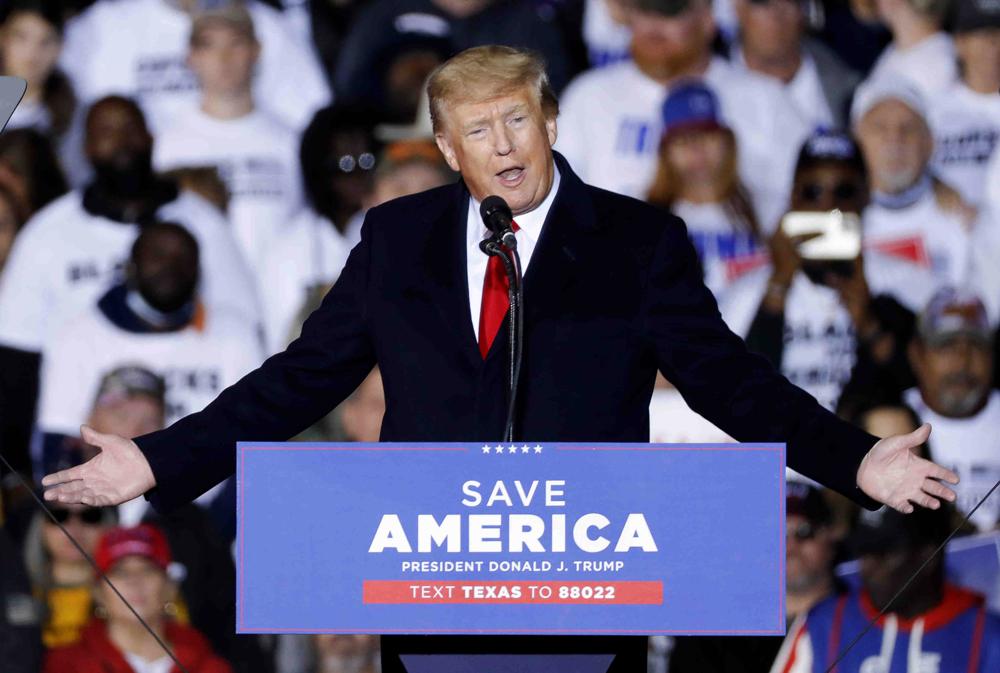
Former President Donald Trump is dangling the prospect of pardons for supporters who participated in the deadly January 6 storming of the U.S. Capitol if he returns to the White House. “If I run and if I win, we will treat those people from January 6th fairly,” Trump said Saturday night during a rally in Conroe, Texas. “And if it requires pardons, we will give them pardons because they are being treated so unfairly.” The offer represents an attempt by Trump to further minimize the most significant attack on the seat of government since the War of 1812. Participants smashed through windows, assaulted police officers, and sent lawmakers and congressional staff fleeing for their lives while trying to halt the peaceful transition of power and the certification of rival Joe Biden’s victory. More than 700 people have been arrested and charged with federal crimes in connection with the riot, marking the largest investigation in the Justice Department’s history. The tally includes more than 150 people charged with assaulting police officers, more than 50 charged with conspiracy, and charges of seditious conspiracy against the founder and leader of the far-right Oath Keepers militia group, and ten other members or associates. More than 100 police officers were injured, some critically, after Trump supporters stormed the Capitol on January 6, 2021, following a “Stop the Steal” rally by Trump near the White House in which he falsely claimed Biden had won the election through massive voter fraud. Two Republican senators on Sunday criticized Trump’s suggestion of pardons as inappropriate. Maine Sen. Susan Collins, one of seven GOP senators who backed an unsuccessful bid to convict Trump on impeachment charges for his role in stoking the January 6 riot, said it would be “very unlikely” she would support him if he ran in 2024. “January 6th was a dark day in our history,” she told ABC’s “This Week.” “We should let the judicial process proceed.” Sen. Lindsey Graham, R-S.C., rejected Trump’s comments as sending a wrong message that it’s OK to defile the Capitol. For the January 6 offenders, “I hope they go to jail and get the book thrown at them because they deserve it,” Graham told CBS’ “Face the Nation.” As president, Trump used his pardon power to pardon or commute the sentences of numerous political allies, friends, and associates, including his former chief strategist, Steve Bannon; his former campaign chair, Paul Manafort; his former national security adviser, Michael Flynn; and a longtime friend and political ally, Roger Stone. Trump has criticized the Democrat-led House for its ongoing investigation of the riot. While his supporters overran the Capitol on January 6, Trump ignored desperate pleas from allies to forcefully disavow the attack and has repeatedly praised those who participated in the protest. “It was a lot of love there,” he said recently of those who attended the rally in an interview on Fox News. “Believe me, there was a lot of love and a lot of friendship and people that love our country.” Trump, who was impeached by the House for his role in inciting the insurrection but acquitted by the Senate, has been teasing a third run for the White House in 2024. Republished with the permission of the Associated Press.
Alabama appeals to Supreme Court in redistricting fight
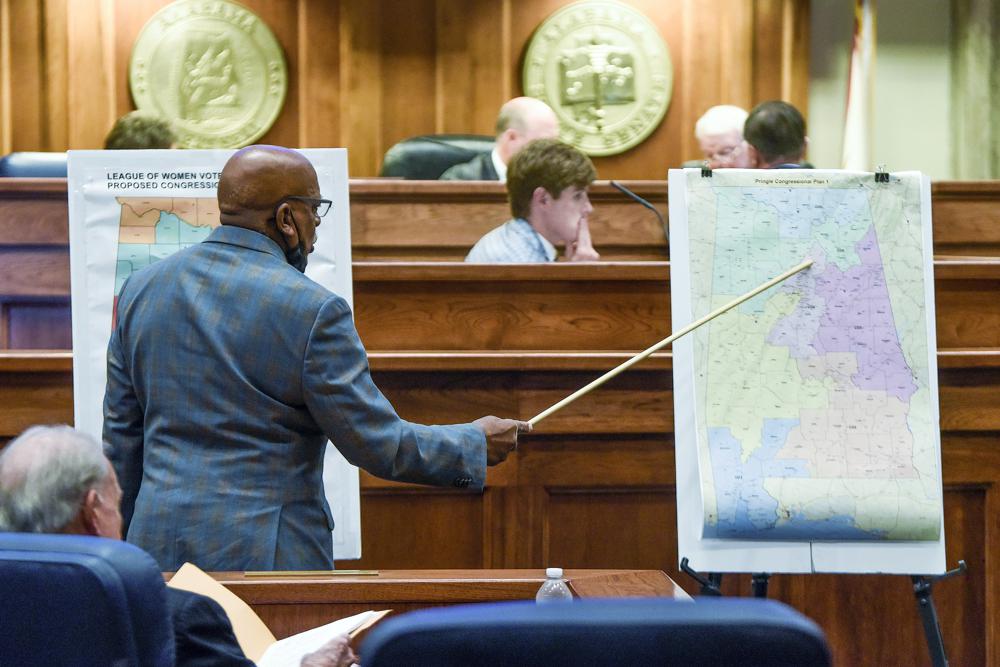
Alabama on Friday asked the U.S. Supreme Court to place a hold on a ruling that will require the state to draw new congressional districts, Lawyers for the state asked the justices to stay a preliminary injunction issued by a three-judge panel on Monday. The injunction blocks the state from using current congressional districts in the upcoming elections. The three judges had ruled Alabama’s current map likely violates the Voting Rights Act and that the state should have an additional district with a significant number of Black voters. In the emergency filing, lawyers for the state argued that the injunction will throw state elections into chaos and require the state to draw districts based primarily on race instead of other factors. “Without this Court’s intervention, Alabama’s only choices are effectively no choices at all: a state-drawn racially gerrymandered map or a court-drawn racially gerrymandered map,” lawyers for the state wrote. “Moreover, this overhaul of Alabama’s congressional map at this late hour would require the last-minute reassignment of hundreds of thousands of voters to new districts and could force candidates and groups seeking ballot access to obtain thousands of new signatures.” Facing a tight timeline, Alabama asked the court to issue an administrative stay followed by a stay or an injunction pending appeal. The state’s qualifying deadline for political candidates was Friday, but the three-judge panel extended the deadline until February 11 for congressional candidates. Alabama is currently represented by one Black Democrat elected from the state’s only majority-Black district and six white Republicans elected from heavily white districts. About 27% of the state’s population is Black. The three-judge panel wrote Monday that, “Black voters have less opportunity than other Alabamians to elect candidates of their choice to Congress” under Alabama’s current map. The judges wrote that any remedial plan “will need to include two districts in which Black voters either comprise a voting-age majority or something quite close to it.” Republished with the permission of the Associated Press.
Paul DeMarco: Significant political implications for court order to redraw Alabama Congressional Districts

This past week a stunning ruling by a three-member panel of the United States 11th Circuit Court of Appeals blocked a redistricting plan drawn up by the Alabama Legislature. The Court ruled that the lawmakers now have until February 11th to draw up a new map that would create two Congressional Districts in Alabama that minority candidates could win in the upcoming 2022 elections. Doing this will be no easy task for legislators without further dividing local communities, possibly pitting incumbents against each other, and trying to get this done in time for this to get approved by the Court with the party primaries in less than just four months. This is not the first time the Courts have forced the legislature to redraw districts, but the current make up of six Republican and one Democratic District has survived twenty years of scrutiny. However, Alabama lawmakers did not help themselves with the lack of transparency in the way they drew the maps this past year. Now Alabama Attorney General Steve Marshall is appealing the ruling to the United States Supreme Court, but there is no guarantee the Court will reinstate the original districts. If the state loses, conservative Alabama may lose a Republican Congressman. And if that happens, look for similar lawsuits in other states with a GOP majority. What we do know for certain is that this ruling could have major political implications not only for the state of Alabama but for the rest of the Nation. Paul DeMarco is a former member of the Alabama House of Representatives.
