
Madeleine Albright, 1st female U.S. secretary of state, dies
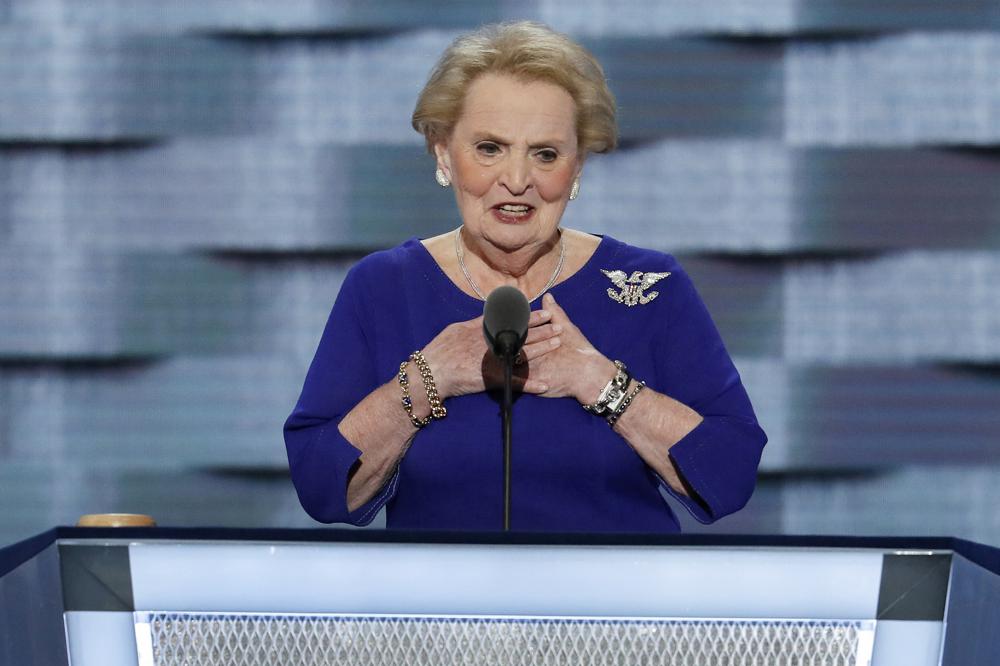
Madeleine Albright, a child refugee from Nazi- and then Soviet-dominated Eastern Europe who rose to become the first female secretary of state and a mentor to many current and former American statesmen and women, died Wednesday of cancer, her family said. She was 84. A lifelong Democrat who nonetheless worked to bring Republicans into her orbit, Albright was chosen in 1996 by President Bill Clinton to be America’s top diplomat, elevating her from U.S. ambassador to the United Nations, where she had been only the second woman to hold that job. As secretary of state, Albright was the highest-ranking woman in the history of the U.S. government. She was not in the line of succession to the presidency, however, because she was born in what was then Czechoslovakia. Still, she was universally admired for breaking a glass ceiling, even by her political detractors. “We have lost a loving mother, grandmother, sister, aunt, and friend,” her family said in a statement. President Joe Biden ordered flags at the White House and other federal buildings and grounds to be flown at half-staff until March 27. Outpourings of condolences came quickly. Biden said, “America had no more committed champion of democracy and human rights than Secretary Albright, who knew personally and wrote powerfully of the perils of autocracy.” “When I think of Madeleine,” Biden added, “I will always remember her fervent faith that ‘America is the indispensable nation.’” Secretary of State Antony Blinken said Albright was “a brilliant diplomat, a visionary leader, a courageous trailblazer, a dedicated mentor, and a great and good person who loved the U.S. deeply and devoted her life to serving it.” Clinton called her “one of the finest Secretaries of State, an outstanding U.N. Ambassador, a brilliant professor, and an extraordinary human being.” “And through it all,” Clinton added, “even until our last conversation just two weeks ago, she never lost her great sense of humor or her determination to go out with her boots on, supporting Ukraine in its fight to preserve freedom and democracy.” Former President George W. Bush said Albright “lived out the American dream and helped others realize it. … She served with distinction as a foreign-born foreign minister who understood firsthand the importance of free societies for peace in our world.” Linda Thomas-Greenfield, U.S. envoy to the United Nations, honored Albright as a “trailblazer and a luminary” in remarks on the General Assembly floor. In 2012, President Barack Obama awarded Albright the Medal of Freedom, the nation’s highest civilian honor, saying her life was an inspiration to all Americans. Albright remained outspoken through the years. After leaving office, she criticized Bush for using “the shock of force” rather than alliances to foster diplomacy and said Bush had driven away moderate Arab leaders and created the potential for a dangerous rift with European allies. As a refugee from Czechoslovakia who saw the horrors of both Nazi Germany and the Iron Curtain, she was not a dove, and she played a leading role in pressing for the Clinton administration to get militarily involved in the conflict in Kosovo. She also took a hard line on Cuba, famously saying at the United Nations that the Cuban shootdown of a civilian plane was not “cojones” but rather “cowardice.” Albright advised women “to act in a more confident manner” and “to ask questions when they occur and don’t wait to ask.” “It took me quite a long time to develop a voice, and now that I have it, I am not going to be silent,” she told HuffPost Living in 2010. When the Senate Foreign Relations Committee asked her in January 2007 whether she approved of Bush’s proposed “surge” in U.S. troops in bloodied Iraq, she responded: “I think we need a surge in diplomacy. We are viewed in the Middle East as a colonial power, and our motives are suspect.” Albright was an internationalist whose point of view was shaped in part by her background. Her family fled Czechoslovakia in 1939 as the Nazis took over their country, and she spent the war years in London. After the war, as the Soviet Union took over vast chunks of Eastern Europe, her father, a Czech diplomat, brought his family to the United States. As secretary of state, Albright played a key role in persuading Clinton to go to war against the Yugoslav leader Slobodan Milosevic over his treatment of Kosovar Albanians in 1999. As U.N. ambassador, she advocated a tough U.S. foreign policy, particularly in the case of Milosevic’s treatment of Bosnia and NATO’s intervention in Kosovo, was eventually dubbed “Madeleine’s War.” “My mindset is Munich,” she said frequently, referring to the German city where the Western allies abandoned her homeland to the Nazis. Albright helped win Senate ratification of NATO’s expansion and a treaty imposing international restrictions on chemical weapons. She led a successful fight to keep Egyptian diplomat Boutros Boutros-Ghali from a second term as secretary-general of the United Nations. He accused her of deception and posing as a friend. And she once exclaimed to Colin Powell, then chairman of the Joint Chiefs of Staff, who would later succeed her as secretary of state: “What’s the point of having this superb military you’re always talking about if we can’t use it?” Powell, who died last year, recalled in a memoir that Albright’s comment almost made him have an “aneurysm.” Despite her championing of diplomacy in the Middle East and a late Clinton-era foray to North Korea, which made her the highest-ranking U.S. official to visit the Stalinist state, Albright drew criticism for her support of sanctions against Iraq that many blame for humanitarian suffering in the country under Saddam Hussein. “I am an eternal optimist,” Albright said in 1998, amid an effort as secretary of state to promote peace in the Middle East. But she said getting Israel to pull back on the West Bank and the Palestinians to rout terrorists posed serious problems. Albright made limited progress at first in trying to expand the
Moderna says its low-dose COVID shots work for kids under 6
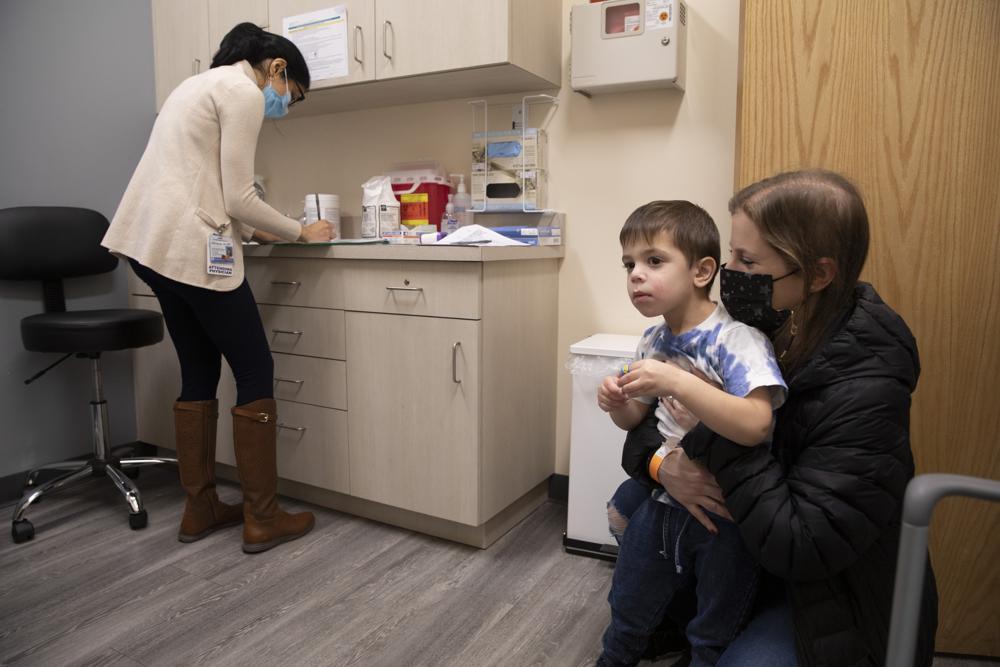
Moderna’s COVID-19 vaccine works in babies, toddlers, and preschoolers, the company announced Wednesday — a development that could pave the way for the littlest kids to be vaccinated by summer if regulators agree. Moderna said that in the coming weeks it would ask regulators in the U.S. and Europe to authorize two small-dose shots for youngsters under 6. The company also is seeking to have larger doses cleared for older children and teens in the U.S. The announcement is positive news for parents who have anxiously awaited protection for younger tots and have been continuously disappointed by setbacks and confusion over which shots might work and when. The nation’s 18 million children under 5 are the only age group not yet eligible for vaccination. Moderna says early study results show tots develop high levels of virus-fighting antibodies from shots containing a quarter of the dose given to adults. Once Moderna submits its full data, the U.S. Food and Drug Administration will have to determine if that important marker means the youngsters are as protected against severe illness as adults. “The vaccine provides the same level of protection against COVID in young kids as it does in adults. We think that’s good news,” Dr. Stephen Hoge, Moderna’s president, told The Associated Press. But that key antibody finding isn’t the whole story. COVID-19 vaccines aren’t as effective against the super-contagious omicron mutant — in people of any age — and Moderna’s study found the same trend. There were no severe illnesses during the trial but the vaccine was only about 44% effective at preventing milder infections in babies up to age 2, and nearly 38% effective in the preschoolers. “Not a home run” but the shots still could be helpful for the youngest children, said Dr. Jesse Goodman of Georgetown University, a former FDA vaccine chief. Goodman said the high antibody levels seen in the study “should translate into higher efficacy against severe infections.” Some parents say even a little protection would be better than leaving their youngest children unvaccinated. “I don’t care if it’s even 15 or 20%,” said Lauren Felitti of Gaithersburg, Maryland. Her 4-year-old son Aiden, who’s at extra risk because of a heart condition, was hospitalized for eight days with COVID-19 and she’s anxious to vaccinate him to lessen the chance of a reinfection. “It was very scary,” Felitti said. “If there’s a chance that I’m able to keep him protected, even if it’s a small chance, then I’m all for it.” Competitor Pfizer currently offers kid-size doses for school-age children and full-strength shots for those 12 and older. And the company is testing even smaller doses for children under 5 but had to add a third shot to its study when two didn’t prove strong enough. Those results are expected by early April. If the FDA eventually authorizes vaccinations for little kids from either company, there still would be another hurdle. The Centers for Disease Control and Prevention recommends who should get them — and Goodman said there may be debate about shots for higher-risk children or everyone under 5. Vaccinating the littlest “has been somewhat of a moving target over the last couple of months,” Dr. Bill Muller of Northwestern University, who is helping study Moderna’s pediatric doses, said in an interview before the company released its findings. “There’s still, I think, a lingering urgency to try to get that done as soon as possible.” While COVID-19 generally isn’t as dangerous to youngsters as to adults, some do become severely ill. The CDC says about 400 children younger than 5 have died from COVID-19 since the pandemic’s start. The omicron variant hit children especially hard, with those under 5 hospitalized at higher rates than at the peak of the previous delta surge. The younger the child, the smaller the dose being tested. Moderna enrolled about 6,900 kids under 6 — including babies as young as 6 months — in a study of the 25-microgram doses. While the study wasn’t large enough to detect very rare side effects, Moderna said the small doses were safe and that mild fevers, like those associated with other common pediatric vaccines, were the main reaction. Hudson Diener, 3, only briefly cried when getting test doses at Stony Brook Medicine in Commack, New York. His parents welcomed the study results and hope to learn that Hudson received the vaccine and not dummy shots. “We are really hoping to get the answer we’re looking for soon so we can take a deep breath,” said Hudson’s mom, Ilana Diener. Wednesday’s news should “hopefully be a step closer for his age group to be eligible for the vaccine very soon.” Boosters have proved crucial for adults to fight omicron and Moderna currently is testing those doses for children as well — either a third shot of the original vaccine or an extra dose that combines protection against the original virus and the omicron variant. Parents may find it confusing that Moderna is seeking to vaccinate the youngest children before it’s cleared to vaccinate teens. While other countries already have allowed Moderna’s shots to be used in children as young as 6, the U.S. has limited its vaccine to adults. The FDA hasn’t ruled on Moderna’s earlier request to expand its shots to 12- to 17-year-olds because of concern about a very rare side effect. Heart inflammation sometimes occurs in teens and young adults, mostly males, after receiving either the Pfizer or Moderna vaccines. Moderna is getting extra scrutiny because its shots are a far higher dose than Pfizer’s. The company said Wednesday that, armed with additional evidence, it is updating its FDA application for teen shots and requesting a green light for 6- to 11-year-olds, too. Hoge said he’s optimistic the company will be able to offer its vaccine “across all age groups in the United States by the summer.” Moderna says its original adult dose — two 100-microgram shots — is safe and effective in 12- to 17-year-olds. For elementary school-age kids, it’s using half the adult
Ketanji Brown Jackson seems headed for confirmation, says no ‘agendas’
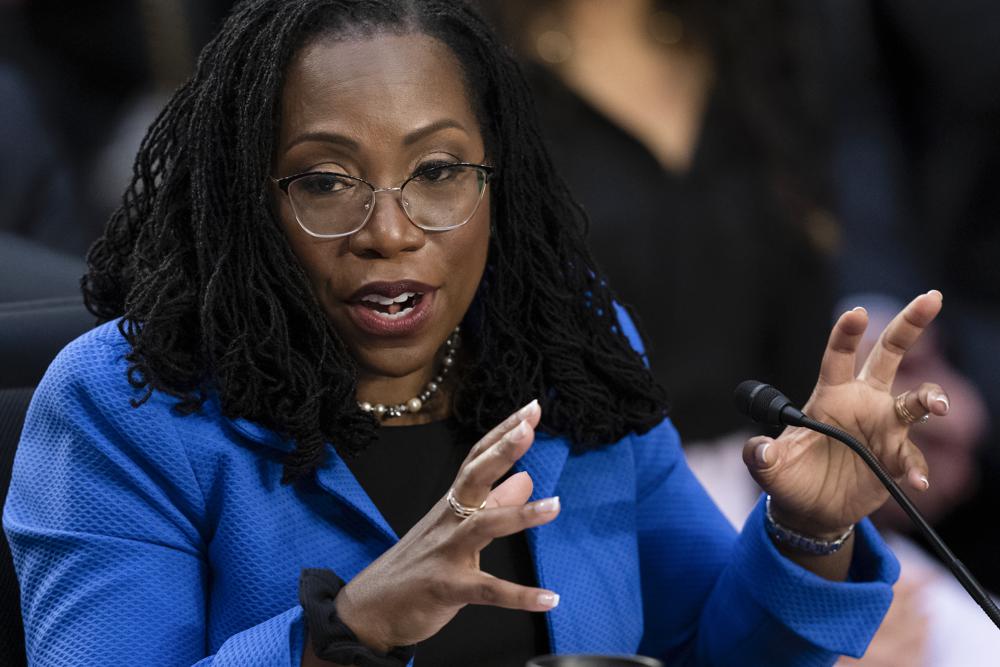
Judge Ketanji Brown Jackson faced a barrage of Republican questioning Wednesday about her sentencing of criminal defendants, as her history-making bid to join the Supreme Court veered from lofty constitutional questions to attacks on her motivations as a judge. She declared she would rule “without any agendas” as the high court’s first Black female justice, rejecting Republican efforts to paint her as soft on crime in her decade on the federal bench. Democrats defended her and heralded the historic nature of her nomination. “America is ready for the Supreme Court glass ceiling to shatter,” Sen. Dick Durbin, the chairman of the Senate Judiciary Committee, said in Jackson’s second and last day answering questions at her confirmation hearings. Though her approval seems all but sure — Democrats are aiming for a vote before Easter — Republicans keep trying to chip away at her record. In more than 12 hours of testimony on Tuesday, and long into the day on Wednesday, GOP senators aggressively questioned her on the sentences she has handed down to child pornography offenders, her legal advocacy on behalf of terror suspects at Guantanamo Bay, her thoughts on critical race theory and even her religious views. In response to questioning about a case over affirmative action at Harvard University, her alma mater where she now serves on the Board of Overseers, Jackson said she would recuse herself. “That’s my plan,” she responded when Texas Sen. Ted Cruz asked her about it. The court will, in the fall, take up challenges to the consideration of race in college admissions in lawsuits filed by Asian American applicants to Harvard, a private institution, and the University of North Carolina, a state school. The court currently plans to hear the suits against the two schools together but could separate them and give Jackson a chance to take part in what will be one of next term’s biggest issues. Tempers rose at Wednesday’s hearing as the day wore on, with Durbin slamming down his gavel at one point when Cruz refused to yield after his time expired while he was grilling Jackson on the specifics of cases. “You can bang it as long as you want,” Cruz snapped, shouting that he just wanted Jackson to answer his question. “At some point, you have to follow the rules,” Durbin shot back. In another round of tense questioning, South Carolina Sen. Lindsey Graham interrogated Jackson on the punishment she believes appropriate for people convicted of child pornography. Like Cruz and others on the committee, Graham said she had been too lenient on those criminals. Graham frequently interrupted her as she tried to speak; at one point, he said judges should simply “put their a— in jail!” The focus on her sentencing was part of a larger effort by the committee’s Republicans — several of whom are potential presidential candidates — to characterize Jackson’s record and her judicial philosophy as too empathetic and soft on criminals who commit the worst offenses. It was also part of an emerging emphasis on crime in GOP midterm election campaigns. North Carolina Sen. Thom Tillis said she seemed like “a very kind person” — but “there’s at least a level of empathy that enters into your treatment of a defendant that some could view as maybe beyond what some of us would be comfortable with, with respect to administering justice.” The sustained focus on her record suggested that, contrary to Democratic hopes, Jackson’s confirmation vote in the full Senate is unlikely to garner much, if any, Republican support. Still, several Republicans acknowledged that she is likely to be on the court. Democrats can confirm her without any bipartisan support in the 50-50 Senate as Vice President Kamala Harris can cast the tie-breaking vote. Jackson, backed by committee Democrats, forcefully defended her record and said that the Republicans were mischaracterizing her decisions. Asked if her rulings were endangering children, she told the committee on Tuesday: “Nothing could be further from the truth.” She said she bases sentences on many factors, not just federal guidelines. Sentencing is not a “numbers game,” she said, noting that there are no mandatory sentences for sex offenders and that there has been significant debate on the subject. Some of the cases have given her nightmares, she said, and were “among the worst that I have seen.” Jackson said that if she is confirmed, she will do what she has done as a federal judge, “which is to rule from a position of neutrality, to look carefully at the facts and the circumstances of every case without any agendas, without any attempt to push the law in one direction or the other.” She reminded the committee that her brother and two uncles served as police officers and that “crime and the effect on the community, and the need for law enforcement — those are not abstract concepts or political slogans to me.” Defending her, Democratic Sen. Chris Coons of Delaware told Jackson that the Republican lines of questioning are “an attempt to distract from your broad support, your deep record, your outstanding intellectual and legal credentials.” President Joe Biden chose Jackson in February, fulfilling a campaign pledge to nominate a Black woman to the Supreme Court for the first time in American history. She would take the seat of Justice Stephen Breyer, who announced in January that he would retire this summer after 28 years on the court. Jackson would be the third Black justice, after Thurgood Marshall and Clarence Thomas, and the sixth woman. Her confirmation would maintain the current 6-3 conservative majority on the court. Democrats have been full of praise for Jackson, noting that she would not only be the first Black woman but also the first public defender on the court and the first with experience representing indigent criminal defendants since Marshall. Jackson said that having a diverse judicial branch is important because it “bolsters public confidence in our system” and “lends confidence that the rulings that the court is handing down are fair and just.” She spoke of her parents often
Deputy fired, another disciplined for no masks on airplane

An Alabama sheriff’s office says a deputy is out of a job and another has been disciplined for refusing to wear face masks on an airplane. Police said they received a call about unruly passengers on a Feb. 26 flight headed to Tampa, Florida, from the Birmingham-Shuttlesworth International Airport, WAAY-TV reported. Four people were drunk and not wearing masks. The flight was forced to deplane before takeoff because the rowdy passengers wouldn’t wear masks, as required by Transportation Security Administration policy. Two of the four identified themselves as off-duty law enforcement officers and were later confirmed to be Morgan County deputies. Birmingham police said one of the deputies started swearing at officers. The group wasn’t arrested, but they weren’t allowed back on the flight. Turk Jones told the station that he wouldn’t give a statement under the advice of his lawyers but said he could be identified as the deputy who was terminated. The other, whose name hasn’t been released, still works for the sheriff’s office but has been disciplined. “Our team, like everyone else, still relies on people, which can make mistakes,” Morgan County Sheriff Ron Puckett said in a statement. “However, we are still responsible for our actions. Our agency apologizes to the Birmingham Police Department, Southwest Airlines, and the passengers on that flight for this off-duty incident.” Republished with the permission of the Associated Press.
