
Progress report on Kay Ivey’s Success Plus plan; Alabama work skills increase
On Thursday, Gov. Kay Ivey shared that Alabama is making progress toward reaching her goal of adding 500,000 people with post-secondary credentials to the state’s workforce by 2025. Also known as Governor Ivey’s Success Plus plan, the report showed that since launching the plan in 2018, Alabama has added 214,922 credentials, according to the Center for Regional Economic Competitiveness (CREC). “Here in Alabama, we are laser-focused on bringing good-paying jobs to the state, and very importantly, we want to ensure we are providing opportunities for Alabamians to be the most equipped for those jobs,” stated Governor Ivey. “I am proud of our progress and predict we are well on our way to surpassing the goal of adding 500,000 additional credentialed individuals to our workforce by 2025.” Governor Ivey, collaborating with AlabamaWorks! and the Alabama Workforce Council, partnered with Credential Engine and the CREC to measure the progress. “I am extremely proud of the work the Alabama Workforce Council has done in advancing Governor Ivey’s Success Plus initiative and helping Alabamians earn post-secondary credentials that will set them up for success,” commented Alabama Workforce Council Chair Tim McCartney. “It is evident we have more work to do to carry this goal to completion, but we are on the right path and have the right leadership with Governor Ivey at the helm.” The progress report shows that since 2018, Alabama has made progress toward the Success Plus goal of adding 500,000 credentialed adults ages 16 to 64 to the workforce by 2025. Of the more than 200,000 added credentialed individuals, 137,848 newly credentialed individuals were in the 16 to 24 age group, and 38,240 were in the 25 to 64 age group. “Alabama’s current and future economic growth depends on a highly skilled workforce. That’s why I am so proud of the progress we are making in increasing our postsecondary education attainment goal,” said Alabama Commerce Secretary Greg Canfield. “We are on track to meet our goal, which will result in more Alabamians in the workforce.” “Success Plus has required focused efforts across multiple state agencies, the private sector and community-based organizations,” stated AIDT Executive Director and Deputy Commerce Secretary Ed Castile. “I am proud of the progress we have made thus far, and I am even more excited about the progress we will make between now and 2025.”
Uvalde video raises more calls for police accountability
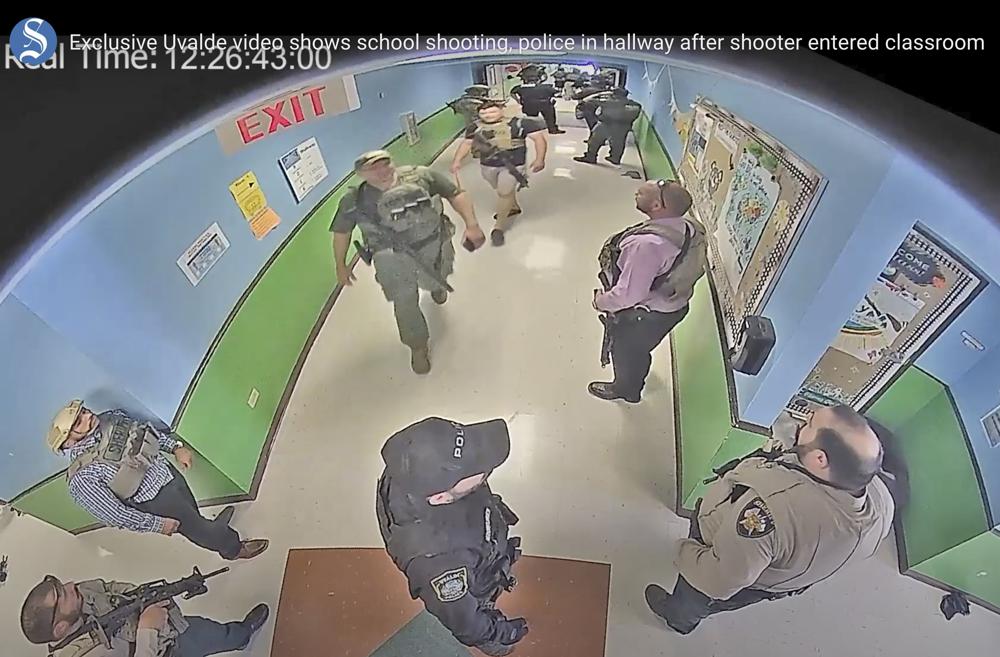
As video taken inside Robb Elementary School puts in full view the bewildering inaction by law enforcement during the May slaughter of 19 children and two teachers, some in Uvalde are shouting: Will police face consequences? Only one officer from the scene of the deadliest school shooting in Texas history is known to be on leave. Authorities have still not released the names of officers who, for more than an hour, milled in and out of a hallway near the adjoining fourth-grade classrooms where the gunman was firing. And nearly two months after the massacre, there’s still disagreement about who was in charge. A nearly 80-minute hallway surveillance video published by the Austin American-Statesman publicly showed for the first time — with disturbing and painful clarity — a hesitant and haphazard tactical response by fully armed officers that the head of Texas’ state police has condemned as a failure, and some Uvalde residents have blasted as cowardly. But it is unclear whether the actions — or inaction — by officers in the school on May 24 will result in more than criticism, even as demands for accountability and anger mount. City and state leaders have urged people to let investigations play out. There are signs impatience is growing: Hours after the video was published, residents shouted from their seats at a City Council meeting Tuesday, demanding to know whether officers who were at the shooting were still on the force or getting paid. Council members did not respond. “What about the cops?” one person yelled. Police are afforded formidable legal protections, set up with the idea that their jobs often require life-and-death judgment calls under great pressure. Even with the officers’ hesitation captured on video, policing experts say it’s difficult to predict how likely they are to face discipline or legal fallout. “It’s going to come down to what would a reasonable police officer have perceived in that moment,” said Bowling Green State University criminologist Philip Stinson. The footage from a hallway camera inside the school shows the gunman entering the building with an AR-15-style rifle and includes 911 tape of a teacher screaming, “Get down! Get in your rooms! Get in your rooms!” Two officers approach the classrooms minutes after the gunman enters, then run back amid the sounds of gunfire. From there, minutes tick by, and more gunshots from the classrooms are heard as additional officers from multiple agencies arrive. More than an hour passes before a team finally advances down the hallway, breaches the classrooms, and ends the massacre. More than a dozen officers — some armed with rifles and bulletproof shields — are visible during some points of the video. During the long wait to confront the gunman, one man in body armor and a vest that says “sheriff” squeezes a few pulls of hand sanitizer from a dispenser mounted on the wall. It is a starkly different scene than the one described by Republican Gov. Greg Abbott the day after the shooting, when he praised a swift response and officers who “showed amazing courage by running toward gunfire.” Abbott later said he was given wrong information but did not identify from whom. That’s just one example of inaccurate and conflicting statements given by authorities in the seven weeks since the shooting. Asked Wednesday if any officers should face discipline for their inaction, Abbott spokeswoman Renae Eze said the governor “believes it would be premature to decide any action” until investigations are complete. After the 2018 shooting at Parkland High School in Florida that killed 17 people, a deputy who knew the gunman was loose but refused to go inside was arrested on criminal charges. Legal experts have called that an extremely rare case of someone essentially being charged for not going into harm’s way and have expressed skepticism about the case, which is set for trial in February. Former U.S. Attorney Joe Brown, who spent two decades as a Republican district attorney in North Texas, said there is “no criminal statute for dereliction of duty” and holding police criminally liable under such circumstances “carries a tremendous social cost.” But he said officers who fail to meet their “moral duty to intervene” could still face ridicule or firing. Uvalde Mayor Don McLaughlin said it was too early to decide whether any officers should be taken off the force. “I don’t know they need to step down,” he said. “But everything needs to be reviewed.” So far, officials have only publicly confirmed one officer on leave: Pete Arredondo, the Uvalde school district police chief who also stepped down from his newly won City Council seat last month. He has disputed state police’s characterization that he was in charge of the scene. A Texas Department of Public Safety spokesman said no troopers who were there have been suspended. Officials with the Uvalde police and sheriff’s office did not answer questions about whether any of their officers have been suspended or placed on leave. Greg Shaffer, a Dallas-based security consultant and retired member of the FBI’s hostage rescue team, said at the very least, the officers in the video should switch to a different line of work. “I think everyone in that hallway should reconsider their career choice,” he said. “If you don’t have the courage and the mindset to run toward gunfire, as a police officer, then you’re in the wrong profession.” Republished with the permission of The Associated Press.
Alabama closes bond deal to build mega-prisons
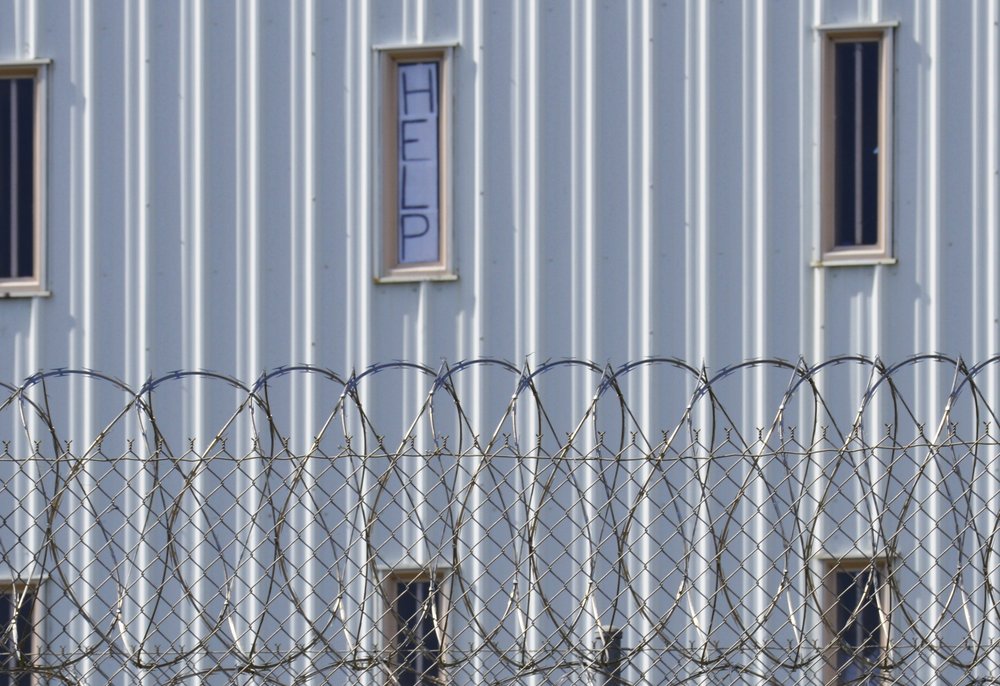
Alabama on Tuesday closed a $509 million bond deal to help build two supersize prisons amid lawsuits by inmates bidding to block the project. The Alabama Finance Department confirmed that the bond sale, which had been approved last month, was finalized. The deal closure comes after criminal justice reform activists had strived for more than a year to disrupt the sale. But legal wrangling over the project is continuing through ongoing litigation. Alabama Gov. Kay Ivey and lawmakers approved the construction as a solution to the state’s ongoing prison woes. Critics of the plan argue that the state is ignoring the bigger issues — prison staffing levels and leadership — to focus on building projects. “The construction of new and modern correctional facilities is absolutely and undeniably necessary to support the safety of both inmates and staff, to improve mental health care, to provide space for vocational and rehabilitative programs, and ultimately to protect public safety,” Alabama officials said in a statement. “No eleventh-hour lawsuits by inmates or activists will halt these efforts, and the state intends to move to dismiss the lawsuits and to vigorously defend against the claims as being without merit,” it continued. The state provided a formal disclosure to underwriters and bondholders regarding the lawsuit, a spokeswoman for the department wrote in an email. Activists had tried to discourage the deal, calling it a cruel investment in mass incarceration. A group of activists and impact investors had urged buyers to stay away from the bond offering. “It’s incredibly disappointing that Alabama just seems hellbent on building prisons,” said Eric Glass, an adviser to Justice Capital, an investment fund that joined the call for a boycott. The bond sale fell $200 million short of expectations, but Glass said it is disappointing that the state had more than $500 million in orders. While financing for the construction was secured, legal wrangling is ongoing over the project. Inmates filed a lawsuit claiming state officials violated the National Environmental Policy Act by failing to analyze the environmental impacts of the new prisons. Another lawsuit challenges Alabama’s use of $400 million in pandemic relief funds from the American Rescue Plan to help pay for the construction. “Building more prisons violates the guiding purpose of ARP: to foster a strong and equitable recovery that will uplift the communities most impacted by the pandemic— namely, low-income communities and communities of color,” the lawsuit states. A separate action filed by an inmate argues the construction cost will drain financial resources and interfere with the prison system’s compliance with a court order to dramatically boost the number of correctional officers working inside state lockups. Alabama prisons remain deadly and dangerous years after federal officials warned the state of unconstitutional conditions, the U.S. Department of Justice said last year, noting that inmate-on-inmate homicides have increased from already high levels. Republished with the permission of The Associated Press.
Alabama adjusts required score on teacher certification test

In an effort to get more teachers in classrooms, Alabama school board officials on Tuesday voted to temporarily lower the minimum passing score on the educator certification test. The temporary measure will implement a sliding scale that will allow higher grades to compensate for a lower score on the Praxis certification test, news outlets reported. It would also set up a waiver system in areas with critical shortages, so lower-scoring graduates could teach temporarily. They must eventually pass the test to earn a permanent certificate. The temporary measure was approved as the state tries to combat a teacher shortage. Alabama lawmakers this spring approved the largest pay raises in a generation in an effort to keep experienced teachers in the classroom. “We have superintendents right now that have jobs posted, and those jobs have no applicants. No applicants at all,” Superintendent Eric Mackey told WSFA. The change will be in place for two years. “For two years, we will look at those students who score between the regular cut score and minus one standard error of measure, so about five points below. If those students score in that range, and they have a higher than normal GPA, then we can go ahead and give them a teaching certificate,” Mackey told the station. In areas experiencing a critical shortage of educators, graduates who scored two standard error measures below the required Praxis score could be hired on a temporary basis and given an opportunity to retake the test. If they don’t eventually score higher, they will not get a teaching certificate. Republished with the permission of The Associated Press.
