
Greg Canfield and Gov. Kay Ivey note challenges, opportunities ahead for state economy
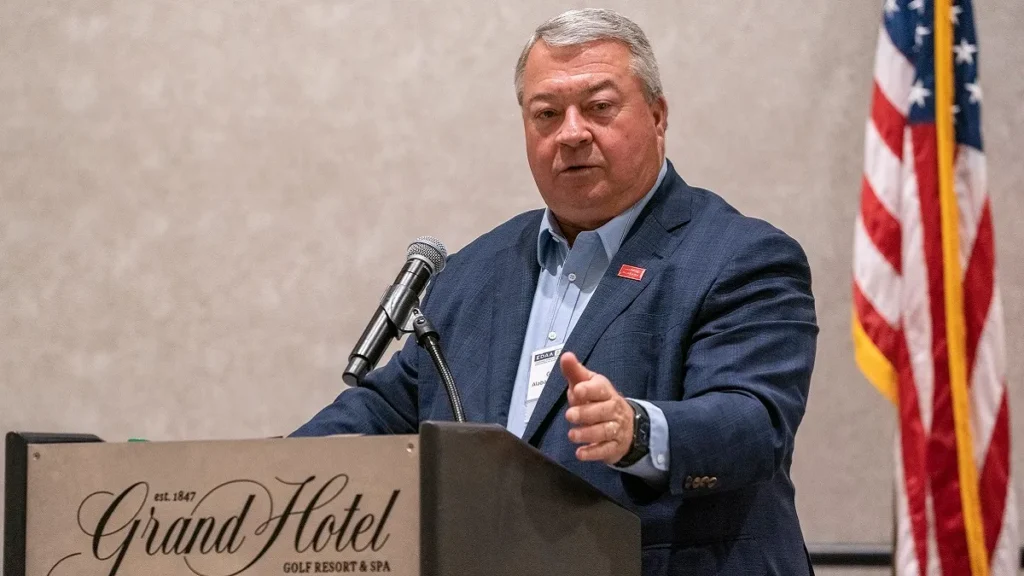
Alabama is not immune to global economic disruptions but is in a strong position to turn challenges into opportunities, according to the state’s commerce secretary. Secretary Greg Canfield said at the Economic Development Association of Alabama’s 2022 Summer Conference this week that the economic disruptions that began with the global pandemic now include worldwide inflation, a tight labor market, and ongoing supply chain issues. “Everyone is talking about disruptions again. It seems like we can’t get out of this pattern of talking about disruptions,” Canfield said. “Yes, we’re coming out of the pandemic, but now we’re facing things like the highest inflation that we’ve seen in 40 years.” While Alabama is feeling the pressures, so is the rest of the world, Canfield said. “We’re concerned that this is a different time,” Canfield said. He referenced the popular Netflix show “Stranger Things” and its Upside Down world where things seem to be opposite. “What is normally good news today is not being perceived as good news by the Federal Reserve,” Canfield said. “What I mean by that is the June reports for joblessness were great. The June reports for the number of jobs being created was great. But the Fed happens to look at that through the lens that maybe that isn’t such great news.” Economists don’t see the economy reacting as it should to high inflation, he said. Sooner or later, that may lead to a recession. Meanwhile, fast-growing inflation is hitting workers with higher prices at the pump and at the grocery store. That’s putting pressure on wages and reducing consumer spending. “We will turn these challenges into opportunities,” Canfield told the state’s economic developers. “Alabama will rise to a more vibrant economy, but we will need your help.” During her keynote address at the conference, Alabama Gov. Kay Ivey promised “the best is yet to come” even as she noted the challenges of high inflation. She declared, “Our country is at a critical point.” Canfield and Ivey both pointed to the $7.7 billion in new investment and more than 10,000 announced jobs connected to Alabama economic development projects announced last year. “Despite all of the challenges we’re facing, Alabama is thriving and will continue to do so,” Ivey said. Canfield’s appearance at the conference was fresh off his participation in the Farnborough International Airshow in London, where he said Alabama was in rarified air because of its aerospace successes. “Aerospace continues to take off in our state,” Canfield said. Space, missile defense, and commercial aviation are areas where Alabama excels, he said. “The whole sector of aerospace that’s really developing new technologies … they see Alabama as a potential home for continuing to expand that base,” Canfield said. Six potential projects were identified from the Farnborough trip that would build on aerospace announcements that most recently included: Airbus adding 1,000 jobs with an aircraft assembly line expansion in Mobile. The nation’s first Remote Tower Air Traffic Control Center at Selma’s Craig Field. A new Lockheed Martin Missile System Integration Lab in Huntsville. Kratos Defense & Security Solutions Inc.’s plans to add 76 jobs at its newly established business unit in Birmingham. Those successes, along with Alabama’s strength in other industries from automotive to advanced manufacturing, have the state in an enviable position, Canfield said. “We have the momentum, and we have disruptions,” Canfield said. “They create challenges, but smart states turn challenges into opportunities.” Ivey echoed Canfield’s optimism. “Make no mistake; we are well-positioned for the future,” she said. “This is our opportunity, so let’s not waste a moment.” Canfield said Alabama’s economic development successes have been aided by incentives programs like the Alabama Jobs Act and the Growing Alabama tax credits. Both programs will expire in June 2023. Canfield said studies show both programs are sustainable and viable, and the Department of Commerce will push to have them reauthorized in the next legislative session. Ivey said the reauthorizations will be on her legislative agenda. Canfield said he couldn’t be sure what the future holds, but he is certain of one thing. “It will be made in Alabama.” Republished with the permission of Alabama NewsCenter.
Swiss company plans $80M upgrade at Alabama pulp mill

The Swiss owner of a pulp mill in Alabama said Wednesday that it is investing $80 million to increase the amount of absorbent pulp it can produce there. The second line at the GP Cellulose Alabama River mill near Monroeville should be able to produce rolls of the absorbent material called fluff pulp in late 2023, a news release said. It said some major aspects are complete. “This investment will enable GP Cellulose to address the increasing fluff pulp needs of our customers worldwide,” said Munir Abdallah, president of GP Cellulose. “The completion of this project will add capability and flexibility to our system to meet a wider range of needs and position us to grow with our customers.” The mill’s first line has been able to produce both bales of paper pulp and rolls of fluff pulp since 2011. Fluff pulp is used in such items as diapers and feminine hygiene, and adult incontinence products. The mill employs about 470 people. GP Cellulose is headquartered in Zug, Switzerland. Republished with the permission of The Associated Press.
Personnel update: Bureau of Pardons and Paroles director Cam Ward announces new leadership roles for Stacey Brown, Darrell Morgan, and Rebecca Bensema

Alabama Bureau of Pardons and Paroles (ABPP) Director Cam Ward announced three new leadership positions. Stacey Brown, Darrell Morgan, and Rebecca Bensema all have prior experience within the bureau, and Ward expressed his enthusiasm for the leadership each one will bring to their new positions. Ward stated on Twitter, “Very excited about this diverse team that will help us move forward with our mission for those on probation and parole. Thank you all for your service.” “I believe these three officers, with their background in law enforcement and pardons and paroles, will do an excellent job in moving forward with our mission to promote public safety and reduce recidivism,” stated Ward in a press release. “They are all extremely qualified career law enforcement officers who will continue to serve our agency well in their new capacities. I look forward to the hard work ahead with these outstanding assistant directors.” Long-time officer Stacey Brown has been named the Assistant Director for Field Operations and will oversee the Bureau’s 62 field offices and more than 275 field officers across 14 districts. Officer Brown will become one of three highly experienced officers in newly developed executive positions for Field Services who report directly to the agency director. “I am humbled and excited for this opportunity to carry out the mission of maintaining a good law enforcement approach to monitoring those in our jurisdiction with a focus on public safety. I appreciate Director Ward for selecting me to serve in this position,” stated Brown. Officer Darrell Morgan is now the Assistant Director of Facilities Management. This position will be an important part of ABPP’s ongoing mission to provide intensive reentry services to the probation and parole population in Alabama. Officer Morgan has been serving in field services leadership roles since 2010 and began his career as an officer with the Bureau in 1998. Morgan said, “Having been engaged in almost every aspect of Bureau function throughout my career, I appreciate the Director providing me the opportunity for contribution to this new frontier.” Rebecca Bensema, who has served the agency for many years as a law enforcement officer and reentry specialist, has been appointed as the Assistant Director for Reentry. Officer Bensema will continue in her duties overseeing the Bureau’s Day Reporting Centers, PREP Center, and all other rehabilitation programs. Officer Bensema began her career as an officer with the Bureau in September 2001. “I am absolutely thrilled for the opportunity to further the reentry and rehabilitation mission of the Bureau. I vow to give my best effort to the agency’s goals of substance abuse treatment, mental health treatment, and job training with public and private partners to reduce recidivism,” said Bensema. “I am thankful for the opportunities that have been provided by the Bureau over the years and am excited to see what the future holds for special populations.”
Joe Manchin, Chuck Schumer report abrupt deal on health, energy, taxes

In a startling turnabout, Senate Majority Leader Chuck Schumer and Sen. Joe Manchin announced Wednesday they had reached an expansive agreement that had eluded them for months on health care, energy and climate issues, taxes on higher earners and corporations, and federal debt reduction. The two Democrats said the Senate would vote on the wide-ranging measure next week, setting up President Joe Biden and Democrats for an unexpected victory in the runup to November congressional elections in which their control of Congress is in peril. A House vote would come afterward, perhaps later in August. Unanimous Republican opposition in both chambers seems certain. Just hours earlier, the expectation was that Schumer, D-N.Y., and Manchin, D-W.Va., were at loggerheads and headed toward far narrower package that Manchin was insisting be limited to curbing pharmaceutical prices and extending federal health care subsidies. Earlier Wednesday, numerous Democratic senators had said they were all but resigned to the more modest legislation. The reversal was stunning, and there was no immediate explanation for Manchin’s abrupt willingness to back a bolder, broader measure. Since last year, the West Virginian had used his pivotal vote in the 50-50 Senate to force Biden and Democrats to abandon far more ambitious and expensive versions of the package. He dragged them through months of negotiations in which leaders’ concessions to shrink the legislation proved fruitless, antagonizing the White House and most congressional Democrats. “This is the action the American people have been waiting for. This addresses the problems of today — high health care costs and overall inflation — as well as investments in our energy security for the future,” Biden said in a statement. He added, “If enacted, this legislation will be historic, and I urge the Senate to move on this bill as soon as possible and for the House to follow as well.” Tellingly, Democrats were calling the measure “The Inflation Reduction Act of 2022” because of its provisions aimed at helping Americans cope with this year’s dramatically rising consumer costs. Polls show that inflation, embodied by gasoline prices that surpassed $5 per gallon before easing, has been voters’ chief concern. For months, Manchin’s opposition to proposed larger packages has been premised in part on his worry that they would fuel inflation. The measure also seemed to offer something for many Democratic constituencies. It dangled tax hikes on the wealthy and big corporations and environmental initiatives for progressives. And Manchin, an advocate for the fossil fuels his state produces, said the bill would invest in technologies for carbon-based and clean energy while also reducing methane and carbon emissions. Manchin said the new measure “would dedicate hundreds of billions of dollars to deficit reduction by adopting a tax policy that protects small businesses and working-class Americans while ensuring that large corporations and the ultra-wealthy pay their fair share in taxes.” The overall proposal is far more modest than the $3.5 trillion package Biden asked Democrats to push through Congress last year, and the pared-down, roughly $2 trillion version that the House approved last November after Manchin insisted on shrinking it. Even then, Manchin shot down that smaller measure in December, asserting it would fuel inflation and was loaded with budget gimmicks. In a summary that provided scant detail, Democrats said Wednesday their proposal would raise $739 billion over the decade in new revenue. That included $313 billion from a 15% corporate minimum tax that a Manchin statement suggested would affect only “billion-dollar companies or larger.” The agreement also contains $288 billion the government would save from curbing pharmaceutical prices, $124 billion from beefing up IRS tax enforcement, and $14 billion from taxing some “carried interest” profits earned by partners in entities like private equity or hedge funds. The measure would spend $369 billion on energy and climate change initiatives and $64 billion to extend federal subsidies for three more years for some people buying private health insurance. Those subsidies, which lower people’s premiums, would otherwise expire at the end of this year. That would leave $306 billion for debt reduction, an effort Manchin has been demanding. While a substantial sum, that’s a small fraction of the trillions in cumulative deficits the government is projected to amass over the coming decade. Sen. Kyrsten Sinema, D-Ariz., who backed Manchin last year in insisting on making the legislation less expensive but objected to proposals to raise tax rates, was still reviewing the agreement, said spokeswoman Hannah Hurley. The spokeswoman referred a reporter to Sinema comments last year supporting a corporate minimum tax. Sen. John Cornyn, R-Texas, said the Democratic agreement would be “devastating to American families and small businesses. Raising taxes on job creators, crushing energy producers with new regulations, and stifling innovators looking for new cures will only make this recession worse, not better.” But if Democrats can hold their troops together, GOP opposition would not stop them. The key is Democratic unity. They can prevail if they lose no more than four votes in the House and remain solidly united in the 50-50 Senate, where Vice President Kamala Harris can cast the tie-breaking vote. “Rather than risking more inflation with trillions in new spending, this bill will cut the inflation taxes Americans are paying, lower the cost of health insurance and prescription drugs, and ensure our country invests in the energy security and climate change solutions we need to remain a global superpower through innovation rather than elimination,” Manchin said. Schumer and Manchin said Democratic leaders’ proposals this fall to revamp permitting procedures would help infrastructure like pipelines and export facilities “be efficiently and responsibly built to deliver energy safely around the country and to our allies.” Collin O’Mara, president and CEO of the National Wildlife Federation, hailed Manchin’s announcement. “This agreement affirms that we can address the climate crisis, lower costs for consumers, lift up frontline and rural communities, and invest in made-in-America jobs and clean energy innovation,” O’Mara said. Sierra Club Legislative Director Melinda Pierce took a more cautious approach. “We are eager to see text
Senate passes bill to boost computer chip production in U.S.
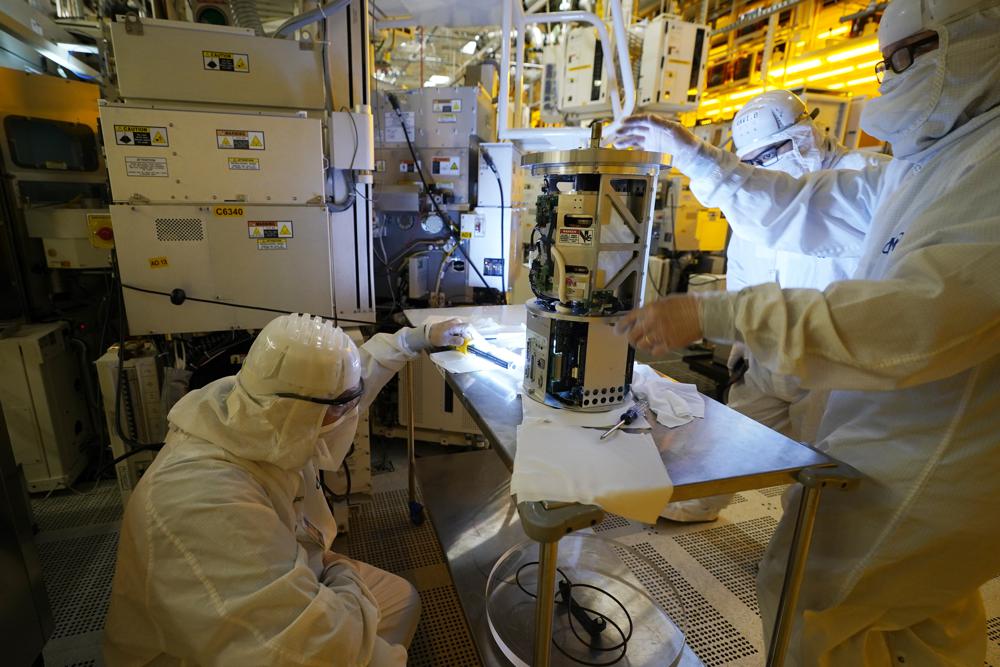
A bill designed to encourage more semiconductor companies to build chip plants in the United States passed the Senate on Wednesday as lawmakers raced to finish work on a key priority of the Biden administration. The $280 billion measure, which awaits a House vote, includes federal grants and tax breaks for companies that construct their chip facilities in the U.S. The legislation also directs Congress to significantly increase spending on high-tech research programs that lawmakers say will help the country stay economically competitive in the decades ahead. Senate passage came by a 64-33 vote. The House vote is expected later this week as lawmakers try to wrap up business before returning to their home states and districts in August. House Speaker Nancy Pelosi, D-Calif., has said she is confident there is enough GOP support to overcome potential defections from Democrats who view the subsidy effort to boost semiconductor companies as a misplaced priority. Seventeen Republicans voted for the measure. Sen. Bernie Sanders, I-Vt., broke ranks with Democrats in voting against the bill. Proponents of the legislation say other countries are spending billions of dollars to lure chipmakers. Backers say the U.S. must do the same or risk losing a secure supply of the semiconductors that power automobiles, computers, appliances, and some of the military’s most advanced weapons systems. Senate Majority Leader Chuck Schumer, D-N.Y., said the bill represented one of the nation’s largest investments in science and manufacturing in decades and that with the Senate’s approval, “we say that America’s best years are yet to come.” Opponents have been critical of the bill’s price tag. It is projected to increase federal deficits by about $79 billion over ten years. President Joe Biden said the bill would create jobs and lower costs on a wide range of products from cars to dishwashers. “For decades, some ‘experts’ said we needed to give up on manufacturing in America. I never believed that. Manufacturing jobs are back,” Biden said. “Thanks to this bill, we are going to have even more of them. The House should promptly pass it and send this bill to my desk.” The bill has been in the works for years, starting with efforts by Schumer and Sen. Todd Young, R-Ind., to increase the government’s investment in high-tech research and development. While the bill has taken several twists and turns, one constant theme that lawmakers repeatedly emphasized during Wednesday’s debate was the need to keep up with China’s massive investments in cutting-edge technology. China’s government is planning on “winning the (artificial intelligence) race, winning future wars and winning the future,” Young said. “And the truth is, if we’re being honest with ourselves, Beijing is well on its way to accomplishing these goals.” Sen. Roger Wicker, R-Miss., said: “Regrettably, we are not in the driver’s seat on a range of important technologies. China is.” Congress, he said, now has “a chance to move us back in the right direction and put America back into a place to win the game.” The bill provides more than $52 billion in grants and other incentives for the semiconductor industry, as well as a 25% tax credit for those companies that invest in chip plants in the U.S. It calls for increased spending on various research programs that would total about $200 billion over ten years, though Congress will have to follow through by approving that money in future spending bills. Despite years of work, the bill’s future did not look so promising about a month ago. That’s when Senate Republican leader Mitch McConnell tweeted that there would be no chips legislation as long as Democrats pursued a party-line package of energy and economic initiatives. GOP support is critical in the Senate to get the 60 votes needed to overcome a filibuster. But when Sen. Joe Manchin of West Virginia quashed the idea of imposing higher taxes on the rich and corporations, key Republicans said that was an opening to go forward on semiconductors. Meanwhile, the Biden administration pushed to get a bill passed before the August recess, even if meant considerably narrowing the focus to just the $52 billion in semiconductor incentives. Commerce Secretary Gina Raimondo told lawmakers behind the scenes and publicly that semiconductor companies were making plans on how to meet the increased demand for chips. She said the growth in the industry would move forward with or without the United States and if lawmakers didn’t act quite soon, those companies would simply choose to build in other countries offering significant financial incentives. Schumer said that after McConnell’s statement, he called the CEOs of chipmakers and companies such as General Motors and Ford and reached out to “unlikely allies” like the U.S. Chamber of Commerce and the Business Roundtable. He urged them to reach out to Republican senators about the importance of the bill. “And they changed things,” Schumer told The Associated Press. “They really, for the first time, industry really helped a good government program.” The House could take up the bill as soon as Thursday. While most Republicans are expected to oppose it, some of the ranking Republicans on committees dealing with national security — Reps. Michael McCaul of Texas, Michael Turner of Ohio, and John Katko of New York — support the measure. So do many of the Republicans on a bipartisan group called the Problem Solvers Caucus, which is made up of moderates from both parties. Republished with the permission of The Associated Press.
Gov. Kay Ivey: Execution set despite wishes of victim’s family

Alabama’s governor said Wednesday that she has decided the state will proceed later this week with a plan to execute a man convicted of killing his former girlfriend decades ago, overriding a plea from the victim’s family to spare the man’s life. Gov. Kay Ivey told reporters she wouldn’t call off the scheduled lethal injection of Joe Nathan James Jr. at a south Alabama prison on Thursday evening. The inmate was convicted and sentenced to die for the 1994 shooting death of 26-year-old Faith Hall in Birmingham. Hall’s daughters, who were just 3 and 6 when their mother was killed, had urged along with Hall’s brother that officials change the sentence to life in prison without parole. But Alabama Attorney General Steve Marshall urged Ivey to let execution plans proceed and ensure “justice is done.” In making public her decision Wednesday morning, Ivey said, “My staff and I have researched all the records and all the facts, and there’s no reason to change the procedure or modify the outcome. The execution will go forward.” Prosecutors said James briefly dated Hall, but that he had become obsessed after she ended their relationship, stalking and harassing her for months before killing her. On Aug. 15, 1994, he forced his way inside an apartment, pulled a gun from his waistband, and shot her three times, they said. In the weeks leading up to the scheduled execution date, Hall’s daughters and brother had said they would rather James serve a life sentence in prison rather than be put to death. “I know it may sound crazy. Like, you really want this man to live? But … I just feel like we can’t play God. We can’t take a life. And it’s not going to bring my mom back,” Terryln Hall had told The Associated Press in a recent telephone interview. State Rep. Juandalynn Givan, who was a friend of Hall’s, sent a letter to the governor relaying the family’s request. “They are simply saying our wish as the family is for him to die in the penal system of the Alabama correctional facility. That’s how we want him to suffer, and we want to see that suffering for the rest of our lives,” Givan said Wednesday. Givan said the case was unusual in that the victim’s family had asked for clemency. Though James “brutally and senselessly killed” the mother of two simply because she rejected him, Givan said the family’s wishes should carry weight. “This is a tough one,” said Givan, who remembered Hall as a kind and devoted mother. “She was just the sweetest person you ever wanted to meet,” Givan said. Meanwhile, James has acted as his own attorney in a bid to halt Thursday’s execution procedure, filing handwritten lawsuits and requests for a stay. He has claimed his lawyers were ineffective and that prison officials did not explain what was at stake when it gave inmates a form in which they could select nitrogen hypoxia as their preferred execution method. Alabama has approved nitrogen hypoxia as an execution means but hasn’t developed a system for its use or scheduled any executions by that method. Republished with the permission of The Associated Press.
