
Alabama lawmakers advance two modest income tax cut bills

Alabama lawmakers advanced on Wednesday a modest income tax cut, one of several tax break proposals as legislators weigh how to use a record budget surplus. The House Ways and Means Education Committee approved the two bills that collectively provide $82 million in income tax cuts by adjusting the lowest and highest tax brackets. The bills now move to the full House of Representatives. One bill would eliminate the current 2% tax that people pay on the first $500 of taxable income for single people and $1,000 for married couples who file their taxes together. The other bill would gradually reduce the 5% state income tax rate — paid on taxable income over $3,000 for single people and $6,000 for taxpayers who are married and file their taxes together — to 4.95% in 2027. “These are modest tax cuts that will not jeopardize the budget, but they are steps,” Committee Chair Danny Garrett, who sponsored the legislation, said. “We’re building this. We’ve done these over the last three or four years. So, when you add up the cumulative effect of those, it’s pretty substantial.” With a record budget surplus, lawmakers are eyeing possible tax cuts this year, including possibly removing the 4% sales tax on food. Alabama is one of the few states that fully tax groceries. Lawmakers have discussed removing the sales tax on food for years but have been hindered by the cost to the state education budget. Removing the tax on groceries would cost the education budget more than $600 million annually. “It will truly make a difference for our families,” Democratic Rep. Curtis Travis, of Tuscaloosa, said. Travis spoke during a press conference about tax cuts proposed by House Democrats, including removing the sales tax on groceries and eliminating the state income tax on overtime pay. Sen. Arthur Orr, who chairs the Senate Finance and Taxation Education budget-writing committee, has proposed to phase out the state sales tax on some foods, such as milk, eggs, vegetables, fruit, whole-grain bread, and baby formula. The bill would remove the state sales tax on food items that are covered by the federal Women, Infants and Children nutrition program for low-income women and young children. Garrett said using the program list would focus the tax break on “healthier type food items” while limiting the financial cost to the state education budget. He estimated that it would cost the state $200 million annually. “This is what the education budget could sustain at this point in time, particularly given the unknown future financially for the country and for the state,” Orr said. Republished with the permission of The Associated Press.
House Committee advances legislation guaranteeing that patients can have visitors
On Wednesday, the Alabama House Healthcare Committee voted to advance legislation that would guarantee that family members may spend time with their sick and dying loved ones in an Alabama hospital or nursing home. Senate Bill 113 (SB113) is sponsored by State Sen. Garlan Gudger. It is being carried in the House by Rep. Debbie Wood. The bill replaces last year’s patient visitation law. “Last year, we passed House Bill 521,” Wood said. “The problem was we still had family members who were not able to get into see their loved ones.” “Sen. Gudger worked hard to come up with another one with teeth in it,” Wood explained. The synopsis states, “Under existing law, a health care facility must follow certain requirements related to visitation for patients, clients, or residents. This bill would repeal existing law related to healthcare facility visitation and would require healthcare facilities to adopt visitation policies and procedures that meet certain standards. This bill would provide that residents, clients, or patients of a health care facility have the right to visit with any individual of their choosing during the facility’s visiting hours.” “This bill would allow a resident, client, or patient to designate an essential caregiver and would require healthcare facilities to allow essential caregivers at least two hours of daily visitation. This bill would require that any safety-related policies or procedures may not be more stringent than those established for the health care facility’s staff. This bill would prohibit a healthcare facility from requiring visitors to submit proof of vaccination or from prohibiting consensual physical contact between a visitor and a resident, client, or patient. This bill would allow a health care facility to suspend in-person visitation of a specific visitor if a visitor violates the facility’s policies and procedures.” Our healthcare facilities are the greatest asset we have,” Wood said. The bill also defines “end of life.” “End of life means something totally different to different people,” Wood explained. “I would think end of life would mean the last few weeks of life, but to a healthcare facility, end of life might mean the last fifty minutes.” Wood explained that the substitute bill carves out an exception for psychiatric care facilities from the visitation requirements if a doctor signs that the patient cannot receive visitors. During the COVID-19 global pandemic, hospitals and nursing homes banned visitors to try to halt the spread of the SARS-CoV-2 virus. Those measures largely failed, as did vaccine requirements once the vaccine was commercially accessible. Thousands of Alabamians died, many of them believing their family had abandoned them because of the strict limits against visiting the sick and seniors in nursing homes. “We also learn when we go through something traumatic,” Wood said. State Rep. Arnold Mooney said, “Thank you both for your work on this.” “We are a state that respects the dignity of life,” Mooney continued. Rep. Pebblin Warren asked, “Was there any conversation or dialogue with the institutions? The Hospital Association and the Nursing Home Association.” “This bill is a joint effort of everyone to make sure that we have policies and procedures that we The bill is named after Harold Sachs – the longtime Chief of Staff of the Alabama Republican Party. Sachs was diagnosed with COVID-19 and pneumonia in late 2020. His condition deteriorated quickly, and after a few weeks, he passed away. Sachs’ family – like many Alabama families- were not allowed to visit Harold in the COVID-19 ward. “They have been instrumental in pushing this issue,” Wood said. Rep. Paul Lee. is the Chairman of the Healthcare Committee Rep. Mooney made a motion to give the bill a favorable report. The favorable report motion passed unanimously. SB113 has already passed the Senate on a 33 to 0 vote. It could be taken up by the full House of Representatives as early as Thursday. Wednesday is the sixth legislative day of the 2023 Alabama Regular Legislative Session. To connect with the author of this story or to comment, email brandonmreporter@gmail.com.
Katie Britt speaks in support of Alabama coal in subcommittee hearing
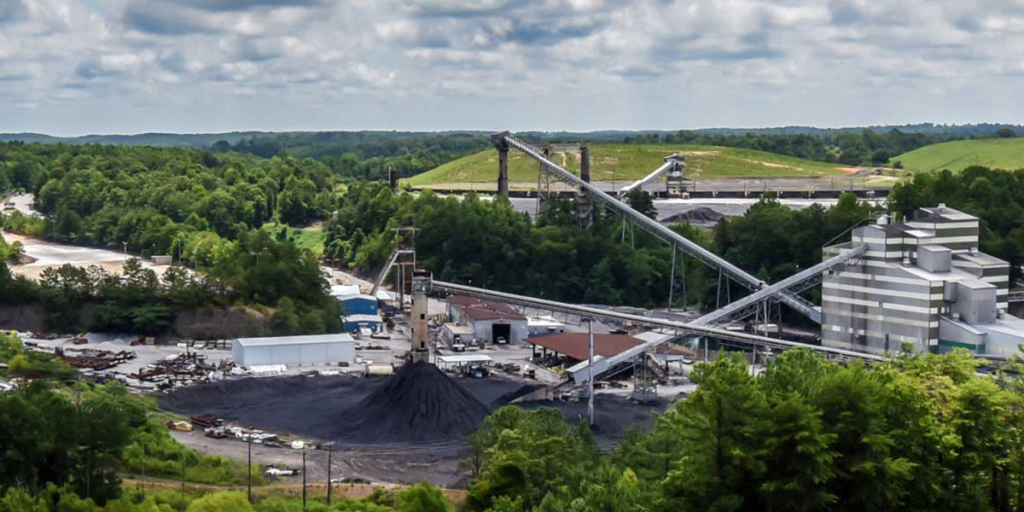
Last week, U.S. Senator Katie Britt questioned Secretary of the Interior Deb Haaland on economic activity across the country. Britt claims the Biden Administration policies strangle economic activity across the country. Alabama’s Warrior Met Coal has applied to develop 24 million tons of metallurgical coal on federal lands adjacent to its current operations in Tuscaloosa County. However, their application has remained untouched by the Biden Administration since May 2022. “Our nation’s public lands are an amazing resource, and we have a responsibility to manage them effectively. Effective stewardship, however, does not mean simply closing them off from all humanity,” Britt said. “Stewardship of our public lands includes finding appropriate economic development to sustain local businesses and our national economy. Warrior Met Coal is one of our U.S. companies trying to work with the federal government to be a good steward of our public lands. Warrior Met Coal is an important economic driver in the State of Alabama. They employ 1,000 people and are the largest customer of our Port of Mobile.” “The company focuses on mining Met Coal,” Britt continued. “And, as you know, Met Coal is a specific type of coal needed to make specialty steel used for roads, bridges, automobiles, renewable energy components, and a wide array of other critical uses. Mining coal underground on federal land results in an 8% royalty payment to the federal government, which is projected to amount to more than $500 million in currently untapped federal proceeds in this case. Some of that total would be returned to the State of Alabama for use. The beneficiaries would also include millions in state severance taxes and more than $100 million in economic benefit to the Port of Mobile.” “The Department currently has a moratorium on the mining of thermal coal, which is used for energy production,” Britt explained. “However, we know that met coal is not the same as thermal coal, and the Department of Justice has stated that met coal is not subject to the reinstatement of the federal coal moratorium.” Warrior Met Coal exports coal to 35 countries. Warrior Met Coal is among the top ten percent highest paying companies in Alabama, with the average worker making over $100,000 annually. The United States has over a century of oil and natural gas reserves, and an estimate of the nation’s coal reserves may exceed even that. Much of those natural resources are on federal lands. The unwillingness to tap those reserves by the Biden administration and the slow pace of approving mine permits means that there are artificial shortages of energy resources. Environmentalists are concerned that utilizing those fossil fuel resources increases pollution and contributes to manmade global warming and sea level rise. Katie Britt was elected to the Senate in 2022 and sworn in in January. To connect with the author of this story or to comment, email brandonmreporter@gmail.com.
Birmingham’s 1963 Palm Sunday civil rights march commemorated with poetry, music
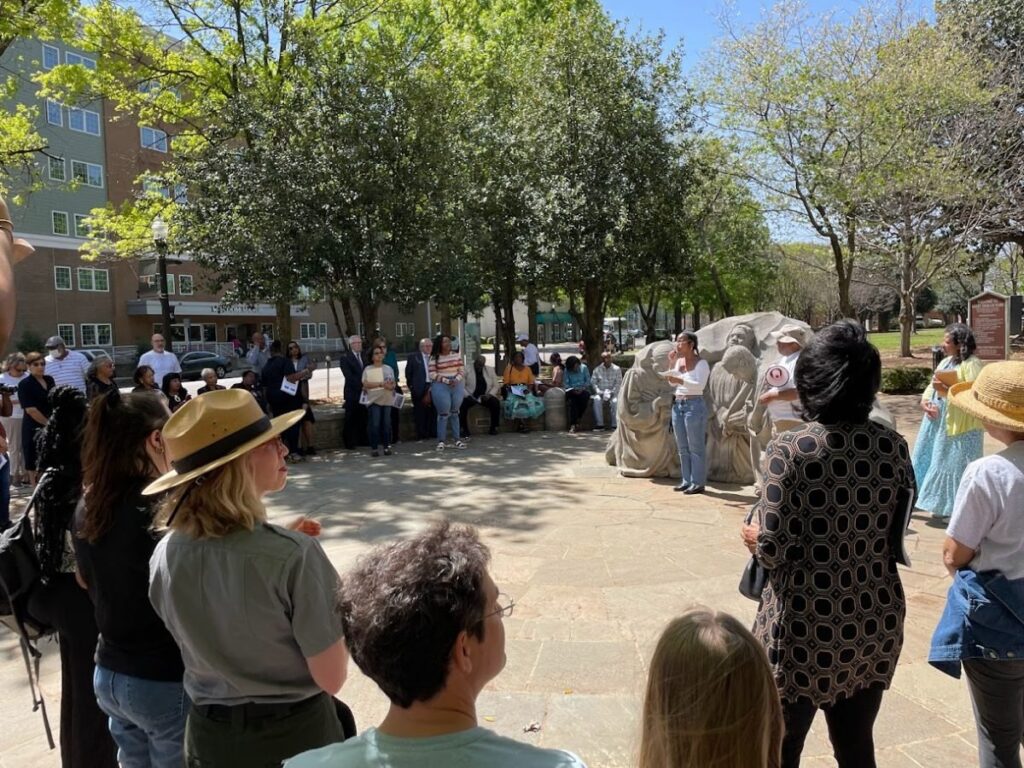
Sixty years ago, on Palm Sunday, three Black pastors led a march from Birmingham’s St. Paul United Methodist Church toward City Hall to protest the Jim Crow segregation laws and support racial equality and human rights. Police arrested 26 people and used police dogs to disperse Black onlookers. On April 1, an interracial group of citizens gathered at St. Paul to recreate the historic march, which was part of the organized campaign in 1963 to dismantle Birmingham’s unjust system of racial separation. Last Saturday’s event included “Poetry in the Park,” starting from the Three Kneeling Ministers sculpture in Kelly Ingram Park, where some of the most violent clashes with police took place during the 1963 campaign. The sculpture commemorates when the local ministers leading the march, John Thomas Porter, Nelson H. Smith Jr., and A.D. King, brother of Martin Luther King Jr., knelt to pray on the sidewalk in front of segregationist Public Safety Commissioner Eugene “Bull” Connor. More than 1,000 people marched that day. The recent event drew about 100 people, as marchers heard from poets at the sculpture and at other locations around the Birmingham Civil Rights National Monument site. Ashley M. Jones, Alabama’s Poet Laureate, joined the events that included a program at St. Paul, as well as music, children’s activities, and food trucks. Supporters of the event included St. Paul United Methodist Church, the Birmingham Civil Rights Institute, the Methodist Foundation of North Alabama, Greater Birmingham Ministries, Magic City Poetry Festival, Scrollworks Music School, and the Alabama Cooperative Extension System. “Protests in April and May 1963, such as the Palm Sunday March, which departed from St. Paul United Methodist Church, elevated civil rights from a Southern issue to a pressing national issue,” said Kathryn Gardiner, park ranger at the Birmingham Civil Rights National Monument. “It was an honor to commemorate the elders and ancestors who took a stand, alongside our many community partners.” Rev. Richard Lane Stryker III, pastor at St. Paul, said the event was a great success, combining a commemoration of important civil rights history with inspirational messages, poetry, and music. “Hopefully, through the poetry and the program, we can inspire a new generation of changemakers,” Stryker said. Learn more about the three kneeling ministers and the sculpture at Kelly Ingram Park here. Republished with the permission of The Alabama NewsCenter.
