
Alabama House passes legislation requiring Alabama Ethics Commission to share exculpatory evidence with the accused
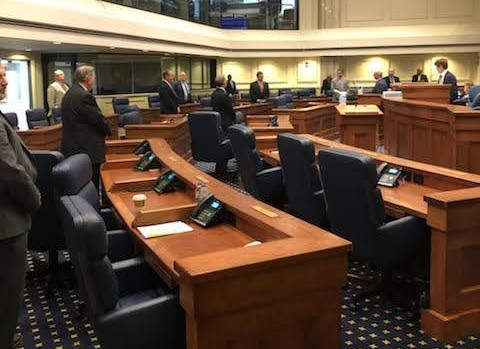
On Wednesday, the Alabama House of Representatives voted to pass Senate legislation requiring that the Alabama Ethics Commission share evidence uncovered that would exonerate persons accused of wrongdoing. Senate Bill 103 is sponsored by State Sen. Arthur Orr (R-Decatur). It is carried in the House by State Representative Cynthia Almond (R-Tuscaloosa). Rep. Almond explained, “What the bill does is require the ethics commission to turn over exculpatory information once the matter has gone through the investigative phase.” Almond asked that the House adopt a substitute version of the bill. The substitute adds the following passage, “If the commission or its employees disclose information to the respondent that the commission or employees believe is exculpatory, neither the commission nor its employees are liable for violating the restrictions relating to secrecy and nondisclosure of information provided in subsections (c) and (d) of Section 36-25-4, Code of Alabama 1975.” The House adopted the Almond substitute 102 to 0. This legislation is in response to an advisory opinion issued last year by the Alabama Ethics Commission stating that the Commission does not have to share any exonerating evidence with the attorneys of persons being investigated by the Commission. Alabama Attorney General Steve Marshall strongly objected to that position. He claimed that that position, which is counter to the rules of evidence in an Alabama courtroom, makes prosecuting any cases referred to the Attorney General’s office by the Commission problematic at best. The Attorney General’s office has sued the Ethics Commission to force the Commission to overturn the policy. Marshall has gone so far as to argue that any referral to prosecute someone from the Ethics Commission is “worthless” when it is highly possible that either in the trial or later when that conviction is appealed, it becomes known that there was exculpatory evidence already known to the Ethics Commission, but that evidence had been intentionally suppressed by the Ethics Commission or its staff. “Thus, the respondent can neither be confident that he fully understands the case against him, nor that the exculpatory evidence has been considered by the Ethics Commission before it votes on whether to refer the matter for prosecution or administrative resolution,” the lawsuit states. “In either case, the respondent’s legal defense is impeded.” According to the synopsis. “This bill would require the State Ethics Commission, before referring a case for prosecution of an alleged ethics or campaign finance violation or before resolving a violation administratively, to provide the person who allegedly violated the law with exculpatory evidence in the possession of the commission.” Passage of SB103 would mean that the Ethics Commission would have to share any evidence that it finds indicating that the accused may have been innocent of whatever crimes they have been charged with the accused and their attorneys before the Commission issues its judgment as well as before it refers any cases to the attorney general’s office or a district attorney for criminal prosecution. The Commission’s counsel has argued in court filings that this would “have a chilling effect” on the work of the Commission. SB103 passed the House of Representatives by a vote of 102 to 0. That afternoon, it returned to the Alabama Senate to consider the House substitute. Sen. Orr asked that the Senate vote to nonconcur with the House version of the legislation. That motion passed the Senate 34 to 0. The legislation now goes to a conference committee for its consideration. If the conference committee of Almond, Orr, and two additional members from each House are able to work out a compromise version of the bill, that conference committee version will still have to be approved by both Houses of the Legislature. Thursday will be day 29 of the regular session. The Alabama Constitution limits the regular session to no more than thirty legislative days. To connect with the author of this story or to comment, email brandonmreporter@gmail.com.
Controversial gambling bill causes issues in closing hours of legislative session

Thursday is the 29th day of the 2023 Alabama Regular Legislative Session, and the Alabama Constitution limits the legislative session to just 30 legislative days. The Senate has an ambitious 27-bill special order calendar to address today, as well as remaining local bills and senate confirmations. All of this was delayed this morning because some Senate Democrats are filibustering confirmations and local bills to keep the Senate from adopting Thursday’s special order calendar. Two issues were responsible for slowing the legislative process, potentially killing dozens of bills before time runs out on the session. State Senator Rodger Smitherman (D-Birmingham) said he is filibustering a controversial provision in the grocery tax cut bill. That provision would prevent a county or municipality that elects to cut its own sales tax on groceries to then come back later and raise the grocery taxes. The legislation, as written, cuts the state sales tax on groceries but does not cut the county, city, or school district sales taxes on groceries. The legislation does, however, bar them from raising the tax on groceries from this point forward. Even if a city council or county commission cuts the tax, they then can’t restore it. Smitherman said that this potentially could “bankrupt my cities.” Sources have told Alabama Today that the second issue is the status of illegal gambling in Greene County. Greene County has legal dog racing and charity bingo, but Greene County dog track, Greenetrack, was not satisfied with that. Because of that, they began offering electronic bingo machines instead of charity bingo. The Alabama Supreme Court has repeatedly ruled that bingo, under Alabama law, is a game played on paper cards. Therefore the gambling machines at Greenetrack are illegal and should be shut down. Greenetrack has also been found guilty of not paying income taxes. Greenetrack argued unsuccessfully that they are a nonprofit corporation and never owed any income taxes. Last week the Alabama Senate passed a controversial constitutional amendment that would allow Greenetrack and potentially other facilities in Greene County to operate historical horse racing machines where players play a machine that shows a previously raced horse race on an electronic video machine. Senate Bill 324 (SB324) is sponsored by State Senate Minority Leader Bobby Singleton (D-Greensboro). “This is a constitutional amendment,” Singleton said when the bill was in committee. “By rule 50, this has to be approved in both the Local Legislation Committee and the Tourism Committee. This has to do with “Racing and Parimutuel for Greene County.” “The Greene County Racing Commission asked me to carry this bill,” Singleton said. This will “add in historical horse racing at one or more tracks in the county.” “This bill has nothing to do with bingo in the county at all,” Singleton told the committee. The Senate Tourism Committee voted to give the bill a favorable report in a 12 to 0 vote, and 24 Senators voted to pass the bill out of the Senate. The House committee did not meet this week to address the legislation. Sources say that gambling proponents want the House Committee to meet in an emergency committee meeting and advance the legislation so that it could be brought to the House floor for a vote before this session ends. To this point, the Legislature has avoided taking up the divisive issue of gambling, which has wasted hours and hours in previous legislative sessions. A source close to the House of Representatives told Alabama Today, “They are not going to advance that legislation.” Sen. Greg Albritton (R-Atmore) said, “It would sure be nice if we could get that same vote on a much bigger type of gambling bill.” As of this morning, Thursday’s special order calendar has been adopted, and legislation is moving. What concessions, if any, have been granted to the minority is unknown at this time. To connect with the author of this story or to comment, email brandonmreporter@gmail.com.
Alabama Legislature passes retail theft bill

The Alabama House of Representatives on Wednesday voted to pass legislation creating the crime of organized retail theft. The new bill will levy heavy criminal penalties on people engaged in organized retail theft. The Senate concurred with the House changes to the bill. Senate Bill 206 (SB206) is sponsored by State Senator Clyde Chambliss (R-Prattville). SB206 is being carried in the House of State by Representative Allen Treadaway (R-Morris). Treadaway explained that cracking down on organized retail theft is necessary to protect the retail industry. “We are trying to keep these stores in the community,” Treadaway said in the House floor debate. “This is a $100 billion problem in America.” Rep. Mary Moore (D-Birmingham) was concerned that people might accidentally be charged with this crime. “When the store is having a sale and goes through and marks through the price with a pen, a shopper could be accused of having marked through the price themselves,” Moore argued. “You have to show intent,” Treadaway said. “That applies right now.” “This bill is trying to put the whole neighborhood in jail,” Moore said. “In my community, if we just walk through the store, people think we are trying to steal something.” “I don’t want us passing bills that may cause harm to innocent people accused of stealing something,” Moore said. Treadaway is a retired deputy chief of police for the City of Birmingham. “Mainly, what we are seeing is the organized crime that has infiltrated this kind of activity,” Treadaway said. Treadaway said this legislation “allows the law to reach out and hold the folks accountable when they are working together in this kind of activity.” Rep. Juandalynn Givan (D-Birmingham) said, “In the urban area, we are losing a lot of businesses. We are seeing where those storefronts are now abandoned.” “How do we identify the theft? How are we identifying the thief?” Givan asked. Treadaway explained, “The organized retail theft you are getting into now involves people working together.” Treadaway explained that organized crime then sells the stolen merchandise online or in a brick and mortar businesses that they operate. “It is happening everywhere,” Treadaway said. “We have seen a tenfold increase.” Rep. Prince Chestnut (D-Selma)asked, “Is legislation alone going to make the difference?” Treadway answered, “No, but it is a part of it.” Chestnut offered an amendment to the bill. “This is a (Judiciary) committee amendment,” Chestnut said. The House voted to adopt the first amendment in a 102 to 0 vote. Rep. Jeremy Gray (D-Opelika) brought a second amendment that was adopted by the House. This legislation is supported by the Alabama Retail Association. The Retail Theft Crime Prevention Act provides for the crime of retail theft in various degrees, provides for the crime of organized retail theft, and provides criminal penalties for a violation. Retail theft in the first degree would be a Class B felony. Retail theft in the second degree is a Class C felony. Retail theft in the third degree is a Class A misdemeanor. A fourth or subsequent conviction for an offense under this article is a Class C felony. Organized retail theft is a Class B felony. The House of Representatives voted 76 to 27 to pass the legislation. It had already passed the Senate. Late on Wednesday afternoon, the Alabama Senate voted 34 to 0 to concur with the House changes to the legislation. SB206 now goes to the governor for her consideration. Thursday will be day 29 of the 2023 Alabama Regular Legislative Session. To connect with the author of this story or to comment, email brandonmreporter@gmail.com.
Reps. Terri Sewell and Robert Aderholt vote in favor of the bipartisan debt ceiling bill
Congressman Robert Aderholt (R-AL04) and Congresswoman Terri Sewell (D-AL07) released statements after voting in favor of the bipartisan Fiscal Responsibility Act. “With the circumstances that we find ourselves in with a divided government, I think this agreement not only reflects the reality of the situation, it is a step in the right direction,” said Congressman Aderholt. ”If Republicans were in control of the Senate and the White House, then I would certainly expect more – more cuts to domestic spending, more funding for our national defense, more restraint on the debt ceiling in the future. However, under this bill, we will, for the first time in our nation’s history, spend less money than we did the previous year. It will lead us to smaller government and more prosperity. We all know that this agreement is not perfect, but let’s be clear: Republicans will not stop here in our ongoing fight for fiscal accountability.” Sewell said that H.R. 3746, the bipartisan budget agreement, was necessary to prevent a devastating default. Sewell said that the bill also rejected Republicans’ extreme demands to make deep cuts to programs that Alabama families rely on. The agreement, negotiated by President Joe Biden, protects against cuts to Social Security, Medicare, Medicaid, veterans’ health care, historic infrastructure, and climate investments. It also prevents Republicans from manufacturing a similar crisis in the next two years by suspending the debt limit until January 1, 2025. “House Republicans could have passed a clean bill to address the debt ceiling months ago, but instead chose to hold the American people hostage and bring our economy to the brink of crisis in order to advance their extreme agenda,” said Rep. Sewell. “To be clear, this bill is far from perfect, but it prevents a default. It prevents future efforts to hold this nation hostage for the rest of the 118th Congress, and it prevents cruel Republican cuts. This budget agreement that President Biden negotiated protects funding for education, health care, veterans’ benefits, Medicare, Medicaid, and Social Security. Most importantly, it prevents Republicans from forcing a devastating default that would kill countless jobs in my district and destroy our economy.” “I join in expressing my frustration with the crisis that my Republican colleagues have manufactured,” Sewell said. “The American people deserve better than a Republican Majority that chooses to govern crisis-by-crisis.” Sewell shared a section-by-section summary of the Bipartisan Budget Agreement is available here. The legislation was negotiated between the Republican leadership led by Speaker of the House Kevin McCarthy with President Biden and the Congressional Democrats. The deal will raise the debt ceiling by $4 trillion. The legislation passed on a bipartisan 314 to 117 vote. The legislation now goes to the Senate for its consideration. The legislation is expected to receive swift passage as the default deadline looms. The issue divided the Alabama Congressional delegation. Terri Sewel (D-AL07), Robert Aderholt (R-AL04), Jerry Carl (R-AL01), and Mike Rogers (R-AL03) all voted in favor of the debt ceiling agreement. Barry Moore (R-AL01), Dale Strong (R-AL05), and Gary Palmer (R-AL06) voted against the deal. To connect with the author of this story or to comment, email brandonmreporter@gmail.com.
Barry Moore votes against debt ceiling deal
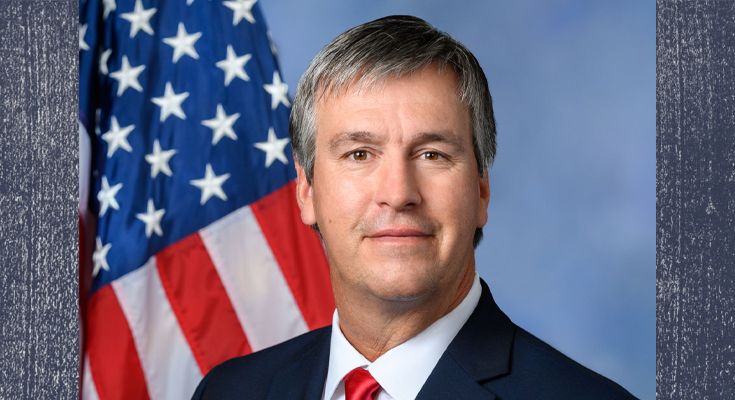
On Wednesday, Congressman Barry Moore voted against the Fiscal Responsibility Act. The legislation was negotiated between Republican leadership led by Speaker of the House Kevin McCarthy, President Joe Biden, and the Congressional Democrats. The deal will raise the debt ceiling by $4 trillion. This is double the amount that was in the Republican plan that passed out of the House of Representatives, the Limit, Save, Grow Act. “The so-called ‘Fiscal Responsibility Act’ promises to saddle Americans with $4 trillion in new debt and kick the can down the road for two more years,” said Moore. “This is a massive disappointment and a far cry from what Republicans passed in the Limit, Save, Grow Act. We must stand up to the Biden Administration and make stronger reforms if we want to protect our children and grandchildren from generations of burdensome debt.” The Fiscal Responsibility Act of 2023 avoids a financially crippling default on the national debt, but it does so by adding $4 trillion to the national debt. Moore expressed his concerns that the deal offers, at best, a 2-year spending freeze and provides only minor reforms to Federally-funded social welfare programs. Moore also cited that the deal includes only minor permitting reform that fast tracks IRA-subsidized unreliable energy and batteries. Moore also expressed concern that the deal includes an administrative pay-go that can be waived and provides no Congressional oversight role. It upholds Biden’s student loan bailout, provides no funding for border security, keeps 98% of IRS expansion spending, and only reclaims $28 billion in COVID funds. Moore was one of just 71 Republicans who voted against the legislation. 46 Democrats also voted in opposition to the bipartisan bill. The House on Wednesday night passed a bipartisan bill to suspend the debt ceiling, overcoming vocal opposition from conservative and liberal lawmakers and bringing the country one step closer to avoiding an economy-rattling default ahead of next week’s deadline. The legislation passed on a bipartisan 314 to 117 vote. The legislation now goes to the Senate for its consideration. The legislation is expected to receive swift passage as the default deadline looms. U.S. Treasury Secretary Janet Yellen warned that the U.S. could run out of cash to pay its bills by June 5, risking the nation’s first-ever default. “Passing the Fiscal Responsibility Act is a crucial first step for putting America back on track,” McCarthy said on the House floor Wednesday. “It does what is responsible for our children, what is possible in divided government, and what is required by our principles and promises.” The bipartisan deal suspends the debt limit through Jan. 1, 2025, so the next debt ceiling increase will be after the 2024 election, but likely before the next presidential inauguration. Barry Moore is serving his second term representing Alabama’s Second Congressional District. To connect with the author of this story or to comment, email brandonmreporter@gmail.com.
Alabama Legislature passes anti ESG legislation

On Thursday, the Alabama Senate passed legislation that would require companies that want state of Alabama contracts to forgo any sort of ESG (environmental, social, and governance) woke corporations or ESGs. Senate Bill 261 (SB261) is sponsored by State Senator Dan Roberts (R-Mountain Brook). It is carried in the House by Rep. Chip Brown (R-Hollinger’s Island). The anti-ESG legislation would prohibit state and local governments from entering into certain contracts that boycott businesses in certain sectors or based on certain environmental or corporate governance criteria. SB261 has been billed as the strongest anti-ESG legislation in the nation. Though the legislature is split along partisan lines on this legislation, both sides elected not to debate the issue in the House of Representatives. Instead, they advanced the bill directly to a vote when it came up on Wednesday’s special-order calendar. The bill prohibits governmental entities from entering into certain contracts with companies that boycott businesses because the business engages in certain sectors or does not meet certain environmental or corporate governance standards, or does not facilitate certain activities. The legislation authorizes the Attorney General to take action to investigate and enforce this act. “I appreciate the support of my colleagues in the Senate for working to pass this legislation,” Sen. Roberts told reporters. “The Alabama Senate has made it clear that we want businesses to focus on growing and expanding and not working to push any political agenda with left-wing ESG policies.” If a company engages in social activism banned by the legislation, then it can’t do business with any local or state government. According to the bill, “This bill would prohibit a governmental entity from entering into a public contract for goods or services with certain companies or businesses that engage in the economic boycott of businesses in certain sectors and industries; that fail to meet or commit to meet certain environmental standards; that fail to meet or commit to meet certain corporate governance criteria; or that fail to facilitate certain activities.” Companies would have to sign a verification that it does not engage in boycotts of other companies and industries. Governments can opt out of this provision if they can prove that it would have an adverse economic effect on that government if they can’t do business with that company. The bill states, “The Attorney General shall seek to prohibit the adoption of federal laws, rules, regulations, bulletins, executive orders, or other federal actions that may penalize, inflict economic harm on, limit commercial relations with, or change or limit the activities of a company in the state or a resident of the state based on the furtherance of economic boycott criteria or other similarly oriented rating.” It also protects companies from state or local governments trying to pressure them company into adopting woke political action. “No company in this state shall be penalized, have economic harm inflicted on it, have commercial relations limited, or have the activities of the company changed or limited by a governmental entity because the company will not engage in economic boycotts; will not establish or implement policies, procedures, guidelines, rules, reports, products, services, notices, disclosures, or rates or pricing; will not provide or submit answers to surveys or other information requests or disclosures; will not invest in or divest of certain securities, stocks, bonds, bills, partnerships, or other investment arrangements; or will not initiate other corporate or business practices that further social, political, or ideological interests including, but not limited to, economic boycott criteria or other similarly oriented rating.” “We have industry in or state that can be hurt by things going on nationally,” Roberts explained on the Senate floor. “We are trying to put them in position so they can thrive. We are trying to make sure that they have access to the mother’s milk of capital in the future.” Sen. Bobby Singleton (D-Greensboro) brought an amendment to the committee substitute of the bill. “It was given to me by the governor’s office,” Singleton said. “The finance department, they just wanted to make sure that they are protected in dealing with the state’s debt obligations.” Roberts accepted the Singleton amendment as friendly. “I think this is an anti-business bill,” Singleton said. “You are telling people that do business in the state of Alabama that you can’t have a social conscience.” “This is not a pro-business bill,” Singleton said. “Dan, you are wrong on this one. I will tell you, Dan, that you are wrong on this one.” “You can’t listen to Fox and decide what you are going to do,” Singleton continued. “We can’t be Florida 20. We won’t be able to recruit with this on the ground. This is a threat to business. If I don’t sign this paragraph, I can’t do business in Alabama.” Senate President Pro Tempore Greg Reed (R-Jasper) said, “This is a difficult topic. This is one that is at a national level that we have to deal with.” Sen. Sam Givhan (R-Huntsville) said, “We did have great dialogue. We had businesses across the gamut in the state of Alabama. We sat down in a room with them, and they presented us with their redlines.” Sen Robert Stewart (D-Selma) said, “Corporations do have an obligation to be good actors.” Givhan responded, “Their job is to maximize shareholder wealth.” Givhan explained the Singleton amendment, which exempts the State Finance Department from following this when refinancing debt obligations. “Debt obligations – that is targeted at the bond market,” Givhan said. “There is not a lot of businesses in that space. We wanted to make sure that we weren’t shooting ourselves in the head. Some think we may have opened the barn door too much.” SB261 passed the Alabama House of Representatives 74 to 27. It had previously passed the Senate by a vote of 27 to 8. The legislation now goes to the Governor for her consideration. Wednesday was day 28 of the 2023 Alabama Regular Legislative Session. To connect with the author of this story or to comment, email brandonmreporter@gmail.com.
Katie Britt, Eric Schmitt, and colleagues introduce legislation to reduce federal regulations
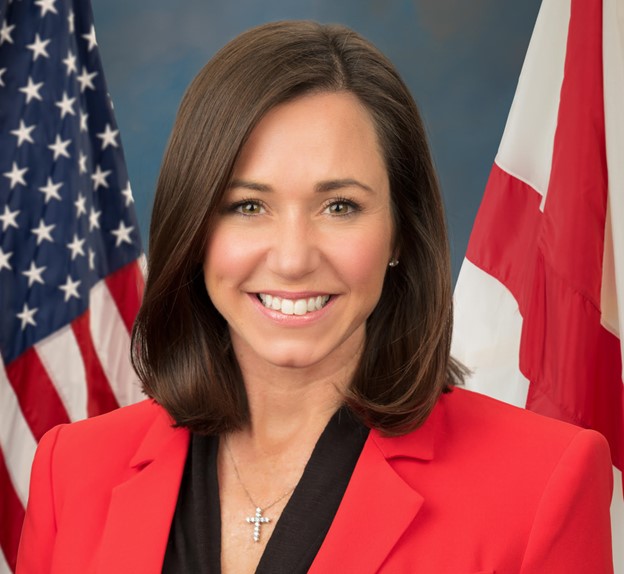
On Wednesday, U.S. Senator Katie Britt joined U.S. Senator Eric Schmitt (R-Missouri) in introducing the Expediting Reform and Stopping Excess Regulations Act, or ERASER Act, which sponsors hope will rein in the administrative state. Britt said the legislation is necessary to protect Alabamians and Americans from overbearing federal regulations. “Time and time again, when I meet with Alabamians, one of their top concerns is the sheer number of burdensome regulations that the Biden Administration continues to churn out without congressional approval, all for the sake of increasing governmental control and power,” Britt said. “These needless restrictions are hamstringing hardworking Americans and making their lives harder, not easier, at a time when the nation is facing persistently high inflation and economic uncertainty. It’s clear that Alabamians and Americans know best how to manage our own households, businesses, and properties, and slashing regulatory red tape will ensure that bureaucratic overreach is kept in check so families can thrive and achieve their American Dream.” “The administrative state is comprised of thousands of unelected bureaucrats at alphabet agencies that have immense power over the lives of Missourians and Americans,” explained Sen. Schmitt. “To reduce the burden on Missourians and Americans and to claw that power away from unelected bureaucrats, I introduced the ERASER Act to ensure that burdensome and outdated regulations are repealed before any new regulations are put forward,” stated Senator Eric Schmitt. “This is an important step in reducing the regulatory burden on Missourians and Americans and affecting much-needed structural reform. I will continue to fight to get government off of the backs of Missourians and Americans and ensure that power is returned to where it belongs: the people.” The ERASER Act provides the framework to ensure government bureaucrats think more critically about new rules and regulations. The bill would require administrative agencies that issue a new regulation to repeal three existing regulations before the new regulation takes effect. The sponsors say that this bill will build upon the Trump Administration executive order issued in 2017 (E.O. 13771) that required agencies to remove two regulations when issuing a new one. Through 2019, those efforts saved small businesses $733 million in regulation costs during the Trump administration. One of President Biden’s first actions was to repeal this policy. The ERASER Act prohibits agencies from issuing a major rule unless the agency has repealed three (3) or more rules, and the cost of the new major rule is less than or equal to the cost of the rules repealed, as certified by the Office of Information and Regulatory Affairs. Major rules are defined under this legislation as any rules that (a) cost $100 million or more, (b) cause a major increase in costs or prices for consumers or individual industries, or (c) have a significant adverse effect on competition, employment, investment, or innovation of U.S. businesses. The ERASER Act provides minimal exceptions for internal governance of an agency and for rules that would make the requirements less burdensome. It also requires the GAO to conduct a study on all rules currently in effect as of the date of the bill’s enactment. Senators Britt and Schmitt were joined in cosponsoring the ERASER Act are Senators Josh Hawley (R-Missouri), Sen. Mike Braun (R-Indiana), and Sen. Rick Scott (R-Florida). The ERASER Act has been endorsed by Heritage Action, Competitive Enterprise Institute, and the Foundation for Government Accountability. With the Democratic Party in control of the Senate, it will take broad bipartisan support for the ERASER Act to even make it to the floor of the Senate. It is doubtful that that legislation will pass the Senate. To connect with the author of this story or to comment, email brandonmreporter@gmail.com.
Committee cuts proposal to exempt overtime pay from income tax
A legislative committee on Wednesday gutted a proposal to exempt Alabama workers’ overtime pay from state income taxes after concerns arose about the potential loss to the education budget. The state House of Representatives had unanimously approved the legislation that would exempt all overtime from the calculation of gross income for state income tax purposes. The Senate Finance and Taxation Education Committee amended the bill so only the first $2,000 of overtime pay would be exempted. The state income tax is 5%. Finance and Taxation Chairman Arthur Orr expressed concern about the budget impact since lawmakers are also eyeing other tax cuts. The original bill would have cost the state a projected $45 million annually, but that would drop to $21 million with the change, according to estimates from the Legislative Services Agency. “I want to move slowly,” Orr said. “We’ve made a lot of decisions when it comes to tax cuts and tax credits.” House Minority Leader Anthony Daniels, the sponsor of the legislation, said he did not support the change. Daniels had argued that exempting overtime pay would allow working people to keep more of their pay. He said it would also help businesses entice workers to overtime shifts. The exemption would end in three years unless extended by lawmakers. Republished with the permission of The Associated Press.
Alabama lawmakers poised to cut sales tax on food in half

Alabama lawmakers are poised to remove half of the state’s sales tax on food, a move that some legislators and advocacy groups had sought for decades, but that gained bipartisan traction this year in the face of soaring food prices. The Senate Finance and Taxation Education Committee on Wednesday advanced House-passed legislation that would remove half of the state’s 4% sales tax on food. Lawmakers are aiming to give final approval to the bill on Thursday, one of the final two meeting days of the legislative session. Alabama is one of only three states that tax groceries at the same rate as other purchases. Republican Sen. Sam Jones, the sponsor of the Senate version of the bill, said the measure had gained support this year as the state sees a record budget surplus — partly driven by rising prices causing higher sales-tax collections — and consumer frustration over the cost of food. “Legislators are hearing from their constituents. Folks are feeling the pinch. They see what it’s taking for folks to put food on the table for their families. And that’s why you’ve got more momentum than ever, I believe,” Jones said. Some lawmakers have pushed for decades to remove the tax— which they said hurts low and moderate-income families — but the efforts failed because of the projected loss to education funding and a lack of political appetite for raising other taxes to offset the revenue loss. The advancing legislation calls for a gradual removal of half the tax. The House-passed bill would reduce the 4% tax on food to 3% on Sept. 1 and 2% on Sept. 1, 2025, provided that tax collections to the Education Trust Fund are projected to rise enough to offset the difference. The 4% tax provides more than $600 million annually to the state for education funding. Cutting it in half would cost the education budget an estimated $318 million annually. Jones said lawmakers are creating a study commission to explore the possibility of eventually removing all of the tax. He said that as people save money on grocery taxes, some will spend that money on other purchases and generate other sales tax revenue. The bill allows local governments to also remove the sales tax on food. Jones said counties are seeking the addition of language that would mirror the budget safeguards put in place for the state by linking the removal of the tax to budget growth. “I think everybody recognizes the political pressure to remove the sales tax on food. In many counties, the substantial portion of the sales tax revenue goes to local schools,” said Sonny Brasfield, executive director of the Association of County Commissions of Alabama. Republished with the permission of The Associated Press.
