
Sen. Tommy Tuberville to participate in press conference on student loans and skyrocketing tuition costs
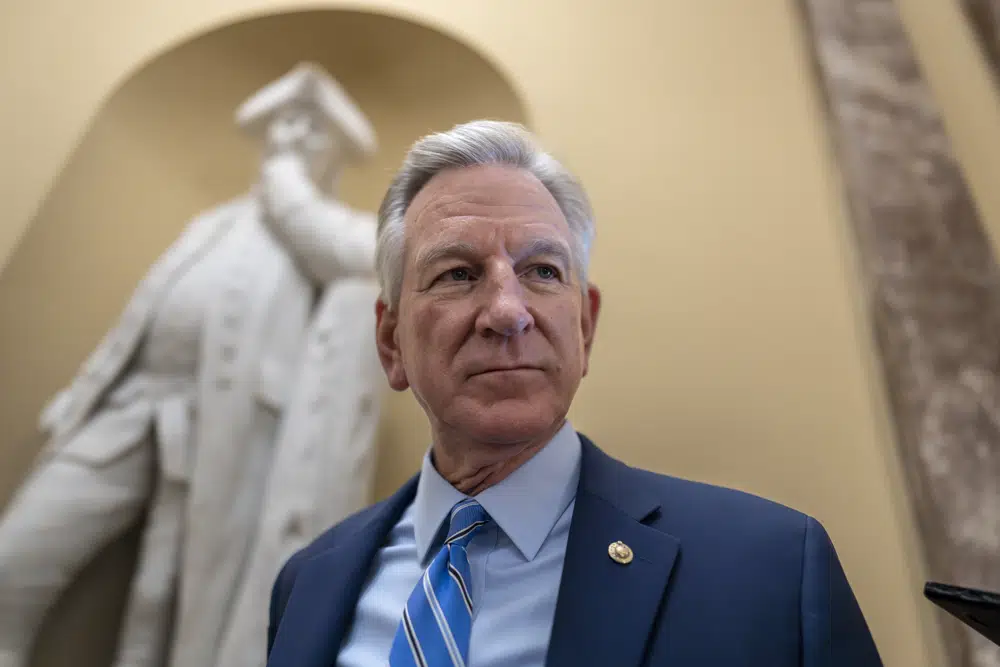
U.S. Senator Tommy Tuberville on Wednesday led the introduction of the Graduate Opportunity and Affordable Loans (GOAL) Act. Sen. Tuberville was joined at Wednesday’s press conference by Sens. Bill Cassidy (R-Louisiana), Chuck Grassley (R-Iowa), and John Cornyn (R-Texas) in a joint press conference. “I spent almost 40 years in this business of education,” Sen. Tuberville said. “In that time, I have seen the cost of college go up, and the quality of education go down.” Tuberville said that the growing student debt is having a crippling effect on students. “Many are putting off owning a home and starting a family,” Tuberville said. “Debt is a problem.” Tuberville and the other Senators said that unlimited federal student loans have allowed colleges and universities to raise tuition, gaming the system. “All they have done is raise the cost for students whether they have loans or not,” Tuberville said. Tuberville explained that the legislation would tell student borrowers the likelihood of graduation from a program at that school, the amount of debt that program will cost, and the likely salary of the position that they will get once they finish the program. Tuberville said that this would force schools to bring down costs and compete for students. “This is just one step in restoring sanity,” Tuberville stated. The Republican Senators introduced a package of five bills, including Tuberville’s. “We need to pass all of this legislation today,” Tuberville said. “We are here today to lower costs for students, parents, and taxpayers.” “We could name this the Save College Education for the Middle-Class Act,” Tuberville said. “Education is not free. We have to pay for it,” “Education should not be a big business, but it is,” Tuberville. “We should put our nose to the grindstone, and everyone should have to pay for their own,” Tuberville said. Tuberville represents Alabama on the Senate Health, Education, Labor, and Pensions (HELP) Committee, where he is the ranking member of the Subcommittee on Children and Families. Sen. Tuberville says that he is committed to lowering costs for students, parents, and taxpayers. Tuberville has repeatedly called on the Biden administration to address the root causes of rising tuition costs and the student loan crisis. From 1980–2020, the average cost of college attendance nearly tripled, rising 169%, much faster than inflation overall, which rose by just 26%. At the same time, federal student aid increased by 57%. According to a 2017 study conducted by the Federal Reserve Bank of New York, expanding student loans increased college tuition by roughly the same amount: 60%. Tuberville has steadfastly opposed President Joe Biden’s student loan forgiveness plan. Earlier this year, Senator Tuberville cosponsored and voted for legislation to stop the U.S. Department of Education’s rule to cancel $10,000 in student loan debt for every borrower making less than $125,000 per year. Borrowers who received federal Pell Grants would receive an additional $10,000 in debt transference from President Biden’s Executive Order. “Joe Biden’s student loan giveaway is illegal,” Coach Tuberville said. “It’s bad economics. It’s bad education policy, and it’s just plain wrong. It encourages our students to take out more debt, and it encourages colleges and universities to raise prices. Joe Biden’s student debt handout costs taxpayers hundreds of billions of dollars and drives up inflation. This is an absolutely reckless policy, and I’m going to do everything I can to stop it.” The plan, which Congress voted to overturn via Congressional Review Act resolution, is expected to cost American taxpayers $400 billion. President Biden vetoed the bipartisan resolution. The U.S. Supreme Court is expected to issue a decision in a case challenging the Biden administration’s unlawful student loan cancelation scheme later this month. Tuberville’s office pointed out that the vast majority of the American people do not have graduate degrees or even college degrees. Nearly nine in ten Americans have no student debt, and the majority of all student debt is held by Americans in the top 60% of income. Tommy Tuberville was elected to the Senate in 2020. He is a member of the Senate Armed Services, Agriculture, Veterans Affairs, and HELP Committees. Tuberville spent four decades as an educator and coach – most notably as the head football coach at the University of Mississippi, Auburn University, Texas Tech University, and the University of Cincinnati. He was also the defensive coordinator at the University of Miami, and at Texas A&M. Prior to his political campaign, he was a sports broadcaster. Tuberville is a native of Arkansas and resides in Auburn. To connect with the author of this story or to comment, email brandonmreporter@gmail.com.
Southwire to expand its manufacturing plant in Florence creating 120 jobs

Southwire, one of North America’s largest wire and cable producers, announced plans on Friday for an expansion of its manufacturing campus in Florence. The effort is expected to increase production capacity by 30% and create approximately 120 jobs. “At Southwire, we’re making a multi-year investment of more than a billion dollars to integrate newer and better equipment, systems, and technology into our operations to increase efficiency,” said Southwire President and CEO Rich Stinson. Stinson said the expansion will, “Enhance competitiveness and ensure the operational capability and capacity to support our strategic growth. The Florence expansion is a testament to those efforts.” Economic developer Dr. Nicole Jones told Alabama Today, “Southwire’s commitment to long-term growth is evident with its latest expansion announcement. The Shoals location investment, which focuses on commercial and residential building wire production, will add 120 jobs to its current total of 625+. A productive, welcoming environment in which companies choose to re-invest in existing buildings, employees, and the local community is a testament to partnerships between the public and private sector and a framework conducive for business.” Southwire also has a facility in Heflin and an Alabama statewide workforce exceeding 625. Greg Canfield is the Secretary of the Alabama Department of Commerce. “Southwire’s investment project will create good-paying jobs in Florence while also enhancing the facility’s competitiveness and solidifying its future in the community,” said Sec. Canfield. “Southwire is a world-class company and a great corporate partner at the state and local level. We’re thrilled to see them grow and thrive in the Shoals area.” The Southwire Florence Plant was acquired from Essex in 2006 to support the company’s production of commercial and residential building wire. The 300,000-square-foot campus has grown over time, and this expansion will include approximately 340,000 square feet of added space for new equipment. Norman Adkins is the president of Wire and Cable and the COO. “Southwire is committed to remain generationally sustainable for the next 100 years and beyond and be an employer of choice,” said President Adkins. “We look forward to the growth opportunities that this expansion will bring to our company.” The expansion not only increases operating space and new equipment but will include renovations to the existing building to enhance the team member experience, including locker rooms, training space, and an outdoor picnic and activity area. “This investment will allow us to better service our customers safely and efficiently, and the Florence team and I are very excited about the expansion and what it means for the future,” said Brian Davis, plant manager. “This expansion speaks volumes about the dedication, hard work, and commitment of our team members, and we look forward to the opportunities that this expansion will bring.” The investments and upgrades will effectively streamline Southwire’s commercial and residential building wire efforts, complement existing products and emphasize the facility’s culture and labor pool. Construction at the Florence campus is expected to begin this quarter and should be completed in 2025. To connect with the author of this story or to comment, email brandonmreporter@gmail.com.
Gov. Kay Ivey meets with Japanese Consul General Mio Maeda
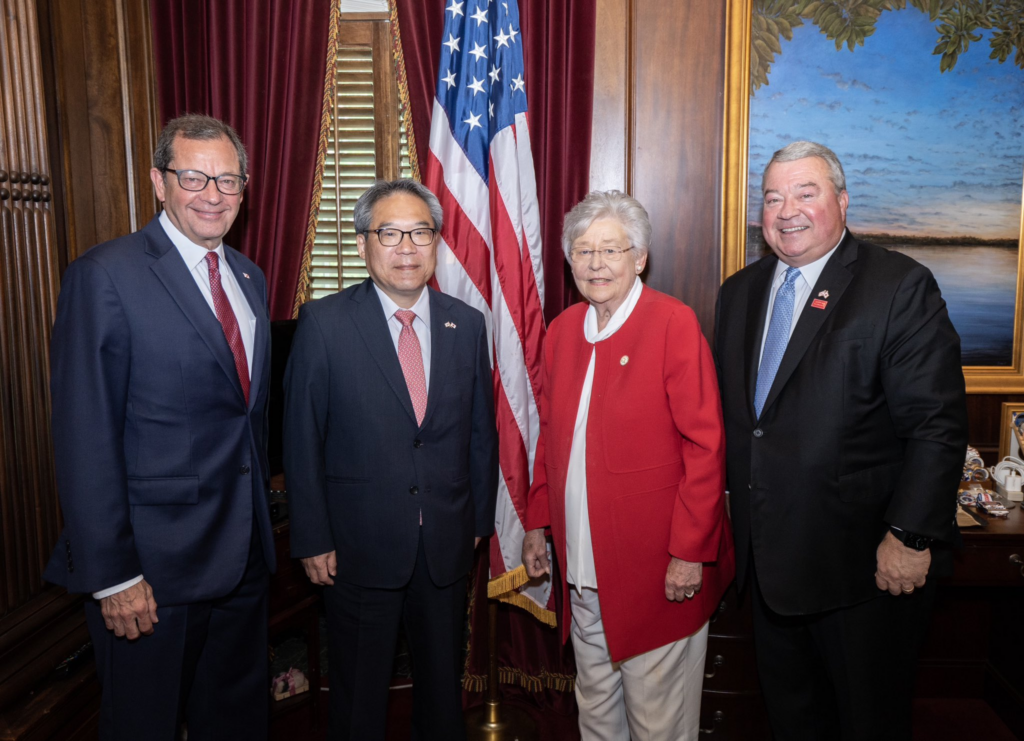
On Tuesday, Governor Kay Ivey met with Japanese Consul General Mio Maeda in Montgomery. Japan is one of Alabama’s top trading partners, and many Japanese companies, including Honda, Toyota, and Mazda, have a substantial manufacturing presence in Alabama. “I was honored to host Consul General Maeda in my office this morning,” Gov. Ivey said on Twitter. “With over 80 Japanese companies that call Alabama home, this robust relationship has produced great economic growth across the state. Truly, there is no stronger partner state to Japan than Alabama.” Gov. Ivey and Consul General Maeda were joined by Alabama Commerce Secretary Greg Canfield. Sec. Canfield said on Twitter, “Good meeting today between Consul General Maeda and Governor Ivey. Thank you to Honorary CG Mark Jackson for his assistance.” “The Southeast has strong ties with Japan,” Maeda said on the Atlanta consulate’s homepage. “These states host a large number of Japanese companies and offer a direct flight to Japan from Hartsfield-Jackson Atlanta International Airport, which is said to be the busiest airport in the world.” Maeda became Consul General in Atlanta on November 3, 2022. Maeda has served in Japan’s Ministry of Foreign Affairs since 1990, but this is his first position in the United States. He previously served as the Deputy Head of Mission at the Japanese Embassy in Switzerland located in Bern. In 2013, Maeda worked as Minister-Counselor and Deputy Head of Mission at the Embassy of Japan in the Islamic Republic of Afghanistan, and in 2014 returned to Japan to serve as Director of the Southwest Asia Division (Southeast and Southwest Asian Affairs Department, MOFA, Japan). He served in the Imperial Household Agency in 2015. He was appointed Chamberlain to HIH, the Crown Prince of Japan, and later as Chamberlain to HM the Emperor of Japan, until 2019, when he was assigned to the Embassy in Switzerland. Maeda is married and has one daughter. He resides in Atlanta with his wife. “The Southeast is great not only for business but also the Southeast is blessed with land full of nature and famous for its people’s ‘Southern Hospitality,’” Maeda added. “I’ve heard this is a very comfortable and good area to live. I would like to get used to life here and make my own form of hospitality combining Japanese ‘omotenashi’ and Southern’ hospitality.’” Japan is Alabama’s fifth largest trading partner, trailing only Germany, China, Canada, and Mexico. Alabama exported one billion dollars worth of goods to Japan in 2022 – a 42% increase from 2021. Alabama set a new record of $25.5 billion in exports in 2022. Probably even more important has been Japanese investment in Alabama. Investments in Alabama from South Korea, Canada, Japan, and Germany are credited by Canfield with contributing to $1.8 billion in investments in rural Alabama in 2022, creating 1,900 new jobs. To connect with the author of this story or to comment, email brandonmreporter@gmail.com.
Reps. Terri Sewell and Gus Bilirakis introduce legislation to increase access to oral prescription drugs
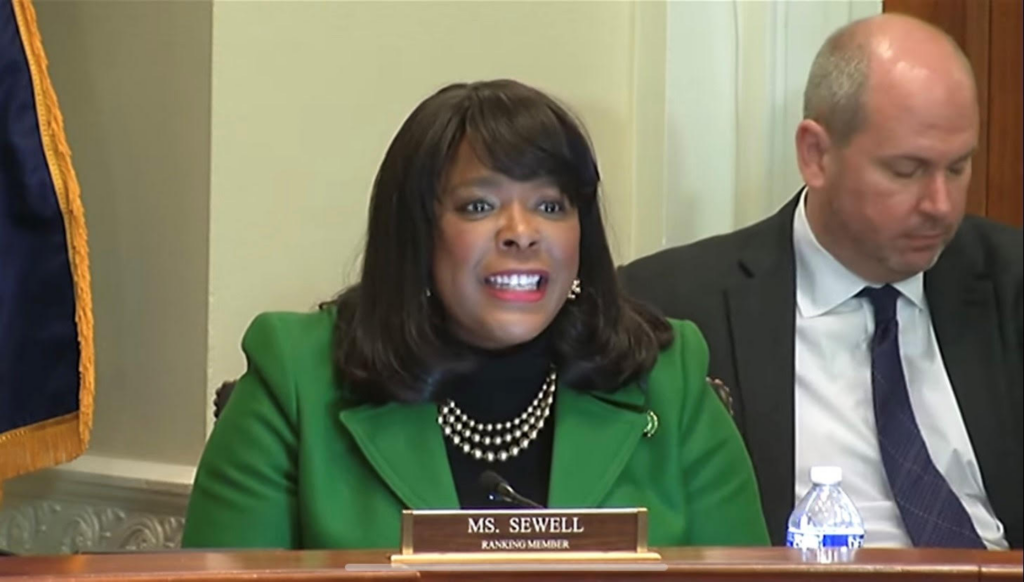
Congresswoman Terri Sewell (D-AL07) joined U.S. Representative Gus Bilirakis (R-Florida) in introducing H.R. 4011, the Timely Access to Clinical Treatment (TACT) Act. This bipartisan legislation would require patients to receive their oral drugs within an acceptable time frame. “Undergoing treatment for a serious illness is difficult enough. No patient should also have to worry about delays in receiving potentially life-saving medication,” said Rep. Sewell. “The TACT Act is a simple, commonsense solution that would remove unnecessary roadblocks and empower doctors to get their patients the critical care that they need in a timely manner. I am proud to introduce this bill and urge my colleagues to support it.” “This bill is about removing the red tape within our healthcare system and ensuring that patients have timely access to their medications,” said Rep. Bilirakis. “Doctors, not bureaucrats, best understand the needs of their patients and should be empowered with the tools needed to provide the best possible care—especially when time is of the essence.” According to the sponsors, patients’ access to the appropriate medically necessary treatment within a reasonable time frame is increasingly challenged by our complex healthcare delivery system. This is especially true for oral drugs. The sponsors claim that pharmacy benefit managers (PBMs), health insurance plan sponsors, and specialty and mail-order pharmacies are notorious for slowing down the process by which patients receive their oral drugs, even in cases where specialty practices can provide those drugs at the site of care via an in-house pharmacy or dispensing facility. In some cases, PBMs even disallow the medications prescribed. The TACT Act requires that patients be provided their oral drugs within an acceptable time frame of 72 hours, allowing for situations—such as acquiring financial support—that are understandable and reasonable. The TACT Act will: · Require PBMs, plan sponsors, insurers, and contract pharmacies, including specialty and mail-order pharmacies, to ensure that patients are able to receive their prescription medication within 72 hours of having the prescription submitted to the patient’s pharmacy benefit plan provider in order to ensure that there is no undo delay in the initiation of the patient’s treatment; · Allow patients who are not able to receive their prescription from a pharmacy benefit plan provider within 72 hours to seek pharmacy services and receive their prescription medication from any other duly-licensed entity that can fill the patient’s prescription and require that it be covered under the patient’s plan with full use of the patient’s applicable benefit(s); · Require pharmacy benefit plan providers receiving the prescription to confirm within 24 hours to the patient’s prescriber receipt of the prescription and the ability to fill it within the 72-hour period; and · Require that any prior authorization required by the pharmacy benefit plan provider take place in such a time that the 72-hour time limit is not exceeded. Ted Okon is the Executive Director of the Community Oncology Alliance. “The Timely Access to Clinical Treatment legislation is vital for patients with cancer and other serious diseases across the country,” said Director Okon. “We hear stories daily about patients not being able to receive their potentially life-saving cancer treatments because of needless delays by contract pharmacies. We applaud Congressman Bilirakis and Congresswoman Terri Sewell for leading this effort to empower patients to ensure they receive their medications in a timely manner.” Terri Sewell is in her seventh term representing Alabama’s Seventh Congressional District. To connect with the author of this story or to comment, email brandonmreporter@gmail.com.
Rep. Robert Aderholt secures Space Command spending language in House appropriations bill

On Tuesday, Congressman Robert Aderholt (R-AL04) announced that he has been able to secure language halting the development of the U.S. Space Command (SPACECOM) in Colorado until an official basing decision has been made. “Now more than ever, the establishment of a permanent Space Command Headquarters remains vital to our national security,” said Rep. Aderholt. “The language incentivizes the Secretary of the Air Force to determine the permanent headquarters location as quickly as possible.” “In this matter, timeliness remains of the utmost importance,” Aderholt continued. “I urge the Department to move the headquarters to its preferred permanent location as quickly as possible; however, if the Administration continues to delay, I am relieved that General (James H.) Dickinson, the SPACECOM Commander, last week assured the Alabama Delegation that he had no national security concerns about moving the headquarters.” The bipartisan language is included in the House Appropriations Subcommittee on Military Construction and Veterans Affairs fiscal year 2024 spending bill, following a review and approval by the United States Air Force. During the Trump administration, the Air Force held a national search for a permanent home for Space Command. Dozens of sites across the country were considered for a multitude of factors. Two different evaluations found that Redstone Arsenal in Huntsville was the best possible site. Nebraska came in second, followed by San Antonio, Texas. Colorado, where Space Command is presently, came in fourth. A review by the inspector general found that the decision to locate SPACECOM in Huntsville was the correct decision and was not tainted by politics. “The fact is, Air Force already made the correct decision well over two years ago,” said Congressman Mike Rogers (R-AL03). That decision was affirmed by the GAO and the DoD Inspector General over a year ago. This decision was based on multiple factors, and Redstone Arsenal in Huntsville, Alabama, was the clear winner in the Evaluation and Selection phase. I am deeply concerned that the continued delays in making this move final are politically motivated and damaging to our national security.” Over 24 months later, no action has been taken to relocate SPACECOM. A recent report by NBC News claims that the White House may halt plans to move Space Command. The report cites Alabama’s restrictive abortion law. Alabama’s congressional delegation, however, points to the fact that Colorado voted for President Joe Biden while Alabama voted to keep President Donald Trump. The SPACECOM basing decision remains a responsibility of the Secretary of the Air Force, Frank Kendall, a decision delegated by the President of the United States and the Secretary of Defense. “As we take this step, I would like to thank the Alabama delegation for their commitment to this fight,” said Aderholt. “We all know that Space Command belongs in the Rocket City.” According to a June 2022 Government Accountability Office (GAO) report, the decision-making process that the Air Force used to decide to move Space Command headquarters from Colorado Springs to Alabama had “significant shortfalls in its transparency and credibility.” “Over the past year, we’ve repeatedly raised concerns that the previous administration used a flawed, untested, and inconsistent process to select a location for U.S. Space Command. The reports from the Government Accountability Office and the Department of Defense Inspector General both confirm that the basing process lacked integrity and neglected key national security considerations,” Sens. Michael Bennet and John Hickenlooper and Reps. Doug Lamborn and Jason Crow said in a joint statement. Additionally, legislators from Colorado argue that the decision to move Space Command was politically motivated, arguing that former President Trump indicated that he would decide the 2020 election. AL.com reported in 2021 that during an interview on the Rick & Bubba show, Trump stated, “Space force – I sent to Alabama. I hope you know that. (They) said they were looking for a home, and I single-handedly said, ‘Let’s go to Alabama.’ They wanted it. I said let’s go to Alabama. I love Alabama.” Robert Aderholt is in his 14th term representing Alabama’s Fourth Congressional District. He is an attorney and was formerly counsel for Alabama Governor Fob James. He is a native of Haleyville. To connect with the author of this story or to comment, email brandonmreporter@gmail.com.
Barry Moore and Jasmine Crockett introduce legislation to protect against feral hogs

Last week, Congressman Barry Moore introduced legislation to combat the growing feral swine problem. Hogs are not native to North America and have no natural predators in the wild here. H.R. 3984, the bipartisan, bicameral Feral Swine Eradication Act, was co-authored by U.S. Rep. Jasmine Crockett (TX-30). “Feral swine have caused millions of dollars in damage on agricultural operations across Alabama and can undo years of hard work on Alabama’s farms, ranches, and forests toward feeding our country,” said Moore. “I am standing with Alabama farmers to take action against this threat by authorizing an eradication pilot program with proven results, with changes to make it better.” “My constituents in TX-30 are still seeing painfully high prices at the grocery store. Fruits and vegetables are missing from the shelves. As with so many things we’ve experienced over the last three years, the issue is the supply chain – and in Texas, our supply chain is getting ravaged by the scourge of feral hogs,” said Rep. Jasmine Crockett. “As a top 5 agriculture exporting state, any disruptions to Texas farms have significant ripple effects across the country. Feral Hogs are an invasive species, and they destroy billions of dollars of crops. This cuts food out of the supply chain and increases costs consumers pay at the grocery store. I am introducing this bill to bring food prices under control and protect rural communities.” This legislation extends the Feral Swine Eradication and Control Pilot Program (FSCP). Feral swine are consistently detrimental to farmers, ranchers, and foresters’ operations, causing $1.5 billion in damages every year while preying on native ground-nesting birds like quail and turkeys as well as native reptiles and other animals. Where the FSCP pilot program has been implemented, it has shown great success in reducing these damages through trapping, removing and monitoring, and assessing the lands on which feral swine frequently reside. This legislation has been introduced in the U.S. Senate as S.613. The Senate version of this legislation is sponsored by Senators Tommy Tuberville, Raphael Warnock (D-Georgia), and John Cornyn (R-Texas). “Feral swine are a serious threat to the livelihoods of Alabama’s farmers. Feral hogs destroy crops, land, and undo months, if not years, of work by our farmers to feed our country,” said Sen. Tuberville. “Over the past five years, feral swine have impacted more than 173,000 acres in Alabama. Yet, the pigs are still running rampant throughout the South. And so today, I’m standing with Alabama farmers and taking action to fight back against this threat.” The legislation has been endorsed by the Alabama Farmers Federation. “Feral swine continue to be a plague on farms all over Alabama, causing both economic and ecological damage,” said Jimmy Parnell, president, and CEO of the Alabama Farmers Federation. “We appreciate Coach Tuberville’s efforts to make permanent a pilot program that has yielded good results in Alabama and other states. While progress has been made there is still work to be done, and this bill will allow USDA to continue and expand upon the work done thus far.” Barry Moore is in his second term representing Alabama’s Second Congressional District. To connect with the author of this story or to comment, email brandonmreporter@gmail.com.
Jim Zeigler: Flag Day, the almost-forgotten holiday

I commemorate Flag Day each June 14 with flags and red-white-and-blue items at our home, my car, and even my clothes. Often, people will remark: “You’re getting ready for Independence Day mighty early,” or some other comment that lets me know they do not realize it is Flag Day, June 14. I call Flag Day “the almost-forgotten holiday.” It is not a federal holiday like Memorial Day (the last Monday in May) or Independence Day, July 4. But it comes almost mid-way between them. It is easy to forget Flag Day since it is not a state or federal holiday. A patriotic song that commemorates our flag is not as well-known as the Star-Spangled Banner, God Bless America, and God Bless the USA. It is “You’re a Grand Old Flag.” You’re a grand old flag You’re a high-flying flag And forever in peace may you wave You’re the emblem of The land I love The home of the free and the brave Ev’ry heart beats true Under red, white, and blue Where there’s never a boast or brag But should old acquaintance be forgot Keep your eye on the grand old flag. June 14 was officially established as Flag Day by a proclamation of President Woodrow Wilson on May 30, 1916. On August 3, 1949, President Harry Truman signed an Act of Congress which designated June 14 as National Flag Day. The date coincides with the adoption of the flag by resolution of the Second Continental Congress in 1777. Interestingly, and probably surprisingly, the colors of the flag have no official meaning. The same colors are used in the Great Seal, though, and they do have meaning there. Red represents valor and strength, white represents purity and innocence, and blue represents perseverance and justice. The Flag Code, part of the U.S. Code, contains specific instructions on how the flag is to be used and displayed and how it is to be destroyed by burning in a dignified manner. On Flag Day 2023, let us display our flag with gratitude for our country and the price that has been paid for our freedom, as well as with a resolve to remain “one nation under God, indivisible, with liberty and justice for all.” Jim Zeigler is the former Public Service Commissioner of Alabama.
Steve Flowers: The Alabama Community College System
Sometimes overlooked and often unsung, Alabama’s community and technical colleges are on a roll. It is time they get the recognition they deserve as workhorses for the state’s economy. There are 24 community and technical colleges in the state, located on 50 different campuses with over 130 service locations. This means every Alabamian reading these words is close to incredible education and training opportunities. The colleges offer over 300 degrees and certifications and award more than 30,000 credentials each year that show employers these students are serious about working. More than 155,000 students are served by Alabama’s community colleges, and 95% of students live in Alabama. What is more, 71% choose to stay in Alabama after completing their studies. These students and alumni add an amazing $6.6 billion to Alabama’s economy each year, according to a report from Lightcast, a national firm that analyzes labor markets. Nearly 99,000 jobs in Alabama are generated or supported by Alabama’s community colleges, their students, and alumni. To put it another way, that is one of every 27 jobs in the state. Under the leadership of Chancellor Jimmy Baker, who took the helm of the Alabama Community College System (ACCS) in 2017, innovative and transformational programs are in place that “build strong Alabama people who are willing to work and do what it takes to move the state forward,” as Baker puts it. Among the most impressive is the Innovation Center, a division of the ACCS that brings together the state’s community colleges, businesses, and industries. These partners deliver Skills for Success training for careers that employers say are most in demand but lack qualified Alabama workers to fill. By working together with Alabama businesses and industries, the ACCS Innovation Center ensures Skills for Success training is perfectly aligned with the jobs that employers say they need to fill right away. Since its launch a little more than a year ago, more than 2,700 Alabamians have benefitted from Skills for Success training. The appeal to trainees – other than getting the skills needed for an in-demand job – is the training is offered at no cost to them. It is free to trainees thanks to appropriations from the State Legislature and support from Gov. Kay Ivey, who has put a strong emphasis on workforce training. The Governor’s Success Plus initiative aims to add 500,000 Alabamians with postsecondary credentials to the state’s workforce by 2025. Rapid training from our community colleges will be key to reaching this important goal. It is incredible to think that every Alabamian has the opportunity to receive no-cost training and become credentialed for jobs as bulldozer operators, fiber optic technicians, truck drivers, and more, but that is the reality of today’s community college system in our state. Chancellor Baker has wisely built a workforce training program around the skills that employers say they need in their workers. As a result, many students can walk right out of training and immediately into jobs that are waiting for someone with their exact skillset. The training is essentially “customized” for Alabama employers in desperate need of workers. What is also innovative is how quickly Skills for Success training can be delivered. Part of each training course is offered online, with self-paced learning that can take place anywhere one can connect to the internet. Some have said they have completed the online training from their mobile phones over a few hours in the evening. When a trainee completes the online portion of the course, they then get hands-on training with qualified instructors at a nearby community college or some other regional location. The average Skills for Success course can be completed in as little as two or three weeks. Any Alabamian can sign up for no-cost training and, in less than a month, have a community college credential that shows employers they have the skills and qualifications to do the job. With Skills for Success training, they are “job-ready” on day one for jobs that are in high demand throughout the state, thanks to the forward-thinking leaders of the Alabama Community College System and the State Legislature. See you next week. Steve Flowers is Alabama’s leading political columnist. His weekly column appears in over 60 Alabama newspapers. Steve served 16 years in the state legislature. Steve may be reached at www.steveflowers.us.
Steve Marshall joins 18 attorneys general who want California’s emissions rule for trucks reversed

Nineteen attorneys general are challenging the Environmental Protection Agency’s decision to allow California to enforce its own regulations requiring zero-emission heavy-duty trucks. In 2021, the California Air Resources Board requested the EPA waive regulations in the federal Clean Air Act. The EPA approved the waiver in March. Democratic California Gov. Gavin Newsom said the EPA’s decision allowed his state to be the world’s first government to require zero-emission trucks and paved the way for clean trucks and buses across the globe. California’s Advanced Clean Trucks rule requires manufacturers to have 40% of semi-tractor sales to be zero-emissions by 2035. All heavy-duty vehicles in California must have no carbon exhaust emissions, wherever feasible, by 2045. Last week, Republican Iowa Attorney General Brenna Bird led a coalition of 19 states challenging the EPA’s decision. “The EPA and California have no right or legal justification to force truckers to follow their radical climate agenda,” Bird said in a statement. “America would grind to a halt without truckers who deliver our food, clothes and other necessities.” Eight other states have moved to adopt or are working to adopt California’s truck regulations, according to Newsom’s office. In 1967, Congress created a waiver provision for state regulations and it was amended in 1990 to include emissions. The Clean Air Act stated there would be only two ways to enforce emission standards from new motor vehicles – EPA regulations and California laws. Other states can only adopt standards identical to California. “This statutory scheme struck an important balance that protected manufacturers from multiple and different state emission standards, while preserving California’s pivotal role as a laboratory for innovation in the control of emissions from new motor vehicles,” Michael Regan, EPA administrator, wrote in a 38-page article published in the Federal Register in April. “Congress recognized that California could serve as a pioneer and a laboratory for the nation in setting new motor vehicle emission standards and the development of new emission control technologies.” “Further, Congress intentionally structured this waiver provision to restrict and limit EPA’s ability to deny a waiver,” he added. “The provision was designed to ensure California’s broad discretion to determine the best means to protect the health and welfare of its citizens.” The attorneys general argue California’s regulations will increase operating costs for the truck industry, lower demand for diesel and biodiesel, and eliminate jobs. “Joe Biden is partnering with California to attempt to upend Missouri’s economy through the federal administrative state, and my office isn’t going to stand for it,” Republican Missouri Attorney General Andrew Bailey said in a statement. Joining Iowa in the petition to the U.S. District Court of Appeals in the District of Columbia are Alabama, Arkansas, Georgia, Indiana, Kansas, Kentucky, Louisiana, Mississippi, Missouri, Montana, Nebraska, North Dakota, Ohio, Oklahoma, South Carolina, Utah, West Virginia, and Wyoming. Republished with the permission of The Center Square.
Florida tax revenue continues to exceed expectations

Tax revenue in the Sunshine State is exceeding projections, according to a recent report from the Office of Economic and Demographic Research. General revenue collections for April showed a gain of $384.8 million, 7.9% higher than what was forecast by the General Revenue Estimating Conference held in March, with 72% of that revenue from corporate income tax. Revenue reports in Florida, unlike other states, are a month behind. The latest report released in April details how after adjusting total sales tax collections for local taxes and distributions, audits, bad checks, and communications services tax — collections were 3% more than the estimate for the month. Florida collected an additional $96.4 million in total sales tax for April. According to the report, this was due in part to several factors, including a “continuing technical shift between estimated payments and unpaid liability,” as well as recovery and rebuilding efforts associated with hurricanes Ian and Nicole, which saw $25.1 million added to the month’s total. Total recovery and rebuilding efforts will cost around $560.4 million, however, the EDR says in the report that estimates are understated. The report states that additional revenue for April is partly due to the rise in inflation, which results in higher consumer prices. It also notes that if inflation continues to persist, consumers will begin spending their income on non-taxed necessities like food — causing a downward turn in sales tax revenue. Food prices have risen 7.1% more than the past 12 months. In April, consumer nondurable goods gained $1.4 million more than the estimate for the month, while tourism took a loss of $2.6 million — 0.3% lower than estimated. The building sector gained an additional $1.5 million, 0.6% more than its projections, and business gained $41.7 million — 6.1% more than its estimate for April. Florida saw gains in other areas too, with eight of its 17 income sources also sliding into positive revenue territory. Corporate income tax gained $277.7 million for April, 31.7% higher than projected. Earnings on investments soared 157.1% more than its estimate, gaining $49.5 million, while intangible taxes gained $9.4 million, a 34.6% increase. Article V fees and transfers gained an additional 10.6% for April, collecting $1 million in revenue, while documentary stamp tax gained $7 million — a total of 7.8% more than was estimated. Coming in negative for April were eight revenue sources, including corporate filing fees, insurance taxes, service charges, highway safety fees, and beverage taxes. The biggest losses came from corporate filings fees, 27.9% under its estimate, losing $30.5 million for April. According to the report, this was partly a timing issue with March estimates. Insurance taxes lost a total of $20.3 million, 27.9% less than the estimate for the month, and services charges, highway safety fees, and beverage taxes lost an average of $4.8 million, falling below estimates by at least 10.9% for April. Tobacco tax, county Medicaid shares, and severance taxes lost between $100,000 and $500,000 in April. In total, these revenue sources generated a loss of $65.4 million. Republished with the permission of The Center Square.
House passes resolution to overturn new federal gun regulation; Joe Biden vows veto
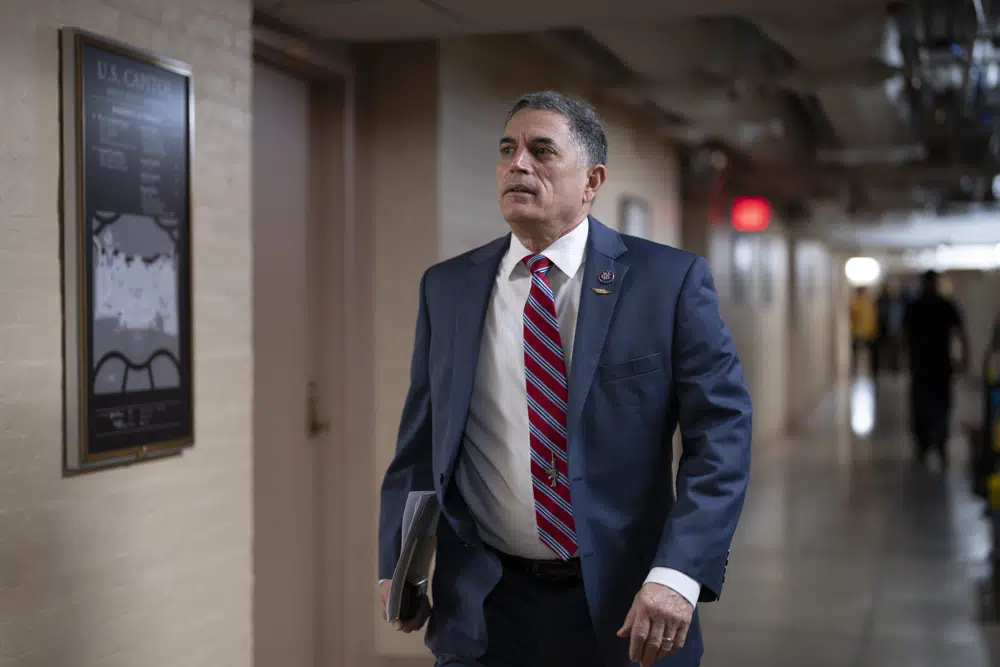
House Republicans passed a resolution that would repeal a Biden administration rule tightening federal regulations on stabilizing braces for firearms, an accessory that has been used in several mass shootings in the U.S. over the last decade. The resolution passed 219-210 nearly on party lines and after a contentious floor debate where Republicans accused the administration of “executive overreach,” and Democrats condemned a bill they said would “help kill people.” Two Democrats voted in support, and two Republicans voted against it. The resolution, which was introduced by Rep. Andrew Clyde, R-Ga., will now go to the Senate, which could take up the measure as soon as this week. Should it pass, President Joe Biden has promised a veto. Overriding a presidential veto would require two-thirds majorities in the House and Senate. The new rule issued by the Bureau of Alcohol, Tobacco, Firearms and Explosives in January treats guns with the accessories like short-barreled rifles, a weapon that is like a sawed-off shotgun and has been heavily regulated since the 1930s. The regulation, which went into effect June 1, was one of several steps Biden announced in 2021 after a man using a stabilizing brace killed 10 people at a grocery store in Boulder, Colorado. A stabilizing brace was also used in a shooting in Dayton, Ohio, that left nine people dead in 2019 and most recently in a school shooting in Nashville, Tennessee. Stabilizing braces transform a pistol into a weapon that’s powerful and easy to conceal, Attorney General Merrick Garland said when he announced the rule. Originally developed for disabled veterans, gun-control groups have said the accessories have became a loophole exploited by gunmakers to make weapons more deadly. Since taking effect earlier this month, the rule requires anyone who has a gun with an arm-stabilizing brace to register the weapon with the federal government and pay a fee or remove the brace from their weapons. Republicans employed the Congressional Review Act, which allows Congress to undo recently enacted executive branch regulations, to try and nullify the new rule that they claim has turned millions of gun owners into felons. “This rule doesn’t just infringe upon Americans’ Second Amendment liberties. It represents a dangerous government overreach by the administration,” Clyde said during debate Tuesday. “Congress maintains sole legislative authority, not government agencies, not the executive branch.” Several lawsuits have been filed against the regulations by gun owners and state attorneys general. They say it violates Second Amendment protections by requiring millions of people to alter or register their weapons. In some cases, judges have recently agreed to temporarily block enforcement of the rule for the plaintiffs in a setback for the Biden administration. House Democrats defended the rule on Tuesday, saying it could save lives. “How many more mass shootings need to happen? How many more kids need to die before my Republican colleagues pull their heads out of the sand and realize that the NRA money is not worth the damage that’s been done to our country,” said Rep. Jim McGovern, D-Mass. The main sponsor for the measure, Clyde, is a member of the ultra-conservative House Freedom Caucus and the owner of a gun store in his district in Georgia. His proposal to overturn the ATF rule first came to the House Judiciary Committee in late March for markup. But House Republicans postponed debate of the measure after a gunman used a weapon with a stabilizing brace to fatally shoot three children and three adults at an elementary school in Nashville, Tenn. Last week, Clyde claimed GOP leadership had blocked his resolution from reaching the floor as retribution for his no vote on a bipartisan agreement to lift the debt ceiling, which leaders denied. House Majority Leader Steve Scalise said he and Rep. Tom Emmer, the GOP’s chief vote-counter, had been working intensely to ensure enough support to pass the legislation in the narrowly divided House. “We’ve been moving people every week on this bill,” Scalise said. “It has not been easy.” Republished with the permission of The Associated Press.
