
Jared Norrell: Alabama needs to expand broadband to rural areas quickly and efficiently

Congress recently passed the bipartisan Broadband Equity, Access, & Deployment (BEAD) Program providing states with the unique opportunity to build out broadband access in rural and underserved areas. As President of Southern Preparatory Military Academy, the official military school for Alabama, I understand how crucial it is to get our cadets connected to high-speed internet access. With Alabama receiving over one billion dollars in BEAD program funding, there will never be a better opportunity to bridge the digital divide and bring high-speed internet to unserved locations. Southern Prep’s campus is in Camp Hill, Alabama, a rural community that is in desperate need of connectivity. Expanding broadband is a top priority for both our academy and our community at large, and I am grateful that State Representative Ed Oliver and Governor Kay Ivey have been champions for rural broadband. Unfortunately, the Biden administration is focused on leveraging federal dollars to conduct a political agenda that forces its liberal politics on our state and will stand in the way of Southern Prep and Camp Hill getting online. We need to put our students and citizens first by protecting our taxpayer dollars meant for broadband from the Biden Administration’s liberal-wish list so we can deliver on BEAD’s promise of 100% connectivity in our state. Building out internet in Camp Hill and some of the more rural corners of our state is a big undertaking, and BEAD funding is meant to make that possible. Our state has a choice now: we can put together a proposal that prioritizes leftist social policy and scares away experienced providers, or we can create a plan that focuses on getting rural Alabama connected. While the Biden administration wants us to impose onerous workforce requirements and recommends strict price ceilings, Governor Ivey has the power to stand up for our state and say no to these absurd demands. BEAD is about getting people connected to the internet. It is not about advocating for liberal social policy, interfering with market capitalism by imposing price controls or creating new government-controlled utilities. The suggestions in the Biden administration’s BEAD plan just do not make sense for our communities. Rural communities in Alabama have been waiting long enough for broadband. We do not need – and we cannot afford – more bureaucratic red tape slowing us down. Jared Norrell is a retired Lt. Colonel from the United States Army and serves as President of Southern Preparatory Academy in Camp Hill, Alabama.
Robert Aderholt cosponsors American Confidence in Elections Act

On Wednesday, Congressman Robert Aderholt (R-AL04) announced that he had signed on as an original cosponsor of the American Confidence in Elections Act (ACE Act). “Proud to join my colleagues as an original cosponsor of the American Confidence in Elections Act,” Aderholt said on Twitter. “We are taking the necessary steps towards securing elections, cracking down on states that allow noncitizens to vote, and improving voting access for our service members overseas.” The legislation was introduced by Committee on House Administration Chairman Bryan Steil (R-Wisconsin). The American Confidence in Elections (ACE) Act is reportedly the most conservative election integrity bill to be seriously considered in the House in over 20 years. The comprehensive bill includes nearly 50 standalone bills sponsored by members of the House Republican Conference. The sponsors say that the ACE Act equips states with election integrity tools, implements key reforms in D.C., and protects political speech. “The ACE Act is a conservative, federalist approach to boost voter confidence and encourage more states to implement commonsense election integrity reforms,” Rep. Steil wrote in an op-ed in the Washington Examiner. “The Committee on House Administration has oversight jurisdiction over federal elections. As chairman, I’m committed to upholding the Constitution by ensuring states maintain primary control over administering elections — not the federal government.” “The ACE Act has three main pillars: equipping states with election integrity tools, implementing election integrity reforms in Washington, D.C., and protecting political speech and donor privacy.” Steil continued. “The primary section of the bill is focused on providing states with tools to improve voter confidence. We will remove outdated policies that stand in their way and provide access to information held only by federal agencies.” Steil wrote that states should have access to the Social Security death list to maintain their voter rolls. “Another safeguard states can implement to improve voter confidence is requiring photo ID.” The ACE Act would also prohibit federal funds from going to places that allow noncitizens to vote and stop noncitizens from voting in Washington, D.C. It would also prohibit the District of Columbia from mailing out ballots and require the District to finally implement photo ID. The ACE Act would prohibit federal agencies like the IRS from asking for nonprofit organizations’ donor lists and bring greater transparency and accountability into the federal campaign finance system. In addition to Rep. Aderholt, there are over 100 original House cosponsors of the ACE Act. House Republicans held a press conference on Wednesday to announce the introduction of the legislation. House Majority Leader Steve Scalise (R-Louisiana) said that the ACE Act would “ensure that elections across America will be fair and that people who are legally eligible to vote can actually cast that ballot and that people who aren’t legally eligible to vote can’t undermine the vote of everyone else, because when someone illegally votes they take away the vote from a legally voting American.” “The idea that you have to show a picture ID to vote is common sense to Americans. In fact, polling indicates that about 80% of Americans support the idea that you require an ID to vote, including by the way a strong majority of Democrats support showing ID.” Scalise said. “Let’s go strengthen the sanctity of the vote. Don’t go mail ballots to people who have been off the rolls for years, that died or moved out of state. We have seen that. It is well documented. This bill that Chairman Steil and members of the committee have brought forward is an important step in the right direction to cleaning up our elections and ensuring that everybody who is entitled to vote can get that vote and that people who aren’t eligible can’t deny that vote. Let’s make it easier to vote and harder to cheat. This bill achieves that. I strongly support it and hope to bring it t the House floor.” Alabama Secretary of State Wes Allen joined House Republicans in D.C. for that press conference. Allen also spoke with Congressman Jerry Carl (R-AL01) about the importance of election integrity during his visit to Washington. “I sat down with Alabama Secretary of State Wes Allen to talk about everything Alabama is doing to ensure election integrity in upcoming elections. He is doing an incredible job!” Rep. Carl said on Twitter. Given the partisan divide over election integrity legislation, it is unlikely that the Senate Democrats will advance this legislation even if House Republicans are able to pass it out of the House. A signature from President Joe Biden is also unlikely ahead of the 2024 presidential election. Aderholt is in his 14th term representing Alabama’s Fourth Congressional District. To connect with the author of this story or to comment, email brandonmreporter@gmail.com.
Joe Biden says Tommy Tuberville should drop his ‘irresponsible’ protest and OK military nominees
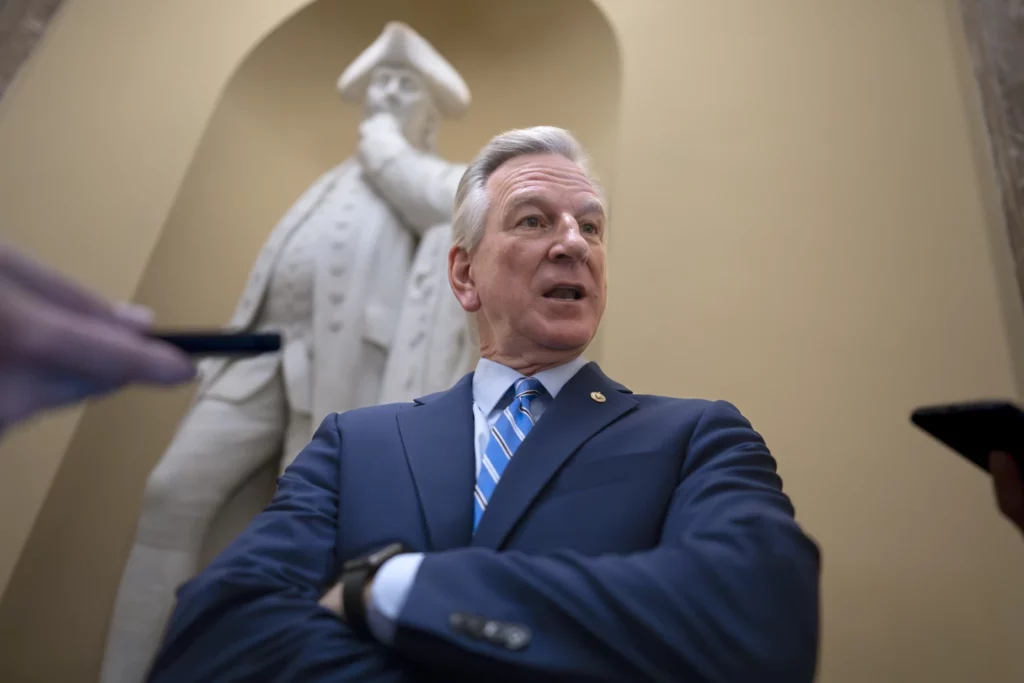
President Joe Biden on Thursday said it is “irresponsible” of a Republican senator from Alabama to block confirmation of military officers in protest of a Defense Department policy that pays for travel when a service member has to go out of state to get an abortion or reproductive care. “He’s jeopardizing U.S. security by what he’s doing,” Biden said of Sen. Tommy Tuberville. “It’s just totally irresponsible in my view.” More than 260 nominations are stalled by Tuberville, including Biden’s pick for the chairman of the Joint Chiefs of Staff, America’s top military officer. The U.S. Marine Corps is currently without a confirmed leader for the first time in a century because of the block. It also affects scores of one-, two- and three-star officers who are assigned to new base commands. “I’d be willing to talk to him if I thought there was any possibility of changing his ridiculous position,” Biden said during a press conference with the president of Finland. Biden traveled to Finland as a show of support for the new NATO member, following the NATO summit in Lithuania this week. “The idea that we’re injecting into fundamental foreign policy decisions what, in fact, is a domestic social debate on social issues is bizarre,” Biden said. There were also efforts at the Pentagon to encourage Tuberville to drop his opposition. The senator told reporters later Thursday that he had just spoken with Defense Secretary Lloyd Austin and expected to speak with him again. The block also affects the families of nominees, who usually relocate over the summer to their new military communities so school-age children can get settled in before fall. And it stretches to hundreds more younger military personnel who don’t need Senate confirmation but are still affected by the hold because they are assigned to serve as staff or aides to the relocating generals. Those aides move their families as well. So they are essentially stuck, too. A proposal last month to hold a Senate debate over Pentagon abortion policies as part of the annual defense bill negotiations was seen by some senators as the best prospect for getting Tuberville to lift those holds, but he opposed it. The Alabama senator’s action bucks decades of precedent in which swaths of military officers and promotions are approved by voice vote and with no objections. Senate Armed Services Committee Chairman Jack Reed, D-R.I., has said that if the Senate were to vote individually on the 260 nominations, it would take 27 days with the Senate working “around the clock” or 84 days if the Senate worked eight hours a day. Tuberville has said he wants Democrats to solve the problem by introducing legislation on the abortion policy and then holding a vote on it. Tuberville does not have his own bill to change the policy. “I’m leaving it up to them,” Tuberville said Wednesday. But Senate Majority Leader Chuck Schumer says that Republican leaders, most of whom have criticized Tuberville’s holds, should prevail on the senator to change his mind. Biden, too, said Tuberville’s fellow GOP senators should work to stop his block. “I’m confident the mainstream Republican party does not support what he’s doing, but they got to stand up and be counted. That’s how it ends,” Biden said. Republished with the permission of the Associate Press.
First over-the-counter birth control pill gets FDA approval

Federal regulators on Thursday approved the nation’s first over-the-counter birth control pill in a landmark decision that will soon allow American women and girls to obtain contraceptive medication as easily as they buy aspirin and eyedrops. The Food and Drug Administration cleared once-a-day Opill to be sold without a prescription, making it the first such medication to be moved out from behind the pharmacy counter. The manufacturer, Ireland-based Perrigo, won’t start shipping the pill until early next year, and there will be no age restrictions on sales. Hormone-based pills have long been the most common form of birth control in the U.S., used by tens of millions of women since the 1960s. Until now, all of them required a prescription. Medical societies and women’s health groups have pushed for wider access for decades, noting that an estimated 45% of the 6 million annual pregnancies in the U.S. are unintended. Teens and girls, women of color, and those with low incomes report greater hurdles in getting prescriptions and picking them up. The challenges can include paying for a doctor’s visit, getting time off from work, and finding child care. “This is really a transformation in access to contraceptive care,” said Kelly Blanchard, president of Ibis Reproductive Health, a nonprofit group that supported the approval. “Hopefully, this will help people overcome those barriers that exist now.” Perrigo says Opill could be an important new option for the estimated 15 million U.S. women who currently use no birth control or less effective methods, such as condoms. They are a fifth of women who are child-bearing age. But how many women will actually gain access depends on the medication’s price, which Perrigo plans to announce later this year. “The reason why so many of us worked tirelessly for years to get over-the-counter birth control pills is to improve access … cost shouldn’t be one of those barriers,” said Dr. Pratima Gupta of the American College of Obstetricians and Gynecologists. Most older birth control pills cost $15 to $30 for a month’s supply without insurance coverage. Over-the-counter medicines are generally much cheaper than prescriptions, but they typically aren’t covered by insurance. Forcing insurers to cover over-the-counter birth control would require a regulatory change by the federal government, which women’s advocates are urging the Biden administration to implement. The FDA approval gives U.S. women another birth control option amid the legal and political battles over reproductive health, including last year’s reversal of Roe v. Wade, which has upended abortion access across the U.S. That said, Opill’s approval is unrelated to the ongoing court battles over the abortion pill mifepristone. And anti-abortion groups have generally emphasized that they do not oppose contraceptives, which are used to prevent pregnancies, not end them. However, that has done little to ease fears that contraception could someday become a target. When the Supreme Court overturned Roe, Justice Clarence Thomas wrote a separate opinion in which he explicitly called on his colleagues to put the high court’s same-sex marriage, gay sex, and contraception cases on the table. In the last year, the FDA has faced pressure from Democratic politicians, health advocates, and medical professionals to improve access to birth control. The American Medical Association and other leading medical groups backed Opill’s application for over-the-counter status. Birth control pills are available without a prescription across much of South America, Asia, and Africa. Perrigo submitted years of research to the FDA to show that women could understand and follow instructions for using the pill. Thursday’s approval came despite some concerns by FDA scientists about the company’s results, including whether women with certain underlying medical conditions would understand that they shouldn’t take the drug. The FDA’s action only applies to Opill. It’s in an older class of contraceptives, sometimes called minipills, that contain a single synthetic hormone and generally carry fewer side effects than more popular combination hormone pills. Women’s health advocates hope the decision paves the way for more over-the-counter birth control options and, eventually, for abortion pills to do the same. An outside panel of FDA advisers unanimously voted in favor of the switch at a hearing in May where dozens of public speakers called for Opill’s approval. Dyvia Huitron was among those who presented, explaining how she has been unable to get prescription birth control more than three years after becoming sexually active. The 19-year-old University of Alabama student said she still isn’t comfortable getting a prescription because the school’s health system reports medical exams and medications to parents. “My parents did not let me go on the pill,” Huitron said in a recent interview. “There was just a lot of cultural stigma around being sexually active before you’re married.” While she uses other forms of contraception, “I would have much preferred to have birth control and use these additional methods to ensure that I was being as safe as possible.” Advocates were particularly interested in Opill because it raised fewer safety concerns. The pill was first approved in the U.S. five decades ago. “It’s been around a long time, and we have a large amount of data supporting that this pill is safe and effective for over-the-counter use,” Blanchard said. Newer birth control pills typically combine two hormones, estrogen, and progestin, which can help make periods lighter and more regular. But their use carries a heightened risk of blood clots, and they shouldn’t be used by women at risk for heart problems, such as those who smoke and are over 35. Opill has only progestin, which prevents pregnancy by blocking sperm from reaching the cervix. It must be taken around the same time daily to be most effective. In its internal review published in May, the FDA noted that some women in Perrigo’s study had trouble understanding the drug’s labeling information. In particular, the instructions warn that women with a history of breast cancer should not take the pill because it could spur tumor growth. Common side effects include irregular vaginal bleeding, headaches, dizziness, and cramps, according to the FDA. The label also cautions that certain drugs can interfere with
Alabama Democrats express frustration over redistricting; GOP proposal to get vote Monday
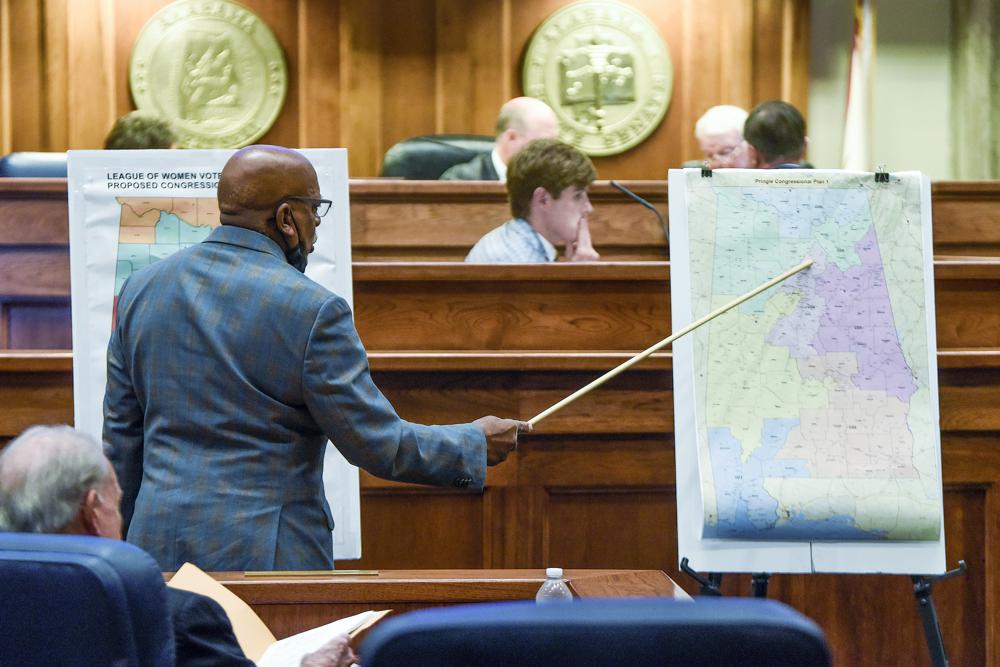
Majority Republican lawmakers have not released their ideas for redrawing Alabama’s congressional districts to comply with a Supreme Court ruling, leading Democrats on Thursday to accuse GOP lawmakers of shutting them, and the public, out of the process ahead of next week’s special session on redistricting. Alabama lawmakers begin the special session Monday to approve a redistricting plan that is being developed by Republicans but hasn’t been presented. “There hasn’t been any public scrutiny on it, and we’re just going to be handed that map at some point over the weekend, maybe even Monday, and say here, ‘Vote on it,’” Rep. Chris England, a Democrat from Tuscaloosa, said after a meeting of the legislature’s redistricting committee. England said he understands that the GOP majority will determine what passes, but said that “something with as much jeopardy attached to it as redrawing the congressional map to satisfy a Supreme Court decision” should be done “in the light of day.” A three-judge panel gave Alabama until July 21 to adopt a new congressional map after the U.S. Supreme Court upheld its ruling that the state likely violated the Voting Rights Act with its current plan that has only one congressional district with a substantial number of Black voters. The Alabama Permanent Legislative Committee on Reapportionment held a meeting Thursday to hear public comments and approve guidelines. House Speaker Pro Tempore Chris Pringle, who serves as co-chairman of the committee, said it will meet Monday to vote on the proposed map. While Democrats accused Republicans of keeping the process shrouded in secrecy, Pringle said they are proceeding as quickly as possible. He said the proposed map will be sent to committee members as soon as possible before the Monday meeting. “We are working on that as fast as we can,” Pringle said. Alabama now has only one majority-Black district out of seven in a state where more than one in four residents are Black. The three-judge panel said in its 2022 ruling that Alabama should have “two districts in which Black voters either comprise a voting-age majority or something quite close to it.” Republicans have the numbers to approve a plan without support from Democratic lawmakers. However, the plan must go back before the three-judge panel. GOP lawmakers risk the court stepping in and drawing its own plan if lawmakers stray too far from the court’s wishes. The group of Black voters that won the Supreme Court case urged committee members Thursday to adopt their proposed map. It would adjust the state’s 2nd Congressional District, now represented by Republican Rep. Barry Moore, to create what is described as an “opportunity” district because it would give Black voters, now making up 50% of the voting-age population, a greater opportunity to elect a candidate of their choice. The proposed district would encompass some Black Belt counties and parts of Mobile County. Some of the plaintiffs described how they joined the case after seeing their communities ignored by the white Republicans who represent their areas. “I want my community to have a seat at that table,” said Shalela Dowdy of Mobile. Some Democrats on the legislative committee disagreed on how to reconfigure the map. Sen. Vivian Davis Figures, D-Mobile, said she will introduce the plaintiffs’ map in next week’s session because it “complies with the court’s instruction.” Sen. Rodger Smitherman, D-Birmingham, favored a rival proposal that would alter the 6th Congressional District, now represented by Republican Rep. Gary Palmer, so it includes all of Jefferson County, which is home to Birmingham. Smitherman argued that a Democrat would have a good opportunity to be elected in the racially diverse district. “Jefferson County is the melting pot,” he said. Republished with the permission of The Associated Press.
Justice Brett Kavanaugh seeks to dispel the notion that the Supreme Court is partisan
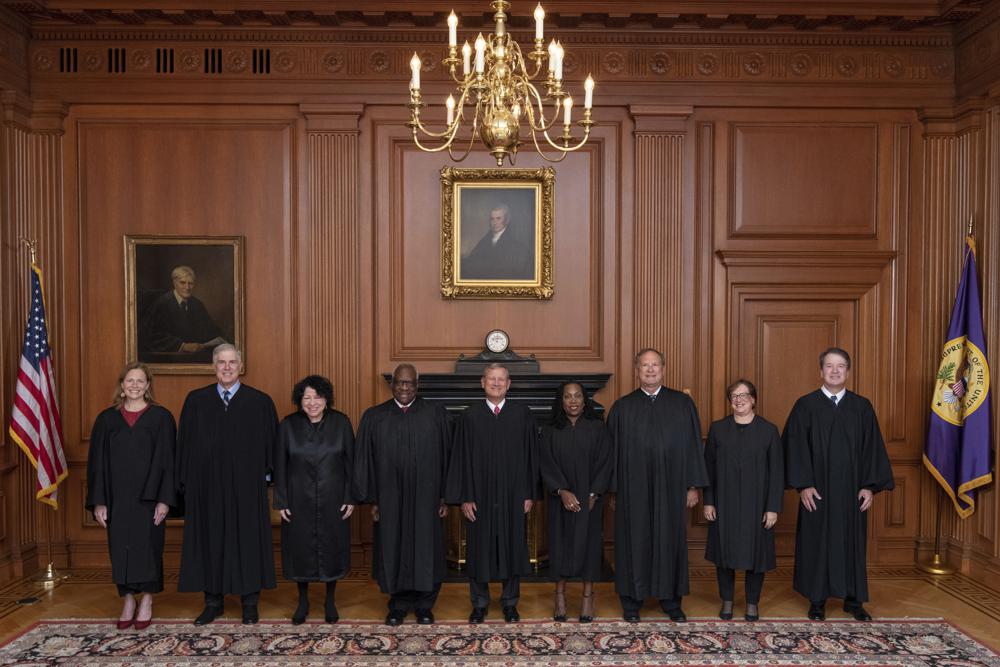
Justice Brett Kavanaugh pointed to the mixed U.S. Supreme Court decisions this term as he sought Thursday to dispel notions that it is partisan, even after conservatives brought about the end of affirmative action in college admissions and struck down President Joe Biden’s student loan debt relief program. “The court is an institution of law. It’s an institution of law, not of politics, not of partisanship,” Kavanaugh said at a judicial conference in Minnesota, in the first public remarks by a justice since the court recessed for the summer late last month. The Supreme Court has been reshaped by the three justices nominated by President Donald Trump, including Kavanaugh. Although Kavanaugh sided with the conservative majorities in the affirmative action and student loan rulings, as well as last summer’s ruling overturning the nationwide right to abortion, he was also part of the mixed conservative and liberal majorities this term that backed Black voters in Alabama and preserved a federal law aimed at keeping Native American children with Native families. And the term was marked by other notable surprises, rejecting conservative positions in a North Carolina redistricting case that could have reshaped elections across the country, while backing the Biden administration in a fight over deportation priorities. “We have lived up, in my estimation, to deciding cases based on law and not based on partisan affiliation and partisanship,” Kavanaugh said. “We don’t caucus in separate rooms. We don’t meet separately. We’re not sitting on different sides of the aisle at an oral argument. … We work as a group of nine.” Speaking to an audience of judges, attorneys, and court personnel from the 8th Circuit, which stretches from Minnesota and the Dakotas south to Arkansas, Kavanaugh said he didn’t fully appreciate until he joined the court how much time the nine justices spend alone with each other. He estimated that they eat lunch together around 65 times a year. “And the rule at lunch is you can’t talk about work,” he said. “It’s a good rule. … It builds relationships and friendships, and then when we have tough cases — and we only really have tough cases — you have a reservoir of goodwill toward each of the other people.” Kavanaugh said he was warmly welcomed in his first term in 2018 by then-Justices Ruth Bader Ginsburg and Stephen Breyer, who were part of the court’s liberal wing. He also praised his working relationships with the two newest justices, conservative Amy Coney Barrett and liberal Ketanji Brown Jackson. Kavanaugh, who was the justice most often in the majority this term in divided cases, said the Supreme Court hears 60 to 70 cases a term and that only a relative few might get most of the attention. But he said there are lots of 9-0 decisions, and there can also be a lot of 7-2 and 6-3 decisions. “All sorts of different lineups,” he said. “And so I might be working with Sonia Sotomayor on the Andy Warhol case, while we disagree on a case on the competition clause. We’re not going to let our relationship where we’re working together on one suffer just because we disagree on the other. And that’s going on with all nine of us on a daily basis.” Kavanaugh only briefly mentioned the ethics issues that have dogged some justices — including conservatives Clarence Thomas and Samuel Alito and the liberal Sotomayor — and potentially undermined public confidence in the court. He noted that Chief Justice John Roberts said in May that the justices were continuing to work on that as a group. “That’s accurate,” he said. “I’m not going to add anything to what the chief justice has said on that topic.” Roberts offered no specifics at the time, and the justices have not adopted an ethics code. Kavanaugh said people getting upset when the high court makes difficult decisions comes with the territory. He said the best the justices can do is try to be consistent, clearly explain their reasoning, and try to show that they actually are working as a team of nine on difficult cases instead of caucusing on a partisan basis. “You shouldn’t be in this line of work if you don’t like criticism,” he said. “Because you’re going to get it. And you’re going to get a lot of it.” Republished with the permission of The Associated Press.
