
Alabama unemployment rates remain at record low 2.2%

The State of Alabama has never in its history enjoyed a period of such widespread sustained prosperity for more of its population than it is now enjoying. On Friday. Alabama Department of Labor Secretary Fitzgerald Washington announced that Alabama’s preliminary, seasonally adjusted June unemployment rate held steady at a record low of just 2.2 percent. “I am proud to continue to celebrate the gains we are making month after month with our economic metrics,” said Secretary Washington. “The number of jobs our economy is supporting also rose to its highest level ever. This is certainly great news. Employers are continuing to add jobs, and more and more people are joining the labor force each month.” June’s rate is well below June 2022’s rate of 2.6%. The rate represents 50,427 unemployed persons. This is down from 51.427 in May and represents a new record low. The number of unemployed Alabamians is down from 58,505 in June 2022. Alabama’s total employment has increased by 20,928 over the past year to a new record high of 2,253,490. Alabama’s civilian labor force also reached a new record high of 2,303,917, with 12,850 more people joining the work force over the past year. Over the year, wage and salary employment increased by 55,700, to set a new record high of 2,163,600. The state experienced gains in the leisure and hospitality sector (+11,400), the private education and health services sector (+10,000), and the trade, transportation, and utilities sector (+8,400), among others. Over the month, wage and salary employment grew by 16,900. The state experienced monthly gains in the leisure and hospitality sector (+8,300), the trade, transportation, and utilities sector (+2,800), and the manufacturing sector (+2,700), among others. The counties with the lowest unemployment rates are Shelby County at 2.0%, Morgan County at 2.1%, and Madison and Cullman Counties at 2.2%. The counties with the highest unemployment rates are Wilcox County at 7.5%, Perry County at 6.2%, and Dallas County at 5.7%. The major cities with the lowest unemployment rates are Trussville and Vestavia Hills at 1.8%, Madison at 1.9%, and Alabaster, Homewood, and Hoover at 2.0%. The major cities that experienced the highest unemployment rates are Selma at 6.7%, Prichard at 5.6%, and Bessemer at 3.9%. To connect with the author of this story or to comment, email brandonmreporter@gmail.com
Redistricting plan goes to a conference committee
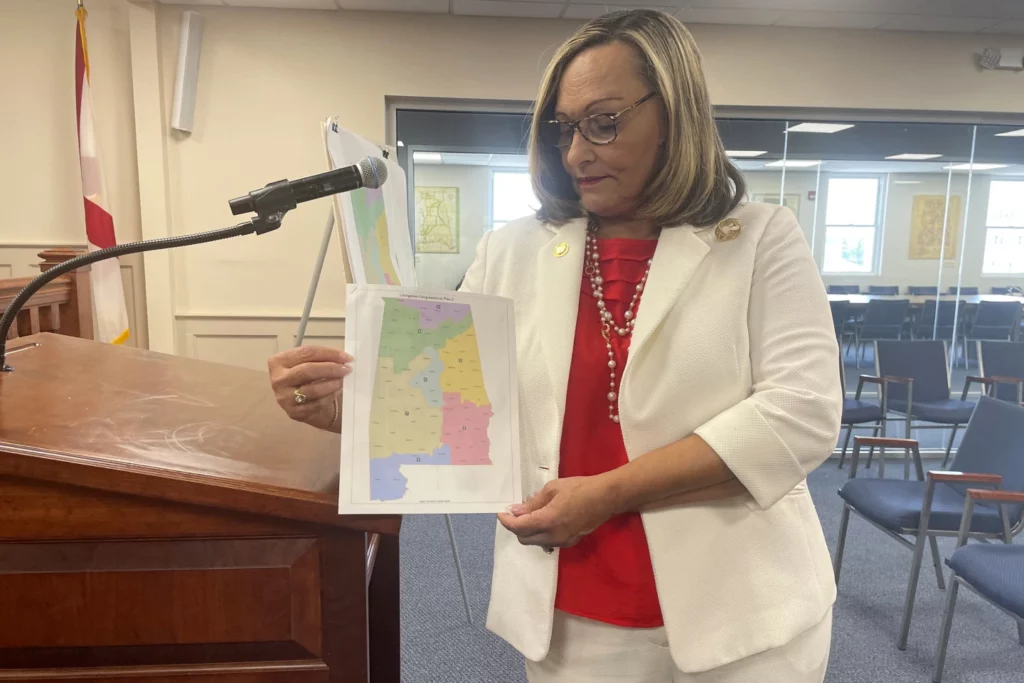
On Friday, the Alabama House of Representatives passed a Republican congressional redistricting plan that it hopes will comply with the Voting Rights Act of 1965. The Alabama Senate voted 30 to 0 to non-concur with the House plan. The redistricting plan has been referred to a conference committee to produce a compromise version that is acceptable to both Houses of the Legislature. For redistricting to pass out of the Legislature, the six-member conference committee has to reach a compromise. Then both Houses of the Legislature must vote to concur with the findings of the conference committee. Senate Bill 5 is sponsored by State Senator Steve Livingston (R-Scottsboro). The bill was carried in the House of Representatives by State Representative Chris Pringle (R-Mobile). Both Livingston and Pringle have introduced competing versions of the redistricting bill. The version of the bill that passed in the House is the Pringle version, the community of interest plan. Pringle’s plan would redraw Alabama’s Second Congressional District, currently represented by Congressman Barry Moore (R-AL02), to increase the Black voting age population in CD2 from 30% of the population to over 42%. Senate Democrats have introduced multiple plans that would produce two majority-minority districts. Livingston’s competing plan passed out of the Senate on Wednesday. Pringle says that his plan’s CD2 would meet the Supreme Court’s ruling that the state provides an opportunity for Blacks to pick a candidate of their choice. Democrats disagree. “You are giving me an opportunity to lose,” said Senate Minority Leader Bobby Singleton (D-Greensboro). “There ain’t no opportunity there for Blacks or Democrats in that district,” said Sen. Rodger Smitherman (D-Birmingham). Democrats maintain that it is necessary for there to be two majority-minority congressional districts for Black voters to have an opportunity to choose their own representation. They also maintain that that is what the court intended. Sen. Merika Coleman (D-Birmingham) said, “I contend that for African Americans to choose the candidate of their choice that we have to have a majority of African-Americans.” “It is irresponsible for the legislature to do what it is doing,” Coleman said. “The court ordered two districts that have 50% African Americans.” “The three-judge panel said that a proper remedy could consist of two majority-minority districts or quite close to it,” said Rep. Artis “A.J.” McCampbell (D-Livingston). The House of Representatives passed SB5 76 to 26. The Senate, in their own debate on redistricting, then voted 30 to 0 to concur with the House version of SB5 and go to a conference committee. Senate President Pro Tempore Greg Reed (R-Jasper) appointed Sens. Livingston, Smitherman, and Clay Scofield (R-Guntersville) to the conference committee. Speaker of the House Nathaniel Ledbetter (R-Rainsville) appointed Pringle, Chris England (D-Tuscaloosa), and Chris Sells (R-Greenville) to the conference committee. Both Houses of the Legislature will return on Friday afternoon, presumably to vote on the conference committee report. To connect with the author of this story or to comment, email brandonmreporter@gmail.com.
State of Alabama executes James Edward Barber
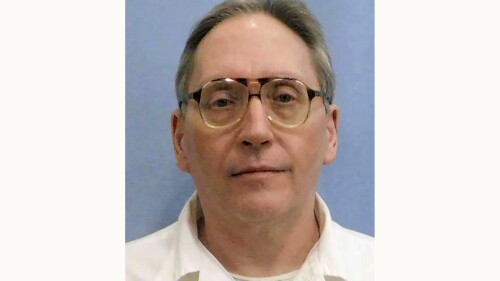
After months of delays, Alabama is once again executing convicted murderers for their crimes. After the U.S. Supreme Court legally cleared the execution of James Edward Barber to move forward, Alabama Governor Kay Ivey told Corrections Commissioner John Hamm that she would not exercise her clemency powers in this case and then directed him to proceed with Mr. Barber’s lawfully imposed death sentence for the 2001 brutal beating of seventy-five-year-old Dorothy Epps. That execution was carried out by lethal injection early Friday morning. “Tonight, the justice that James Barber managed to avoid for more than two decades has finally been served,” said Gov. Ivey. “In 2001, 75-year-old Dorothy Epps desperately fought for her life as Mr. Barber brutally and gruesomely beat her to death in her own home. The facts are clear: Mr. Barber confessed to his guilt, and the jury has spoken. His litany of appeals to delay justice finally came to an end, and Mr. Barber has answered for his horrendous crime. In Alabama, we will always work to enforce the law and uphold justice.” Alabama Attorney General Steve Marshall issued a statement this morning after the execution of James Edward Barber at the William C. Holman Correctional Facility in Atmore, Alabama. “Justice has been served,” Marshall said. “This morning, James Barber was put to death for the terrible crime he committed over two decades ago: the especially heinous, atrocious, and cruel murder of Dorothy Epps.” “I ask the people of Alabama to join me in praying for the victim’s family and friends, that they might now be able to find some sense of peace and closure,” said Marshall. The Attorney General cleared the execution to commence at 1:34 a.m. James Barber’s time of death was 1:56 a.m. On Sunday, May 20, 2001, James Barber brutally murdered Dorothy Epps at her home in Harvest, Alabama, taking her life so that he could steal her purse. Dorothy Epps was home alone on the night of her murder. Mrs. Epps knew and had a friendly relationship with James Barber, who in the past had dated her daughter and had been hired to do repair work on her house. When Barber knocked on Mrs. Epps’s door, she probably invited him inside, having no reason to suspect his malevolent intent. According to prosecutors, after entering her home, “Barber viciously and mercilessly attacked Mrs. Epps,” a 75-year-old woman who weighed 100 pounds, striking her in the face and beating her to death with his fists and a claw hammer. Dorothy Epps suffered multiple skull fractures, head lacerations, fractured ribs, injuries to her neck, mouth, and eye, and bleeding over her brain. She also suffered numerous defensive wounds, establishing that she was facing Barber at times, was conscious and aware of what was happening, and tried to fend off his blows with her bare hands. Prosecutors say that after murdering Mrs. Epps, Barber grabbed her purse and ran from the scene. Barber left the house a bloody mess. Barber’s bloody footprints were found on Mrs. Epps’s body, and his bloody handprint was left on a countertop. Barber was arrested and voluntarily confessed to the murder of Dorothy Epps, providing police with an elaborate account of his crimes. He admitted that “the crime was senseless and stupid” and that he deserved “to be charged and put to death” for committing it. At trial, where overwhelming evidence of his guilt was presented—including his own video-recorded confession—Barber was convicted of capital murder by a jury of his peers and sentenced to death. Barber’s execution was opposed by liberal groups who oppose the death penalty – even though the death penalty has been among the penalties for murder for thousands of years of human history across numerous civilizations. Ivey temporarily halted executions late last year after workers at the Department of Corrections botched two lethal injection executions because of difficulties inserting IVs into the condemned men’s veins. The Governor authorized the executions to resume in February. To connect with the author of this story or to comment, email brandonmreporter@gmail.com.
Legislature to finish redistricting today
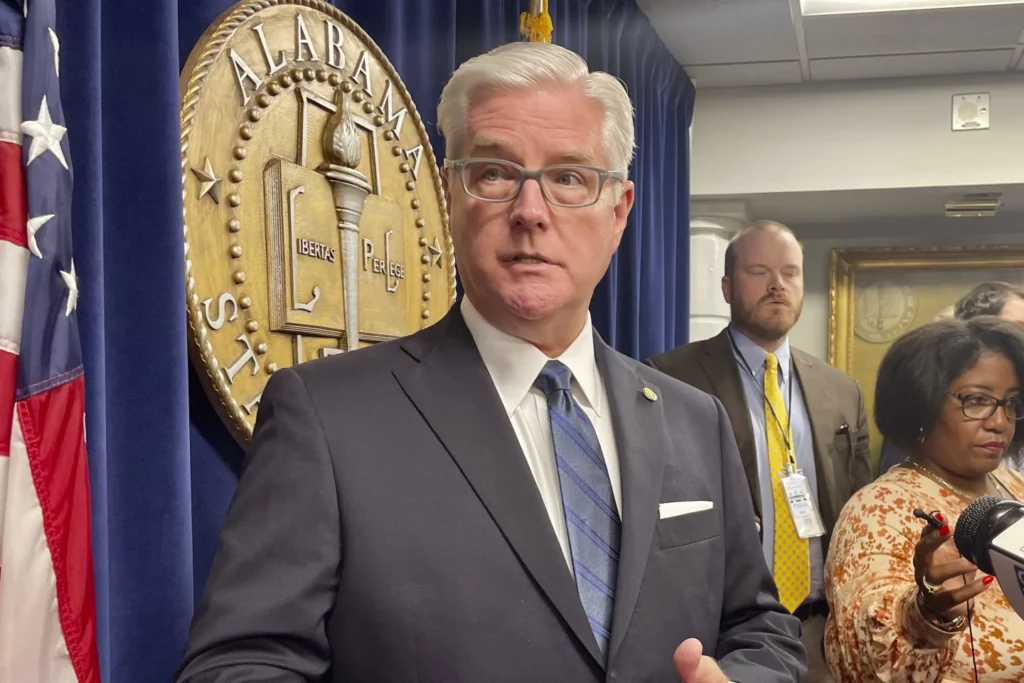
On Friday, both Houses of the Alabama Legislature will meet on redistricting. The federal appeals court in Atlanta has set Friday, July 21, as the deadline for the state to submit a new congressional redistricting for the court to consider in the state’s ongoing Voting Rights Act case concerning congressional redistricting. There are a lot of disagreements in the Legislature on what plan the legislators should pass. Legislative Democrats, the plaintiffs in the lawsuit against the state, and civil rights groups believe that to comply with the Voting Rights Act of 1965, the state should pass a plan with two majority-minority districts. This would almost certainly mean a pickup of one House of Representatives seat for Democrats in the U.S. Congress as Alabamians overwhelmingly vote along racial lines, with over 90% of Black Alabamians preferring Democrats and over 80% of White Alabamians preferring Republicans in recent elections. Alabama’s Legislative Republicans have rejected calls by Democrats to turn Alabama’s Second Congressional District into a majority-minority district. Congressional District 2 is currently represented by Congressman Barry Moore (R-Enterprise) – who served two terms in the Alabama House of Representatives from 2010 to 2018. Moore is a Republican, a member of the conservative Freedom Caucus, and an ardent Donald Trump supporter. Currently, 30% of the voters of CD2 are Black. State Senator Rodger Smitherman (D-Birmingham) has introduced a plan that would turn Congressional District 2 into a majority-minority district with over 50% of the voters in the district being Black. Republicans rejected that map as well as others introduced by Sen. Bobby Singleton (D-Greensboro) and other Democrats. Republicans maintain that the court has not ruled on Milligan v. Allen that the state is in violation of the Voting Rights Act. Democrats look at the same U.S. Supreme Court ruling and the recent order by a three-judge panel of the Eleventh Circuit Court of Appeals and say that the court did not provide the state with enough guidance to know what an “opportunity district” means. “That could be 42% (Black voters), that could be 38%, we just don’t know,” Senate President Pro Tempore Greg Reed (R-Jasper) told reporters. House Republicans have passed a plan by State Representative Chris Pringle (R-Mobile) they title the community of interest plan where Congressional District 2 is over 42% Black. Pringle maintains that that is close enough racially so that it is winnable by either party. Senate Republicans have passed a competing plan by State Sen. Steve Livingston (R-Scottsboro). The Livingston plan would only raise the Black voting age population of CD2 from 30% Black to 38% Black. Livingston said his plan kept communities of interest together and is the most compact while still providing an opportunity district for Black voters in Congressional District 2. More radical elements in the Legislature had called for turning Alabama’s Seventh Congressional District into an opportunity district that would be potentially winnable by Republicans. Congressional District 7 is represented by Terri Sewell – the only Democrat and the only Black representative in the congressional delegation. Both Pringle and Livingston, while deeply divided on the merits of their respective plans, did not go that far, and Congressional District 7 remains majority Black. Livingston said that his plan kept the Wiregrass whole and in the Second Congressional District, and it keeps the Gulf Coast and Mobile County whole. The House passed Pringle’s plan on Wednesday, but when he brought his bill to the Senate, Livingston motioned to substitute the Pringle plan for the Livingston plan. The Committee passed that motion. Pringle then stormed out of the room without continuing to present his bill. His bill, now the Livingston Bill, was passed by the Committee along party lines, with Democrats voting against it and Republicans voting for it. The one exception was State Senator Andrew Jones (D-Centre). His primary disagreement with the Livingston plan is that a small portion of northwest Etowah County would be in Congressional District 4, while 90% of Etowah County would switch to Congressional District 3. Jones told reporters he did not care whether Congressman Mike Rogers (R-AL03) or Robert Aderholt (R-AL04) represented Etowah County. “My issue is that historically Etowah County has not been divided,” Jones, who represents Etowah and Cherokee Counties, said. Smitherman told reporters that he and Sen. Singleton had brought their own federal lawsuit and joined Milligan and the other plaintiffs. Smitherman said that it is his understanding that the plaintiffs will be given the opportunity to tell the court whether the plan passed by the Legislature satisfies their concerns or not. “Right now, I can’t support either (Republican) plan,” Smitherman said. Smitherman has demanded that the Apportionment Committee prepare a report on the plans showing the likelihood of a Democrat or a Republican winning each of these. “They can get that, or they already know it and don’t want to release it,” Smitherman said, Since the GOP is wildly divided on which plan they will advance to federal court, there is uncertainty about what the Legislature will pass on Friday. “Obviously, there will be negotiations,” Reed said. A compromise plan can be substituted on the floor of either House. Failing that, any difference between the House and Senate plans would be settled by a conference committee. If that happens, then under the circumstances, both Houses will recess until the conference committee returns with a conference committee plan to vote on. If the state and the plaintiffs cannot agree on a redistricting plan that is acceptable to both sides, a trial will likely be held in the eleventh circuit. Whatever is ultimately decided by the federal appeals court in Atlanta will likely be appealed by whichever party is dissatisfied with the outcome meaning that the Milligan case could go back to the Supreme Court, where Justice Brett Kavanaugh appears to be the swing vote. There is even a possibility that this case may not be resolved until after the 2024 elections. To connect with the author of this story or to comment, email brandonmreporter@gmail.com.
Alabama Power’s Chandler Mountain Project is generating controversy
Alabama Power Company’s plan to build a new series of dams on Little Canoe Creek in St, Clair, and Etowah Counties is generating a lot of questions in the local community. Alabama Power is seeking approval for its Chandler Mountain Project through the Federal Energy Regulatory Commission (FERC). The Company filed a notice of intent and Pre-Application Document with FERC on April 14, 2023. According to Alabama Power’s website to promote the project, “The unconstructed Chandler Mountain Project would be a pumped storage hydroelectric generating facility, which is anticipated to provide 1,600 megawatts (MW) and would involve the construction of new water storage, water conveyance, and generation facilities at locations where such facilities do not exist at this time. The proposed Chandler Mountain Project would be located on Little Canoe Creek East in Etowah and St. Clair Counties near the town of Steele, Alabama.” “The Chandler Mountain Project would include an upper dam that creates an approximate 526-acre lined upper reservoir; an upper reservoir intake structure; an underground powerhouse with four reversible pump turbines, each 400 MW; four dam sections (Lower Dam A, Lower Dam B, Lower Dam C, and Lower Dam D), including a discharge structure at Lower Dam A, that create the approximate 1,090-acre lower reservoir; an approximate 6-mile supplemental water source conveyance structure; and transmission-related structures and facilities,” the company explained. The total dimensions of the project remain unclear at this time as it is still in the design stage. “The Chandler Mountain Project is currently in the planning and design phase,” the Company stated. “For this reason, Alabama Power does not know final details about the size of the facility and the specific land needed for the project at this time. However, information will be provided to stakeholders as it becomes available during the FERC licensing process, which will span the next 5-10 years. The Project Area shown in the Pre-Application Document includes lands and waters that may be affected by the proposed construction and operation of the project. During the FERC licensing process, Alabama Power will evaluate the potential impacts to the Project Area that may occur during project construction and operation.” “Pumped storage is a form of technology that utilizes two reservoirs at different elevations,” Alabama Power explained on their website. “During periods of low-energy demand, water is pumped from the lower reservoir to the upper reservoir and stored there until periods of high-energy demand when it is released back to the lower reservoir through a powerhouse where electricity is generated. Energy storage projects such as the Chandler Mountain Project are used across the country to help ensure a reliable and resilient electricity system that is increasingly integrating intermittent renewable forms of energy such as wind and solar.” This proposal has been met with skepticism by the local community and some local environmentalists alike, who feel that the project could jeopardize the culture of the area as well as the flora and fauna. Already a ‘Stop the Chandler Mountain Dam Project’ and ‘Save Chandler Mountain’ Facebook groups have started. There have been two public hearings in the Steele and Rainbow City areas to better inform the public about Alabama Power’s plans for the area. While the Steele and Chandler Mountain areas are very rural and best known for cattle, poultry, and tomato farms, the area has been targeted for transformation into industrial development. Etowah County has purchased 1,200 acres of farmland near Steele as the County’s Little Canoe Creek Megasite and has been marketing tracts to would-be industrialists. Alabama Power said that Pumped storage projects can take well over a decade to license, design, and construct. The FERC licensing process for the Chandler Mountain Project officially began with the filing of the Notification of Intent and Pre-Application Document on April 14, 2023. APC says that it will take 4-5 years to prepare and file a license application. Then, Alabama Power anticipates that FERC will require an additional 2-4 years after filing the license application to reach a licensing decision. Only after license issuance, and when all other regulatory approvals are in place, can construction begin. Alabama Power anticipates 5-7 years for construction following the issuance of the FERC license, so this project will not be operational until sometime in the mid-2030s at the earliest. To connect with the author of this story or to comment, email brandonmreporter@gmail.com.
Alabama to carry out first lethal injection after review of execution procedures
Alabama plans to execute an inmate on Thursday for the 2001 beating death of a woman as the state seeks to carry out its first lethal injection after a pause in executions following a string of problems with inserting the IVs. James Barber, 64, is scheduled to be put to death Thursday evening at a South Alabama prison. It is the first execution scheduled in the state since Alabama Gov. Kay Ivey paused executions in November to conduct an internal review. Ivey ordered the review after two lethal injections were called off because of difficulties inserting IVs into the condemned men’s veins. Attorneys for inmate Alan Miller said prison staff poked him with needles for over an hour as they unsuccessfully tried to connect an IV line to him and, at one point, left him hanging vertically on a gurney during his aborted execution in September. State officials called off the November execution of Kenneth Eugene Smith after they said they were unsuccessful in connecting the second of two required lines. Advocacy groups claimed a third execution, carried out in July after a delay because of IV problems, was botched because of multiple attempts to connect the line, a claim the state has disputed. “Given Alabama’s recent history of botched executions, it is staggering that James Barber’s lethal injection is set to take place,” Maya Foa, director of the anti-death penalty group Reprieve, said. “Three executions in a row went horribly wrong in Alabama last year, yet officials have asserted that ‘no deficiencies’ were found in their execution process.” Barber was convicted in the 2001 beating death of 75-year-old Dorothy Epps in Harvest, Ala. Prosecutors said Barber, a handyman who knew Epps’ daughter, confessed to killing Epps with a claw hammer and fleeing with her purse. Jurors voted 11-1 to recommend a death sentence, which a judge imposed. Barber’s execution was scheduled for the same day that Oklahoma executed Jemaine Cannon for stabbing a Tulsa woman to death with a butcher knife in 1995 after his escape from a prison work center. Attorneys for Barber have asked federal courts to block the lethal injection, citing the state’s past problems. The 11th U.S. Circuit Court of Appeals refused to halt the execution on Wednesday. Judges noted the state had conducted a review of procedures and wrote that “Barber’s claim that the same pattern would continue to occur” is “purely speculative.” The court noted that the Alabama Department of Corrections had changed medical personnel and lengthened the timeframe for executions. “ADOC conducted a full review of its execution processes and procedures, determined that no deficiencies existed with the protocol itself, and instituted certain changes to help ensure successful constitutional executions,” the court wrote. Barber appealed to the U.S. Supreme Court on Thursday, asking justices to stay the execution. His lawyers wrote that the “fourth lethal injection execution that will likely be botched in the same manner as the prior three.” “Alabama’s past three execution proceedings imposed needless physical and emotional suffering on inmates to such an extent that Alabama paused its lethal injection executions and undertook an internal review of its procedures,” Barber’s lawyers wrote in the Supreme Court filing. “Shockingly, however, that review resulted in no substantive changes to Alabama’s procedures or to the qualifications of those carrying out lethal injection executions.” The Alabama attorney general’s office has urged the Supreme Court to let the execution proceed. The state wrote that the previous executions were called off because of a “confluence of events—including health issues specific to the individual inmates and last-minute litigation brought by the inmates that dramatically shortened the window for ADOC officials to conduct the executions.” “Dorothy Epps, Smith’s victim, has survivors who have already waited overlong to see justice done,” the office added. The state conducted an internal review of procedures. Ivey rebuffed requests from several groups, including a group of faith leaders, to follow the example of Tennessee Gov. Bill Lee and authorize an independent review of the state’s execution procedures. One of the changes Alabama made following the internal review was to give the state more time to carry out the execution. The Alabama Supreme Court did away with its customary midnight deadline to get an execution underway in order to give the state more time to establish an IV line and battle last-minute legal appeals. The state will have until 6 a.m. Friday to start Barber’s execution. Republished with the permission of The Associated Press.
Alabama lawmakers are divided on eve of major redistricting deadline impacting Black voters
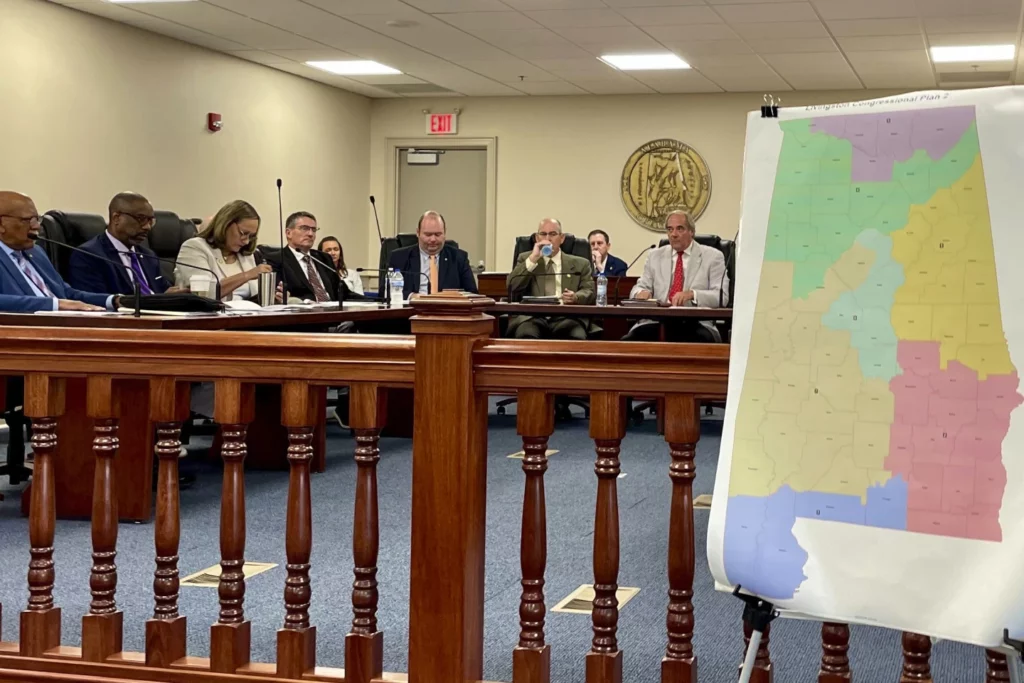
On the eve of a court deadline, Alabama lawmakers are still divided Thursday over the map designating new congressional districts and sparred over what constitutes an “opportunity” district that the state was ordered to create for Black voters. Republican-controlled committees in the House of Representatives and Senate continue to advance separate plans that increase the number of Black voters in the state’s 2nd congressional district but fail to establish the second majority-Black district, as sought by plaintiffs who won the Supreme Court case last month. Under the state Senate plan, the number of Black voters in the 2nd congressional district would increase from about 30% to 38%; under the House plan, it would increase to 42%. “We believe it does meet the Voting Rights (Act) standard because we followed all the guidelines. As an opportunity district, nobody knows what the definition of opportunity is. They didn’t give us (a definition),” Sen. Steve Livingston said. The Republican senator from Scottsboro said the chamber settled on 38% of the population of Black voters as adequate to fulfill the court’s directive. “So I’ve got an opportunity to lose,” said Senate Minority Leader Bobby Singleton, a Democrat from Greensboro. Black lawmakers argued those numbers would make it impossible for a Black candidate to win in that district, and do not comply with the court directive to create a second majority-Black district “or something quite close to it.” “There ain’t no way that in that district — that we’re dealing with here in two — that an African-American got a chance to get elected. Ain’t no way whatsoever,” said Democratic Sen. Rodger Smitherman of Birmingham. State lawmakers face a Friday deadline to adopt new lines after the U.S. Supreme Court in June upheld a three-judge panel’s finding that the current state map — with one majority-Black district out of seven in a state that is 27% Black — likely violates the federal Voting Rights Act. State Republicans, who have been reluctant to create a Democratic-leaning district, are engaging in a high-stakes wager that the panel will accept their proposal, arguing that the compact scale of the districts satisfies redistricting principles, or that the state will prevail in a second round of appeals. The panel that issued a preliminary injunction blocking use of the existing map said in 2022 that Alabama should have “either an additional majority-Black congressional district or an additional district in which Black voters otherwise have an opportunity to elect a representative of their choice.” The judges added that any map should include two districts where “Black voters either comprise a voting-age majority or something quite close to it.” The meaning of the terms “quite close” and “opportunity” has dominated much of the legislative debate. “We’ve got information that’s come from the court. We’ve had information come from the justices, but much of this is speculative as to what they meant,” Senate President Pro Tem Greg Reed, the Republican leader of the Senate, told reporters Thursday. Reed said lawmakers are working toward a compromise between the state House and Senate plans, and that the lawmakers will “absolutely” meet the Friday deadline. Once a new GOP map is approved, the fight will shift quickly back to the courts. A Democratic state senator speculated that Alabama Republicans are seeking another Voting Rights Act challenge before the U.S. Supreme Court. “I think the (Alabama) attorney general is setting up a war with Section 2 (of the Voting Rights Act) so once they get back, they can have a real shot at gutting Section 2. That’s just my gut,” Singleton said. Plaintiffs who won the Supreme Court case have said they will challenge either proposal if enacted. Scott Douglas, executive director of Greater Birmingham Ministries and a plaintiff in the case, said lawmakers have “apparently learned nothing from their loss at the Supreme Court. The Legislature has put forward yet another map that dilutes the electoral power of Black Alabamians.” Republished with the permission of The Associated Press.
