
Twitter users blocked by Donald Trump cry censorship
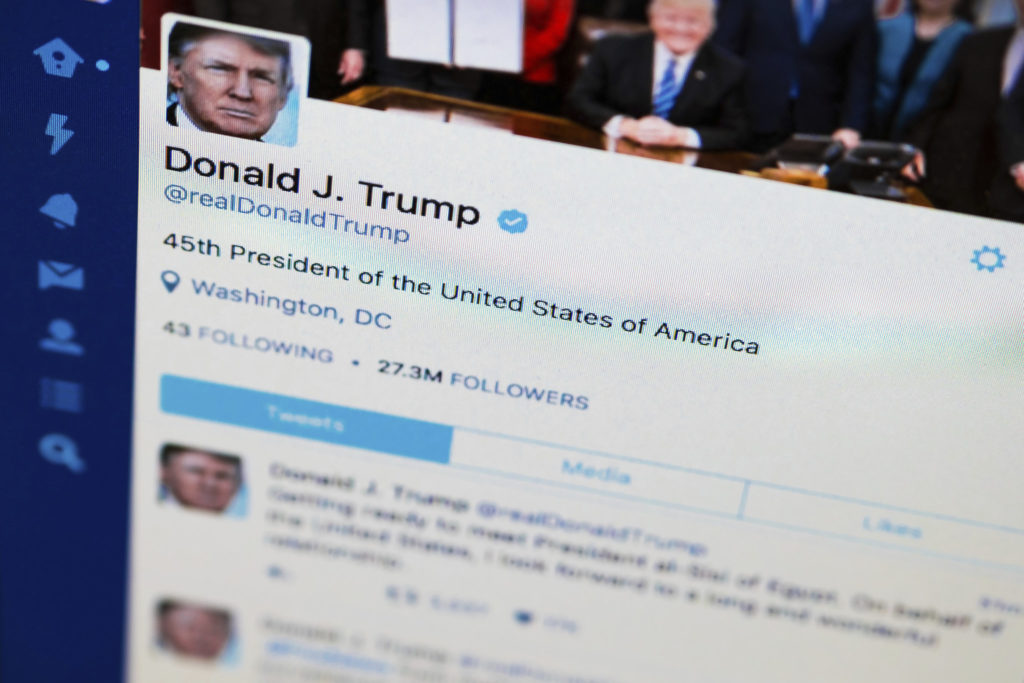
President Donald Trump may be the nation’s tweeter-in-chief, but some Twitter users say he’s violating the First Amendment by blocking people from his feed after they posted scornful comments. Lawyers for two Twitter users sent the White House a letter Tuesday demanding they be un-blocked from the Republican president’s @realDonaldTrump account. “The viewpoint-based blocking of our clients is unconstitutional,” wrote attorneys at the Knight First Amendment Institute at Columbia University in New York. The White House didn’t immediately respond to a request for comment. The tweeters – one a liberal activist, the other a cyclist who says he’s a registered Republican – have posted and retweeted plenty of complaints and jokes about Trump. They say they found themselves blocked after replying to a couple of his recent tweets. The activist, Holly O’Reilly, posted a video of Pope Francis casting a sidelong look at Trump and suggested this was “how the whole world sees you.” The cyclist, Joe Papp, responded to the president’s weekly address by asking why he hadn’t attended a rally by supporters and adding, with a hashtag, “fakeleader.” Blocking people on Twitter means they can’t easily see or reply to the blocker’s tweets. Although Trump started @realDonaldTrump as a private citizen and Twitter isn’t government-run, the Knight institute lawyers argue that he’s made it a government-designated public forum by using it to discuss policies and engage with citizens. Indeed, White House press secretary Sean Spicer said Tuesday that Trump’s tweets are “considered official statements by the president.” The institute’s executive director, Jameel Jaffer, compares Trump’s Twitter account to a politician renting a privately-owned hall and inviting the public to a meeting. “The crucial question is whether a government official has opened up some space, whether public or private, for expressive activity, and there’s no question that Trump has done that here,” Jaffer said. “The consequence of that is that he can’t exclude people based solely on his disagreement with them.” The users weren’t told why they were blocked. Their lawyers maintain that the connection between their criticisms and the cutoff was plain. Still, there’s scant law on free speech and social media blocking, legal scholars note. “This is an emerging issue,” says Helen Norton, a University of Colorado Law School professor who specializes in First Amendment law. Morgan Weiland, an affiliate scholar with Stanford Law School’s Center for Internet and Society, says the blocked tweeters’ complaint could air key questions if it ends up in court. Does the public forum concept apply in privately run social media? Does it matter if an account is a politician’s personal account, not an official one? San Francisco-based Twitter Inc. declined to comment. The tweeters aren’t raising complaints about the company. Republished with permission of The Associated Press.
Religious freedom could top Jeff Sessions civil rights priorities
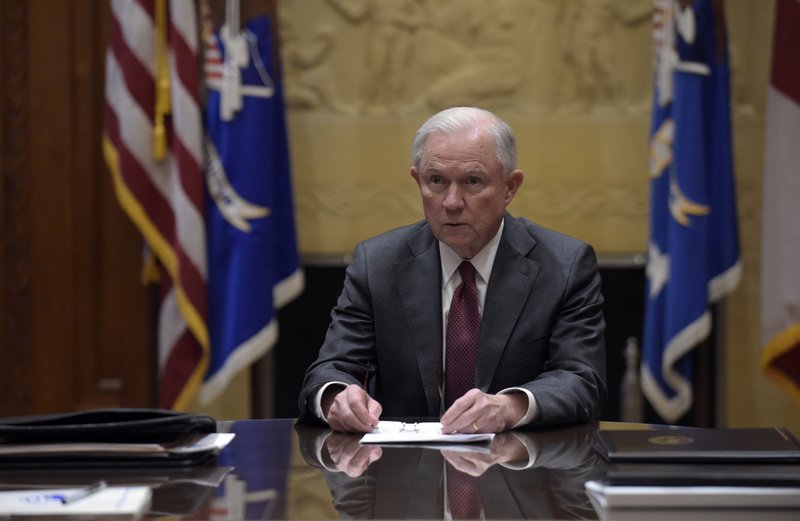
When President Donald Trump spoke to the National Prayer Breakfast this month, he underscored his vow to defend the religious rights of the conservative Christians who helped propel him to power. Now, they expect the Justice Department under new Attorney General Jeff Sessions will reposition itself as a champion of what they see as that religious freedom. It would be a welcome change for conservative Christians who say their concerns were marginalized under the Obama administration in favor of First Amendment and LGBT issues. Exactly how Sessions will approach the issue remains to be seen, but he has given them plenty of reasons to be hopeful. As a Republican senator from Alabama, Sessions, a devout Methodist, argued that the separation of church and state is unconstitutional, and that the First Amendment’s bar on an establishment of religion has been interpreted too strictly, while its right to free exercise of religion has been diminished. Asked at his confirmation hearing whether a “secular person” has “just as good a claim to understanding the truth as a person who is religious,” Sessions replied, “Well. I’m not sure.” That backdrop suggests Sessions’ Justice Department could more eagerly insert itself into religion-oriented cases such as that of the bakery fined for refusing to make a gay wedding cake, or the high-school football coach fired for praying on the field after games, who Trump repeatedly mentioned during his campaign. “Religious conservatives have sort of been the forgotten people,” said Hiram Sasser, deputy chief counsel for First Liberty Institute, a law firm that specializes in issues of religious liberty. “Now, we have a refreshing sort of reboot to be able to have at least a voice, and to be able to once again have a seat at the table.” Sessions could bring major changes throughout the Justice Department. But the department’s civil rights division traditionally is subject to the most radical shift in agendas with each change in presidential administration. Where the Obama Justice Department wanted to leave its mark on reforming troubled police departments, Sessions will likely use its resources differently. On his first full day on the job, Sessions signaled a shift away from Obama priorities when the Justice Department changed its legal position in a case involving transgender rights. The department is no longer asking a judge to limit an injunction restricting the federal government from telling schools that students should be able to use bathrooms and locker rooms corresponding to their gender identity. Transgender rights were a focus of the department under former Attorney General Loretta Lynch, who sued the state of North Carolina over a bathroom bill that the government said discriminated against transgender people. Such a move would be improbable in an administration like Trump’s, which has already signaled its deference to states’ rights. It’s unclear exactly what priorities Sessions will pursue when it comes to the civil rights division. The Justice Department declined to comment on his plans for enforcement of religious freedom. He has faced intense criticism of his record on civil rights with regard to race. A renewed focus on religious causes would be “especially troubling in light of the fact that increasing numbers of Americans are not religious,” said Marci Hamilton, a Yeshiva University legal expert on religious liberty. “This landscape is radically different.” But it would help satisfy Trump’s campaign promise to his Christian political base. While the appointment of Sessions is a promise fulfilled, some religious conservatives remain concerned that Trump won’t deliver. When he was Indiana’s governor, Vice President Mike Pence signed a religious freedom law but softened it after criticism that it was discriminatory, a move that disappointed some conservatives. Trump still has not signed an executive order to boost protections for those with religious objections to gay marriage and create a working group within the Justice Department to protect “the religious freedom of persons and religious organizations.” Groups ranging from the U.S. Conference of Catholic Bishops to Sasser’s First Liberty Institute have launched campaigns urging Trump to enact broad protections for religious objectors to laws such as gay marriage and abortion. His civil rights division could bear a close resemblance to that of the Bush administration, which took a keen interest in matters of religious freedom. It touted its work on human trafficking, an issue of importance to religious conservatives, as a counter to claims that it was weak on civil rights enforcement. Such trafficking cases could again dominate the civil rights division’s criminal caseload, while prosecutions of police officers for rights violations, for example, might move to the back burner, said William Yeomans, who spent 24 years as a lawyer in the civil rights division during Democratic and Republican administrations. The department could insert itself in federal lawsuits on behalf of faith-based groups, among other actions. It could aggressively enforce the provision of the Civil Rights Act that bans workplace bias based on religion, and also a law designed to let churches and other religious institutions skirt zoning restrictions, which the Obama administration used to sued several cities that refused to allow the construction of mosques. Said Mat Staver, founder and chairman of Liberty Counsel: “You’re going to see a big effort to protect religious freedom. It’s a welcome change.” Republished with permission of the Associated Press.
Judge: No, teacher-student sex bans are not unconstitutional
An Alabama judge ruled on Tuesday that prohibitions against teachers having sex with students do not violate the Constitution. It may seem obvious, but defense attorneys for Carrie Witt — a Decatur High School teacher and athletics coach charged with having sex with two minors — challenged the principle in a Morgan County District Court proceeding earlier in April. Witt’s counselors, Robert Tuten and Nick Heatherly, filed a motion asking a Judge Brent Craig to throw out their client’s charges on the basis the state law criminalizing student-teacher sexual relationships violate the 1st Amendment to the U.S. Constitution, with its protections of free speech and free association. The judge dismissed that motion, arguing restricting Witt’s right to sex with underage students does indeed limit her rights, but that such a restriction is in the state’s broader interest. “Constitutional liberties may be restrained when the state has a legitimate interest in doing so,” Craig said of his ruling. “The classic example is, while American citizens enjoy the freedom of speech, one cannot yell fire in a crowded movie theater. Freedom of speech can be restricted.” “Teachers are vested with a great deal of trust by the school districts, the parents, the public, and the students themselves,” continued Craig, citing a Kansas case. “Our legislature has sought to preserve that trust by prohibiting teachers from misusing their access to students as a means to obtain sex. A sexually charged learning environment would confuse, disturb, and distract students, thus undermining the quality of education in Kansas.” In other words, though Alabama law deprives her of certain liberties, the state has a valid and defensible reason for doing so. The 42-year-old Witt taught history and social studies and coached the girls’ golf and JV cheerleading squads. The case will continue at a preliminary hearing on May 3, 2016, at 9:00 a.m.
