
Marco Rubio speaks New Hampshire House of Representatives on Wednesday
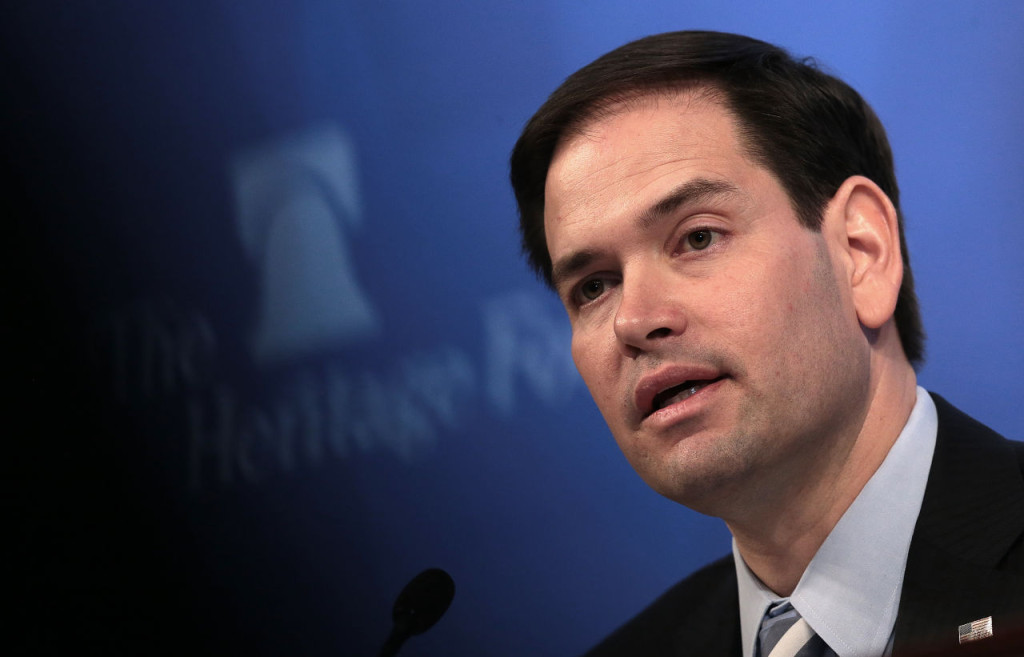
Marco Rubio may be on familiar territory during a trip to New Hampshire this week. Rubio is set to head to the Granite State on Wednesday, according to his campaign. The Florida senator is scheduled to address the New Hampshire House of Representatives on Wednesday morning. The address could remind campaign watchers of Rubio’s early days in politics. He was elected to the Florida House of Representatives in 2000 and was House Speaker from 2006 to 2008. The speech is scheduled for 10:20 a.m. Wednesday at the New Hampshire State House in Concord. Earlier Wednesday, Rubio is set to attend a town-hall meeting Plymouth, New Hampshire. The swing through New Hampshire comes three weeks before that state’s primary. Rubio is polling in second place in New Hampshire with 12.8 percent. He trails GOP front-runner Donald Trump, who is at 30.4 percent, according to RealClearPolitics. Rubio isn’t heading just to New Hampshire this week. He’s also campaigning in Iowa and has several town hall meetings scheduled for Monday. The Iowa caucuses are in two weeks on Feb. 1.
Jeb Bush super PAC targets Chris Christie, John Kasich in New Hampshire
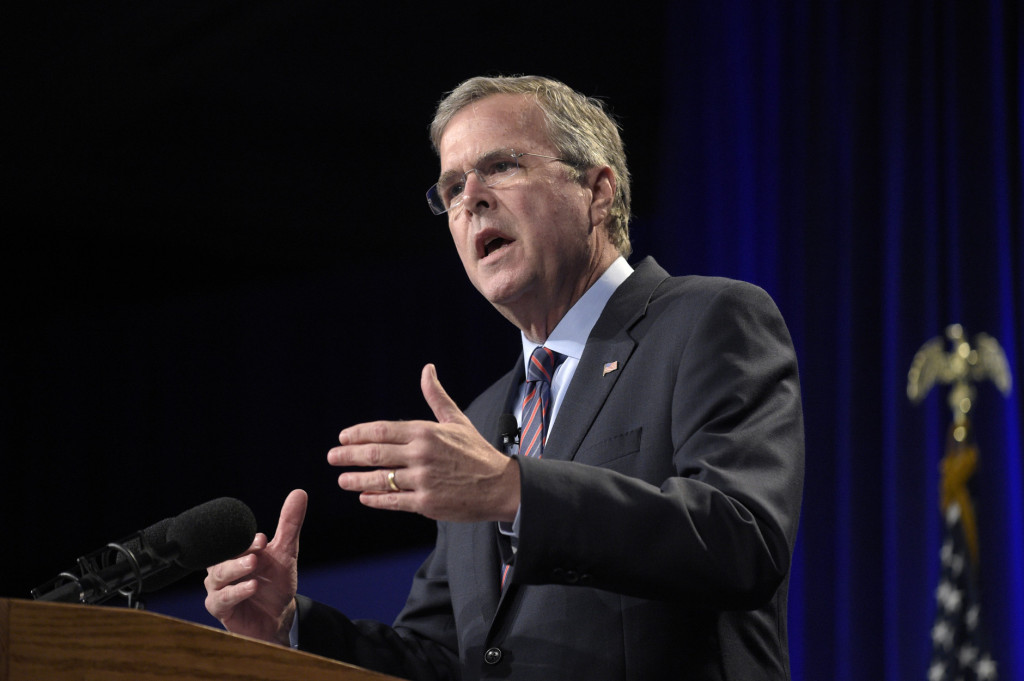
A super PAC supporting Jeb Bush will begin airing advertisements in New Hampshire this week as the former Florida governor tries to make gains in advance of the state’s Feb. 9 primary. On Tuesday, Right to Rise USA released a 30-second spot that contrasts Bush’s record with the records of Govs. Chris Christie and John Kasich. The advertisement — dubbed “Three Governors” — focuses on Bush’s record in several areas, including hurricane response, job creation and health care. Bush has been trailing in the polls, and recent polling averages show he is in behind Christie and Kasich in New Hampshire. The former Florida governor was campaigning in the Granite State on Tuesday. Starting today in New Hampshire “Three Governors” https://t.co/8SnZA6ngqS https://t.co/i9htlaRuUO — R2R USA (@r2rusa) Dec. 29, 2015
New polls show Donald Trump strong but “race still young”

New polling shows Republican presidential candidate Donald Trump sweeping primaries in Florida and early-vote state New Hampshire, and tying with Texas Sen. Ted Cruz in South Carolina. The pollster, though, warns the “race is still young” and “there is still much room for movement for virtually all of the candidates.” More to the point, other focus-group surveys suggest Trump “may have hit his ceiling.” The polling of “likely” Republican voters was done this month by Associated Industries of Florida, one of the state’s premier business lobbies, for its predominantly GOP clientele. The results were obtained by FloridaPolitics.com on Tuesday. It shows Trump leading New Hampshire with 24 percent, Florida with 29 percent, and coming neck-and-neck with Cruz in South Carolina with 27 percent each. Cruz is in second in both New Hampshire and Florida, according to the polls, and Florida Sen. Marco Rubio is in third in all three states. Primaries are Feb. 9 in New Hampshire and Feb. 20 in South Carolina. Florida’s primary is March 15. In a memo to members, however, AIF Vice President of Political Operations Ryan Tyson shakes some salt on the numbers. “This data is a snapshot in time and only meant to detail how 2015 is ending,” he writes. “There is still plenty of time for movement within the top-tier candidates and this is evidenced by the soft image ratings of virtually every candidate we surveyed in New Hampshire and South Carolina.” For example, Trump is the front-runner in New Hampshire, but his ratings there break down as 24 percent “very favorable,” 25 percent “somewhat favorable,” 20 percent “somewhat unfavorable,” and 26 percent “very unfavorable.” “The higher a candidate’s ‘very’ percentage, be it favorable or unfavorable, is a gauge of intensity,” Tyson writes. “With that in mind, the image ratings in these early states suggests there is still much room for movement for virtually all of the candidates, and we should expect the persuasion efforts to ramp up dramatically after the holidays.” Still, he adds, the GOP race “is essentially a three-way contest between Donald Trump, Sen. Ted Cruz and Sen. Marco Rubio.” In all three states, “Cruz and Rubio find themselves deadlocked in a heated battle for second place, with their image numbers potentially serving as a leading indicator they could become the front-runners before too much longer.” Rubio’s favorability numbers in New Hampshire trump Trump’s, according to the poll, with 18 percent “very favorable,” 52 percent “somewhat favorable,” 11 percent “somewhat unfavorable,” and 7 percent “very unfavorable.” Also in the Granite State, Cruz comes in with 18 percent “very favorable,” 47 percent “somewhat favorable,” 11 percent “somewhat unfavorable,” and 8 percent “very unfavorable.” Tyson notes New Jersey Gov. Chris Christie “has made up substantial ground in New Hampshire,” with a fourth place showing of 13 percent, ahead of former Florida Gov. Jeb Bush‘s 9 percent. But Christie is dying on the vine in South Carolina and Florida, with 2 percent and 3 percent in South Carolina and Florida, respectively. Trump, the real estate tycoon-turned-reality television star, may have attained top-dog status simply by dint of “the large field of GOP candidates,” according to a Florida focus group, Tyson adds. “There is a deep sense of division within the Republican Party and this divide can be described as the fuel which has propelled Mr. Trump’s rise,” he says. Trump “clearly has benefited from an environment within the Republican base which expresses deep disenchantment with their elected party leaders, as well as the entire political process as a whole.” The voters in the focus group “believed there is a profound alienation between them and their elected leaders at virtually all levels of government,” Tyson writes. “They also sensed their elected leaders have no interest in the well-being of ordinary Americans but instead perpetuate a government that increasingly disconnects from the needs of the people they serve. “It’s clear that the candidates who best empathize with those sentiments (i.e., Trump and Cruz) will have the best starting position as the 2016 primaries begin.” Trump’s sustained lead “is mostly a result of simple mathematics rather than his prowess as a candidate,” Tyson tells members. “After all, any candidate who is backed by 25 percent of a likely electorate will look “dominant” when (about) 65 percent of that electorate is split 12 ways and another (about) 10 percent remain undecided.” Along with Democratic contender Bernie Sanders, the U.S. senator from Vermont, “both candidates’ extreme positions speak to an isolated, but distinct and very disenchanted, base within their respective parties,” Tyson writes. “Do we believe Mr. Trump can still secure the GOP nomination? Possibly,” he says. “But as of today it seems there are likely alternatives … It is difficult today to envision the GOP nominating a candidate that about 40 percent of them collectively view unfavorably.” In Florida, the organization surveyed 400 likely Republican primary voters and held a focus group on Dec. 8 in St. Petersburg, noting that “Pinellas County had the second-highest number of Republican votes cast in the 2012 Florida Presidential Preference Primary.” After the fifth and final Republican debate of 2015, AIF surveyed 800 likely Republican primary voters in Florida this past Wednesday and Thursday. “However, with so many states voting prior to March 15, and with two native sons in the race for the Republican nomination, we acknowledged that Florida very well could be an outlier,” Tyson writes. “Therefore, in order to put the Florida data in proper context, we also fielded surveys in South Carolina (600 likely Republican primary voters)” on Wednesday, Dec. 16 and Thursday, Dec. 17, and polled 500 likely Republican and unaffiliated voters in New Hampshire on Thursday, Dec. 17 and Friday, Dec. 18,” he adds.
Bobby Jindal talks radical Islam, immigration at #SunshineSummit

Louisiana Gov. Bobby Jindal took a scattershot approach in his Sunshine Summit speech Saturday, bouncing between political correctness, immigration and national security. He first chided fellow candidate Donald Trump, however, for equating Ben Carson‘s childhood “pathological temper” to a child molester in comments to CNN. Saying it was an “insane comment,” Jindal told the crowd, “I’m for all an exchange of ideas, (but) folks, there is a line we should not cross.” He also called out college students at the University of Missouri for recent protests, supposedly sparked by racially charged incidents, that led to the resignation of the school president. Reporters trying to cover the protests have been blocked or harassed by campus activists. Liberal students fail to appreciate the principles of free speech, Jindal said: “You don’t have a right not to be offended.” He quickly added that he shouldn’t be surprised since President Obama “has taught us all to be victims.” Turning to the thicket of immigration, Jindal — the son of Indian immigrant parents — said the American dream is “not having the government take care of you. He told the story of his parents not having the health coverage to pay for his birth, so his father offered to write a check every month until the hospital bill was paid. Jindal’s message to those who want to be Americans: “Come legally, learn English and when you get here, roll up your sleeves and get to work.” Finally, he offered solidarity with the victims of the Paris attacks on late Friday and early Saturday, saying the problem isn’t Islam, but “Islam has a problem (and) the problem is radical Islam.” “Our friends don’t trust us and our enemies … don’t fear us,” Jindal warned. “It’s time to send a message … you’ve got to kill evil terrorists before they come here and kill us first.” Jindal’s tough talk comes amid his averaging 1 percent in national polls, with his campaign facing a “major cash crunch,” The Associated Press reported. “His financial disclosure forms show he’s finding ways to campaign cheaply, bunking at affordable hotel chains,” the AP report said.
Donald Trump on Oregon shootings: “You’re always going to have problems”
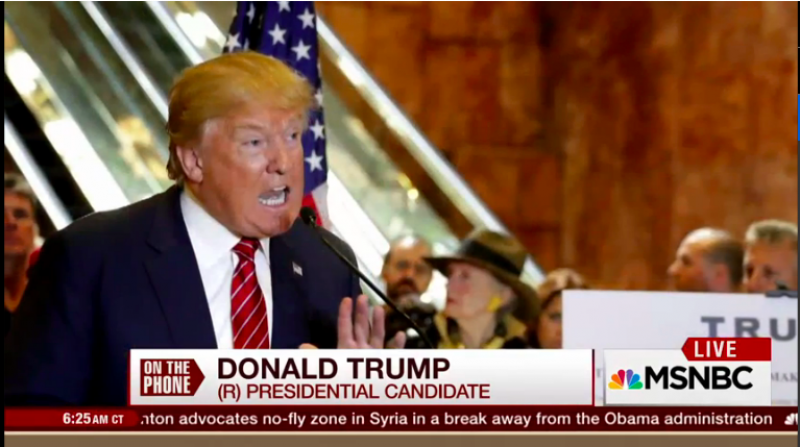
Republican presidential candidate Donald Trump on Friday said the most recent campus shooting in Oregon could have happened anywhere, adding that there are already “very strong laws on the books” to address gun violence. Trump joined MSNBC’s “Morning Joe” program by phone – his 13th time on the show, either in person or on the phone, since declaring himself a candidate for 2016. He spoke the day after a 26-year-old man walked into a morning class at Umpqua Community College in rural Oregon and opened fire, hitting some students with multiple gunshots. At least nine people were killed and seven others were wounded. Co-host Willie Geist asked Trump what he would have done if the shooting happened under his presidency, noting that Oregon has universal background checks. “Well first of all, you have very strong laws on the books, but you’re always going to have problems,” Trump said. “I mean, we have millions and millions of people. We have millions of sick people all over the world. It can happen all over the world. “And it does happen all over the world, by the way, but this is sort of unique to this country, the school shootings, and you’re going to have difficulty no matter what,” he added. “I mean … probably we’ll find out with him, like we did with numerous of the others, that gee whiz, they were loners and they were probably sick. “You know, oftentimes this happens and the neighborhood says, you know, we sort of saw that about him and it really looked like he could be a problem. But it’s awfully hard to put somebody in an institution for the rest of their lives based on the fact he looks like he could be a problem. So it’s a terrible situation, it’s huge mental illness. You’re going to have these things happen and it’s a horrible thing to behold.” Geist asked, “So Donald, is it fair to say then that your opinion is some people are going to slip through the cracks and there’s not much you can do about it?” Trump responded, “… People are going to slip through the cracks and even if you did great mental health programs, people are going to slip through the cracks … What are you going to do? Institutionalize everybody? So you’re going to have difficulties … with many different things, not just this. That’s the way the world works. And by the way, that’s the way the world always has worked, Willie.” Trump also addressed remarks about him by Democratic presidential contender Hillary Clinton, discussed whether Congressman Kevin McCarthy should be the next speaker of the U.S. House of Representatives, and sized up fellow GOP candidate Ben Carson. A link to the video is here: https://on.msnbc.com/1M5ZCVu Material was used from The Associated Press in this post.
