
Donald Trump bristles at Ted Cruz-John Kasich collaboration
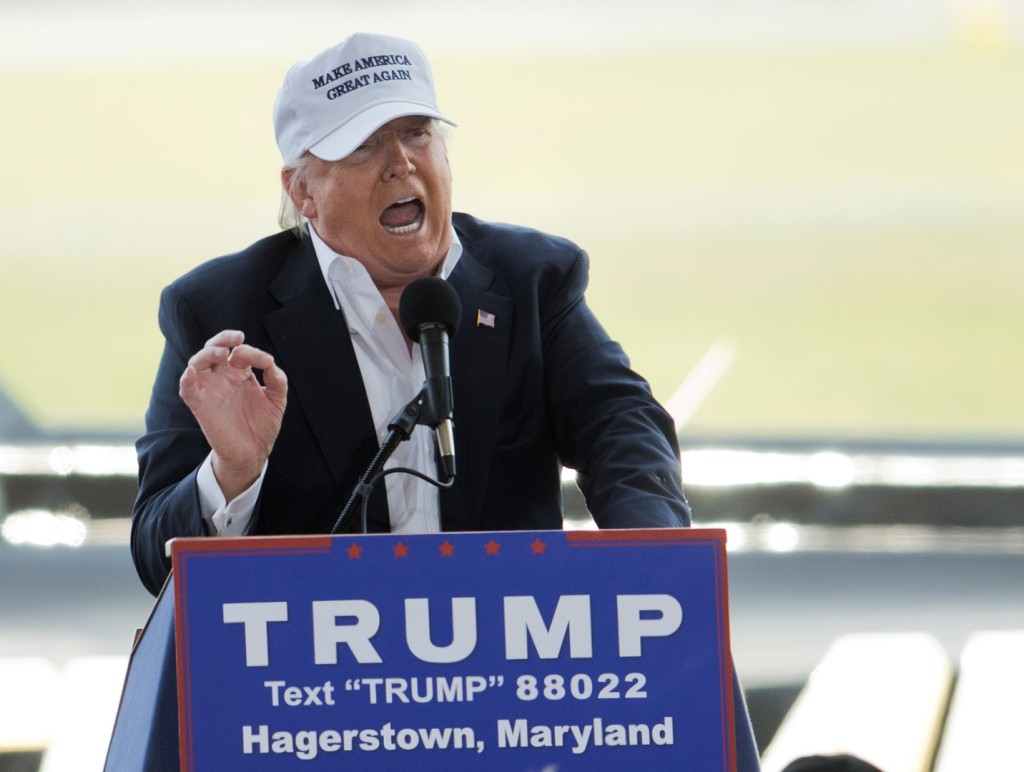
Donald Trump says an extraordinary collaboration between Ted Cruz and John Kasich aimed at unifying the anti-Trump vote in some remaining primaries is a desperate move by “mathematically dead” rivals. Such collusion would be illegal in many industries, the Republican presidential front-runner said, but it’s illustrative of “everything that is wrong in Washington and our political system.” Under the arrangement outlined Sunday, Kasich, the Ohio governor, will step back in the May 3 Indiana contest to let Cruz bid for voters who don’t like Trump. Cruz, a Texas senator, will do the same for Kasich in Oregon and New Mexico. The arrangement does not address the five Northeastern states set to vote Tuesday, where Trump is expected to add to his already overwhelming delegate lead. Yet the shift offers increasingly desperate Trump foes a glimmer of hope in their long and frustrating fight to halt the billionaire’s rise. Trump said in a statement the Cruz-Kasich compact joins two “puppets of donors and special interests” who have no path to the nomination. Cruz’s campaign manager, Jeff Roe, said in a statement explaining the new plans that Trump would be soundly defeated by the Democratic nominee, whether it’s Hillary Clinton or Bernie Sanders. “Having Donald Trump at the top of the ticket in November would be a sure disaster for Republicans,” he said. Added Kasich’s chief strategist, John Weaver, “Our goal is to have an open convention in Cleveland, where we are confident a candidate capable of uniting the party and winning in November will emerge as the nominee.” The announcement marks a sharp reversal for Cruz’s team, which aggressively opposed coordinating anti-Trump efforts with Kasich as recently as late last week. And the agreement applies only to Indiana, Oregon and New Mexico — three of the 15 states remaining on the Republican primary calendar. As Kasich backs out of Indiana, Cruz promised he would not compete in Oregon on May 17 and New Mexico on June 7. Trump campaigned Sunday in Maryland, which will vote on Tuesday along with Rhode Island, Connecticut, Pennsylvania and Delaware. Speaking to several thousand people in an airplane hangar in Hagerstown, Maryland, Sunday evening, Trump stressed repeatedly that he expects to win the 1,237 delegates needed in the first round of voting in Cleveland to stave off a contested convention. “I only care about the first,” he said. “We’re not going for the second and third and fourth and fifth.” As recently as three days ago Kasich’s campaign announced investments in Indiana, including the opening of two offices and the creation of a campaign leadership team. His campaign on Sunday night canceled a town-hall meeting and gathering in Indianapolis scheduled to watch the results of Tuesday’s primaries. Both campaigns encouraged allied super PACs and other outside groups to “honor the commitments.” On the Democratic side Sunday, underdog Sanders rallied thousands of voters in two New England states and offered mixed signals on how hard he would push his differences with the commanding front-runner, Clinton. The Vermont senator largely steered clear of Clinton at a Rhode Island park, but hours later delivered a sharp critique before more than 14,000 supporters in New Haven, Connecticut. Sanders reiterated his call for Clinton to release transcripts of lucrative Wall Street speeches she delivered after leaving the State Department in early 2013. Republished with permission of the Associated Press.
How Donald Trump can lock up GOP nomination before the convention
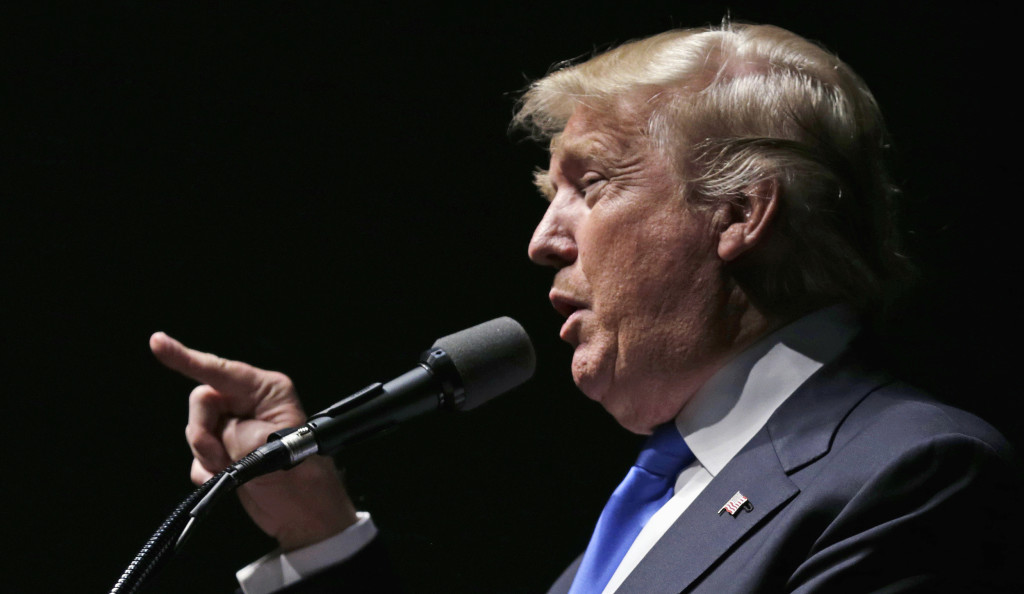
To all the political junkies yearning for a contested Republican convention this summer: not so fast. It’s still possible for Donald Trump to clinch the nomination by the end of the primaries on June 7. His path is narrow and perilous. But it’s plausible and starts with a big victory Tuesday in his home state New York primary. Trump is the only candidate with a realistic chance of reaching the 1,237 delegates needed to clinch the nomination before the July convention in Cleveland. His rivals, Texas Sen. Ted Cruz and Ohio Gov. John Kasich, can only hope to stop him. If Cruz and Kasich are successful, politicos across the country will have the summer of their dreams — a convention with an uncertain outcome. But Trump can put an end to those dreams, and he can do it without any of the 150 or so delegates who will go to the convention free to support the candidate of their choice. What comes next isn’t a prediction, but rather, a way in which Trump could win the nomination outright on June 7. To be sure, Trump will have to start doing a lot better than he has so far. He gets that chance starting Tuesday, beginning the day with 744 delegates. ___ NEW YORK There are 95 delegates at stake in the Empire State, and it’s important for Trump to win a big majority of them. It won’t be easy. There are 14 statewide delegates and three delegates in each congressional district. If a candidate gets more than 50 percent of the statewide vote, he gets all 14 delegates. Otherwise, he has to share them with other candidates. If a candidate gets more than 50 percent of the vote in a congressional district, he gets all three delegates. Otherwise, again, he has to share. Trump leads statewide in the most recent preference polls, with right around 50 percent. New York is a large and diverse state, so he probably won’t win all the congressional districts. Let’s say Trump does make it to 50 percent, but Kasich or Cruz wins five congressional districts; Trump will take 77 delegates on the night. Trump’s running total: 821 delegates. ___ APRIL 26 Five states have primaries on April 26, with 172 delegates at stake: Pennsylvania, Connecticut, Delaware, Maryland and Rhode Island. Pennsylvania could be trouble for Trump. The state has a unique system in which 54 delegates — three from each congressional district — are listed by name on the ballot, with no information for voters to know which candidate they support. That means even if Trump wins Pennsylvania, he’s only guaranteed to claim 17 of the state’s 71 delegates. Connecticut awards 13 delegates to the statewide winner and three to the winner of each congressional district, for a total of 28. The New York real estate mogul needs to win his neighboring state. If he does well, he could get 22 delegates. Delaware’s 16 delegates are winner-take-all, increasing the importance of this small state. If Trump loses Delaware, he has to make it up elsewhere. Maryland awards 14 delegates to the statewide winner and three to the winner of each congressional district, for a total of 38. Recent polls show Trump with a significant lead. If he does well, he could get 32 delegates. Trump can afford to lose Rhode Island, which awards its 19 delegates proportionally. In all, it’s a day on which we’ll say Trump claims 93 delegates. Trump’s running total: 914. ___ MAY Five states hold contests in May, with a total of 199 delegates at stake: Indiana, Nebraska, West Virginia, Oregon and Washington State. Indiana’s May 3 primary is important for Trump. The state awards 30 delegates to the statewide winner and three delegates to the winner of each congressional district, for a total of 57. If Trump can win the state and a majority of the congressional districts, he could collect 45 delegates. West Virginia is another unique state in which voters elect 31 delegates in the May 10 primary. In West Virginia, however, the delegates will be listed on the ballot along with the presidential candidate they support. If Trump does well here, he could pick up 20 or more delegates. Nebraska’s 36 delegates are winner-take-all. But if Nebraska is like its neighbors Kansas and Iowa, two states Cruz won earlier in the race, Trump can’t count on these delegates. Oregon and Washington state award delegates proportionally, so even the losers get some. We’ll give Trump 70 delegates for the month. Trump’s running total: 984. ___ JUNE 7 This could be Trump’s D-Day. Or his Waterloo. Five states vote on June 7, with 303 delegates up for grabs. The biggest prize is California, along with New Jersey, South Dakota, Montana and New Mexico. The only state Trump can afford to lose is New Mexico, which awards 24 delegates proportionally. New Jersey, South Dakota and Montana are winner-take-all, with a total of 107 delegates. California is more complicated, with 172 delegates at stake. The statewide winner gets only 13. The other 159 are awarded according to the results in individual congressional districts. Each of the state’s 53 congressional districts has three delegates. You win the district, you get all three. For Trump to clinch the nomination on June 7 — the last day of the primary season — he has to win a big majority of California’s congressional districts. If he wins 39 districts, he gets 130 delegates. On the last voting day of the primary campaign, we’ll say Trump wins 242 delegates. Trump’s running total: 1,226 — or 11 delegates short of the magic number. ___ OH, WAIT! Missouri has certified the results of its March 15 primary, with Trump beating Cruz by 1,965 votes. If the results survive a potential recount, Trump wins Missouri and another 12 delegates. Trump’s total: 1,238. Cue the balloons. *** Republished with permission of the Associated Press.
Pro-Ted Cruz super PAC taking aim at Marco Rubio
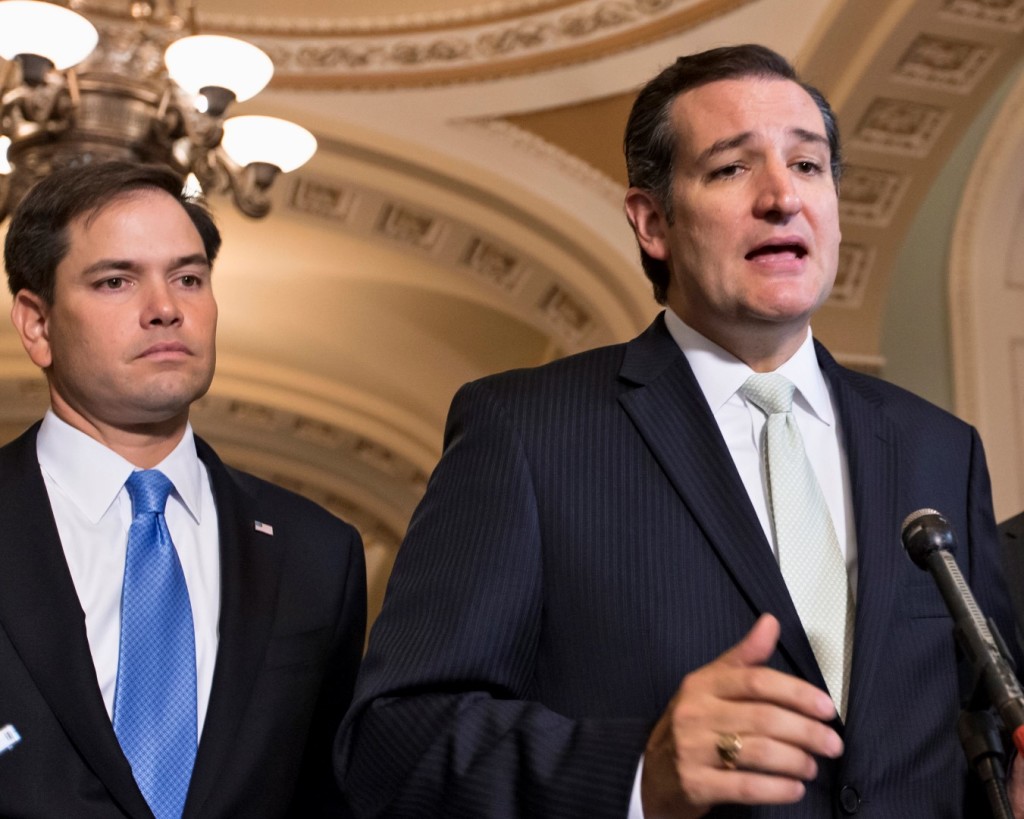
A rash of anti-Marco Rubio advertisements could be hitting Florida’s airwaves soon. On Monday, POLITICO reported that Keep the Promise I, the main super PAC backing Ted Cruz, is planning to air several advertisements taking aim at Rubio in his home state. The ads take on Rubio on several issues, including sugar subsidies and his tax plan. In one 30-second spot uploaded to Keep the Promise I’s YouTube page, the super PAC takes aim at Rubio’s attendance record. “Rubio talks up his national security experience, but did you know he skipped 18 defense votes, including one to arm the Kurds to fight ISIS,” a voice is heard saying in the advertisement. Rubio took hits early in the campaign about his attendance in the Senate, with some candidates even calling on the Florida senator to step down. In the sugar subsidies advertisement, the super PAC attempts to compare Rubio to Hillary Clinton. “So-called conservative Marco Rubio has been taking your hard earned tax dollars and giving them to pay his billionaire buddies who run big sugar with government subsidies,” a man is heard saying in the 30-second spot. “Did you know big sugar is run by the same billionaires who have funded Marco Rubio’s political career? You know who else practices this kind of pay to play corporate cronyism? Hillary Clinton.” Averages of recent Florida polls show Cruz trails Rubio in Florida. The Texas senator, however, leads the Florida Republican nationwide, according to national polling averages.
Donald Trump leads GOP field with 40 percent support in new poll
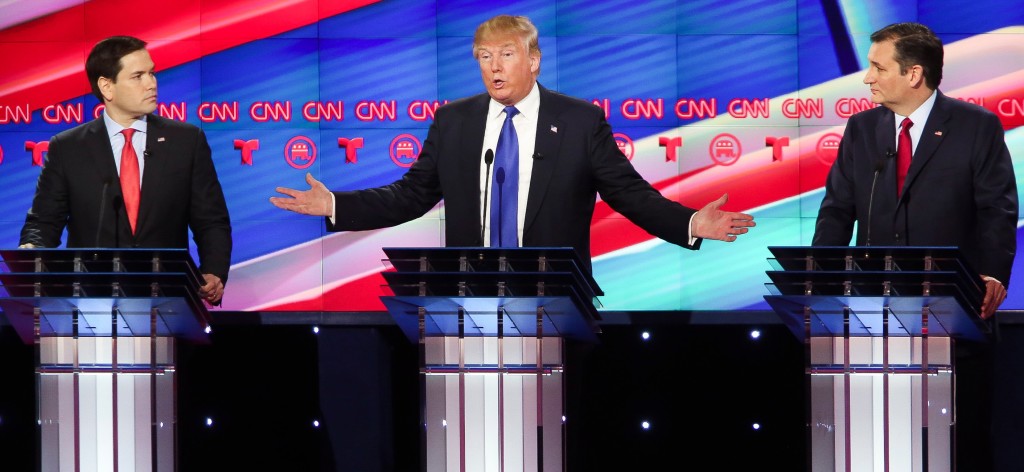
More than 70 percent of Republicans said they believe Donald Trump will be their party’s nominee. According to an NBC News|SurveyMonkey Weekly Election Tracking Poll, 71 percent of registered Republicans said Trump will win the Republican nomination. That’s up 15 percent from just one week earlier. Trump leads the GOP pack with 40 percent support, followed by Marco Rubio at 21 percent. Ted Cruz is in third with 18 percent. According to the survey, 47 percent of Republicans said they are absolutely certain they will vote for their top choice; while 16 percent said was a 50-50 chance they would vote for their top choice. In a two-man race, Trump defeats Rubio 52-percent to 46 percent. The survey found Trump beats Cruz, 55-percent to 42-percent. On the Democratic side, Hillary Clinton leads Bernie Sanders, 51 percent to 41 percent. The NBC News|SurveyMonkey online tracking poll was conducted from Feb. 22 through February 28.
