
Kay Ivey signs legislation creating School of Cyber Technology and Engineering, Education Budget
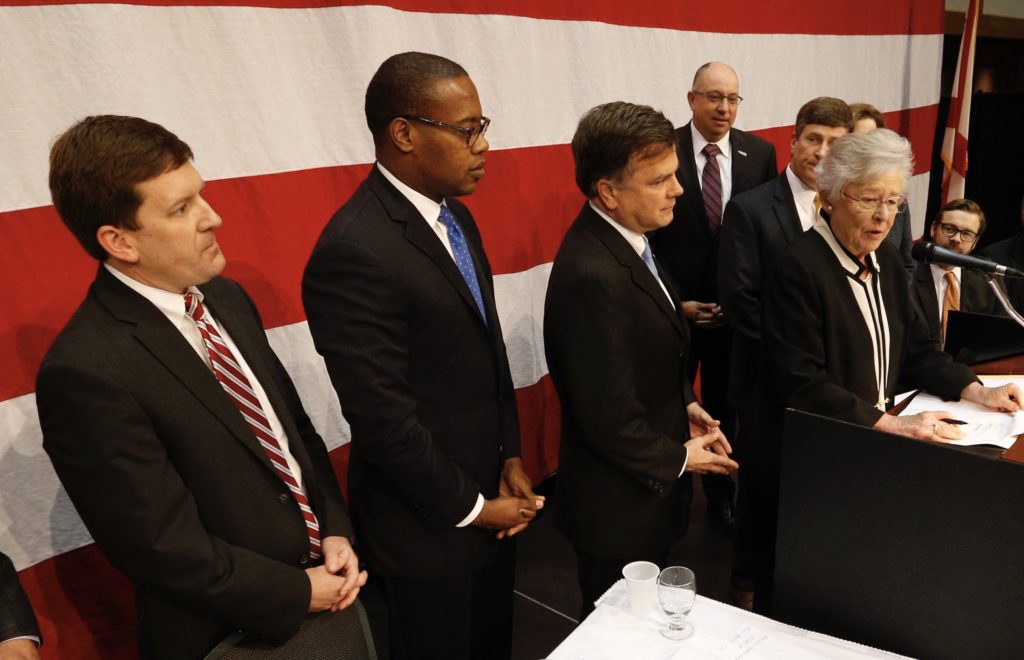
Governor Kay Ivey on Monday signed into law a pair of bills SB212 and SB175, which creates the Alabama School of Cyber Technology and Engineering and funding the 2019 education budget, respectively. SB212: Alabama School of Cyber Technology and Engineering Sponsored by Decatur-Republican State Sen. Arthur Orr and Huntsville-Democrat, House Democratic Leader State Rep. Anthony Daniels, SB212 creates the Alabama School of Cyber Technology and Engineering in Huntsville. The school will be an independent, residential school that is established for academically-motivated and gifted Alabama students with educational opportunities and experiences in the rapidly growing fields of cyber technology and engineering. The school will also assist teachers, administrators, and superintendents across the state in replicating cyber technology and engineering studies in their own schools. “The Alabama School of Cyber Technology and Engineering will prepare some of our state’s highest-achieving students to enter the growing fields of cyber technology and engineering,”Ivey said. “Just as Huntsville has always been on the leading edge of the rocket and aerospace industries, the Alabama School of Cyber Technology and Engineering will ensure that Alabama students are at the forefront of today’s emerging technologies.” Orr said he envisions students from across the country wanting to relocate and attend the school. “I see the school as a real magnet for gifted students not only from all over the state, but also from across the country who may want to relocate here to be able to access such a world class, cutting-edge education in the fields of cyber and engineering. The graduates of the school will be long term contributors to this state’s growth in these emerging areas,” explained Orr. “Today is an important day for Huntsville, our state and, most importantly, our young people. In addition to continuing to grow our reputation as an emerging hub in the tech and cybersecurity industry, this school will provide our students the opportunity to become the next generation of innovators by giving them a jump-start on careers in technology, engineering, and protecting our nation’s cyberinfrastructure,” added Daniels. The Huntsville/Madison County Chamber of Commerce was instrumental in coordinating efforts between the Chamber, Cyber Huntsville and the Alabama School of Cyber and Engineering Foundation. “We are pleased that the vision for an Alabama cyber technology and engineering magnet school has been acted upon by our state leaders,” said Alicia Ryan, Vice President of the Cyber Huntsville Board and President of the Alabama School of Cyber and Engineering Foundation. “This school will provide a wonderful opportunity for students from across Alabama to get early exposure to new STEM-based curriculum that will prepare them for exciting cyber and engineering career paths. By enabling unique educational opportunities today, we are building our workforce for the future.” A location for the school has yet to be selected. The legislation allows for the school to open and formally begin operation during the fall semester of 2020. SB175: Education Budget Ivey also signed the Education Budget on Monday, which was also sponsored by Decatur-Republican State Sen. Arthur Orr along with Tuscaloosa-Republican and Committee chair state Rep. Bill Poole. The 2019 budget provides a historic level of funding for all aspects of the state’s education system. It also includes a 2.5 percent raise for all education employees. “I am proud to have worked closely with the Legislature to pass a historic Education Budget which gives a raise to our teachers and school employees, increases funding for our voluntary Frist-Class Pre-K Program and provides more opportunities for higher-education students across Alabama,” Ivey commented. “I am committed to improving education in Alabama for everyone, regardless of where they live or the economic resources available to them.” The Education Trust Fund Budget is the largest investment in education in a decade, and was passed with overwhelming bipartisan support. “Alabama’s teachers and education support staff have an important task – educating our children – our children who are the key to our state’s success,” Ivey added. “It is important that we attract the best people possible to work in our education system and this pay raise will help us do that.” The budget covers the fiscal year 2019 which begins in October.
State House passes data breach protections for consumers

Before Thursday, Alabama was one of only two states in the nation that did not require a data breach notification. SB318, or the Data Breach Notification Act, passed through the Alabama house with a unanimous 101-0 vote Thursday evening. The bill requires all companies doing business in the state to notify their customers if their personal information has been compromised. “Virtually all of our vital personal information – including Social Security numbers, military IDs, drivers’ licenses, bank account numbers, and medical data – is now online,” said the bill’s sponsor Decatur-Republican state Sen. Arthur Orr. “With this bill, consumers will know if their information has been compromised and what steps a company is taking to recover and protect consumers’ data.” “Tonight, the Alabama House took action to arm Alabama consumers in the event that their personal information is compromised in a data breach,” added state Attorney General Steve Marshall. “Passage of the Alabama Data Breach Notification Act has been a high priority for my office. It is all the more important now, as yesterday the only other state in the country without such a consumer-protection law – South Dakota – enacted a data breach notification law, leaving Alabama alone.” Marshall congratulated Orr and Huntsville-Republican state Rep. Phil Williams, who advanced the bill through the House. “I appreciate the hard work of Williams and Orr in moving the data breach notification bill a step closer toward final passage,” said Marshall. The Alabama Senate passed SB318 by a vote of 24 to 0 earlier in March, the bill now returns to the Senate for a vote on whether to concur with the House changes.
State Senate votes to reform controversial practice of civil asset forfeiture

The Alabama Senate on Wednesday voted 25-1 to reform one of the state’s most controversial practices — civil asset forfeiture. Civil asset forfeiture allows police to seize — and then keep or sell — any property they suspect is part of criminal activity. Owners need not ever be arrested or convicted of a crime for their cash, cars, or even real estate to be taken away permanently by the government. Which is Birmingham-Republican state Rep. Arnold Mooney introduced to HB518, to try and help improve the often unchecked, and unfair process. HB518 creates the Forfeiture Database and Reporting Act, which would require law enforcement to report information including the date of property seizure, the type of property seized, the place of the seizure, the value of the seizure, the alleged criminal offense that led to the seizure, as well as the outcomes of criminal cases related to seizure when applicable. Mooney had originally introduced a bill HB287 — along a companion bill in the Senate, SB213, introduced by his colleague Decatur-Republican State Sen. Arthur Orr — that would have required a criminal conviction for property seizures. But the bills ultimately went nowhere due to pushback from prosecutors and law enforcement officers who argued the seizures are a valuable crime-fighting tool. The bill now moves to the State House.
State Senate votes against term limits for lawmakers

According to a poll commissioned by the organization and conducted by McLaughlin and Associates 84% of Alabamians want term limits placed on Members of Congress, but only nine state senators voted to bring a term limits bill to the floor for debate on Wednesday. State Sens. Bill Hightower, Trip Pittman, Paul Sanford, Bill Holtzclaw, Greg Reed, Larry Stutts, Phil Williams, Rusty Glover and Arthur Orr voted in favor of bringing SB127 to the floor for debate. But the bill failed a procedural motion, 9-15, to do so. “Today’s decision by Montgomery Insiders to vote against legislative term limits legislation epitomizes why Alabama voters are so frustrated with their state government,” said the bill’s sponsor, Mobile-Republican state Senator, and candidate for Governor, Bill Hightower. “More than four in five Alabama voters believe we need term limits, but career politicians understand this is a threat to their personal ambition and power. This morning the Montgomery Insiders put cronyism and smoke-filled backroom deals above the people they are supposed to represent.” SB127 would have proposed an amendment to the Constitution of Alabama that would provide that no person may be elected to either house of the state Legislature for more than three consecutive four-year terms. Currently, most other constitutional offices in Alabama have term or age limits. Hightower’s term limits legislation is a key component of his gubernatorial platform — the Alabama First Agenda, which is focused on reforming the way Montgomery operates. “We will not stop until we end the old boys network that is stopping real change!,” Hightower continued. “We will never change Montgomery if we continue to elect the same insiders, and that is why I am running for Governor, to shake up the establishment and bring positive change to Alabama. As Governor, we will continue to push for term limits and many other reforms that the career politicians know will end their grip on power,” concluded Hightower. Most all of the senators who voted in favor of bringing SB127 up for debate, are all self-term limited: Sen. Bill Hightower: self term limited after 2 terms Sen. Trip Pittman: self term limited after 3 terms Sen. Paul Sanford: self term limited after 3 terms Sen. Bill Holtzclaw: self term limited after 2 terms Sen. Phil Williams: self term limited after 2 terms Sen. Rusty Glover: self term limited after 3 terms
Alabama civil asset forfeiture reform calls for transparency

When Opelika police officer Benjamin Carswell pulled over Daryl Gray for following too closely in August 2014, Carswell found $32,660 in the vehicle. Gray told Carswell he was on his way to buy a car, but the large amount triggered suspicion. The officer seized the cash and handed it over to the Drug Enforcement Administration less than a month later. After two months, Daryl Gray filed a complaint in court through his attorney Joe Reed. A local judge ruled a year later that his court couldn’t decide on the case because the federal government kept the cash. Gray didn’t get his money back and was never charged with a crime. What happened to Gray is legal under the controversial practice of civil asset forfeiture. Instituted to fight drug crime, it allows police to seize property they have reason to believe was criminally gained – even when the owner isn’t yet charged with a crime – and keep assets with a court order. Fourteen states require a conviction for forfeiture. In Alabama, state Sen. Arthur Orr and Rep. Arnold Mooney, both Republicans, proposed legislation this year to require a conviction before assets could be seized. The bills ignited three weeks of debate and received so much pushback from police and prosecutors that they were shelved. On Thursday, Mooney introduced a new bill that requires law enforcement to gather detailed data on seized assets starting in 2019 and publish an annual report online beginning 2020. However, it wouldn’t change the current legal process. Artur Davis, senior consultant with The Institute for Justice and former U.S. congressman involved in the negotiations, said the bill would move Alabama from being one of the least transparent states to having comprehensive data – although it still falls short of the reforms he and other advocates wanted. Critics of civil asset forfeiture say it fuels policing for profit because law enforcement gains millions of dollars from individuals not always proven guilty of a crime. Robert Bradford’s mother fought forfeiture proceedings after her husband faced drug charges and committed suicide in Chilton County in 2009. She proved her innocence and kept her house. “The problem was that there was no conviction that had taken place, but they were asserting the property belongs to the sheriff’s department. But it’s not the American way at all,” said Bradford, 40, who now lives in the house. Law enforcement and prosecutors argue civil asset forfeiture is necessary to disempower criminals. “It’s a tool we have to use to fight crime,” said Clark Morris, a U.S. attorney for the Middle District of Alabama. “It’s not about taking innocent people’s property. It’s about making our communities safe.” Barry Matson, executive director of the Alabama District Attorneys Association and the Office of Prosecution Services, said that nothing can be seized without a criminal investigation or kept without due legal process under Alabama’s 2014 civil asset forfeiture law. He supported transparency to maintain trust in the police, who have “a strong respect for the property rights of law-abiding citizens.” But Sara Zampierin, an attorney with the Southern Poverty Law Center, said the process burdens the property owner to prove his or her innocence. Judges tend to rule in favor of police, who only have to prove to the court’s “reasonable satisfaction” that assets were criminally gained to keep them. The law center and Alabama Appleseed, also an advocacy organization, found that property owners were never charged with a crime in a quarter of more than 1,000 civil asset forfeitures in 2015. Although police say forfeiture targets major drug kingpins, the amount of cash was less than $1,000 in around half of the cases. Law enforcement agencies received $2.2 million from state courts and $3.1 million from the federal government in 2015. Guy Gunter, Opelika city’s attorney, said in a statement that police received around $100,000 forfeited assets over the last three years. The department’s budget is more than $9 million. Gunter said police complied with federal forfeiture laws in Gray’s case. Gray received a letter from the DEA letting him claim his property in November 2014. He never responded. Gray’s attorney Reed said his client didn’t understand the process until it was too late. An owner must file a claim contesting the forfeiture within 30 days. At least 80 percent of DEA seizures in the last decade were uncontested, the Department of Justice Office of the Inspector General reported in 2017. Orr’s and Mooney’s original bills prohibited Alabama state agencies from giving assets directly to the federal government. That was omitted in the new version. The bill faces a difficult deadline for passage in the two weeks left this legislative session. Republished with the permission of the Associated Press.
State Senate unanimously approves $6.6 billion Education Budget

The 2019 education budget unanimously passed the State Senate on Thursday. The body approved SB165, the $6.6 billion Education Trust Fund for Fiscal Year 2019, which starts October 1 on a 29 to 0 vote. It is the largest education budget for Alabama’s schools since the great recession of 2008. “Nothing is more important than ensuring a quality education for every student in Alabama, and this education budget is a statement of strong support for our teachers and schools,” said Decatur-Republican State Senator Arthur Orr, Chairman of the Finance and Taxation Education committee. “This is also a sustainable budget that protects taxpayers. From 2001 to 2011, proration – the midyear slashing of local school budgets because of irresponsible fiscal plans from the Legislature – occurred six times. Proration hasn’t happened once since 2011.” The FY19 education budget includes a $18.5 million increase for First Class, Alabama’s nationally-recognized, volunteer pre-kindergarten program. A University of Alabama at Birmingham study, released in February by the Department of Early Childhood Education, showed that students who participated in First Class outperformed their peers in reading and math assessments. First Class, currently available in 941 classrooms, has been named the nation’s best pre-kindergarten program in the nation for eleven years in a row by the National Institute for Early Education Research. The $18.5 million increase will help fund approximately 120 new Pre-K classrooms. “I want to commend Senator Orr and the Finance and Taxation Education committee for their hard work in passing the Education Trust Fund. This fiscally-responsible budget is another step in the right direction as we were able to include a pay raise for teachers, increased funds for school security, and additional money for classroom supplies,” added Anniston-Republican Senate Pro Tem Del Marsh. The Senate’s education budget is paired with a 2.5% pay raise for K-12 and two-year college education employees, at a cost of $102 million to Alabama taxpayers, along with a $1.1 uptick for K-12 career tech and a $6 million increase for K-12 transportation. “This budget is an investment in the future of Alabama. Conservatives in the legislature are strongly committed to fighting for Alabama’s students and teachers, and improving our schools to ensure that every student in every county in Alabama has access to a quality education,” said Jasper-Republican Senate Majority Leader Greg Reed. “We have set aside additional money for school security, given a much-deserved raise to teachers, and invested more money in our vital career tech programs.” The $6.6 billion FY19 education budget includes funds for a new robotics program for middle and high school students, and at the request of Governor Kay Ivey, allocates $500,000 for mental health counselors to be available for K-12 students in the aftermath of school shootings. The budget boosts spending on textbooks by $11 million, along with a $4 million increase for new technologies in classrooms. Earlier in the week, the Senate approved a proposal that will allow local school boards to use money from the Advancement and Technology Fund to improve school security by hiring new security officers and installing metal detectors at school entrances. The FY19 education budget now goes the House of Representatives for either concurrence with the Senate’s version, or a conference committee between the two chambers before it heads to the Governor’s desk.
Senate Passes ’30 days to pay’ bill to reform payday lending
On Thursday, the Alabama Senate passed a bill that seeks to issue reforms to Alabama’s payday loan industry. The bill passed with bipartisan support on a vote of 20-4, and now moves to the House. Under current law, lenders are allowed to set the terms of their loans from 10 to 31 days, and can charge up to a 17.5 percent fee for the loan; giving a loan with payment due in 14 days an annualized interest rate of 456 percent. SB138 seeks to drop this rate to 200 percent by requiring payday lenders to give borrowers 30 days to repay their loans. Decatur-Republican Sen. Arthur Orr, the bill’s sponsor, believes it is a simple, but necessary change, and will make repayment easier for Alabamians who pay their loans monthly, alongside their household bills. “This simple reform enjoys bipartisan, overwhelming, statewide support, we are grateful for the responsive leadership that carried this bill through the Senate. Now, we look toward the House seeking the same level of commitment to the well-being of Alabama’s borrowers. Predatory lending reform is a priority for many Alabama voters who are tired of seeing this can kicked down the road year after year, and this bill is an opportunity for legislators to finally deliver on the change that their constituents have requested for so long.” Dana Sweeney with the Alabama Appleseed Center for Law & Justice, told Alabama News. Madison-Republican Sen. Bill Holtzclaw, Rainbow City-Republican Sen. Phil Williams, and Birmingham-Democrat Sen. Rodger Smitherman are co-sponsors of the bill.
State Senate enhances protections for consumers with data breach notification law
Alabama is one of only two states nationwide that doesn’t require companies to report the theft of electronic consumer information. Thursday morning, the State Senate took action to change that. In an effort to protect Alabama consumers, lawmakers unanimously voted, 24-0, in favor of SB318, the Alabama Data Breach Notification Act, which will require private companies and state agencies to report data breaches to affected consumers. “Equifax reported this week that 2.4 million Americans were affected by a breach last year of the company’s data,” said the bill’s sponsor by Decatur-Republican state Senator Arthur Orr. “Virtually all of our vital personal information – including Social Security numbers, military IDs, drivers’ licenses, bank account numbers, and medical data – is now online. With this bill, consumers will know if their information has been compromised and what steps a company is taking to recover and protect consumers’ data.” If hackers steal sensitive personal information from a private company or a state agency, the Data Breach Notification Act requires the company or agency to notify the affected consumers within forty-five days of the breach’s discovery. Should a breach affect more than: 1,000 people: the company or agency must notify the state Attorney General’s office 500,000 people: the company or agency must post notices online, and in the newspapers, TV, and radio stations where the affected consumers live. “I appreciate Attorney General Steve Marshall for partnering with me on this legislation. It is imperative we do everything we can to protect the privacy of Alabamians’ medical and financial information,” Orr added. If a company or state agency fails to notify consumers of a data breach, the Attorney General’s office can assess fines of $5,000 per day and file a lawsuit on behalf of the affected individuals. “I want to thank Senator Orr for partnering with my office to ensure that Alabama’s consumers share in the same protections afforded to the citizens of 48 other states when it comes to their personal information,” Alabama Attorney General Steve Marshall said. “This is a strong piece of pro-consumer legislation and we applaud the Senate’s action today.” Orr’s proposal now goes to the House of Representatives for consideration.
State alcohol regulator’s website gets facelift. Should agency operations?

The state’s ABC Board’s old website was beyond just dated in a visual way. It also included some questionable content including mixed drink recipes. But no more, according to Dean Argo, Govt. Relations and Communications Manager at the Alabama ABC Board, the site was updated on Jan. 1, 2018 for that among other reasons. “The previous site was extremely outdated, hard to navigate, had little to no ability to interact with a visitor, a limited search function and provided little information about the Board, its mission, or division functions. Obviously, it had not been updated in several years,” Dean said in a statement. Dean said the board worked off the state contract for professional services and through the State-managed service provider network (ACRO). The State-managed service provider submitted to us resumes from qualified vendors and they evaluated those resumes and then interviewed individual candidates. From those interviews, they chose a web developer by the name of David Connerth to rework the site. “While we are still working on a couple of areas of the new site, including a section for our public education/awareness program about the dangers and consequences of underage and binge drinking called ‘Under Age – Under Arrest,’ our contract with the web developer was about 6 months in length and will cost approximately $85,000,” Argo added. What’s the purpose of the ABC Board? According to the newly update site, the purpose of the ABC Board is: The ABC Board controls alcoholic beverages through distribution, licensing, and enforcement. The Board operates a chain of retail stores selling the majority of liquor purchased in Alabama. The ABC Board also licenses commercial firms to sell alcoholic beverages. These range from restaurants and nightclubs to small stores selling beer for off-premise use. Applicants for a license are examined carefully to ensure the individuals involved are of solid moral character and will ensure the laws of Alabama and rules of the Board are obeyed. The proposed site for selling or dispensing of beverages is checked through neighborhood survey. After a license is issued, the ABC Board continuously inspects operations of licensees. The Board also conducts audits, collects taxes, and disburses revenue obtained from those taxes, and disburses revenues from the ABC Stores. Recipients of these funds include the Department of Mental Health, Special Education Trust Fund, Department of Human Resources, and the State General Fund. Controversial Role in Alcohol Sales But the board’s work isn’t without controversy as Alabama remains one of the last states in the nation with such strict control over sales and licensing. Legislation to change the structure operations has been introduced for years by State Senator Arthur Orr trying to do away with the portion of the Board that runs package stores. Orr has refiled the legislation this session, SB98, in an effort to privatize ABC stores. Cameron Smith, Vice President and General Counsel at the R Street Institute, took on the issue noting its fiscal sense in a 2015 AL.com post saying, “Orr’s bill would eliminate the cost of more than 600 employees and the expense of leasing ABC stores from the ABC Board’s operational cost. While the move would undoubtedly incur one-time costs associated with eliminating those positions, those costs are far less expensive than the ongoing salaries and benefits of those state employees.” Alabama Today’s own Apryl Marie Fogel wrote a piece on the subject and website, noting you could get some fun recipes there. Those have sense been removed from the website. The conclusion of the post according to her remains relevant today new website or not, “The fact is the prohibition days are long behind us and so should be the days of state-run liquor stores.” BEFORE: AFTER:
30 Days to Pay bill would extend time to repay payday loans

Another legislative session, and another attempt to reform payday lending has made it’s way to the Legislature’s to-do list. Decatur-Republican State Sen. Arthur Orr is leading the fight to put an end to the state’s predatory lending practices in the state Senate. Orr has introduced SB138, the 30 Days to Pay bill, which would give borrowers 30 days to pay payday loans back, versus the current 10 to 14. Advocates for reform say the average interest rate for the payday loans in the Yellowhammer State is a whopping 300 percent, but with refinancing and missed payments, that rate can get as high as 456 percent, which they say trap borrowers in a debt cycle. In 2015, the Alabama Department of Banking established a database to enforce an existing law that limits people to borrowing no more than $500 at a time. The database revealed that for the period between Oct. 2015 and Sept. 2016, more than 2 million payday loans totaling $668 million were taken out, by roughly 239,000 Alabamians and borrowers paid $116 million in fees in 2015-2016. Between the same period of time from 2016-2017, another 1.83 million payday loans were taken out by over 214,000 consumers totaling nearly $615 million and borrowers paid $107 in late fees.
Arthur Orr files bill to allow counties to ask voters for gas tax increase

Alabama has some of the cheapest gas nationwide. The state hasn’t seen the state gas tax since 1992. Despite the need for funds to complete road projects across the state, proposals to increase the gas tax have been discussed and died in session for years. Which is why Decatur-Republican State Sen. Arthur Orr introduced SB89. Rather than putting forth a statewide tax, Orr’s bill would allow Alabama county commissions to ask voters in their counties to raise the gasoline tax with all of the funds going to specific road projects. The bill would county commissions to tax up to five cents, referendum, to be distributed on said transportation projects. Counties would have to present to their residents a resolution — including a list of projects the tax would fund, as well as the the amount of and the duration of the tax — on which they would vote and have the final say as to whether the tax would go through.The tax would expire after five years. Orr made the same proposal last year after a statewide gas tax failed to pass Legislature. While many Republican lawmakers balk at the notion of raising taxes, Gov. Kay Ivey considers it a business decision and has been a proponent of a gas tax in the past. “I strongly support the gas tax and I encourage the members of the House to do likewise,” Ivey said in May. “Our commerce needs good transportation. It’s a business decision. I’m a conservative. I’m a Republican. I got the facts. Who better to make a business decision than a conservative Republican who has all the facts? That’s the message and I hope all Democrats and Republicans will step up to the plate and let’s do business for Alabama.”
Alabama PastPort Program to be unveiled as part of state’s bicentennial
The Alabama Bicentennial Commission and Mercedes-Benz U.S. International Inc. (MBUSI) will announce the launch of the Alabama PastPort Project. The launch will take place at the Mercedes-Benz Visitors Center in Vance at 10 a.m. on Friday, Jan. 26, and will be carried live on Alabama NewsCenter’s Facebook page. “The bicentennial of Alabama is a once-in-a-lifetime moment and it demands a project that can make a lifetime of difference,” said Sen. Arthur Orr, chair of the Alabama Bicentennial Commission. “These unique opportunities will inspire a younger generation to learn about the great treasures of Alabama, while fostering education in a stimulating and exciting way.” The PastPort is meant to be a passport to the past and will serve as the official bicentennial publication and a guide to Alabama’s historic places. Children, parents, teachers and out-of-state visitors can use the Alabama Bicentennial PastPort Project to visit every corner of Alabama. Each of the state’s 67 counties has at least one destination in the PastPort, which includes information about offerings in every region. Representatives from the Bicentennial Commission and MBUSI, along with co-sponsors Verizon and Alabama NewsCenter, on Friday will highlight the opportunities the program will provide to people of all ages who want to explore the state. Airbus is also a co-sponsor of the project. “This program encourages kids to learn about Alabama’s rich history by visiting the historic sites, museums and landmark locations that tell its story,” MBUSI CEO Jason Hoff said. “We’re proud to sponsor a program that provides these learners with the resources to make these trips not only educational but also entertaining.” For more information about the Alabama PastPort Project and to learn more about plans and projects that help commemorate the state’s bicentennial, visit www.ALABAMA200.org. Republished with permission from the Alabama NewsCenter.
