
What’s Next: Impeachment depositions turn to the White House
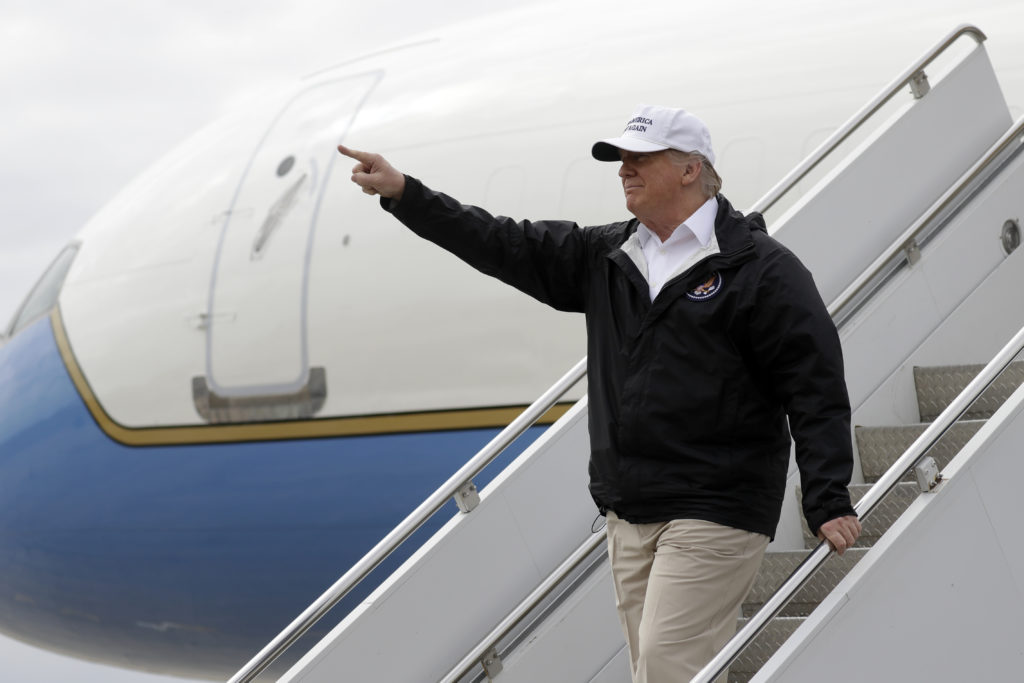
For only the fourth time in U.S. history, the House of Representatives has started a presidential impeachment inquiry. House committees are trying to determine if President Donald Trump violated his oath of office by asking Ukraine to investigate political rival Joe Biden and his family, and to investigate the country’s involvement in the 2016 U.S. presidential election. A quick summary of the latest news: DEPOSITIONS TURN TO WHITE HOUSE The three House committees leading the Democratic investigation have scheduled several current and former National Security Council officials to testify this week behind closed doors — an attempt to get a better look inside the White House as Trump pushed Ukraine to conduct politically motivated investigations. But it’s not clear whether the witnesses will appear as scheduled. A lawyer for Charles Kupperman, a former deputy at the NSC under then-national security adviser John Bolton, said Kupperman will comply if a court orders his appearance. He had been scheduled to testify Monday. Other witnesses summoned this week are current NSC staffers Tim Morrison and Alexander Vindman. Morrison is particularly significant. William Taylor, the top U.S. diplomat in Ukraine, told lawmakers in his deposition last week about phone calls he had with Morrison that described the Ukraine effort. The chairman of the House Intelligence Committee, Rep. Adam Schiff, who’s leading the inquiry, said Sunday he would like Bolton to testify but expects the White House would “fight us” over his appearance. Bolton is “a very important witness” who has “very relevant information,” Schiff, Democrat-California, told ABC’s “This Week.” The committees are scheduled to hear from three other State Department and Defense Department witnesses as well. Lawmakers want to determine whether military aid to Ukraine was held up as a condition of the investigations. The Democrats are moving quickly, sometimes scheduling multiple depositions in one day. They’re trying to compile facts and eventually transition to public hearings. Schiff said Saturday that the committees are making “rapid progress.” He told ABC that “we will be doing public hearings, and I think we’ll be doing them soon.” A WITNESS SUES It is unclear if all of the officials will appear because Trump has pledged to obstruct the probe. So far, most witnesses have decided to testify after receiving subpoenas from the committees. One of the witnesses, Kupperman, has taken the extraordinary step of asking a federal court who he should listen to — Congress or Trump. After he was subpoenaed, Kupperman filed a lawsuit in federal court on Friday asking a court whether he should accede to House demands for his testimony or to assert “immunity from congressional process” as directed by Trump. In the lawsuit, Kupperman said he “cannot satisfy the competing demands of both the legislative and executive branches.” Without the court’s help, he said, he would have to make the decision himself — one that could “inflict grave constitutional injury” on either Congress or the presidency. DEMOCRATIC COURT VICTORY A judge on Friday ordered the Justice Department to give the House secret grand jury testimony from special counsel Robert Mueller’s Russia investigation , handing a victory to Democrats who want the material for the impeachment inquiry. In ordering the department to turn over the material by Oct. 30, Chief U.S. District Judge Beryl Howell affirmed the legality of the impeachment inquiry itself. The Mueller materials could reveal previously hidden details to lawmakers about Trump’s actions during the 2016 election and become part of the impeachment push. The Trump administration could appeal the decision, however, further delaying the release of the materials. WORTH WATCHING The basics of the impeachment process are explained in less than two minutes in this AP-produced animated video: https://youtu.be/TSuLV_kDzeo Republished with the permission of the Associated Press.
The diplomat took notes. Then he told a story.
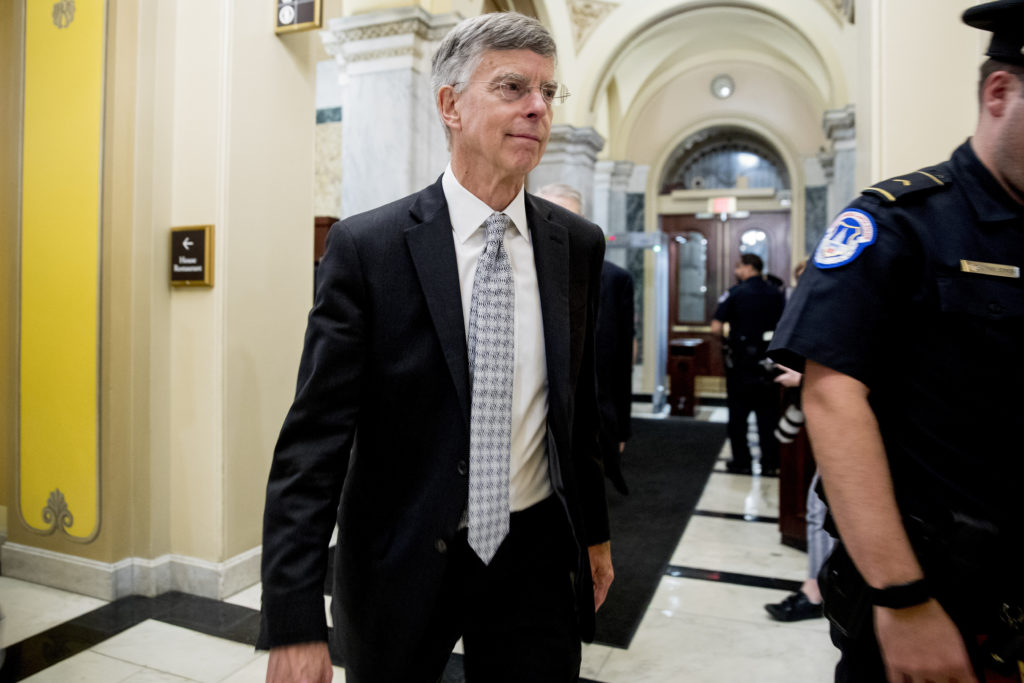
A secret cable. A disembodied voice. A coded threat. William Taylor, a career diplomat, went behind closed doors in the basement of the Capitol on Tuesday and told a tale that added up to the ultimate oxymoron — a 10-hour bureaucratic thriller. His plot devices were not cloak and dagger, but memos, text messages — and detailed notes. His testimony was laden with precision — names, dates, places, policy statements and diplomatic nuance, not typically the stuff of intrigue. But from the moment Taylor revealed that his wife and his mentor had given him conflicting advice on whether he should even get involved, the drama began to unfold. Their counsel split like this: Wife: no way. Mentor: do it. The mentor won out — or the story would have ended there. Instead, on June 17, Taylor, a West Point graduate, Vietnam veteran and tenured foreign service officer, arrived in Ukraine’s capital of Kyiv as the chief of mission. He had been recalled to service after the U.S. ambassador to Ukraine had been forced out. That alone offered foreshadowing of troubles to come. And, soon enough, Taylor said in his written opening statement, he discovered “a weird combination of encouraging, confusing and ultimately alarming circumstances.” The story Taylor related from there amounted to a detailed, almost prosecutorial, rejoinder to White House efforts to frame President Donald Trump’s actions in Ukraine as perfectly normal and unworthy of an impeachment investigation. With each documented conversation, he made it harder for the president to press his argument that there was no quid pro quo in which he held up military aid to advance his political interests. Over three months, Taylor told legislators, he fought his way through a maze of diplomatic channels and rival backchannels as he tried to unravel the story behind the mysterious hold-up of $400 million in U.S. military aid that Ukraine desperately needed in order to defend itself against the Russians. First came mixed signals about whether Trump would follow through on his promise to invite Ukraine’s new president, Volodymyr Zelenskiy, to meet with him in the Oval Office. Taylor was told by other U.S. diplomats that Trump needed “to hear from” Zelenskiy before the meeting would be scheduled. And that Zelenskiy needed to make clear he was not standing in the way of “investigations.” Next, Taylor wrote, there was “something odd:” Gordon Sondland, a Trump ally and U.S. ambassador to the European Union, “wanted to make sure no one was transcribing or monitoring” a June 28 call that the diplomats made to Zelenskiy. Soon enough, Taylor was detecting that Zelenskiy’s hopes of snagging the coveted Oval Office meeting were contingent on the Ukrainian leader agreeing to investigate Democrats in the 2016 election and to look into a Ukrainian company linked to the family of Trump political foe Joe Biden. “It was clear that this condition was driven by the irregular policy channel I had come to understand was guided by Mr. Giuliani,” Taylor said, referring to Rudy Giuliani, the former New York City mayor and Trump lawyer who was involving himself in Ukrainian affairs. The dueling channels of communication were highly unusual. Then things got more strange: Toward the end of a routine July 18 video conference with National Security Council officials in Washington, “a voice on the call” from an unknown person who was off-screen announced that the Office of Management and Budget would not approve any more U.S. security aid to Ukraine “until further notice.” “I and others sat in astonishment,” Taylor recounted. From there, Taylor made his way through a confusing web of conversations, text messages, cables and other contacts trying to figure out why this was happening. His diplomatic parrying was punctuated by a detour to the front lines of the Russia-Ukraine fighting in northern Donbas, where Taylor witnessed firsthand “the armed and hostile Russia-led forces on the other side of the damaged bridge across the line of contact.” That frozen military aid was no mere abstraction. “More Ukrainians would undoubtedly die without the U.S. assistance,” Taylor wrote.The diplomat was so troubled that he requested a private meeting with John Bolton when the national security adviser visited Kyiv in late August. Bolton’s counsel to Taylor: Send a “first-person cable” to Secretary of State Mike Pompeo laying out his concerns. Taylor took the advice and sent a secret cable describing the “folly” of withholding assistance. He got no specific response. He still couldn’t explain to the Ukrainians why they weren’t getting their aid. And time was running out: If the assistance wasn’t delivered by Sept. 30, the end of the government’s fiscal year, it would vanish. In early September, the puzzle pieces began to fit together. It wasn’t just the Oval Office meeting that was contingent on Zelenskiy investigating Democrats, Taylor learned, it was the military aid. Taylor said Sondland told him that if Zelenskiy didn’t publicly announce the investigations, there would a “stalemate.” He took “stalemate” to be code for holding up the assistance. Taylor’s text messages take the story forward: “I think it’s crazy to withhold security assistance for help with a political campaign,” he wrote to Sondland. Sondland waited five hours to respond with a clinical denial of any such contingency: “The President has been crystal clear no quid pro quo’s of any kind.” He reportedly talked to Trump before he sent the response. The explanation didn’t satisfy Taylor. But, at last, on Sept. 11, Taylor got word that the hold on releasing the money had been lifted and the security assistance would be provided. Taylor summed up his tale as “a rancorous story about whistleblowers, Mr. Giuliani, side channels, quid pro quos, corruption, and interference in elections.” Democrats found it riveting, with Rep. Raja Krishnamoorthi of Illinois describing Taylor as “like a witness out of central casting.” White House press secretary Stephanie Grisham, though, dismissed it as part of a “coordinated smear campaign from far-left lawmakers and radical unelected bureaucrats waging war on the Constitution.” In the end, Taylor said he
Shifting explanations for withholding aid draw GOP alarm
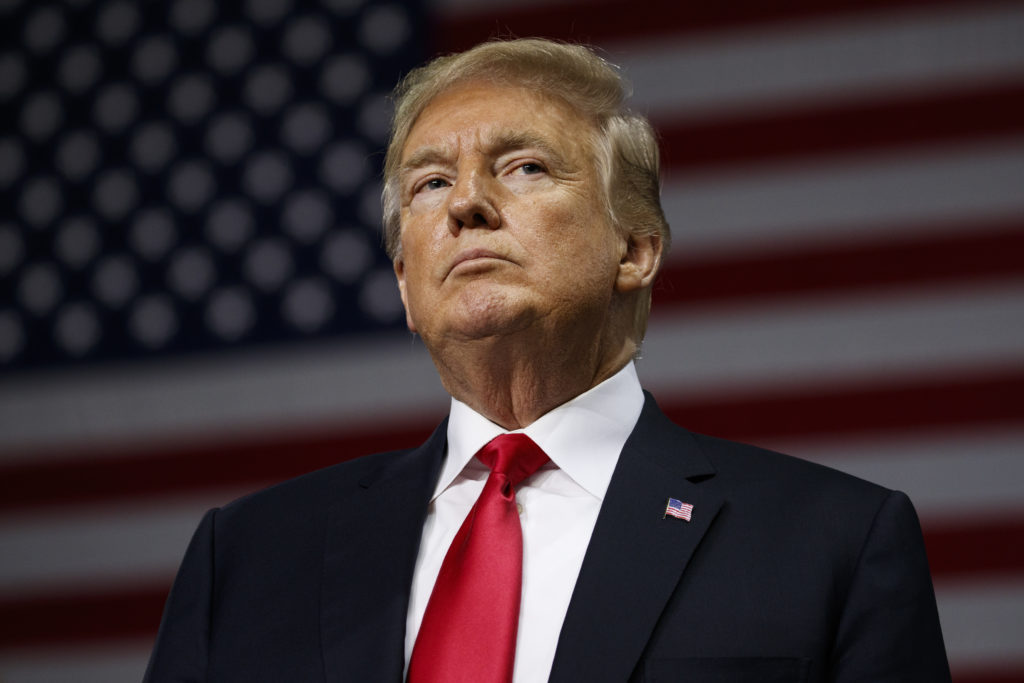
The shifting White House explanation for President Donald Trump’s decision to withhold military aid from Ukraine drew alarm Friday from Republicans as the impeachment inquiry brought a new test of their alliance. Trump, in remarks at the White House, stood by his acting chief of staff, Mick Mulvaney, whose earlier comments undermined the administration’s defense in the impeachment probe. Speaking Thursday at a news conference, Mulvaney essentially acknowledged a quid pro quo with Ukraine that Trump has long denied, saying U.S. aid was withheld from Kyiv to push for an investigation of the Democratic National Committee and the 2016 election. He later clarified his remarks. Trump appeared satisfied with Mulvaney’s clarification and the president dismissed the entire House inquiry as “a terrible witch hunt. This is so bad for our country.” But former Ohio Gov. John Kasich, who ran against Trump in the 2016 Republican primary, said he now supports impeaching the president. Mulvaney’s admission, he said, was the “final straw.” ”The last 24 hours has really forced me to review all of this,” Kasich said on CNN. In Congress, at least one Republican, Rep. Francis Rooney of Florida, spoke out publicly, telling reporters that he and others were concerned by Mulvaney’s remarks. Rooney said he’s open to considering all sides in the impeachment inquiry. He also said Mulvaney’s comments cannot simply be undone by a follow-up statement. “It’s not an Etch-A-Sketch,” said Rooney, a former ambassador to the Holy See under President George W. Bush. “The only thing I can assume is, he meant what he had to say — that there was a quid pro quo on this stuff,” he said. The tumult over Mulvaney’s remarks capped a momentous week in the impeachment investigation as the admission, from highest levels of the administration, undercut the White House defense and pushed more evidence into the inquiry. GOP leaders tried to contain the fallout. But four weeks into the inquiry, the events around Trump’s interaction with the Ukraine president, which are are at the heart of impeachment, have upended Washington. The Energy Secretary, Rick Perry, who has been caught up in the probe, announced his resignation. A beloved House chairman, Rep. Elijah Cummings, Democrat-Maryland, a leading figure in the investigation, died amid ongoing health challenges. The march toward an impeachment vote now seems all but inevitable, so much so that the highest-ranking Republican, Senate Majority Leader Mitch McConnell, privately told his GOP colleagues this week to expect action in the House by Thanksgiving with a Senate trial by Christmas. Speaker Nancy Pelosi has given no timeline for conclusion but wants the inquiry completed “expeditiously.” She said Thursday that facts of the investigation will determine next steps. “The timeline will depend on the truth line,” she told reporters. This week’s hours of back-to-back closed-door hearings from diplomats and former top aides appeared to be providing investigators with a remarkably consistent account of the run-up and aftermath of Trump’s call with Ukraine President Volodymy Zelenskiy. In that July call, Trump asked the newly elected Zelenskiy for a “favor” in investigating the Democratic National Committee’s email situation, which was central to the 2016 election, as well as a Ukraine gas company, Burisma, linked to the family of Trump’s 2020 Democratic rival, Joe Biden, according to a rough transcript of the phone conversation released by the White House. Republican leaders tried to align with Trump Friday, amid their own mixed messages as House Democrats, who already issued a subpoena to Mulvaney for documents, now want to hear directly from him. Rep. Kevin McCarthy, the House GOP leader, cited Mulvaney’s clarification as evidence that there was no quid pro quo. He said witnesses have also testified similarly behind closed doors in the impeachment inquiry. “We’ve been very clear,” McCarthy said. “There was no quid pro quo.” Lawmakers involved in the three House committees conducting the investigation want to hear more next week, which promises another packed schedule of witnesses appearing behind closed doors. Republicans want the interviews made open to the public, including releasing transcripts. Democrats in the probe being led by Rep. Adam Schiff, chairman of the Intelligence Committee, are keeping the proceedings closed for now, partly to prevent witnesses from comparing notes. Three House committees investigating impeachment have tentatively scheduled several closed-door interviews next week, including one with Bill Taylor, the current top official at the U.S. Embassy in Ukraine. Taylor’s interview, scheduled for Tuesday, is significant because he was among the diplomats on a text message string during the time around the July phone call. He raised a red flag and said it was “crazy” to withhold the military aid for a political investigation. It’s unclear whether all the witnesses will appear, given that the White House is opposing the inquiry and trying to block officials from testifying. The schedule includes a mix of State Department officials and White House aides. By Lisa Mascaro, Andrew Taylor, Mary Clare Jalonick Associated Press Republished with the permission of the Associated Press
Bradley Byrne: Congress must investigate the escalating Joe Biden scandal
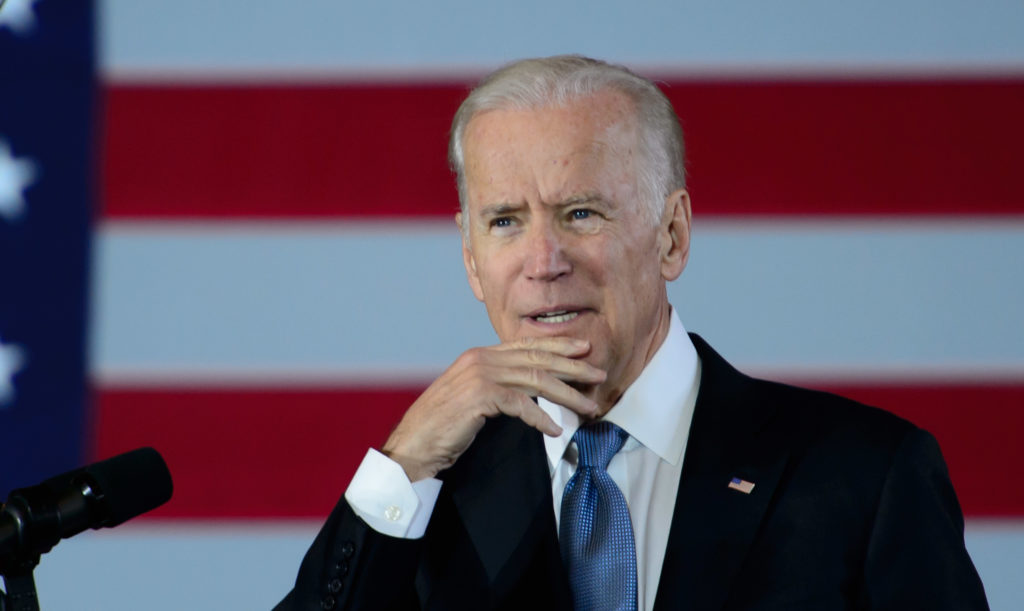
While Democrats recklessly intensify their partisan scheme to impeach President Donald Trump, the Biden scandal has escalated to a level Congress can no longer responsibly ignore. As more details come out regarding Hunter Biden’s business dealings overseas, their connection with actions taken by his father, Joe Biden, in his official capacity as Vice President raise new questions that must be answered. For example, we have learned that Hunter Biden accompanied his father aboard Air Force Two to China six years ago. Ten days after the trip, Hunter Biden’s new Chinese private equity firm, formed in partnership with the communist government-owned Bank of China, received a license. Hunter Biden admitted to meeting with his Chinese partner in the fund during the visit but insists they did not discuss business. That sure doesn’t pass the smell test. At least one Chinese government-owned company Hunter Biden’s firm later invested in, Aviation Industry Corporation of China, exists primarily to compete with the United States and has a history of stealing American technology. Think about that. Hunter Biden partnered with the Chinese government in a lucrative business venture whose purpose is to weaken the United States. We still do not know where else Hunter traveled or who else he met with on this trip. But Joe Biden may have played an even more direct role in promoting his son’s financial prospects in Ukraine. Joe Biden has bragged openly about successfully pressuring the Ukrainian government to remove its top prosecutor or risk losing United States assistance. We’ve now learned this prosecutor was investigating Burisma Holdings, a Ukrainian company on whose board Hunter Biden sat at the time. Some reports have Hunter Biden earning as much as $50,000 per month on the board – a hefty salary for someone with almost no experience in foreign policy or business. Democrats can’t in good faith continue investigating every single action the President has ever taken—many predating his time as a political candidate—while the Biden scandal stares them straight in the face. But this gets back to the purpose of the Democrats’ impeachment effort. It was never about corruption or any high-minded ideals. Democrat Congressman Al Green told us back in 2017 why Democrats want to impeach President Trump: “I’m concerned that if we don’t impeach this president, he will get reelected.” If the same facts in the Biden case occurred with one of President Trump’s children, Democrats would have already launched a full-scale investigation. We must expose their hypocrisy. This week I am introducing a House resolution calling for an investigation into the Bidens’ shady business dealings. This resolution calls for the House Committees on Foreign Affairs, Oversight and Government Reform, and Financial Services to begin investigations of business dealings of Hunter Biden during the period in which his father Joe Biden served as Vice President of the United States, whether those business dealings resulted in improper conflicts of interests, and whether Hunter Biden’s work affected United States foreign policy or a foreign government or foreign entity’s response. As more information comes to light regarding Hunter Biden’s business dealings with the Ukrainians and Chinese and his father’s apparent actions to use his position as Vice President to facilitate his son’s financial pursuits, it stretches all credibility to deny an investigation is warranted. Instead of neglecting all their legislative responsibilities to investigate President Trump, Democrats must acknowledge a serious scandal festers in their own ranks and take appropriate action. We need to stop playing politics and look to get to the bottom of a potentially real scandal. If Democrats continue to ignore the Biden scandal, this impeachment inquiry will be haunted by a legacy of illegitimacy, and the American people’s faith in their representative government will suffer a demoralizing blow.
New whistleblower may give house democrats fresh information
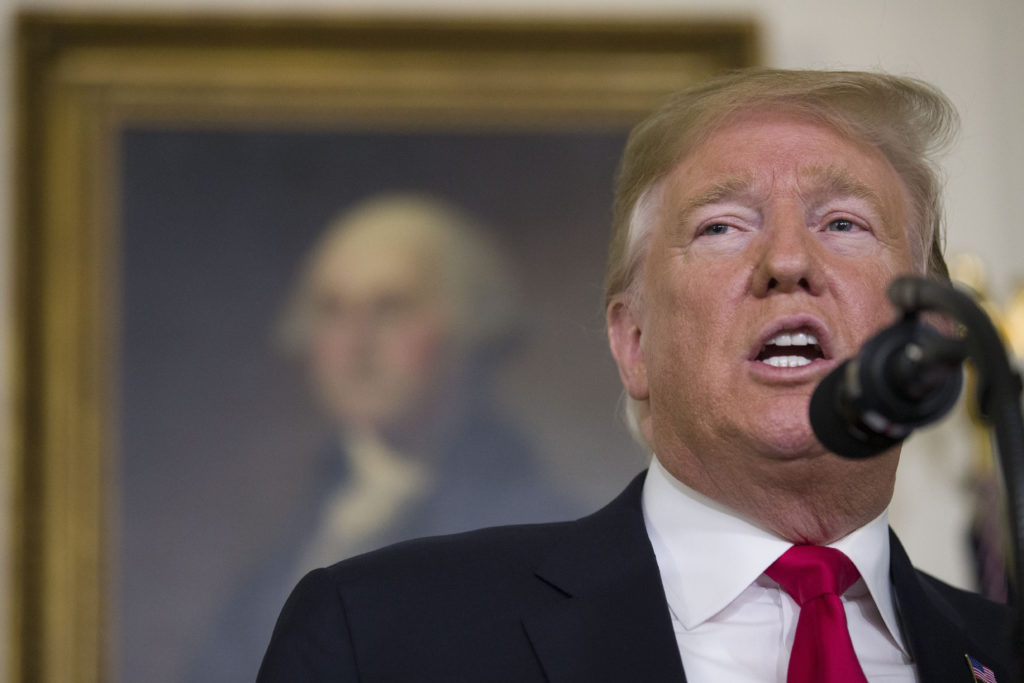
House Democrats leading an impeachment inquiry of President Donald Trump’s dealings with Ukraine may have fresh information to work with after a new whistleblower stepped forward with what the person’s lawyer said were firsthand knowledge of key events. With Congress out for another week and many Republicans reticent to speak out, a text from attorney Mark Zaid that a second individual had emerged and could corroborate the original whistleblower’s complaint gripped Washington and potentially heightened the stakes for Trump. Zaid, who represents both whistleblowers, told The Associated Press that the new whistleblower works in the intelligence field and has spoken to the intelligence community’s internal watchdog. The original whistleblower, a CIA officer, filed a formal complaint with the inspector general in August that triggered the impeachment inquiry. The document alleged that Trump had used a July telephone call with Ukraine President Volodymyr Zelenskiy to investigate a political rival, Joe Biden, and his son Hunter, prompting a White House cover-up. The push came even though there was no evidence of wrongdoing by the former vice president or his son, who served on the board of a Ukrainian gas company. Trump and his supporters deny that he did anything improper, but the White House has struggled to come up with a unified response. A second whistleblower with direct knowledge could undermine efforts by Trump and his allies to discredit the original complaint. They have called it politically motivated, claimed it was filed improperly and dismissed it as unreliable because it was based on secondhand or thirdhand information. A rough transcript of Trump’s call with Zelenskiy, released by the White House, has already corroborated the complaint’s central claim that Trump sought to pressure Ukraine on the investigation. Text messages from State Department officials revealed other details, including that Ukraine was promised a visit with Trump if the government would agree to investigate the 2016 election and a Ukrainian gas company tied to Biden’s son — the outline of a potential quid pro quo. Rep. Jim Himes, Democrat-Connecticut, a member of the House Intelligence Committee, said word of a second whistleblower indicates a larger shift inside the government. “The president’s real problem is that his behavior has finally gotten to a place where people are saying, ‘Enough,’” Himes said. Democrats have zeroed in on the State Department in the opening phase of their impeachment investigation. The Intelligence, Oversight and Foreign Affairs committees have already interviewed Kurt Volker, a former special envoy to Ukraine who provided the text messages, and least two other witnesses are set for depositions this week: Gordon Sondland, the U.S. ambassador to the European Union, and Marie Yovanovitch, who was abruptly ousted as the U.S. ambassador to Ukraine in May. Sen. Lindsey Graham, Republican-South Carolina, one of Trump’s most vocal backers, provided perhaps the strongest defense of the Republican president. He said there was nothing wrong with Trump’s July conversation with Zelenskiy and said the accusations look like a “political setup.” As for Trump, rather than visiting his nearby golf course in Sterling, Virginia, for a second day, he stayed at the White House on Sunday, where he tweeted and retweeted, with the Bidens a main target. “The great Scam is being revealed!” Trump wrote at one point, continuing to paint himself as the victim of a “deep state” and hostile Democrats. Aside from Trump’s attempt to pressure Zelenskiy, the July call has raised questions about whether Trump held back near $400 million in critical American military aid to Ukraine as leverage for an investigation of Burisma, a Ukrainian gas company. Hunter Biden served on the board of Burisma at the same time his father was leading the Obama administration’s diplomatic dealings with Ukraine. Though the timing raised concerns among anti-corruption advocates, there has been no evidence of wrongdoing by either Biden. Joe Biden, a leading candidate for the 2020 Democratic presidential nomination, wrote in The Washington Post that he had a message for Trump and “those who facilitate his abuses of power. … Please know that I’m not going anywhere. You won’t destroy me, and you won’t destroy my family.” Additional details about the origins of Trump’s July 25 call with Zelenskiy have emerged over the weekend. Energy Secretary Rick Perry had encouraged Trump to speak with the Ukrainian leader, but on energy and economic issues, according to spokeswoman Shaylyn Hynes. She said Perry’s interest in Ukraine is part of U.S. efforts to boost Western energy ties to Eastern Europe. Trump, who has repeatedly has described his conversation with Zelenskiy as “perfect,” told House Republicans on Friday night that it was Perry who teed up the July call, according to a person familiar with Trump’s comments who was granted anonymity to discuss them. The person said Trump did not suggest that Perry had anything to do with the pressure to investigate the Bidens. Himes appeared on CBS’ “Face the Nation” while Graham spoke on Fox News Channel’s “Sunday Morning Futures.” By Eric Tucker, Richard Lardner and Jill Colvin Associated Press Associated Press writers Alan Fram, Ellen Knickmeyer and Mary Clare Jalonick contributed to this report. Republished with the permission of the Associated Press.
Jimmy Carter says he couldn’t have managed presidency at 80
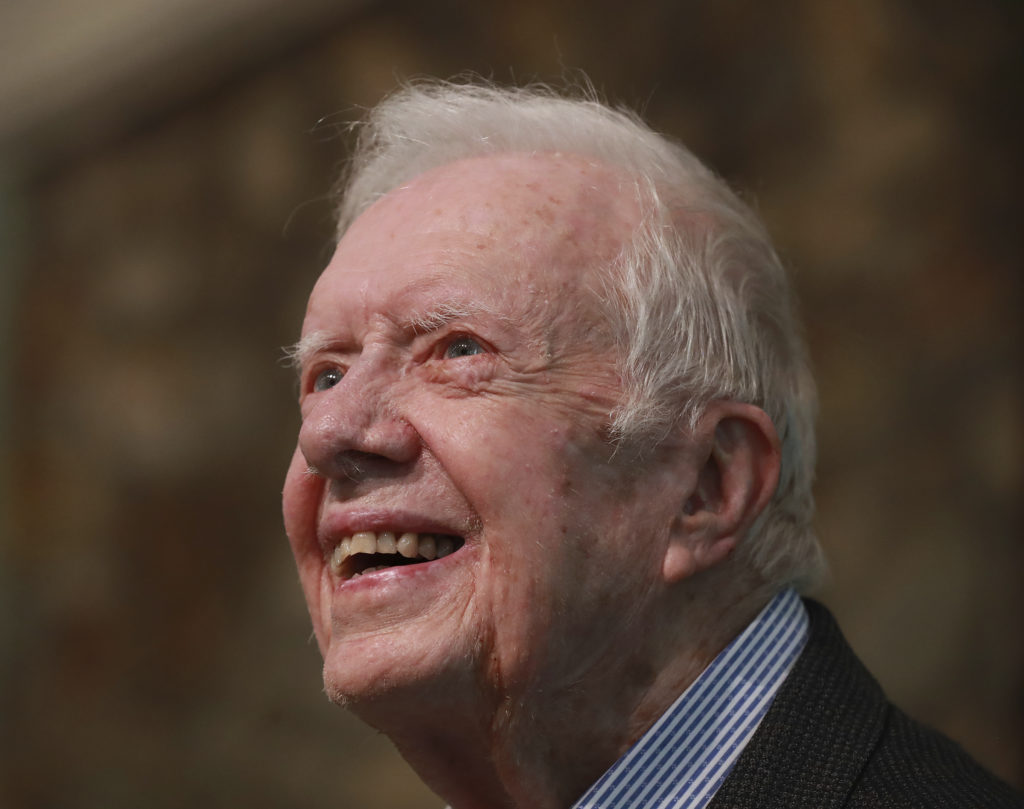
Weeks shy of his 95th birthday, former President Jimmy Carter said he doesn’t believe he could have managed the most powerful office in the world at 80 years old. Carter, who earlier this year became the longest-lived chief executive in American history, didn’t tie his comments to any of his fellow Democrats running for president in 2020, but two leading candidates, Joe Biden and Bernie Sanders, would turn 80 during their terms if elected. Biden is 76. Sanders is 78. “I hope there’s an age limit,” Carter said with a laugh as he answered audience questions on Tuesday during his annual report at the Carter Center in Atlanta. “If I were just 80 years old, if I was 15 years younger, I don’t believe I could undertake the duties I experienced when I was president.” Carter’s observation came in response to a jovial inquiry about whether he had considered running in 2020 since he’s still constitutionally allowed another term. The 39th president left office in 1981 at the age of 56 after losing his reelection bid to Ronald Reagan, who served two terms and left office as the oldest sitting president in history, at 77. Either Biden or Sanders would be older upon their inauguration than Reagan was on his final day in the Oval Office. At 73, President Donald Trump is a record setter, as well. He eclipsed Reagan’s mark as the oldest newly elected president in history and would become the oldest president to be reelected. Age has been a flashpoint for some critics of Trump, Sanders and Biden. Carter, who turns 95 on Oct. 1, said the Oval Office requires a president “to be very flexible with your mind,” particularly on foreign affairs. He was speaking on the 41st anniversary of the Camp David Accords, a peace agreement he negotiated with Egyptian President Anwar Sadat and Israeli Prime Minister Menachem Begin. “You have to be able to go from one subject to another and concentrate on each one adequately and then put them together in a comprehensive way, like I did between Begin and Sadat with the peace agreement,” Carter said. “The things I faced in foreign affairs, I don’t think I could undertake them at 80 years old,” he continued, before adding with a smile: “At 95, it’s out of the question. I’m having a hard time walking.” Carter said he remains undecided in the 2020 primary. “I’m going to keep an open mind,” he said, explaining that he wants to vote for a candidate who pledges to make the U.S. the world’s leading champion for peace, human rights and equality. “One of the major factors I will have in my mind is who can beat Trump,” he added, noting that he’ll vote for the Democratic nominee in the general election regardless.Still, Carter’s assessments on age could leave him with few easy choices in the primary. Carter repeated his previous disclosure that he voted for Sanders over Hillary Clinton in 2016, siding with the democratic socialist over the party establishment favorite. But Carter has since warned Democrats not to go too far left, lest they risk alienating independents and moderate Republicans who can help the party defeat Trump. He has specifically cited proposals like a single-payer health insurance system as potential deal-breakers for some voters inclined to vote against Trump. Sanders and another leading progressive candidate, Massachusetts Sen. Elizabeth Warren, back single-payer health insurance run by the federal government. Warren is 70 years old. Meanwhile, Biden is leading most national and early state primary polls in part because of his strength among more moderate Democrats. Other moderates in the field trail far behind Biden, Sanders and Warren. When Carter ran and won in 1976, he was the outsider toppling establishment favorites. But the former Georgia governor also represented the more moderate wing of a party that had been dominated by Northeastern liberals. Since his defeat, however, Republicans have used Carter as a liberal caricature. And Carter himself, through his work at the Carter Center, has embraced the role of an outspoken human rights advocate willing to criticize the world’s establishment institutions and accepted world order. He’s long blasted Israel’s treatment of Palestinians, even as both major U.S. parties more carefully navigated the U.S. alliance with Israel. As Israel tallies votes from its Tuesday elections, Carter lamented that returning hard-line Prime Minister Benjamin Netanyahu to power could “end the peace process” altogether. Exit polls show that Netanyahu’s party fell short of securing a parliamentary majority, potentially threatening his position. Speaking about his post-presidency legacy, Carter said he wants the Carter Center, which has focused since 1982 on public health and election monitoring, to be more willing to criticize the U.S. government, advocate for policies to combat the climate crisis and explicitly take sides against war. “The Carter Center has been basically mute on the subject of global warming,” Carter said, putting blame on himself. He also warned Americans against the consequences of perpetual military conflict. He noted that China, the major economic and geopolitical competitor to the U.S., has spent four decades at peace since Carter normalized relations with Beijing. In that time, China has spent trillions of dollars on infrastructure and education, Carter said, while the U.S. has spent corresponding amounts on military engagement. “That just shows you the difference between peace and war,” Carter said, later adding, “I just want to keep the world at peace.” By Bill Barrow Associated Press Follow Barrow on Twitter at https://twitter.com/BillBarrowAP. Republished with the permission of the Associated Press.
Joe Biden on racism: White people ‘can never fully understand’
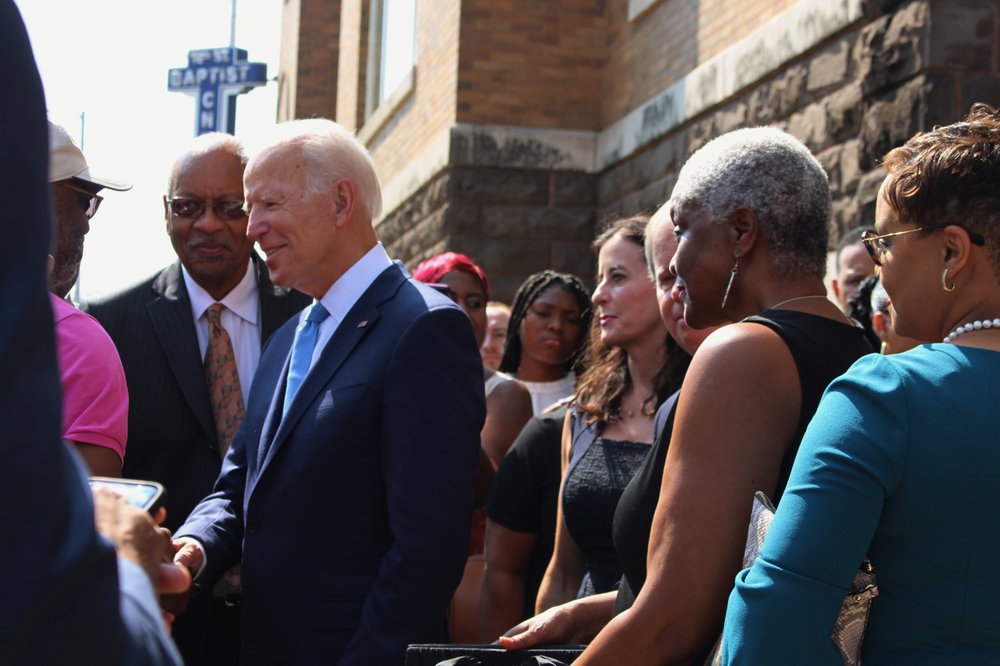
Visiting a black church bombed by the Ku Klux Klan during the civil rights era, Democratic presidential candidate Joe Biden framed current racial tensions as part of an enduring struggle that is older than the nation. “In a centuries long campaign of violence, fear, trauma, brought upon black people in this country, the domestic terrorism of white supremacy has been the antagonist of our highest ideals since before the founding of this country,” Biden told the 16th Street Baptist Church congregation in downtown Birmingham on Sunday as they commemorated the 56th anniversary of the bombing that killed four black girls in 1963. “It’s in the wake of these before-and-after moments,” Biden added, “when the choice between good and evil is starkest.” Biden’s appearance comes at an inflection point for Democrats’ 2020 leader in the polls. He is trying to capitalize on his strength among older black voters while navigating criticism from some African American and other nonwhite leaders, particularly younger ones, who take a skeptical view of the 76-year-old white man’s willingness and ability to address systemic racism. During his 20 minutes at the pulpit, Biden condemned institutional racism as the direct legacy of slavery and lamented that the nation has “never lived up to” the ideals of equality written into its founding documents. But then he added a more personal note — perhaps the closest he would come to addressing his detractors. “Those who are white try,” Biden said, “but we can never fully understand.” The former vice president called out the names of the bombing victims — Addie Mae Collins, Denise McNair, Carole Robertson and Cynthia Wesley — and he drew nods of affirmation as he warned that “the same poisonous ideology that lit the fuse on 16th Street” has yielded more recent tragedies, including in 2015 at a black church in South Carolina, in 2018 at a Jewish synagogue in Pittsburgh and in August at an El Paso, Texas, Walmart frequented by Latino immigrants. The Birmingham church, Biden said, offers an example to those communities and a nation he said must recommit itself to “giving hate no safe harbor — demonizing no one, not the poor, the powerless, the immigrant or the ‘other.’” From his long time in government, first as a senator and then vice president to Barack Obama, the first black president, Biden has deep ties in the black community. Though Biden didn’t mention President Donald Trump in his remarks, he has made withering critiques of the president’s rhetoric and policies on race and immigration a central feature of his candidacy. Yet Biden sometimes draws searing appraisals from younger nonwhite activists who point to complexities in his record. That includes his references to working productively alongside segregationist senators in the 1970s to distrust over his lead role in a 1994 crime law that critics frame as partially responsible for mass incarceration, especially black men. The dynamics flared up again Thursday after Biden, during a Democratic debate, offered a sometimes incoherent answer when asked how the nation should confront the legacy of slavery. At one point, Biden suggested nonwhite parents use a play a record player to help their children with verbal and cognitive development. That led to a social media firestorm and commentary that Biden takes a paternalistic view of black and brown America even as he hammers Trump for emboldening more obvious forms of racism. Author Anand Giridharadas called Biden’s answer “appalling — and disqualifying” for “implying that black parents don’t know how to raise their own children.” Biden’s audience Sunday seemed more to reflect his relative popularity with black voters. Parishioners wielded their cellphones when he arrived with Alabama Sen. Doug Jones, a white politician beloved in the church for his role as the lead prosecutor who secured convictions decades after the bombing occurred. The congregation gave Biden a standing ovation when he completed his remarks. Alvin Lewis, a 67-year-old usher at 16th Street Baptist, said the welcome doesn’t necessarily translate to votes. But as Lewis and other congregants offered their assessment of race relations in the United States under Trump, they tracked almost flawlessly the arguments Biden has used to anchor his campaign. “Racism has reared its head in a way that’s frightening for those of us who lived through it before,” Lewis said, recalling that he was at home, about “20 blocks from here” when the Klan bomb went off at 10:22 a.m. on Sept. 15, 1963. “No matter what anyone says, what comes out of the president of the United States’ mouth means more than anything,” Lewis added, saying Trump “has brought out some nastier times in this country’s history.” Antoinette Plump, a 60-year-old who took in the service alongside lifelong member Doris Coke, 92, said racism “was on the back burner” until Trump “brought out all the people who are so angry.” Coke, who was at the church on that Sunday in 1963, said, “We’ve come a long way.” But she nodded her head as Plump denounced Trump. Nearby sat Fay Gaines, a Birmingham resident who was in elementary school in 1963 — just a few years younger than the girls who died. Gaines said she’s heard and read criticisms about Biden. Asked whether she’d seen his “record players” answer in the debate, she laughed and said she did. But he remains on her “short list” of preferred candidates. “I think there may just be a generational divide,” she said of the reaction. “People who lived through all these struggles maybe can understand how to deal with the current situation a little better.” That means, she said, recognizing a politician’s core values. “I trust Joe Biden,” she said. “History matters. His history matters.” Follow Barrow on Twitter at https://twitter.com/BillBarrowAP. Republished with the permission of the Associated Press.
Key takeaways from the 2020 democratic candidates’ debate
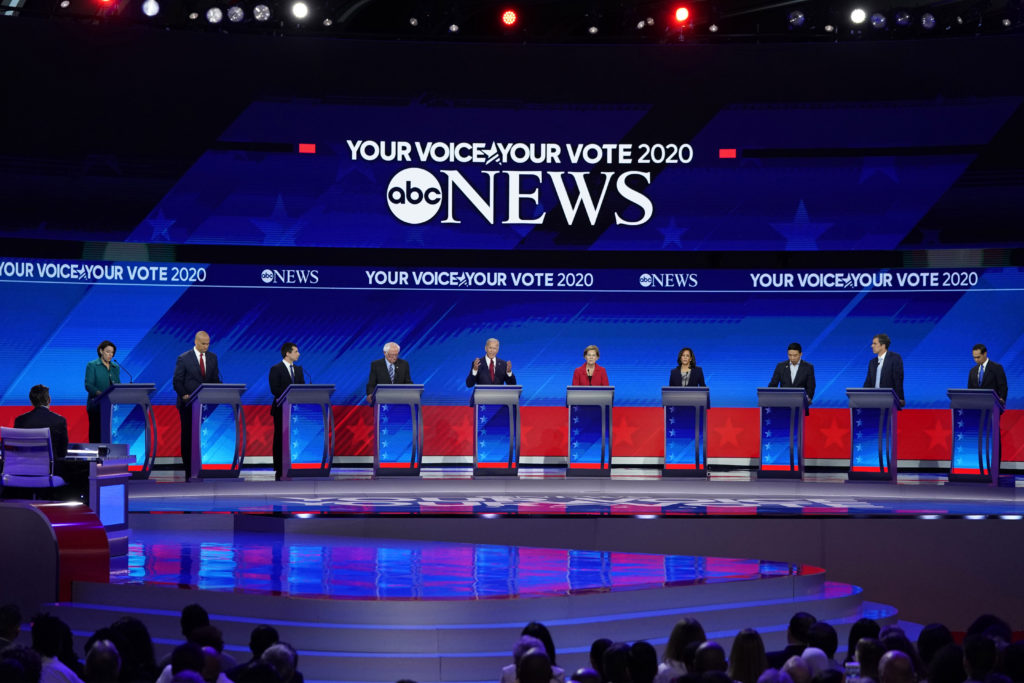
Democratic debate night No. 3: Attacks and counter-attacks. Love for one former president, loathing for the current one. A 76-year-old front-runner essentially got called old, and he turned around and called another rival a “socialist.” But will it change the fundamentals of a nominating fight that remains remarkably stable at the top with five months until voting begins? Here’s a look at some takeaways and potential answers: STATUS QUO PREVAILED The third Democratic debate seemed to end in a 10-way tie. Former Vice President Joe Biden was sure-footed (until the end), at least for him and compared with the previous two debates. There were more attacks on President Donald Trump than on each other. No one dominated. Biden took on the most fire, but parried it and, as front-runner, benefits the most from a no-decision. Sen. Bernie Sanders faced sharp criticism about his universal health care plan from several candidates, but his base has demonstrated its loyalty. Sen. Elizabeth Warren was more in the background than in prior debates but didn’t damage herself, and she closed with a compelling personal story. Sens. Kamala Harris and Cory Booker were both crisp but got lost on the crowded stage at times. Mayor Pete Buttigieg, former Rep. Beto O’Rourke and Sen. Amy Klobuchar helped form a sensibility caucus, offering pragmatism and civic-mindedness. Andrew Yang, a tech entrepreneur, spoke eloquently about immigration and assured himself a mention with his proposal to give 10 families $1,000 a month, from his campaign. The normally mild-mannered Julián Castro, a former Housing secretary, decided that attacking Biden, often in personal terms, was one way to get noticed. The likely result: little change in a primary that has been remarkably static for months. FIGHT THAT DIDN’T BREAK OUT The first matchup between Biden and Warren had so much anticipation — and so little fireworks. There were a few criticisms of Warren on health care, though she not directly answer whether her plan would raise taxes on the middle class. During a discussion on trade, Biden even said he agreed with Warren’s call to bring labor to the table. Certainly, the head-to-head confrontation will come if Biden continues as the front-runner and Warren maintains her momentum as perhaps the most likely progressive alternative. But perhaps the two campaigns were right after all when they said privately before the debate that September — five months before the Iowa caucuses — isn’t necessarily the time for a titanic fight at the top of the field. BERNIE BATTERED ON HEALTH CARE Sanders took heavy fire on his single-payer health insurance proposal, with Biden and others hammering the Vermont senator for the cost and the political palatability of effectively eliminating the existing private insurance market. The former vice president went hardest at Sanders when the senator argued that his estimated $30 trillion cost over a decade is cheaper than the “status quo,” which he put at $50 trillion — with most of the money being what Americans spend privately on premiums, co-pays and out-of-pocket costs. Sanders’ argument is that most U.S. households would pay less overall under his system, even if their taxes go up. Biden roared that Sanders would effectively be handing Americans a pay cut, arguing employers who now pay a share of workers’ premiums would pocket that money instead of giving workers raises if the government were to cover all health care costs. Biden punctuated the point with one of the quotes of the night: “For a socialist, you’ve got a lot more confidence in corporate America than I do.” Buttigieg piled on Sanders, too. Buttigieg said he “trusts the American people to make the right decision” between private insurance and a public option. “Why don’t you?” he asked Sanders. OF AGE AND EXPERIENCE At the center of the debate stage were three candidates in their 70s who have had a collective headlock on the upper tier for months. Of the seven younger contenders, Castro, 44, was most explicit in arguing it was time for a new generation — and he specifically targeted the front-runner, 76-year-old Biden. “Our problems didn’t start with Donald Trump,” Castro said in his opening statement. “We won’t solve them by embracing old ideas.” Castro also seemed to allude to speculation about Biden’s mental acuity during an exchange about health care. When Biden denied that his health plan required people to buy into Medicare, Castro exclaimed, “Are you forgetting what you said 2 minutes ago?” He continued to suggest Biden didn’t remember what he’d just said about his own plan. Later, during a discussion about deportations under the Obama administration, Castro mocked Biden for clinging to former President Barack Obama, but then saying he was only vice president when Obama’s conduct was questioned. “He wants to take credit for Obama’s work but not answer any questions,” Castro said. MONEY FOR NOTHING Yang is an unorthodox candidate, and he came to the debate with an offer to match his persona: a proposal to use his campaign funds to pay 10 randomly-selected families $1,000 a month. Yang announced the maneuver in his opening statement. It’s intended to illustrate the center of his quixotic campaign, to provide monthly $1,000 payments to all Americans 18 and over. After lamenting how the country is in thrall to “the almighty dollar,” Yang, 44, urged viewers to go to his campaign website and register for the contest to win the money.His offer drew cheers from the audience and chortles from some of the other candidates onstage. “It’s original, I’ll give you that,” Buttigieg said. By Bill Barrow and Nicholas Riccardi Associated Press. Republished with the permission of the Associated Press.
Democratic debate: Top 2020 contenders finally on same stage
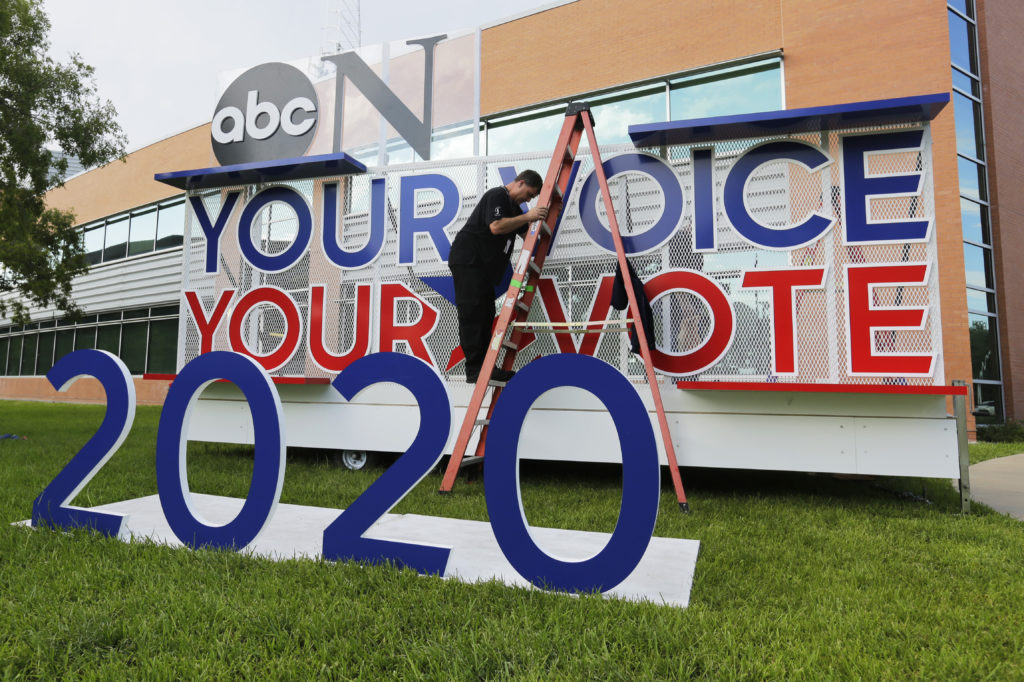
Progressive Democrats Elizabeth Warren and Bernie Sanders share the debate stage for the first time with establishment favorite Joe Biden Thursday night in a prime-time showdown displaying sharply opposing notions of electability in the party’s presidential nomination fight. Biden’s remarkably steady lead in the crowded contest has been built on the idea that the former vice president is best suited to defeat President Donald Trump next year — a contention based on ideology, experience and perhaps gender. Sanders and Warren, meanwhile, have repeatedly criticized Biden’s measured approach, at least indirectly, by arguing that only bold action on key issues like health care, the economy and climate change can build the coalition needed to win in 2020. The top-tier meeting at center stage has dominated the pre-event talk, yet each of the other seven candidates hopes for a breakout moment with the attention of the nation beginning to increase less than five months before the first primary votes are cast. “For a complete junkie or someone in the business, you already have an impression of everyone,” said Howard Dean, who ran for president in 2004 and later chaired the Democratic National Committee. “But now you are going to see increasing scrutiny with other people coming in to take a closer look.” The ABC News debate is the first limited to one night after several candidates dropped out and others failed to meet new qualification standards. A handful more candidates qualified for next month’s debate, which will again be divided over two nights. Beyond Biden and Sens. Warren and Sanders, the candidates on stage Thursday night include Minnesota Sen. Amy Klobuchar, New Jersey Sen. Cory Booker, South Bend, Indiana, Mayor Pete Buttigieg, California Sen. Kamala Harris, New York businessman Andrew Yang, former Texas Rep. Beto O’Rourke and former Obama administration Housing chief Julian Castro. Viewers will see the diversity of the modern Democratic Party. The debate, held on the campus of historically black Texas Southern University, includes women, people of color and a gay man, a striking contrast to the Republicans. It will unfold in a rapidly changing state that Democrats hope to eventually bring into their column. Perhaps the biggest question is how directly the candidates will go after one another. Some fights that were predicted in previous debates failed to materialize with candidates like Sanders and Warren in July joining forces. The White House hopefuls and their campaigns are sending mixed messages about how eager they are to make frontal attacks on anyone other than Trump. That could mean the first meeting between Warren, the rising progressive calling for “big, structural change,” and Biden, the more cautious but still ambitious establishmentarian, doesn’t define the night. Or that Harris, the California senator, and Buttigieg, the mayor of South Bend, Indiana, look to reclaim lost momentum not by punching rivals but by reemphasizing their own visions for America. Biden, who has led most national and early state polls since he joined the field in April, is downplaying the prospects of a clash with Warren, despite their policy differences on health care, taxes and financial regulation. “I’m just going to be me, and she’ll be her, and let people make their judgments. I have great respect for her,” Biden said recently as he campaigned in South Carolina. Warren says consistently that she has no interest in going after Democratic opponents. Yet both campaigns are also clear that they don’t consider it a personal attack to draw sharp policy contrasts. Warren, who as a Harvard law professor once challenged then-Sen. Biden in a Capitol Hill hearing on bankruptcy law, has noted repeatedly that they have sharply diverging viewpoints. Her standard campaign pitch doesn’t mention Biden but is built around an assertion that the “time for small ideas is over,” an implicit criticism of more moderate Democrats who want, for example, a public option health care plan instead of single-payer or who want to repeal Trump’s 2017 tax cuts but not necessarily raise taxes further. Biden, likewise, doesn’t often mention Warren or Sanders. But he regularly contrasts the price tag of his public option insurance proposal to the single-payer system that Warren and Sanders back. In a pre-debate briefing, Biden campaign officials said he would reject the premise that he’s an incrementalist, either in his long career as a senator and vice president or in his proposals for a would-be presidency. In an apparent rebuke of Warren, known for her policy plans, the advisers said Biden will hit on the idea that “we need more than just plans, we need action, we need progress.” Health care will top the list of examples, they said. They note that Biden’s proposal for a government-run “public option” to compete with private insurance still would be a major market shift, even if it stops short of Sanders’ and Warren’s proposal for a government insurance system that would effectively end the existing private insurance system. And, by extension, the difference may make Biden’s plan more likely to make it through Congress, they contend. There are indirect avenues to chipping away at Biden’s advantages, said Democratic consultant Karen Finney, who advised Hillary Clinton in 2016. Finney noted Biden’s consistent polling advantages on the question of which Democrat can defeat Trump. A Washington Post-ABC poll this week found that among Democrats and Democratic-leaning voters, 45 percent thought Biden had the best chance to beat Trump, though just 24 percent identified him as the “best president for the country” among the primary field. “That puts pressure on the others to explain how they can beat Trump,” Finney said.Voters, she said, “want to see presidents on that stage,” and Biden, as a known quantity, already reaches that threshold. “If you’re going to beat him, you have to make your case.”Harris, said spokesman Ian Sams, will “make the connection between (Trump’s) hatred and division and our inability to get things done for the country.” Buttigieg, meanwhile, will have an opportunity to use his argument for generational change as an indirect attack on the top
Analysis: Black votes will define electability for Democrats
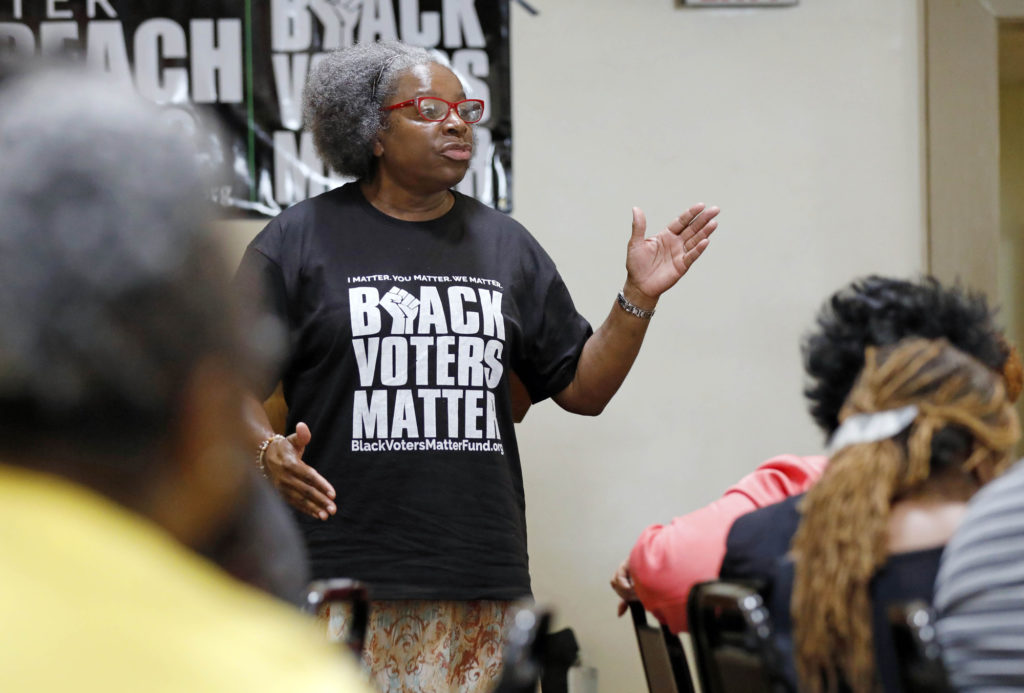
For all the strategic calculations, sophisticated voter targeting and relentless talk about electability in Iowa and New Hampshire, the Democratic presidential nomination will be determined by a decidedly different group: black voters. African Americans will watch as mostly white voters in the first two contests express preferences and winnow the field — then they will almost certainly anoint the winner. So far, that helps explain the front-running status of former Vice President Joe Biden. He has name recognition, a relationship with America’s first black president and a decadeslong Democratic resume. Black voters have long been at the foundation of his support — his home state of Delaware, where he served as a U.S. senator for nearly four decades, is 38 percent black — and until another presidential candidate proves that he or she can beat him, he is likely to maintain that support. In the 2008 campaign, Hillary Clinton held a strong lead among black voters over Barack Obama until he stunned her by winning the Iowa caucuses and proved to black voters that he was acceptable to a broad spectrum of Democrats. Those same voters returned to Clinton in 2016. Full Coverage: Election 2020 This cycle, many black voters are also making a pragmatic choice — driven as much or more by who can defeat President Donald Trump as the issues they care about — and sitting back to see which candidate white voters are comfortable with before deciding whom they will back. At the same time, the early courtship of black voters, overt and subtle, is part of a primary within the primary that includes detailed plans on issues like criminal justice reform, reparations, maternal mortality among black women, voter suppression and systemic racism. “As black voters and movers and drivers of national politics, our self-image and awareness of our power and influence is evolving,” said Aimee Allison, founder of the She the People network, which hosted the first presidential forum aimed specifically at female voters of color. Trump appealed to black voters during the 2016 campaign by saying “What the hell do you have to lose?” and ended up with only 8 percent of the black vote. But the Republican president again is saying he will try to win over black voters, frequently citing low unemployment and his own success in signing criminal justice legislation. So far, there is no evidence to suggest that he will succeed. But the first test of the decisiveness of black voters will come in the primaries. African Americans make up roughly 13 percent of the U.S. population but 24 percent of the Democratic primary electorate. That number is more formidable in the early primary state of South Carolina, where black voters are two-thirds of primary voters, and in other early voting states like Georgia, Alabama and Virginia. Biden reminded black reporters in a recent roundtable that his strength is not just with working class whites, but with the black voters he’s known for more than half a century in politics. “After all this time, they think they have a sense of what my character is and who I am, warts and all,” Biden said. “I’ll be surprised if you find any African Americans that think I’m not in on the deal, that I’m not who I say I am … I’ve never, ever, ever in my entire life been in circumstances where I’ve ever felt uncomfortable being in the black community.”He acknowledged that his familiarity is no assurance of success. And he noted that black voters may ultimately prefer black candidates like Sens. Kamala Harris of California or Cory Booker of New Jersey. First, though, one of them would have to prove to black voters that they were viable alternatives. Black voters can be decisive not only in determining the Democrats’ nominee but also the ultimate winner. While Democrats have peaked in recent cycles with white voters at around 40 percent, black voters have been their most loyal constituency. But in 2016, a drop-off among black voters had consequences. Black voter turnout dropped from about 67 percent in 2012 to about 60 percent, according to government data. “It comes down to a strategy decision that campaigns have to make: Do they believe that the way to win the White House is to win white voters, or do they believe that the way to White House is to mobilize voters of color?” said Leah Daughtry, who recently hosted a 2020 Democratic forum for black faith voters in Atlanta. “Is there a strategy that allows you to do both? Perhaps,” Daughtry said. “But one is a sure bet. If you get us to the polls, we are most likely to vote Democrat. If you get white folks to the polls, you don’t know what they’re going to do.” In the past, Biden would have been a prohibitive favorite, said LaTosha Brown, co-founder of Black Voters Matter. But black voters are demanding that candidates deliver on their priorities in a way they haven’t done in recent history. “Black folks are looking to figure out who white voters are going to align with, but I don’t think that’s the driver that it has been in the past,” she continued. “Black voters, like white voters, are increasingly frustrated with the process. No longer is it good enough to choose between the devil or the witch.” EDITOR’S NOTE — Errin Haines is national writer on race and ethnicity for The Associated Press. Follow her work on Twitter at https://www.twitter.com/emarvelous. Republished with the permission of the Associated Press.
Democrats face identity crisis in next phase of 2020 race
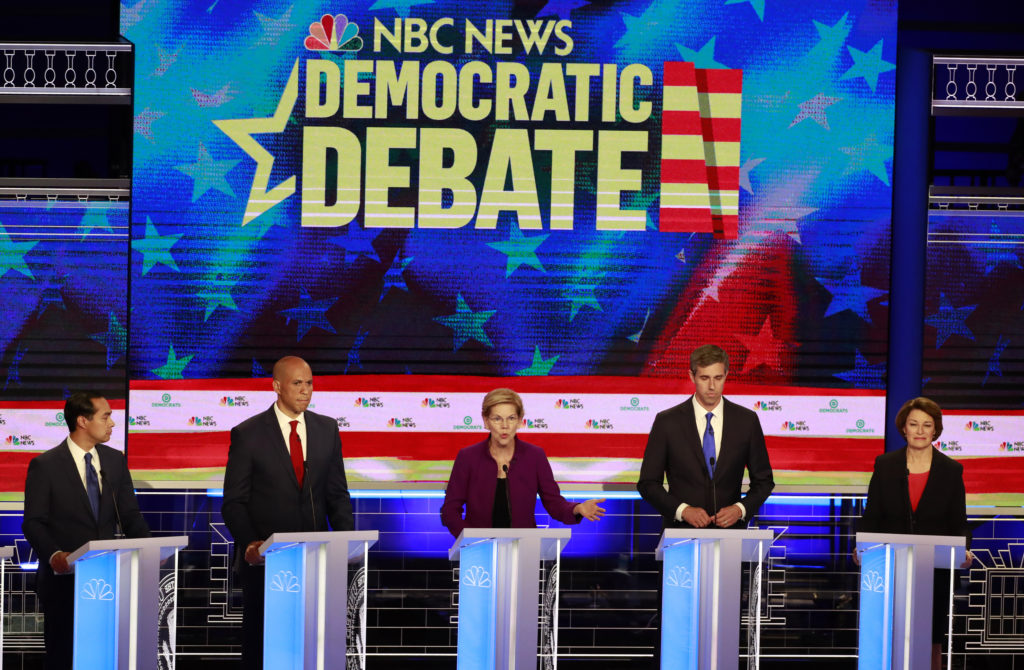
Doug Ogden doesn’t know what to do. The 75-year-old retired law enforcement officer is disgusted by President Donald Trump. But he can’t imagine voting for a Democrat in 2020, either. A self-described independent in South Carolina, Ogden doesn’t recognize the modern-day Democratic Party. “The state of the Democratic Party is wild against wilder,” says Ogden, standing with his arms crossed at a recent town hall meeting for Democratic presidential hopeful Pete Buttigieg. “It scares me.” At the core of Ogden’s concern is a broader question about the direction of the Democratic Party and its values in the age of Trump. While Democrats are united in their fierce opposition to the Republican president, most party leaders agree that Democrats will not reclaim the White House simply by running against him; they must give people something to vote for. But nine months into the first year of the 2020 campaign season, Democrats are no closer to resolving the big questions dividing their party by race, generation and ideology than they were on the day of Trump’s inauguration. And as the campaign enters a new heightened phase after Labor Day when far more voters begin paying closer attention, there is increasing pressure on Democrats to answer the questions behind their extended identity crisis. How can they peel back Trump’s support with white working class voters while boosting turnout with minorities and suburban women? How hard should they lean into anti-Trump fervor and calls for impeachment? And perhaps above of all, should they embrace transformational change on issues like health care, free college and higher taxes on the rich or a modest shift back to normalcy after Trump’s turbulent presidency? Some Democrats suggest an all-of-the-above strategy. But other presidential candidates, party leaders and top activists are searching for more definite answers to win over those anxious voters desperate for something or someone else to believe in. “There are diverse messages coming from diverse candidates,” Sen. Bernie Sanders of Vermont, a 2020 presidential candidate, said in an interview. “What the corporate media and the corporate pundits are trying to tell us is that it’s a middle-of-the-road agenda that will win the election. I categorically disagree,” said Sanders, a self-described democratic socialist. Sanders, of course, represents the Democratic Party’s energized left flank. Montana Gov. Steve Bullock, the only member of the Democrats’ 2020 class who has held statewide office in a state Trump won, fears his party will scare away the very same working class voters it needs to beat Trump if they embrace extreme change. “We need to make sure voters know we can improve upon their lives,” Bullock said in an interview. “That’s less about a revolution than addressing the problems of here and now.”In the middle of the Democratic Party’s quest for a clear identity are candidates like Kamala Harris and Buttigieg, the 37-year-old openly gay mayor of South Bend, Indiana, whose positions straddle the divide in a party whose poles are set by Sanders and Sen. Elizabeth Warren of Massachusetts on the left and by former Vice President Joe Biden and Bullock, among others, as moderates. As Buttigieg courted overwhelmingly white audiences recently in rural South Carolina, he said it was a “false choice” to think Democrats have to appeal to minority voters at the expense of the white working class. And he offered a direct message to older, white voters like Ogden, who fear that his party has become too focused on the concerns of minority voters. “Supporting people like him and making sure we have racial justice in this country go hand in hand because everybody’s life in this country is diminished as long as these inequalities continue,” Buttigieg said in an interview. “We’ll know we’re getting where we need to be if being part of a minority — and, in particular, in this country right now being black — has no bearing on your health or your wealth or your relationship with law enforcement.” “It’s not only people of color who suffer from racial inequity. It drags down all of us,” Buttigieg continued. “I’m talking about what we’re trying to build up. And I think we can build a story about where America is headed, where everybody can see where they belong.” Buttigieg, like Sanders, Biden, Warren and Harris, will continue to have prominent voices in the 2020 conversation, having met new polling and fundraising standards to qualify for the next round of presidential debates. At the same time, several lesser-known centrists have been silenced by Democratic National Committee rules that pushed them off the debate stage altogether. Bullock, one of the castaways, fears his party isn’t doing enough to win back working class voters across the Midwest. Democratic leaders, he said, have “not incentivized actually talking to the voters that we need to win this election.” The Democrats’ search for a consistent message plays into the party’s broader quest to assemble a coalition to deny Trump reelection. Barack Obama twice won the presidency by inspiring stronger-than-normal support from young voters, minorities and working class men. That coalition failed to show up for Hillary Clinton in 2016, but young people in particular helped fuel Democrats’ success in the midterm elections last year. An estimated 31% of voters ages 18 to 29 turned out to vote in 2018, with 2 out of 3 backing Democrats, according to data compiled by the Center for Information & Research on Civil Learning and Engagement at Tufts University. Yet it’s unclear how committed Democrats are to energizing young voters in 2020.The Democratic National Committee only just recently hired its first full time staffer dedicated to youth turnout, according to Calvin Wilborn, president of the College Democrats of America. “The party is moving in the right direction. I’m not sure it’s moving fast enough,” Wilborn warned. Many liberal activists are convinced that black and Hispanic voters hold the key to Democrats’ victory in 2020. Much of the Democratic establishment, meanwhile, is far more focused on white working class men, a voting bloc that shifted
Donald Trump ties U.S. success to 2nd term: ‘You have to vote for me’
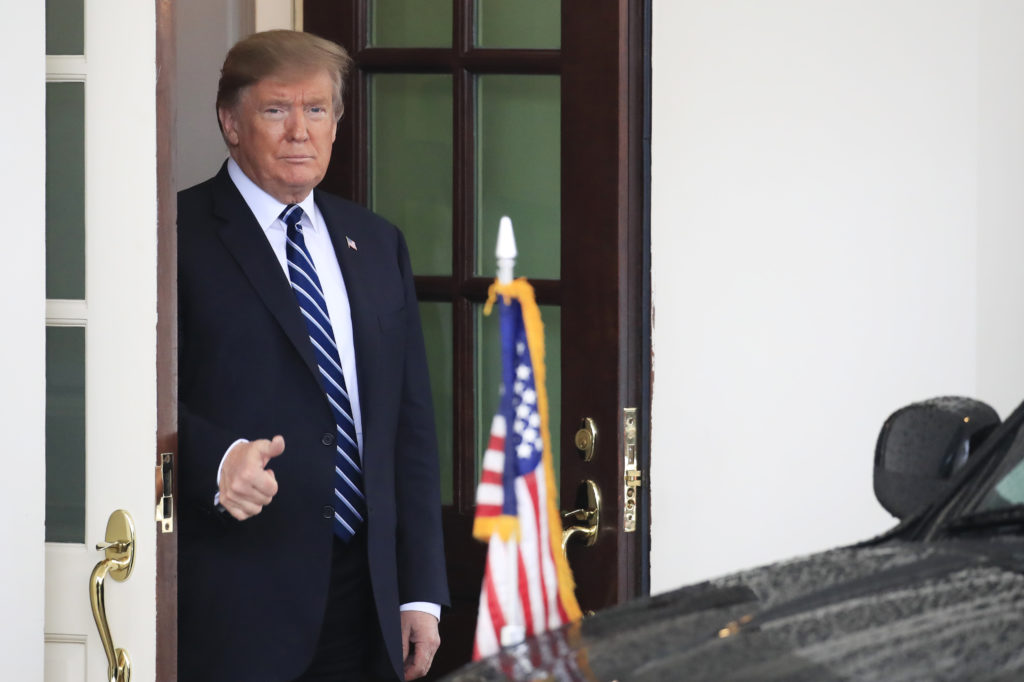
President Donald Trump sought to reassure his supporters about the state of the U.S. economy despite the stock market volatility and told rallygoers in New Hampshire, a state that he hopes to capture in 2020, that their financial security depends on his reelection. “Whether you love me or hate me you have to vote for me,” Trump said. Speaking to a boisterous crowd at Southern New Hampshire University Arena, Trump dismissed the heightened fears about the U.S. economy and a 3 percent drop Wednesday in the Dow Jones Industrial Average, which was fueled by a slowing global economy and a development in the bond market that has predicted previous recessions. Avoiding an economic slump is critical to Trump’s reelection hopes. “The United States right now has the hottest economy anywhere in the world,” Trump said. Trump, who reached the White House by promising to bring about a historic economic boom, claimed, as he often does, that the markets would have crashed if he had lost his 2016 bid for the presidency. And he warned that if he is defeated in 2020, Americans’ 401(k) retirement accounts will go “down the tubes.” The Republican president also defended his tactics on trade with China. He has imposed 25 percent tariffs on $250 billion of imports from China and has threatened to hit the remaining $300 billion worth of Chinese imports with 10 percent tariffs. He has delayed that increase on about half of those items to avoid raising prices for U.S. holiday shoppers. He said China wants to make a trade deal with the U.S. because it’s costing the country millions of jobs, but he claimed that the U.S. doesn’t need to be in a hurry. “I don’t think we’re ready to make a deal,” Trump said. Trump’s rally was the first since mass shootings in El Paso, Texas, and Dayton, Ohio, killed 31 people and wounded dozens more. The shootings have reignited calls for Congress to take immediate action to reduce gun violence. Trump said the U.S. can’t make it more difficult for law-abiding citizens to protect themselves, but he advocated for expanding the number of facilities to house the mentally ill without saying how he would pay for it. “We will be taking mentally deranged and dangerous people off of the streets so we won’t have to worry so much about them,” Trump said. “We don’t have those institutions anymore, and people can’t get proper care. There are seriously ill people and they’re on the streets.” Along with discussion of the economy and guns, Trump hit a number of other topics, accusing the European Union of being “worse than China, just smaller”; bragging about his 2016 electoral victories in Wisconsin, Michigan and Pennsylvania; and calling it a “disgrace” that people were throwing water on police officers in New York. The rally was interrupted about a half an hour in by a handful of protesters near the rafters of the arena. As the protesters were being led out, a Trump supporter wearing a “Trump 2020” shirt near them began enthusiastically shaking his fist in a sign of support for the president. But Trump mistook him for one of the protesters and said to the crowd: “That guy’s got a serious weight problem. Go home. Start exercising. Get him out of here, please.”After a pause, he added, “Got a bigger problem than I do.” New Hampshire, which gave Trump his first GOP primary victory but favored Hillary Clinton in the 2016 general election, is doing well economically, at least when using broad measures. But beneath the top-line data are clear signs that the prosperity is being unevenly shared, and when the tumult of the Trump presidency is added to the mix, the state’s flinty voters may not be receptive to his appeals. An August University of New Hampshire Survey Center poll found that 42 percent of New Hampshire adults approve of Trump while 53 percent disapprove. The poll also showed that 49 percent approve of Trump’s handling of the economy and 44 percent disapprove. Some Democratic presidential campaigns are holding events to capitalize on Trump’s trip. Joe Biden’s campaign set up down the street from the arena to talk to voters and enlist volunteers. A group for Pete Buttigieg’s campaign gathered in nearby Concord to call voters about his support for new gun safety laws. And Cory Booker urged Trump to cancel the speech and instead order Congress to take immediate action to prevent gun violence. At 2.4 percent, New Hampshire’s seasonally adjusted unemployment rate for May was among the lowest in the nation. But wage growth is significantly below national gains. Average hourly earnings rose a scant 1 percent in New Hampshire in 2018, lagging the 3 percent gain nationwide, according to the Bureau of Labor Statistics. In other ways, like the home ownership rate — first in the nation — and median household income — seventh in the U.S. — the state is thriving, according to census data. New Hampshire’s four Electoral College votes are far below that of key swing states like Florida, Wisconsin and Michigan, but its influence can prove powerful in close election years like 2000, when George W. Bush’s victory in the state gave him the edge needed to win the White House. By Kevin Freking Associated Press AP Economics Writer Josh Boak and AP Polling Editor Emily Swanson in Washington and Associated Press writer Hunter Woodall in Manchester, N.H., contributed to this report. Republished with permission of the Associated Press.
