
Mitch McConnell reaches out to Mitt Romney about possible Senate bid
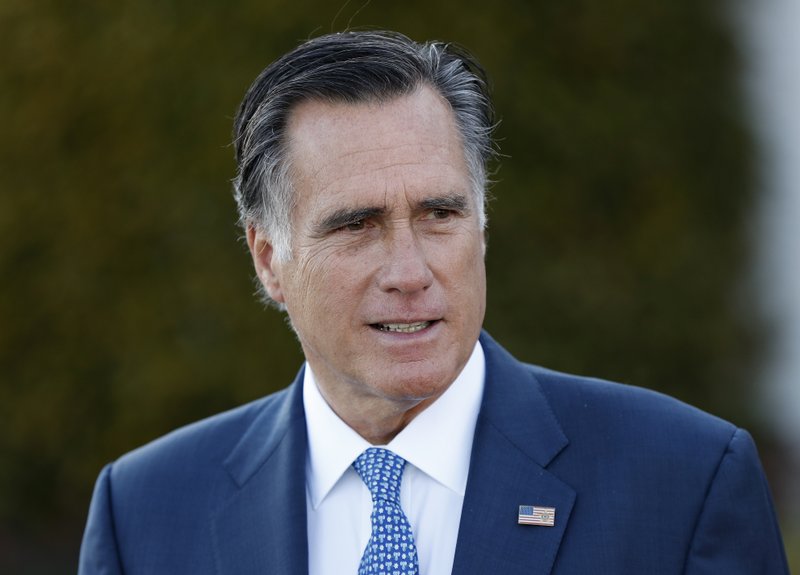
Senate Majority Leader Mitch McConnell said Friday he has reached out to former Republican presidential candidate Mitt Romney about possibly running for the Senate, if a vacancy opens in Utah. There has been much speculation about whether seven-term Republican Sen. Orrin Hatch will retire instead of running for re-election next year. The 83-year-old Hatch has fueled some of it, saying on Friday that he suggested that McConnell reach out to Romney, the former governor of Massachusetts. “I’m planning on running, but if I for some reason withdrew, I’d be thrilled if Mitt Romney would be willing to consider it,” Hatch said. “He’s a big supporter, he and his whole family.” Hatch has been in office since 1977, making him the most senior Republican in the Senate. He chairs the powerful Senate Finance Committee and, as president pro tem of the Senate, is third in line to succeed the president. McConnell made it clear that he would support Hatch if he wants to run again. And Romney has said he would only run with Hatch’s blessing. McConnell told reporters at a Capitol Hill news conference, “I’ve had some conversations with Mitt Romney. Obviously, I’m an Orrin Hatch supporter. Orrin has to decide what he wants to do. If he wants to run again, I’m for him.” Hatch has a resume thick with legislative victories. A conservative with a reputation for working with Democrats, Hatch was close friends with the late Sen. Ted Kennedy, the liberal Democrat from Massachusetts. In reaching out to Romney, Hatch said he is trying to prevent a divisive Utah primary over his successor. In 2010, Hatch’s good friend, the late Utah Sen. Robert Bennett, was ousted by tea party favorite Sen. Mike Lee. “I wouldn’t want that to happen again,” Hatch said. “If (Romney) ran, I would hope that everybody would get behind him. He’d be excellent.” If Hatch does retire, Rep. Jason Chaffetz, R-Utah, could be in the mix to replace him. Chaffetz raised Hatch’s ire in 2012 when he publicly considered challenging Hatch for his seat. Chaffetz ultimately decided to run for re-election for his House seat. In promoting Romney, Hatch is making it clear whom he would rather replace him. Romney’s Mormon faith helps make him popular among many Utah voters. He also led the organizing committee for the 2002 Winter Olympics in Salt Lake City. Republished with permission of The Associated Press.
Judiciary panel votes 11-9 in favor of Neil Gorsuch

The Latest on the nomination of Judge Neil Gorsuch to the Supreme Court (all times local): 2:35 p.m. A divided Senate panel is backing Supreme Court nominee Neil Gorsuch. The Judiciary Committee voted 11-9 along party lines on Monday to favorably recommend Gorsuch to the full Senate. A confirmation vote is expected on Friday, but not before a partisan showdown over President Donald Trump‘s choice. Democrats have secured the 41 votes to block Gorsuch with a filibuster after Delaware Sen. Chris Coons said he would vote against the nominee. The opposition will prevent Republicans from reaching the 60 votes they need to move Gorsuch over procedural hurdles to a final Senate vote. Determined to confirm him despite Democratic objections, Majority Leader Mitch McConnell has signaled he will likely change Senate rules later this week to reduce the threshold from 60 to a simple majority to get Gorsuch confirmed. ___ 1:25 p.m. Senate Democrats now have enough votes to try to block Supreme Court nominee Neil Gorsuch with a filibuster, setting up a showdown with Republicans who plan to confirm him anyway. The crucial 41st vote came from Democratic Sen. Chris Coons of Delaware who announced his decision Monday as the Senate Judiciary Committee met to vote on Gorsuch’s nomination. Coons said that he had decided to oppose President Donald Trump’s nominee over concerns that include his vague answers in his hearing. Coons’ opposition will prevent Republicans from reaching the 60 votes they need to move Gorsuch over procedural hurdles to a final Senate vote. Determined to confirm him despite Democratic objections, they will likely change Senate rules later this week to reduce the threshold from 60 to a simple majority. __ 11:45 a.m. Senator Michael Bennet says he will not join Democratic efforts to block a full-Senate vote on the nomination of Judge Neil Gorsuch to the Supreme Court. The Colorado Democrat has been under pressure to support Gorsuch in part because the nominee is also from Colorado. Bennet doesn’t say whether he will ultimately vote in favor of Gorsuch. But he says he will not try to block a vote. If Democrats successfully block a vote on Gorsuch, Senate Republicans are threatening to change Senate rules to enable them to confirm a Supreme Court nominee with a simple majority of 51 votes. Under current rules, the need 60 votes to end debate. Bennet says, “Changing the Senate rules now will only further politicize the Supreme Court.” ___ 11:35 a.m. Senator Lindsay Graham says flatly that Republicans will change the Senate’s rules if Democrats use a filibuster to block the nomination of Judge Neil Gorsuch to the Supreme Court. Under current rules, Supreme Court nominees need at least 60 votes to end debate and hold a vote on their confirmation. So far, 40 Democrats have publicly said they will try to block Gorsuch’s nomination. That’s just one shy of the number needed to stop the nomination under current Senate rules. The South Carolina Republican says his GOP colleagues will change the rules to enable them to confirm a Supreme Court nominee with a simple majority of 51 votes. Graham says: “The Senate’s traditions are going to change over this man. This says more about the Senate than it does Judge Gorsuch.” ___ 11:15 a.m. Senators Mark Warner and Patrick Leahy say they will vote against the nomination of Judge Neil Gorsuch to the Supreme Court. The two Democrats are the 39th and 40th senators to say they will try to block Gorsuch’s nomination. That’s just one shy of the number needed to stop the nomination under current Senate rules. The nomination needs 60 votes to succeed. However, Senate Republicans are threatening to change Senate rules to enable them to confirm a Supreme Court nominee with a simple majority of 51 votes. All 52 Republicans are expected to support the Gorsuch. ___ 10:45 a.m. Senator Dianne Feinstein says she will vote against the nomination of Judge Neil Gorsuch to the Supreme Court. The California Democrat cited two cases in which, she says, Gorsuch inserted his own view of what the law should be. In one case Gorsuch sided with a trucking company over a fired trucker who refused to drive a disabled truck in subzero weather. In the other case, Gorsuch sided with a school district that denied services to a student with autism. Feinstein also says she is troubled that Gorsuch refused to say whether he supports the outcome of Brown v. Board of Education, the court decision that ended racial segregation in public schools. Feinstein is the top Democrat on the Senate Judiciary Committee, which is voting Monday on Gorsuch’s nomination. ___ 10:25 a.m. Senate Judiciary Chairman Charles Grassley says Supreme Court nominee Neil Gorsuch is a mainstream judge who will be independent from the president. The Iowa Republican is accusing Democrats of “moving the goal posts” in their assessment of Gorsuch. Grassley opened a committee meeting on Gorsuch’s nomination by making the case in favor of President Donald Trump’s nominee for the high court. Republicans on the committee are expected to send Gorsuch’s nomination to the full Senate after a lengthy series of speeches. Most Democrats are expected to oppose the nomination. ___ 3:30 a.m. A Senate panel is opening a weeklong partisan showdown over President Donald Trump’s Supreme Court nominee with Democrats steadily amassing the votes to block Neil Gorsuch and force Republicans to unilaterally change long-standing rules to confirm him. The Republican-led Judiciary Committee meets Monday and is expected to back Gorsuch and send his nomination to the full Senate, most likely on a near-party line vote. Intent on getting Trump’s pick on the high court, Majority Leader Mitch McConnell, R-Ky., is likely to change Senate rules so that Gorsuch can be confirmed with a simple majority in the 100-seat chamber, instead of the 60-voter threshold. So far, 36 Democrats and one independent have announced they will vote to block the nomination on a procedural cloture vote — a parliamentary step to advance a legislative
Congress seen as not likely to pass tax overhaul quickly

After their humiliating loss on health care, Republicans in Congress could use a quick victory on a big issue. It won’t be an overhaul of the tax code. Overhauling the tax code could prove harder to accomplish than repealing and replacing Barack Obama‘s health law. Congressional Republicans are divided on significant issues, especially a new tax on imports embraced by House Speaker Paul Ryan. And the White House is sending contradicting signals on the new tax, adding to the uncertainty. House Republicans also can’t decide whether to move on from health care. Ryan canceled a scheduled vote on a House GOP plan after it became obvious that Republicans didn’t have the votes. He said he will continue to work on the issue but one of his top lieutenants on health care, Rep. Kevin Brady, R-Texas, says he is now “100 percent” focused on a tax overhaul. Ryan says Congress can work on both at the same time. It won’t be easy. Here’s why: ___ REPUBLICAN DIVIDE House and Senate Republicans largely agree on the broad outlines of a tax overhaul. They want to lower tax rates for individuals and corporations, and make up the lost revenue by scaling back tax breaks. But they are sharply divided on a key tenet of the House Republican plan. The new “border adjustment tax” would be applied to profits from goods and services consumed in the U.S., whether they are domestically produced or imported. Exports would be exempt. House GOP leaders say the tax is key to lowering the top corporate income tax rate from 35 percent to 20 percent. But good luck finding a single Republican senator who will publicly support the tax. Sen. Rob Portman, R-Ohio, is the latest in a long line of Republican senators to come out against the tax. ___ ABSENT DEMOCRATS Senate Finance Committee Chairman Orrin Hatch, R-Utah, says he wants to work with Democrats to overhaul the tax code. “A bipartisan bill would allow us to put in place more lasting reforms and give the overall effort additional credibility,” Hatch said. Majority Leader Mitch McConnell, R-Ky., has said it is bad policy to pass major legislation without bipartisan support. “Without some meaningful buy-in, you guarantee a food fight,” McConnell wrote in his memoir last year. “You guarantee instability and strife.” But in the House, Republicans haven’t reached out to Democrats in any meaningful way. ___ WHERE’S THE WHITE HOUSE? “Obviously we’re driving the train on this,” White House press secretary Sean Spicer said. But President Donald Trump‘s administration has been all over the map on tax reform. Trump at one point said the House border tax is too complicated, then said it’s in the mix. Treasury Secretary Steven Mnuchin told a Senate panel that “there would be no absolute tax cut for the upper class” in Trump’s tax plan. However, the plan Trump unveiled during his presidential campaign would provide big tax breaks to high-income households. Since taking office, Trump has promised “massive” tax cuts for the middle class. A former Treasury official under President Barack Obama says the White House needs to stake out clear goals on tax overhaul to guide the debate in Congress. “I think it’s important for the administration to signal early the general shape” of what they would like to accomplish so that there are fewer proposals vying for attention, said Michael Mundaca, a former assistant Treasury secretary now at Ernst & Young. ___ TAX CHANGE IS DIFFICULT There is a reason it’s been 31 years since the last time Congress rewrote the tax code. Since then, the number of exemptions, deductions and credits has mushroomed. Taxpayers enjoyed $1.6 trillion in tax breaks in 2016 — more than the federal government collected in individual income taxes. That huge number could provide plenty of tax breaks that lawmakers can scale back so they can lower tax rates significantly. There is just one problem — all of the biggest tax breaks are very popular and have powerful constituencies. Nearly 34 million families claimed the mortgage interest deduction in 2016. That same year more than 43 million families took advantage of a deduction of state and local taxes. The House Republicans’ tax plan would retain the mortgage deduction and eliminate the deduction for state and local taxes. ___ HEALTH CARE Both Trump and Republicans in Congress made big campaign promises to repeal and replace Obama’s health law, so the issue won’t go away. However, several players say negotiations on a way forward are non-existent. In the meantime, Trump is stoking animosity among a key voting bloc by criticizing them on Twitter. Two factions in the House GOP had members oppose the health plan: the hard-right Freedom Caucus and the moderate Tuesday Group. Ryan has suggested that they get together to sort out their differences, but it’s not happening, according to one key lawmaker. “We are not currently negotiating with the Freedom Caucus. There was never a meeting scheduled with the Freedom Caucus. We will never meet with the Freedom Caucus,” said Rep. Chris Collins, R-N.Y., a member of the Tuesday Group. Trump tweeted: “The Freedom Caucus will hurt the entire Republican agenda if they don’t get on the team, & fast. We must fight them, & Dems, in 2018!” To quote a favorite saying of the president, Not nice. Republished with permission of The Associated Press.
House GOP releases bill replacing Barack Obama health care overhaul
House Republicans on Monday released their long-awaited plan for unraveling former President Barack Obama‘s health care law, a package that would scale back the government’s role in health care and likely leave more Americans uninsured. House committees planned to begin voting on the 123-page legislation Wednesday, launching what could be the year’s defining battle in Congress and capping a seven-year Republican effort to repeal the 2010 law. Though GOP leaders expect their measure to win the backing of the Trump administration, divisions remain and GOP success is by no means ensured. The plan would repeal the statute’s unpopular fines on people who don’t carry health insurance. It would replace income-based subsidies the law provides to help millions of Americans pay premiums with age-based tax credits that may be less generous to people with low incomes. Those payments would phase out for higher-earning people. The bill would continue Obama’s expansion of Medicaid to additional low-earning Americans until 2020. After that, states adding Medicaid recipients would no longer receive the additional federal funds the statute has provided. More significantly, Republicans would overhaul the federal-state Medicaid program, changing its open-ended federal financing to a limit based on enrollment and costs in each state. In perhaps their riskiest political gamble, the plan is expected to cover fewer than the 20 million people insured under Obama’s overhaul, including many residents of states carried by President Donald Trump in November’s election. Republicans said they don’t have official estimates on those figures yet. But aides from both parties and nonpartisan analysts have said they expect coverage numbers to be lower. House Speaker Paul Ryan, R-Wis., said the bill would “drive down costs, encourage competition, and give every American access to quality, affordable health insurance.” He added, “This unified Republican government will deliver relief and peace of mind to the millions of Americans suffering under Obamacare.” But besides solid opposition from Democrats, there were signals galore that Republican leaders faced problems within their own party, including from conservatives complaining that the measure isn’t aggressive enough in repealing parts of Obama’s law. “It still looks like Obamacare-lite to me,” said Sen. Rand Paul, R-Ky., among three Senate conservatives who have criticized the emerging GOP bill. “It’s going to have to be better.” The Republican tax credits — ranging from $2,000 to $14,000 for families — would be refundable, meaning even people with no tax liability would receive the payments. Conservatives have objected that that feature creates a new entitlement program the government cannot afford. Senate Finance Committee Chairman Orrin Hatch, R-Utah, wouldn’t rule out changes in the measure by his chamber, where significant numbers of moderate Republicans have expressed concerns that the measure could leave too many voters without coverage. “The House has the right to come up with what it wants to and present it to the Senate by passing it. And we have a right to look it over and see if we like it or don’t,” Hatch told reporters. Underscoring those worries, four GOP senators released a letter to Senate Majority Leader Mitch McConnell, R-Ky., shortly before the bill was unveiled. They complained that an earlier, similar draft of the measure “does not provide stability and certainty for individuals and families in Medicaid expansion programs or the necessary flexibility for states.” Signing the letter were Sens. Rob Portman of Ohio, Shelley Moore Capito of West Virginia, Cory Gardner of Colorado and Lisa Murkowski of Alaska. Thirty-one states and the District of Columbia opted to expand Medicaid coverage under the law and accept beefed-up federal spending for the program. Around half those states have GOP governors, who are largely reluctant to see that spending curtailed. In another feature that could alienate moderate Republicans, the measure would block for one year federal payments to Planned Parenthood, the women’s health organization long opposed by many in the party because it provides abortions. It also forbids people receiving tax credits to help pay premiums to buy coverage under a plan that provides abortions. Republicans said they’d not yet received official cost estimates on the overall bill from the nonpartisan Congressional Budget Office. That office’s projections on the bill’s price tag and the number of people the measure would cover could be key in winning over recalcitrant Republicans, or making them even harder to win over. A series of tax increases on higher-earning people, the insurance industry and others used to finance the Obama overhaul’s coverage expansion would be repealed as of 2018. In a last-minute change to satisfy conservative lawmakers, business and unions, Republicans dropped a plan pushed by Ryan to impose a first-ever tax on the most generous employer-provided health plans. Popular consumer protections in the Obama law would be retained, such as insurance safeguards for people with pre-existing medical problems, and parents’ ability to keep young adult children on their insurance until age 26. Republished with permission of The Associated Press.
Donald Trump embraces legacy of Andrew Jackson

It was an ugly, highly personal presidential election. An unvarnished celebrity outsider who pledged to represent the forgotten laborer took on an intellectual member of the Washington establishment looking to extend a political dynasty in the White House. Andrew Jackson‘s triumph in 1828 over President John Quincy Adams bears striking similarities to Donald Trump‘s victory over Hillary Clinton last year, and some of those most eager to point that out are in the Trump White House. Trump’s team has seized upon the parallels between the current president and the long-dead Tennessee war hero. Trump has hung a portrait of Jackson in the Oval Office and Trump’s chief strategist, Stephen Bannon, who has pushed the comparison, told reporters after Trump’s inaugural address that “I don’t think we’ve had a speech like that since Andrew Jackson came to the White House.” Trump himself mused during his first days in Washington that “there hasn’t been anything like this since Andrew Jackson.” It’s a remarkable moment of rehabilitation for a figure whose populist credentials and anti-establishment streak has been tempered by harsher elements of his legacy, chiefly his forced removal of Native Americans that caused disease and the death of thousands. “Both were elected presidents as a national celebrity; Jackson due to prowess on battlefield and Trump from making billions in his business empire,” said Douglas Brinkley, a professor of history at Rice University. “And it’s a conscious move for Trump to embrace Jackson. In American political lore, Jackson represents the forgotten rural America while Trump won by bringing out that rural vote and the blue collar vote.” The seventh president, known as “Old Hickory” for his toughness on the battlefield, gained fame when he led American forces to a victory in the Battle of New Orleans in the final throes of the War of 1812. He did serve a term representing Tennessee in the Senate, but he has long been imagined as a rough and tumble American folk hero, an anti-intellectual who believed in settling scores against political opponents and even killed a man in a duel for insulting the honor of Jackson’s wife. Jackson also raged against what he deemed “a corrupt bargain” that prevented him from winning the 1824 election against Adams when the race was thrown to the House of Representatives after no candidate received a majority in the Electoral College. Even before the vote in November, Trump railed against a “rigged” election and has repeatedly asserted, without evidence, widespread voter fraud prevented his own popular vote triumph. Jackson’s ascension came at a time when the right to vote was expanded to all white men — and not just property-owners — and he fashioned himself into a populist, bringing new groups of voters into the electoral system. Remarkably, the popular vote tripled between Jackson’s loss in 1824 and his victory four years later, and he used the nation’s growing newspaper industry — like Trump on social media — to spread his message. Many of those new voters descended on Washington for Jackson’s 1829 inauguration and the crowd of thousands that mobbed the Capitol and the White House forced Jackson to spend his first night as president in a hotel. Once in office, he continued his crusade as a champion for the common man by opposing the Second Bank of the United States, which he declared to be a symptom of a political system that favored the rich and ignored “the humble members of society — the farmers, mechanics, and laborers — who have neither the time nor the means of securing like favors to themselves.” Jackson, as Trump hopes to do, expanded the powers of the presidency, and a new political party, the new Democratic party, coalesced around him in the 1820s. He was the first non-Virginia wealthy farmer or member of the Adams dynasty in Massachusetts to be elected president. “The American public wanted a different kind of president. And there’s no question Donald Trump is a different kind of president,” Sen. Majority Leader Mitch McConnell, R-Ky., said this past week. “He’s now comparing himself to Andrew Jackson. I think it’s a pretty good, a pretty good comparison. That’s how big a change Jackson was from the Virginia and Massachusetts gentlemen who had been president of the United States for the first 40 years.” But there are also limits to the comparison, historians say. Unlike Jackson, who won in 1828 in a landslide, Trump lost the popular vote by nearly 3 million ballots. Jon Meacham, who wrote a 2008 biography of Jackson, “American Lion,” said Jackson was “an outsider in style but not in substance” and his outlandish public pronouncements would often be followed by hours of deep conversations and letter-writing hashing out political calculations. “He was a wild man during the day but a careful diplomat at night,” said Meacham, who said it was too early to know whether Trump, like Jackson, “had a strategy behind his theatrics,” and whether Trump had the ability to harness the wave of populism that has swept the globe as it did in the 1820s. “The moment is Jacksoninan but do we have a Jackson in the Oval Office?” Meacham asked. Trump’s appropriation of Jackson came after his victory. Trump never mentioned Jackson during the campaign or discussed Jackson during a series of conversations with Meacham last spring But it is hardly unique for a president to adopt a previous one as a historical role model. Barack Obama frequently invoked Abraham Lincoln. Dwight Eisenhower venerated George Washington. Jackson himself had been claimed by Franklin Roosevelt and his successor, Harry Truman, both of whom — unlike Trump — interpreted Jackson’s populism as a call for expanded government, in part to help the working class. There could be other comparisons for Trump. A favorable one would be Eisenhower, also a nonpolitician who governed like a hands-off CEO. A less favorable one would be Andrew Johnson, a tool of his party whose erratic behavior helped bring about his impeachment. Trump’s embrace could signal an
For GOP, a dimmed zeal for investigations in Donald Trump era

The Republicans’ ardor for investigations and oversight, on display throughout the Obama administration, has cooled off considerably with Donald Trump in the White House. Each day seems to bring a new headache or near-crisis from Trump, the latest being the departure of his national security adviser under questionable circumstances involving Russia. Yet if there is a line too far, at which point Republicans will feel duty-bound to call for an independent investigation of their president or his administration, Trump hasn’t crossed it yet. Democrats are clamoring for a full-scale probe of the resignation of National Security Adviser Michael Flynn, including demanding to know what Trump knew, and when, about Flynn’s pre-inauguration conversations with a Russian ambassador about U.S. sanctions. White House press secretary Sean Spicer disclosed that Trump was told in late January that Flynn had misled Vice President Mike Pence about those conversations. Rather than go along with Democrats’ call for an independent outside investigation, Senate Republicans insisted Tuesday that the Intelligence Committee could look at the circumstances as part of an existing probe into Russia’s interference in the presidential election. “The Intelligence Committee is already looking at Russian involvement in our election and they have broad jurisdiction over the intel community writ large and they can look at whatever they choose to,” said Senate Majority Leader Mitch McConnell, R-Ky., adding that “it’s highly likely they’d want to take a look at this episode as well.” The intelligence panel’s chairman, Sen. Richard Burr of North Carolina, told reporters that “aggressive” oversight would continue “privately. We don’t do that in public.” House Republicans were even less interested, with some shrugging off Democrats’ calls for an investigation entirely. Rep. Devin Nunes of California, chairman of the House Intelligence Committee, said that the “real crime” is how Flynn’s phone conversations were leaked, echoing a complaint Trump himself made over Twitter. “I think the situation has taken care of itself” in light of Flynn’s resignation, House Oversight Committee Chairman Jason Chaffetz, R-Utah, told reporters. That’s a far different stance toward potential wrongdoing by the executive branch than Chaffetz took last year, when House Republicans issued more than 70 letters and subpoenas aimed at investigating Democrat Hillary Clinton over a period of less than three months after the FBI announced criminal charges weren’t warranted related to her use of a private email server as secretary of state. Chaffetz did turn his attention to a different Trump administration matter later Tuesday, sending a letter to the White House seeking information about Trump’s discussion of a North Korea missile launch while dining al fresco with the Japanese prime minister at a resort in Florida. Sen. Rand Paul, R-Ky., went so far as to counsel publicly against spending too much time investigating the White House, saying that doing so could only be counterproductive at a moment when the GOP faces a daunting legislative agenda on Capitol Hill. “I just don’t think it’s useful to be doing investigation after investigation, particularly of your own party,” Paul said in an appearance on Fox News Radio’s “Kilmeade and Friends.” ”We’ll never even get started with doing the things we need to do like repealing Obamacare if we’re spending our whole time having Republicans investigate Republicans. I think it makes no sense.” The relatively hands-off stance of the GOP toward the Trump White House angers Democrats, who are powerless to do much except fume from the minority in both chambers of Congress. “Do you hear the silence? This is the sound of House Republicans conducting no oversight of President Trump. Zero,” Rep. Elijah Cummings of Maryland, top Democrat on the Oversight Committee, complained at a news conference Tuesday. “That is what it sounds like when they abdicate their duty under the Constitution. We’ve been asking for months for basic oversight.” The GOP’s lack of enthusiasm about investigating the Trump White House comes as Capitol Hill Republicans struggle to come to terms with a new administration that has been engulfed in upheaval after upheaval. Republicans are trying to focus on their agenda despite the distractions. And for now, they appear to have concluded, going easy on Trump is the best way to achieve their goals, including confirming a Supreme Court justice and passing a new health care law and other legislation they want the president to sign. “We know full well that there are issues that are going to come up on a daily basis that we’re going to get asked about and have to respond to,” said Sen. John Thune of South Dakota, the No. 3 Senate Republican, “but we’re interested in repealing and replacing Obamacare, reforming the tax code, reducing the regulatory burden on businesses, confirming a Supreme Court justice, getting these Cabinet nominees through — that’s what our agenda is right now.” Republished with permission of The Associated Press.
Dems force delays in votes on Jeff Sessions, Steve Mnuchin, Tom Price
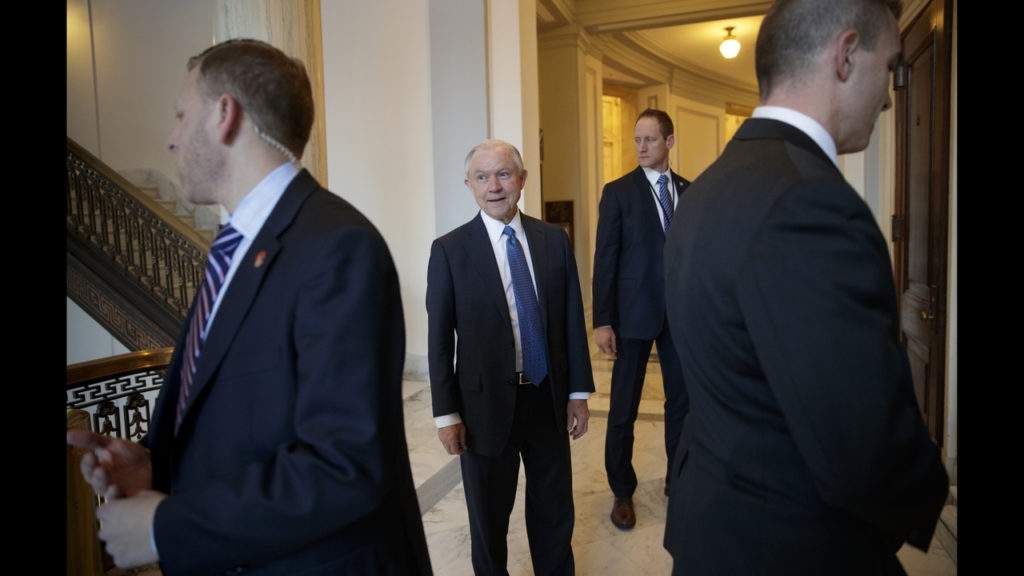
Democrats forced delays Tuesday in planned Senate committee votes on President Donald Trump‘s picks for Health and Treasury secretaries and attorney general, amid growing Democratic surliness over the administration’s aggressive early moves against refugees and an expected bitter battle over filling the Supreme Court vacancy. Democrats abruptly boycotted a Senate Finance Committee meeting called to vote on Rep. Tom Price, R-Ga., the Health nominee and Steve Mnuchin, Trump’s Treasury selection, saying both had misled Congress about their financial backgrounds. The Democrats’ action prevented the Finance panel from acting because under committee rules, 13 of its members — including at least one Democrat — must be present for votes. It was unclear when the panel would reschedule to votes. At the Senate Judiciary Committee, a meeting considering Sen. Jeff Sessions, R-Ala., to be attorney general lasted so long — chiefly because of lengthy Democratic speeches — that Chairman Charles Grassley, R-Iowa, said the panel would meet again Wednesday. The meeting on Sessions’ nomination was coming with Democrats and demonstrators around the country in an uproar over Trump’s executive order temporarily blocking refugees. Even some Republicans were warning it could hinder anti-terrorism efforts. Not everything ground to a halt. The Senate education committee voted 12-11 to send Trump’s pick to head the Education Department, Betsy DeVos, to the full Senate for a confirmation vote. The Senate Energy and Natural Resources Committee quickly approved former Texas Gov. Rick Perry as Energy secretary by 16-7, and Rep. Ryan Zinke, R-Mont., to head Interior by 16-6. And the full Senate easily confirmed Elaine Chao to become transportation secretary by a 93-6 vote. Chao was labor secretary under President George W. Bush, and is wife of Senate Majority Leader Mitch McConnell, R-Ky. Just before the Finance committee was scheduled to vote on Price and Mnuchin, Democrats called a briefing for reporters and announced their plan to force a delay. Sen. Debbie Stabenow, D-Mich., said Price and Mnuchin would hold positions “that directly affect peoples’ lives every day. The truth matters.” Finance Committee Chairman Orrin Hatch, R-Utah, accused Democrats of “a lack of desire to fulfill their constitutional responsibilities.” “They ought to stop posturing and acting like idiots,” he said. In 2013 when Democrats controlled the Senate, Republicans boycotted a committee vote on Gina McCarthy to head the Environmental Protection Agency, temporarily stalling it. Democrats cited one report in The Wall Street Journal that Price received a special, discounted offer to buy stock in a biomedical company, which contradicted his testimony to Congress. They said another report in The Columbus Dispatch showed documents revealing that Mnuchin had not been truthful with the Senate in the confirmation process in comments about how his bank OneWest had handled home foreclosures. Republicans have supported both men, and both have strongly defended their actions. Democrats have opposed Price, a seven-term congressional veteran, for his staunch backing of his party’s drive to scuttle Obama’s health care law and to reshape Medicare and Medicaid, which help older and low-income people afford medical care. They’ve also assailed Price for buying stocks of health care firms, accusing him of using insider information and conflicts of interest for backing legislation that could help his investments. Price says his trades were largely managed by brokers and that he’s followed congressional ethics rules. Democrats have criticized Mnuchin for not initially revealing nearly $100 million in assets, and were expected to vote against both nominees. They’ve also accused him of failing to protect homeowners from foreclosures and criticized him for not initially disclosing all his assets. DeVos, a wealthy GOP donor and conservative activist, has long supported charter schools and allowing school choice. That’s prompted opposition from Democrats and teachers’ unions who view her stance as a threat to federal dollars that support public education. Critics have also mocked her for suggesting that guns could be justified in schools to protect students from grizzly bears. Two prominent Republicans on the education committee, Sens. Susan Collins of Maine and Lisa Murkowski of Alaska, said they remained uncertain if they will vote for her on the Senate floor. Murkowski said DeVos has yet to prove that she deeply cares about America’s struggling schools and its children. Republished with permission of the Associated Press.
Martin Dyckman: Paul Ryan, Mitch McConnell — why are you enabling Donald Trump?
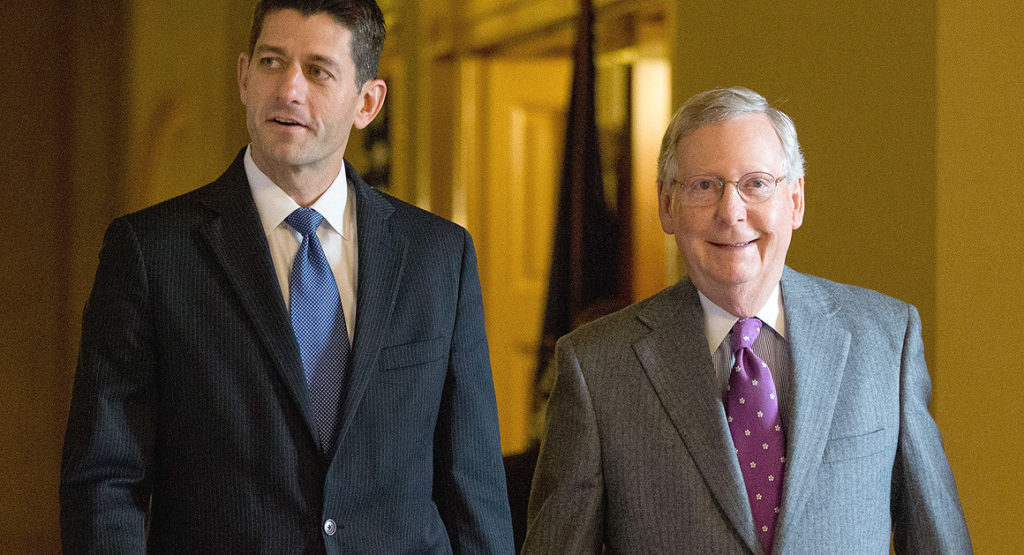
An open letter to House Speaker Paul Ryan and Senate Majority Leader Mitch McConnell: Gentlemen: It was wisdom rather than whim that guided the founders of our nation in separating the powers of government with a system of checks and balances. As James Madison remarked in The Federalist 47, “the accumulation of all powers … in the same hands, whether of one, a few or many … may justly be pronounced the very definition of tyranny.” Their faith in the future is being put to the test by current events in Washington that prompt me to ask: Have you lost your minds? Are you as irresponsible as the madman in the White House? Why are you defaulting on the duty of the Congress to defend our democracy? Why are you enabling Mr. Trump’s excesses? I’m writing this letter Jan. 30, the anniversary of two world-changing events. One was the birth of President Franklin D. Roosevelt, who greatly honored the office that you are allowing the current occupant to disgrace. The other was that of Adolf Hitler attaining the chancellorship of Germany in 1933, despite not having won a majority in any election. A month and a half later, Dr. Paul Joseph Goebbels, Hitler’s new propaganda chief, warned German newspapers against publishing criticism that could be used, as The Associated Press paraphrased it, “by oppositionists to the government’s detriment.” “The press must be the keyboard on which the government can play,” he said. “Criticism will be allowed, but it must be expressed so that no enemy of the government at home or abroad may be enabled to seize upon such criticism to the government’s detriment. Cooperation between the government and the press is our aim.” I don’t have to tell you what happened soon after to the German press. Well, sirs, it hasn’t taken nearly that long for Mr. Trump’s propaganda minister, Steve Bannon, to tell The New York Times to shut up, for the president himself to indulge himself in infantile Twitter messages attacking the Times and other great newspaper, The Washington Post; for a committee chairman in your Congress to lecture the media on its duty to be the government’s mouthpiece; and for Kellyanne Conway, who is apparently the junior propaganda minister, to say that reporters who criticize Trump ought to be fired. Doesn’t any of that concern you? I have specific concerns about what Trump is doing and what you are not doing. A case in point is your reported assurance that Mr. Trump’s great wall will be built, at extraordinary expense to the public in one form or another of direct or indirect taxation. That wall will be as abject a failure as France’s Maginot Line, and the only beneficiaries will be wall builders in the United States and tunnel builders in Mexico. The latter, as you should know, already have expertise in smuggling narcotics and people under our existing defenses. As deep as you build a wall, people will find ways around it. We have a long and essentially unguarded coastline. The Canadian border is open. Visas can easily be overstayed. The wall would be a failure not only practically but in the moral sense as well. History will come to regard that wall and its builders with the same contempt deservedly directed at the Soviet Union and its puppets in the former East Germany. My second issue is your timid acceptance of the catastrophic incompetence and cruelty with which the president issued his executive orders against Muslim immigrants last Friday. That he picked Holocaust Remembrance Day to do so is an irony almost too painful to bear. The agencies that would have to carry out his abuse of executive power (and what has become of the distaste you expressed when President Obama exercised his?) were neither consulted nor forewarned in time to avert massive confusion at airports. Decent people holding legitimate green cards were treated as criminals. Families were sundered. And why were only certain countries singled out, excluding those where, by remarkable coincidence, Mr. Trump has been doing business? Why are people from Iraq subject to his ban when those from Saudi Arabia, the country of origin of most of the 911 terrorists, are not barred? Don’t these inconsistencies bother you? Are you unconcerned by his unconstitutional preference for immigrants of one religion over all others? Are you not frightened — frankly, I’m terrified — that he is excluding the Chairman of the Joint Chiefs of Staff and the Director of National Intelligence from the regular meetings of the National Security Council? And that in their place, he is installing his far-right adviser, Steven Bannon? It would seem that he wants to hear only from those who would inform and flatter his biases. In my opinion, the Congress should without delay provide by legislation for the permanent, full NSC membership of those officials, and find a way to keep the dangerous Mr. Bannon at a distance. In my view, and that of others among whom we share concerns, you have decided to tolerate and even enable the administration’s dangerous conduct because of the short-term benefits that might accrue to the Republican Party. Yes, you might attain some policy goals that the candidate who won the popular vote would have blocked. But you are deluding only yourself if you think all this will rebound to the long-term benefit of your party. When America comes to its senses, the people will hold you along with Trump responsible for all the damage that needs to be undone. The greater the harm, the more you’ll be blamed for it. Sincerely, Martin A. Dyckman ___ Martin Dyckman is a retired associate editor of the Tampa Bay Times. He lives in Asheville, North Carolina.
18M more Americans would be uninsured under 2016 GOP repeal

Insurance premiums would soar and some 18 million Americans would lose health coverage if Republicans partially repeal President Barack Obama‘s health care law without a replacement, Congress’ nonpartisan budget office estimated Tuesday. The Congressional Budget Office analyzed a GOP 2016 repeal measure, which Republicans have cited as a starting point for their 2017 drive to dismantle and replace Obama’s health overhaul. Premiums for policies bought from online marketplaces established by Obama’s law would rise up to 25 percent a year after enactment of repeal. They’d about double by 2026, the report estimated. There’d also be 18 million more uninsured people a year after enactment and 32 million more by 2026, the report projected. The numbers served as a flashing yellow light for this year’s effort by President-elect Donald Trump and congressional Republicans to annul Obama’s law and — in a more complex challenge — institute their own alternative. While Republicans have produced several outlines for how they’d recraft Obama’s 2010 statute, they’ve never united behind one plan despite years of trying and there are many unknowns about what will happen in insurance markets while the GOP effort is underway. The report also became immediate political fodder for both sides in what is expected to be one of this year’s premier battles in Congress. Trump seemed to complicate that fight over the weekend when he told The Washington Post that a forthcoming GOP plan would provide “insurance for everybody.” In contrast, some congressional Republicans have used a more modest description, saying the plan will offer “universal access.” The 2016 bill that CBO analyzed did not replace Obama’s law with a GOP alternative, which Republicans have insisted will be an integral part of their health care drive this year. Because of that omission, Donald Stewart, spokesman for Senate Majority Leader Mitch McConnell, R-Ky., said the report “assumes a situation that simply doesn’t exist and that no one in Congress advocates.” AshLee Strong, spokeswoman for House Speaker Paul Ryan, R-Wis., called the estimates “meaningless” because they ignored plans for legislation and regulatory actions by the incoming Trump administration aimed at revamping how people could obtain coverage. Even so, Republicans have cited last year’s bill — which Obama vetoed — as a starting point for their 2017 drive to erase his law. Finding unity among Trump and GOP lawmakers on what a new plan should look like is expected to be a challenging task Democrats used the report as ammunition to assail the Republican health-care push. “Nonpartisan statistics don’t lie: it’s crystal clear that the Republican effort to repeal the Affordable Care Act will increase health care costs for millions of Americans and kick millions more off of their health insurance,” Senate Minority Leader Chuck Schumer, D-N.Y., said in a written statement that used the law’s formal name. Republished with permission of The Associated Press.
Year’s top news filled with division — and no middle ground

Fed up with Europe’s union across borders? Reject it. Disgusted with the U.S. political establishment? Can it. The news in 2016 was filled with battles over culture and territory that exposed divisions far deeper than many realized. But people confronting those divides repeatedly rejected the prospect of middle-ground solutions and the institutions put in place to deliver them. While the headlines told many different stories, the thread connecting much of the news was a decisive torching of moderation, no matter how uncertain the consequences. “You’re not laughing now, are you?” Nigel Farage, a leader of the Brexit campaign, told the European Parliament after voters in Great Britain spurned membership in the continental union. “What the little people did … was they rejected the multinationals, they rejected the merchant banks, they rejected big politics and they said, ‘Actually, we want our country back.’” Farage was speaking only about the United Kingdom. But his observation that many people well beyond Britain shared that disdain for working within the system was borne out repeatedly in the year’s biggest headlines. In a U.S. presidential campaign fueled by anger and insults, in Syria’s brutal war and Venezuela’s massive protests, in fights over gay rights and migration, opposing sides rejected not just compromise but also the politics of trying to forge it. That was clear from the year’s first days, when armed activists took over a national wildlife refuge in Oregon’s high desert, opposing the federal government’s control of public lands. “It needs to be very clear that these buildings will never, ever return to the federal government,” LaVoy Finicum, an Arizona rancher among the activists, told reporters. Weeks later, federal agents stopped vehicles outside the refuge, arresting eight of the activists and fatally shooting Finicum when he reached into a jacket that held a loaded gun. Even in the rare cases when compromise prevailed, it was viewed with suspicion. When a deal took effect in January limiting Iran’s nuclear program in exchange for relief on sanctions, it marked the culmination of prolonged negotiation by President Barack Obama‘s administration. But the pact was repeatedly attacked by critics in both countries, including Donald Trump, saying it gave the other side too much. “The wisest plan of crazy Trump is tearing up the nuclear deal,” a leading Iranian hard-liner, Hossein Shariatmadari, told his country’s news agency. In mid-February, U.S. Supreme Court Justice Antonin Scalia died in his sleep, leaving a vacuum on a court where he had long been the leading conservative voice. Barely an hour after Scalia’s death was confirmed, Senate Majority Leader Mitch McConnell staked out an uncompromising position on what lay ahead. “The American people should have a voice in the selection of their next Supreme Court justice,” McConnell said, disregarding the fact that U.S. voters had twice elected Obama. “Therefore, this vacancy should not be filled until we have a new president.” North Carolina lawmakers prompted protests and counterprotests when they rushed through House Bill 2, voiding local gay-rights ordinances and limiting bathroom access for transgender people. Companies, the NBA and others followed through on threats to move jobs, games and performances out of the state, amplifying the division. Tensions over U.S. policing bled into a third year. In July, a sniper killed five Dallas police officers during a protest over shootings of black men by police in Louisiana and Minnesota. A South Carolina jury failed to reach a verdict in the trial of a white officer caught on video fatally shooting a black man fleeing a traffic stop. Division, though, was hardly limited to the U.S. In Venezuela, triple-digit inflation and shortages of food and medicine fueled 6,000 protests throughout the year that brought millions into the streets. But the government of President Nicolas Maduro, blamed by many voters for the chaos, blocked a recall campaign. “If you’re going to shoot me because I’m hungry, shoot me!” a young man shouted at a soldier during one protest in Caracas. In Colombia, voters narrowly rejected a deal between the government and a guerrilla group to end a 52-year civil war. Even when lawmakers approved a renegotiated deal, the peace remained fragile. In Brazil, senators impeached President Dilma Rousseff for manipulating budget figures, though many of the lawmakers were, themselves, tarred by accusations of corruption. South Korean President Park Geun-hye was stripped of power in December amid allegations she let a close friend use the government for financial gain. Meanwhile, Syria’s war entered its sixth year. But despite pressure by the U.S. and its allies, Russia and the government of President Bashar Assad unleashed an assault on Aleppo to wipe out rebels, driving up the toll in a conflict that has already claimed as many as 500,000 lives. “This is a targeted strategy to terrorize civilians and to kill anybody and everybody who is in the way of their military objectives,” U.S. Secretary of State John Kerry said, accusing Syria and Russia of war crimes. “As long as war crimes are at question,” a Russian government spokeswoman said, “the Americans should start with Iraq.” In Yemen, cease-fires broke down, extending a nearly two-year civil war. But with Syria capturing most international attention, a famine resulting from the turmoil was mostly overlooked. As the fighting continued, terrorist strikes spread fear well beyond the Middle East. A bombing at a Brussels airport in March and another attack in June at Istanbul’s airport by gunmen with explosives killed a total of nearly 80 people. More than 70 died when a bomb went off in a park in Pakistan, with a faction of the Pakistani Taliban claiming responsibility. In July, a terrorist drove a truck into a Bastille Day crowd in Nice, France, killing 86 and injuring more than 400 others. The Islamic State group claimed responsibility. In June, security guard Omar Mateen opened fire inside a gay nightclub in Orlando, Florida, in the deadliest mass shooting ever in the U.S. In a call to police during the attack, which killed 49, Mateen — a U.S. citizen born
Mitch McConnell rejects calls for select panel on Russian meddling

Senate Majority Leader Mitch McConnell is rejecting bipartisan calls for a special committee to investigate Russian interference in the U.S. election, which American intelligence says was aimed in part at helping Republican Donald Trump defeat Democrat Hillary Clinton. The likely meddling by Russia “is a serious issue, but it doesn’t require a select committee,” said McConnell, R-Ky. The Senate intelligence committee is able to investigate the matter, he added. CIA Director John Brennan has said the intelligence community is in agreement that Russia tried to interfere in the U.S. presidential election, although there’s no evidence Moscow succeeded in helping Trump win. “There’s no question that the Russians were messing around in our election,” McConnell told Kentucky Educational Television on Monday night. “It is a matter of genuine concern and it needs to be investigated.” Still, McConnell said the issue should be investigated in “regular order” by the Senate intelligence panel, which is “fully capable of handling this.” McConnell’s comments put him at odds with Arizona Sen. John McCain and other Republicans who have joined with incoming Senate Democratic leader Chuck Schumer in calling for a special committee to investigate efforts by Russia, China and Iran to interfere in U.S. elections. A select committee is a high-profile panel created by congressional leaders that taps lawmakers from a variety of committees to focus on a single issue, such as Watergate or the Iran-contra arms deal. McCain, chairman of the Senate Armed Services Committee, said Russian interference in the election threatens to “destroy democracy,” adding that a select committee is needed to find out exactly what Russia did and what effect it had on the election. “We need to get to the bottom of this,” McCain said. “We need to find out exactly what was done and what the implications of the attacks were, especially if they had an effect on our election.” He said: “There’s no doubt they were interfering and no doubt that it was cyberattacks. The question now is how much and what damage and what should the United States of America do? And so far, we have been totally paralyzed.” Trump has called reports of Russian hacking “ridiculous,” and his transition team dismissed the CIA assessment, saying it was the work of the same people who claimed Iraq had weapons of mass destruction before the U.S. invaded. Schumer, D-N.Y., said in a statement that the investigation must be bipartisan. “We don’t want this investigation to be political like the Benghazi investigation,” he said. “We don’t want it to just be finger pointing at one person or another.” Schumer added: “We want to find out what the Russians are doing to our political system and what other foreign governments might do to our political system. And then figure out a way to stop it.” McCain, Schumer and other senators say a select committee is needed to “reconcile contradictory information” and give the issue needed focus. In the interview with KET’s Bill Goodman, McConnell spoke of his surprise at the election’s outcome. “I thought we’d come up short” in the Senate, McConnell said. “And I didn’t think President Trump had a chance of winning.” Trump won in part because he was able to connect with rural voters in states such as Michigan, Pennsylvania and Wisconsin that had previously voted for Democrats, McConnell said. “Trump was able to convey – oddly enough a message from a billionaire who lives in Manhattan – a genuine concern for people who felt kind of left off, who felt offended by all the political correctness they see around them,” he said. Republished with permission of The Associated Press.
John McCain sees Russia hacking as threat, at odds with Donald Trump
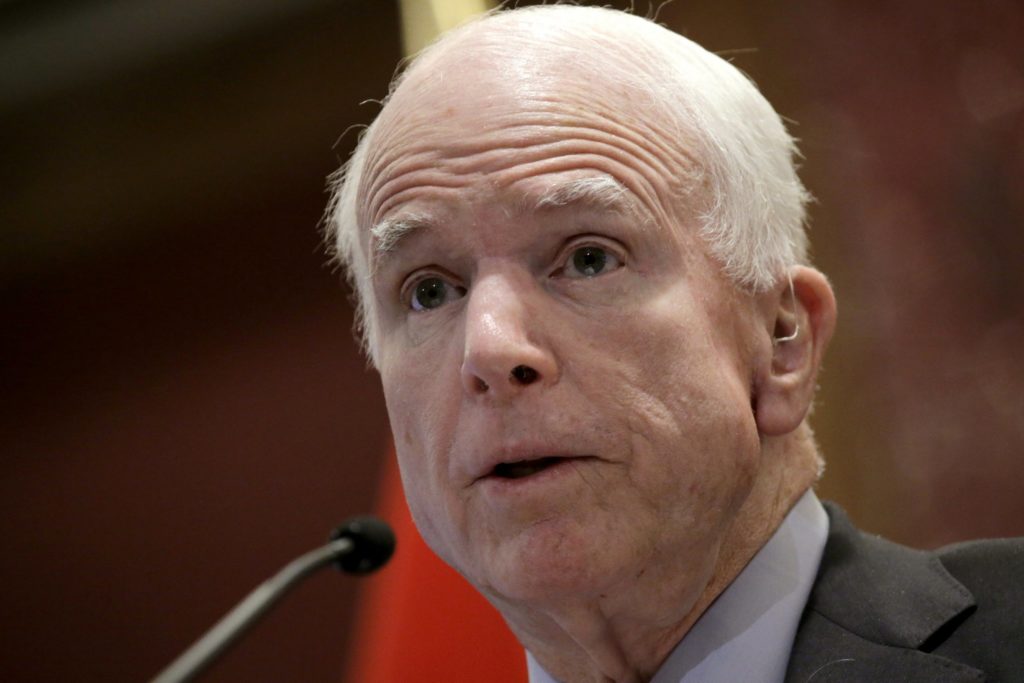
President-elect Donald Trump is the business titan who has spoken appreciatively of Russian President Vladimir Putin. Republican Sen. John McCain is the tough-talking national security hawk who warns that Russian interference in the U.S. election threatens to “destroy democracy.” McCain, chairman of the Armed Services Committee, on Sunday joined Democrats in calling for a special select committee to investigate foreign cyberattacks, putting him at odds not only with the incoming GOP president but with Senate Majority Leader Mitch McConnell, R-Ky., who favors allowing the Intelligence committee to take the lead on the inquiry. “We need a select committee. We need to get to the bottom of this. We need to find out exactly what was done and what the implications of the attacks were, especially if they had an effect on our election,” McCain said. “There’s no doubt they were interfering and no doubt that it was cyberattacks. The question now is how much and what damage and what should the United States of America do? And so far, we have been totally paralyzed.” Trump calls reports of Russian hacking “ridiculous” and his transition team dismissed the CIA assessment, saying it was the work of the same people who claimed Iraq had weapons of mass destruction. CIA Director John Brennan has said the intelligence community is in agreement that Russia tried to interfere in the U.S. presidential election, though there’s no evidence Moscow succeeded in helping Trump win. But the charge, along with Trump’s selection of a potential secretary of state with business ties to Russia, has divided a GOP riven by a fierce presidential primary and Trump’s refusal to single out Moscow for criticism. The fractures within the Republican Party will test longstanding GOP orthodoxy that saw Russia as a threat and responded to Putin’s annexation of Crimea with tough sanctions. “I think reality is going to intercede at one point or another,” McCain said Sunday on CNN’s “State of the Union,” on the eve of the Electoral College vote expected to formalize Trump’s victory. Trump, McCain suggested, “will very quickly understand what the Russians are all about.” The Twitter-loving Trump did not immediately respond to McCain’s remarks. But the president-elect’s incoming chief of staff refused Sunday to say that the president-elect trusts the CIA’s conclusion that Russia hacked the Democratic National Committee in a bid to help the real estate mogul defeat Democrat Hillary Clinton. “They haven’t been totally up front and transparent in their opinion as to who, what, where and how this all happened,” Reince Priebus said of the intelligence community on “Fox News Sunday.” Republican Sen. Richard Burr of North Carolina said Friday that his Intelligence panel “will follow the intelligence wherever it leads.” McCain at Armed Services and Sen. Bob Corker, chairman of Foreign Relations, also plan inquiries. McCain joined Republican Sen. Lindsey Graham and Democratic Sens. Chuck Schumer and Jack Reed in pressing for a select committee in a letter released Sunday. An aide to McConnell said he would review the letter. McCain and Trump have clashed throughout the campaign. Trump bashed McCain as a “loser” and “not a war hero” because he was shot down and captured during the Vietnam War. McCain criticized Trump for making disparaging remarks about NATO, immigrants, Muslims and a “Gold Star” family that lost a son in Iraq – and for refusing to say he’d accept the presidential election results unless he won. McCain dropped his tepid support for his party’s nominee in October over the release of a recording in which Trump boasts about assaulting women. President Barack Obama has ordered a full review of any Russian involvement before he leaves office next month. While Trump’s choice of Exxon Mobil CEO Rex Tillerson to be secretary of state has drawn concern among some Republicans, he is expected to win confirmation despite ties to Russia. Republished with permission of The Associated Press.
