
Guest lineups for Sunday news shows
Guest lineups for the Sunday TV news shows: ABC’s “This Week” — Democratic vice presidential nominee Tim Kaine; former House Speaker Newt Gingrich; former CIA Director David Petraeus. ___ NBC’s “Meet the Press” — Vice President Joe Biden; Republican vice presidential nominee Mike Pence. ___ CBS’ “Face the Nation” — Pence, Kaine ___ CNN’s “State of the Union” — Rep. Nancy Pelosi; former New York City Mayor Rudy Giuliani. ___ “Fox News Sunday” — Pence, Kaine ___ Republished with permission of the Associated Press.
Hillary Clinton’s turn: Guide to the Democratic National Convention
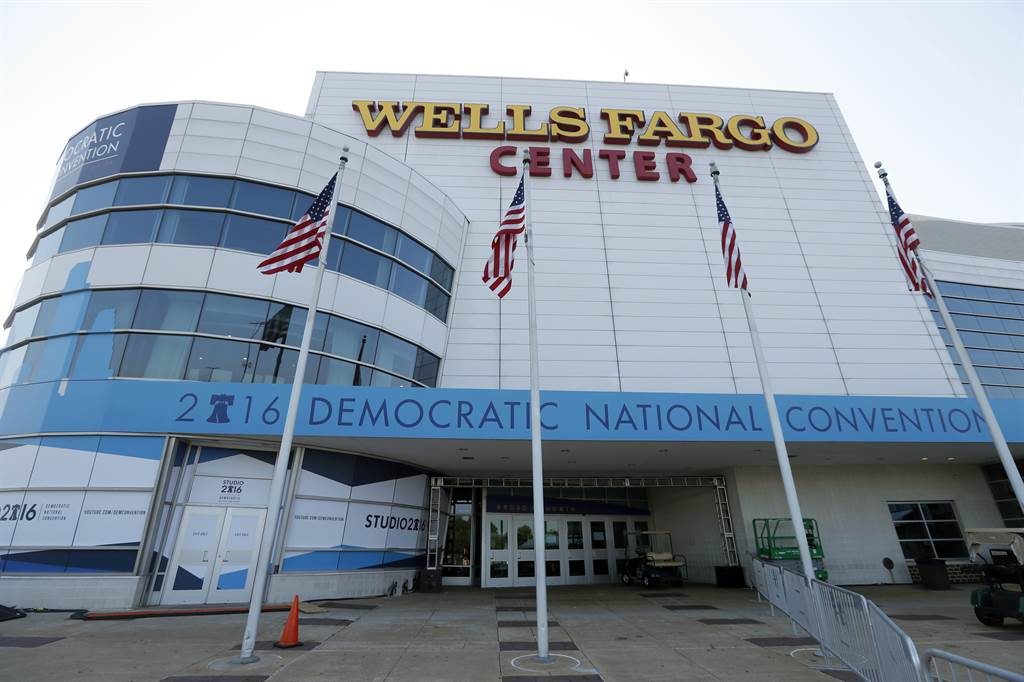
It’s Hillary Clinton‘s turn. The Democratic National Convention opening Monday in Philadelphia is Clinton’s chance to hit reset after a vigorous primary against Bernie Sanders and the unlikely movement that formed behind the Vermont senator. Sanders, a self-described democratic socialist, has endorsed Clinton, but many of his supporters have not. Some of them were dismayed by her choice of Sen. Tim Kaine, D-Va., as her running mate. Last week’s Republican National Convention in Cleveland exposed deep, lingering reservations about Donald Trump from within his own party. The Democratic gathering is expected to be a more smoothly choreographed display of unity among Clinton, Sanders and Democratic lawmakers and voters. What to know about the week: THE POINT Both parties use their national conventions to formally nominate candidates for president and vice president. Party leaders showcase their nominees, and the prime-time speeches by the candidates and prominent politicians win some of the largest television audiences of the campaign. That makes the convention a critical opportunity for a party to introduce its candidates to the country. Democrats also will adopt its platform, which lays out policy principles but has no binding effect. THE LOCATION The Wells Fargo Center, home to the NHL’s Philadelphia Flyers and the NBA’s Philadelphia 76ers, is the convention site. The arena has been transformed with stages, platforms, cameras and lights. Democrats are hoping that city’s historical role in the founding of American democracy will serve as a powerful backdrop for the themes they’ll highlight. WHO’S GOING More than 5,000 delegates are among the 50,000 people set to be in Philadelphia. They include alternates, lawmakers, special guests, journalists and protesters. Among the delegates, about 15 percent are superdelegates, mainly members of Congress and members of the Democratic National Committee. At the GOP convention, a striking number of prominent Republican lawmakers and party leaders were nowhere to be seen, including the party’s previous two presidents and its two most recent presidential nominees. In contrast, bold-name Democrats have been eagerly vying for a chance to speak in Philadelphia. Most Democratic senators and House members are expected to attend. THE SCHEDULE First lady Michelle Obama is set to speak Monday. That’s also when Sanders will give his speech — a closely watched moment for signs of whether his loyal supporters will line up behind Clinton, as he’s asked them to do. Former President Bill Clinton, the candidate’s husband, is the speech to watch Tuesday. A day later, President Barack Obama and Vice President Joe Biden come to Philadelphia. On Thursday, the final night, Chelsea Clinton will introduce her mother for her speech accepting the Democratic nomination. Kaine, who made his debut as Clinton’s running mate at a joint appearance Saturday, will give a speech introducing himself to the country. Officials haven’t yet said when, but the running mate typically speaks Wednesday. Other scheduled speakers are Massachusetts Sen. Elizabeth Warren, New Jersey Sen. Cory Booker, New York Mayor Bill de Blasio and House Minority Leader Nancy Pelosi. THE ENTERTAINMENT Shoop Dogg, Lady Gaga, Lenny Kravitz and Cyndi Lauper will appear in Philadelphia during the convention. Fergie will perform at The Creative Coalition’s gala. THE ROLL CALL States will get a chance to announce how their delegates are voting in the formal roll call Tuesday. It’s a high point for Sanders delegates; they’re pushing to have their votes fully tallied. In 2008, Clinton halted the roll call midway through to call for then-Sen. Barack Obama’s approval by acclamation, or unanimous vote. Sanders says he favors a state-by-state roll call, but he hasn’t indicated exactly what he will do. There’s a total of 4,763 delegates. It takes 2,382 to win the Democratic nomination. Clinton arrives in Philadelphia with 2,814 delegates to Sanders’ 1,893, according to an Associated Press count. That includes the superdelegates, who can vote for any candidate they choose. This year, those superdelegates overwhelmingly backed Clinton. The remaining 4,051 are pledged delegates, won by the candidates based on the results of state primaries and caucuses. THE PROTESTS If there are any fireworks in Philadelphia, expect them to come from Sanders supporters. They have said they plan to show up in full force. Philadelphia officials estimate between 35,000 and 50,000 people will demonstrate across the city each day. Activists have put the estimate higher, at roughly 100,000. Among the groups planning to demonstrate are gun control advocates, the group Occupy DNC Convention and Trump supporters from Pennsylvania. Republished with permission of the Associated Press.
Presidential Primary Brief: 175 days until Election Day
175 days until Election Day Convention Dates: Republican July 18-21 2016, Democratic July 25-28 2016 Weekly Headlines: Pelosi still withholding Clinton endorsement Georgia poll shows tight presidential race Trump racks up endorsements from House chairs Press Clips: America’s Speed Date with Bernie Sanders (Washington Post 5/15/16) When Sen. Bernie Sanders of Vermont announced his candidacy last spring, he trailed Hillary Clinton by 56 points in national polling. He had the support of less than 6 percent of Democrats. How many of those Democrats were residents of Vermont is hard to say, but it’s pretty safe to assume that part of Sanders’s low poll numbers were the fact that, to most Americans, he was one of the vast majority of the United States of whom they’d never heard. That changed. Quickly. Gallup conducts regular polling on how Americans view presidential candidates, asking respondents whether they view politicians favorably or unfavorably. There’s a third option, too; people can tell Gallup whether they’ve never heard of the candidate. And using that metric, we can get a good sense for how quickly (or slowly) awareness of presidential candidates spread across the country. State GOP leaders crush ‘Never Trump’ rebellions (Politico 5/14/16) Republican activists chose party unity over “never Trump” resistance Saturday, with party leaders in one state after another pressuring their members to fall in line behind the presumptive nominee — and even punishing those who refused. Eleven states held annual Republican conventions or party leadership meetings Saturday, offering a platform for those who still object to Donald Trump as their party’s standard-bearer a prime opportunity to make mischief. But at almost every turn, they slammed into state leaders who closed ranks around a candidate who many once said they’d never support. A GOP senator just compared the 2016 election with 9/11 (The Week 5/15/16) Speaking at the Wisconsin Republican Party Convention on Saturday, Sen. Ron Johnson likened the 2016 presidential election to Sept. 11’s Flight 93, which crashed after the passengers decided to fight the hijackers and keep the plane from hitting its target. “We’re going to be encouraging our fellow citizens to take a vote,” said Johnson, who has endorsed Donald Trump. “It may not be life and death, like the vote the passengers on United Flight 93 took, but boy is it consequential.” If it ends up Trump vs. Clinton, over 25% of born-again Christians are ready to skip voting (Christian Today 5/15/16) An ongoing interactive “polling explorer” by Reuters news agency indicated that as of Friday, May 13, 25.9 percent of “born again Christians” will neither vote for Donald Trump nor Hillary Clinton, and will vote for a third candidate or abstain from voting instead. With the “born-again Christian” filter applied for the May 13 Reuters polling, Trump was favored by 43 percent of 422 respondents while Clinton registered 30.8 percent. However, without any filter, the polling results showed Clinton getting the vote of 38.1 percent of the respondents while Trump had 34 percent. The “Other/wouldn’t vote/refused” sector registered 27.9 percent. Poll predictor Nate Silver gives Trump 25% chance of beating Clinton in November (Washington Times 5/15/16) Political prognosticator Nate Silver said Sunday that he gives Republican Donald Trump a 25 percent chance of winning the 2016 presidential election, while noting that he has been wrong before. Mr. Silver admitted that he initially gave Mr. Trump only a 5 percent chance of capturing the Republican nomination, saying he would peak early and “flame out” like 2012 presidential contender Herman Cain. “This is one of the crazier things we’ve seen in politics for a long time. I think it was fair for us to be skeptical early on about the odds this could occur,” Mr. Silver told CNN’s “Reliable Sources.”
Barack Obama says Democrats are good for American government

President Barack Obama praised Democratic lawmakers for having his back through some politically tough votes and encouraged supporters to help elect more of them in November. “A Democratic Congress is good for America,” he said Friday. Obama also criticized Senate Republicans for refusing to consider his Supreme Court nominee and said GOP presidential candidates Donald Trump and Ted Cruz aren’t “outliers” but are simply parroting what some congressional Republicans have said for years. Obama didn’t mention that votes taken by House Democrats, led by then-House Speaker Nancy Pelosi of California, to muscle his economic recovery plan and health care law through Congress early in his first term ended up souring the public and costing Democrats the House majority. “I’ve done a lot of tough stuff since I’ve been president,” Obama told about 100 supporters who rose to their feet and chanted his “Yes We Can” campaign slogan as he entered a high-ceilinged room at the Pacific Heights home of businessman and philanthropist Gordon Getty. “But I couldn’t do it unless I had outstanding legislators who had my back, even when it wasn’t politically convenient,” he said, praising Pelosi for possessing a combination of “idealism and just tough as nails conviction and savvy” that he said the country has benefited from during his presidency. “I could not have had a better partner than Nancy Pelosi.” The California Democrat holds the fundraiser annually at the Getty home. Couples paid $33,400. Turning to the presidential race, Obama said Republicans shouldn’t feel embarrassed by the comments from Trump and Cruz, the Texas senator. He said the GOP rivals are saying what some Republican members of Congress have said about immigration and other issues for years. “In fact, that’s where Trump got it,” Obama said. “He said, ‘You know what, I can deliver this message with more flair.’” Obama said he wants a Republican Party that is “rational and well-functioning, but that’s not what we have right now. And that’s why this election is so important.” He noted that he will no longer be president in 10 months. “But in 10 months I will, contrary to Mr. Trump’s opinion, still be a citizen of the United States,” Obama said, recalling Trump’s past attempts to cast doubt on Obama’s citizenship because the president’s father was Kenyan. Obama also praised House Democrats at a fundraiser late Thursday in Los Angeles. Democrats have a good chance to add at least a handful of House seats in November’s election. The number could grow if the Republican presidential nominee is Trump, who has alienated large numbers of women, Hispanics and others with his biting rhetoric and issue positions. But to regain control of the 435-seat chamber, Democrats would need to pick up 30 seats, which would be an uphill climb. Obama’s remarks late Thursday opened a two-day fundraising swing through Los Angeles and San Francisco. Friday brought three more events, including a roundtable for Senate Democratic candidates at the Brentwood home of “Spiderman” actor Tobey Maguire that was closed to news media coverage. Tickets cost $33,400, officials said. Obama also attended a closed Democratic Party event Friday at the San Francisco home of activists Steve Phillips and Susan Sandler. Republished with permission of the Associated Press.
Nancy Pelosi praises Bernie Sanders for energizing young voters
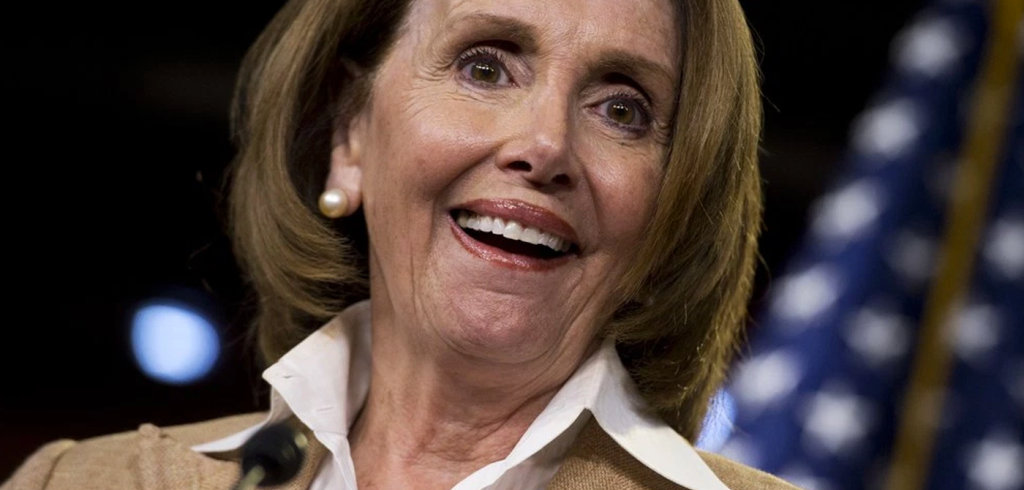
Top House Democrat Nancy Pelosi is praising Vermont Sen. Bernie Sanders for getting more young people “interested in the political process” as he mounts a surprisingly strong race for the Democratic presidential nomination. The California congresswoman says that “history will record that Bernie Sanders’ candidacy has had a very wholesome effect.” Pelosi spoke as House Democrats are closing out a team-building conference aimed at building unity and sharpening the party’s message heading into the November elections. She was responding to a question about whether Sanders’ candidacy will hurt Democrats’ chances this election. Pelosi has steered clear of endorsing a candidate in the party’s three-way primary but is regarded as a supporter of Hillary Clinton. Republished with permission of the Associated Press.
Darryl Paulson: Why Donald Trump won’t win the GOP nomination

As we rapidly approach the Iowa caucuses and the New Hampshire primary, speculation increases that Donald Trump will likely be the Republican presidential nominee. I believe Trump has no better than a 20 percent chance of winning the nomination. We all know the common criticisms of Trump. He has made outrageous statements about Mexicans as “rapists,” John McCain as not a military hero, and his rants against Carly Fiorina‘s ugly face and Megan Kelly bleeding from “wherever.” We know Trump has flip-flopped on almost every major issue including abortion, national health care and his attitude toward Hillary and Bill Clinton. We know that Trump has spent far more time as a Democrat or independent than as a Republican and he has given most of his $1.5 million in political donations to Democrats, including large contributions to Nancy Pelosi and the Clinton Foundation. We know that Trump has never been a conservative. Besides calling himself a liberal on health care, Trump quit the Republican Party in 1999 saying, “Republicans are just too crazy right.” We know that PolitiFact awarded Trump the “lie of the year” for his numerous misstatements during the campaign. Of the 77 statements PolitiFact investigated, they rated 76 percent of them Mostly False, False or Pants on Fire. Among the lies cited by PolitiFact was Trump’s comment that he watched “thousands of Muslims” cheering the fall of the World Trade Center on 9/11. You think at least one person would have a photo or video of that incident. None of it has damaged the Trump campaign yet. In fact, the more outrageous his statements, the more his numbers rise. So, why will Trump not win the Republican nomination? Because he will either suffer a Howard Dean-like fall, or because his support is concentrated among people who are not Republicans and people who are less likely to vote. Ross Douthat wrote in The New York Times that Trump’s support will vanish as Election Day approaches. As Joe Trippi, Howard Dean’s campaign manager wrote, “People get more pragmatic the closer they get to an actual vote.” According to Trippi, this is what happened to Dean. Why waste a vote on someone unlikely to win? Second, Trump will lose because much of his support comes from people who are not Republican and who don’t vote. Trump’s strongest support comes from what The New York Times called “a certain kind of Democrat.” It is hard for anyone to win the nomination of a political party when much of their support comes from people in the other party. As we get past the early caucuses and primaries, the candidates will face several closed primaries, where only members of a party can vote. If his support comes from Democrats, they will not be able to vote for him in states such as Florida and New York where Trump is doing well in the polls. A final problem for Trump is that much of his support comes from individuals who are least likely to vote, especially in caucuses and primaries. Civis Analytics, in a study of 11,000 Republican-leaning supporters, found that Trump would get 40 percent of the vote of those who have less than a 20 percent chance of voting. Unless Trump has a plan to compensate for these problems, he may quickly find himself, much like Dean, going from first place to out of the race in a period of weeks. If Trump loses the Iowa caucus, where Cruz is now leading, the bottom could fall out of his campaign very quickly. For a “winner” like Trump to lose the first major race of the campaign season would reduce the sense of inevitability that Trump will win the nomination. As other Republicans fall by the wayside, it is unlikely that Trump will win their support. Conservative and evangelical voters are unlikely to align with Trump, who is only a Republican of convenience. • • • Darryl Paulson is Professor Emeritus of Government at the University of South Florida St. Petersburg and resides in Palm Harbor, Florida. For more state and national commentary visit Context Florida.
Paul Ryan elected 62nd House speaker
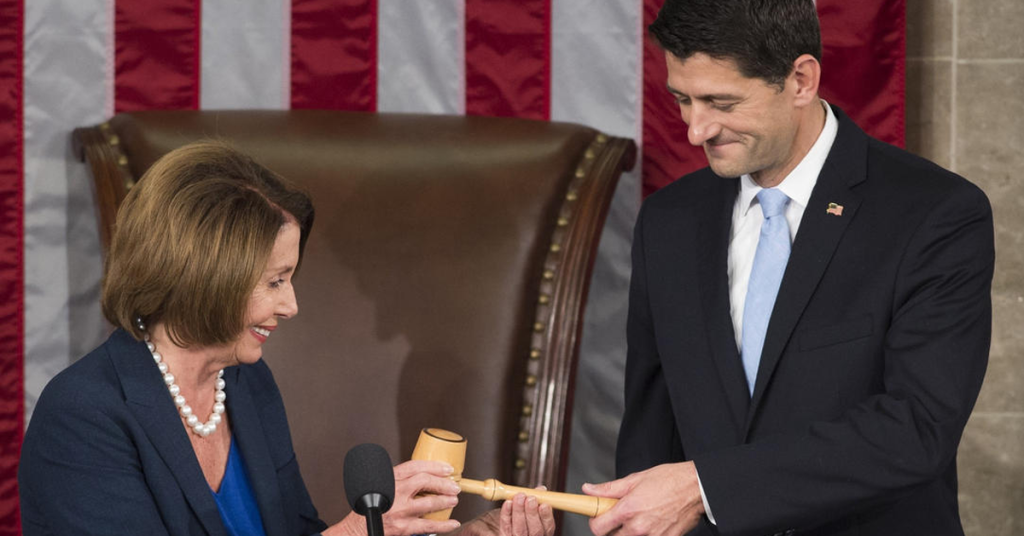
It’s a big day for Rep. Paul Ryan. The U.S. House of Representatives welcomes the Wisconsin Republican as the 62nd speaker of the House. Largely a formality – after House Republicans nominated him for the position on Wednesday afternoon – Ryan won the support of 236 House members during Thursday morning’s vote. After cinching the position, Ryan arrived on the House floor to a sea of applause. There both Republicans and Democrats joined in congratulating him on his position before House Minority Leader Nancy Pelosi, a California Democrat, passed the gavel his way. “It’s not till you hold this gavel and stand in this spot and look out and see all 435 members of the House – as if all of America was sitting right in front of you,” Ryan began his first speech as House Speaker. “It’s not till then that you feel it: the weight of responsibility, the gravity of the moment.” Ryan continued, “I never thought I’d be the Speaker. But early in my life, I wanted to serve in the House. I thought the place was exhilarating – because here, you could make a difference. If you had a good idea and worked hard, you could make it happen. You could improve people’s lives. To me, the House represented the best of America: the boundless opportunity to do good.” The GOP’s vice-presidential nominee in 2012 and the current chairman of the House Ways and Means Committee, the new House Speaker began his Capitol Hill career as a legislative aide in 1992 and won his Wisconsin House seat in 1998, at 28. At just 45 years old, the reluctant leader is the youngest speaker since 1869.
In op-ed, Jeb Bush links his tax reform package to California’s iconic Prop 13
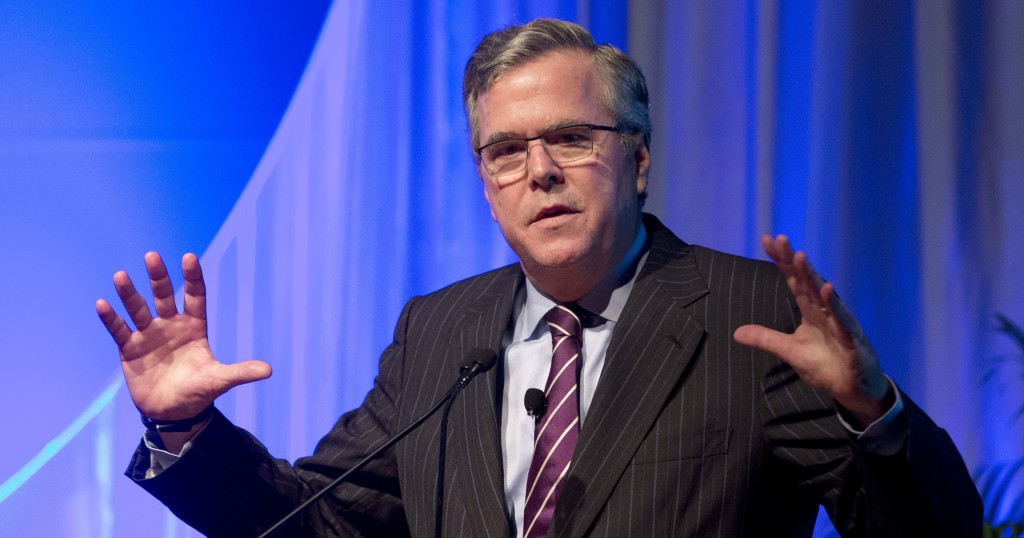
With the second Republican Party presidential debate taking place this week at the Ronald Reagan Library in Simi Valley, we’re hearing more references than ever references by the GOP candidates to the the nation’s 40th president, who remains as powerful an iconic figure as anyone in Republican politics. That certainly includes Jeb Bush, whose op-ed in today’s Orange County Register is titled, “A Reagan inspired tax reform plan.” He begins the piece by celebrating the fact that the debate (to be televised by CNN at 8 p.m. Eastern on Wednesday) takes place in Southern California, “the birthplace of the tax-cut movement in America.” He’s right about that. It was in 1978 that Californians voted on Proposition 13, also known as “Jarvis/Gann.” It was named after two Southern California conservative activists, Howard Jarvis, and Paul Gann, who would end losing to Democrat Alan Cranston in a bid for the U.S. Senate in 1980. Prop 13 was a political earthquake. It put a strict cap on property taxes, which in the 1970s were going through the roof in the Golden State. It was opposed by then Governor Jerry Brown, who immediately supported it after it won decisively at the polls. “President Reagan wisely identified that the American people were fed up with paying exorbitant taxes and weary from the failed economic policies of the Jimmy Carter administration,” Bush writes in the piece. “During his run for the presidency in 1980, Reagan put dramatic tax relief at the center of his campaign, calling for an across-the-board reduction in marginal tax rates. As president, Reagan succeeded in ending the Carter malaise by bringing the top marginal tax rate down from 70 percent to 28 percent and, in the process, unleashing a period of economic growth and prosperity that renewed the American Dream.” Bush then segues to his recently announced tax reform plan, a plan that he says will put the country on a path to 4 percent growth, something that neither his father nor brother was ever able to achieve in their collective 12 years in the White House. “Like President Reagan, I intend to dramatically reform our tax code, consolidating today’s seven brackets to three (28 percent, 25 percent and 10 percent) and eliminating special interest loopholes and carve-outs that disproportionately benefit the wealthy.” Bush writes that he will “relish” the opportunity to contrast his vision for sparking economic growth with Donald Trump, who he accuses of having supporting “the liberal big government, high tax philosophy espoused by Nancy Pelosi, Elizabeth Warren, Hillary Clinton and Barack Obama.” Here’s the piece in its entirety: The Republican candidates for president will debate Wednesday at the Reagan Library in Simi Valley. It is fitting that this important debate be held in Southern California, the birthplace of the tax-cut movement in America. Thirty-seven years ago, Howard Jarvis, a Southern California businessman and political activist, spearheaded Proposition 13, a ballot measure to place a strict cap on property taxes. Californians, who had endured massive increases in the taxes on their homes, revolted against the status quo in Sacramento and passed Prop. 13 overwhelmingly, sparking a nationwide movement to cut taxes that Ronald Reagan referred in his autobiography to as a “prairie fire.” President Reagan wisely identified that the American people were fed up with paying exorbitant taxes and weary from the failed economic policies of the Jimmy Carter administration. During his run for the presidency in 1980, Reagan put dramatic tax relief at the center of his campaign, calling for an across-the-board reduction in marginal tax rates. As president, Reagan succeeded in ending the Carter malaise by bringing the top marginal tax rate down from 70 percent to 28 percent and, in the process, unleashing a period of economic growth and prosperity that renewed the American Dream. After six and half years of the Obama administration, the nation again finds itself at a critical crossroads. President Obama has increased taxes by nearly $2 trillion and left us with one of the weakest recoveries in our nation’s history, so weak that, for many, the recession never stopped due to the hardships they are personally experiencing. What these working and middle-class Americans see as a recession, the Democrats and liberal academics call “the new normal.” I refuse to accept that. That is why I have outlined a bold tax reform plan that will help put us on the path to 4 percent economic growth, 19 million new jobs and rising wages for working families. Like President Reagan, I intend to dramatically reform our tax code, consolidating today’s seven brackets to three (28 percent, 25 percent and 10 percent) and eliminating special interest loopholes and carve-outs that disproportionately benefit the wealthy. Under my plan, millions of working families will have their income tax liabilities eliminated, and the average middle-class family will receive a tax reduction of approximately $2,000. For a working family earning under $40,000, we’ll eliminate their income tax liability altogether. I also am proposing major corporate tax reform to make American businesses more competitive. U.S. businesses pay the highest tax rate in the industrialized world. Under my plan, the top rate would fall from 35 percent to 20 percent, five points lower than China’s corporate rate. This tax cut for job providers will turbocharge our economy, lead to productivity gains and make it possible for American businesses to provide higher wages to their workers, something that is critically important since the middle class hasn’t received a pay raise in 15 years. I relish the opportunity Wednesday to contrast my vision for sparking economic growth and lifting up the middle class with those of other candidates, like Donald Trump, who have supported the liberal big government, high tax philosophy espoused by Nancy Pelosi, Elizabeth Warren, Hillary Clinton and Barack Obama. This issue isn’t just about numbers. It’s the difference between working Americans staying ahead or falling behind. The difference between being stuck in this “new normal” or growing at a pace that lifts up everyone. As president, I will be committed to leading in the
Darryl Paulson: The zenith of Donald Trump
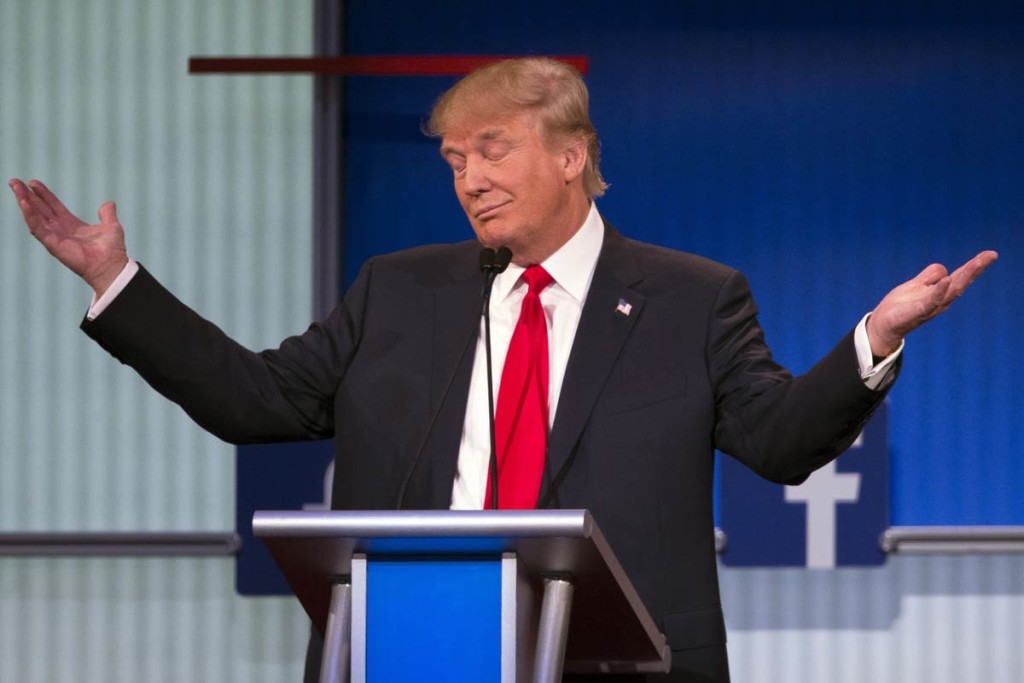
Here are two critical points concerning Donald Trump. First, he is barely a Republican. Second, he is certainly not a conservative. It is obvious that Trump is leading the field of 17 Republican candidates. His support in four recent polls all had Trump in first place, ranging from a low of 21 percent in the Bloomberg poll to 26 percent in both the Fox poll and the Monmouth University poll. That’s the good news for Trump. The bad news is that Trump may move up a few points, but he has reached the zenith of his support. A recent Economist/YouGov.com survey found that about a third of Americans had a favorable view of Trump and 58 percent had an unfavorable view. Trump will soon be taking the “down” elevator in public opinion polls. The same poll found that when the numbers were broken down by age, race, region, gender and income, Trump’s unfavorables were substantially higher in every category but one: voters 65 and older. His support among African-Americans, Hispanics and women is almost nonexistent. A Rasmussen Poll released Tuesday found strong evidence that the Trump decline may have already started. A survey of 651 likely Republican voters conducted between Sunday and Monday, found that support for Trump has declined from 24 percent to 17 percent in the past 10 days. Trump’s support among men has fallen from 30 percent to 19 percent, and support from women has dropped from 22 percent to 14 percent. Trump is at the top right now because he is perceived as the non-politician in the age where Americans of all political stripes hate the establishment. Voters are frustrated and alienated with politics and politicians, and Trump has successfully appealed to them. Trump’s supporters see him as the outsider who will shake-up the system, much like those who supported George Wallace and Ross Perot were viewed as political mavericks. Trump’s one major contribution to the presidential race us that he has demonstrated to the other candidates that the voters do not like them and their hollow promises one bit. Trump will falter for many reasons. As Larry Thornberry has written in The American Spectator, a leading conservative publication, Trump is “an arrogant, self-satisfied, crude and pompous windbag and bully who grossly overestimates his knowledge, his successes, and, not the least, his charm.” He attacks any critic as “stupid” or “loser,” but has a political glass jaw when he is criticized. Trump will lose because he is running as a Republican this year simply because he feels like it. He quit the party in 1999 saying that “Republicans are just too crazy right.” He then hired Roger Stone, who resigned as Trump’s campaign manager a few days ago, to consider a 2000 run as a Reform Party candidate. In 2009, Trump was back as a Republican. The next year he decided he was an independent and then in 2012, he was once again a Republican. His moving from one political party to another, all for political expediency, might remind Florida voters of Gov. Charlie Crist. Trump is the Bernie Sanders of the Republican Party. Both Trump and Sanders are running to lead a party that neither really calls home and that both have spent more time disparaging than uplifting it. During most of the first decade of the 21st century, the vast majority of the $1.5 million that Trump donated to political candidates went to Democrats, including contributions to Nancy Pelosi and $100,000 to the Clinton Foundation. When asked about his contributions to both Democrats and Republicans, Trump justified them by saying, “When you give, they do whatever you want them to.” I am sure that will appeal to Americans who hate politics for precisely that reason. Trump will lose because he is not a conservative in a party that is dominated by conservatives. In a 2000 book Trump called himself a “liberal” on health care. He supported a single-payer health plan that conservatives loathe, and he was once pro-choice, although he now says he is against abortion. A few years ago, Trump supported a 14.25 percent mega-tax on those making more than $10 million. Now he wants to cut income taxes in half. As Bruce Bartlett, former aide to U.S. Rep. Jack Kemp, said of Trump: “He is nothing if not inconsistent. He’s been on every side of every issue from every point of view as far as I can tell.” If you have not noticed, Trump is also delusional. He calls immigrants “rapists and murderers,” and then says he will win the Hispanic vote. He insults conservative icon Megyn Kelly for attacking him unfairly and having blood coming out her eyes and “whatever.” Trump also believes he will win the votes of women. Republicans, conservatives and Americans deserve better than Trump. “Donald, you’re fired!” Darryl Paulson is Professor Emeritus of Government at the University of South Florida St. Petersburg and resides in Palm Harbor.
Phil Kerpen: Stop Obama’s Clean Power grab

In President Obama’s first big speech to Congress, just a month after he took office, he said: “I ask this Congress to send me legislation that places a market-based cap on carbon.” They didn’t. Indeed, largely because of Obama’s own words on the campaign trail, it became clear that under his plan for a cap-and-trade system, “electricity rates would necessarily skyrocket” and that if “somebody wants to build a coal-powered plant, they can. It’s just that it will bankrupt them.” These facts became well known and contributed directly to the smashing defeat of his proposed cap-and-trade legislation during his first term, when it barely squeaked the through the House and was dead-on-arrival in the Senate even though Nancy Pelosi and Harry Reid were running the places. Yet this week, the president had his EPA issue the Clean Power Grab, a 1,560-page rule coercing states to adopt precisely the cap-and-trade policies he previously admitted required legislation from Congress. They did it with wildly creative lawyering to twist the Clean Air Act of 1970 into a global warming law. Longtime liberal Congressman John Dingell said: “This is not what was intended by the Congress and by those of who wrote that legislation.… So we are beginning to look at a wonderfully complex world which has the potential for shutting down or slowing down virtually all industry and all economic activity and growth.” The failed 2009 cap-and-trade bill called for a 20 percent reduction in greenhouse gas emissions over 11 years and 42 percent reduction over 21 years. The Clean Power Grab splits the difference, requiring a 32 percent reduction over 15 years. Otherwise it is nearly identical. The administration is simply acting as if the law they wanted passed. If they succeed, it would mean steeply higher electric bills and major manufacturing job losses for what, according to conventional climate models, would avert less than 0.02 degrees Celsius of global warming by the year 2100. Can they get away with it? There will certainly be litigation, and President Obama’s own Harvard law professor, liberal legal giant Laurence Tribe, has said of the Clean Power Grab: “Burning the Constitution should not become part of our national energy policy.” But the recent history of a related rule, and the insidious structure of the Clean Power Grab, suggest that President Obama and the EPA may succeed even if they ultimately lose in court. In June, the Supreme Court caught the EPA failing to even consider billions of dollars in costs, and struck down another expensive anti-coal rule. The EPA’s response was a smug press release saying the illegal rule had already accomplished its purpose: “EPA is disappointed that the Court did not uphold the rule, but this rule was issued more than three years ago, investments have been made and most plants are already well on their way to compliance.” In those three years , the value of the country’s three largest publicly traded coal companies was crushed from $25 billion to just $1 billion. That’s 96 percent of the wealth of a vital American industry already wiped out. The Clean Power Grab similarly seeks to lock itself in permanently, even if eventually found illegal, by coercing states to do most of the dirty work of enacting draconian caps on fossil fuel use into state law. Those laws would continue in effect after the EPA rule is struck down, and would create permanent rent-seeking corporate cronies who benefit from emissions trading and renewables mandates that would make the laws almost impossible to repeal. All state leaders should protect their citizens from higher electricity prices and job losses by rejecting the Obama administration’s call to submit a state plan. And they should join the effort to defeat the Clean Power Grab in court, in Congress, and at the ballot box. Phil Kerpen is president of American Commitment and a free-market policy analyst.
Jeb Bush rides Uber to San Francisco startup meeting
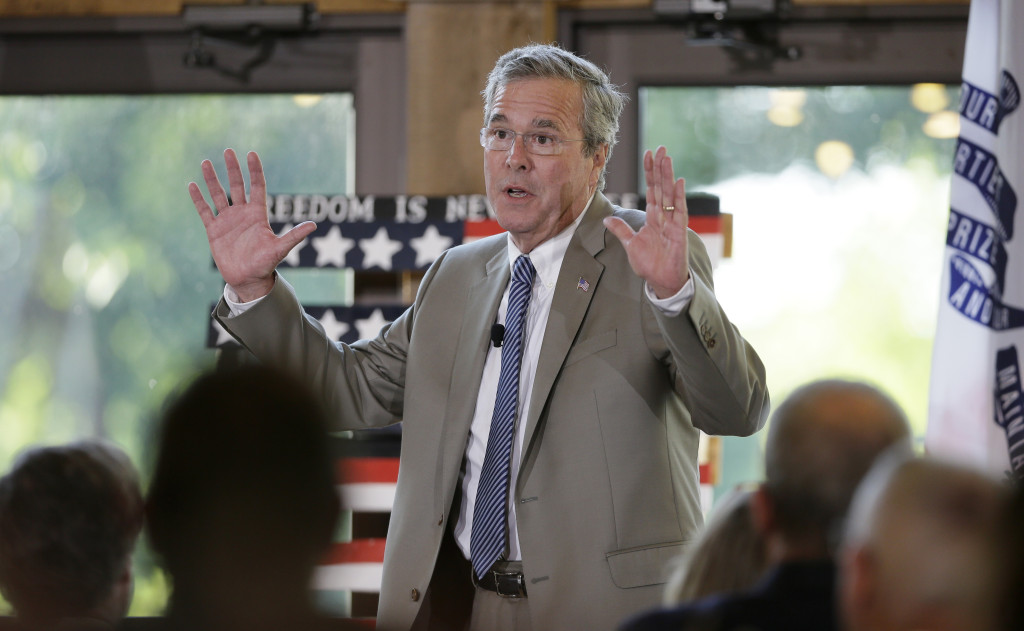
Presidential contender Jeb Bush used the ride-sharing service Uber to arrive Thursday at a startup where he was expected to talk up the benefits of small business and entrepreneurship as part of a fundraising swing through the San Francisco Bay Area. Bush pulled up at Thumbtack headquarters in the front seat of a black Toyota Camry being driven for Uber. Uber connects travelers with various cars through its smartphone app. Uber drivers are independent contractors, not employees, so they aren’t eligible for overtime pay, unemployment insurance or workers’ compensation. Bush’s potential rival, Hillary Clinton, has promised to crack down on companies that wrongly classify workers as contractors. She has praised the “gig economy” for creating exciting opportunities but has also said it is raising hard questions about workplace protections. Bush’s visit to San Francisco, a Democratic stronghold and home to U.S. House Minority Leader Nancy Pelosi, comes as a new Associated Press-GfK poll shows that negative views of the former Florida governor have ticked up. Forty-four percent say they have an unfavorable view, up from 36 percent in April. Among Republicans, 53 percent have a favorable view and 27 percent have an unfavorable view of Bush. Bush and supporting super PACs have raised a combined $114 million for the 2016 presidential campaign, outraising other candidates in the jam-packed GOP field. Donald Trump recently has emerged as a front-runner in the GOP field, drawing attention and criticism for his tough talk on illegal immigration. San Francisco has been a focal point of the immigration debate following the arrest of Juan Francisco Lopez-Sanchez, a Mexican who had been deported five times and now is charged with killing a woman while she walked on a pier with her father. Bush has been among the GOP candidates who have criticized Trump’s harsh comments claiming Mexico is sending its criminals to the United States. After visiting Thumbtack, Bush is scheduled to attend a fundraising luncheon in Silicon Valley. There also was a $2,700-per-person reception at a home in San Francisco on Wednesday night. Thumbtack was started by CEO Marco Zappacosta and President Jonathan Swanson. They served as aides to economic advisers in the White House administration of Jeb’s older brother, George W. Bush. Thumbtack aims to link people with service providers without the usual back and forth of phone calls or emails. Customers go online to specify what they want — for example, a portrait photographer for a specific date — and the company returns up to five names of providers that fit the bill, with bid prices attached. The company is named after the longtime practice of people who advertise their services via a notice tacked to a bulletin board. Thumbtack spokeswoman Michele Husak said the visit is not an endorsement of Bush’s candidacy. “Any politician who reaches out to us,” she said, “we’re happy to welcome them.” Republished with permission of The Associated Press.
Mo Brooks leads U.S. House GOP to strip immigration language from defense bill
U.S. House conservatives on Thursday voted down a nonbinding provision aimed at helping young immigrants without permanent legal status enlist in the military, angering some fellow Republicans and handing Democrats a political issue heading into an election year. The vote was 221-202 to remove the measure from Congress’ annual defense policy bill. Some 20 Republicans voted “no” but couldn’t overcome conservatives who threatened to oppose the overall bill if they didn’t get their way. “This Congress should support and represent Americans by voting to stop military service opportunities from being taken from struggling American families in order to give them to illegal aliens,” GOP Rep. Mo Brooks of Alabama, who led the fight, argued on the House floor ahead of the vote. The handful of Republicans on the other side of the issue struggled to round up votes. Their job was made harder because Democrats had already decided to vote against the defense bill for unrelated budgetary issues, giving Brooks and his supporters leverage to bring down the bill if they didn’t prevail. “This is a mistake,” said Rep. Carlos Curbelo, a freshman Republican from Florida. “It sends the wrong message to the country. I assure you that the overwhelming majority of Americans are for allowing young people who were raised in this country, who love this country and want to serve it, to have that opportunity.” Democrats wasted no time in jumping on an issue that could help them mobilize Latino voters heading into a presidential election year. House Democratic leader Nancy Pelosi of California and her top lieutenants held a news conference to denounce Republicans over the issue, and presidential candidate Hillary Rodham Clinton also got in on the action. She issued a prepared statement from her political director, Amanda Renteria, saying: “If these courageous young men and women want to serve, they should be honored and celebrated, not discriminated against.” The debate revived the simmering partisan dispute over executive actions President Barack Obama took this past fall to defer deportations for millions of immigrants in this country illegally, including expanding protections for those, known as Dreamers, who arrived in the United States as young children. Many Republicans argued that supporting the provision included in the defense bill would have validated the actions Obama took, which have been challenged in court and are on hold pending a ruling by the 5th U.S. Circuit Court of Appeals. “The House should not take action to legitimize the president’s unconstitutional overreach,” said House Judiciary Chairman Bob Goodlatte, a Virginia Republican. Other Republicans argued that the $612 billion defense policy bill, which covers a multitude of military issues, was not the place for a debate on immigration. The measure by Democratic Rep. Ruben Gallego of Arizona would have expressed the House’s view that the Pentagon should study whether military enlistment should be opened to Dreamers. It was added to the defense bill during a marathon committee session last month, with the support of six Republicans. But several Republicans asserted Thursday that it shouldn’t have been included in the first place, suggesting that perhaps it only was because the debate occurred so late at night and people were not fully focusing. “It went for 18 hours, late in the process one of our members offered an amendment to insert the immigration issue into this bill, it was unfortunate and it was inappropriate,” said Alabama Rep. Bradley Byrne. Gallego disputed that argument, saying his amendment was offered about 10:30 p.m., which he asserted was not overly late. Republished with permission from The Associated Press.
