
UAB urges public to protect eyes from long-term damage while viewing the eclipse

Watching the captivating sight of the moon’s passing between the sun and Earth, where the moon fully or partially covers the sun, could cause serious and potentially long-term harm to the eyes if not viewed properly. Eye specialists from the University of Alabama at Birmingham offer tips on eye safety during the eclipse to avoid post-exposure symptoms like pain, red eyes, light sensitivity, tearing or watery eyes, blurry vision and many others. “It is never safe to stare directly into the sun, and that includes during the eclipse,” said Tamara Oechslin, O.D., Ph.D., assistant professor in the UAB School of Optometry. To protect your eye health, wear NASA-approved solar eclipse glasses. (UAB) “Parts of the country will see partial coverage, while others will see full coverage. It will never be safe to view the eclipse without eye protection unless you are in a zone with complete coverage and, then, only during those two minutes of complete coverage, or totality.” According to NASA, all of North America will be treated to an eclipse of the sun today. This is the first of its kind in the United States since 1979. Anyone within the path of totality can see a total solar eclipse, and observers outside this path will see a partial solar eclipse. NASA released the 2017 total solar eclipse path map to help viewers identify the amount of coverage that will be seen in their area. Viewers can also use the interactive solar eclipse Google map to find the type of eclipse that will be seen in a particular region. “The best option to view an eclipse safely is to wear solar eclipse glasses approved by the International Organization for Standardization,” said Tyler A. Hall, M.D., assistant professor from the UAB School of Medicine’s Department of Ophthalmology. Standard sunglasses, regardless of ultraviolet markings, including UVA and UVB, will not provide enough protection for eclipse viewing due to the intensity of the rays. The sun’s rays may be partly blocked during an eclipse, but the remaining visible rays are still intense enough to cause serious eye damage or even loss of vision. Protective eyewear should have an ISO 12312-2 marking on them to be considered safe for looking at the sun. When a viewer is in the total coverage zone and during the brief two-minute period of total coverage, the solar eclipse can be viewed without wearing the approved eclipse glasses. The sun’s rays are blocked in this zone, allowing viewers to remove the glasses for a brief time to see the total eclipse. Viewers in the partial eclipse zones should wear protective eyewear the entire time. “The only exception to the rule of strictly wearing solar eclipse glasses while viewing the eclipse is that you can remove your eclipse glasses if you are viewing a total eclipse when all the sun’s rays become blocked,” Hall said. “Most people, however, will be viewing a partial eclipse, which should be seen only through solar eclipse glasses.” Oechslin suggests the only safe way to look directly at the uneclipsed or partially eclipsed sun is through special-purpose solar filters, such as eclipse glasses or hand-held solar viewers. She suggests certain filters to view the solar eclipse, including specialty eclipse glasses or a welder’s helmet. An educational activity she recommends for children is to make pinhole cameras for viewing the shadow of the moon’s path across the sun. These cameras are not to look through, but to watch the small shadow on the ground. Directions for making a pinhole camera and its use can be found online. Oechslin highly recommends NASA’s do’s and don’ts while viewing the solar eclipse: Always inspect your solar filter before use; if scratched or damaged, discard it. Read and follow any instructions printed on or packaged with the filter. Always supervise children using solar filters. Stand still and cover your eyes with your eclipse glasses or solar viewer before looking up at the bright sun. After glancing at the sun, turn away and remove your filter – do not remove it while looking at the sun. Do not look at the uneclipsed or partially eclipsed sun through an unfiltered camera, telescope, binoculars or other optical device. Similarly, do not look at the sun through a camera, a telescope, binoculars or any other optical device while using your eclipse glasses or hand-held solar viewer — the concentrated solar rays will damage the filter and enter your eye(s), causing serious injury. Seek expert advice from an astronomer before using a solar filter with a camera, telescope, binoculars or any other optical device. If you are within the path of totality and only during the brief two-minute period of totality, remove your solar filter only when the moon completely covers the sun’s bright face and it suddenly gets quite dark. Experience totality; then, as soon as the bright sun begins to reappear, replace your solar viewer to glance at the remaining partial phases. There are no specific alerts to stop someone from looking directly at an eclipse in order to avoid damage, regardless of whether they are wearing appropriate eclipse glasses. Hall recommends limiting viewing the solar eclipse to three minutes or less, even with approved solar eclipse glasses. “If the essential guidelines are adhered to, eye damage is extremely unlikely to occur,” Hall said. “Should damage occur, it typically takes the form of blurred vision or blind spots that develop several hours after the viewing occurred.” Ocular damage from the sun can be rather serious and can severely damage the front surface and inside of the eye. Two types of eye damage can occur from overexposure to the sun: photokeratitis, damage to the front surface; and solar retinopathy, damage to the inside or back of the eye. “Persons should seek medical attention immediately if experiencing any post-exposure symptoms, especially if the condition is worsening with time,” Oechslin said. “Just as with a sunburn, delayed symptoms can also occur several hours after overexposure.” Symptoms of photokeratitis include eye pain, burning or red eyes, light sensitivity, blurred vision, watery eyes, and/or swelling around the eye or eyelid.
Alabama makes strides in bringing high-speed internet to rural communities
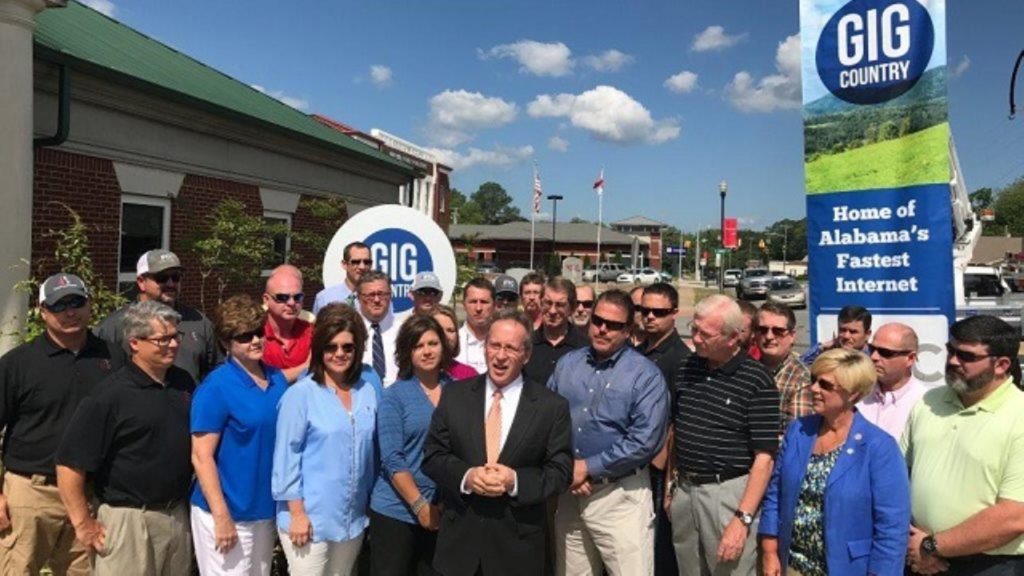
Fiber infrastructure is a key tool in attracting new and expanding businesses across Alabama, and local providers are actively working to install innovative internet technologies, particularly in the state’s rural areas. In recent years, AT&T has invested nearly $1.2 billion in Alabama to enhance its wired and wireless networks, in both urban and rural areas. While AT&T has been deploying fiber in Alabama since the mid-1980s, a new initiative allows local leaders to designate industrial parks, office campuses and other business locations as “AT&T Fiber Ready” and use that message in marketing materials. “In today’s world, internet connectivity is an important part of the puzzle,” said AT&T Alabama President Fred McCallum. “No matter the size or the sector, companies rely on high-speed internet access to grow and scale their business.” “Our goal with Fiber Ready is to highlight the existing presence of fiber optics and high-speed communications infrastructure and — hopefully — in turn, support economic developers and local leaders as they diligently work to attract new businesses and drive growth for the businesses that already call Alabama home.” To date, 31 sites in the state have been designated Fiber Ready. Rural targets Other local providers are also making strides in boosting connectivity in the state. Just last month, Farmers Telecommunications Cooperative Inc. (FTC) announced a new fiber infrastructure investment in Marshall County, starting in Albertville and later moving into Boaz and Guntersville. Angela Till, deputy secretary of the Alabama Department of Commerce, speaks at an AT&T Fiber Ready event in Prattville. (Made in Alabama) The Rainsville-based company serves the northeastern corner of Alabama, including Jackson, Marshall and DeKalb counties. In 2015, FTC was the first provider in Alabama to launch active Ethernet-Based GIG internet to residents and small businesses. “Active Ethernet service essentially means each customer is served with a dedicated fiber from the serving wire center,” said Fred Johnson, FTC’s executive vice president and general manager. “This means that from the wire center to the customer there is dedicated bandwidth rather than a sharing of bandwidth between customers as in the case of a passive optical network (PON).” In all fairness, Johnson continued, the public internet itself is shared bandwidth, so that distinction must be allowed. “Nevertheless, assuming that wire centers are adequately supported, as ours are, with high-capacity links, the customer experience is improved because there is less shared bandwidth in the distributed portion of the network,” he said. “A PON essentially takes a single fiber and ‘splits’ it multiple times among a group of customers who effectively share the bandwidth of that fiber.” Johnson added that every business park in the FTC service footprint has optical fiber available. Service may be provisioned in any of those parks up to and beyond the 1 Gig level. “Having ‘GIG’ residential service available has brought the area a degree of notoriety — we have an even more robust system than the ‘Gig Poster Child’ of Chattanooga — but is less significant economically than the even higher capacity afforded the business and industrial community,” Johnson said. “The local economic development associations inform us that almost every prospect checks off broadband availability as a condition precedent to any further evaluation. To date, I am unaware of FTC’s facilities failing this checkoff. They are literally as modern as any in the country.” Recruiting 21st-century jobs Alabama Sen. Clay Scofield of Guntersville said FTC is providing critical support to the quality of life in the region. “We’re very excited that Farmers has made the decision to expand in Marshall County,” he said. “It’s a significant investment that we think is going to have a huge impact on economic development in our area.” The region is trying to recruit 21st-century jobs, Scofield said. “The only way we’re going to be able to do that is with this type of infrastructure,” he said. “From here and into the future, high-speed internet is going to have to be just as important for a utility to offer as power and water are. “It’s going to be critical that our communities throughout the state of Alabama have access to this if we want to really grow, not only to recruit jobs but also to recruit people to live in those areas.” Scofield is sponsoring legislation that would provide incentives to companies to expand broadband into rural and underserved areas of the state. “It’s very costly to expand as it is, and in our more urban and suburban areas, it’s easier for companies to make it profitable. But in rural or poor urban areas, it’s not as profitable for them to expand,” he said. Scofield’s bill stalled in the House during the last legislative session, but he continues to work on it and intends to introduce it again in the next session. He said he recently spoke to the Marshall County Realtors Association, and he asked them how many of their clients inquire about internet connectivity before they purchase a home. “Every hand went up. This is really going to affect smaller areas’ ability to recruit people to move there,” he said. It’s also important when it comes to training the workforce of the future, Scofield said. “We’ve done a great job in Alabama of getting technology into the classroom, but what happens when those students go home? I think this is critical when we look at workforce development and training to make sure we have connectivity,” he said. ‘Highways of the future’ Alabama Rep. Kyle South of Fayette, who also is general manager of West Alabama Cable TV, agreed that a robust fiber infrastructure is key to a region’s economic growth. Officials in Thomasville celebrate the arrival of AT&T’s Fiber Ready initiative in the rural Alabama community. (Contributed) “There’s no question it’s terribly important,” he said, citing the automotive industry as an example of the industries that rely on the network. Suppliers and auto manufacturing plants operate on a just-in-time strategy, with parts being shipped and received as they are needed. “There’s no way they can stay on schedule without proper communication between
UAB students’ research work takes flight with drone technology
Drones are quickly becoming a prolific part of modern society, and students at the University of Alabama at Birmingham are doing cutting-edge research involving the flying machines. Elizabeth Bevan, a doctoral student in the Department of Biology, is using drones in her thesis project that studies the effects of climate change on the endangered Kemp’s ridley sea turtle in the Gulf of Mexico. Her focus is understanding the courtship and mating behaviors of the turtles, and drones have given her an up-close view into their previously unknown habitat. They do so without interfering with the animals. In 2013, Bevan and her mentor, biology professor Dr. Thane Wibbels, started using a basic drone with a GoPro camera attached. They sent it out over the water to film hatchings they had been monitoring on the beach, and they were floored by the potential. They followed up with a more sophisticated drone and camera. “The next season we were awestruck,” she said. “The newer model had a communication system between the aircraft and the remote control, and we could see in real time what the camera saw. It was the first time we’ve ever seen this kind of glimpse into this habitat.” Revolutionary technology Elizabeth Bevan pilots the UAB team’s DJI Inspire drone. (UAB) Bevan and Wibbels have documented eight types of courtship and mating behavior among the turtles in the Gulf. They’re now exploring with new cameras, including a thermal imager that lets them track turtles in the ocean and on their nesting beaches through body heat. Bevan said drone technology is revolutionizing the way researchers conduct biological studies of sea turtles and wildlife in general. “Without drones, we wouldn’t have been able to get this kind of information,” she said. “It’s not just opening a new door; it’s like blowing open a whole new wall.” Bevan has received a fellowship through the National Science Foundation’s East Asia and Pacific Summer Institute Program. This summer, she will spend three months in Australia, where researchers are doing advanced work involving drone technology and wildlife habitat exploration. Limitless potential Meanwhile, Ali Darwish, a UAB doctoral student in the Department of Electrical and Computer Engineering, has been building drones since 2009 and says they have unlimited applications. He is developing a software that will allow drones to track other drones. He was also part of a team that developed a small, waterproof quadcopter drone for dam inspections; another project is looking at potential applications for agriculture. UAB professor Dr. Arie Nakhmani and graduate student Ali Darwish hold a quadcopter drone in the School of Engineering laboratory. (UAB) “By placing infrared sensors and thermal sensors on drones, we can enable farmers to see plants, see diseases and see whether plants are irrigated,” he said. Darwish, who grew up in Dubai, has always had a fascination with flying machines. A native of Syria, he and students from other schools were involved in a project that sought to deliver humanitarian aid by drones to his war-torn home country. Their work was stymied by the political climate, but that hasn’t stopped Darwish’s interest in drones. He will soon start a job in Washington, D.C., with a company that specializes in artificial intelligence. He continues to work on his dissertation, and his work with drones – flying them, testing them, developing new uses and abilities for them – will continue. Not too long ago, drone technology was a military secret, Darwish said. But now, it’s showing up in all types of commercial applications. “People shouldn’t be afraid of drones. They’re coming anyway, because the technology is evolving, so let’s get used to living with them,” he said. This story originally appeared on the Alabama Department of Commerce’s Made in Alabama website. Republished with permission of Alabama NewsCenter.
UAB unveils first look at completely net-positive solar house headed for competition
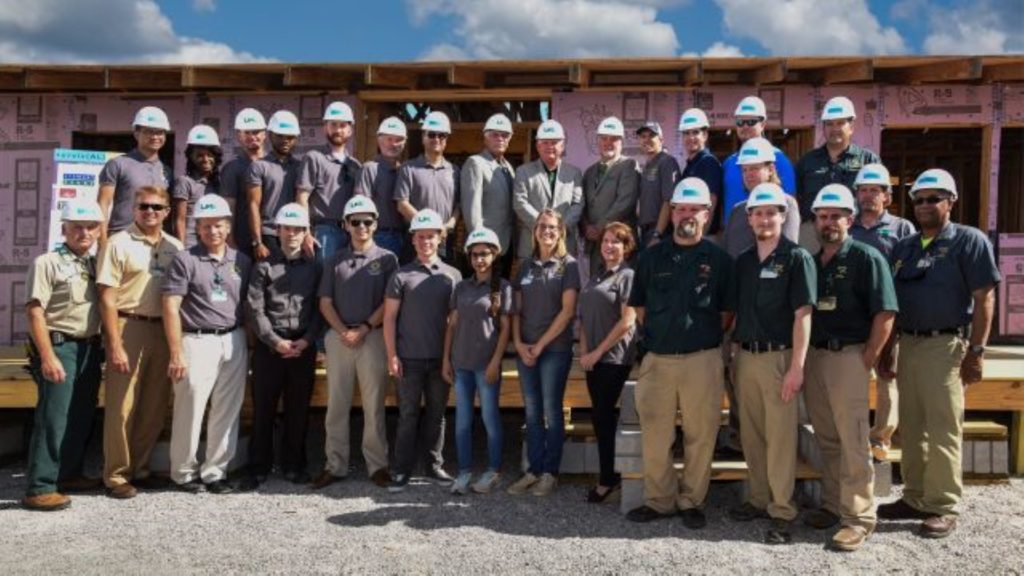
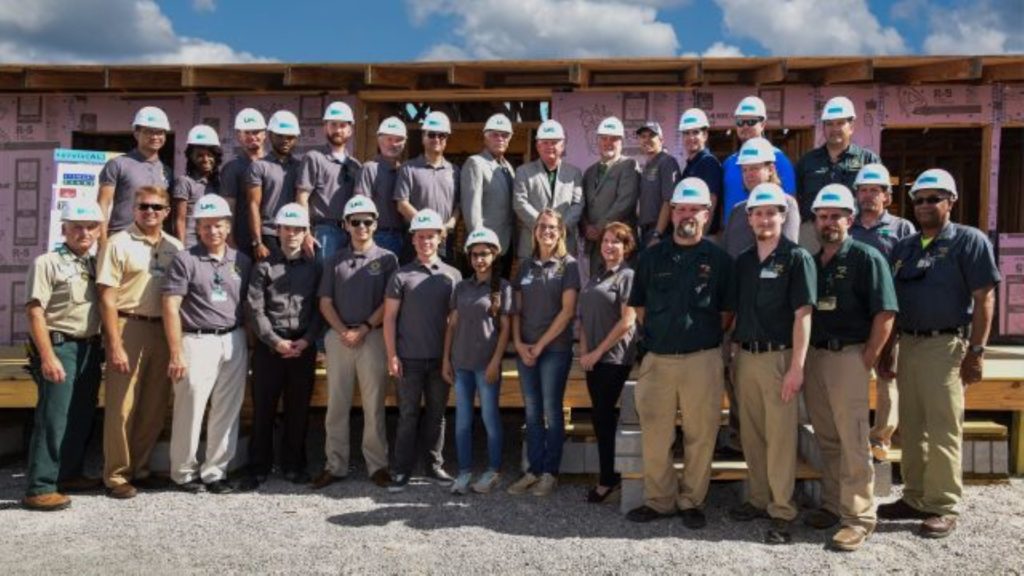
A team of University of Alabama at Birmingham students are building a house powered completely by solar energy in a competition against 11 other colleges from around the world. The UAB team unveiled the beginning stages of the house in a ceremony at the construction site recently. UAB is among an elite group of collegiate teams selected for the U.S. Department of Energy Solar Decathlon 2017 competition. UAB’s team is made up of students from a variety of disciplines across the university who have begun working on the house, along with students from neighboring Calhoun Community College. The team is working toward completing the design, construction and testing of what they dub the surviv(AL) house. Once the house is completed and tested on the UAB campus, it will be disassembled and transported to the Denver competition site, where it will be reassembled in October along with the 11 other solar houses. “The Solar Decathlon attracted more than 60,000 visitors last year, so this is an incredible opportunity for UAB students to showcase their talent and capacity to the world in 2017,” said Bambi Ingram, UAB Sustainability program administrator. Team Alabama is preparing to showcase the net-positive solar home. (UAB) The team’s solar house must be equipped to run all the appliances and accouterments at the same level of a comparable house on a conventional power grid, but with the only source of energy coming from what the house is able to harness itself. The efficiency of the house will allow it to produce more energy than it consumes, leaving the homeowners or users of the structure with extra energy to use in other ways. “The U.S., and particularly Alabama, lags behind the rest of the world in the number of net-zero, and especially net-positive, energy buildings built,” said Hessam Taherian, assistant professor in the UAB School of Engineering, and an adviser for the project. “By searching for innovative ways of harnessing and conserving energy, UAB students will have opportunities to develop technology that will be customized to meet the particular challenges of the local environment — from seasonal heat and humidity to surprise tornadoes and thunderstorms.” Because the houses must be suited to their local climate, the Alabama house will be designed with tornadoes in mind. The house will include at least one room with tornado-resistant walls, incorporating panels designed by engineers in the UAB Materials Processing and Applications Development Center. The design will allow for the house to be efficiently reassembled surrounding that tornado room, should a natural disaster occur. The house will also be built to beat the Alabama heat. A UAB-developed solar collector system helps cool the house by taking water out of the air and reducing energy costs. A device dehumidifies the air inside the home at night and recharges the material during the day, reducing the overall load on the home’s air conditioning system. The house will be tested in advance of the judging to ensure it produces enough energy to power all appliances. For example, students will be required to wash laundry, and clothes will be checked to make sure there is enough power for the dryer to fully dry the clothes. Other appliances will be checked to make sure they meet normal expectations, such as a water heater that can sustain hot water for the typical length of a shower. The house will have to provide sufficient energy to charge an electric car so that it can be driven 25 miles. The team will be required to prepare meals for two dinner parties at which they will host teams from other universities. They will also host a game night using the house audiovisual equipment, with snacks prepared in the kitchen. Bonus points will be awarded for any excess power generated by the house. “We want to fight the misconception that a house using renewable energy means compromising on comfort or performance,” Taherian said. Stringent criteria The teams will showcase the houses to the public and provide free tours of renewable energy systems and energy-efficient technologies, products and appliances. The houses will be judged according to strict criteria in 10 separate categories, ranging from architecture and engineering to the performance of the appliances. The winner will be the team that best blends affordability, consumer appeal and design excellence with optimal energy production and maximum efficiency. The Solar Decathlon village and competition houses will be open to the public at 61st & Peña Station near the University of Colorado. A free commuter train will be available: Thursday, Oct. 5-Sunday, Oct. 8: 11 a.m.-7 p.m. Monday, Oct. 9: 1-7 p.m. Thursday, Oct. 12-Sunday, Oct. 15: 11 a.m.-7 p.m. The Solar Decathlon 2017 teams will compete for a minimum of $100,000 and a maximum of $300,000 in prizes. Once the competition is over, the house will be returned to UAB as a permanent net-positive building on campus, where it will be available for sustainability research and other uses, while helping raise awareness and educating the public about renewable energy. UAB’s team of 60 students is guided by faculty in the School of Engineering, in partnership with UAB Sustainability and the Collat School of Business, as a component of the project includes marketing and communications activities. Industry partners have been equally important in the progress of the project. Williams Blackstock Architects, for instance, has offered its services in helping students, faculty and staff with the design. Additional industry partners will be key to the project’s success. A team effort Team Alabama’s Solar Decathlon effort so far has truly spanned across campuses and into the community. The UAB Facilities Division continues to be instrumental to the project through offsetting some costs, providing materials and the construction site, as well as offering construction expertise to the team. “This project is the perfect example of how we strive to integrate research and innovation processes to operate like a living lab,” said Mike Gebeke, assistant vice president of Facilities Management. “We are really happy to have the opportunity to partner with academic
Terri Sewell applauds $6M UAB grant to train local young adults for 925 high-paying jobs
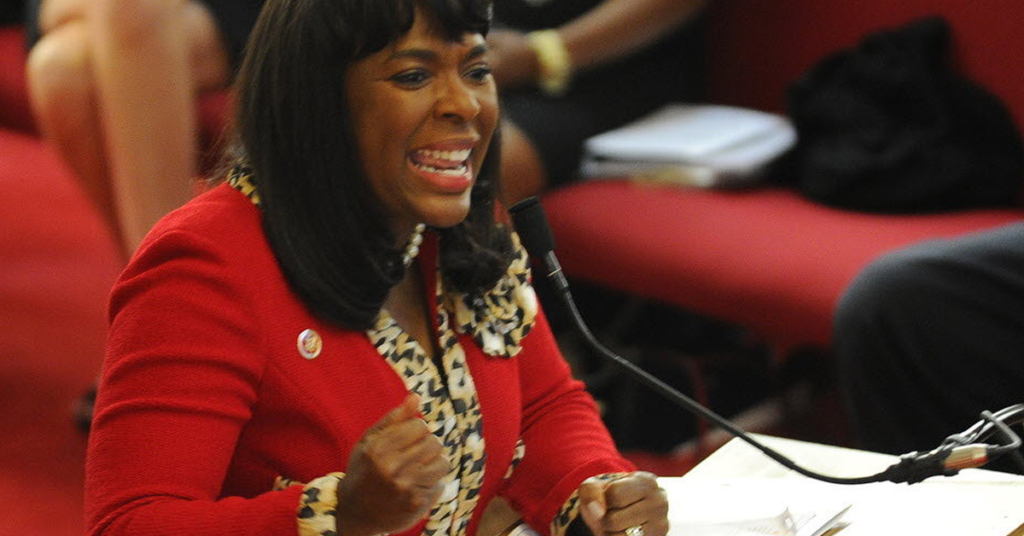
The University of Alabama at Birmingham (UAB) is getting $6 million in federal funding to help train students for in-demand jobs. UAB was one of 23 groups to receive the U.S. Department of Labor‘s America’s Promise grants, a federal program designed to accelerate the development and expansion of regional workforce partnerships committed to providing a pipeline of skilled workers in specific sectors. UAB was the only recipient in Alabama. Alabama 2nd District U.S. Rep. Terri Sewell helped UAB secure grant at the maximum allowed amount of nearly $6 million, which will fund Innovate Birmingham, a broad coalition led by UAB of public, community, business and education leaders committed to fostering economic growth for the region and offering better opportunities for young adults. “Innovate Birmingham’s consortium partners are among the most successful corporate, academic, and non-profit citizens in Alabama, all of whom realize that our national and global competitiveness is only as strong as our local workforce pipeline,” said Rep. Sewell. “With this vital funding from the Department of Labor, Innovate Birmingham will be able to meet the demand of the second fastest growing IT workforce in the country by educating and training 925 Birmingham-area disconnected youth for high-wage, high-demand jobs in the industry.” UAB President and Birmingham Business Alliance Board Chairman Ray Watts says UAB is excited to have the opportunity to help lead this important project that combines education, community service and economic development, touching several key priorities of the institution’s multifaceted mission. “The main focus of this effort is to offer new educational opportunities for the young adults in our community to provide them with training and expertise that will enable them to have prosperous, bright futures,” Watts said. “It will positively change their futures and the futures of their families and communities.” The Innovate Birmingham Regional Workforce Partnership’s program will fuel inclusive innovation for local employers by meeting workforce demand in information technology with sustainable, demand-driven education, training and employment opportunities for area young adults who are disconnected from the labor market. “This is a tremendous opportunity,” said Birmingham Mayor William Bell, “and the City of Birmingham leadership is proud to be among the dedicated team who combined their time, expertise and resources to make a compelling plan that truly embodies the spirit of America’s Promise and will have a great impact in our communities.”
Alabama business roundup: Headlines from across state – 9/30/16 edition

Which manufacturer has just produced their four millionth vehicle in Alabama? As the global shipping industry faces problem, should Alabama’s port be concerned? Answers to these questions and more in today’s business roundup below: Birmingham Business Journal: Bham contractors named to prestigious list Birmingham-based companies were recently named to a list of the nation’s top construction firms. Building Design + Construction magazine ranked B.L. Harbert as the No. 2 on its list of Federal Government Giants, firms with the largest amount of government projects last year. According to a press release, B.L. Harbert had more than $661.2 million in revenue for federal projects in 2015. Federal work is the company’s largest market sector in a diverse portfolio. “We are humbled to be recognized as a Building Design + Construction Giant in the federal division,” said Chuck Bohn, President of BL Harbert’s International Group. “This is a testament to our employees, near and far, for securing contracts and performing the work successfully. We look forward to what next year will bring for our team.” Another local firm, Brasfield & Gorrie, ranked No. 8 on the list. The company had more than $105 million in 2015 federal project revenue. Robins & Morton ranked No. 17 with more than $38 million, and Hoar Construction came in at No. 27 with around $7.7 million in 2015 federal project revenue. Alabama News Center: Milestone: Honda produces 4 millionth Alabama-made vehicle If you line up all the Honda vehicles that have been built at the automaker’s Talladega County plant since it opened 15 years ago, they would stretch across the U.S., from New York to Los Angeles, more than four times. That’s what 4 million Alabama-made Hondas look like. Last week, Honda Manufacturing of Alabama celebrated a key milestone: the production of 4 million vehicles and V-6 engines. The $2.2 billion plant started mass production in November 2001. It is the sole source of Honda’s Odyssey minivan, Pilot SUV and Ridgeline pickup, as well as the Acura MDX luxury SUV. It also produces the engines that power all four vehicles. “The commitment and dedication of our 4,500 associates has allowed HMA to achieve this production milestone and fulfill our commitment to quality for Honda customers across the globe,” HMA President Jeff Tomko said. The 4 million milestone came as a delegation of Alabama government and business leaders were visiting Tokyo for SEUS Japan 39, a forum that aims to strengthen cultural and economic ties between the Southeastern U.S. and the Asian nation. Greg Canfield, secretary of the Alabama Department of Commerce, led the state delegation in Tokyo. Canfield and a group of Alabama officials visited Honda’s corporate headquarters last week. “Honda has been a powerful economic engine in Alabama, creating thousands of jobs and new levels of opportunity for residents in Talladega County and across the state,” Canfield said. “Honda has found a home in Alabama, expanding repeatedly to boost output and add capabilities,” he said. “We’ll work hard to keep this fruitful partnership going strong.” Going the distance To mark the milestone, Honda had a little fun with the numbers. Based on an average length of 16.4 feet per vehicle, 4 million HMA-built vehicles lined up end-to-end would stretch 12,422 miles, the company said. That would: Stretch around the Talladega Superspeedway 4,670 times (2.66 miles) Nearly span the distance (just eight miles short) from the North Pole to the South Pole (12,430 miles) Go from New York to Los Angeles almost 4.5 times (2,791.8 miles) Four million vehicles also would: Fill up every parking space at Hoover’s Riverchase Galleria 370 times (10,800 spaces) Fill up every parking space at Walt Disney World 170 times (23,540 spaces) 2.2 million minivans The Odyssey represents the lion’s share of the plant’s output over the past 15 years, accounting for more than 2.2 million models produced. It’s followed by the Pilot, at 1.4 million, the Acura MDX at 216,521 and the Ridgeline at 121,009. The plant also turned out 27,119 Accord V-6 sedans from 2009 to 2010. Honda’s Alabama assembly lines have the capacity to produce up to 340,000 vehicles and engines per year. Since 2013, the company has invested more than $520 million and added more than 500 jobs in multiple expansions. A 2015 study showed the plant generated $6.8 billion in economic activity in the state. Along with its Tier 1 suppliers, the automaker is responsible for more than 43,000 jobs and 4.4 percent of the state’s total annual output of goods and services. Honda leads the way in Japanese investment in the state. Since 1999, when the automaker announced plans for the Talladega County operation, Japanese companies have invested more than $5 billion in Alabama. Birmingham Business Journal: UAB, Under Armour sign 7-year apparel agreement Sports apparel company Under Armour will pay the University of Alabama at Birmingham a rights fee of $50,000 per year under a new seven-year outfitter contract. UAB and Under Armour on Thursday publicly announced the partnership, though the contract officially began on June 1 of this year. UAB athletes and employees began wearing Under Armour apparel in July. “We’re thrilled for all of our student athletes,” UAB Athletic Director Mark Ingram said. “We’re excited to provide such a high quality product for our students.” In addition to the annual rights fee, UAB will receive a $1,075,000 product allowance for the 2016-17 school year. The annual allowance will decrease to $1 million for the 2018 and 2019 school years before increasing again, ending at $1,030,000 for the 2022 school year. Todd Locklear, manager of Under Armour’s NCAA services, announced the partnership alongside Ingram and UAB coaches Thursday. “UAB checks a lot of boxes for us. Birmingham is a huge market for Under Armour,” Locklear said, pointing to their relationship with Birmingham-based Hibbett Sports (Nasdaq: HIBB) Locklear said Under Armour (NYSE: UA) is excited about the rebirth of UAB football, as well. Under Armour will design a unique football uniform and sideline products to commemorate the return of the program next fall. “Their jerseys mean a lot to us,” Locklear said. “We
UAB space archaeologist Sarah Parcak on a mission to unearth Peru’s lost civilizations
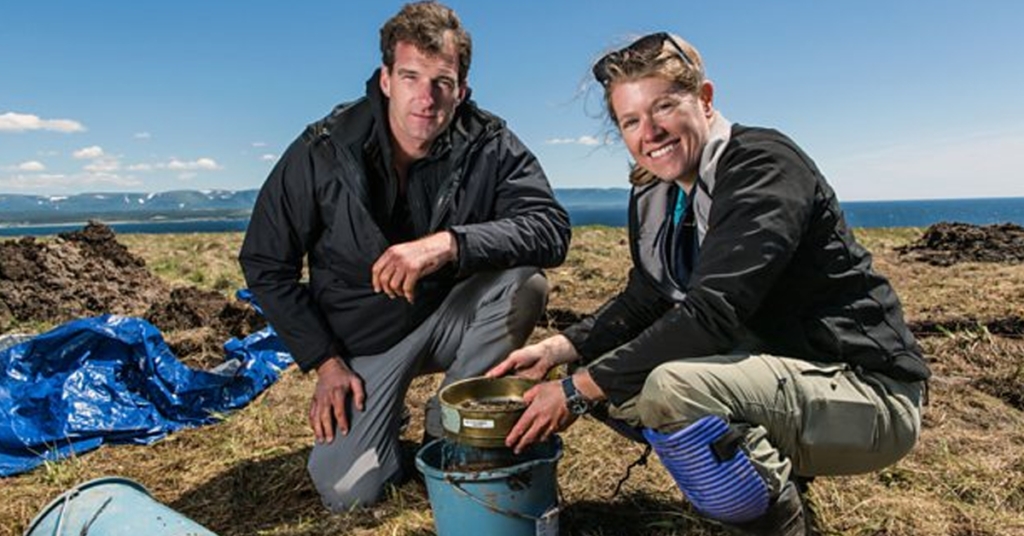
World-renowned “space archaeologist” and UAB professor Sarah Parcak is mission-focused: to find hundreds of thousands of lost, ancient sites buried beneath the earth before looters do. No easy feat, Parcak, the 2016 TED Prize winner — a highly-coveted $1 million grant that is awarded annually to one exceptional individual whose creative, bold vision sparks global change — will use her winnings to create an online tool that will train and enlist an army of volunteers across the globe to aid in her quest. Parcak announced the platform, Global Xplorer, at the recent TED Summit in Canada. There, she explained the platform will partner with DigitalGlobe and National Geographic, also working closely with UNESCO, and will allow anyone to help discover unknown archaeological sites. Archaeologist, together with citizen scientists, will help discover previously unknown sites and track looting of known sites. Across the globe, the UAB archaeologist is already helping countries preserve history by using satellites identifying ancient sites lost in time. In Egypt alone, Parcak helped locate 17 potential pyramids, plus an additional 1,000 forgotten tombs and 3,100 unknown settlements. She’s discovered even more throughout the Roman Empire. Sarah “uses 21st century technology to make the world’s invisible history visible again,” the TED blog explained. In the first exploration with Global Xplorer, Parcak said she and her team will look to map an entire country, Peru — the home of Machu Picchu, the Nazca lines and other archaeological wonders waiting to be discovered. “We will do nothing less than use state-of-the-art technology to map an entire country,” said Parcak at the TED Summit. “This is a dream started by Hiram Bingham, but we are expanding it to the world, making archaeological exploration more open, inclusive, and at a scale simply not previously possible.” Slated to launch January 2017, the platform will be available in both Spanish and English, it will be accessible to people in Peru and across Latin America with plans to include more and more languages over time. Those interested, may join the project by clicking here. You can watch Parcak’s latest TED Ted about the Global Xplorer project, from the recent TED Summit here: Noteworthy updates include: Global Xplorer will launch in Peru and use state-of-the art satellite technology to map the entire country – an archaeological feat more open, inclusive and advanced than anything before
Alabama business round up: Headlines from across state – 3/29/16 edition
Who’s helping connect early startups with angel investors? What company is joining the Mobile Aeroplex to support Airbus? Who’s pledging $500k to a UAB football building? Answers to all of these questions and more in today’s business roundup: Birmingham Business Journal: ZipCar coming to Alabama The City of Huntsville is set to welcome the popular car sharing service ZipCar this week. Huntsville Mayor Tommy Battle is scheduled to join ZipCar executives and other local officials Tuesday to welcome the company. In February, the city approved ordinances allowing services like Uber, Lyft and Zipcar to start offering rides within Huntsville city limits. Uber began operating in Huntsville on March 4. Zipcar, a subsidiary of Avis Budget Group, offers monthly membership plans allowing consumers to drive cars billable by the day or hour. The company has more than 500 urban locations worldwide. AL.com: Gulf Shores to extend Spring Break booze ban beyond this year Gulf Shores Mayor Robert Craft “has no second thoughts” about a beach alcohol ban hastily imposed 11 days ago amid soaring arrests during Spring Break 2016, which was fast getting out of control. Craft and Police Chief Ed Delmore, following Monday’s City Council meeting, both said they support a similar spring-break-only ban of booze on the beaches next year. This year’s ban ends on April 17. “I know this was the right thing for this community,” Craft told AL.com. “Next year, we’ll do the same thing and we’ll continue to do this. We had too many issues with it not to do it on the front end.” Added Delmore: “Everyone needs to know this was a group decision and it’s nothing that none of us are looking back on.” Delmore said the situation on the beach is much more “manageable,” although police have made further arrests. According to Delmore, there had been 461 arrests since March 5, a majority attributed to underage possession of alcohol. This month, the Gulf Shores Police Department has received 3,100 calls for service. The key trouble spot was March 12-18, when police logged 288 criminal charges. Nearly 60 percent were for underage drinking. Last week, when days were damper and cool, and fewer spring breakers came out to the beaches, police filed 129 charges. Of those, 44 were related to underage drinking. Delmore and Craft credited the City Council’s March 18 decision to immediately ban alcohol on the beaches for the decline. The ban came as angry locals were taking to social media to document unruly beach crowds and trashy parties. Craft, himself, witnessed one of the gatherings outside the San Carlos condominium. “You couldn’t see the water and neither could our paramedics or beach attendants. It was a mass of people,” he said. “There was a climate in there for conditions that we were not willing to have happen on our beach.” ‘Manageable’ situation Very little was said about the alcohol ban during Monday’s council meeting. Only Delmore spoke about it as he thanked the council for moving ahead with the ban. “We are still making numerous arrests every day but not nearly at the level we were being forced to prior to that ordinance,” Delmore said. Last year, Panama City Beach, Fla., implemented a spring break booze ban after wild parties sullied that city’s image. This year, reports indicate that the ban drove spring breakers away, to Gulf Shores and elsewhere. This week, national media have described a throbbing spring break scene at Daytona Beach, Fla., where arrests have soared by 327 percent. Very few colleges or universities are on spring break after the end of this week. The Gulf Shores ban ends on April 17. Baldwin County Public Schools are on break this week, with Mobile County Public Schools taking its break April 11-15. The University of Missouri is out this week, but classes have resumed at the University of Alabama, Auburn University, Texas A&M University, University of Texas, the University of Tennessee, Louisiana State University and the University of Arkansas. Read more here. Alabama News Center: Logistics giant Miller Transfer joins Mobile Aeroplex to support Airbus On the day the latest batch of major component assemblies made the trek from the Port of Mobile to Airbus’ U.S. Manufacturing Facility, the Mobile Airport Authority inked its latest tenant agreement with a service provider integral to the operation. The office, which currently employs one person, is responsible for the logistics of physically moving the major component assemblies required by Airbus to assemble A320-family aircraft at its $600 million campus, also located at Brookley. The facility is slated to deliver its first Mobile-assembled A321 to JetBlue soon and reach production of four aircraft per month before the close of 2017, and as many as eight per month in the years following.Pennsylvania-based Miller Transfer will operate out of the second floor of the authority’s Ninth Street headquarters, known as Building 11, at Mobile Aeroplex at Brookley. “We believe that (Miller Transfer’s) decision to join us at the Aeroplex is another byproduct of our commitment to a well-thought-out and deliberate aerospace incubator strategy and adds just one more world-class capability set to the Aeroplex and Mobile,” said Roger Wehner, the airport authority’s executive director. Thursday’s announcement comes less than one week after Germany-based aircraft seat manufacturer Recaro confirmed plans to occupy renovated space on the second floor of the former fire station in the heart of the former U.S. Air Force base, now home to a thriving aviation and aerospace cluster.The airbus incubator strategy offers low-cost, flexible solutions to attract suppliers to Mobile during Airbus’ initial low rate of production. Wehner called the logistics announcement a “big piece” of the broader Airbus and Brookley strategies. Praising Miller Transfer as a “great company,” he said the firm expects to employ as many as five in its large 9th Street office, while also operating a small truck yard and potentially taking advantage of exterior storage options. “Miller Transfer provides world-class, specialized logistics solutions that could serve many large, high-value applications well,” Wehner said. Founded in 1968, Miller Transfer was
UAB provides first results of ‘Carly’s Law’ study

The University of Alabama at Birmingham released results from its Cannabidiol Program study, which was created to test the efficacy and tolerability of CBD oil, a marijuana-derived medicine with only trace amounts of the high-inducing chemical THC meant to assist in the quelling of seizures. According to the results, half of the 51 patients saw sustained improvement of seizure control – specifically a 32 to 45 percent decline in seizures depending on the dose. Two patients were seizure-free at the end of the study and nine others were forced to drop out due to side effects or ineffectiveness. Currently, 49 children and 30 adults are enrolled in the studies. “The studies are ongoing, and we have a lot more to learn; but these preliminary findings are encouraging,” Jerzy Szaflarski, M.D., Ph.D., professor in the Department of Neurology and principal investigator of the adult study said in a press release. “Among our goals was to determine the safety of CBD oil therapy, and it appears that, in many cases, patients tolerate the oil quite well. The evidence of seizure reduction gives us hope that, the more we learn about CBD oil, the better we will be able to tailor this therapy to provide relief for those with severe epilepsy.” The study began in April of 2015 after the legislature unanimously passed “Carly’s Law” the year before. While the legislation approved the study of the CBD oil on patients with intractable seizures, it has drawn the ire of many CBD supporters who complain that the studies aren’t inclusive enough. “Leni’s Law,” sponsored by Rep. Mike Ball (R-Madison), seeks to decriminalize the oil at the center of the UAB studies in order to make it more readily available to desperate citizens throughout the state. The law’s namesake, Leni Young, and her family fled Alabama to seek relief in Oregon. Despite having been on the front lines of the push to pass “Carly’s Law,” Leni was left out of the initial study. While the medication that Leni receives is slightly different from CBD oil, or more specifically the epidiolex being given to patients in the “Carly’s Law” studies, she has improved by leaps and bounds since moving to Oregon. UAB’s results will be described at the annual American Academy of Neurology meeting in Vancouver, Canada, which takes place April 15 through 21.
Angi Stalnaker: Why Homewood’s smokefree movement is getting it wrong

The Homewood City Council passed one of the most aggressive smoking ordinances in the state several years ago and that ordinance has served as a model for similar ordinances throughout the state. Recently, a group of concerned citizens calling themselves “Smokefree Homewood” started a movement to expand the smoking ordinance and include provisions to ban the use of vape products inside privately owned vape businesses with an ordinance that would continue to make it permissible to smoke cigarettes and cigars inside tobacco shops. (You didn’t read that wrong. The ordinance would allow smoking in tobacco shops but would ban vape use in vape shops.) A public hearing held by the Homewood City Council this week gave residents the opportunity to voice their support for or opposition of the ordinance expansion and the “Smokefree Homewood” movement brought nearly 20 people to speak on their behalf while the vape industry presented four speakers on its behalf. The hearing, which lasted more than an hour, turned out to be the perfect example of how the smokefree movements in Homewood and across the country are getting in wrong when it comes to the vape industry. The fact is that the vape industry and the smokefree movement have the same goal. They both want to encourage people to make healthier choices and to end their dependence on dangerous tobacco products. Research from well-respected medical facilities shows that former smokers who use vape products to try to quit smoking are much more likely to give up their tobacco habit permanently than those who try a variety of other methods. The studies also show that vape usage has no secondhand effect on the air quality surrounding the user and that such products are 95 percent safer than smoking cigarettes. Even UAB recently acknowledged that vape use should not be condemned when the UAB employee benefits committee issued a statement amending its nicotine usage policy. The committee removed the use of e-cigarettes or “vaping” as a declared tobacco product and will no longer charge an additional wellness fee to users of electronic cigarettes and vape products. So, overwhelming medical research shows that vaping is a safer alternative to smoking and even UAB has made in a change in its policy to reflect that. Furthermore, Alabama law prohibits the sale of the products to anyone under 19 years old so there is no marketing or sales to children. Even the American Heart Association acknowledged in their journal, Circulation, that electronic cigarette usage is one of the most effective tobacco cessation techniques available. But, when faced with all of the research and evidence, the smokefree movement decided to attack the vape industry instead of joining them to pursue a common goal. For nearly an hour, person after person went to the microphone, many of them quoting studies that espouse the harm of electronic cigarettes. They told horror stories about the vape industry. The irony is that they were not quoting independent studies: They instead referred to research funded and distributed by the tobacco industry. How is that for irony? The smokefree movement discounted independent medical studies and instead chose to carry the propaganda of Big Tobacco. I don’t think it was intentional. I don’t think many of the smokefree advocates knew that the studies they quoted were so flawed. I believe they genuinely were trying to do the right thing for their community and their families. Unfortunately, they were playing right into the hands of Big Tobacco. This is not isolated to Homewood. This happens across Alabama and throughout this country. The smokefree movement would be best served by following the advice of fellow smokefree advocate, Scott Ballin. Ballin is a former American Heart Association VP and a former coordinator for Tobacco Free Kids and he advocates for a coordinated public education effort about the potential role that electronic cigarettes could play in reducing disease and death caused by tobacco usage. The smokefree movement is waging a war but they are aiming their artillery in the wrong direction and that’s not good for anyone. Angi Stalnaker is an Alabama native who, as a political consultant, has worked on numerous statewide, legislative and constitutional amendment races for conservative causes and candidates. For more information about her visit Virtus Solutions.
Alabama business roundup: Headlines from across the state
One of the world’s most popular video games is teaming up with Alabama to help vets — find out which one. How close is UAB to restoring their football program? There’s a degree for brewing beer? See which Alabama company is suing the EPA. All this and more inside today’s business roundup of headlines from across the state: Birmingham Birmingham Journal: UAB hits initial $2M goal toward restoring football The University of Alabama at Birmingham has exceeded its $2 million goal toward restoring its football program. According to AL.com, Hatton Smith – the Royal Cup executive tasked with leading efforts to raise $13 million toward facility improvements – said the fundraising committee already has more than $2 million cash in hand. Last month, prospective donors were asked to submit their initial donations by Sept. 1, instead of the original Dec. 31 deadline for first payments. Smith said in the report that the accelerated timetable was “to meet requirements set forth by the (University of Alabama System) Board of Trustees. Smith is leading a team of heavy hitters who are raising money for the program’s reinstatement following the school’s controversial decision to cut the football program following the 2014 season. Several business leaders were critical of the initial decision, saying UAB football was a missed opportunity for Birmingham, specifically its potential impact on downtown development. Birmingham Business Journal: Alabama leads some, lags others for average debt Debt is a problem that plagues much of America, but for Alabama, it could be worse. A recent study from NerdWallet.com showed that Alabama ranks near the middle of U.S. states for debt, with the exception of debt caused by student loans. On the low end of the spectrum, Alabama’s average student loan debt was $28,895 – the 12th highest among states. Neighboring Mississippi ranked 19th for average student loan debt ($27,571), while Georgia ranked 37th ($24,517). However, Alabama ranked at 24th overall for states with the highest average credit card debt, at $3,784. Mississippi ranked 47th for the highest credit card debt ($3,416.53), while Georgia came in at 12th ($4,060.44) These numbers are small, though, when considering U.S. citizens have $703 billion in credit card debt alone. Alaska finished with the highest credit card debt for each state, with residents having an average revolving card balance of $5,081, Alabama’s best ranking was 34th highest average mortgage debt – $136,154.26. Georgia topped Alabama in this category ranking as the 20th highest ($162,916.66.) Mississippi also finished well for average mortgage debt, ranking 44th overall ($119,129.52). AL.com: Call of Duty video game teams with Alabama group to help vets The philanthropic heart behind one of the world’s most popular video games has found one of the best ways to put action to its money is to hook up with an Alabama-based veterans organization. The Call of Duty Endowment – the veterans-aid foundation behind the video game that features war-like scenes produced by Activision Blizzard – has bestowed the seal of distinction on Still Serving Veterans, a non-profit organization based in Huntsville that also has locations in Birmingham and Phenix City. Still Serving Veterans focuses in helping vets transition into their post-military lives. That certification has turned into real money for Still Serving Veterans, according to Dan Goldenberg, executive director of Call of Duty Endowment. During a recent visit to Still Serving Veterans in Huntsville, Goldenberg said the foundation began working with the Alabama group five years ago. Still Serving Veterans first received an award of $25,000 from the foundation. Then by meeting a series of metrics, the allotment has increased to a high of $777,000 last year, Goldenberg said. Altogether, the foundation has donated $1.75 million to Still Serving Veterans. “It’s only because they get better and better at what they do,” Goldenberg said. In 2013, Still Serving Veterans was among the 11 organizations to receive the first seals of distinction from the Call of Duty Endowment. There are now 18 veterans groups carrying the CODE seal of distinction. “These are organizations that can expand and find way to serve under-served vets,” Goldenberg said. “Still Serving Veterans has done a great job with that with their expansion all over the state.” For Still Serving Veterans, the partnership with CODE is confirmation that their process is effective. “We appreciate as a business-oriented, business-focused non-profit, a partner that is savvy enough and also business-oriented to give us that leeway,” said Will Webb, co-founder and president of Still Serving Veterans. “I came up with a way to explain it as verify by trust. Which is kind of a flip on President Reagan’s trust but verify. What they do is they verify you are the best, most efficient, effective and integrity-based organization. But once done, they trust them to do the right thing if they make the metrics. “For an organization that is similarly focused, we love that. We love for somebody to check us out, give us the thumbs up and give us the ball and let us run with it — an increasingly more lucrative ball. With a partner like that, then we can go to the next level and really leverage what we’ve done. It’s a great partnership.” CODE has set a goal of placing 25,000 veterans in jobs by 2018 by working through partners such as Still Serving Veterans. Goldenberg said 14,700 vets have found jobs through CODE and its partners so far. “It’s not us doing it,” he said. “It’s our grantees. We’re vetting them and writing the checks and trying to support them if we can but they are the ones doing this amazing hard work.” Dothan Eagle: Grants that helped Todd Farms expand could be cut from Alabama budget “Coffee’s ready,” 78-year-old Joe Todd alerted visitors before an event with city and state officials on Monday. His hospitality and will to grow the family’s seven-generation syrup business into a viable regional attraction on U.S. 431 are what Headland Mayor Ray Marler said the city considered in providing funds to help with a sewer line project that aided Todd Farms’ creation of a
UAB president: University bringing football back in 2016
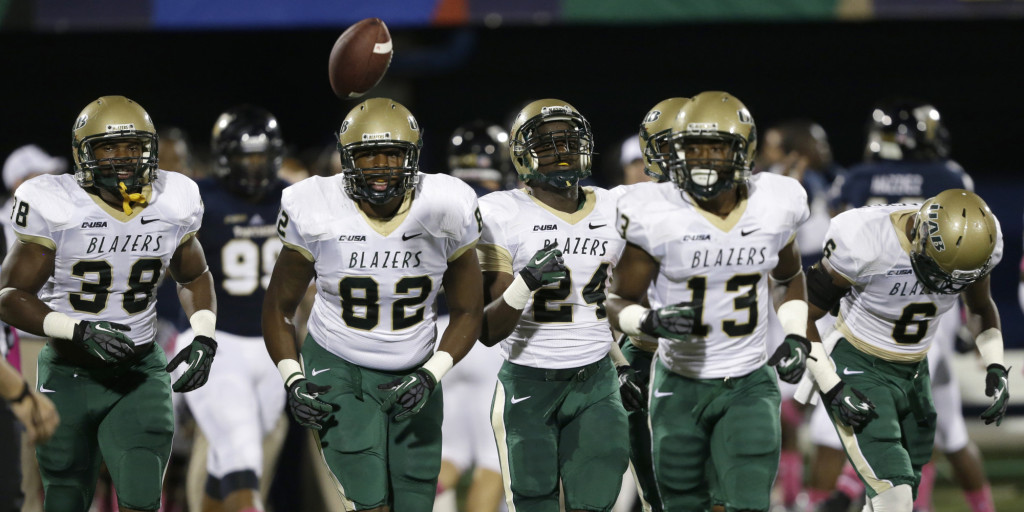
UAB President Ray Watts said Monday he is bringing the football program back as early as 2016, reversing a decision to shut it down because it was too expensive. Watts cited renewed financial commitment from supporters, students and the city as reasons for the change of heart. He said donors have pledged to make up the projected $17.2 million deficit over the next five years if football is restored,. Watts told The Associated Press he decided on Monday morning to reverse the earlier decision after meetings with UAB supporters continued through the weekend. “The biggest single difference is that we now have tangible commitment for additional support that we never had before,” Watts said at a news conference. In addition to reinstating football, Watts said Monday that he was also bringing back bowling and rifle. The study commissioned by the university was based on the programs being brought back in 2016. However, new athletic director Mark Ingram stopped short of guaranteeing 2016, saying only that the goal is to bring football back as soon as possible. Watts cut the programs last December after UAB commissioned a report saying it would cost $49 million over five years to field a competitive football program, generating both a groundswell of criticism for the decision and a rallying of financial support for the Blazers program. The president said UAB has dropped an indoor practice facility from the equation since the initial report, and has raised about 10 percent of the estimated $12.5 million to $14.5 million needed for a turf practice field and new fieldhouse. The December decision left players looking for teams and stirred fans, student and faculty groups to issue no-confidence votes against Watts. “This was a very difficult decision,” he said. “It broke our hearts to make that decision, and we are sorry for any consequences of that. But we are excited today that our community and supporters have come together. Had we not made that decision, which was based on sound information, that we wouldn’t be where we are today. We have never seen this level of support. It has been a painful process at times but it has been a process that has brought us to a new day.” UAB commissioned College Sports Solutions to review the initial report by CarrSports Consulting. The numbers were similar minus the indoor facility. Watts also said UAB’s cost of attendance could be about half the initial projected $5,000 per athlete, based on other Conference USA schools. The first season’s College Football Playoff payout also was higher than UAB had projected. Watts said that the initial projections “showed there was no way for us to cover that unless we took away from education and research and health care.” Watts said UAB sent documents to C-USA and NCAA notifying them of his decision, but he makes it clear UAB plans to remain in the league and play at the FBS level. Without football, UAB would have likely not have remained in C-USA, which has a bylaw requiring members to field football programs. C-USA Commissioner Britton Banowsky said members had not wanted to change the rule because “football is something that is critical to our long-term success and part of our core as a conference.” “It didn’t really come as a great surprise, but we’re very pleased with the decision to bring back football,” Banowsky told The AP. “As a conference, we’re committed to football so we welcome the good news that UAB football has been given another chance.” UAB will cap its subsidizing of athletics to $14.49 million for each of the next five years, about $200,000 less than the university paid in 2014. The City of Birmingham and UAB’s National Alumni Society have each pledged contributions to athletics while student government leaders will raise student fees. Those total $5.3 million with the balance of money coming from private donors. One thing that’s not on the table: UAB building an on-campus stadium to replace aging Legion Field. Watts said that’s up to the city and community to fund. “We will be happy to play in any new, modern facility that the city might choose to build,” he said. “We leave the specific type of facility and the exact location up to the mayor and city leaders and community leaders.” Now comes a huge rebuilding process on the field. Many of the players have moved onto other programs, leaving Clark and his staff to find recruits for 2016. Ingram said bringing football back “will bring a lot of renewed excitement around this program, that’s from top to bottom.” Clark issued a statement saying it was a relief that UAB football was being resurrected. “This is a critical first step toward UAB football’s new path,” Clark said. “It takes tremendous commitment and support to run a successful football program. We have a lot of work to do but we start anew today!” Republished with permission of The Associated Press.
