
Vision 2020: Will mailed-in ballots be delivered on time?
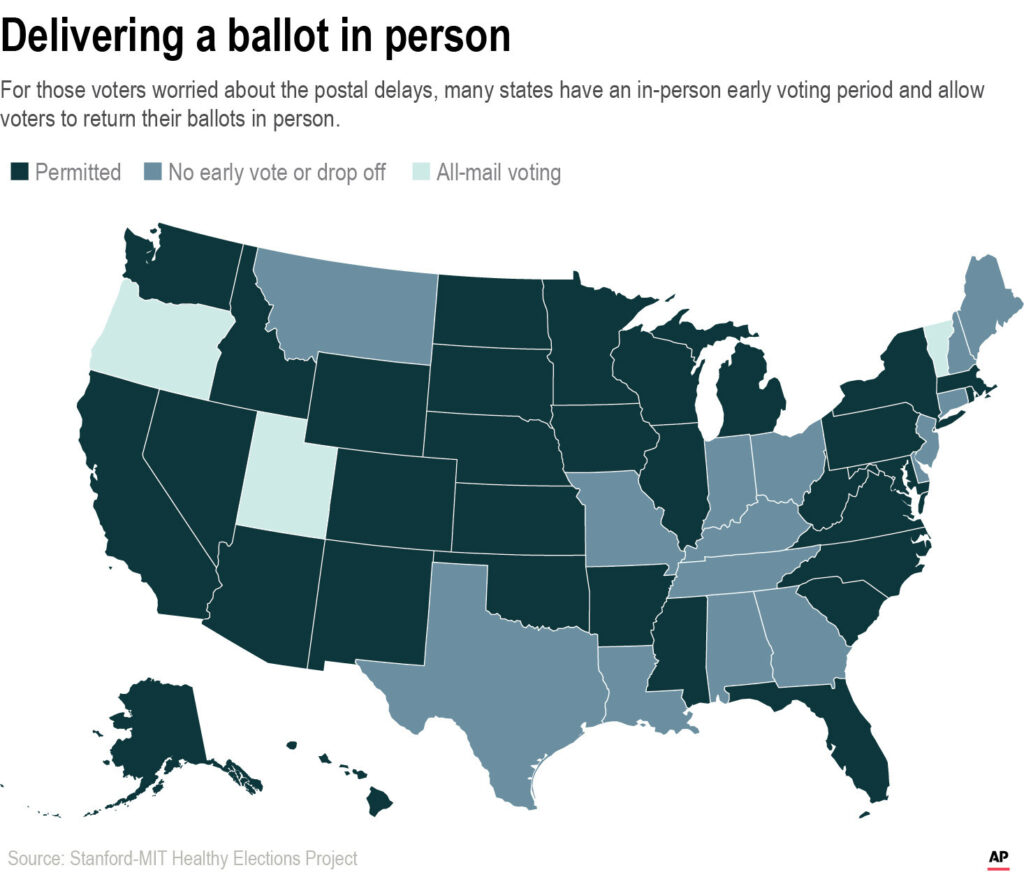
Can you trust the U.S. Postal Service to deliver your ballot on time? If you plan on voting by mail, election officials say it’s best to do it as early as possible so your ballot gets to its destination well before Election Day, which is Nov. 3. Postal officials have repeatedly said the agency has more than enough capacity to handle the surge of ballots this fall, and its leaders have committed to prioritizing election mail. But on-time delivery rates vary widely depending on where you live, and the service has been falling short of its internal goals to deliver all first-class mail within five days. On top of that, each state has different rules on whether it accepts mail ballots that arrive after Election Day. Some policies are the subject of court cases and could change before Nov. 3, so voters should check with their local election officials if they’re unsure. All that is to say, the earlier you mail your ballot, the better. It has been a tumultuous few months for the Postal Service. This summer, the agency’s new leader, Louis DeJoy, a major donor to the GOP and President Donald Trump, set in motion a series of controversial policy changes that have delayed deliveries nationwide. Then, not too long after DeJoy took over, Trump openly admitted he was starving the Postal Service of coronavirus relief money to make it harder for the agency to process ballots. The combination of Trump’s remarks and DeJoy’s policies have led to a lot of distrust in the agency and fears about political manipulation. The Postal Service has been sued several times in multiple states over the policy changes and has been handed a series of bruising court decisions blocking them. One judge in Washington state called them “a politically motivated attack on the efficiency of the Postal Service” before the election. The Postal Service agreed Wednesday to reverse changes that had slowed mail service nationwide, settling a lawsuit filed by Montana Gov. Steve Bullock. The changes had included reduced retail hours, removal of collection boxes and mail sorting machines, closure or consolidation of mail processing facilities, restriction of late or extra trips for timely mail delivery, and banning or restricting overtime. The agreement also requires the Postal Service to prioritize election mail. So, if you’re worried about voting by mail, what should you do? Consider early voting options in your state, check if your area has ballot drop boxes, or go to the polls on Election Day. Otherwise, return your ballot early and don’t wait until the last few days. Republished with the permission of the Associated Press.
USPS unveils new stamp in honor of Alabama’s 200th birthday

The United States Postal Service (USPS) on Saturday commemorated Alabama’s bicentennial and entry as the 22nd state in the union with the unveiling of the Alabama Statehood Forever stamp during the Alabama200 ceremony at the EarlyWorks Children’s Museum in Huntsville, Ala. “Since becoming America’s 22nd state on Dec. 14, 1819, Alabama has built a rich history grounded in the diversity, tradition and hard work of its people, and the natural beauty and wonderment of its land,” said USPS Acting Chief Human Resources Officer Isaac Cronkhite, who officially dedicated the stamp. “Alabama has been pivotal in the growth of our nation to constantly strive to be a more perfect union.” Joining Cronkhite to unveil the stamp were State Sen. Arthur Orr, Alabama Senate President Pro Tem Del Marsh, Speaker of the House Mac McCutcheon, County Commission Chairman Dale Strong, Constitution Hall Executive Director Bart Williams, Madison Mayor Paul Finley and Huntsville Mayor Tommy Battle. The stamp The Alabama Statehood Forever stamp features an existing photograph taken at sunset in Cheaha State Park. Alabama photographer Joe Miller shot the picture from the park’s Pulpit Rock Trail, and Pulpit Rock is visible in the foreground. Greg Breeding designed the stamp with Art Director William Gicker. According to the USPS, customers may purchase the Alabama Statehood Forever stamp at The Postal Store at usps.com/shop, by calling 800-STAMP24 (800-782-6724), by mail through USA Philatelic, or at Post Office locations nationwide. Forever stamps will always be equal in value to the current First-Class Mail 1-ounce price.
Ross Marchand: Amidst abysmal finances, postal reform is a must
The United States Postal Service (USPS) continues to bear the consequences of poor financial management to the detriment of taxpayers and consumers across the country. The agency reported yet another financial loss this week, bringing total net losses for the year to $3.9 billion, an increase of $1.2 billion compared to last year. To outside observers of this fiscal malaise, better choices at every step of the way could have averted subsidization via low-interest Treasury loans. By adapting stronger efficiency guidelines and making a greater effort to reign in crony deals, the USPS can finally tackle its mammoth debts. Despite the misleading pronouncements of senior USPS officials, taxpayers would save billions of dollars per year from a better-fun fiscal ship. To listen to the claims of USPS top brass, the agency is doing everything it can to “put information and technology at the center of its business strategies” in delivering mail to hundreds of millions of Americans. Unfortunately, successive reports by the Office of the Inspector General (IG) shed considerable doubt on this hype. The USPS, for instance, is supposed to use a modeling tool to sort out job assignments based on mail processing volume, but regular deviations result in increased overtime and lower employee productivity. The IG estimates that a more thorough use of its own modeling tools would save the USPS $420 million in labor costs alone. But assigning employees requires a thorough, well-documented hiring process in the first place. On this basic function, the USPS again comes up short. In the IG’s analysis of non-career employee background screening in the Los Angeles District, the IG found that HR officials were not doing their due diligence. Of the 33 hired applicants analyzed in the report, 11 had “automatic disqualifying driving eligibility factors” and 7 had “disqualifying criminal suitability factors.” Maybe bad employees slip through the cracks, but at least performance evaluation reviews can be used to hold them accountable. Too bad, then, that “13 of 13 (100 percent) 90-day performance evaluation reviews were not maintained in the electronic official personnel file, as required.” This permissive culture and poor documentation lead to further poor behavior, contributing to the USPS’s mammoth financial problems. Too often contractors fail to satisfactorily perform a service requested by the USPS due to avoidable mistakes on the part of the contractor. These “chargeable irregularities” should result in the USPS getting refunds from contractors. But, due to the lack of necessary paperwork and complete reviews, the USPS squanders tens of millions of dollars nationwide to lost contracts. For the Chicago Network Distribution Center alone, the USPS’s IG estimates that $7 million is at risk for a mere 11 contracts renewed during the 2016 and 2017 fiscal years. And, then, of course, there are the increased distribution and delivery costs that come with the USPS’s arrangement with Amazon. As the result of 2013 deal inked with the multi-billion dollar company, Amazon gets to use USPS to deliver packages at a far lower rate than the usual Priority Mail Express prices companies would have to use for Sunday delivery. In the five years since the approval of the deal, Sunday-related parcel delivery costs have quickly risen. Since Sunday operations are dictated by a special carveout, the result is hardly an efficient operation. The OIG finds that, in the San Francisco District, “the increased use of higher cost full-time city carriers and scheduling uncertainty” has resulted in more than $2 million in additional quarterly operating costs. Additionally, parcel volume uncertainty leads to overstaffing with employees paid at the overtime rate. While the USPS will charge somewhat higher fees on Amazon starting in 2019, its unlikely that the privilege of lower Sunday prices will go away. USPS should reexamine this, and other deals with major companies, while committing to efficiency and spending priority reforms. Making greater use of a national, comprehensive F1 Scheduler system and keeping greater tabs on questionable contracts could save the USPS billions of dollars per year and restore the promise of one of America’s more popular government institutions. ••• Ross Marchand is the director of policy for the Taxpayers Protection Alliance.
The costly secrets the rallying postal unions don’t want you to know
Monday postal service workers in Birmingham and in four other cities in Alabama joined others in cities all across the nation to protest privatizing the U.S. Postal Service (USPS). The rallies were coordinated through the American Postal Workers Union (APWU), a branch of the AFL-CIO. This idea of privatization is not new, nor is the debts and woes of the postal service. President George W. Bush set up a commission which issued a report in July 2003 that essentially said the future looked quite bleak and without major changes (most of which haven’t happened) it was unsustainable in a digital world. Here’s the issue: the union workers will tout their revenue which in 2017 was $69 7 billion but what they won’t tell you is that the total expenses were $72 4 billion, resulting in a net loss of $2.7 billion. Yes, that’s $2.7 billion with a B. The fact is that the USPS has run deficits for the last eleven years. Think things might just turn around? Well think again, a report by the Federal News Network points out that the USPS “posted a $1.3 billion loss in the second quarter of fiscal 2018 — more than double the loss from the same period last year.” According to the same story, “USPS has more than $100 billion in unfunded liabilities, and owes another $15 billion to the Treasury Department’s Federal Financing Bank.” While currently the USPS does not take taxpayer funding (at the moment) their retirement debt alone is not sustainable given the continued losses that they face. For every dollar that will eventually have to be subsidize could go to something else: education, health care, I don’t know, how about the novel idea of just letting taxpayers have more of their own money to keep rather than subsidizing failed programs. From a 2017 Government Accountability Office report: Large unfunded liabilities for postal retiree health and pension benefits— which were $73.4 billion at the end of fiscal year 2016—may ultimately place taxpayers, USPS employees, retirees and their beneficiaries, and USPS itself at risk. As we have previously reported, funded benefits protect the future viability of an enterprise such as USPS by not saddling it with bills after employees have retired.22 Further, since USPS retirees participate in the same health and pension benefit programs as other federal retirees, if USPS ultimately does not adequately fund these benefits and if Congress wants these benefits to be maintained at current levels, funding from the U.S. Treasury, and hence the taxpayer, would be needed to continue the benefit levels. According to USPS’s testimony last year, “absent fundamental legislative reform, we face the prospect of having to continue to default on these prefunding payments [for retiree health benefits] in order to continue paying our employees and suppliers and to provide postal services to the American public. This increases the risk that taxpayers may ultimately be called on to fund these benefits.”23Alternatively, unfunded benefits could lead to pressure for reductions in benefits or in pay. Thus, the timely funding of benefits protects USPS employees, retirees and their beneficiaries, taxpayers, and the USPS enterprise. Where we have private mail delivery services like Fed-Ex and UPS that both cost taxpayers nothing the USPS is a federal program that in its current form and size time may have passed. It is past time for the government to get out of the business of losing money by running a failed business experiment — the private sector has proven it can do the same thing much more successfully. It’s time for people to look for and understand there are opportunities to save taxpayers money, and to reinvest more wisely where we do spend our dollars. This is one of them. Here’s a summary of the US Postal Service costs:
Postal Service: More financial loss as mail delivery slumps
The U.S. Postal Service is reporting another quarterly loss. That’s because strong gains in package deliveries were outweighed by an unrelenting decline in mail volume and the costs of its health care and pension obligations. The financial report released Friday comes amid sharp criticism from President Donald Trump, who says the Postal Service is being scammed out of billions by Amazon and other online retailers. The Postal Service is seeking greater freedom to raise stamp prices to help cover costs. It warns of a weak financial situation that demands attention to allow for much-needed investments in package delivery in the e-commerce age. The Postal Service report shows a net loss of $1.3 billion between January and March, larger than a $562 million loss in the same period last year. Republished with permission from the Associated Press.
House passes Terri Sewell’s bill to rename Selma post office after civil rights legend Amelia Boynton Robinson
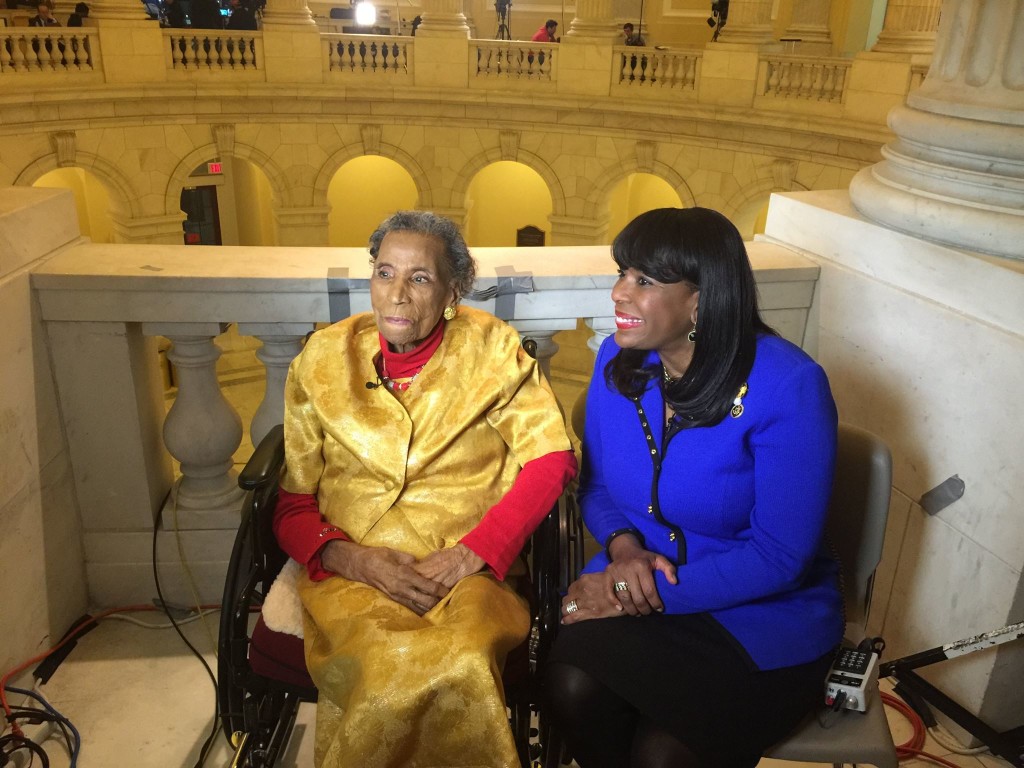
The U.S. House of Representatives passed legislation Tuesday to officially name a Selma USPS post office after the late civil rights legend Amelia Boynton Robinson. H.R. 4777, a bill authored by Alabama 7th District U.S. Rep. Terri Sewell, next goes to the Senate for approval. A time frame for passage there is uncertain. The bill would designate the post office at 1301 Alabama Avenue in Selma as the “Amelia Boynton Robinson Post Office Building.” Boynton Robinson was a voting rights pioneer and a leader in the American Voting Rights Movement in Selma. She was among those beaten during the voting rights march across Selma’s Edmund Pettus bridge in March 1965 — a day that became known as “Bloody Sunday.” In 1990 she was awarded the Martin Luther King Jr. Medal of Freedom. Boynton Robinson died Aug. 26, 2015, at 104 years old. “I was delighted that the House of Representatives passed my legislation to name the Selma Post Office after Voting Rights Activist Amelia Boynton Robinson,” said the bill’s sponsor Rep. Sewell. “Mrs. Boynton Robinson was known as the matriarch of the voting rights movement. Her life and legacy epitomized strength, resilience, perseverance and courage — the same characteristics that embody the City of Selma where she made such a significant impact.” Sewell continued, “A trailblazer, Amelia Boynton Robinson also made history in 1964 as the first black woman to run for Congress from the State of Alabama. I know the journey I now take as Alabama’s first black congresswoman was only made possible because of her courage, tenacity and faith. As a daughter of Selma, I am honored to sponsor this legislation, and I can think of no more deserving person to name the Selma post office after than Amelia Boynton Robinson. She truly represents the heart, spirit and essence of Selma.” Mayor George Evans of Selma was also pleased to see the bill pass the House, stating, “I am delighted that Congresswoman Sewell’s bill passed with such overwhelming support. Amelia Boynton Robinson put herself and her family’s lives at risk and this is a long overdue honor and I am in support of naming the post office after her.”
