
Thousands party in streets after Alabama win, despite virus
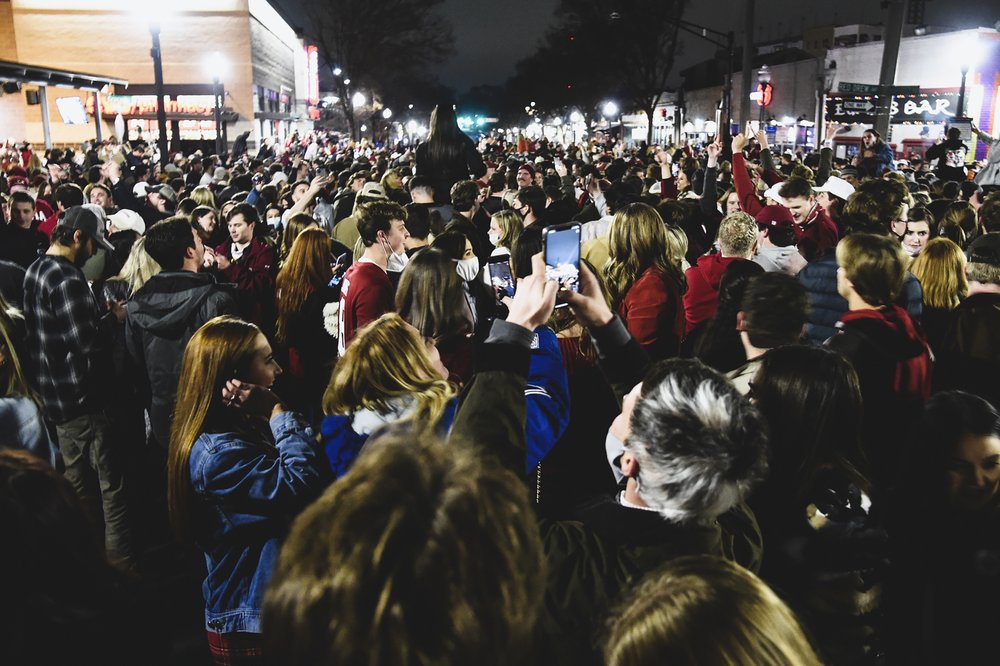
Thousands of University of Alabama football fans partied in the street near campus after the Crimson Tide defeated Ohio State 52-24 for the national championship, ignoring pleas for safety at the height of the coronavirus pandemic in a celebration a top health official said Tuesday could worsen disease. Students and others poured out of jampacked bars near campus as time expired in Miami late Monday, traffic cameras and images posted on social media show, gathering on University Boulevard in an area called “The Strip.” Many of the fans screaming and cheering as they pressed against each other in the street didn’t wear face masks. Dr. Scott Harris, the head of the Alabama Department of Public Health, said he expected more cases of COVID-19 to result from the street party. “It’s disappointing to see people not paying attention to the guidance that we try to give to keep them safe. I was excited as anybody and wanted to celebrate also, but right now is not a time to be out in large groups of people close together when you are not masked,” he said. Fourteen people were arrested on charges including public intoxication, disorderly conduct and resisting arrest, officials said at a news conference where Mayor Walt Maddox said the crowd was “larger than any celebration that we’ve seen in recent memory.” In an open letter released through social media, the United Campus Workers of Alabama, a labor group for university employees, said the gathering could become a “super-spreader event” and asked for hazardous-duty pay for workers in close contact with students; evidence of virus testing; and a two-week suspension of in-person classes. The university is requiring virus screening for all students returning for the semester who plan to live on campus, with testing planned through next week at the basketball arena. Students and workers also are required to complete online training about reducing the risk of spreading the illness. A university statement released Tuesday afternoon said its officials had worked to minimize risk before, during, and after the championship game, including “issuing warnings and admonitions about the need for masks, social distancing, and responsible behavior.” “As a result of recent events, we are allowing faculty to be flexible for the next two weeks with the option to temporarily hold classes remotely,” the statement added. “Students have the option to attend in-person activities remotely as well.” It added that while classroom transmission “is almost nonexistent, we understand the concerns caused by recent events” and said all health and safety rules continue in effect. More than 5,500 people have died in Alabama from the illness caused by the coronavirus, and about 408,000 have tested positive. About 20,000 people have tested positive in Tuscaloosa County, making it one of the worst in the state for the virus in overall numbers, and about 175 COVID-19 patients are being treated by DCH Regional Medical Center in the city. The postgame scene was exactly what officials feared as they urged people to watch at home and celebrate privately. “Cheer, celebrate, and enjoy the success of our team, but please do so responsibly and safely. Roll Tide!” Police Chief Brent Blankley said in a statement beforehand. Police cars and officers are visible at the fringes of the throng in some images. People lined up to get into the bars an hour before kickoff despite the warnings, The Tuscaloosa News reported. “All bars are open and we’re ready to roll over Ohio State,” said a tweet by Gallettes, a popular student bar, long before the game began. Republished with the permission of the Associated Press.
University of Alabama denies report it is under investigation for ties to Wuhan COVID lab
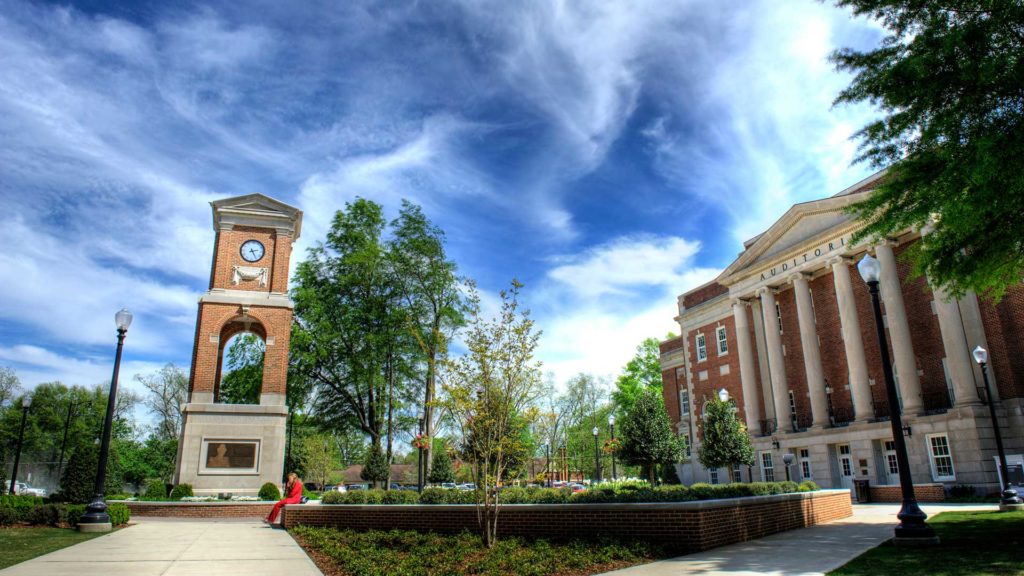
The University of Alabama is denying that it is under federal investigation for possible ties to the Wuhan Institute of Virology (WIV). Annie Mapp from ABC3340 reported on Twitter, “The University of Alabama is under investigation by the federal government for improper ties to China.” #NEW: The University of Alabama is under investigation by the federal government for improper ties to China. More information at the provided link.https://t.co/XH2vTUDjw3 — Annie Mapp (@AnnieMapp_) December 23, 2020 WIV, which is owned by the Chinese government’s Academy of Sciences, includes a maximum biocontainment laboratory that may be closely linked to the origin and/or spread of the Chinese COVID-19 virus. UA President Stuart Bell received the investigation notice from the federal government, asking for “a full report of statutorily defined gifts, contracts, and/or restricted and conditional gifts or contracts from or with a foreign source to the U.S. Department of Education (Department).” The letter stated, “It appears that UA has failed to report an alleged partnership with the Wuhan Institute of Virology (“WIV”), in Wuhan, China.” The university is listed on the Wuhan Institute of Virology website as a “partner”. The University responded to Mapp. She posted a Twitter update stating, “#UPDATE: The University of Alabama sent me the following statement.” #UPDATE: The University of Alabama sent me the following statement @abc3340 pic.twitter.com/pPnLHJznxJ — Annie Mapp (@AnnieMapp_) December 23, 2020 The school is denying any connections to the WIV, and stated that they contacted the institute and asked that UA be removed from their website. The school never received a response to that request.
Ted Cruz Alabama Crimson Tide football tweet stirs fans, critics
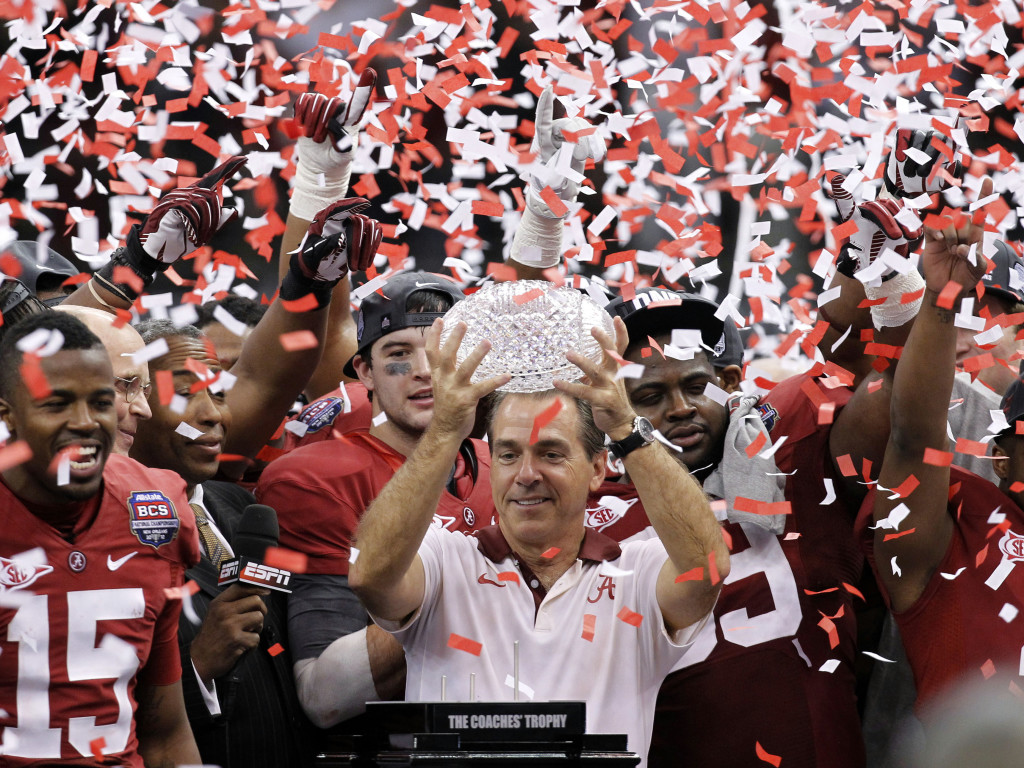
Texas U.S. Sen. Ted Cruz took to Twitter Wednesday night mocking the Ivy League with an Alabama Crimson Tide football team joke. On Wednesday, the New York Post tweeted an article titled, “The Ivy League is cancelling all fall sports, including football” due to the COVID-19 pandemic. To which Cruz tweeted, “Finally, Alabama has a chance,” in response as if a top team, like the Crimson Tide, would even be affected by the Ivy League losing their season. Finally, Alabama has a chance. https://t.co/rZ5f7e8V14 — Ted Cruz (@tedcruz) July 9, 2020 Ivy League schools, among the top academic institutions in the country, no longer participate in the NCAA Division I Football Bowl Subdivision (FBS). Their teams are never ranked in the top-25, nor do they go to bowl games, leaving some fans to questions the intent of his tweet — was he mocking the Ivy League or knocking the Crimson Tide. Did the Ivy League schools have a football team? — MacSloppy (@kdmc0932) July 9, 2020 A Texas senator with an Alabama football shoutout. I’m sure longhorn fans are hurt. #RollTide — LeeTown (@LeeTown8) July 9, 2020 They hate us cause they ain’t us! Roll Tide! Roll! — Peas ‘n Cheezus 😎🇺🇸 (@treefish827) July 9, 2020 Looks like there will be about 200 fans looking for something else to do on Saturday. — Rick Vasquez (@Rick5591Vasquez) July 9, 2020 A Texas senator with an Alabama football shoutout. I’m sure longhorn fans are hurt. #RollTide — LeeTown (@LeeTown8) July 9, 2020 Damn. Alabama burn. pic.twitter.com/johAEZ2JI9 — AJM (@Amalgham) July 9, 2020 Ummm Bama has how many national championships — jesse o’malley (@dragonram7924) July 9, 2020 Cruz is no stranger to the Ivy League or Alabama. He graduated cum laude from Princeton University in 1992 with a Bachelor of Arts in public policy, and the former presidential hopeful made several stops across the Yellowhammer State during his presidential run in 2016.
University of Alabama: Move Confederate plaques, study building names
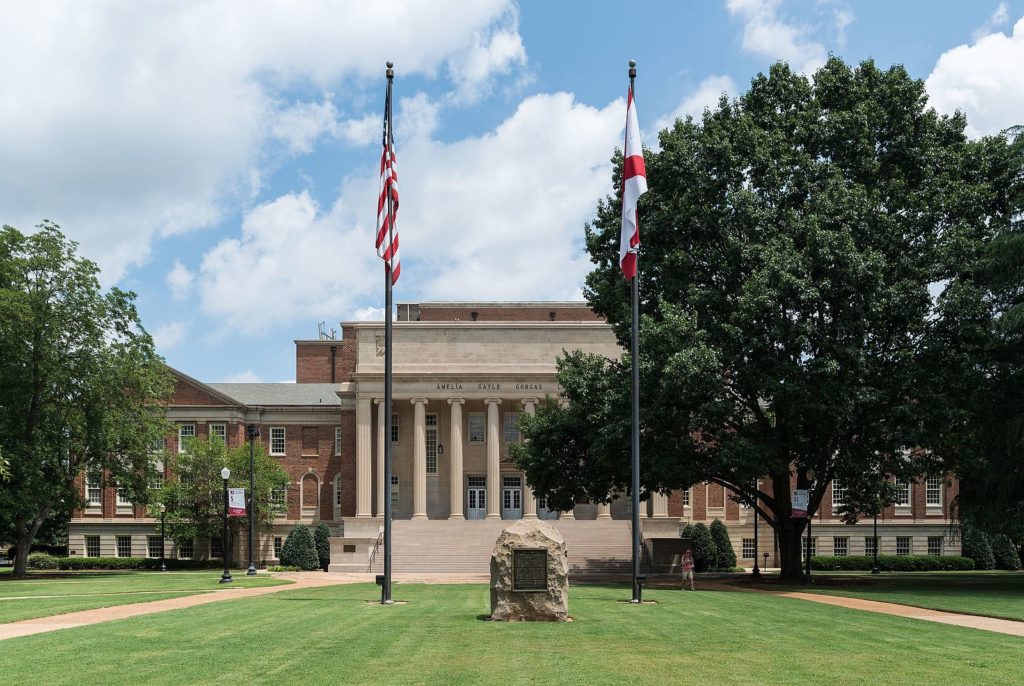
Some of the school’s Board of Trustees also have been appointed to study the names of buildings on all University of Alabama System campuses and report to the board on any recommended changes.
Alabama local/state Coronavirus updates (March 12)

This is our third in a series of collective Coronavirus (COVID-19) updates from around the state. You can find the first here and the second here. This update includes statements from Secretary of State John Merrill, the state senate, and from Auburn University and Samford We will update this post throughout the day as more notices become available. For up to the minute and detailed information from the Alabama Department of Public Health please visit their resource center here. For information from the Center for Disease Control that includes mitigation strategies visit their website here. Download full CDC Mitigation Strategy pdf here. Download CDC at home care guidance for those who have coronavirus but do not require hospitalization here. As of 2:40pm central there are still no confirmed cased of coronavirus in Alabama. However, the big caveat to this is also that there has been limited testing. State Senate: On Thursday the Alabama Senate approved a $5 million supplemental appropriation to the budget to combat the spread of COVID-19, commonly referred to as Coronavirus, in Alabama. These funds will help supplement the Federal funding which totals $8.1 million to this date. The money is for health care professionals to use as they see fit to stop the spread of the disease in Alabama including helping set up local centers for testing, covering expenses related to telehealth and covering the costs for the uninsured for testing and treatment. Currently there have been no positive tests for Coronavirus in Alabama, however after meeting with professionals in the healthcare industry and public health officials, legislative leadership determined it was important to be proactive and work to get the situation under control should any tests in Alabama come back positive for the disease. Both Senate President Pro Tempore Del Marsh (R-Anniston) and Senate Majority Leader Greg Reed (R-Jasper) emphasized that if someone is not feeling well, they should contact their physician to administer next steps and determine if further testing is necessary. “I want to thank Governor Ivey and her team for taking this issue head on. One of the biggest problems we have seen from this disease is simply a lack of preparation,” Marsh said. “It is important for everybody to know that Alabama has a solid plan to combat Coronavirus. I cannot stress enough that if someone feels as though they need to be tested for Coronavirus they should contact their doctor to work through the next steps.” “Over the past several days legislative leadership has held a series of meetings with the Governor and her Coronavirus Task Force, as well as with health care professionals who are on the front lines of combating this pandemic,” Reed said. “It is important to know that we have test kits and tests are being administered and we have excellent health care professionals who are prepared to act. One important thing to note is that we are setting up the ability to contact doctors with telehealth so that next steps can be decided over the phone or video chat to limit the potential of exposure to this illness,” Reed said. “In response to the pandemic that has been going around the nation and the world, this supplementary spending bill is a way for the State of Alabama to be proactive and show our citizens that we are serious about fighting the spread of the coronavirus,” said Alabama Senate Minority Leader Bobby Singleton (D-Greensboro). “Although we have not had a positive test in the state, we understand that this highly contagious virus could be potentially deadly for those with compromised immune systems. Therefore, we are moving forward in setting up crisis centers to protect our citizens.” Auburn University statement: Auburn University will transition from on-campus instruction to remote delivery beginning Monday, March 16 and continue through April 10 in response to concerns about the spread of the coronavirus (COVID-19). University officials ask that students refrain from returning to campus after spring break. University officials will subsequently determine if students will return to campus for the remaining weeks of the spring semester. Auburn faculty will contact students on steps they should take to continue their academic coursework. The university will continue normal operations, although departments and units should utilize remote work and “social distancing” as appropriate. “The Auburn Family faces many unknowns about this virus,” said Auburn University President Jay Gogue. “We are taking these unprecedented steps based on our utmost concern for the health and well-being of Auburn students, faculty and staff. In the meantime, we continue working with public health and emergency preparedness officials to make decisions in the best interest of the campus community and to help stop the spread of COVID-19.” Other university actions: All university events, including sporting events, are canceled through April 10, ensuring appropriate “social distancing” and helping prevent the potential spread of the virus. All university domestic and international travel is suspended through April 10. Dining facilities, libraries and residence halls will be closed through April 10. University officials will make arrangements for international students and others who are unable to return home. Students who have specific questions should contact the Division of Student Affairs. Decisions have not yet been made on spring commencement, summer study abroad programs or other events and activities beyond April 10. The university medical clinic remains open. Those exhibiting COVID-19 symptoms should immediately call the Auburn Medical Clinic at 334-844-9825 before visiting the clinic. University officials will make arrangements for students who do not have access to the technology needed for remote instruction. Students who live on campus and believe it necessary to return to campus to collect personal items should first contact the Office of University Housing at housing@auburn.edu. John Merrill, Secretary of State: Our plan for changes in the elections process, if necessary, will be revealed at the appropriate time. Our intentions are to ensure a safe and secure election and provide accountable results in a manner that is transparent to the people of our state. We will continue to do so as we
Man: Slashing ‘Baby Donald Trump’ was matter of good versus evil

An Alabama man charged with criminal mischief in the slashing of a towering “Baby Trump” balloon has defended his actions, saying it was a matter of good versus evil. Al.com reports Hoyt Deau Hutchinson called the syndicated radio show “Rick & Bubba Show” on Monday to describe what happened. Hutchinson said he was shaking in anger when he drove past the balloon and its handlers Saturday during President Donald Trump’s visit to see Louisiana State play against the University of Alabama. He yelled at the protesters, but then realized they might have seen him, so he bought a University of Alabama shirt to better blend into the crowd and get close to the balloon, he said. Pretending he wanted a picture with the balloon, Hutchinson said he used a material cutter with a sharp razor to slice the symbol open. The orange, diaper-clad caricature of the president is often floated at Trump appearances to protest and mock the president, which the balloon shows clutching a cellphone. The balloon measures over 20 feet (6.1 meters) tall and was left with an 8-foot-long (2.4-meter-long) gash in its backside. “I get so mad about people not taking a stand,” he said. “The left wants to use religion against you like you shouldn’t act like this and stuff but I’ll tell you this — the Devil knows the Bible as good as we do.” Asked if the slashing was Hutchinson’s attempt to echo the Biblical story of Jesus turning over the temple tables of money changers, he said yes. “It comes a point when you gotta take a stand. We don’t have two parties anymore. We have good versus evil. When you got one party that says it’s OK to kill babies and by the way, this is the first time I’m ever seen a liberal get mad about chopping up a baby.” He said he yelled “Trump 2020” as he was being arrested. He later posted bail and was released. When asked about his motivations, the 32-year-old Hutchinson told the radio station he keeps up with politics by watching Fox News and his two favorite anchors, Tucker Carlson and Sean Hannity. “I’m not young but I’m not old. I’m sort of middle aged. I feel like a lot of people my age don’t keep up with the news and politics the way they should,” he said. Information from: The Birmingham News, https://www.al.com/birminghamnews. Republished with the permission of the Associated Press.
Hugh Culverhouse donates $250,000 to planned parenthood clinic
Planned Parenthood has received a $250,000 donation for its new Birmingham clinic from a critic of Alabama’s attempt to ban abortion. Planned Parenthood Southeast said Thursday that Hugh Culverhouse donated the large sum to support the relocation of its Birmingham location. Planned Parenthood is building a 10,000-square foot (929-square-meter) health clinic. Culverhouse said he has long supported Planned Parenthood and opposes a new Alabama law that seeks to ban abortion. Culverhouse recently ended a feud with the University of Alabama. Culverhouse had once called for a boycott over the abortion ban, but the university indicated their relationship had soured for other reasons. In a joint statement, the university and Culverhouse has said they had different views on the law school’s future. The university returned a $21.5 million donation from Culverhouse. Republished with the permission of the Associated Press.
J. Pepper Bryars: Alabama moves to protect free speech on campus
Free speech zones, meant to move certain discussions away from where they could offend listeners, or be heard at all. Speech codes, meant to limit acceptable topics to an ever-shrinking list of progressive-leaning beliefs. And heckler’s vetoes, meant to give the power of censorship to a loud minority. These tactics and others are part of a trend on college campuses that is chilling the free speech rights of faculty, students and visiting speakers who dare mention controversial or unorthodox ideas. Thankfully, lawmakers in Alabama have an opportunity to ensure the trend doesn’t take hold here by passing what is being called “one of the most comprehensive and effective campus free-speech laws in the country.” State Rep. Matt Fridy, Republican -Montevallo, has introduced House Bill 498 that would require the state’s public colleges and universities to adopt policies and procedures to protect free speech on campus. The bill was recently approved in committee and now awaits further action. “Freedom of expression is critically important during the education experience of students, and each public institution of higher education should ensure free, robust, and uninhibited debate and deliberation by students,” the bill states. It goes on to declare that it is not the proper role of these schools to “shield individuals from speech that is protected by the First Amendment to the United States Constitution, including ideas and opinions the individuals may find unwelcome, disagreeable, or offensive.” But is campus free speech really a problem in Alabama? Yes, at least according to one expert who has helped draft similar campus free speech laws in other states. “Although it’s sometimes argued that the campus free speech crisis only affects deep-dyed blue states like California and Massachusetts, the problem is national,” wrote Stanley Kurtz, a senior fellow at the Ethics and Public Policy Center. Kurtz noted how Alabama A&M near Huntsville recently made it on the “10 Worst Colleges for Free Speech” list maintained by the individual-rights advocacy group FIRE for having the most “red light” rated policies that, in their view, restrict free speech. The Washington Examiner published an article last year accusing the University of West Alabama in Livingston of having a “free speech zone” by limiting any demonstrations to a spot near its student union building. And at the University of South Alabama in Mobile, a pro-life student club founded by Katherine Sweet was told in 2013 that they had to set up their display on an arguably low-traffic portion of the campus that’s designated for free speech. “I went to South thinking it would be a place where I could debate freely with other students, engage in discourse, and ultimately learn from not only our professors, but each other,” Sweet wrote in an AL.com guest opinion article. “Aren’t universities supposed to be atmospheres that promote just that?” Yes, and Fridy’s bill seeks to ensure they do through various measures, including: • Ensuring that faculty and students are free to take political positions, to express themselves in outdoor areas of the campus, and to assemble, speak and pass out literature,• Prohibiting the establishment of any “free speech zones,”• Keeping the campus open to anyone invited by student groups to speak,• Forbidding the imposition of excessive security fees that discourage some speakers,• And potentially suspending those who disrupt the free speech of others.Voltaire’s beliefs in freedom of expression were once famously summarized with the phrase, “I disapprove of what you say, but I will defend to the death your right to say it.” But unless our lawmakers act now, what you may hear on your local college campus could someday be, “I disapprove of what yousay, so I will restrict your right to say it.” J. Pepper Bryars is a senior fellow at the Alabama Policy Institute. Follow him on Twitter at @jpepperbryars.
University of Alabama team wins $1 million grant to develop tool to combat opioid epidemic
![[Photo Credit: canva.com]](https://altoday.com/wp-content/uploads/2018/10/Canva-Cure-Drug-Cold-Dose-The-Disease-Pharmacy-1024x683.jpg)
Across the country, opioid abuse has reached epidemic levels, severely affecting communities and straining public safety resources. The Institute of Business Analytics, or IBA, a research unit at the University of Alabama’s Culverhouse College of Business, has received an approximate $1 million grant from the Office of Justice Programs at the Justice Department to develop a data-driven tool to help officials better understand the scope of the opioid epidemic in Alabama and how to intelligently allocate resources. The University of Alabama team, which consists of principal investigators Drs. Matthew Hudnall, Jason Parton and Dwight Lewis, will develop the Unified Nexus for Leveraging Opioid Crime Knowledge, or UNLOCK, system that pulls in data from multiple sources and analyzes it using high-powered computing techniques to create reports that will assist field officers, law enforcement administrators, prosecutors, community affiliates, public health providers and researchers in their work combating the abuse of opioids in Alabama. “Critical data about the opioid epidemic comes from a multitude of sources including public health entities, law enforcement and municipalities,” said Hudnall, associate director of the IBA. “UNLOCK brings those data together to create intelligent, actionable recommendations that end users can deploy in their work fighting opioid abuse.” The data that UNLOCK will use includes summarized toxicology information, evidence test results, coroner death report information and other geo-referenced data. This award was made as the result of a highly competitive grant solicitation issued by Office of Justice Programs in the spring titled “Comprehensive Opioid Abuse Site-based Program” that resulted in 46 awards nationwide. “Many of us are very aware of the ways that the opioid crisis has negatively impacted communities and families across the state,” said Parton, director of IBA. “My team and I are excited about the promise of UNLOCK as a tool to counter the crisis.” This story originally appeared on the University of Alabama’s website. Republished with permission from the Alabama NewsCenter.
Kay Ivey wants to see Alabamians become safer drivers

Gov. Kay Ivey wants to see Alabamians become safer drivers. That’s why she’s awarded a $2.8 million grant to the University of Alabama and Auburn University, who are putting their gridiron rivalries aside to team up to help Alabamians become safer drivers. The two universities, along with the Alabama Department of Public Health (ADPH), are gathering traffic safety data and converting it into messages to encourage Alabama drivers to use seat belts and child restraint seats, do not drink and drive or drive while distracted and obey traffic safety laws. “Regardless of your allegiance, when two of our larger universities work collaboratively to save lives and prevent injuries on our highways, our entire state wins,” Ivey said. “I am very grateful for the efforts of these universities along with the Department of Public Health to bring greater awareness to traffic safety. My administration remains committed to keeping drivers safe on our roadways, and I am proud to offer my support to this project.” The University of Alabama’s Center for Advanced Public Safety provides data to determine where crashes are occurring and the causes. The information, much of it collected by ADPH, also examines factors such as seat belt use, distracted driving and sobriety. Law enforcement agencies use that information to increase patrols and monitor traffic in high-crash zones. Auburn University’s Media Production Group produces outreach and awareness campaigns geared toward safe driving. Many of those promotions are tied to national highway safety campaigns like “Click it or Ticket” seatbelt enforcement or “Drive Sober or Get Pulled Over” impairment crackdown and are conducted around major holidays, like Labor Day, when more people are likely to be travelling. The Alabama Department of Economic and Community Affairs (ADECA) is administering the grants from funds made available to the state by the National Highway Traffic Safety Administration. “These efforts along with increased law enforcement presence send a clear signal that dangerous drivers are not tolerated on Alabama’s roads,” ADECA Director Kenneth Boswell. “ADECA is pleased to join Gov. Ivey in supporting the efforts of these institutions to increase highway safety.” Gov. Ivey notified Cynthia Hope, UA director of sponsored programs, John M. Mason, AU vice president for Research and Economic Development and Dr. Scott Harris, state Health Officer, that the grants had been approved.
New $6M water research grant could protect lives, property of Alabamians
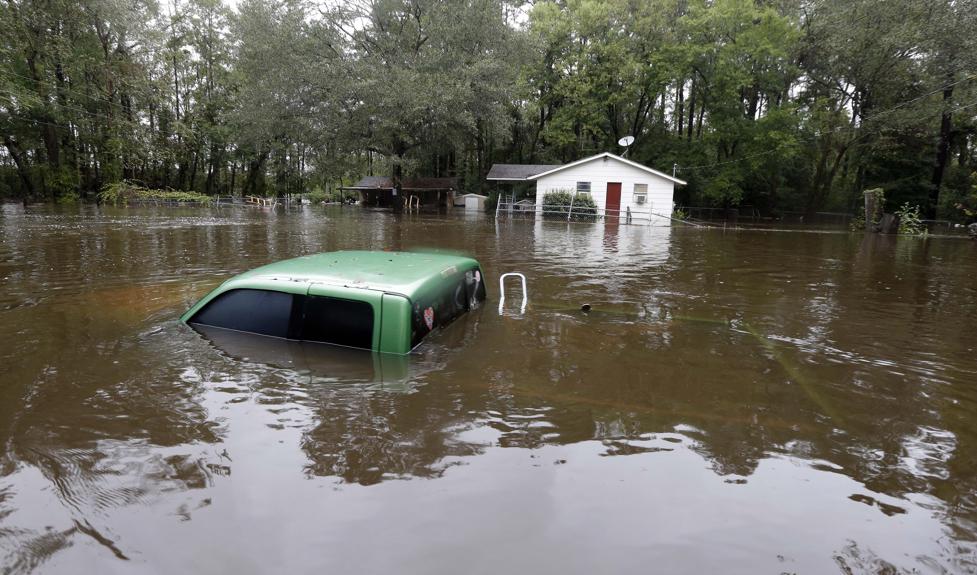
Alabamians lives and property may soon be better protected thanks to a new federal grant to help improve the nation’s water prediction capabilities and forecasts. Alabama U.S. Senator Richard Shelby on Tuesday announced that the National Oceanic and Atmospheric Administration (NOAA) has granted $6 million for water prediction research efforts at the University of Alabama (UA) in partnership with the University Corporation for Atmospheric Research (UCAR). “This is excellent news for the University of Alabama, our state, and the nation,” said Shelby. “The research made possible by this $6 million grant will drive scientific advances to help improve the nation’s water prediction capabilities and forecasts. I am proud to have helped secure this funding that will better protect the lives and property of all Americans.” This funding will support the efforts of UA, UCAR, and NOAA researchers to develop 21st century radar technologies aimed at improving measurements of snow and soil moisture. These improved observations will have the opportunity to advance the predictive and prognostic ability of future versions of the National Water Model, the nation’s first-ever continental-scale hydrologic prediction system operated at the National Water Center in Tuscaloosa, Ala. Scientists at the National Water Center will utilize the data produced by the radars to strengthen research and grow the nation’s water prediction capabilities. “This award further demonstrates the University’s commitment to cultivating a research culture that will have a far-reaching impact,” said Dr. Stuart Bell, University of Alabama President. “We are very pleased to see our research efforts making a significant difference for water resources and for the nation at large.” The university will receive $5 million of the funding while UCAR will receive $1 million to support administration and management of the grant.
Personnel Note: Jon Barganier leaving Kay Ivey staff to head Alabama Petroleum Council
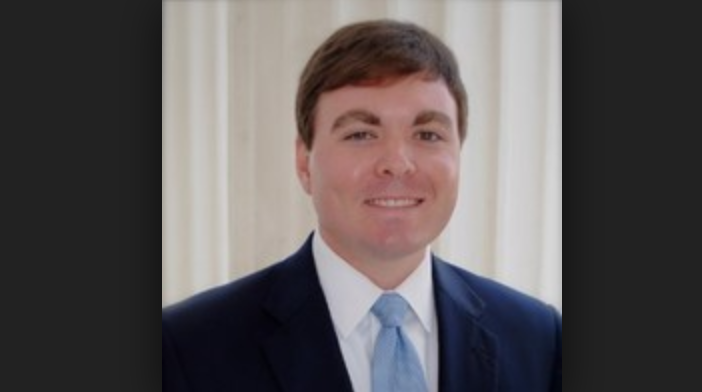
Governor Kay Ivey‘s Deputy Chief of Staff Jon Barganier is leaving his long-time post in Alabama’s capitol to serve as the Executive Director for the Alabama Petroleum Council. Barganier earned his undergraduate degree from the University of Alabama, majoring in Journalism, then attended Auburn University at Montgomery to earn an M.B.A. while working at the State Department of Finance. He has served in Montgomery since 2006, beginning his career as a state planning analyst and division manager of IT Operations at the Alabama Department of Finance. From there, he served as the Director of the Executive planning Office in the same department. After a brief one-year stint in the private sector he joined former Governor Robert Bentley‘s staff as a legislative liaison working his way through the ranks to become the deputy chief of staff, and finally Bentley’s chief of staff, according to his LinkedIn profile. He’s since served as Ivey’s deputy chief of staff for over a year; his resignation goes into effect August 31. According to Yellowhammer News, “the Alabama Petroleum Council is a division of the American Petroleum Institute and represents upstream (exploration and production) and downstream (refining, supply, marketing and transportation) interests and investments of major integrated oil and natural gas companies.”
