
Joe Biden eyes defeated candidates for key administration roles

In politics, there can sometimes be an upside to losing. President-elect Joe Biden is eyeing several Democrats who lost congressional reelection races last month for key positions in his administration. They include outgoing Reps. Abby Finkenauer of Iowa, Donna Shalala of Florida, and Sen. Doug Jones of Alabama. Their consideration continues a long Washington tradition of defeated politicians seeking shelter in a new White House. Landing a job in a new administration can both position the losing candidates for future campaigns and provide the incoming president with important relationships on Capitol Hill. “It’s good to have people who know how to roam the halls of Congress,” said Andrew Card, who directed George W. Bush’s transition and later served as the Republican president’s chief of staff. Biden’s transition team declined to comment on the prospects of any individual contender for an administration role. He has already unveiled much of his economic and national security team and is expected to announce picks soon for key health positions. But there are still a large number of major Cabinet positions to be filled, including attorney general and leaders of the departments of Labor, Commerce, and Transportation. As Biden considers his options, his personal connection with some of the defeated lawmakers could carry significance. Finkenauer, who is under consideration as Labor secretary, owes her start in politics in part to Biden. As a college student, she worked on his ill-fated 2008 presidential campaign. A decade later, he headlined a rally for her winning congressional campaign. She was a key surrogate for Biden ahead of the Iowa caucuses. “I know they have a long relationship, and it’s been mutually supportive,” said former Assistant Dubuque City Manager Teri Goodman, who is a decades-long Biden supporter and has watched Finkenauer’s rise. Finkenauer narrowly lost her bid for a second term in a rural northeast Iowa district. But since then, the former state legislator, who made a name promoting public employee unions, has had conversations with senior Biden transition officials about leading the Labor Department, according to Democratic sources familiar with the communications. Jones, meanwhile, is in the mix to lead the Justice Department, partly due to his work as a U.S. attorney who helped convict Ku Klux Klansmen for the Birmingham church bombing that killed four Black girls. He narrowly won a special Alabama Senate election in 2017 but lost reelection last month. He also has a longstanding personal relationship with Biden, dating to Biden’s first presidential campaign in 1988. Biden spoke at Jones’ campaign kickoff in 2017, saying of Jones, “He knows your heart and will never let you down,” and was the first to telephone him on Nov. 3 after he’d lost the seat to Republican Tommy Tuberville. Shalala is perhaps the most administration-ready of 2020′s losing Democratic class. She spent eight years as secretary of health and human services under Bill Clinton and then served as president of the University of Miami before winning a south Florida House seat in 2018. She has heard from Biden transition officials. Beyond the outgoing members of Congress, Biden is also considering his former rivals in the Democratic primary for jobs. He already tapped California Sen. Kamala Harris as his vice president. Biden is weighing roles for Pete Buttigieg, the former South Bend, Indiana mayor who mounted a surprisingly strong campaign in the early stretch of the Democratic primaries. Biden has expressed deep affection for Buttigieg, who was one of the first major candidates to drop out of the race and endorse Biden. Montana Gov. Steve Bullock, who lost his Senate bid after leaving the White House race, is part of discussions for a Biden administration role, perhaps as secretary of agriculture. Another name under consideration for agriculture is former North Dakota Sen. Heidi Heitkamp, who lost in 2018 but has been a champion of reinvigorating rural America. “If they think I can be helpful, then good,” Heitkamp told The Associated Press recently. Presidents have often sought losing rivals for positions. Republican Donald Trump chose fellow 2016 GOP presidential candidates Rick Perry as energy secretary and Ben Carson for housing and urban development. Democrat Barack Obama notably chose former rival Hillary Clinton to be secretary of state after the 2008 election. Missouri Sen. John Ashcroft’s defeat in 2000 paved the way for his four years as attorney general under George W. Bush, including during the aftermath of the 2001 terrorist attacks in the United States. Former Senate Majority Leader Tom Daschle of South Dakota, who lost the election to a third term in 2004, was tapped after the 2008 election by Obama to head health and human services, which would have put him at the forefront of the health care debate. Daschle withdrew from consideration after questions arose about his failure to properly report and pay income taxes. The most successful losing congressional candidate of the past 50 years is George H. W. Bush, who as a two-term Republican U.S. House member from Texas lost his 1970 bid for Senate against Democrat Lloyd Bentsen. As a consolation, President Richard Nixon picked Bush to be ambassador to the United Nations, a disappointment for the up-and-comer who was hoping for a treasury job. But the post led to an ambassadorship to China, and the experiences were valuable when as president he found himself leading a global coalition in Operation Desert Storm. “The significance is that was the beginning of his self schooling and expertise in foreign affairs,” said Chase Untermeyer, director of White House personnel during George H. W. Bush’s administration. In a White House led by a Capitol Hill veteran like Biden, a team with a background in Congress is particularly valuable to those around the president, since Biden remains well acquainted with the rules and many members. But considering Biden hasn’t been a senator in nearly a dozen years, Card said those with more recent experience in Congress will be helpful. “More than helping the president, these people can help the White House staff dealing with members of Congress,” said Card. “They know where
Iowa swung fiercely to Donald Trump. Will it swing back in 2020?
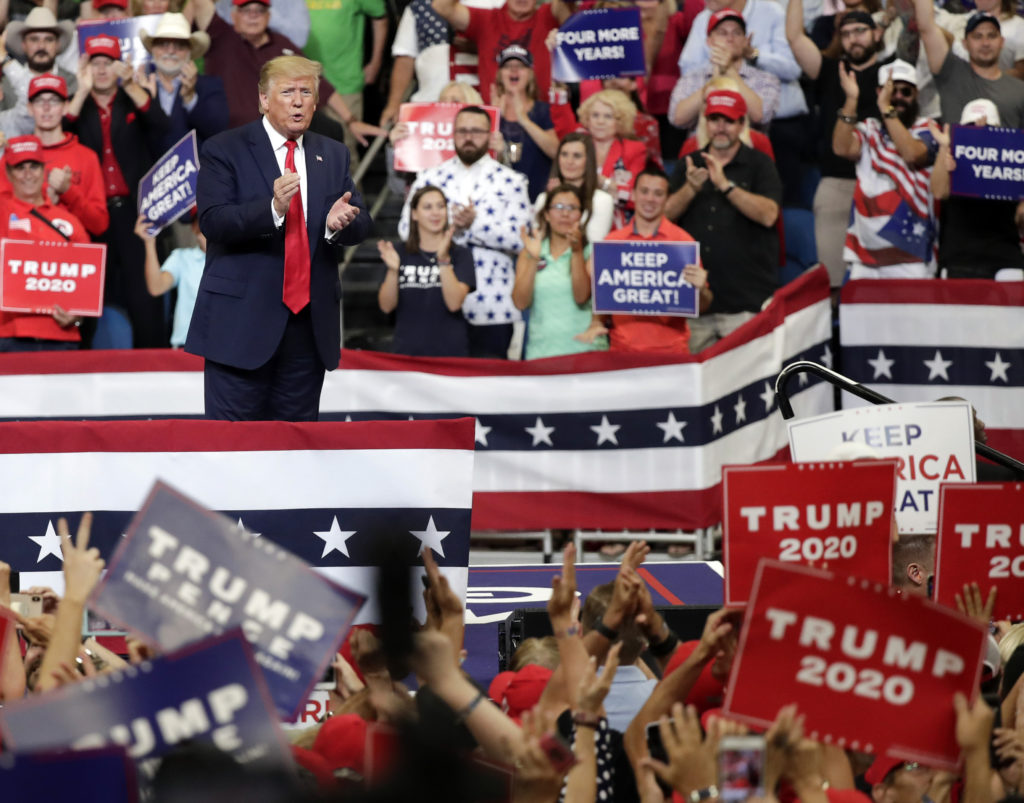
Few states have changed politically with the head-snapping speed of Iowa. Heading into 2020, the question is whether it’s going to change again. In 2008, its voters propelled Barack Obama to the White House, as an overwhelmingly white state validated the candidacy of the first black president. A year later, Iowa’s Supreme Court sanctioned same-sex marriage, adding a voice of Midwestern sensibility to a national shift in public sentiment. In 2012, Iowa backed Obama again. All that change proved too much, too fast, and it came as the Great Recession punished agricultural areas, shook the foundations of rural life and stoked a roiling sense of grievance. By 2016, Donald Trump easily defeated Hillary Clinton in Iowa. Republicans were in control of the governor’s mansion and state legislature and held all but one U.S. House seat. For the first time since 1980, both U.S. Senate seats were in GOP hands. What happened? Voters were slow to embrace Obama’s signature health care law. The recession depleted college-educated voters as a share of the rural population, and Republicans successfully painted Democrats’ as the party of coastal elites. Those forces combined for a swift Republican resurgence and helped create a wide lane for Trump. The self-proclaimed billionaire populist ended up carrying Iowa by a larger percentage of the vote than in Texas, winning 93 of Iowa’s 99 counties, including places like working-class Dubuque and Wapello counties, where no Republican since Dwight D. Eisenhower had won. But now, as Democrats turn their focus to Iowa’s kickoff caucuses that begin the process of selecting Trump’s challenger, could the state be showing furtive signs of swinging back? Caucus turnout will provide some early measures of Democratic enthusiasm, and of what kind of candidate Iowa’s Democratic voters — who have a good record of picking the Democratic nominee — believe has the best chance against Trump. If Iowa’s rightward swing has stalled, it could be a foreboding sign for Trump in other upper Midwestern states he carried by much smaller margins and would need to win again. “They’ve gone too far to the right and there is the slow movement back,” Tom Vilsack, the only two-term Democratic governor in the past 50 years, said of Republicans. “This is an actual correction.” Iowans unseated two Republican U.S. House members — and nearly a third — in 2018 during midterm elections where more Iowa voters in the aggregate chose a Democrat for federal office for the first time in a decade. In doing so, Iowans sent the state’s first Democratic women to Congress: Cindy Axne, who dominated Des Moines and its suburbs, and Abby Finkenauer, who won in several working-class counties Trump carried. Democrats won 14 of the 31 Iowa counties that Trump won in 2016 but Obama won in 2008, though Trump’s return to the ballot in 2020 could change all that. “We won a number of legislative challenge races against incumbent Republicans,” veteran Iowa Democratic campaign consultant Jeff Link said. “I think that leaves little question Iowa is up for grabs next year.” There’s more going on in Iowa that simply a merely cyclical swing. Iowa’s metropolitan areas, some of the fastest growing in the country over the past two decades, have given birth to a new political front where Democrats saw gains in 2018. The once-GOP-leaning suburbs and exurbs, especially to the north and west of Des Moines and the corridor linking Cedar Rapids and the University of Iowa in Iowa City, swelled with college-educated adults in the past decade, giving rise to a new class of rising Democratic leaders. “I don’t believe it was temporary,” Iowa State University economist David Swenson said of Democrats’ 2018 gains in suburban Des Moines and Cedar Rapids. “I think it is the inexorable outcome of demographic and educational shifts that have been going on.” The Democratic caucuses will provide a test of how broad the change may be. “I think it would be folly to say Iowa is not a competitive state,” said John Stineman, a veteran Iowa GOP campaign operative and political data analyst who is unaffiliated with the Trump campaign but has advised presidential and congressional campaigns over the past 25 years. “I believe Iowa is a swing state in 2020.” For now, that is not a widely held view, as Iowa has shown signs of losing its swing state status. In the 1980s, it gave rise to a populist movement in rural areas from the left, the ascent of the religious right as a political force and the start of an enduring rural-urban balance embodied by Republican Sen. Chuck Grassley and Democratic Sen. Tom Harkin. Now, after a decade-long Republican trend, there are signs of shifting alliances in people like Jenny O’Toole. The 48-year-old insurance industry employee from suburban Cedar Rapids stood on the edge of the scrum surrounding former Vice President Joe Biden last spring, trying to get a glimpse as he shook hands and posed for pictures. “I was a Republican. Not any more,” O’Toole said. “I’m socially liberal, but economically conservative. That’s what I’m looking for.” O’Toole is among those current and new former Republicans who dot Democratic presidential events, from Iowa farm hubs to working-class river towns to booming suburbs. Janet Cosgrove, a 75-year-old Episcopal minister from Atlantic, in western Iowa, and Judy Hoakison, a 65-year-old farmer from rural southwest Iowa, are Republicans who caught Mayor Pete Buttigieg’s recent trip. If such voters are a quiet warning to Trump in Iowa, similar symptoms in Wisconsin and Michigan, where Democrats also made 2018 gains, could be even more problematic. Vilsack has seen the stage change dramatically. After 30 years of Republican dominance in Iowa’s governor’s mansion, he was elected in 1998 as a former small-city mayor and pragmatic state senator. An era of partisan balance in Iowa took hold, punctuated by Democratic presidential nominee Al Gore’s 4,144-vote victory in Iowa in 2000, and George W. Bush’s 10,059-vote re-election in 2004. After the 2006 national wave swept Democrats into total Statehouse control for the
