
Taliban sweep into Afghan capital after government collapses
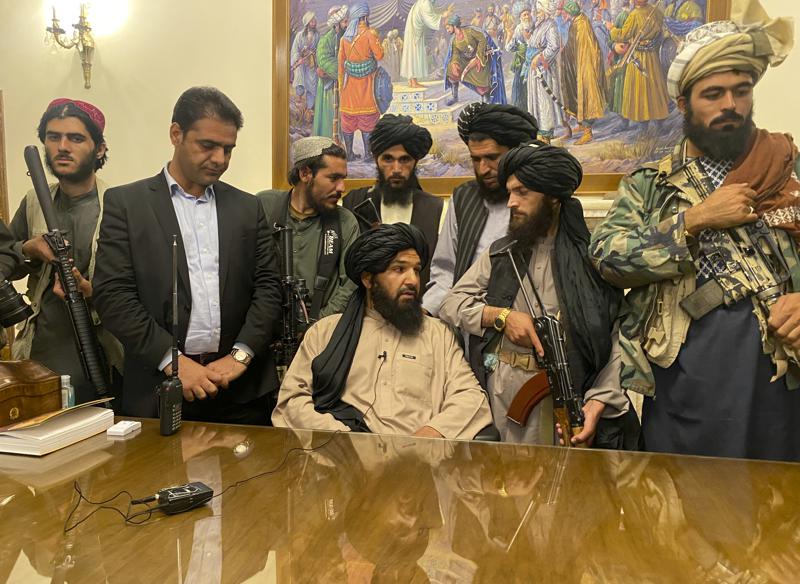
The Taliban swept into Afghanistan’s capital Sunday after the government collapsed, and the embattled president joined an exodus of his fellow citizens and foreigners, signaling the end of a costly two-decade U.S. campaign to remake the country. Heavily armed Taliban fighters fanned out across the capital, and several entered Kabul’s abandoned presidential palace. Suhail Shaheen, a Taliban spokesman, and negotiator told The Associated Press that the militants would hold talks in the coming days aimed at forming an “open, inclusive Islamic government.” Earlier, a Taliban official said the group would announce from the palace the restoration of the Islamic Emirate of Afghanistan, the formal name of the country under Taliban rule before the militants were ousted by U.S.-led forces in the wake of the 9/11 attacks, which were orchestrated by al-Qaida while it was being sheltered by the Taliban. But that plan appeared to be on hold. Kabul was gripped by panic. Helicopters raced overhead throughout the day to evacuate personnel from the U.S. Embassy. Smoke rose near the compound as staff destroyed important documents, and the American flag was lowered. Several other Western missions also prepared to pull their people out. Fearful that the Taliban could reimpose the kind of brutal rule that all but eliminated women’s rights, Afghans rushed to leave the country, lining up at cash machines to withdraw their life savings. The desperately poor — who had left homes in the countryside for the presumed safety of the capital — remained in parks and open spaces throughout the city. Though the Taliban had promised a peaceful transition, the U.S. Embassy suspended operations and warned Americans late in the day to shelter in place and not try to get to the airport. Commercial flights were suspended after sporadic gunfire erupted at the Kabul airport, according to two senior U.S. military officials. Evacuations continued on military flights, but the halt to commercial traffic closed off one of the last routes available for fleeing Afghans. Many people watched in disbelief as helicopters landed in the U.S. Embassy compound to take diplomats to a new outpost at the airport. U.S. Secretary of State Antony Blinken rejected comparisons to the U.S. pullout from Vietnam. “This is manifestly not Saigon,” he said on ABC’s “This Week.” The American ambassador was among those evacuated, officials said. He was asking to return to the embassy, but it was not clear if he would be allowed to. The officials spoke on condition of anonymity to discuss ongoing operations. As the insurgents closed in, President Ashraf Ghani flew out of the country. “The former president of Afghanistan left Afghanistan, leaving the country in this difficult situation,” said Abdullah Abdullah, the head of the Afghan National Reconciliation Council and a longtime rival of Ghani. “God should hold him accountable.” Ghani later posted on Facebook that he left to avert bloodshed in the capital, without saying where he had gone. As night fell, Taliban fighters deployed across Kabul, taking over abandoned police posts and pledging to maintain law and order during the transition. Residents reported looting in parts of the city, including in the upscale diplomatic district, and messages circulating on social media advised people to stay inside and lock their gates. In a stunning rout, the Taliban seized nearly all of Afghanistan in just over a week, despite the billions of dollars spent by the U.S. and NATO over nearly 20 years to build up Afghan security forces. Just days earlier, an American military assessment estimated that the capital would not come under insurgent pressure for a month. The fall of Kabul marks the final chapter of America’s longest war, which began after the Sept. 11, 2001, terror attacks. A U.S.-led invasion dislodged the Taliban and beat them back, but America lost focus on the conflict in the chaos of the Iraq war. For years, the U.S. sought an exit from Afghanistan. Then-President Donald Trump signed a deal with the Taliban in February 2020 that limited direct military action against the insurgents. That allowed the fighters to gather strength and move quickly to seize key areas when President Joe Biden announced his plans to withdraw all American forces by the end of this month. After the insurgents entered Kabul, Taliban negotiators discussed a transfer of power, said an Afghan official. The official, who spoke on condition of anonymity to discuss details of the closed-door negotiations, described them as “tense.” It remained unclear when that transfer would take place and who among the Taliban was negotiating. The negotiators on the government side included former President Hamid Karzai, leader of Hizb-e-Islami political and paramilitary group Gulbudin Hekmatyar, and Abdullah, who has been a vocal critic of Ghani. Karzai himself appeared in a video posted online, his three young daughters around him, saying he remained in Kabul. “We are trying to solve the issue of Afghanistan with the Taliban leadership peacefully,” he said. Afghanistan’s acting defense minister, Bismillah Khan Mohammadi, did not hold back his criticism of the fleeing president. “They tied our hands from behind and sold the country,” he wrote on Twitter. “Curse Ghani and his gang.” The Taliban earlier insisted that their fighters would not enter people’s homes or interfere with businesses and said they would offer “amnesty” to those who worked with the Afghan government or foreign forces. But there have been reports of revenge killings and other brutal tactics in areas of the country the Taliban have seized in recent days. Reports of gunfire at the airport raised the specter of more violence. One female journalist, weeping, sent voice messages to colleagues after armed men entered her apartment building and banged on her door. “What should I do? Should I call the police or Taliban?” Getee Azami cried. It wasn’t clear what happened to her after that. An Afghan university student described feeling betrayed as she watched the evacuation of the U.S. Embassy. “You failed the younger generation of Afghanistan,” said Aisha Khurram, 22, who is now unsure of whether she will be able to graduate in two months. She
World jittery about Donald Trump’s ‘America first’ inaugural speech

President Donald Trump‘s inaugural speech promised “America first” policy led by a forceful executive, in contrast to the coalition building and international conferences which have featured strongly in past administrations. The billionaire businessman and reality television star — the first president who had never held political office or high military rank — promised to stir a “new national pride” and protect America from the “ravages” of countries he says have stolen U.S. jobs. “This American carnage stops right here,” Trump declared. In a warning to the world, he said, “From this day forward, a new vision will govern our land. From this moment on, it’s going to be America first.” A look at some reactions from around the world: ___ AFGHANS DISAPPOINTED BUT HOPEFUL Like many in the Afghan capital of Kabul, restaurant owner Mohammad Nahim watched the presidential inauguration ceremonies but was disappointed to not hear any mention of Afghanistan. “Trump did not mention a word about Afghanistan in his speech and the salaries of the Afghan army and police are paid by the U.S.,” he said. He added that if the U.S. stops helping Afghanistan, “our country will again become a sanctuary to terrorists. I hope Trump will not forget Afghanistan.” Mohammed Kasim Zazi, a shopkeeper whose home is in eastern Afghanistan’s Khost province, where the feared Haqqani network is prominent, said he expected Trump to stay focused on Afghanistan. “Trump said he will finish the terrorists in the world and that has to mean that Afghanistan will remain in the sights of the U.S.” said Zazi. Chief Executive Abdullah Abdullah said he was encouraged by Trump’s speech to soldiers in Bagram. “There he announced his support to the troops and the continuation of support for their troops here and strengthening their troops, which is a good and elegant step and I am sure that our cooperation in other areas will continue as well.” ___ SPEECH RESONATES IN MEXICO Perhaps no country was watching the speech more closely than Mexico. Trump has made disparaging remarks about immigrants who come to the United States illegally and sought to pressure companies not to set up shop in Mexico by threatening a border tariff on goods manufactured there and exported to the United States. So Trump’s talk of “protect(ing) our borders,” ”America first” and “buy American and hire American” had particular resonance in America’s southern neighbor. Ricardo Anaya Cortes, president of the conservative opposition National Action Party, called for “the unity of all Mexicans, unity in the face of this protectionist, demagogic and protectionist speech we just heard. Unity against that useless wall, against deportations, against the blockade of investment.” “The challenge is enormous. … We demand the federal government leave aside tepidity, that it tackle with absolute firmness and dignity the new relationship with the United States,” Anaya said. The United States is by far Mexico’s largest commercial partner, buying some 80 percent of its $532 billion in exports in 2015. Mexico is the second-largest market for U.S. exports. “At least the word ‘Mexico’ was not heard in the speech. Nevertheless one can expect the United States to launch a hyper-protectionist project,” said Ilan Semo Groman, a researcher at Iberoamericana University. If Trump truly moves to block or drive away U.S. investment in Mexico, Semo said Mexico should focus its commercial efforts on other countries. “There are very clear possibilities,” Semo said. Mexican President Enrique Pena Nieto sent three tweets after Trump’s inaugural speech Friday: — “I congratulate @realDonaldTrump on his inauguration. We will work to strengthen our relationship with shared responsibility.” — “We will establish a respectful dialogue with the government of President @realDonaldTrump, to Mexico’s benefit.” — “Sovereignty, national interest and the protection of Mexicans will guide the relationship with the new government of the United States.” ___ PAKISTAN WORRIES ABOUT MUSLIM COMMENTS A group of retired government officials gathered after morning prayers for a walk in a sprawling park in the heart of the federal capital of Islamabad and the topic of their conversation was President Trump’s inaugural speech. They expressed concern that Trump would target the Islamic world, particularly Pakistan, because of his campaign rhetoric about Muslims as well as his inaugural speech in which he promised to eradicate Islamic terrorism worldwide. Pakistan has often been accused of harboring militant insurgents and declared terrorist groups that have targeted neighboring India, against whom Pakistan has fought three wars, as well as Afghanistan. Pakistan denies the charges. “Likely there is more trouble in store for the Islamic world and our country will take the most brunt of the harsh treatment from President Trump administration,” said Mohammad Afzal. His sentiments were echoed by Shafiq Khan, who said “the one main thing that the new president mentioned about the world outside America is to tackle Islamic radicalism and that should be the matter of concern for all of us.” Amanaullah, a school teacher in Islamabad, feared Trump’s reference to eliminating radical Islamic terrorism. “I think under this name he wants to malign and eliminate Islam,” he said. Umair Khan, an engineer, said of Trump: “Let him taste the burden of government and get settled, I am sure he will calm.” ___ CONCERN IN TOKYO Some Tokyo residents are worried that Trump’s “America first” policy will usher in an era of populism and protectionism at the expense of the rest of the world. Tadashi Gomibuchi, who works in the manufacturing industry, recorded Trump’s inauguration speech overnight as he was keen to hear what the new president had to say. “Trump is trying to make big changes to the way things are. Changes are good sometimes, but when America, the most powerful, loses stability … it’s a grave concern,” he said. “If you take his words literally, it may destabilize the world going forward and I’m really worried. I hope things will lead to a soft landing.” Retiree Kuninobu Inoue, who lived in the U.S. during the 1990s, is concerned about trade frictions between Japan and the U.S, citing Trump’s decision
