
Federal judge blocks Alabama’s strict abortion ban

A federal judge on Tuesday blocked Alabama’s near-total abortion ban from taking effect next month and called the law — part of a wave of new abortion restrictions by conservative states — clearly unconstitutional. U.S. District Judge Myron Thompson issued a preliminary injunction temporarily blocking Alabama from enforcing the law that would make performing an abortion a felony in almost all cases. The ruling came after abortion providers sued to block the law from taking effect Nov. 15. The injunction was widely expected and will remain in place until Thompson decides the full case. “Alabama’s abortion ban contravenes clear Supreme Court precedent,” Thompson wrote in an accompanying opinion. “It violates the right of an individual to privacy, to make choices central to personal dignity and autonomy. It diminishes the capacity of women to act in society, and to make reproductive decisions. It defies the United States Constitution.” Energized by new conservatives on the U.S. Supreme Court, Alabama and other conservative states have attempted to enact new restrictions on abortion in the hopes of getting Supreme Court justices to reconsider Roe v. Wade, the landmark 1973 decision that legalized abortion nationwide. A number of states attempted to ban abortion once a fetal heartbeat is detected. The Alabama law went further by attempting to ban almost all abortions with no exceptions for cases of rape and incest. Passed by the Republican-led legislature, the 2019 Alabama Human Life Protection Act would make performing an abortion at any stage of pregnancy a felony punishable by up to 99 years or life in prison for the abortion provider. The only exceptions would be when there is a serious health risk to the mother or the fetus has a lethal anomaly that would cause it to die shortly after birth. None of the state bans has taken effect. Some have already been blocked, and elsewhere courts are considering requests to put them on hold while legal challenges play out. “This is not only a victory for the people of Alabama — it’s a victory for the entire nation. We said it from the start: This ban is blatantly unconstitutional, and we will fight it every step of the way,” said Staci Fox, president and CEO of Planned Parenthood Southeast. Planned Parenthood was one of the groups that sued to block the law. Randall Marshall, executive director of the American Civil Liberties Union of Alabama, said the decision was expected. “Abortion remains legal in Alabama. The state’s repeated attempts to push abortion out of reach by enacting unconstitutional laws restricting abortions has already cost taxpayers nearly 2 ½ million dollars,” Marshall said. “This ill-advised law will cost taxpayers more money.” Supporters of the Alabama law have also said they anticipated the action but hope to eventually convince the U.S. Supreme Court to roll back abortion rights. Alabama Republican Rep. Terri Collins, who sponsored the ban, said the ruling “is merely the first of many steps on that legal journey.” “As we have stated before, the state’s objective is to advance our case to the U.S. Supreme Court where we intend to submit evidence that supports our argument that Roe and Casey were wrongly decided and that the Constitution does not prohibit states from protecting unborn children from abortion,” Alabama Attorney General Steve Marshall said in statement. In a measured statement, Alabama Gov. Kay Ivey said the ban reflects Alabamians beliefs, but that she also supports the “rule of law.” “This legislation passed with overwhelming support in the Alabama Legislature and was signed into law as a testament to Alabamians’ longstanding belief that every human life is sacred. We must continue doing all we can to protect life,” Ivey said. Republished with the permission of the Associated Press.
Martha Roby: It’s not up for debate
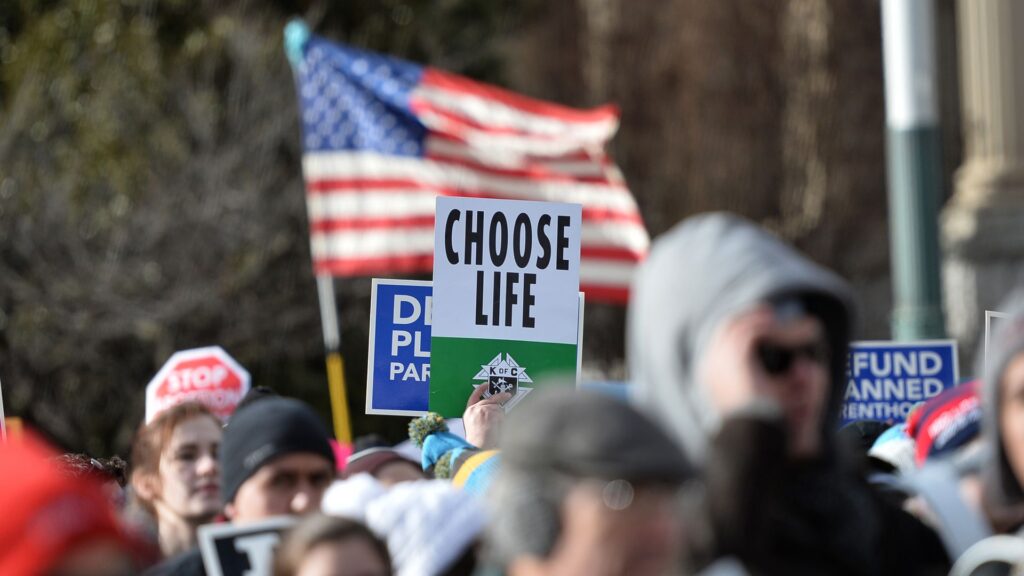
45 years ago this month, the Supreme Court of the United States ruled in Roe v. Wade to make abortion legal and available nationwide. While many abortion activists celebrate this infamous anniversary, it represents a particularly somber occasion for those of us who advocate for life – at all stages. Every year since this ruling, the pro-life community has gathered in Washington to march in peaceful protest. The 2018 March for Life took place on Friday, January 19th – and wow, the pro-life energy was certainly high in Washington. This year the March for Life theme was “Love Saves Lives.” Leading up to and during the March, the pro-life community participated in a social media campaign to share photos, videos, and thoughts to shed light on why we march – and on the many reasons why life at every stage is worth fighting for. I’d like to extend a very sincere “thank you” to each and every person from our great state who made the long trip to participate in the March. I am truly inspired by the thousands of March for Life participants and their dedication to the pro-life movement. I stand with you. I was especially impressed by a young lady from Montgomery named Agnes Armstrong. She’s a graduate of the Montgomery Catholic Preparatory School and is currently a sophomore at Auburn University. She was selected to speak to more than 600,000 people at the pre-March rally to offer the perspective of a young female college student. This past summer, Agnes wrote a letter to March for Life President Jeanne Mancini thanking her for the impact the organization has made. Mrs. Mancini was moved by the letter and asked Agnes to be featured as this year’s March for Life “Young Adult” keynote speaker. I am so thankful to have young leaders like Agnes to represent our state in such a remarkable way. It’s because of individuals like her that our pro-life momentum is as strong as it is. I am excited to report that during the March for Life festivities, the House took action to defend the defenseless by taking up and passing H.R. 4712, the Born-Alive Abortion Survivors Protection Act. I was proud to cosponsor the legislation, and I also had the unique opportunity to manage debate of the bill while it was being considered on the floor. At this point, I don’t think it’s a secret that I am unapologetically pro-life, and I believe that our laws and policies should assign the utmost importance to life at every stage. I have stood on the House floor many times in defense of the unborn, but this time, we weren’t talking about the unborn. H.R. 4712 seeks to protect those who have already been born. The bill is pretty simple. It states that if a baby is born alive after a failed abortion, he or she must be given the same exact medical care that would be given to any other baby. I know Congress will continue to play politics about when life begins and argue about the point at which the law should step in to protect it – and I understand not everyone agrees with my strong pro-life stance. However, I cannot fathom how any person could be opposed to legislation that protects babies who are so alive that you can look them in the eye. Of course, I supported this measure, but it did feel strange to take a stand in defense of living, breathing children – to even have to make the case that a baby who survives an abortion and is born in this world should be treated just like a baby born any other way. Unfortunately, I didn’t have a choice. There is currently no law mandating that a baby born alive after a failed abortion receives medical treatment instead of being left to die. That’s why this bill is necessary. It would require under federal law, nationwide, that a baby born alive after an abortion attempt receives the same care that any other baby would. I know that as a Member of Congress, part of my job is to debate the issues facing our nation, and while I take this responsibility very seriously, I don’t believe this particular issue is up for debate. I hope the Senate acts swiftly and passes this bill, and I’ll keep you informed as we progress. ••• Martha Roby represents Alabama’s Second Congressional District. She lives in Montgomery, Alabama with her husband Riley and their two children.
