
Joe Biden faces questions about commitment to minimum wage hike
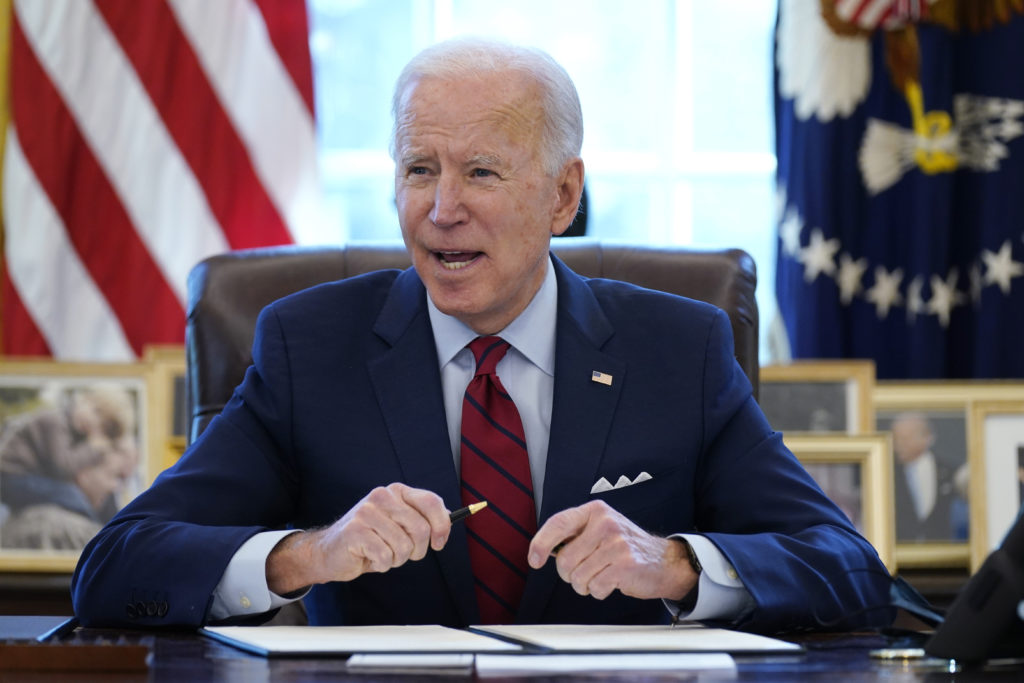
Union activist Terrence Wise recalls being laughed at when he began pushing for a national $15 per hour minimum wage almost a decade ago. Nearly a year into the pandemic, the idea isn’t so funny. The coronavirus has renewed focus on challenges facing hourly employees who have continued working in grocery stores, gas stations, and other in-person locations even as much of the workforce has shifted to virtual environments. President Joe Biden has responded by including a provision in the massive pandemic relief bill that would more than double the minimum wage from the current $7.25 to $15 per hour. But the effort is facing an unexpected roadblock: Biden himself. The president has seemingly undermined the push to raise the minimum wage by acknowledging its dim prospects in Congress, where it faces political opposition and procedural hurdles. That’s frustrating to activists like Wise, who worry their victory is being snatched away at the last minute despite an administration that’s otherwise an outspoken ally. “To have it this close on the doorstep, they need to get it done,” said Wise, a 41-year-old department manager at a McDonald’s in Kansas City and a national leader of Fight for 15, an organized labor movement. “They need to feel the pressure.” The minimum wage debate highlights one of the central tensions emerging in the early days of Biden’s presidency. He won the White House with pledges to respond to the pandemic with a barrage of liberal policy proposals. But as a 36-year veteran of the Senate, Biden is particularly attuned to the political dynamics on Capitol Hill and can be blunt in his assessments. “I don’t think it’s going to survive,” Biden recently told CBS News, referring to the minimum wage hike. There’s a certain political realism in Biden’s remark. With the Senate evenly divided, the proposal doesn’t have the 60 votes needed to make it to the floor on its own. Democrats could use an arcane budgetary procedure that would attach the minimum wage to the pandemic response bill and allow it to pass with a simple majority vote. But even that’s not easy. Some moderate Democratic senators, including Joe Manchin of West Virginia and Krysten Sinema of Arizona, have expressed either outright opposition to the hike or said it shouldn’t be included in the pandemic legislation. The Senate’s parliamentarian may further complicate things with a ruling that the minimum wage measure can’t be included in the pandemic bill. For now, the measure’s most progressive Senate backers aren’t openly pressuring Biden to step up his campaign for a higher minimum wage. Bernie Sanders, the chair of the Senate Budget Committee, has said he’s largely focused on winning approval from the parliamentarian to tack the provision onto the pandemic bill. Sen. Elizabeth Warren, who like Sanders challenged Biden from the left for the Democratic nomination, has only tweeted that Democrats should “right this wrong.” Some activists, however, are encouraging Biden to be more aggressive. The Rev. Dr. William J. Barber II, the co-chair of the Poor People’s Campaign, said Biden has a “mandate” to ensure the minimum wage increases, noting that minority Americans were “the first to go back to jobs, first to get infected, first to get sick, first to die” during the pandemic. “We cannot be the last to get relief and the last to get treated and paid properly,” Barber said. The federal minimum wage hasn’t been raised since 2009, the longest stretch without an increase since its creation in 1938. When adjusted for inflation, the purchasing power of the current $7.25 wage has declined more than a dollar in the last 11-plus years. Democrats have long promised an increase — support for a $15 minimum wage was including in the party’s 2016 political platform — but haven’t delivered. Supporters say the coronavirus has made a higher minimum wage all the more urgent since workers earning it are disproportionately people of color. The liberal Economic Policy Institute found that more than 19% of Hispanic workers and more than 14% of Black workers earned hourly wages that kept them below federal poverty guidelines in 2017. Blacks, Hispanics, and Native Americans in the U.S. also have rates of hospitalization and death from COVID-19 that are two to four times higher than for whites, according to the Centers for Disease Control and Prevention. People of color are a vital part Biden’s constituency, constituting 38% of his support in November’s election, according to AP VoteCast, a nationwide survey of the electorate. Adrianne Shropshire, executive director of BlackPAC, noted that Biden has promised to address racial inequalities and create a more fair economy. That means he now has a chance to ensure that hourly wage earners “come out of this pandemic in better shape than they went into it.” “The recovery around COVID shouldn’t just be about how to stabilize and get people back to zero,” Shropshire said. “It should be about how do we create opportunities to move people beyond where they were.” The White House says Biden isn’t giving up on the issue. His comments to CBS, according to an aide, reflected his own evaluation of where the parliamentarian would rule based on his decades of experience in the Senate dealing with similar negotiations. Biden suggested in the same interview that he’s prepared to engage in a “separate negotiation” on raising the minimum wage, but White House press secretary Jen Psaki offered no further details on the future of the proposal if it is in fact cut from the final coronavirus aid bill. One option could be forcing passage by having Vice President Kamala Harris, as the Senate’s presiding officer, overrule the parliamentarian. But Psaki was clear in opposing that: “Our view is that the parliamentarian is who is chosen, typically, to make a decision in a nonpartisan manner.” Navin Nayak, executive director of the Center for American Progress Action Fund, the political arm of the progressive think tank, said he wasn’t surprised at Biden’s assessment, but still feels the White House is
Biden works to push Black turnout in campaign’s final days
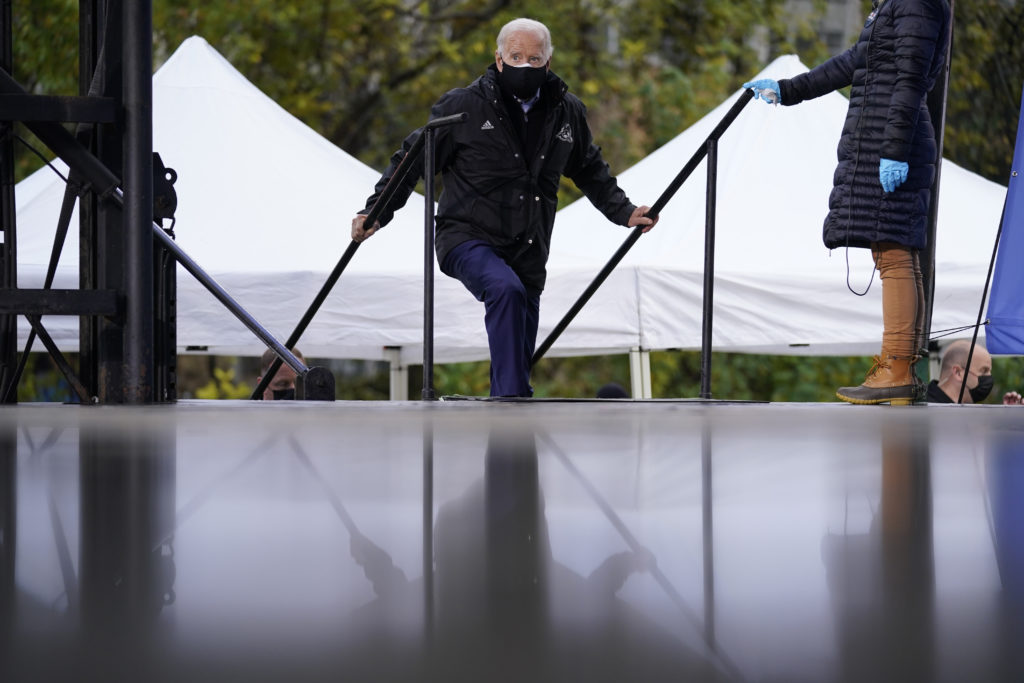
Joe Biden was spending the final days of the presidential campaign appealing to Black supporters to vote in-person during a pandemic that has disproportionally affected their communities, betting that a strong turnout will boost his chances in states that could decide the election. Biden was in Philadelphia on Sunday, the largest city in what is emerging as the most hotly contested battleground in the closing 48 hours of the campaign. He participated in a “souls to the polls” event that is part of a nationwide effort to organize Black churchgoers to vote. “Every single day we’re seeing race-based disparities in every aspect of this virus,” Biden said at the drive-in event, shouting to be heard over the blaring car horns. He declared that Trump’s handling of COVID-19 was “almost criminal” and that the pandemic was a “mass casualty event in the Black community.” His running mate, Sen. Kamala Harris, was in Georgia, a longtime Republican stronghold that Democrats believe could flip if Black voters show up in force. The first Black woman on a major party’s presidential ticket, she encouraged a racially diverse crowd in a rapidly growing Atlanta suburb to “honor the ancestors” by voting, invoking the memory of the late civil rights legend, longtime Rep. John Lewis. She later campaigned in Goldsboro and Fayetteville, North Carolina, two cities with a large share of Black voters. But even as 93 million Americans have cast ballots and election officials prepare to count, President Donald Trump was already threatening litigation to stop the tabulation of ballots arriving after Election Day. As soon as polls closed in battlegrounds such as Pennsylvania, Trump said, “we’re going in with our lawyers.” It was unclear precisely what Trump meant. There is already an appeal pending at the Supreme Court over the counting of absentee ballots in Pennsylvania that are received in the mail in the three days after the election. The state’s top court ordered the extension and the Supreme Court refused to block it, though conservative justices expressed interest in taking up the propriety of the three added days after the election. Those ballots are being kept separate in case the litigation goes forward. The issue could assume enormous importance if the late-arriving ballots could tip the outcome. Biden is focusing on turning out Black voters in the final stretch in part to avoid a narrow outcome that could prompt Trump to seek an advantage in the courts. It’s a challenging dynamic because Democrats have spent months pushing their supporters to vote by mail. But their energy has shifted to urge Black supporters who have long preferred to vote in person or distrust voting by mail to get out on Tuesday. A Biden path toward victory must include Black majority cities, including Philadelphia and Detroit, which will be crucial in determining the outcome in Pennsylvania and Michigan. Those are states where both candidates have spent a significant amount of time in the final days of the 2020 election. “The historical but also cultural reality for our community is that Election Day represents a collective political act and it’s a continuation of our struggle for full citizenship in this country,” said Adrianne Shropshire, the executive director of BlackPAC. “Black voters are showing up in ways that they did not in 2016 and we can take heart in that.” In Detroit, officials are projecting a 50% voter turnout, which would be higher than 2016, yet lower than 2008 and 2012 when Obama’s candidacy drew record voter participation. Grassroots organizers in the Philadelphia area have spent months engaging potential voters, many of whom they expect will be casting ballots for the first time on Election Day. “Most Black voters in Philly have been skeptical of mail-in voting,” said Joe Hill, a veteran Democratic operative-turned-lobbyist from the city. “A lot of us have gotten our ballots already,” Hill said, but added, “Election Day has always been everything in Philadelphia.” Healthcare Pennsylvania, a local union chapter of the Service Employees International Union, is working to increase turnout by at least 10,000 in west Philadelphia and spent the weekend knocking on more than 600 doors. West Philadelphia has a majority Black population and has experienced firsthand the convergence of the pandemic’s disproportionate impact on Black Americans and protests in recent days against police brutality, mirroring what’s occurred nationwide. Biden has also drawn a sharp contrast to Trump through a summer of unrest over the police killings of Breonna Taylor in Kentucky and George Floyd in Minneapolis. Their deaths sparked the largest protest movement since the civil rights era. Biden responded by acknowledging the systemic racism that pervades American life, while Trump emphasized his support of police and pivoted to a “law and order” message that resonated with his base but did little to broaden his appeal. Four years ago, Trump made his pitch to voters of color by bellowing “What have you got to lose?” in supporting the Republican candidate and aides have pointed to pre-pandemic economic gains by people of color. He only won 8% of the Black vote, but in a development that has haunted Democrats for four years, Clinton’s margin fell 7 percentage points from Obama’s in 2012, according to Pew Research Center. There’s little chance that Trump will win all that many more Black voters this year, though his campaign believes it has made inroads with young Black men. The president’s primary strategy has been to erode Biden’s support with a barrage of negative advertisements. One replays Biden’s eyebrow-raising “you ain’t Black” comment, in which the former vice president questioned how African Americans could support Trump. Another uses the Democrat’s own past words in support of the 1994 crime bill against him. The bill, which Biden helped write, led to stiffer prison sentences that disproportionately incarcerated Black men. Trump, in a tweet Sunday, claimed that Biden called young Black man “superpredators” — which he did not do, though he used the term “predators” in a 1993 floor speech to describe criminals. Biden, who has a
