
AL.com tries to follow Troy King’s money; finds dead-ends, leaves many questions

Former Alabama Attorney General and current Republican Attorney General candidate, Troy King has found himself in the headlines this week for his campaign donations. His opponent Steve Marshall‘s campaign has been working overtime pushing details from his campaign finance report to discredit his assertion that he won’t take gaming money. AL.com took an in-depth look at King’s donations and found that while he says he will not accept donations from gambling interests, he has “has taken about $90,000 from five South Carolina companies and individuals with links to gaming, records show.” According to the report, one of the major South Carolina donors, Keith Gray, is involved in the gambling business, with one of his businesses being prosecuted in 2017 b the state of Alabama. King does not deny taking money from Gray’s company, but did not comment to AL.com on Gray’s ties to gambling groups. When Alabama Today reached out to King’s campaign to ask about taking money from gaming, they denied it; “Troy King has not accepted donations from gaming,” a representative from his campaign said. They went on to point a finger a Marshall, saying he’s accepted gaming money from various organizations. “Steve Marshall has accepted hundreds of thousands of dollars from organizations like BCA which is largely comprised of Indian gaming money, from RAGA which is full of Las Vegas gambling money and has accepted a trip to Africa from CWAG which is sponsored by corporations including Caesars Entertainment which is one of the largest operators of Las Vegas casinos,” added the King campaign. Muddled contributions from potential straw donors Perhaps the most alarming news from AL.com’s report (and wholly overlooked by their own reporter who noted it almost as an aside) is that of the donation from Gray’s wife, Phyllis. King’s campaign received $15,000 from her, but when AL.com asked about the donation, “she said she had never heard of Troy King and did not care about the Alabama election.” While easy to gloss over, straw donations — making a political contribution in another person’s name or agreeing to be the named donor with someone else’s money to evade campaign finance limits— is against state and federal laws. In fact, it’s what conservative author and filmmaker Dinesh D’Souza pleaded guilty to in 2014. Ultimately the court sentenced him to five years probation, eight months in a halfway house (referred to as a “community confinement center”) and a $30,000 fine. President Donald Trump recently pardoned D’Souza saying he had been unfairly treated by the justice system under the Obama Administration. That said, Alabama Today spoke to the King campaign about said donation and got a very different response. “The check from Phyllis Gray was received via mail to the Troy King campaign mailbox,” said a representative from King’s campaign to Alabama Today. “Phyllis and her husband, Keith, are longtime friends of Troy King. We are unsure of who the Phyllis Gray is that the reporter at AL.com claims to have spoken with but we have been in touch with the Gray’s that donated to the campaign this afternoon and they have assured Troy that they have and continue to support him.” King’s history with gambling King says he’s a strong opponent to gambling. During his time as Attorney General, not only did he introduce anti-gambling legislation every year of his time in public office, he also prosecuted several electronic gambling sites, opposed a gambling expansion for the Native American tribes in Alabama, and even requested that the United States Department of the Interior deny the Poarch Band of Creek Indian’s application to broaden their gambling operations in the state. Back in 2013, he filed a series of gambling-related patents with the U.S. Patent office. When questioned about them by AL.com’s John Archibald, “King said he filed the patents simply on behalf of a client. He said he has no financial interest in any of them, and reiterated that “I don’t have anything to do with it.” This practice is common for lawyers, but the appearance hasn’t stopped his opponent from attempting to use it against him in what has turned into a runoff focused on attacks. This story was updated at 2:40 p.m. CT with additional comments from Troy King’s campaign.
AL.com’s John Archibald wins Pulitzer Prize in commentary

John Archibald, an editorial writer at the AL.com, was named today a Pulitzer Prize winner for commentary Monday afternoon at Columbia University during the announcements for journalism and arts winners for 2018. Archibald was awarded the prize “for lyrical and courageous commentary that is rooted in Alabama but has a national resonance in scrutinizing corrupt politicians, championing the rights of women and calling out hypocrisy,” said the Pulitzer Prize website. Archibald’s commentaries encompassed everything from from the scandal and resignation of former Gov. Robert Bentley to the contentious special election between former Ala. Chief Justice Roy Moore and former U.S. Attorney Doug Jones. Archibald is a columnist for the Alabama Media Group, with his work appearing in the Birmingham News, the Huntsville Times, Mobile’s Press-Register, AL.com and its probing social brand, Reckon. Before he began his column in 2004, he worked on the News’ investigative team and has covered everything from crime and punishment to Birmingham City Hall. He grew up in North Alabama and graduated from the University of Alabama in 1986. He is married with three grown children.
Celebrating John Archibald’s Pulitzer while mourning the lack of talent in most newsrooms

Journalism is a strange beast. I’ve thought that for years, even before I started on this crazy adventure that is Alabama Today. What I want from those covering hard news is facts. What I want from a columnist is a fact-based argument or story with an emotional or personal hook. I don’t just want to read your opinion; I want your opinion to move me even if the emotion I feel isn’t a positive one. AL.com’s, or more aptly Alabama Media Group’s, John Archibald nails that nearly every time. Which is why he deserves his newly minted Pulitzer Prize. I like to think that my news taste are like most readers or consumers. What I want from a news story is straight down the middle, facts. If I can tell what the reporter thinks about a particular subject by time I’ve reached the end of an article, then I feel as though they have failed. If I get to the end of an article and have to pause to reflect upon my own position, or consider the story to be just a neutral factual telling of events, then the reporter has done their job. Most days I can simply look at the headline, the by-line, read a lede, and can guess exactly where the reporter is headed with their story and how they feel personally about the topic. That’s what I consider a failure by both the reporter and the outlet running their story. One of my favorite reporters of all time (doesn’t everyone have favorite reporters?) is Brendan Farrington of the Florida bureau of the Associated Press. I’ve known Brendan personally and professionally for many years, and yet I still have no idea what his politics are. That’s a dang good reporter. When I was in Florida I read nearly every story he wrote because I knew that it would do exactly what journalist are taught to do in school: write straight down the middle. Wait, are they still taught to report straight down the middle? Hard to tell these days. I resent the current state of journalism where news stories and content is heavily weighted with bias; which is part of the reason I started this site. Journalism is hard which is why it’s a profession that used to be revered instead of mocked. It’s hard to explain a topic or situation and stay reasonably objective from your own opinions when writing. Beyond that, good journalists live by an ethics code whereby they have a duty to the public to be honest and loyal, even when they fundamentally disagree. Frankly those with the skills to do so can usually avoid journalism altogether and take jobs paying better money elsewhere. A good journalist is like a good teacher they do it for the love of the job not the accolades or pay. In fact, Mike Rosenberg of the Seattle Times yesterday tweeted, “One of today’s Pulitzer winners has already left the paper to run a brewery’s social media account. This is at least the 4th Pulitzer winner since 2015 who left for PR by the time they won. PR pays 2x more & has much more job security than journalism.” Nevertheless I believe readers need to demand more from Alabama’s newsrooms. While I do realize I live in a football state — football, crime and feature fluff-stories dominate the majority of content across most well-trafficked Alabama sites these days. I mean I love knowing the best place for burgers, hotdogs, nails, blah, blah, blah, but I find the constant lists and photo galleries lacking. I get it. That stuff makes for great click-bait, but no one’s winning a Pulitzer for 99% of the content showing up on news sites these days. And when there is award-winning journalism happening in our state, how could one be expected to find it in the stream of constant shhhhhhttuff. Back to what got me writing about the state of things, Alabama’s own John Archibald, his column nails it, most days. Even when I don’t agree with what he’s writing, which is fairly frequent, I appreciate his investigative skills, his passion and his consistency. I appreciate that every column is well-researched, well-cited and covers every base a real journalist should. He doesn’t traffic in click-bait or TMZ style gossip. Lord knows there’s plenty of that around the state to publish if he was so inclined. He focuses on issues that matter. He shapes conversation and leaves those skirting the law or ethics rightfully shaking in their boots. I know a handful of people celebrating John’s win and you can count me among them. He’s the best in Birmingham and probably in Alabama. It’s is a well-deserved award. I just wish Alabama had more of them coming our way.
Child sex abuse victim calls out Doug Jones for ‘hypocrisy’ in blasting Roy Moore
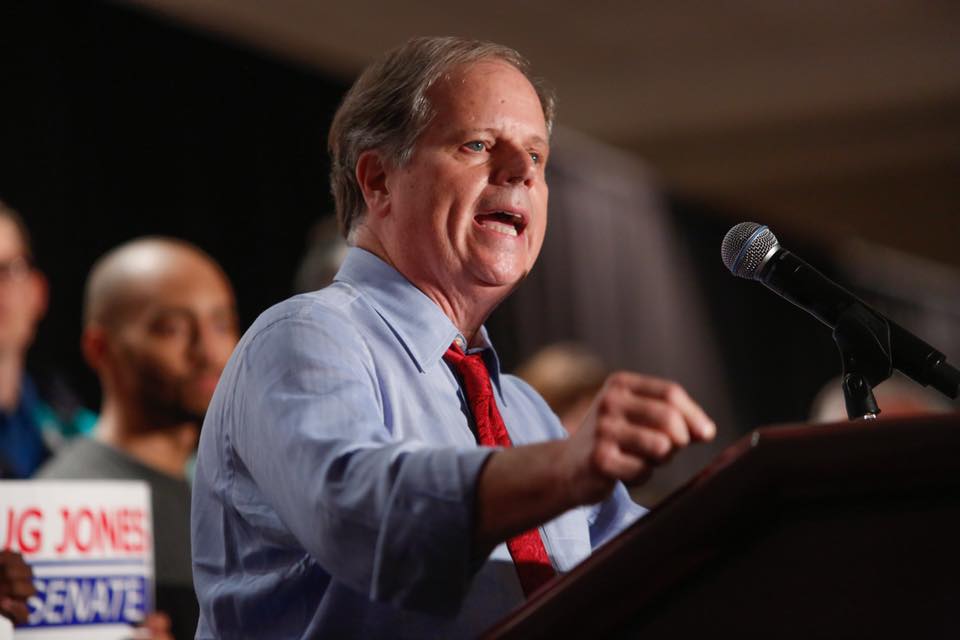
AL.com on Tuesday reported a woman who sued the University of Alabama-Birmingham (UAB) over sexual abuse in 2001, called out Alabama Democratic U.S. Senate candidate Doug Jones for “hypocrisy” for his role as a defense attorney on behalf of the university. Brittany Benefield was a child-prodigy recruited by UAB at 14. While attending the university, living in the doors with football players, she claimed to have suffered sexual abuse by the hands of UAB coaches and the administration when she was only 15-years old. In the high-profile case, Jones said Benefield’s claims were “without merit.” “The charges against UAB administrators and coaches are entirely without merit and represent nothing more than a cynical attempt to extort money by slandering this institution and its employees,” Jones said at the time according to the AL.com report. Now, in light of Jones’ reaction to the allegations against Republican nominee Roy Moore, Benefield has come forward speaking against Jones. “I find it to be the height of hypocrisy that he sets his campaign to be on the moral high ground against Roy Moore,” Benefield told AL.com. She claims some of the things Jones said during the process “really made my jaw hit the floor. I just think Doug Jones is full of … something. He was cold, uncaring, unfeeling and calculated throughout the case.” Benefield is referring to Jones saying the credibility of the allegations against Moore “have a lot more credibility” than his denials. A response in stark contrast to his stance on the allegations Benefield made in 2001. “The credibility of the allegations and the statements of these women in Etowah County seem to have a lot more credibility than denials that he’s made or denials made by his handlers,” Jones said last Wednesday. However, Benefield’s attorney in the trial defended Jones actions. Attorney John Whitaker said Jones acted professionally did not mistreat his client. “Never, ever, do I think that Doug Jones did anything inappropriate,” Whitaker said. Jones faces Moore in the special election on Dec. 12.
Election night is here and AL.com is focused on sorority rush

It’s election night in across the Yellowhammer State and while most statewide outlets are following the results of various municipal elections, the headline stories over on AL.com are about sorority rush and Sabrina the Teenage Witch. We’ll just leave it at that.
BP oil spill 5 years later
Here’s a look at some of the local and national news coverage on the five year anniversary of the BP oil spill: Alabama’s Attorney General, Luther Strange penned an op-ed 5 years after the Gulf oil spill, Alabama nearer to closure published at AL.Com. He wrote, “Since I first took office as Attorney General in January 2011, one of my highest priorities has been to ensure that Alabama is fairly compensated for the damages it sustained from a disaster so catastrophic that it captured the world’s attention. I am pleased to report that we are making steady progress in our pursuit of restitution.” Looking back at the spill Fox10 interviewed several local residents and the reactions were mixed. They reported that local resident April Linheart “is glad her family can enjoy the water. She doesn’t think the gulf coast is fully restored, but she’s hopeful for the future.” Fox’s Renee Dials quoted Linheart saying, “It’s hard to get oil out of the water. They’re trying they’re best. It’s not going to get out immediately, it’s going to take time.” NPR published a detailed story Monday morning. The piece 5 years after BP oil spill, effects linger and recovery is slow cited Gulf Shores Mayor Robert Craft. He discussed the clean and crowded beaches you’d see today saying, “Five years ago you’d see oil all over our beach and you’d see no people here. Our beaches were ruined.” Looking at the big picture he went on to say, “Economically we’re doing really well and the environment seems to be short-term looking well too,” he said. “But what we don’t know is the long-term environmental consequences of this. It just hasn’t been long enough to know.” In New Orleans, The Times-Picayune spoke with Jane Lubchenco, a marine biologist who ran the National Oceanic and Atmospheric Administration during the spill. In its report, On BP oil spill anniversary, ex-NOAA director urges major changes in federal spill contingency plan, Lubchenco details steps to do before there’s another crisis. The article stresses that during the BP spill “federal responders were forced to adapt on the run. But now its time to adjust the plan to take advantage of the lessons learned during the 2010 disaster.”
