
Democrat Bob Vance outraising GOP opponent Tom Parker in Alabama chief justice race
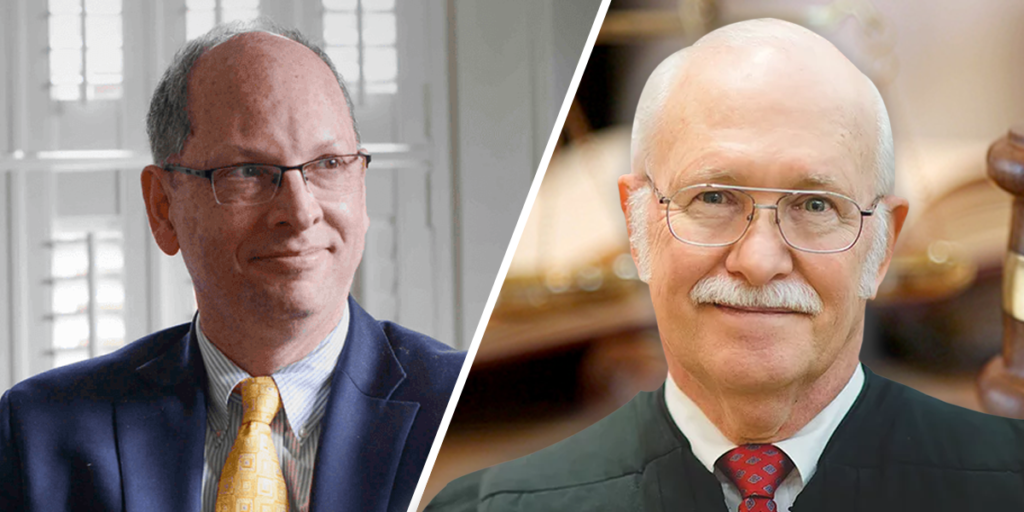
In the race for Alabama chief justice, Democratic nominee Bob Vance is attracting more donors than Republican Tom Parker. Campaign finance reports filed recently show that Vance raised $200,000 for his campaign last month. Parker reported raising less than $4,000. Vance has an available campaign balance of $420,197 while Parker has $17,500. The race pits Parker, a member of the court since 2005 and a past adviser to former chief justice Roy Moore, against Vance, a Jefferson County judge. Finance reports show that two former Republican Supreme Court members, former Chief Justice Drayton Nabers and former Justice Thomas Woodall, donated to Vance’s campaign. Parker won the GOP primary over incumbent Chief Justice Lyn Stuart, who had a financial advantage in the race. Republished with permission form the Associated Press.
Former Chief Justice Sue Cobb compares pricey judicial races to legalized extortion
The phones rang. The donations flowed. Former Alabama Chief Justice Sue Bell Cobb in 2006 won one of the most expensive judicial races in American history. Cobb, however, is no fan of the pricey system that got her to be the state’s top jurist. The high-dollar races that have judicial candidates dialing for dollars are tawdry, she said, and the donations that judicial candidates must solicit from law firms and businesses that appear in their courtroom are something akin to “legalized extortion.” “To fully achieve the goal of having fair courts, there must be reform in how judges are selected,” Cobb said in an interview with The Associated Press Cobb, who stepped down as chief justice in 2011, has become a national advocate for changing how judges are selected. At one time in history, judges were appointed by kings, Cobb said, and electing judges was seen as a way of letting people decide who would hear cases. “The money now has become the king,” Cobb said. In her 2006 race for chief justice, Cobb initially set a goal of raising $2 million. She said it quickly became clear that more would be needed. She raised and spent $2.6 million. Her opponent, Republican Chief Justice Drayton Nabers raised and spent $5.5 million. That spending ranked as the second most expensive judicial race in American history, according to a report by Justice at Stake, the Brennan Center for Justice at NYU School of Law, and the National Institute on Money in State Politics. “Everything we did was legal and ethical, but that didn’t mean it was right,” Cobb said of her race. Judicial candidates are not allowed to discuss cases when they call seeking donations. Still, Cobb said there is an inevitable unspoken pressure when a judge, or potential judge is seeking a donation from a lawyer, head of a law firm or business owner who will appear in their courtroom. “How do they refuse?” Cobb said. Cobb became a judge at age 25 and resigned as chief justice in 2011 at age 55. During her 30 years on the bench, Cobb said she never witnessed a direct quid pro quo where a judge traded a ruling for a donation. But patterns in rulings become suspect, she said. “When a judge almost always rules the way his backers want him to rule, you would have to question, did that judge arrive at that result in an intellectually honest way or did they not want to displease the people who sent them?’ Cobb said. For years, Cobb has been an advocate on changing how judges are elected. In her resignation speech, she urged the non-partisan elections. Cobb this spring penned a first-person piece for the online news site Politico provocatively titled “I Was Alabama’s Top Judge. I’m Ashamed By What I Had To Do To Get There. How money is ruining America’s courts.” “What former Justice Cobb is saying publicly, is what a lot of judges feel privately but are afraid to say,” said Bert Brandenburg, executive director of the Justice at Stake Campaign. “Judges are pressured now routinely to raise money from parties who then appear before them in court and are pressured to become politicians in black robes who are more accountable to political pressure than they are the law and the constitution,” Brandenburg said. “Every state that elects judges needs to take a hard look at how best to keep insulation around their judges so money is not pressuring them to be accountable to politics instead of the law.” Cobb said the optimum choice would be to have merit-based selection system of judges with giving voters the decision on retention with information made available to voters on the judge’s record. A second choice, she said, would be to make the races nonpartisan, an option that she says cut down on the price tag of races. Ultimately, it is not a matter of party, said Cobb, a Democrat. “Everybody should want – no matter where they come from in life – they should want our courts to be fair, not lean one way or the other,” Cobb said. Republished with permission of the Associated Press.
Alabama gay marriage fight echoes states’ rights battles

Alabama Chief Justice Roy Moore‘s judicial building office overlooks Montgomery’s Dexter Avenue, a history-soaked thoroughfare topped by the Alabama Capitol where Jefferson Davis was inaugurated president of the Confederacy and where the Rev. Martin Luther King, Jr. ended the 1965 march for voting rights. As gay and lesbian couples left a nearby courthouse clutching marriage licenses last week, Moore, an outspoken critic of gay marriage, was fighting to stop the weddings using a states’ rights argument that conjured up those historical ghosts of slavery, the Civil War and the battle against desegregation. There has been resistance in other states to the tide of rulings allowing gay marriage. Some Florida clerks’ offices scrapped all marriage ceremonies rather than perform same-sex unions. In South Carolina and Georgia, legislation is being developed to let individual employees opt out of issuing marriage licenses to gay couples out of sincere religious belief. No state, however, went as far as Alabama, where the 68-year-old Moore instructed the state’s probate judges not to issue marriage licenses to gay couples. “It’s my duty to speak up when I see the jurisdiction of our courts being intruded by unlawful federal authority,” Moore said. Moore objected to a Jan. 23 ruling by U.S. District Judge Callie Granade in Mobile that Alabama’s gay marriage ban violates the 14th Amendment’s guarantee of equal protection and due process. After the Supreme Court on Feb. 9 refused to stay the decision, Alabama became the 37th state – plus the District of Columbia – where gays and lesbians can legally wed. In his dissent when the U.S. Supreme Court refused to block that order, Justice Clarence Thomas pointedly raised the states’ rights flag, complaining that the court’s decision was made “without any regard for the people who approved these laws in popular referendums or elected the representatives who voted for them.” The decision, he added, “represents yet another example of this court’s increasingly cavalier attitude toward the states.” Moore, who is head of the Alabama court system, threw the Granade ruling into disarray when he urged the probate judges in a letter to stand against “judicial tyranny” and claims Granade had no authority to “redefine marriage.” Alabama probate judges were not defendants in the case, Moore argues, and thus are not subject to a direct court order. He also said they are part of a parallel state court system that doesn’t have to submit to Granade’s views until the U.S. Supreme Court says otherwise. “She has no control over the state of Alabama to force all probate judges to do anything,” Moore said. “This is a case of dual sovereignty of federal and state authorities. The United States Supreme Court is very clear in recognizing that federal courts do not bind state courts.” Although he bristles at the link, Moore’s action drew inevitable parallels with former Gov. George Wallace’s 1963 “stand in the schoolhouse door” aimed at preventing federal court mandated desegregation at the University of Alabama. Wallace was attempting to fight integration nine years after education segregation was ruled illegal by the U.S. Supreme Court. Moore said such a final decision hasn’t happened yet on the subject of gay marriage. “The rhetoric and demagoguery of states’ rights and federal judges, you can’t help but make that comparison,” said Doug Jones, a former U.S. attorney who prosecuted the two Ku Klux Klansmen who bombed Birmingham’s 16th Street Baptist Church in 1963, killing four black girls in a crime that helped galvanize the civil rights movement. Many legal experts think Moore and other states’ rights advocates are on shaky ground. Ruthann Robson, a law professor at the City University of New York, said Granade’s decision should be considered the law of the state unless overruled by a higher court or contradicted by a state court. “If what Moore says is true, then no federal court could ever hold a state law, regulation or policy unconstitutional. And the 14th Amendment, then, would be essentially meaningless,” Robson said in an email. It’s unclear what Moore’s reaction would be if the U.S. Supreme Court determines that gay marriage bans nationwide are unconstitutional when the justices issue their ruling later this year. But Robson pointed to a 1958 decision involving a school desegregation fight in Little Rock, Arkansas, that made it clear states must adhere to the high federal court’s interpretation of the Constitution – a cornerstone of the inherent authority the U.S. government has on constitutional issues over the states. “If parties defy a direct order, the remedy is contempt,” she said. An official found in contempt can be fined or even jailed. Alabama Gov. Robert Bentley, a Republican and Southern Baptist who reads his Bible every morning in his office, said he firmly believes marriage should be between one man and one woman. But he doesn’t want Alabama to go against history’s tide this time. “I have friends who obviously believe very strongly that defiance is the route to go. I just personally don’t feel that way and I have to be the governor of all the people. I have to represent the state of Alabama to the rest of the nation and the rest of the world,” Bentley said. In Florida, the law firm that advises the state’s 67 court clerks initially said a Tallahassee federal judge’s decision voiding a gay marriage ban only applied to one clerk. That’s because, the lawyers reasoned, only that clerk was specifically named in that case. Moore made a similar argument in saying his state’s probate judges were not specifically cited. In Tallahassee, U.S. District Judge Robert Hinkle responded by warning clerks choosing not to follow his ruling that they could face serious legal consequences in future lawsuits, including payment of costs and attorney’s fees. All the clerks eventually complied without incident in early January. “History records no shortage of instances when state officials defied federal court orders on issues of federal constitutional law,” Hinkle wrote in the New Year’s Day order. “Happily, there are many more instances when responsible
