
Alabama Republican Party State Executive Committee approves rule change banning AEA, NEA contributions for certain candidates
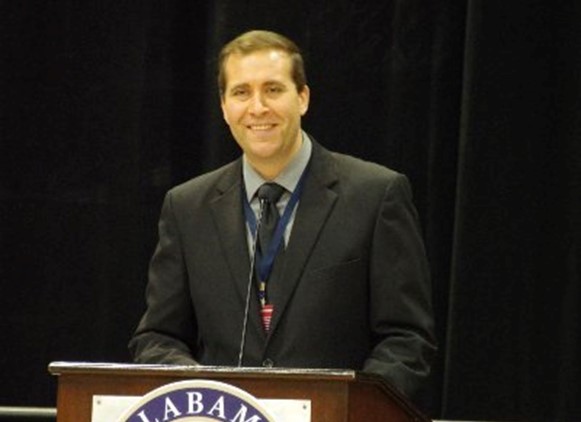
On Saturday, the Alabama Republican Party State Executive Committee voted to pass a rule change barring candidates for State Board of Education, county school superintendent, and county board of education from accepting donations from either the National Education Association (NEA) or its Alabama affiliate, the Alabama Education Association (AEA). The rule change, which does not retroactively apply to past election cycles, will apply to the 2024 elections. The rule change was sponsored by Alabama Republican Party Chairman John Wahl. “One of my goals with this Standing Rule Amendment is making sure our school board and superintendent candidates are not dependent on any special interest group,” said Wahl. “With that in mind, I have already committed that the Party will step in and replace any funding lost should it become necessary. The Alabama Republican Party is in an extremely strong position financially, and we will have our candidate’s backs.” Since Wahl was the author of the proposed bylaws change, he handed over his Chairman’s gavel to Alabama Republican Party Vice Chair Joan Reynolds for this debate while leading efforts on the floor to pass his bylaws change. The Wahl amendment was weakened somewhat in an agreed-on change when the words “and coordinate with” were removed. This effectively means that the candidate could still coordinate with AEA efforts to smear their opponent on an issue such as a school tax increase that both support. The original wording would have made both activities grounds for removal from the ballot. Hale County Commissioner Don Wallace offered an amendment to the rule change that would have also applied to candidates for the Alabama Legislature. State Representative Ron Bolton (R-Northport) objected to Wallace’s amendment and asked that it be tabled. State Auditor Andrew Sorrell said there would be time to consider extending this to other offices in future meetings, but with the 2024 election cycle beginning this fall, this was a time sensitive matter. Sorrell is the Bylaws Committee Chairman for the Alabama Republican Party and the State Auditor. Wallace replied that the State Legislature just passed the largest school budget in state history and voted down school choice legislation, and were likely to consider an even bigger $10 billion education budget next year. Wahl said Governor Kay Ivey has pledged that the state will pass one of the strongest school choice laws in the nation next session. The members of the executive voted to take consideration of the Wallace amendment. They also voted to table a second amendment which would have applied to all Republican candidates – no matter what the office. Jefferson County Republican Party Chairman Chris Brown made the argument that while he advises all of his clients and candidates never to take AEA dollars, the GOP has disqualified candidates from the ballot for several different reasons, and by putting this in the bylaws, it could make those efforts to disqualify future candidates more difficult. He then introduced a resolution to table the Wahl bylaws change. In what appeared to be a stunning rebuke of Chairman Wahl, the Executive Committee voted to table the proposed bylaws change. The State Executive Committee then moved on and passed a number of other bylaws changes – including making the bylaws and rules committees permanent committees and establishing that the state executive committee will pick the delegates to the Republican National Convention. After the other bylaws changes had passed, Sorrell said that in respect for all of the hard work that Chairman Wahl put into his AEA bylaws change, he asked the Committee to reconsider its earlier vote. The Committee then voted to pass the bylaws change. “The Party is strongly committed to protecting our children from indoctrination in the classroom by left-wing groups like the NEA and its affiliated organizations,” Wahl explained. “Parents should decide what their children learn about divisive concepts, not education unions that have lost touch with the values of the American people. Transgender ideology and other woke policies have no place in our schools, period. So many of our parents and local teachers want to see change in our education system, but how can we expect our superintendents and school board members to stand up against teaching these woke concepts if they are afraid of the money and financial power coming from liberal unions responsible for pushing this type of curriculum? It’s a blatant conflict of interest and something that needs to be addressed. Our elected school representatives must be responsible to Alabama parents, not special interest groups. This will stop this conflict of interest and is no different than the state’s prohibition on members of the Alabama Public Service Commission accepting donations from the utilities they regulate. The bottom line is it’s time to get woke agendas out of our curriculum and out of our classrooms.” This rule change only applies to Republicans. The AEA may still donate to candidates for school board, superintendent, or State Board of Education, but candidates who accept AEA contributions will have to run as Democrats or as independents. Republican state legislators, as well as statewide and county officeholders (outside of the school boards and school superintendents), may still take AEA and NEA contributions. The roughly 475 members Alabama Republican State Executive Committee is the largest state committee in the country. All 67 counties are represented on the state executive committee. It meets at least twice a year, holding meetings in both the summer and the winter. All 67 counties have a county Republican Party where members of that county party elect a chairman. The 67 county chairmen all are members of the state executive committee. There are members of the state executive committee elected by the Republican primary voters of each county. Additionally, the state party awards counties bonus members based on its GOP election performance. The bonus member spots are then filled by the members of the county parties (in most cases, the county party executive committee). To connect with the author of this story or to comment, email brandonmreporter@gmail.com.
Alabama lawmakers advance historic pay raises for teachers

Alabama lawmakers are poised to approve the largest pay raises in a generation for experienced public school teachers in an effort to keep educators from leaving state classrooms. The Alabama Senate voted 32-0 Thursday for the budget that would raise minimum salaries for teachers with nine or more years experience. The raises would range from 5% to nearly 21%, depending on years of experience. Sen. Arthur Orr, the chairman of the budget writing committee, said the goal is to encourage experienced teachers to stay in the classroom and to attract more students to the field of teaching. The spending plan now moves back to the Alabama House of Representatives, where House leaders have expressed support for the raises. “Hopefully, seeing those pay raises, we’ll have more people staying in education rather than saying, ‘I’m out, I’m tired,’” Orr, a Republican from Decatur, said. The size of the raise would be based on a teacher’s years of experience. A teacher with a bachelor’s degree and 20 years of experience would see their salary rise from $51,810 to $57,214. A teacher with a master’s degree and 25 years of experience would see their pay rise from $61,987 to $69,151. Teachers with less than nine years of experience would see a 4% raise. Orr said the state has competitive salaries for new teachers compared to surrounding states, but the state is “falling behind” in salaries for mid-career educators. The proposal would also provide an automatic 1% yearly raise and do away with a salary cap that currently ends step raises after 27 years of teaching. Orr said that should give educators — and those considering teaching as a career — some minimum guarantee of how their salaries will increase over time. School systems in Alabama and across the country have reported concerns about teacher shortages, particularly as the coronavirus pandemic accelerated a wave of retirements. That has led states to look at pay increases and other measures to try to recruit and retain educators. Amy Marlowe, executive director of the Alabama Education Association, said the positive response from teachers has been “just overwhelming.” “This will do more to keep people in the classroom than what we originally thought,” Marlowe said. Marlowe said school systems are seeing a teacher shortage in all subjects and in all grades as educators leave the classroom for retirement or other jobs. She said the state is at the precipice of a staffing cliff unless something is done. Under the current proposal, teachers with 35 years experience would see a record-setting yearly raise of nearly 21%, Marlowe said. Marlowe said teachers last saw large pay raises in the 1980s when lawmakers approved 15% increases for two consecutive years during George Wallace’s last term as governor. Mississippi Gov. Tate Reeves on Wednesday signed legislation authorizing a pay raise for that state’s public school teachers, long among the lowest-paid in the nation. Republished with the permission of the Associated Press.
Kay Ivey faces decision on promotion requirement for 3rd graders

After the COVID-19 pandemic interrupted classrooms, Alabama Gov. Kay Ivey faces a decision whether to delay next year’s high-stakes requirement to hold back third-graders who aren’t reading on grade level. Ivey has through Thursday to sign legislation by Sen. Rodger Smitherman, a Democrat from Birmingham, that would push back the promotion requirement from the 2021-22 school year to the 2023-24 school year. If she does not sign the bill, the legislation will die by what is known as a pocket veto. Ivey spokeswoman Gina Maiola said the bill is under review. The governor’s office is getting lobbied both by people asking her to approve the delay and others seeking a veto of the bill. Supporters of a delay argue it will be unfair to force the requirement on students who were out of the traditional classroom for long stretches during the pandemic. But opponents argue it will be a disservice to students to delay the promotion requirement — a part of a broader state program to boost literacy — or that the state should wait until the latest test scores are available to decide. The Alabama Education Association, the state lobby representing public school employees, said teachers have called and emailed asking Ivey to sign the bill and approve the delay. The group said many Alabama teachers have not received the training required under the 2019 law. “Students also need more time to make up for learning loss. It is not feasible to implement the law as it currently stands while students and educators are trying to recover from this unprecedented school year,” the AEA said in a statement on the legislation. Republican Rep. Terri Collins of Decatur, who sponsored the original measure in 2019, said she is hopeful Ivey will veto the bill. Collins has said lawmakers should wait and see the latest test scores before deciding if a delay is needed. “To continue moving forward is the best thing for the children,” Collins said. The Republican representative said lawmakers will have have “plenty of time” to approve a delay in the 2022 legislative session if the test scores show large numbers of children might be held back. Collins said she met with the governor Tuesday. Alabama lawmakers in 2019 approved several initiatives to try to boost reading scores. It included that beginning in the 2021-22 school year, third graders would be required to meet reading benchmarks before moving to the fourth grade. Students would have to make a minimum score on a reading assessment or demonstrate mastery of all third-grade state reading standards as evidenced by a student reading portfolio. Republished with the permission of the Associated Press.
Teachers group files suit over charter school

The state teachers lobby filed a fraud lawsuit Friday against the creators of a planned charter school in south Alabama accusing them of misleading a state commission about their finances and level of community support. The lawsuit filed by the Washington County chapter of the Alabama Education Association seeks to block public funds from going to Woodland Preparatory school in Washington County. “The citizens of Washington County do not want this school,” AEA Associate Executive Director Theron Stokes said in a press conference. The lawsuit claims the planned charter school does not have significant support from the community, as required by law, and is a front for a private education company. A lawyer representing Woodland Prep disputed the accusations and said local supporters wanted a school choice option because of concerns about test scores at traditional public schools in the county. “While we’ve been trying to give students and parents an option for a better education, the opposition in Washington County has been led by teachers afraid of losing their jobs and union bosses who fear losing union dues,” a statement released on behalf of Woodland Prep said. The suit names Washington County Students First, the locally incorporated group, that applied to start the school, and consultant Soner Tarim and his company Unity School Services who were hired by to operate Woodland Prep. Stokes said they believe that the group who applied to open the school is a front for Tarim. “We feel like this is an attempt from someone who wants to get a payday,” Stokes said. Woodland Prep’s statement said the school’s board picked Tarim “to bring about an innovative and challenging educational opportunity” to students in Washington County. The Alabama Public Charter School Commission gave the permission to open the charter school. The approval came despite that the National Association of Charter School Authorizers found the application “does not meet the standard for approval,” according to the lawsuit. Woodland Prep was supposed to open this month but received an extension. The lawsuit also accused the school of improperly seeking students from Mississippi to attend the school that would be funded with Alabama tax dollars. Woodland Prep denied that but said it has been targeting parents from Washington County who are currently sending their children to schools in Mississippi “in hopes of a better education.” Public charter schools are schools that receive government funds but operate independently. Alabama lawmakers authorized the creation of charter schools in 2015. A few have opened but more are planned. Stokes said AEA is not opposed to all charter schools. “This is not about charter schools. This is about bad charter schools,” said Tom Loper, an attorney representing the plaintiffs in the case. Republished with permission of the Associated Press.
Alabama Education Association calls for end to state’s ‘Failing Schools List’
The Alabama Education Association (AEA) — statewide professional organization that represents public school employees in the state of — is asking state lawmakers to repeal the Alabama Accountability Act (AAA), a law that allows parents to transfer students from schools that have been placed on the state’s “Failing Schools List” to other schools not on that list. The AEA published their call to lawmakers in the latest edition of the Alabama School Journal. The issue: the AAA creates a refundable income tax credit to reimburse Alabama taxpayers who are the parents of students enrolled in or assigned to attend a failing K-12 public school to offset the cost of transferring the student to a non-failing public or nonpublic school of the parents’ choice. The AEA says this is taking money from cash-strapped, failing schools. “Since its inception in 2013, the Alabama Accountability Act (AAA) has directly siphoned more than $140 million from Alabama’s cash-strapped K-12 classrooms,” wrote the AEA. “The mounting reports of ineffectiveness of the program come as no surprised to education officials who correctly warned of the AAA’s flaws in 2013.” “AEA encourages educators to share the data list in the chart [above] with all concerned citizens… talk to your community leaders about the financial losses to your school district due to the AAA,” the AEA added in the article.
AEA helps Irondale teachers fight back against city’s new occupational tax

Despite public outcry, the City of Irondale, Ala. unanimously approved and passed a one percent occupational tax during its Council Meeting back in May, which went into effect Aug. 1. The decision came in an effort to remedy the city’s $1.6 million budget deficit, due in part the city losing a big chunk of the yearly tax revenue when Sam’s Club closed. But a lot of people aren’t happy about it, including Irondale’s teachers. Which is why the Alabama Education Association (AEA) — statewide professional organization that represents public school employees in the state of — is now helping teachers in city fight back against the new occupational tax. “Public education employees cannot afford anything else to come out of their pay checks and that’s just the bottom line,” Tracee Binion, Uniserve Director for District 28, told WVTM-13. She said the tax could cost some teachers as much as $500 a year, leaving Irondale teachers to be paid less than their Jefferson County counterparts, despite also being located in Jefferson County. Teachers voice their disapproval In conjunction with school going to into session, earlier of this month dozens of Irondale teachers went down to City Hall to voice their disapproval. “We have many teachers..many of our child nutrition professionals couldn’t be here tonight and that is because they are working two jobs to be able to support themselves,” Dana Jacobson, the 2017 Alabama School Teacher of the Year, said according to WBRC. “There are some 25-year paraprofessionals that are bringing home less than $25,000 and that will take $250 out of their pay and when you think they could be living on this salary..that is a burden.” The AEA intends to file a motion against the city in the next few weeks.
Here’s why Alabama’s Open Meetings Law is important to you
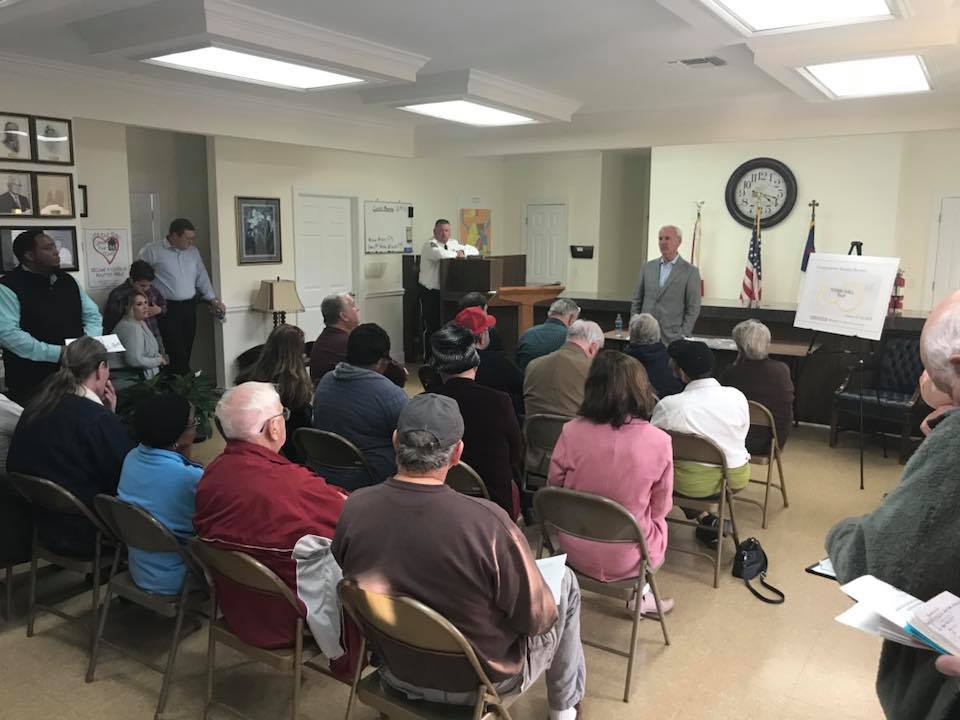
“It was pretty egregious,” said Brandon Cox, publisher and editor at the paper as well as the author of the column that sparked the controversy. Prior to his column, Cox said there were rumblings of access issues in the town of about 200 people because officials had closed a school with little notice by adding a last-minute agenda alteration. After that, he received word about rules barring admission to city meetings and what seemed like a overall refusal to grant public records requests. A call to the city’s clerk and Paint Rock Mayor Brenda Fisk seemed like it wouldn’t lead to much on a Friday nearing deadline as Cox prepared to head out of town for the weekend. Then the phone rang. “She said if you don’t live here, you don’t have any business here,” he said. “She stood by it and she was pretty aggressive about it.” — Almost 300 people crowded into the City Hall auditorium, shouting down supporters of an unpopular insurance change. The mayor was booed from the podium at one point. — At least five, possibly six, council members headed to a back room behind a locked door to iron out a compromise resolution — Under Alabama law, a quorum is half of a body’s members. The City Council has nine members, though one seat is currently vacant. — Experts and advocates said the council’s meeting last week raised eyebrows, especially since they came from behind closed doors and passed a resolution with little discussion. — City officials said there was never five members in the room at one time, but state law also forbids the cycling of members in and out of the room to avoid a quorum. — Advocates said the meeting likely violated the spirit of the law. There isn’t any central database for recording open meeting act violations because they are brought as civil suits, but a cursory search shows several instances of alleged violations over the last few years. Since the 2015 amendments to the Act, there have been at least 10 reported allegations of violations of the law, according to various news reports, with groups ranging from the Alabama Ethics Commission, the Gadsden City Board of Education and the Gulf Shores Schools Board of Education. Last August, a 2016 increase in Alabama teachers’ health insurance premiums was reversed after a judge sided with the Alabama Education Association over open meetings violations, according to the Lagniappe Weekly. Often times, those issue are not prosecuted though, especially when the issues over which an open meeting was closed proves to be non-controversial. — An Alabama citizen, the attorney general, media company or the circuit’s district attorney can bring forward action in civil court. No member of the governmental body can bring suit against the others in that same group. — For each violation of the meeting, each official can be fined $1,000 or half of their governmental monthly salary, whichever is less. The minimum penalty is $1. — Monetary violations can also be levied in cases of improperly called executive sessions. — The court can also invalidate the actions taken in the meeting that violates the act, provided that the complaint is filed within 21 days of the action being made public, similar to the judges reversal in the AEA insurance case. — Multiple violations raised from the same instance are combined into one case. — The governmental body can pay for the expenses of the present or former members that violate the law. With advocates concerned about the violations, some are calling for increased penalties and enforcement of the law. Alabama Sen. Cam Ward, R-Alabaster, who led the charge in his chamber to strengthen the law in 2015, said he wants to revisit the act in the upcoming session. “I think we could look at increasing the penalties,” he said. “You have to make it more of a deterrent or they aren’t going abide by it.” When asked about several cases where bodies may have possibly violated the law accidentally, like a legal official hinted at in Montgomery, Ward was emphatic. “Ignorance of the law is no excuse. On that point, I don’t have a lot of sympathy.” Advocates that talked with the Advertiser previously agreed with that assessment of open meetings laws, saying violations are violations, no matter the intent. “Even if it was inadvertent, it doesn’t take away the fact that there was an attempt to engage in a public decision process without accountability,” said Noel Isama, a senior policy analyst at the Sunlight Foundation, a nonpartisan, nonprofit open government advocacy group. Cox said that in Texas, where he recently worked, there are stringent rules for open meetings and public records training to make sure that officials are well-versed in the laws. “You actually had to take a course and pass a test. Here I don’t think there is any of that. These people want to do well, they just have no guidance,” he said. That ignorance extends itself to public records disclosure, another central piece to the issues in Paint Rock that feel to the wayside amid the explosion of scrutiny related to their closed meetings. Ward said he wants to tighten up those laws as well, which have become increasingly clouded with technological advances. Officials can avoid disclosing their emails, for example, by using a personal account, he said. That intentional skirting of the law is a perfect parallel to the changes he made in 2015 that stopped officials from holding “serial meetings” that skirted the quorum rule on purpose without breaking the law. It comes down to accountability in both meetings and records, Ward said, which helps expose misguided or wrong-doing by public officials. “I think,” Ward said, “they go hand-in-hand because they are about transparency in your governments activities.” Republished with the permission of the Associated Press.
Will Barfoot and the art of the political mulligan

With the election of President Donald Trump, the true spirit of the Republican Party — small government and fiscal conservatism — is even more popular than it was during Ronald Regan’s presidency. This especially true in Alabama where Trump’s approval rating hovers around 63 percent. It’s no wonder why candidates in competitive primaries across the state are running to the right, regardless of the political ideologies, hoping to woo a segment of the electorate that loves Trump and loathes Democrats. That’s why it’s important for voters to look beyond what candidates are saying in trying to align themselves with Trump, but to also look at what they’ve said and done in the past. Flash-back to 2006 12 years ago, Montgomery-attorney Will Barfoot ran for the Republican nomination for Alabama’s Senate District 25 seat, which covers parts of Elmore, Montgomery and Crenshaw counties. Ultimately he was bested by Larry Dixon in the primary, but not before Dixon and his other GOP opponent Suzelle Josey pointed out that they didn’t believe Barfoot was Republican enough. They believed he was cozying up to Democrats for donations a bit too much for GOP-comfort and criticized his willingness to accept support from anyone. In May 2006, the Montgomery Advertiser doubled-down on the accusations against Barfoot when one of their staff writers wrote a piece titled “Candidate crossing party lines,” detailing how Barfoot said he welcomed “support from the Democrat-aligned Alabama Education Association, a group the Alabama Republican Party has come out against with a resolution not to take campaign money from the powerful teachers’ lobby.” “AEA union boss Paul Hubert has tried basically to buy the State house and run the Democratic agenda, said then Alabama Republican Party Chair, and current Lt. Governor-hopeful, Twinkle Andress Cavanaugh told the Advertiser.. “We frown upon anybody taking the money.” Taking home only 32 percent of the votes, the election was a swing and a miss for Barfoot, who’s steered clear of running for office again the past decade. 2018 election Fast-forward 12 years later and we find Barfoot is taking a mulligan. Having learned his lesson in 2006 — and hoping to cash in on a forgetful electorate — he’s now running as an über-conservative. Gone are the days of trying to woo Democratic supporters, Barfoot has yet to take a check from a Democratic organization’s (according to his campaign finance reports anyway) this election cycle. Instead, he’s touting himself as the anti-career politician with out-of-the-box ideas. Senate District 25 The seat is currently held by Pike Road-Republican Senator Dick Brewbaker who announced in November 2015 that he will not seek re-election. Barfoot faces Vice-Chairman of the Montgomery County Commission Ronda Walker in the June 5 Republican primary. The winner go to face whomever advances from the Democratic primary: David Sadler or Frank Snowden in the November 6 general election.
Judge rules against Montgomery’s first charter school; won’t open in 2018
Montgomery’s first charter school is no longer on track to open in 2018. On Tuesday, Circuit Judge J.R. Gaines ruled the Alabama Public Charter School Commission’s 5-1 vote to approve the LEAD Academy’s application for a charter school missed the mark by one vote that it legally needed for approval. Alabama law requires at least six votes for the charter school’s approval to be valid. The judge’s decision follows a March lawsuit made against the school by the Alabama Education Association, which alleged the state charter commission’s approval of Montgomery’s first-approved charter school was “invalid” or “arbitrary,” calling into question the legitimacy its approval of LEAD Academy. It named both LEAD Academy and state commission members as defendants. The AEA applauded Judge Gaine’s decision, which they believe stops “the unlawful granting of a charter school to out-of-state investors.” “The Commission’s own national experts said this application was deficient in all three core areas it reviewed and should be denied,” explained AEA President Sherry Tucker. “Thus, it was no surprise that its backers could not get enough votes in favor of it. AEA will continue to be the strongest supporter of all students in all of Alabama’s public schools.” Theron Stokes, AEA Associate Executive Director, added, “AEA will remain vigilant and fight all attempts to illegally divert public school dollars from Alabama classrooms to out-of-state, for-profit, charter school corporations and those operators should know that before trying to take public money from our public schools. We celebrate this victory for the students in the Montgomery Public Schools and the taxpaying citizens of Montgomery County.” But the school’s spokeswoman said they’re not giving up. The school’s chairwoman Charlotte Meadows told the AP, “it’s a sad day for our students” but “this is not the end of a charter school in Montgomery.” Meadows said she’s looking into legal options, but the start date may be delayed to 2019. Last month the school secured a facility for its learning center, after their initial plans to renovate the building that houses the Small Business Resource Center in downtown Montgomery fell through in February. When it opens, LEAD Academy will be located at the former Algernon Blair Building, which previously served as a bank headquarters, at 2897 Eastern Boulevard.
Women of Influence: Alabama Democratic Party Chair Nancy Worley
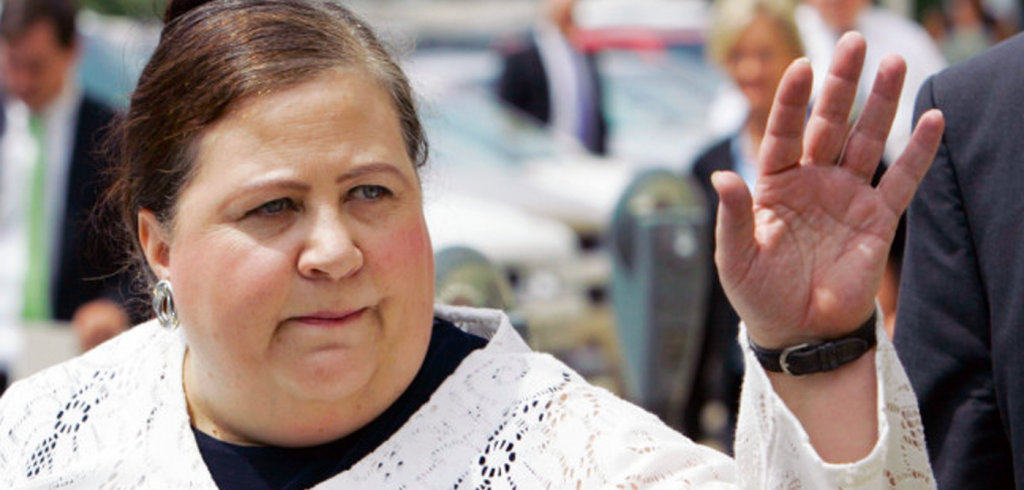
Nancy Worley has been an influencer in the state of Alabama for over forty years. Worley, a lifelong resident of the Yellowhammer State, grew up in New Hope, Ala. on a family farm. She attended the University of Montevallo receiving her Bachelors degree in 1973; then continued her education at Jacksonville State University, obtaining a Master’s degree in 1975. After graduation Worley taught in the public school system in Decatur for 25 years. In addition to teaching English and Latin she was very active in the school, sponsoring and leading numerous professional and civic organizations, student clubs, as well as coaching the cheerleaders. Worley also fundraised for the Cystic Fibrosis Foundation and American Heart Association. All the while also teaching part-time for Northeast State Community College and John C. Calhoun Community College. Her work within the Decatur school system earned her the Teacher of the Year award. Twice. She was also nominated to the Teacher Hall of Fame. The Alabama Jaycees, a Junior Chamber civic organization, recognized Worley as Alabama’s Outstanding Young Educator, and Good Housekeeping magazine honored her as one of the “100 Young Women of Promise.” Worley received several more honors and awards including being named by The Decatur Daily as one of the “Twenty Leaders of Decatur,” the Alumnus of the Year honor at the University of Montevallo, and the Education Award by the Alabama Senior Citizens Hall of Fame. Worley’s career in leadership began in 1983 when she was elected statewide to serve as President of the Alabama Education Association, she later won this election again and served from 1995-1997. She held many leadership positions since then, serving four terms on the Alabama Democratic Executive Committee; State President of the Association of Classroom Teachers, twice, and twice as State President of the American Association of University Women (AAUW). She was also the President of the Decatur Education Association, the Alabama Foreign Language Teachers Association, Alabama Classical Association and the Opportunity Toastmistress Club. Career of public service From 2002-2007 Worley served as the Alabama Secretary of State implementing substantial reforms to voting practices including longer and uniform polling hours, voter identification, and automatic recounts in close races. Worley previously served on the Welfare Reform task force, the Education Reform task force, the Lt. Governor’s Legislative Council, and the Tuition Eligibility Board. She spent time lobbying with the AARP Capital City Task Force on Senior Citizen issues, and worked with retired educators from The Alabama Retired Teachers’ Association, and was one of only seven super delegates to the 2016 Democratic National Convention from Alabama. In 2007, Worley became vice-chair of the Alabama Democratic Party until 2013 when she was elected to serve as the party’s chairman; a position she has continued to hold. Worley is a woman who is absolutely dedicated to serving others, and her many years of experience in education and politics speak for themselves; but just in case you needed to hear directly from her, she was kind enough to answer some of Alabama Today’s questions about her life, work and influences: How have other women influenced your success? Several women in my family, along with numerous female teachers, church, community, civic and political leaders taught me the value of hard work, the importance of education, the need for involvement in community and causes, and respect for the dignity of all persons. Looking back over my life, these women “took me under their wing,” and nourished, protected, promoted, and pushed me to set goals, and work to achieve those goals. What shaped your desire to work with education and government? Several family members were educators, and a few were involved in government; therefore, I grew up knowing that both professions made a difference in many lives. I began my professional career as an educator with a strong desire to make a difference, to enhance young minds, to move students forward and to see them succeed. Although my career as an educator was quite fulfilling, I realized that government also played a large role, perhaps a larger role, in making a difference. After all, government controls our economic well being, our basic health needs, our access to public education, the quality of air we breathe, the cleanliness of the water we drink, the affordability of housing, etc..; therefore, I became involved in government to make a difference. What has been your favorite area of service, and what is your favorite thing about that position? I have enjoyed all my positions of service; however, every job has its good days and its bad days. I loved the classroom (most days), and I will always be an educator “at heart,” but I am equally inspired by how much government can do to help others. Have you read any books that have shaped your perspective on life? I grew up with a Mother who took me to church “every time the door was open”; therefore, at an early age, the Bible and its teachings certainly shaped my perspective on life. I studied and taught English and Latin; therefore, classical to modern authors/books also shaped my perspective on life. What advice would you give to young women who want to work in education or politics? My best advice to young women who want to work in education or politics is listen and study at home, in school and beyond, learn as much as possible about a variety of subjects, get involved in the community in which one lives, work hard with the “perfection ethic” as a guide to complete any job, no matter how menial, and always try to do what is right, to the best of one’s ability. How do you spend your (rare) free time? My free time is rare; however, I enjoy reading a magazine or book, attending the theatre, a concert, etc., going to a place I’ve never been, from a “tourist trap” to an isolated location, sitting and talking with a friend in a restaurant, or hearing an excellent speaker, panel, etc
Ed Richardson says Montgomery schools need to cut teachers jobs
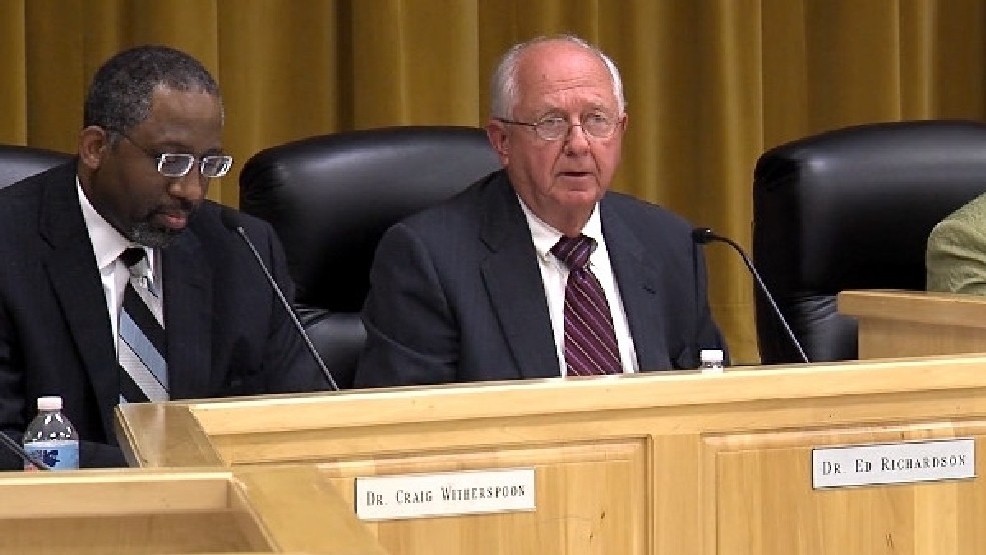
An interim superintendent in Alabama says about 200 teacher positions in Montgomery will have to be eliminated and outsource 400 support jobs to stabilize finances. Al.com reports that Ed Richardson says the Alabama Education Association could have prevented the job cuts for Montgomery Public Schools if it had not gone to court to block his plan to sell Georgia Washington Middle School to the town of Pike Road. Richardson led a state intervention into Montgomery schools because of financial and academic problems. Montgomery Mayor Todd Strange joined Richardson during the news conference Thursday. The city has no authority over education, but the city expended some time and money studying the possibility of a city school system but determined it was not feasible. The AEA represents teachers and other education employees. “Now here’s a system that’s already struggling with academic problems,” Richardson said. “The original plan, we did not have to cut any teacher nor outsource any employees. And now we’re faced with that distasteful task and by the end of this month, April, we will make those decisions.” The AEA said in a statement that Richardson had a conflict of interest since he worked as a consultant for the Pike Road system. “Anyone paying attention to the matter knows Ed Richardson has a personal issue with AEA,” AEA President Sherry Tucker said in a statement. “This is causing him to make decisions that he thinks will hurt AEA, regardless of if they will help the children of Montgomery County.” However, Richardson said the AEA’s claim is “totally false.” “Wherever I’m employed is where I give my full attention,” Richardson said. “In this case it’s trying to get the intervention for Montgomery Public Schools in a position where they have a chance to be released sometime in the near future.” Richardson said he still expects Georgia Washington and the three other schools to close. Robert Porterfield, president of the Montgomery Public Schools Board, said Richardson was being prematurely negative. “We were accredited before the state came and we have not been unaccredited and I think you’re making a big to-do out of this before the board gets an opportunity to even see what they’ve come up with,” Porterfield said. Republished with the permission of the Associated Press.
Montgomery Public Schools receives $1.4 million reimbursement

A school system in Alabama has a received $1.4 million reimbursement for money that was wrongly sent to another school system in 2016. Al.com reports that the state Department of Education reimbursed the funds to Montgomery Public Schools after improperly sending money to the Pike Road system. The Alabama Education Association made the announcement. “We are happy that these funds will finally be where they were supposed to go in the first place – Montgomery Public Schools,” AEA Associate Executive Director Theron Stokes said in the press release. Montgomery Public Schools Interim Superintendent Ann Roy Moore said the funds have already been deposited. The misdirected money was mentioned in a lawsuit that the AEA filed last month against Interim Superintendent Ed Richardson to block the sale of Georgia Washington Middle School to the Pike Road system. Richardson is overseeing an intervention of Montgomery Public Schools by the state for financial and academic reasons. He announced plans to sell Georgia Washington Middle School to Pike Road to help shore up finances for the Montgomery system. The plan also included closing Chisholm, Dozier and Floyd elementary schools, selling unused property, eliminating 17 central office positions and other steps. Michael Sibley, spokesman for the Department of Education, said Richardson’s plan to sell Georgia Washington came after the Montgomery County BOE initially voted to sell the school. In the AEA lawsuit, filed on behalf of three Montgomery school employees, the AEA claimed that Richardson had no authority to sell the school and was not acting in the best interests of Montgomery schools, noting that he had worked as a consultant for Pike Road when it separated from the Montgomery system. In response, Richardson said his goal was was to address what he described as “dismal student achievement” in Montgomery’s non-magnet schools. Theron Stokes said Montgomery Public Schools received the $1.4 million through mediation in the lawsuit. Republished with the permission of the Associated Press.
