
Alabama beats Clemson, will take on Georgia in the National Championship game
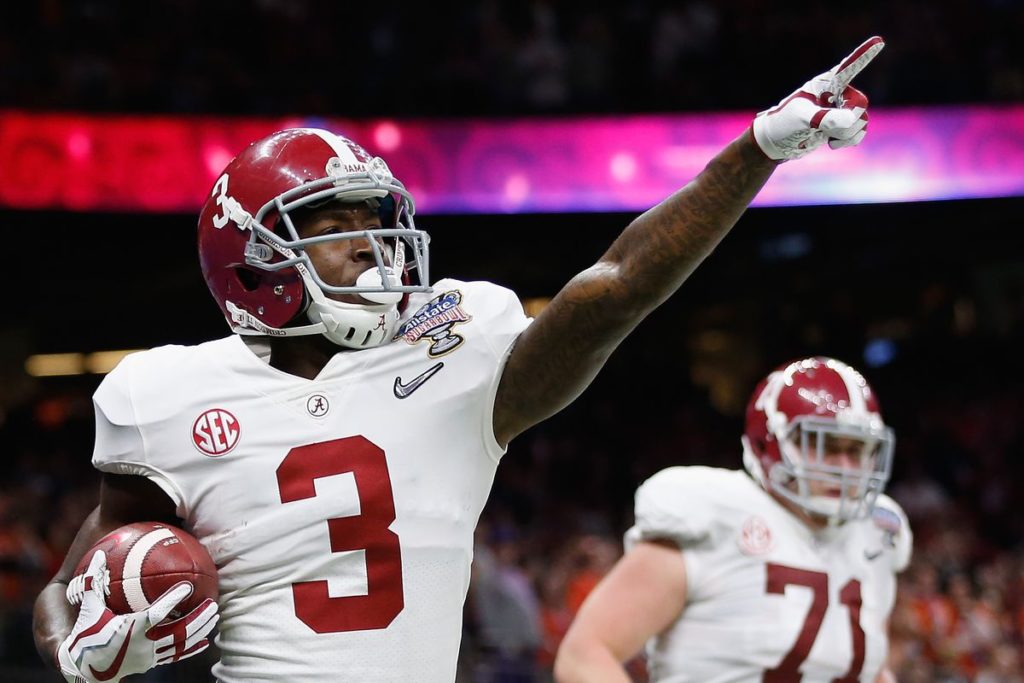
Monday night Alabama’s Crimson Tide beat the Clemson Tigers 24-6 in the Sugar Bowl just hours after the Georgia Bulldogs bested the Oklahoma Sooners 54-48 in an exciting double-overtime in the Rose Bowl, advancing both teams to the 2018 College Football Playoff National Championship next Monday night. For the second time in seven seasons, two teams from the Southeastern Conference (SEC) will go head-to-head for a national title. Alabama will be playing in its sixth championship game in nine seasons, while Georgia is aiming for its first title since 1980. Here’s what you need to know: Who: Alabama vs. Georgia What: College Football Playoff championship When: Monday, Jan. 8, 2018 Where: Mercedes-Benz Stadium, Atlanta Time: 7 p.m. CT TV: ESPN Livestream: WatchESPN
Crimson Tide in the college football playoffs; Auburn faces another unbeaten in Peach Bowl
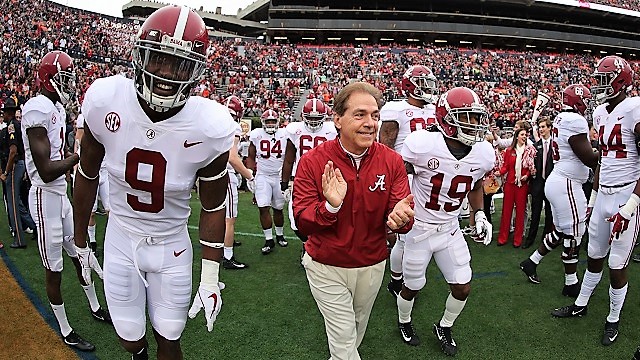
A really imaginative tweet went out Saturday night. “With the noon (Eastern) time college football playoff show, will there even be church services in Alabama, or just all morning prayer vigils? Houndstooth blazers required.” With the noon time college football playoff show, will there even be church services in Alabama, or just all morning prayer vigils? Houndstooth blazers required. — drgraves-UGA Adm. (@drgravesUGA) December 3, 2017 Those prayers of Crimson Tide fans were answered Sunday morning as Alabama was awarded the fourth and final slot in the college football playoffs. Coach Nick Saban’s squad will face CFP No. 1-ranked Clemson in a national semifinal at 7:45 p.m. CST on New Year’s Day in the Allstate Sugar Bowl at the Mercedes-Benz Superdome in New Orleans. “Dabo (Swinney) has done a fantastic job with that program,” Saban said of the Clemson coach. “They’ve been consistently successful and this will be the third year we’ve played them in the playoff. I know our guys will be ready to play and will have a tremendous amount of respect for Clemson. We’ll have to play our best game of the year to have a chance to be successful against them.” The No. 2 Oklahoma Sooners and No. 3 Georgia Bulldogs will play in the other semifinal game at the Rose Bowl in Pasadena, California, at 4 p.m. in the Rose Bowl. Georgia punched its ticket into the playoffs by beating Auburn 28-7 in a rematch of the Tigers’ 40-17 victory three weeks prior. The national championship game is at 7 p.m. on Jan. 8 in Atlanta’s Mercedes-Benz Stadium. All three games are on ESPN. Alabama Athletic Communications reported Sunday that Tide Pride members have until 5 p.m. on Monday, Dec. 4, to submit requests for playoff semifinal and championship game tickets. Each participating school will receive 13,000 tickets for the semifinal and 20,000 tickets to the championship. Other than the tickets allotted to the schools, the game is sold out. All requests made by University of Alabama constituency groups (Tide Pride, lettermen and faculty/staff) will be evaluated for all games following the request deadline. For the Allstate Sugar Bowl, all confirmed ticket requests will be shipped to customers via UPS, with a planned shipment date of Friday, Dec. 15. For the championship game in Atlanta, all confirmed requests are planned to be sent via mobile ticket (email and Ticketmaster app download) delivery with a planned send date of Thursday, Jan. 4. Ticket prices are as follows: semifinal Allstate Sugar Bowl: $275 club and $175 reserved; national championship: $675 (club), $575 (100- and 200-level seats) and $475 (300-level seats). The ability to request tickets does not guarantee tickets. If demand is greater than the allotment of tickets received, refunds will be given based on Tide Totals priority points. Lettermen should note that, if requests received exceed the lettermen allotment, requests will be filled based on last year lettered. UA faculty/staff should note that, if requests received exceed the faculty/staff allotment, requests will be filled based on years of service. “We’re extremely pleased for our team, our players, our coaches and all the people who work hard here for us,” Saban said. “I’d like to congratulate the other teams that will have the opportunity to participate in the playoff as well as the teams who were considered and had potential to be selected. We are really pleased and happy to be a part of the college football playoff again this year.” Since its inception in 2014, Alabama is the only team to appear in all four playoffs, and has appeared in the top five of every poll put out by the selection committee over the past four seasons. The Crimson Tide and Clemson will meet for the 18th time in the history of the series that dates back to 1900. Alabama owns the series advantage, 13-4. The two most recent matchups came in the 2016 and 2017 national championship games. Alabama rallied to defeat the No. 1 Tigers, 45-40, to capture the Tide’s 16th national championship in the 2016 game in Glendale, Arizona. The Tigers returned the favor with a come-from-behind 35-31 win in the 2017 championship in Tampa, Florida. No. 7 Auburn faces American Athletic Conference Champion and CFP No. 12 Central Florida in the Chick-fil-A Peach Bowl’s 50th anniversary game. That contest is set for the Mercedes-Benz Stadium in Atlanta and will be nationally televised by ESPN at 11:30 a.m. UCF is making its first trip to the Chick-fil-A Peach Bowl, while Auburn will make its sixth appearance. Auburn has a 4-1 record in the game, with its most recent appearance resulting in a 43-24 victory over Virginia in 2011. “We couldn’t have asked for a better matchup to celebrate our 50th anniversary,” said Gary Stokan, Chick-fil-A Peach Bowl CEO and president. “To have college football’s only undefeated team square off against the first-ever team to defeat two College Football Playoff No. 1-ranked teams in a season makes for an extremely compelling game.” Auburn’s Gus Malzahn will coach in the bowl game with a new contract. He has agreed to a seven-year deal to remain at the school after a strong late-season rebound, The Associated Press reported on Sunday. Complete financial details were not immediately available but the AP reported Malzahn will make more than $7 million in the final year of the contract. Other Southeastern Conference teams headed to bowl games are: Citrus Bowl presented by Overton (Orlando) – LSU vs. Notre Dame at noon on Jan. 1 on ABC. Academy Sports & Outdoors Texas Bowl (Houston): Missouri vs. Texas at 8 p.m. Dec. 27 on ESPN. Belk Bowl (Charlotte): Texas A&M vs. Wake Forest at noon on Dec. 29 on ESPN. Franklin American Mortgage Music City Bowl (Nashville): Kentucky vs. CFP No. 20-ranked Northwestern at 3:30 p.m. on Dec. 29 on ESPN TaxSlayer Bowl (Jacksonville): Mississippi State vs. Louisville at 11 a.m. on Dec. 30 on ESPN. Outback Bowl (Tampa): South Carolina vs. Michigan at 11 a.m. on Jan. 1 on ABC. UAB got a jump on Selection Sunday. The Blazers released their postseason plans last week, announcing that they’ll play Ohio in the Bahamas Bowl at 11:30 a.m. on Friday, Dec. 22 on ESPN. In other state-connected bowls: R+L Carriers New Orleans Bowl: Troy is the other state team that is
Daniel Sutter: College football, competition and monopoly
The 2016 college football season kicks off with Alabama ranked No. 1, after winning its fourth national championship under Coach Nick Saban last year. Any company dominating its business like the Tide could easily face antitrust charges as a monopolist. Sports, however, illustrate the key role of competition in the economy, even when the same competitor often comes out on top. Alabama’s run of four titles in seven years has only been equaled by Notre Dame (1943-49) in the 80-year history of the AP poll. In the game of Monopoly, play continues until one player has 100 percent of the properties, but in markets the term gets applied well below this threshold. So a charge of monopolization of the championship is plausible. Economist John Hicks wrote that “The best of all monopoly profits is a quiet life,” because a monopolist earns profit with little stress. If Alabama were a football monopoly, Coach Saban and the team are probably wondering when they will have a leisurely stroll to a title. Instead the Tide faces fierce competition annually. While Alabama has a large football budget, according to Knight Commission figures, Auburn, LSU, Tennessee, Ohio State and Texas all outspent the Tide in 2014. Alabama fans know that championships are not automatic, as the 30 years between Bear Bryant’s last title and Coach Saban’s first title brought only one championship and six straight losses to Auburn. Competition ensures that Alabama cannot rest on its laurels. The same applies for Olympic champions like Michael Phelps and Usain Bolt, who continue to win gold medals by besting the best competitors in the world. Economists recognize the same role of competition. As microeconomics students will soon learn, the key factor for monopoly is barriers to entry. This asks, can new firms readily challenge the dominant firm? Absent barriers to entry, a large market share can only be maintained by offering consumers a better product or service, or a lower price. This should affect how we view the economy. John D. Rockefeller started Standard Oil after the Civil War, and by 1890 was refining 88 percent of America’s oil. This was market dominance for sure, but Rockefeller enjoyed no barrier to entry and was challenged by over 100 new refineries. Standard succeeded by continually innovating, and their cost of refining fell from 3 to 0.29 cents per gallon between 1869 and 1897. This helped reduce the price of refined petroleum from 30 to 6 cents per gallon. The discovery of oil in Texas eventually boosted new refiners like Gulf and Texaco, which Rockefeller had no power to prevent. By 1911, when the Supreme Court broke up the company, Standard’s market share had fallen to 64 percent. Unfortunately, antitrust lawyers often view large market share as inherently suspicious, as illustrated in the Alcoa antitrust case. Alcoa had a 90 percent share in the market for new aluminum because they kept their price low, increased efficiency, and expanded capacity. The market dominance was enough for Judge Learned Hand, who wrote in the case, “It was not inevitable that it should always anticipate increases in the demand for ingot and be prepared to supply them. Nothing compelled it to keep doubling and redoubling its capacity before others entered the field.” I would characterize increasing production capacity to meet demand as serving customers. The most prevalent and effective barrier to entry is a legal restriction, which only government can enact. The U.S. Postal Service, for example, enjoys a legal monopoly on the delivery of first class mail. Cities established and maintained cable television monopolies for years. Between the 1930s and late 1970s, the Civil Aeronautics Board (CAB) regulated commercial airlines and never approved entry for a single new airline. All 79 applications between 1950 and 1974 were shot down. Will Alabama win another title this year, or will today’s prominent firms like Amazon, Google, and Microsoft still be significant 20 years from now? I really have no idea. But as long as rivals are free to challenge them, success can result only from sustained excellence, which improves our lives. ••• Daniel Sutter is the Charles G. Koch Professor of Economics with the Manuel H. Johnson Center for Political Economy at Troy University and host of Econversations on TrojanVision. The opinions expressed in this column are the author’s alone and do not necessarily reflect the views of Troy University.
