
Alabama’s long history with Senate special elections
With Alabamians about to head to the polls Tuesday, Sabato’s Crystal Ball published a look back over the Yellowhammer State’s long and fascinating history with Senate special primary elections. Since the ratification of the 17th Amendment, which requires U.S. Senators to be directly elected, Alabama has had five special elections for Senate. The first of those five, held in 1914, was actually “the first to test the authority of a Governor to fill a vacancy since the direct election amendment to the Constitution was adopted” according to a Los Angeles Times article published at the time. The amendment, in part, states “that the legislature of any state may empower the executive thereof to make temporary appointments until the people fill the vacancies by election as the legislature may direct.” But the Alabama Legislature, which didn’t meet annually during that era, wasn’t scheduled to be back in session until 1915. The second race, in 1920, brought about the preferential primary voting system, which requires candidates to win a majority of the vote to secure their party’s nomination. If that doesn’t happen in the primary election, the top two finishers duke it out in a runoff election. The same system is still in place today, and if recent polls are anything to go by, the primary runoff will have to be used on the GOP side again this year. The lead up to the 1938 election saw Alabama with its first female senator, Dixie Bibb Graves, who was appointed by her husband, then-Gov. Bibb Graves, so he could avoid showing any favoritism among candidates in his party. Once the special primary election was decided, Graves rescinded his wife’s appointment and put the winner, J. Lister Hill, into the seat before holding the general election. In the fourth special election saw George Sparkman win a seat in the Senate and avoid a primary runoff with a narrow 50.1 percent victory. He went on to hold the seat for 32 years and is to this day the state’s longest-serving senator. He could have never made it to office, though, if it were not for his two primary opponents splitting the conservative vote down the middle in a contentious campaign. Alabama’s most recent Senate special election was held in 1978, and it is the most similar to the 2017 edition. After the death of Sen. Jim Allen his wife, Maryon Pittman Allen, was appointed to the seat. She was considered a favorite early on in the race but fell sharply in the polls after bad-mouthing then-Gov. George Wallace in a Washington Post interview. The move marked her as undignified and, more importantly, not conservative, though she came in second place in the primary and ultimately lost the runoff by 15 points.
Roscoe Brown, Jr., Tuskegee Airman and educator, dies at 94
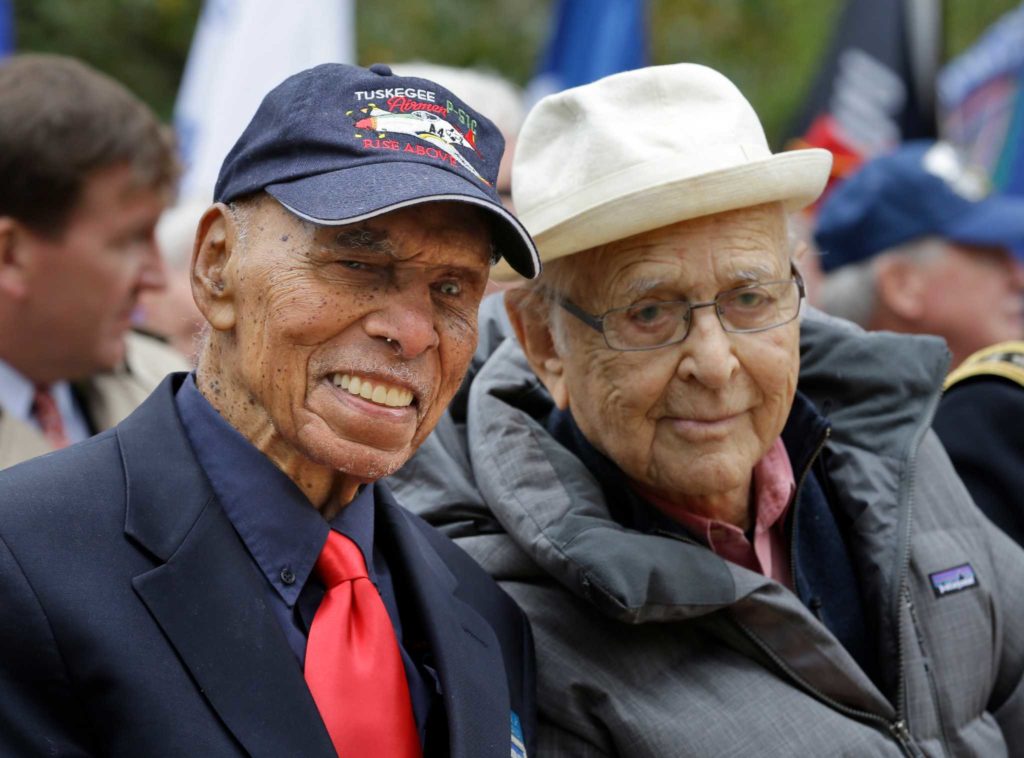
Roscoe Brown Jr., who served with the all-black Tuskegee Airmen during World War II and was a longtime New York City educator, has died. Brown died Saturday at a hospital in the Bronx after breaking his hip in a recent fall, his granddaughter Lisa Bodine said. He was 94. In 2007, Brown and five other airmen accepted the Congressional Gold Medal on behalf of the Tuskegee Airmen. President George W. Bush and Congress awarded the airmen with one of the nation’s highest honors for fighting to defend their country even as they faced bigotry at home. At the time, Brown told The Associated Press that receiving the medal was one of the greatest days in the history of the Tuskegee Airmen. Brown was a commander of the 100th Fighter Squadron of the 332nd Fighter Group, and is credited with being the first U.S. pilot to shoot down an advanced German military jet, the family noted. He earned numerous awards including the Distinguished Flying Cross. Nearly 1,000 fighter pilots trained as a segregated Army Air Corps unit at the Tuskegee, Alabama, air base. Not allowed to practice or fight with their white counterparts, the Tuskegee Airmen distinguished themselves by painting the tails of their airplanes red, which led to them becoming known as the “Red Tails.” Their story was told in a 2012 movie of the same name, on which Brown was an adviser. In a 2011 interview with WNBC-TV, Brown noted that the Civil War occurred only about 70 years before World War II. “I didn’t understand the brutality of the Civil War, but when I was a Tuskegee Airman, I knew that I was good, I knew that I had to challenge the system, and I loved to fly.” “My message to young people is to keep on working,” he added. “You’ve got to be better, you’ve got to be disciplined, you’ve got to believe. And if you believe you can overcome. … That’s the story of the Tuskegee Airmen.” A native of Washington, D.C., Brown held a doctorate from New York University. He served as president of the Bronx Community College at the City University of New York and director of the Institute of Afro-American Affairs at New York University. He was later professor at The City University of New York Graduate Center and director of the Center for Urban Education Policy. For many years, he also hosted “African American Legends,” a public affairs show produced by CUNY TV. During his 17 years at the Bronx Community College, “Dr. Brown intensified the college’s outreach to New York City’s economic and educational institutions through partnerships with business and industry,” said CUNY Chancellor James Milliken. “With his leadership, new programs were developed in high growth professions in the fields of health, technology and human services.” Republished with permission of The Associated Press.
