
Kay Ivey delivers books to Chisholm Elementary school
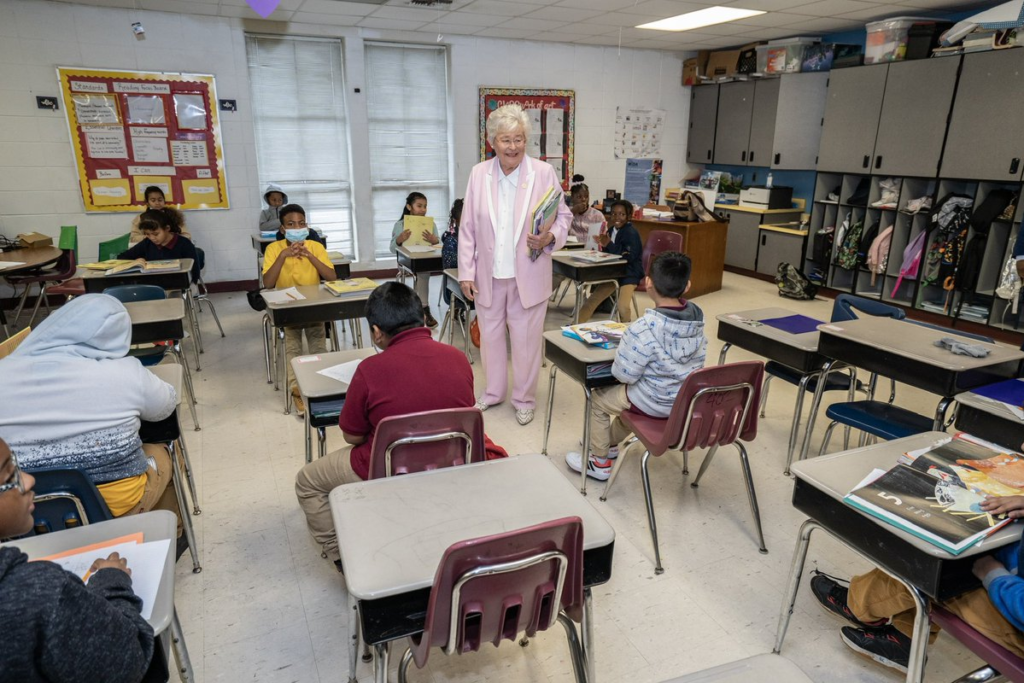
Gov. Kay Ivey on Wednesday visited Chisholm Elementary School, one of Alabama’s “Turnaround Schools,” to visit with some of the students and to deliver books for each third grader to take home. The students were thrilled when Ivey gave each of them a book to take home. As soon as they had a book in their hands, they began flipping through the pages and reading. The governor offered encouraging words to them and urged them to read daily. Ivey suggested that they find books about topics they like. She told the students that she enjoyed mysteries as a child and was an avid reader of the Nancy Drew series. “I was truly encouraged when I met some of the students at Chisholm Elementary today,” Ivey said in a statement. “These children just lit up when they had a book in their hands, and that was exciting to see. I urge all of my fellow Alabamians to encourage our children to read. This is a vital skill to life, and I am committed to seeing all Alabama students achieve success with reading and in school.” During her inaugural address on Monday, Ivey told Alabamians that the education of Alabama’s children is her number one priority and promised that before the end of her term that Alabama would be in the top thirty states in educational rankings. Ivey followed this visit by issuing four new executive orders addressing education. “I am proud to sign these executive orders into effect and believe they will lay an essential foundation for ensuring every Alabama student receives a high-quality education,” said Governor Ivey. “This is the first of many steps I plan to take in this new term to increase Alabama’s national ranking in our student’s reading and math performance. Our children are our future, and by investing in their education, we are investing in a better Alabama.” Ivey is investing heavily in improving early literacy. Every child in the state will receive a book every month from birth thru age five. Ivey has also increased funding for Alabama’s national award-winning four-year-old kindergarten program. On Wednesday, Ivey sent a memo to the Department of Early Childhood Education, telling the agency to prioritize creating new First-Class Pre-K classrooms in counties where more than 20% of the population falls below federal poverty guidelines. The state has postponed full implementation of the Alabama Literacy Act due to the COVID-19 school closures, but at some point, the state will begin requiring third graders who do not read at grade level to repeat third grade. This is intended to put additional pressure on students, teachers, and parents to ensure students can read effectively by the end of the third grade. The Legislature has also passed, and the governor signed, the Numeracy Act to address the horrid performance that Alabama students have had in math scores. To connect with the author of this story, or to comment, email brandonmreporter@gmail.com.
Major issues to be decided in session’s final days
Alabama lawmakers return to Montgomery on Tuesday with a number of large issues to be decided in the closing days of the legislative session. Legislators expect to conclude the session next week. Here’s a look at some of the proposals that could be decided in the session’s final days. TEACHER PAY RAISES Lawmakers are expected to give final approval to the largest pay raise in a generation for teachers with nine or more years experience. The Senate approved the raises as part of next year’s education trust fund budget. The House of Representatives must decide whether to accept Senate changes, but House leaders have expressed support for the raises. The raise would be based on the teacher’s experience. A teacher with a bachelor’s degree and 20 years of experience would see their minimum salary rise from $51,810 to $57,214. School systems in Alabama and across the country have reported concerns about teacher shortages, particularly as the coronavirus pandemic accelerated a wave of retirements. That has led states to look at pay increases and other measures to try to recruit and retain educators. READING PROMOTION REQUIREMENT The House of Representatives on Tuesday will debate a proposal to postpone a high-stakes requirement to hold back third-graders who don’t read on grade level. The requirement of the 2019 Alabama Literacy Act is now scheduled to start this spring but would be pushed back until the 2023-2024 school year under the proposal. Many lawmakers expressed concern after the pandemic interrupted classrooms for two years. There is broad support for a delay, although lawmakers have disagreed on how long that delay should be. To move on to fourth grade, students would have to make above a “cut score” on standardized testing or demonstrate mastery of reading standards through a reading portfolio. State officials earlier this year said 23% of students scored below the set cutoff score on the latest assessment. DIVISIVE CONCEPTS The bill by Republican Rep. Ed Oliver of Dadeville would prohibit a list of “divisive concepts” from being taught in schools and in diversity training for state entities. The banned concepts would include that the United States is “inherently racist or sexist” and that anyone should be asked to accept “a sense of guilt” or a need to work harder because of their race or gender. The Alabama House of Representatives approved the bill after an emotional night of debate. The House-passed bill is awaiting committee action in the Alabama Senate. The list in the bill is similar to a now-repealed executive order that former President Donald Trump issued regarding training for federal employees. Similar language has since popped up in bills in more than a dozen states. TRANS TREATMENT BAN The Alabama Senate has approved a measure by Republican Sen. Shay Shelnutt of Trussville to make it a felony, punishable by up to 10 years in prison, for doctors to give transgender minors puberty-blockers, hormones, or surgeries to help affirm their gender identity. Proponents of the bill said the decisions on the medications should wait until a person is an adult. Opponents say lawmakers are inserting themselves into decisions that belong with families and their doctors. The Senate-passed bill, along with similar legislation by Republican Rep. Wes Allen of Troy, is pending in the Alabama House of Representatives. The U.S. Department of Justice last week sent a letter to state attorneys general warning that laws and policies that prevent individuals from receiving gender-affirming medical care might be an infringement on a person’s constitutional rights. REDEFINING RIOT The Alabama House of Representatives approved a bill that would create a new crime of assault of a first-responder and change the definition of a riot in state law. The bill defines a riot as “the assemblage of five or more persons engaging in conduct which creates an immediate danger of and/or results in damage to property or injury to persons.” The legislation is pending in the Senate committee. Rep. Allen Treadaway, a retired Birmingham assistant police chief, proposed the bill after a protest turned violent in Birmingham in the wake of George Floyd’s killing by police in Minneapolis. Opposed lawmakers say the definition of a riot is subjective, and an officer could make arrests based on his or her presumptions about the people involved. Republished with the permission of the Associated Press.
Paul DeMarco: Alabama legislature’s delay of Alabama Literacy Act will have long term effects on students

This past week the Alabama Senate passed a bill delaying the implementation of a major portion of the Alabama Literacy Act. It is expected The Alabama House of Representatives will follow along and send this bill to the Governor for her signature. The Act requires third graders to read at their grade level, or they must repeat that year. The push to pass this legislation by some Alabama educators and politicians is due to concerns about the number of third-graders that could be held back based on recent test scores. There have been reports that it could mean up to a quarter of these students would not meet the reading requirements. There is no question that the pandemic had an effect on some students’ ability to learn to read, with some schools that were closed forcing students to depend on virtual learning. This is a serious issue that must be addressed. There are millions of federal, state, and local dollars that have been spent to assist students with reading. Every child in this state must be provided with the full resources so that they have the opportunity to achieve at the highest levels. The ability to succeed in all aspects of a classroom, whether it is math, science, or social studies, all start with ensuring a student can properly read and write. The question for lawmakers is how a delay in the literacy act benefits students who are promoted to the fourth grade if they are not academically proficient in reading. The long-term effects of this legislation, if it passes, will do more harm to students than spending another year preparing for their future by improving their reading skills. Alabama already trails the nation in education and reading skills. Alabama State Representatives and Senators should not add to this problem by delaying the literacy act. Alabama has had enough scholastic woes through the years, but it appears Alabama lawmakers are about to make it worse. Paul DeMarco is a former member of the Alabama House of Representatives.
Lawmakers to delay 3rd grade reading promotion requirement

Alabama lawmakers are close to approving a delay of a high-stakes requirement to hold back third-graders who don’t read on grade level. The Alabama House of Representatives on Wednesday unanimously voted to push back the requirement for two years. Instead of taking effect at the end of this school year, the legislation would delay implementation until the 2023-2024 school year. The Alabama Senate has approved similar legislation. Lawmakers in 2019 approved the Alabama Literacy Act that will require third graders to meet reading benchmarks before moving to the fourth grade. Students would have to make a minimum score on a reading assessment or demonstrate mastery of all third grade state reading standards. However, many lawmakers and educators pushed for a delay after the COVID-19 pandemic interrupted classrooms for two years. The state Board of Education in November set a cutoff score that third-graders must make on that Alabama Comprehensive Assessment Program in order to be promoted. State officials said 23% of students scored below that number on the latest assessment. Republican Rep. Terri Collins, the sponsor of the Literacy Act, said the two-year delay is a compromise. Collins said she believes the interventions and other measures in the law are already making a difference for students. Collins said the Senate bill will be in House committee next week. Republished with the permission of the Associated Press.
Last in math: Alabama politicians look for ways to close gap
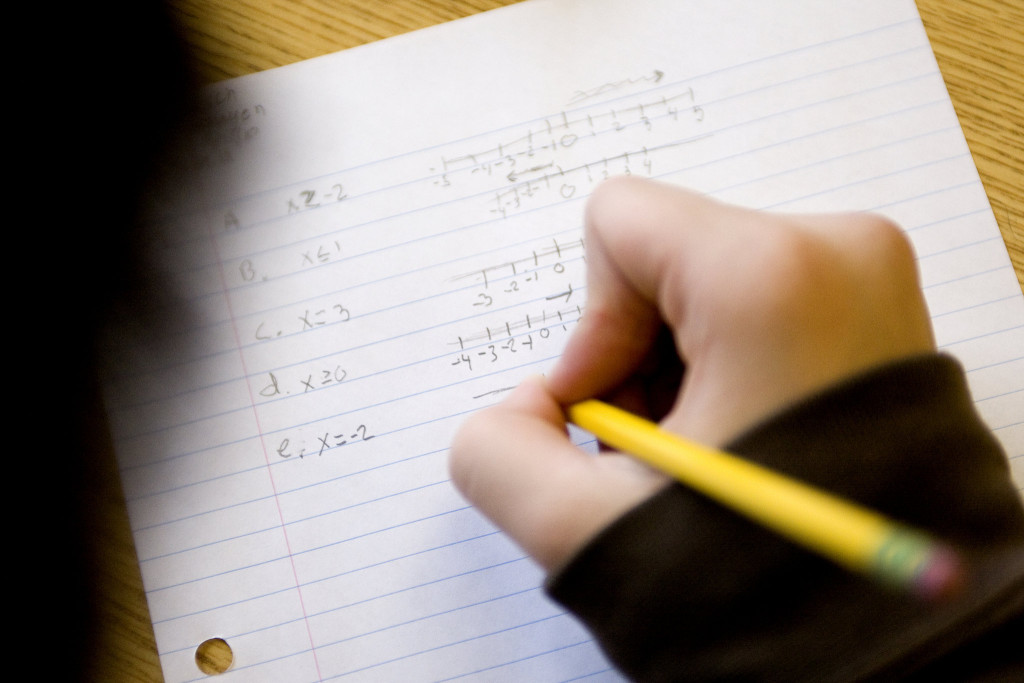
Alabama students for years have ranked at the bottom in a national math assessment. That has led one lawmaker to propose an overhaul in math instruction that would include more math coaches in schools, summer programs, and interventions. Eventually, fifth-grade students would need to show they were meeting certain math benchmarks to move to the sixth grade under the proposal, he said. Republican Sen. Arthur Orr, who chairs the state education budget committee, is working on the proposal for the legislative session that begins in January. He said it would be a math counterpart to the Alabama Literacy Act, which puts a similar promotion requirement on third-grade reading skills. “When you are 50th in the country you have no choice but to improve,” Orr, R-Decatur, said. He said the persistent lagging scores shows the need for the state to put a heavy emphasis on math. The proposed promotion requirement is likely to be controversial since lawmakers pushed last year to delay the reading promotion test because of the pandemic. Orr emphasized the math promotion requirement for fifth graders wouldn’t kick in until the latter part of this decade and only after students had been in the revamped math program since first grade, he said. Orr said he supports the retention component because students must have basic math skills — adding, subtraction, multiplication, division, and fractions — to function well in life or to be ready to take on advanced math. “You need to have a comfort level with those fundamentals,” he said. Alabama’s math performance in fourth and eighth grades ranked dead last among states in the 2019 National Assessment of Educational Progress, often called “The Nation’s Report Card.” Education officials have expressed concern that the pandemic led to learning losses. Test scores from last spring, after the pandemic interrupted classrooms, showed just 24% of fourth-graders and 14% of eighth-graders were considered proficient in math. Students took a new assessment last year called the Alabama Comprehensive Assessment Program, complicating comparisons with prior years, but officials said the test results were concerning. Alabama Gov. Kay Ivey told state Board of Education members this week that she is supportive of developing a math counterpart to the Alabama Literacy Act. “In the weeks and months ahead, I look forward to working with you to place the same sense of urgency on mathematics as we have rightfully placed on reading,” Ivey said Asked if the governor supports a requirement to hold back fifth graders who don’t meet math benchmarks, spokeswoman Gina Maiola said, “improving mathematics education in Alabama will require a comprehensive plan that is informed by all stakeholders. The 2019 Alabama Literacy Act will require third graders to meet reading benchmarks to be promoted to the fourth grade. The promotion requirement is set to take effect this spring. However, Ivey said she will ask lawmakers to delay the promotion requirement for one year. Orr said he is working with subject-matter experts on the proposal. “It’s no secret the state is last in math,” said Mark Dixon, president of the A+ Education Partnership. “We need a statewide commitment to improving math achievement.” Republished with the permission of the Associated Press.
