
Congenital syphilis cases rising; ADPH emphasizes detection and treatment
Syphilis is a venereal disease that is usually spread by sexual contact. Sadly, it can also spread from mother to child in the womb. These cases are called congenital syphilis, and congenital syphilis cases are increasingly common in Alabama. The Alabama Department of Public Health (ADPH) announced on Monday that the state of Alabama reported 36 cases of congenital syphilis in 2021. That is the highest number of cases since 2006. There were 15 cases in 2019, 23 in 2020, and 36 cases in 2021 – a 63.9% increase over 2020 and a 140% increase since 2019. Infants born with syphilis can have lifelong complications. Up to 40 percent of such babies are stillborn or die soon after birth. Not all babies have symptoms at birth. Babies who do not get treatment for congenital syphilis and develop symptoms later can die from the infection, be developmentally delayed, or have seizures. Babies born with congenital syphilis may have deformed bones; severe anemia; enlarged liver and spleen; jaundice; brain and nerve problems, such as blindness or deafness; meningitis; and skin rashes. In a joint effort of the Alabama Department of Public Health and the Alabama Medicaid Agency to stop the rise of syphilis, healthcare providers and the public are reminded that ADPH offers free syphilis testing and treatment for pregnant women and their partners. In a joint effort of ADPH and the Alabama Medicaid Agency to stop the rise of #syphilis, healthcare providers and the public are reminded that ADPH offers free syphilis testing and treatment for pregnant women and their partners. #NewsRelease: https://t.co/p4edcUcRrV pic.twitter.com/o1ydwWXxIc — Alabama Public Health (@ALPublicHealth) September 19, 2022 Testing is recommended both at the initial prenatal visit and again early in the third trimester of pregnancy, regardless of risk factors. Forty-four percent of these pregnant women had a negative syphilis test result at the first prenatal testing but a positive test close to or during labor and delivery. Congenital syphilis is a preventable condition. As the syphilis rates of childbearing females are increasing, this means that congenital syphilis rates also increase. Of reported cases in Alabama, 79 percent of the mothers who delivered infants with congenital syphilis received prenatal care, but prevention opportunities were missed. The most missed opportunities to prevent congenital syphilis among prenatal care recipients in Alabama were the lack of syphilis diagnosis in the early third trimester. According to the Centers for Disease Control and Prevention, since 2013, the rate of congenital syphilis nationally has increased each year. In 2020, 2,148 cases of congenital syphilis were reported, including 149 congenital syphilis-related stillbirths and infant deaths. Although the majority of congenital syphilis cases were reported from a few states, 49 jurisdictions (47 states, the District of Columbia, and one US territory) reported at least one case of congenital syphilis in 2020, up from just 26 jurisdictions in 2011. The national congenital syphilis rate of 57.3 cases per 100,000 live births in 2020 represents a 15% increase relative to 2019 and a 254% increase since 2016. These increases mirror increases in syphilis among reproductive-aged women. During 2019–2020 the rate of P&S syphilis increased 24% among women aged 15–44 years. In 2020, there were 5,726 cases of syphilis (all stages) diagnosed among pregnant women, an increase of 16% from 2019. The best way to avoid syphilis and other sexually transmitted diseases is for both partners to avoid sexual relations before marriage and with partners outside of the marriage. In 2020, over half (53%) of reported cases of STDs were among adolescents and young adults ages 15 to 24 years. Disparities continue to persist in rates of reported STDs among some racial minority or Hispanic groups when compared with rates among non-Hispanic White persons. In 2020, 32% of all cases of chlamydia, gonorrhea, and P&S syphilis were among non-Hispanic Black persons, even though they make up only approximately 12% of the US population. To connect with the author of this story, or to comment, email brandonmreporter@gmail.com.
Alabama Arise to host a listening session on Medicaid, other policy solutions

Alabama Arise, a grassroots group aimed at protecting low-income families from harmful state policies, plans to host a listening session next week in Andalusia. During the session, Arise representatives plan to discuss several healthcare related topics, including improving healthcare within the state, discussions on Medicaid, and pay-day lending. The Covington County Grassroots Alliance joins Arise in co-sponsoring the event. Local organizer Steve Hubbard hopes at least 100 people will attend. “There is a real issue with healthcare in the state and I hope people will come listen and speak out,” Hubbard told the Andalusia Star-News. “A number of counties in Alabama have seen rural hospitals closed within the last 12 months. Camden has closed its hospital doors and there has been a significant impact on lower-income healthcare because of it. I hope that healthcare professionals will also come to the listening session, because there has to be a concern about how this is affecting healthcare providers.” This week, the Alabama Medicaid Agency opened a new public comment period on the proposed Medicaid work requirement. The proposal would only apply to “able-bodied” Parent or Caretaker Relative (POCR) recipients — with exemptions being made for people with disabilities, anyone who pregnant or receiving postpartum care, anyone required to care for a disabled child or adult, among others — that will require unemployed or underemployed adults to become gainfully employed, or participate in training opportunities to enhance their potential for full employment. Alabama Arise have been opponents of the Medicaid work requirement since the proposal’s beginnings and will no doubt discuss it at the meeting. “Alabama Medicaid’s work requirement proposal would create a no-win situation for thousands of parents living in deep poverty. They’ll lose health coverage if they don’t get a job – and if they do,” Arise Citizens’ Policy Project policy director Jim Carnes said in a press release. “Any way you look at it, this proposal is nothing more than an expensive plan for denying health coverage to parents in deep poverty. Instead of punishing struggling families, our leaders need a vision for a healthier Alabama. We urge Gov. Ivey to save tax dollars, cut red tape and save lives by withdrawing this misguided plan.” The Alabama Arise listening session will begin at 6 p.m. on August 14, at the Andalusia City Hall Auditorium.
Alabama taking comments on Medicaid work requirement
Alabama is accepting comments on its proposal to put a work requirement on 74,000 Medicaid recipients. The Alabama Medicaid Agency opened a new public comment period on the proposal. The proposal would require 35 hours of work, job training, education or volunteer service each week. Exceptions would be made for people with young or disabled children The proposal only impacts a small number of Medicaid recipients, able-bodied parents and caretakers who qualify because their income is less than 18 percent of the federal poverty level. Most Medicaid beneficiaries in the state are children, disabled or elderly. State officials wrote that the requirement will improve the health and economic stability of recipients. Advocacy groups criticize the proposal, saying it would cause the “poorest of the poor” to lose their health care. Republished with the permission of the Associated Press.
Federal audits request Alabama to pay back nearly $100 million for improperly claimed Medicaid funds

2016 has been a rough year for the state of Alabama and things don’t look like they’ll be getting any easier any time soon. In a speech Thursday, State Auditor Jim Zeigler brought public attention to the results of federal audits of the Alabama Medicaid Agency that his office received Wednesday. According to two July 2016 reports from the Office of Inspector General at the U.S. Department of Health and Human Services (HHS), Alabama overcharged the HHS by nearly $100 million for Medicaid services delivered years ago. Report one, titled Alabama Claimed Millions in Unallowable School-Based Medicaid Administrative Costs, concludes the state did not get their school-based administrative costs approved properly. According to the report, some state employees were listed more than once on state’s list of school officials dedicated to Medicaid. It recommends a $75,274,946 refund to the federal government. The second report, titled Alabama Did Not Comply with Federal and State Requirements for Claiming Medicaid Certified Public Expenditures for Federal Fiscal Year 2010, concludes Alabama used the wrong inflation factor when calculating requests for federal money to pay for service at privately run hospitals that didn’t qualify for the payments. It recommends the state refund the $21,302,31 to the federal government. Combined, the two reports call for a total of $96,577,257 to be refunded to the federal government, which equates to roughly 14 percent of the general fund budget the state Legislature has appropriated to Medicaid services for Fiscal Year 2016. While the audits do not fall under the authority the State Auditor’s Office, Zeigler points out the state will essentially lose out on the money it’s receiving from the BP oil spill settlement to repay these debts. “Alabama will lose $75 million of that [settlement] money because it failed a federal audit — and failed badly,” said Zeigler. “What the BP settlement gave, the failed audit will take away.” Zeigler’s Thursday speech in Fairhope comes less than 24 hours after the Alabama Legislature approved distribution for the oil spill settlement money that sent an additional $120 million to Medicaid for 2016-2017. “The Bentley administration has reached a new low point in mismanagement,” Zeigler continued. “They did not bring to the attention of the Legislature that the failed audits would grab all of the new BP Medicaid money for 2017 and part for 2018.”
Advocacy coalition says it’s time for Alabama to get serious and stop the Medicaid cuts

A bill that would allow Alabama to spend the $20 billion BP oil spill settlement and help fund the state’s $85 million Medicaid shortfall died in the state Senate late Tuesday night. The Legislature’s 30-day session is poised to end Wednesday and lawmakers have yet to find a way to fund the Alabama Medicaid Agency with the additional monies officials say are needed to maintain services across the state for the nearly one million Alabamians who live below the poverty line. Progress seemed to be made last week when the House approved a bill dividing the settlement money to pay off state debts and as well as road projects in coastal Alabama counties, meanwhile freeing up $55 million of the necessary $85 million for the state’s Medicaid program. But the bill stalled in the Senate’s budget committee Tuesday, leaving little hope for closing the budget gap before the Legislature goes out of session. Following Tuesday night’s impasse, Alabama Arise, a coalition advocating for low-income Alabamians, called on the Alabama Legislature and Gov. Robert Bentley to “get serious” and stop the Medicaid cuts. “Putting health care at risk for children, seniors, and people with disabilities is no way to build a stronger Alabama,” said Alabama Arise state coordinator Kimble Forrister. “Neither is lurching from one budget crisis to another because of our state’s failure to solve the General Fund’s long-term funding shortfall. “Alabama’s looming Medicaid cuts would be devastating for our most vulnerable neighbors. The cuts could prompt many pediatricians to leave the state and could end coverage of essential services like outpatient dialysis and adult eyeglasses. “The governor and the Legislature need to act quickly to prevent these Medicaid cuts from becoming a reality later this year. And our state needs to get serious about raising the long-term, sustainable new revenue needed to invest in a healthier, stronger Alabama for all.”
Bentley Administration announces creation of Children’s Cabinet
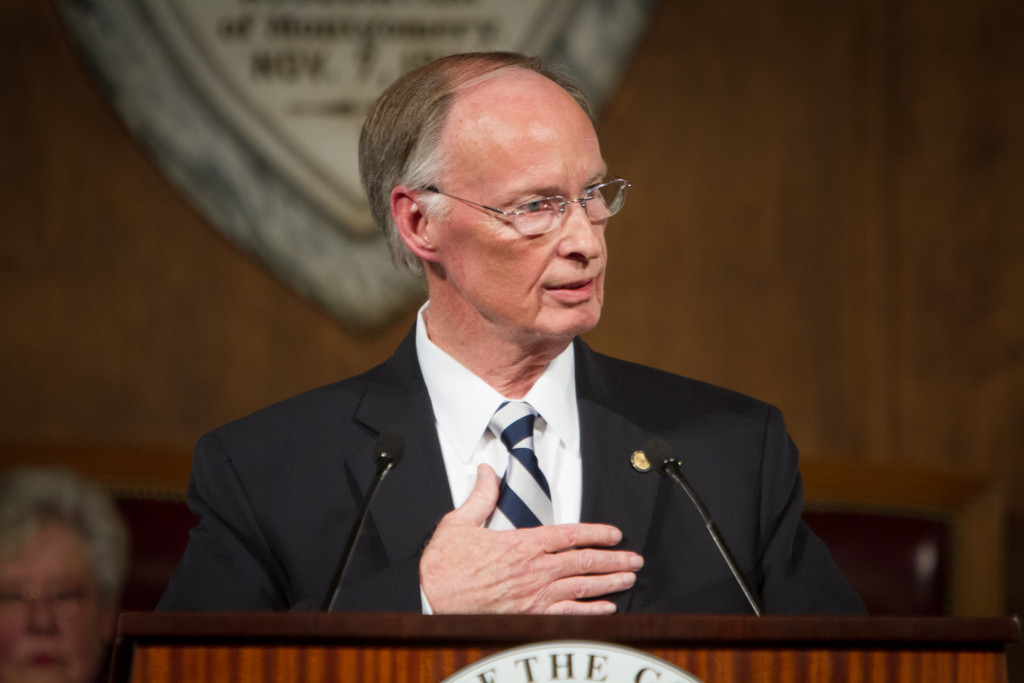
Alabama Governor Robert Bentley announced Tuesday afternoon the creation of the Alabama Children’s Cabinet. The Cabinet will include members of existing state agencies who will work together to “maximize efficiency in the use of state resources, reduce duplication of services and create a greater return of state tax dollars,” according to a press release from the governor’s office announcing the new body. “Alabama’s children are our future, and we must ensure that their needs are being met just as we do with adults,” said Bentley at the announcement of the Cabinet’s creation. “Whether it is education, health care, nutrition programs, or other needs, children need someone to advocate for what is best for them. We have put together a great group of individuals, already working hard on children’s issues, that has the knowledge and experience necessary to improve the lives of the children of Alabama. The Children’s Cabinet will be an important group dedicated to Alabama’s children” This group will work to develop measures of accountability to improve effectiveness in achieving positive outcomes for children. — Gov. Robert Bentley (@GovernorBentley) April 12, 2016 We’ve put together a great group of individuals that have the knowledge & experience necessary to improve the lives of Alabama children. — Gov. Robert Bentley (@GovernorBentley) April 12, 2016 The Cabinet will consist of the director, or an appointed delegate from the State Department of Education, Alabama Department of Human Resources, Alabama Medicaid Agency, Alabama Department of Public Health, Alabama Department of Mental Health, Alabama Department of Early Childhood Education, Alabama Department of Youth Services, Alabama Department of Rehabilitation Services, Alabama Department of Child Abuse and Neglect Prevention, and the Governor’s Office of Minority Affairs. The Cabinet, created by Executive Order 17, is created effective immediately, and must meet monthly, and is given authority to develop its own rules. According to the governor’s office, the members of the Children’s Cabinet will receive no additional compensation for the position.
Robert Bentley says Alabama will see cuts in Medicaid services due to budget

Following the Alabama Legislature’s vote to override Gov. Robert Bentley‘s veto of the General Fund budget, Bentley announced announced at a press conference Wednesday the Alabama Medicaid Agency is considering several significant cuts to their services in an effort to operate within the means of the new 2017 budget. Bentley said the budget comes up $85 million short of what the federal government requires for assistance. “For a number of years we have tried to make our Medicaid agency more effective, more steam-lined, and more efficient,” Bentley said. “We have tried to improve the lives of the people in this state, the one million people who depend on medicaid… and we did that.” Bentley said he has asked the Medicaid Agency, which provides health care to roughly one million Alabamians, to come up with a list of possible cuts to be reviewed within the coming days. Medicaid Commissioner Stephanie Azar joined Bentley listing some options up for consideration such as eliminating prescription drug coverage for adults, adult eyeglasses, prosthetics, outpatient dialysis, or requiring patients to go to one big box pharmacy, among others. “I think today it is very important for recipients to know that their access to care is at risk and for the Medicaid providers in the state to start preparing for the impact of these cuts,” Azar said. The governor has previously suggested he might call a special session on Medicaid funding, but said Wednesday that he has yet to make a decision. “We are going to have to make some very tough decisions. After we look at the options, we will make those tough decisions,” said Bentley.
State Senate leader files plan to check Medicaid, prison spending
Senate President Pro Tem Del Marsh has introduced a plan to address what he sees as the deeper issue in the current budget dilemma: growth in state spending on Medicaid and corrections. Late last week, Marsh filed Senate Bill 476 to limit the Alabama Medicaid Agency to no more than 10 percent Alabama’s total discretionary spending and to keep funding for the Alabama Department of Corrections below 5.5 percent. According to a Yellowhammer News report, Medicaid now accounts for about 9 percent of Alabama’s appropriations and corrections makes up 5.1 percent. Marsh told Yellowhammer News that he brought the bill because of his concerns over how the two programs have expanded in recent years. Here’s a quote from that interview: “Because of the budget situation, we have been forced to take a deep dive into the issues with the General Fund and look at ways to make deliverable changes in the way we spend taxpayer money,” Marsh said. “This bill gives both Medicaid and corrections room to grow from their current allocation but caps the amount so we can begin to control spending within those two programs.” Appropriations for both programs come from the state general fund: the Alabama Medicaid Agency absorbs about 35 percent of the general fund and corrections accounts for another 20 percent. However, Alabama’s healthiest revenue streams – personal income and sales taxes – are earmarked for the Education Trust Fund, not the general fund. The governor has cited lack of revenue in the general fund as the basis for his plan to increase taxes by $541 million. So far, lawmakers have failed to come to consensus on how to address the shortfall.
