
‘Do not come’: Kamala Harris seeks ‘hope at home’ for Guatemalans

Vice President Kamala Harris offered an optimistic outlook for improved cooperation with Guatemala on addressing the spike in migration to the U.S. after she met with Guatemalan President Alejandro Giammattei on Monday. She also delivered a direct warning to migrants considering making the trek: “Do not come. Do not come.” Her comments, during a press conference after she met privately with Giammattei, underscored the challenge that remains even as Harris engages in substantive talks with the Guatemalan and Mexican presidents during a three-day visit to the region this week, her first foreign trip as vice president. “I want to emphasize that the goal of our work is to help Guatemalans find hope at home,” Harris said. “At the same time, I want to be clear to folks in this region who are thinking about making that dangerous trek to the United States-Mexico border: Do not come, do not come.” In conjunction with Harris’ trip, the Biden administration announced that the Justice Department would create an anti-corruption task force and an additional task force to combat human trafficking and drug smuggling in the region. Harris also promised a new program focused on creating education and economic opportunities for girls there, among other new initiatives. And she told Giammattei that her goal in the region was to restore “hope” to residents, so they no longer felt the need to flee their homeland for better opportunities in the U.S. But for all the talk about new ways to cooperate, reining in corruption and improving living conditions in the region have been long-running challenges that previous administrations have been unable to achieve in their efforts to stem the tide of migration to the United States. Part of the challenge remains that, despite the best efforts of U.S. officials, corruption underpins many of the region’s governments. Indeed, Giammattei himself has faced criticism over his handling of the issue. Last month, two lawyers who are outspoken critics of Giammattei’s administration were arrested on what they say were trumped-up charges aimed at silencing them. And the selection of judges for Guatemala’s Constitutional Court, its highest, was mired in influence peddling and allegations of corruption. Giammattei picked his chief of staff to fill one of the five vacancies. When Gloria Porras, a respected force against corruption, was elected to a second term, the Congress controlled by Giammattei’s party refused to seat her. On Monday, Giammattei seemed less than eager to address those issues. Asked by The Associated Press about criticism of his record on corruption, Giammattei initially ignored the question. When pressed by another journalist to answer for the complaints against him, Giammattei seemed to bristle at the allegation that he was at fault, insisting there were “zero” allegations of corruption against him and labeling drug traffickers the biggest corruption issue in his nation. Still, Harris expressed optimism about their ability to work together, telling reporters that the two had a “very frank and very candid” conversation that included “the importance of anti-corruption and the importance of an independent judiciary.” Harris said the Justice, Treasury, and State departments would work together on anti-corruption investigations and train local law enforcement to conduct their own. “We are creating this task force to address corruption. We are working on a task force that is about human smuggling. We are doing the work of requiring certain progress be made if we are going to attract U.S. investment, private investment, to this region,” Harris said. Giammattei said that the U.S. and Guatemala also agreed to collaborate on a “very simple process” through visas to allow for regular migration to the U.S. and that the two countries would work to prioritize family reunifications. The White House also announced a $7.5 million commitment through USAID to support entrepreneurs and innovators in Guatemala, as well as millions more in investments in affordable housing, agribusinesses, and loans to small businesses in the country. Besides her meeting with Giammattei, Harris participated in a roundtable with the Guatemalan community and civil society leaders and met with young female engineers and entrepreneurs. In addressing the root causes of migration, Harris has laid out an approach centered on creating better opportunities and living conditions in the region through humanitarian and economic aid. Harris had previously announced plans to send $310 million to provide support for refugees and address food shortages, and she recently secured commitments from a dozen companies and organizations to invest in the Northern Triangle countries to promote economic opportunity and job training. Washington won some goodwill through its vaccine diplomacy this past week. Giammattei and Mexican President Andres Manuel López Obrador both received calls from Harris on Thursday telling them the U.S. would be sending 500,000 doses and 1 million doses, respectively, of COVID-19 vaccine. While in Latin America, Harris is also navigating the politics of immigration. Congressional Republicans have criticized both President Joe Biden and Harris for not visiting the U.S.-Mexico border and contend the administration is ignoring what they say is a crisis there. April was the second-busiest month on record for unaccompanied children encountered at the border, following March’s all-time high. The Border Patrol’s total encounters in April were up 3% from March, marking the highest level since April 2000. On Monday, Harris defended her decision not to visit the border, telling reporters she was focused on addressing the root causes of migration in a way that delivers “tangible” results “as opposed to grand gestures.” But even as Harris made the case for reforms in the nation’s capital, those very migrants she hoped to help were still streaming to the nation’s borders. On Monday, Henry Armando Rodríguez, 27, from El Paraiso in south-central Honduras, rested outside the migrant shelter in Tecun Uman at the Guatemala-Mexico border on his journey toward the United States. He didn’t know about Harris’ visit but described reasons for leaving that touched on the hopelessness the vice president wants to address. “Life is very bad in Honduras right now,” he said. It was his first time attempting to migrate, he said. He decided to make the journey
U.S. to swiftly boost global vaccine sharing, Joe Biden announces
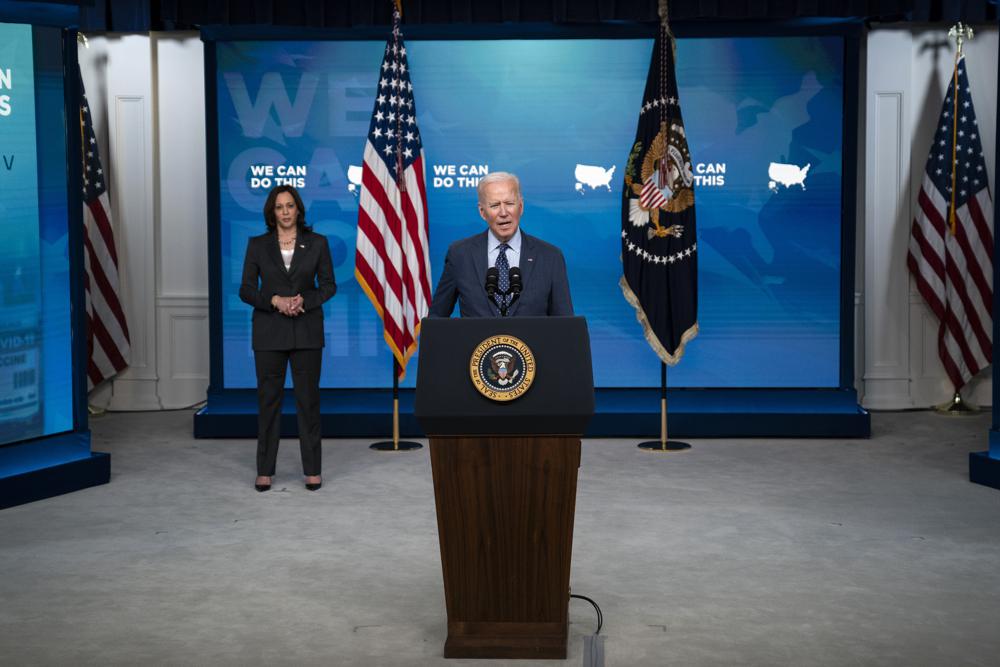
President Joe Biden announced Thursday the U.S. will swiftly donate an initial allotment of 25 million doses of surplus vaccine overseas through the United Nations-backed COVAX program, promising infusions for South and Central America, Asia, Africa, and others at a time of glaring shortages abroad and more than ample supplies at home. The doses mark a substantial — and immediate — boost to the lagging COVAX effort, which to date has shared just 76 million doses with needy countries. The announcement came just hours after World Health Organization officials in Africa made a new plea for vaccine sharing because of an alarming situation on the continent, where shipments have ground to “a near halt” while virus cases have spiked over the past two weeks. Overall, the White House has announced plans to share 80 million doses globally by the end of June, most through COVAX. Officials say a quarter of the nation’s excess will be kept in reserve for emergencies and for the U.S. to share directly with allies and partners. Of the first 19 million donated through COVAX, approximately 6 million doses will go to South and Central America, 7 million to Asia, and 5 million to Africa. “As long as this pandemic is raging anywhere in the world, the American people will still be vulnerable,” Biden said in a statement. “And the United States is committed to bringing the same urgency to international vaccination efforts that we have demonstrated at home.” U.S. National Security Adviser Jake Sullivan said the U.S. “will retain the say” on where doses distributed through COVAX ultimately go. But he also said: “We’re not seeking to extract concessions, we’re not extorting, we’re not imposing conditions the way that other countries who are providing doses are doing. … These are doses that are being given, donated free and clear to these countries, for the sole purpose of improving the public health situation and helping end the pandemic.” The remaining 6 million in the initial distribution of 25 million will be directed by the White House to U.S. allies and partners, including Mexico, Canada, South Korea, West Bank and Gaza, India, Ukraine, Kosovo, Haiti, Georgia, Egypt, Jordan, Iraq, and Yemen, as well as for United Nations frontline workers. The White House did not say when the doses would begin shipping overseas, but press secretary Jen Psaki said the administration hoped to send them “as quickly as we can logistically get those out the door.” Vice President Kamala Harris informed some U.S. partners they will begin receiving doses in separate calls with Mexican President Andres Manuel López Obrador, President Alejandro Giammattei of Guatemala, Indian Prime Minister Narendra Modi, and Prime Minister Keith Rowley of Trinidad and Tobago. Harris is to visit Guatemala and Mexico in the coming week. The long-awaited vaccine sharing plan comes as demand for shots in the U.S. has dropped significantly — more than 63% of adults have received at least one dose — and as global inequities in supply have become more pronounced. Scores of countries have requested doses from the United States, but to date, only Mexico and Canada have received a combined 4.5 million doses. The U.S. also has announced plans to share enough shots with South Korea to vaccinate its 550,000 troops who serve alongside American service members on the peninsula. White House COVID-19 coordinator Jeff Zients said that 1 million Johnson & Johnson doses were being shipped to South Korea Thursday. The U.S. has committed more than $4 billion to COVAX, but with vaccine supplies short — and wealthy nations locking up most of them — the greater need than funding has been immediate access to actual doses to overcome what health officials have long decried as unequal access to the vaccines. The U.S. action means “frontline workers and at-risk populations will receive potentially life-saving vaccinations” and bring the world “a step closer to ending the acute phase of the pandemic,” said Dr. Seth Berkley, CEO of Gavi, which is leading the COVAX alliance. However, Tom Hart, the acting CEO of The ONE Campaign, said that while Thursday’s announcement was a “welcome step, the Biden administration needs to commit to sharing more doses. “The world is looking to the U.S. for global leadership, and more ambition is needed,” he said. Biden has committed to providing other nations with all 60 million U.S.-produced doses of the AstraZeneca vaccine, which has yet to be authorized for use in America but is widely approved around the world. The AstraZeneca doses have been held up for export by a weeks-long safety review by the Food and Drug Administration, and without them, Biden will be hard-pressed to meet his sharing goal. The White House says the initial 25 million doses announced Thursday will be shipped from existing federal stockpiles of Pfizer, Moderna, and Johnson & Johnson vaccines. More doses are expected to be made available to share in the months ahead. Mexican President Andrés Manuel López Obrador said via Twitter that Harris had informed him before the White House announcement of the decision to send 1 million doses of the single jab Johnson & Johnson vaccine. “I expressed to her our appreciation in the name of the people of Mexico,” he wrote. Guatemala’s Giammattei said Harris told him the U.S. government would send his country 500,000 doses of COVID-19 vaccine. As part of its purchase agreements with drug manufacturers, the U.S. controlled the initial production by its domestic manufacturers. Pfizer and Moderna are only now starting to export vaccines produced in the U.S. to overseas customers. The U.S. has hundreds of millions more doses on order, both of authorized and in-development vaccines. The White House also announced that U.S. producers of vaccine materials and ingredients will no longer have to prioritize orders from three drugmakers working on COVID-19 shots that haven’t received U.S. approval — Sanofi, Novavax, and AstraZeneca — clearing the way for more materials to be shipped overseas to help production there. Republished with the permission of the Associated Press.
