Lower costs, fewer benefits in new Trump administration health insurance option
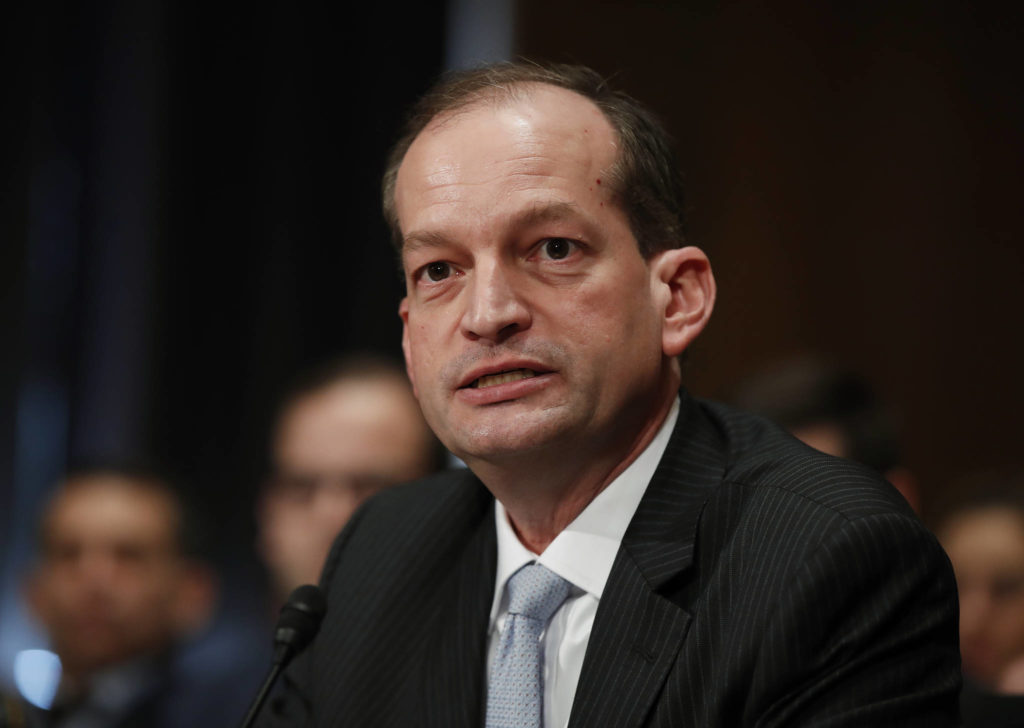
The Trump administration Tuesday rolled out a health insurance option for small businesses and self-employed people that could lead to lower premiums but may also cover fewer benefits than current plans. Labor Secretary Alex Acosta said the new “association health plans” will allow small business to pool their purchasing power, gaining access to some of the advantages that large employers have in the health insurance market. “Today the Trump administration helps level the playing field between large companies and small businesses,” Acosta said. “This expansion will offer millions of Americans more affordable health care options. The new plans would retain the same protections for people with pre-existing conditions, older workers, and women, that large company plans now have, Acosta added. Details were expected later Tuesday. The plans could be marketed across state lines within a geographic region to businesses in a given industry — auto repair shops, for example. Or a local chamber of commerce could sponsor one in a given community. The plans could be sold to self-employed people, like musicians. Allowing interstate marketing within a geographic region represents a shift from the original concept that the plans would be offered nationwide. President Donald Trump has long asserted that promoting the sale of health insurance across state lines can bring down premiums without sacrificing quality. But many experts weren’t convinced, because medical costs vary greatly according to geography. Ultimately, the idea’s success depends on buy-in from plan sponsors, consumers, insurers and state regulators. No major consequences are expected for people covered by large employers. Acosta cited enrollment estimates that predict a modest impact: about 4 million people covered by the plans within a few years, including 400,000 who would have been uninsured. Compare that to the total number of about 160 million covered by job-based insurance. After Republicans hit a dead end trying to repeal the Affordable Care Act, the Trump administration has pushed regulatory actions to loosen ACA requirements and try to lower premiums for individuals and small businesses, which now reflect the cost of comprehensive coverage. Another major initiative is expected later this summer when the administration eases rules for short-term health plans lasting less than a full year that could be purchased by individuals. Those plans wouldn’t have to cover people with pre-existing conditions, but would offer healthy people much lower premiums. Critics say the administration’s approach will draw healthy people away from the Obama health law’s insurance markets, raising the cost of coverage, which is subsidized by taxpayers. About 11 million people are covered by HealthCare.gov and state markets, but the administration’s priority is to try to lower premiums for another 7 million or so who buy their coverage directly and don’t get any help from the government. “To the extent that these plans develop and serve as a parallel market, that could have a destabilizing effect,” said Karen Pollitz of the nonpartisan Kaiser Family Foundation, an expert on individual health insurance. Pollitz also served as a consumer protection regulator in the Obama administration. “People who think they can get by without those (comprehensive) benefits will look for cheaper premiums,” she added. State insurance regulators have been concerned about association health plans because similar plans in the past had problems with financial solvency and fraud. Administration officials said Tuesday that states and the federal government would share regulatory oversight of the plans, with states retaining their current authority. The new plans will be phased in, starting in September. A small business group called Job Creators Network welcomed the Trump administration move. Group president Alfredo Ortiz said it “will create more options, more competition, and lower costs for Main Street small businesses.” Republished with the permission of the Associated Press.
Cabinet chaos: Trump’s team battles scandal, irrelevance
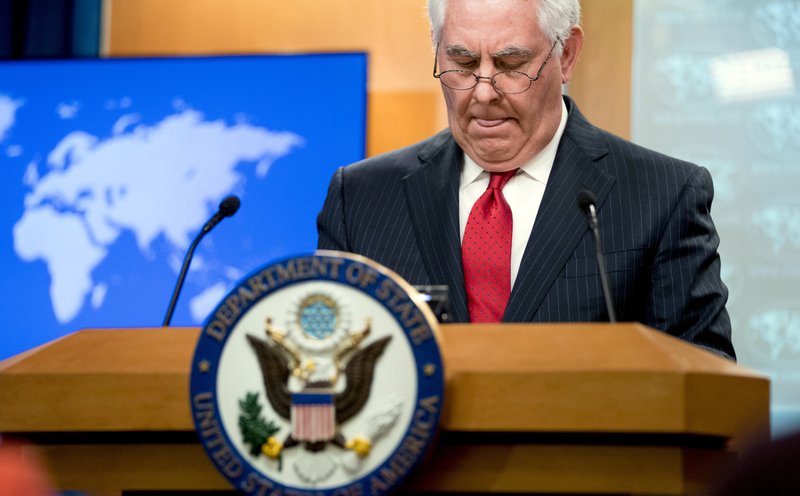
One Cabinet member was grilled by Congress about alleged misuse of taxpayer funds for private flights. Another faced an extraordinary revolt within his own department amid a swirling ethics scandal. A third has come under scrutiny for her failure to answer basic questions about her job in a nationally televised interview. And none of them was the one Trump fired. President Donald Trump’s Cabinet in recent weeks has been enveloped in a cloud of controversy, undermining the administration’s ability to advance its agenda and drawing the ire of a president increasingly willing to cast aside allies and go it alone. Trump’s ouster of Secretary of State Rex Tillerson on Tuesday may have just been the first salvo in a shakeup of a Cabinet that, with few exceptions, has been a team of rivals for bad headlines and largely sidelined by the White House. “Donald Trump is a lone-wolf president who doesn’t want to co-govern with anybody and doesn’t want anyone else getting the credit,” said presidential historian Douglas Brinkley of Rice University. “For his Cabinet, he brought in a bizarre strand of outsiders and right-wing ideologues. Many are famed conservative or wealthy business people, but that doesn’t mean you understand good governance.” The string of embarrassing headlines for Trump’s advisers, as well as the president’s growing distance from them, stands in sharp contrast to how he portrayed the group last year. “There are those that are saying it’s one of the finest group of people ever assembled as a Cabinet,” Trump said then. On Tuesday, the president hinted after firing Tillerson that more changes may be forthcoming, saying an ideal Cabinet is in the making. “I’ve gotten to know a lot of people very well over the last year,” Trump told reporters at the White House, “and I’m really at a point where we’re getting very close to having the Cabinet and other things that I want.” Even as Trump routinely convened Cabinet meetings in front of the cameras for “Dear Leader”-type tributes over the past year, his relationship with many of its members began to splinter. Last summer he began publicly bashing Attorney General Jeff Sessions, a former close adviser who was the first senator to back his campaign. Furious that the attorney general recused himself from the Russia probe that has loomed over the White House, Trump has privately mused about firing Sessions and taken to delivering unprecedented Twitter broadsides against him. Trump has used the words “beleaguered” and “disgraceful” to describe Sessions, who only recently stood up to the president and defended his recusal decision. Tillerson also frequently clashed with Trump, who never forgave the outgoing secretary of state for reportedly calling him “a moron” last summer after grumbling that the president had no grasp of foreign affairs. The pair never developed a particularly warm relationship. Last November, during a full day of meetings in Beijing, Trump and his senior staff were served plates of wilted Caesar salad as they gathered in a private room in the Great Hall of the People. None of the Americans moved to eat the unappetizing dish, but Trump prodded Tillerson to give it a try, according to a senior administration official. “Rex,” the president said, “eat the salad.” Tillerson declined, despite Trump’s urging. After repeatedly undermining and contradicting Tillerson, Trump at last fired his secretary of state in a tweet. Trump in recent days has told confidants that he feels emboldened. He’s proud of his unilateral decisions to impose sweeping tariffs on metal imports and to meet with North Korean dictator Kim Jong Un, and far less willing to put up with disloyalty around him, according to a person who has spoken to the president in recent days but was not authorized to discuss private conversations publicly. Trump’s esteem for the Cabinet has faded in recent months, according to two White House officials and two outside advisers. He also told confidants that he was in the midst of making changes to improve personnel and, according to one person who spoke with him, “get rid of the dead weight” — which could put a number of embattled Cabinet secretaries on notice. The officials all spoke on condition of anonymity to discuss internal matters. Interior Secretary Ryan Zinke underwent questioning Tuesday by Senate Democrats, who accused him of spending tens of thousands of dollars on office renovations and private flights while proposing deep cuts to conservation programs. Zinke pushed back, saying he “never took a private jet anywhere” — because all three flights he had taken on private planes as secretary were on aircraft with propellers, not jet engines. Veterans Affairs Secretary David Shulkin’s days on the job may be limited after a bruising internal report found ethics violations in connection with his trip to Europe with his wife last summer, according to senior administration officials. He also has faced a potential mutiny from his own staff: A political adviser installed by Trump at the Department of Veterans Affairs has openly mused to other VA staff about ousting the former Obama administration official. Trump has floated the notion of moving Energy Secretary Rick Perry to the VA to right the ship, believing Shulkin has become a distraction, according to two people familiar with White House discussions. They were not authorized to discuss internal deliberations and spoke on condition of anonymity. Others under the microscope: —White House aides deemed Education Secretary Betsy DeVos’ recent appearance on “60 Minutes” a disaster as she struggled to defend the administration’s school safety plan and could not answer basic questions about the nation’s education system. —Housing and Urban Development Secretary Ben Carson came under fire last month after reports his agency was spending $31,000 for a new dining set, a purchase HUD officials said was made without Carson’s knowledge. —Environmental Protection Agency Administrator Scott Pruitt has faced questions about $25,000 spent on a soundproof “privacy booth” inside his office to prevent eavesdropping on his phone calls and another $9,000 on biometric locks. —The first Cabinet member to