
Pro-liberty student group sues UAH over speech policy
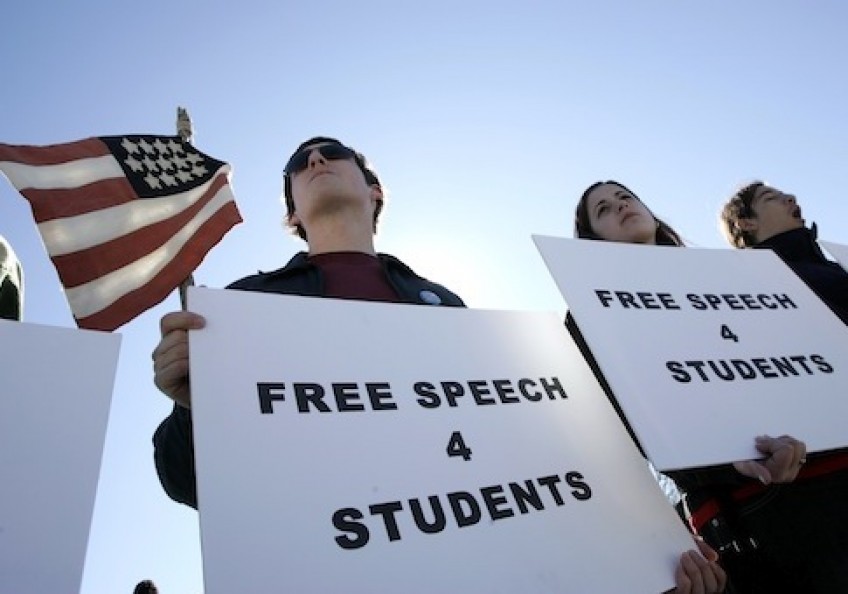
Young Americans for Liberty, a student group at the University of Alabama Huntsville (UAH), sued the school over a campus speech policy Tuesday. The school’s “Use of Outdoor Areas of Campus” policy requires students to seek approval for campus speakers three days in advance and leaves the permits subject to university approval. The conservative student group argued that this policy violated Alabama’s Campus Free Speech Act by affording the university the ability to cherrypick which viewpoints are permitted on campus. Attorneys from Alliance Defending Freedom are currently representing the UAH campus chapter of Young Americans for Liberty in the suit filed in Madison County. “Alabama law is clear: students don’t need a permit from college officials to speak on campus, but that’s exactly what the University of Alabama in Huntsville is doing—violating the law and shutting down speech on campus,” ADF Legal Counsel Michael Ross said. “Public universities are the very places that should be encouraging free speech, not stifling it with burdensome and illegal rules.” A representative of UAH did not comment on the specifics of pending legislation but stated, “The University of Alabama System Board of Trustees, the University of Alabama System, and the University of Alabama in Huntsville (UAH) are steadfastly committed to the freedom of speech and expression for all campus community members. Our policies were implemented to preserve this important constitutional right.”
Lawsuit cites campus speech rule at University of Alabama
A conservative Christian group has filed suit against the University of Alabama, challenging rules that require students to obtain a permit to speak on campus days in advance. Filed by the campus chapter of Alliance Defending Freedom and two student members in state court on Friday, the civil lawsuit claims the rule violates a state law which requires public college and universities to respect students’ rights to free speech. A campus rule requires students to request permission to speak on campus at least five days in advance, according to the complaint. The requirement prevents members from engaging fellow students on important topics including gun control and federalism, said a statement from the organization. “Universities are supposed to be the very places where students are free to explore diverse ideas and engage in civil and meaningful debate, but the University of Alabama is shutting down this debate with its burdensome speech policies,” said Michael Ross, a lawyer for the group. The school hadn’t responded to the lawsuit on Tuesday, court records show, and university spokeswoman Deidre Stalnaker said officials would not comment on a pending lawsuit. Alabama “remains committed to freedom of speech and expression for members of its campus community.” she said. University administrators can use the rule to “pick and choose” which viewpoints and events are allowed on campus, said Alliance Defending Freedom, which based in Arizona and says it has chapters on 500 U.S. campuses. Republished with the permission of the Associated Press.
More LGBT issues loom as justices near wedding cake decision

A flood of lawsuits over LGBT rights is making its way through courts and will continue, no matter the outcome in the Supreme Court’s highly anticipated decision in the case of a Colorado baker who would not create a wedding cake for a same-sex couple. Courts are engaged in two broad types of cases on this issue, weighing whether sex discrimination laws apply to LGBT people and also whether businesses can assert religious objections to avoid complying with anti-discrimination measures in serving customers, hiring and firing employees, providing health care and placing children with foster or adoptive parents. The outcome of baker Jack Phillips’ fight at the Supreme Court could indicate how willing the justices are to carve out exceptions to anti-discrimination laws; that’s something the court has refused to do in the areas of race and sex. The result was hard to predict based on arguments in December. But however the justices rule, it won’t be their last word on the topic. Religious conservatives have gotten a big boost from the Trump administration, which has taken a more restrictive view of LGBT rights and intervened on their side in several cases, including Phillips’. “There is a constellation of hugely significant cases that are likely to be heard by the court in the near future and those are going to significantly shape the legal landscape going forward,” said Shannon Minter, legal director of the National Center for Lesbian Rights. Several legal disputes are pending over wedding services, similar to the Phillips case. Video producers, graphic artists and florists are among business owners who say they oppose same-sex marriage on religious grounds and don’t want to participate in same-sex weddings. They live in the 21 states that have anti-discrimination laws that specifically include gay and lesbian people. In California and Texas, courts are dealing with lawsuits over the refusal of hospitals, citing religious beliefs, to perform hysterectomies on people transitioning from female to male. In Michigan, the American Civil Liberties Union filed suit against the state’s practice of allowing faith-based child placement agencies to reject same-sex couples. Advocates of both sides see the essence of these cases in starkly different terms. “What the religious right is asking for is a new rule specific to same-sex couples that would not only affect same-sex couples but also carve a hole in nondiscrimination laws that could affect all communities,” said Camilla Taylor, director of constitutional litigation at Lambda Legal, which supports civil rights for LGBT people. Jim Campbell of the Christian public interest law firm Alliance Defending Freedom said the cases will determine whether “people like Jack Phillips who believe marriage is the union of a man and a woman, that they too have a legitimate place in public life. Or does he have to hide or ignore those beliefs when he’s participating in the public square?” ADF represents Phillips at the Supreme Court. The other category of cases concerns protections for LGBT people under civil rights law. One case expected to reach the court this summer involves a Michigan funeral home that fired an employee who disclosed that she was transitioning from male to female and dressed as a woman. The 6th U.S. Circuit Court of Appeals ruled that the firing constituted sex discrimination under federal civil rights law. That court is one of several that have applied anti-sex discrimination provisions to transgender people, but the Supreme Court has yet to take up a case. The funeral home argues in part that Congress was not thinking about transgender people when it included sex discrimination in Title VII of the 1964 Civil Rights Act. A trial judge had ruled for the funeral home, saying it was entitled to a religious exemption from the civil rights law. “Congress has not weighed in to say sex includes gender identity. We should certainly make sure that’s a conscious choice of Congress and not just the overexpansion of the law by courts,” Campbell said. ADF also represents the funeral home. In just the past week, two federal courts ruled in favor of transgender students who want to use school facilities that correspond to their sexual identity. Those cases turn on whether the prohibition on sex discrimination in education applies to transgender people. Appeals in both cases are possible. In the past 13 months, federal appeals courts in Chicago and New York also have ruled that gay and lesbian employees are entitled to protection from discrimination under Title VII. Those courts overruled earlier decisions. Title VII does not specifically mention sexual orientation, but the courts said it was covered under the ban on sex bias. The Obama administration had supported treating LGBT discrimination claims as sex discrimination, but the Trump administration has changed course. In the New York case, for instance, the Trump administration filed a legal brief arguing that Title VII was not intended to provide protections to gay workers. It also withdrew Obama-era guidance to educators to treat claims of transgender students as sex discrimination. There is no appeal pending or expected on the sexual orientation issue, and there is no guarantee that the court will take up the funeral home’s appeal over transgender discrimination. The trend in the lower courts has been in favor of extending civil rights protections to LGBT employees and students. Their prospects at the Supreme Court may be harder to discern, not least because it’s unclear whether the court’s composition will change soon. Justice Anthony Kennedy, 81, has been the subject of retirement speculation, though he has not indicated he is planning to retire. When Justice Stephen Breyer turns 80 in August, he will join Kennedy and Justice Ruth Bader Ginsburg, 85, as octogenarians on the bench. If President Donald Trump were to replace any of those justices, the court probably would be much less receptive to LGBT rights. Even the landmark gay marriage ruling in 2015 that Kennedy wrote was a 5-4 decision. “We’re very concerned about the composition of the federal bench. Under the Trump administration, we’ve seen a
Jeff Sessions addresses group representing baker who refused to serve gay couple

Attorney General Jeff Sessions on Tuesday delivered a speech to the religious freedom group that is representing a Colorado baker who refused to bake a wedding cake for a gay couple in 2012. Sessions’ attendance at the closed-press Alliance Defending Freedom‘s (ADF) Summit on Religious Liberty in Orange County, Calif. is drawing criticism as advocacy groups and Democrats across the country are questioning why the leader of the U.S. Department of Justice (DOJ) agreed to speak at the ADF group at all. Founded by Dr. Bill Bright, ADF is best known for supporting socially conservative causes and advocating on behalf of religious freedom. Recently, the Supreme Court agreed to hear a case in which ADF is representing Colorado baker Jim Phillips. Phillips made national headlines in 2012 when he refused to create a wedding cake for a gay couple. He is now challenging Colorado’s nondiscrimination law, saying he should be allowed to refuse service to same-sex couples due to his religious beliefs. A spokesman for the Democratic National Committee (DNC) criticized Sessions’ decision to speak to the group. “You can judge a person by the company they keep and tonight – Attorney General Jeff Sessions is choosing to spend his time speaking in front of one of the country’s leading anti-LGBTQ hate groups,” Joel Kasnetz said. “Sessions’ appearance at this event, as the top law enforcement official in the country, brings into question whether the attorney general intends to protect all Americans.” “ADF has been extremely active in pushing for so-called ‘religious liberty’ laws around the country that allow Christians to discriminate against LGBT people,” said the Southern Poverty Law Center who in 2016 designated the ADF as a hate-group, on their website. “The nation’s top lawyer rallying with an anti-LGBTQ hate group? Outrageous,” the Human Rights Campaign (HRC), a civil rights group promoting LGBTQ equality, said in a blog post Wednesday. HRC was also troubled by the DOJ’s decision to keep Sessions’ remarks private. “The attorney general has every right to speak to a group like Alliance Defending Freedom,” commented David Stacy, Government Affairs Director of HRC. “What troubles us is that his remarks are being kept hidden from the public at the same time he has been tasked by the President with issuing religious discrimination policies that ADF has long promoted.” The DOJ did not respond to questions about whether the speech was in support for Phillips’ case.
