
Taylor Dawson: Is the American Dream alive and well in Alabama?

A recent Pew Research study found that over 80% of U.S. citizens believe they’ve achieved the American dream, or at least that they’re on the way to doing so. Only 17% of those surveyed said the American dream is “out of reach” for their family. But what about Alabamians? This high level of satisfaction seems like it might not translate in a relatively poor state like ours. U.S. Census data from 2016 indicates that 17.1% of Alabamians live below the poverty line. Based on that, one could reasonably conclude that because the percentage of those living below the poverty line in Alabama almost matches the percentage of those who believe the American dream is out of reach, affluence—or at least living above the poverty line—is the key to the American dream. But it may not be that simple. As the Pew study revealed, 89% of Americans (and Alabamians are likely no exception) agree that wealth is not central to achieving the American dream. There are two big values, however, that were found to be key to its attainment: enjoying fundamental freedoms and having a strong family life. The Pew research found that a whopping 77% agree that the American dream is tied to “freedom of choice in how to live”, and 70% say having “a good family life” is essential to living the dream. Freedom of religion and freedom of expression, including the freedom of speech and press, are protected by the First Amendment. Their preservation simply requires that the government and fellow citizens allow a person to exercise their faith and speak their mind as they see fit. While the freedoms of religion and speech are paramount, other liberties are also essential to the American dream. A large majority of Alabamians embrace the right of a parent to teach their children as they see fit, the principle of free enterprise to engage in business without overregulation and taxation from the government, and the right of a gun-owner to legally purchase and carry a firearm without being treated like a criminal. Needless to say, the survey’s second most agreed-upon basis for achieving the American dream—having a good family life—is far more personal than the protection of various liberties, but no less important. That’s likely the response of those surveyed because they inherently know what research statistically demonstrates. According to Dr. Pat Fagan of the Family Research Council, adults in intact families are statistically more economically productive, and children from broken families learn less, achieve less academically, and drop out of formal education earlier. While financial freedom can certainly make life easier, the ageless adage that money can’t buy happiness seems to hold sway in the minds of most Americans, as it certainly must in the minds of most Alabamians. When it’s all said and done, affluence takes a back seat to the love and security of family in every estimation, and that reaches far beyond the traditional notion of the American dream. ••• Taylor Dawson is Director of Communications for the Alabama Policy Institute (API). API is an independent, nonpartisan, nonprofit research and educational organization dedicated to strengthening free enterprise, defending limited government, and championing strong families. If you would like to speak with the author, please e-mail communications@alabamapolicy.org or call (205) 870-9900.
Marco Rubio new TV ad focuses on his father and the American Dream
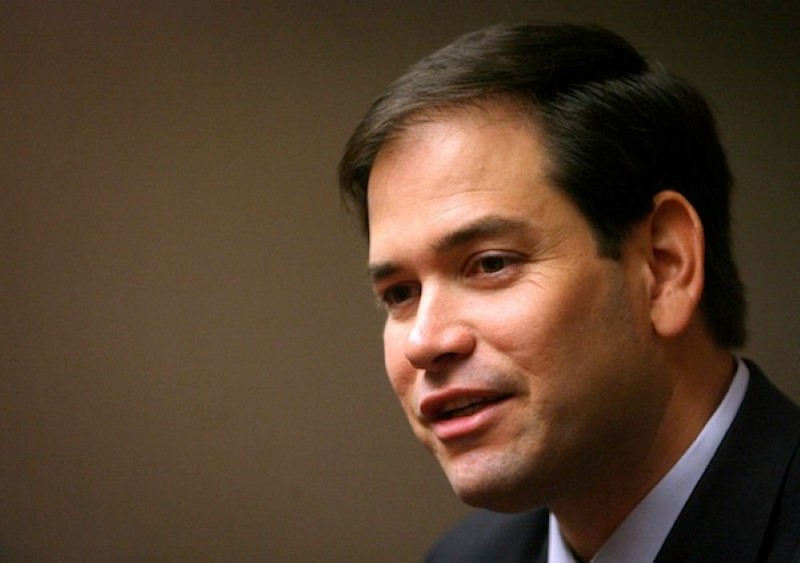
Marco Rubio’s basic stump speech always features him speaking movingly about his father working hard as a bartender when he first moved to America to provide for his children, in an ode to the American Dream. The Rubio campaign is now releasing a television ad featuring Rubio speaking about his father, called, “Bartender.” It’s scheduled to begin airing in Iowa on Thanksgiving and in New Hampshire starting next week. “I remember the sounds of his keys jingling at the front door of our home, well past midnight as he returned from another long day at work,” Rubio says, in a speech taken from his announcement that he was running for president in Miami’s Freedom Towers last April. “When I was younger, I didn’t fully appreciate all he did for us. But now, I more fully understand. You see, my father was grateful for the work he had, but that was not the life he wanted for his children. He wanted all the dreams he once had for himself to come true for us. He wanted all the doors that closed for him to open for me. So my father stood behind a small portable bar in the back of a room for all those years, so that I could stand behind this podium in front of this room and this nation. That journey from behind that bar to behind this podium, that’s the essence of the American Dream.”
Steven Kurlander: Faux unité avec Paris — ditching internationalism to protect the American Dream

Over the weekend, images of wanton bloodshed in Paris were conveyed to Americans. Unlike ISIS’ other barbaric attacks, including the horrific bombing of a Russian airliner about a week previous, this attack seemed to hit closer to home. The Paris attacks raised the level of concern and awareness of the ISIS threat to this country. An attack on a major U.S. city was feared next, and expected by many anxious Americans. Immediately, the coordinated attacks in Paris that killed scores of innocent civilians were described by the media and our political leaders strictly in terms of another act of barbaric terrorism against Western civilization. “The killing of innocent people based on a twisted ideology is an attack not just on France, not just on Turkey, it is an attack on the civilized world,” President Barack Obama said at the start of a G20 summit in Ankara, Turkey. In turn, millions of Americans showed solidarity with the people of France, many of us adopting the French tricolor flag as our profile picture on social media sites such as Facebook. We are supposedly all the same citizens of the same Western world. Unlike ISIS, we are, of course, civil people in the truest sense of the word. That mantra was confirmed in the Democratic debate Saturday night by former Secretary of State Hillary Clinton, an architect and continued advocate of such international policies: “But it cannot be an American fight. And I think what the president has consistently said – which I agree with – is that we will support those who take the fight to ISIS.” It’s a mistake that Americans continue to be misled by Obama, Clinton, and their supporting cast in the mainstream press into thinking the fight against ISIS and Islamic radicalism is not strictly our fight to fight alone. Our continuous “internationalist” war against Islamic terrorism, wrapped in the guise of an united effort of “allies” in the Middle East to combat the spread of feudal radical Islamic governance and brutality, is not working. Paris shows that. Americans for too long have had troublingly false expectations of immediate gratification in terms of foreign policing. Internationalism fits that bill because it misplaces responsibility of security and strength onto allies who can’t bring the fight to a level that the United States can to defeat Islamic fascism. It’s easy to say invading Iraq was a mistake. But it wasn’t. It’s time to re-examine whether invading Iraq was truly a mistake in the long view of world events and history, and whether the premature withdrawal from Iraq was the real mistake indeed. The United States is losing a battle now not in terms of saving Western civilization, but in real terms of strictly preserving American borders, way of life, and economy. We have too long fought a half-assed war on terrorism where we’ve substituted expensive electronic gimmickry for boots on the ground, where we’ve made killing a single civilian in a fight against a merciless enemy a war crime, and where we’ve lost perspective of the necessary and proper goal of defeating totalitarianism in order to implant democratic virtues and economic opportunity around the world. It shouldn’t be politically incorrect any more to unleash the massive firepower we hold in our arsenal to actually win a war for a change. We need to begin fighting a real war for the American way of life, not for Western civilization. And it likely won’t be won overnight: It might take decades. Japan and Korea are prime examples of how we did it right. Our long-term occupation of those countries, still secured by American troops, are the model to use. Ideological radicalism died in those countries because we successfully helped build economies that allowed large middle classes to prosper. That relieved the unemployment and restlessness that characterizes the Middle East masses. Paris in the true sense exemplifies the massive failure of President Obama’s ananchronic internationalist foreign policies that have both diminished our power overseas and endangered our security at home. It’s time to fight a brutal war against ISIS and the citizenry who support them, occupy territories in the Middle East, and recreate and stabilize the boundaries to better reflect the tribal nature of the region, and to foster economic opportunity through capitalism in those regions. Instead of including the French flag in our online profiles to show our solidarity in the fight against ISIS, Americans instead should start flying Old Glory on their social media pages. Steven Kurlander blogs at Kurly’s Kommentary (stevenkurlander.com) and writes for Context Florida and The Huffington Post and can be found on Twitter @Kurlykomments. He lives in Monticello, New York.
Ronda Walker: Fiscal conservatism, the true American dream

Do you realize that home ownership is an American dream not an American right? The same is true with vacations, cars, and designer clothing. Not everyone gets to enjoy all of the amenities America has to offer and the sooner we accept that the better off we will be. Moreover, the sooner we end our bondage to the debt-driven life the more prosperous we will become as individuals and as a society. We rail about wasteful government spending and unsustainable budget deficits but the truth is most of our personal financial practices are as bad as the financial practices of most governments. Thanks to financial institutions with overzealous lending practices, coupled with individuals with little to no fiscal responsibility, people buy homes they cannot afford. Add to that buying pattern a recession, and now we have foreclosed homes sitting in neighborhoods all across America. Shame on us. What does it mean to live within your means? Unfortunately it is a concept that most Americans care nothing about. Consider this: if you don’t have the money, don’t spend the money. If you have ever paid for a Disney vacation on a credit card then you are not living within your means. If you find yourself swimming in holiday debt come January, you are not living within your means. If you have a nice house and two cars, yet you cannot ever seem to make ends meet you are not living within your means. For some, being fiscally responsible is not a priority and I guess those individuals are clicking off of this article about now. But for those that care about being responsible with their money, for those that believe it is important to spend wisely, build savings, and give generously then please read on. There was a time when it was shameful to be indebted to another person and individuals would work tirelessly until they could pay their debt in full. But by the 1980s the American work ethic had been replaced by a new debt driven consumerism. We devolved from a personal savings oriented society to a debt accruing oriented society. Where families once endeavored to build their savings, they now had a credit card burning a hole in their wallet. There was no more reason to skimp and save, just put it on the plastic! Just as your family income is limited, government funds are also limited. As an elected official with responsibility over a one hundred million-dollar budget, I have to constantly make difficult spending decisions. Setting budgets for various departments that serve the residents of Montgomery County is a challenge. Deciding which extra-governmental organizations receive assistance and which do not is difficult. I take my fiscal role seriously. I am the overseer of tax dollars that were hard earned by the residents of my county and I will manage those dollars to the best of my ability. Each month the County Commission has a long line of departments, groups and individuals seeking government dollars to aid their project or service and sometimes we have to tell them no. It is imperative that I balance the basic infrastructure needs of the county with the need to ensure the health and general welfare of the citizenry. The budget must be balanced, spending decisions must be wise, and debt must be minimal. My approach to governing as a fiscal conservative did not begin when I was sworn into office. It began many years before when my husband and I first got married and we committed to live within our means. The same standards I apply to my family budget I apply to the Montgomery County Commission budget. I will admit, in my personal life I am sometimes swayed by my children to splurge on an unnecessary item. I occasionally give in and buy them some candy from the check out aisle. The same is true with work, but I assure you that is the exception and not the rule. When my husband and I married neither of us was in a great place financially. He was divorced, paying steep child support payments, and living in his aunt’s basement in Lowndes County. I had just finished graduate school, had a few thousand dollars in student loan debt, and had cashed in my small 401k a few years earlier to buy a nice red Mustang. Although in our early 30s we were starting from financial scratch. As our wedding date approached our friends and family wanted to know where we were going to buy our new home. They were surprised and confused when we told them of our decision to rent a two-bedroom house not far from downtown Montgomery. It was a small house in what was quickly becoming a sketchy neighborhood, but the rent was low so we made it work. My husband and I both worked hard and made modest salaries so it confused everyone further when we told them of our decision to live on my husband’s income and put my entire paycheck directly into a savings account. We lived simply, but we did not go without basic necessities or even an occasional splurge. We had one emergency credit card with a five hundred dollar limit, which went unused, we had a small amount of student loan debt we chipped away at each month, but most importantly we had a growing savings account. At the end of that first year we had enough money to put a nice down payment on a home of our own. Again, friends and family chimed in assuming we would buy a newer home in a newer area of town. We didn’t. We bought a nice older home in a central Montgomery neighborhood. We got twice the square footage for half of the price of a newer home. Sure we qualified for a much nicer home, but we were not lured into that debt trap. After some paint and new light fixtures our new house was perfect for us. After the home purchase
Presidential TV ad roundup: July 24 edition

Here’s a roundup of all the Presidential TV ads from this past week. Jeb Bush: Title: Come Join Us Published: June 18, 2015 Tone: Playful and welcoming Title: The Journey So Far Published: July 21, 2015 Tone: Exciting Title: Defending Life Published: July 22, 2015 Tone: Honest and humble Title: Empowering Individuals with Disabilities Published: July 25, 2015 Tone: Heartbreaking and inspiring Title: Mr. Washington Week Published: July 25, 2015 Tone: Anti-establishment Chris Christie: Title: Every Day America Gives You a Chance to be Great Published: July 20, 2015 Tone: Inspiring and honest Title: Protect America Published: July 24, 2015 Tone: Tough and protective Ted Cruz: Title: Defend Life: #DefundPlannedParenthood Published: July 22, 2015 Tone: Passionate and agressive Rick Perry: Title: Speech of the Campaign Published: July 17, 2015 Tone: Inspiring and sincere Mike Huckabee: Title: Sin, Not Skin Published:July 20, 2015 Tone: Sincere Title: Lived to tell about it Published: July 23, 2015 Tone: Humorous Rand Paul: Title: How Would You Kill the Tax Code? Published: July 21, 2015 Tone: Playful Hillary Clinton: Title: Stand for Reality Published: July 26, 2015 Tone: Serious
Marco Rubio focuses on Cuban immigrant upbringing in Vegas talks
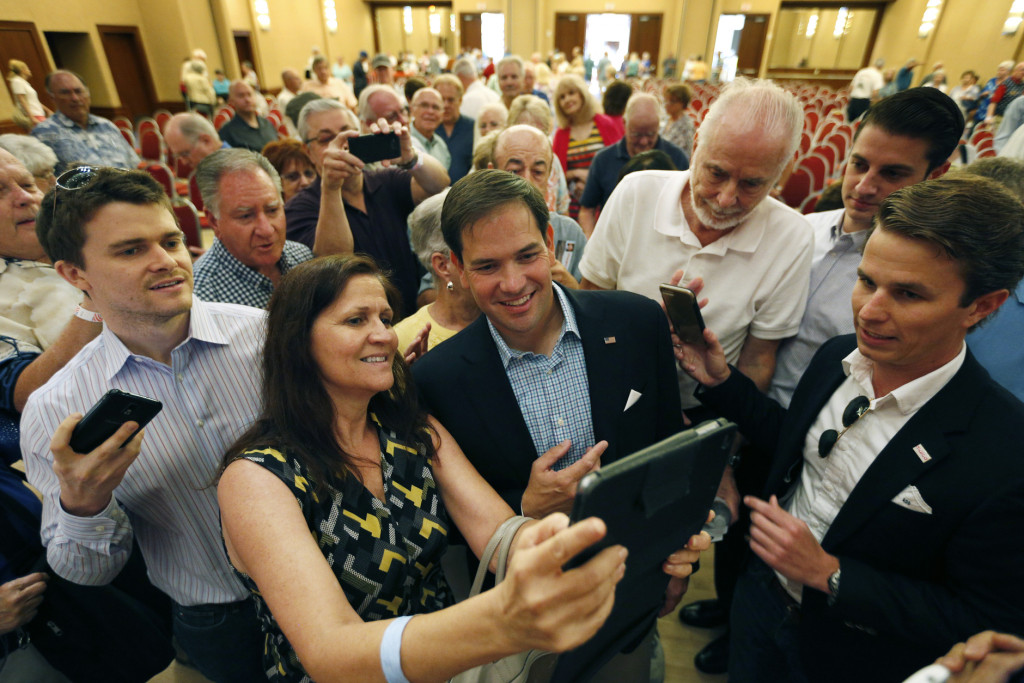
Florida Sen. Marco Rubio says he is indebted to America and running for president is his way of repaying his obligation. The 44-year-old Republican candidate told the Libertarian FreedomFest audience on Friday how his parents made their way from Cuba to Las Vegas, where they found jobs in the casinos. Rubio says his parents embody the American dream. Rubio told several hundred voters in a suburban retirement community on Saturday that as president he would make the U.S. the single greatest military superpower by competing with other nations that are investing billions in new military technology. He also promised to repeal and replace President Barack Obama‘s Affordable Care Act. Rubio also repeated his stance that Yucca Mountain in Nevada is currently the only option for storing the country’s nuclear waste. Republished with permission of the Associated Press.
Study: Alabama counties can offer kids shorter – or longer – odds for escaping poverty
The county that a poor family lives in doesn’t just determine what schools or economic opportunities are within their grasp today, it can actually decide how much money their children might earn in 20 years, according to a new study. Harvard economists Raj Chetty and Nathaniel Hendren – renowned for their research on why low-income families in certain cities are locked out of the middle class – are now challenging the basic concept of the American Dream. Their Equality of Opportunity Project analyzed county-level data on family movement and income from 1996 through 2012. The Harvard report extends the Moving to Opportunity study commissioned by Congress in the 1990s to analyze the effects of offering housing vouchers to poor families moving to better neighborhoods. Chetty and Hendren conclude that every year after a child moves to a strong community adds to their future earnings – but every year a child spends in a poor community takes a bit more away from their paycheck as an adult. The key, according to Chetty, is for the child to move as early as possible. “The data shows we can do something about upward mobility,” he said in a recent interview with The New York Times. “Every extra year of childhood spent in a good neighborhood seems to matter.” “Geography does not simply separate rich from poor,” wrote David Leonhardt in his New York Times article analyzing the recent findings. “But also plays a large role in determining which poor children achieve the so-called American Dream.” Matthew O’Brien wrote in The Atlantic that the Harvard study offers a snapshot of not two or three Americas, but hundreds. According to his coverage of the study, kids have a better chance of moving up the economic ladder if they live in the middle states (Utah, Kansas, Iowa or Nebraska), but very little chance if they live in the Deep South. In Alabama, the findings suggest that if a family is poor, moving to a handful of counties early in their children’s lives would improve their odds of escaping poverty in adulthood. Which counties offer the best odds for kids in poor families? Cleburne (#630), Dekalb (#635), Coffee (#824), Geneva (#933), and Lawrence (#947) counties were Alabama’s highest ranked counties compared with the rest of the nation. The study assumes the average household income at age 26 is $26,000. A child growing up in DeKalb County would earn about 8.9 percent more as an adult than if they grew up elsewhere, translating to $2,314 of additional income. In Lawrence County, that additional income drops to $1,378. By contrast, children in wealthier families have a chance at adding to their future earnings if they live in Fayette (#8), Geneva (#57), Crenshaw (#142), Cullman (#150) or Cleburne (#157) counties. Growing up in Fayette County will boost household income at age 26 by 12.7%, or $3,302; in Cleburne County, that additional income is $2,288 (8.8%) Here are some of the findings for Alabama’s largest counties: For an interactive map to see results in another county, click here
