
Donald Trump can be sued for January 6 riot harm, Justice Dept. says
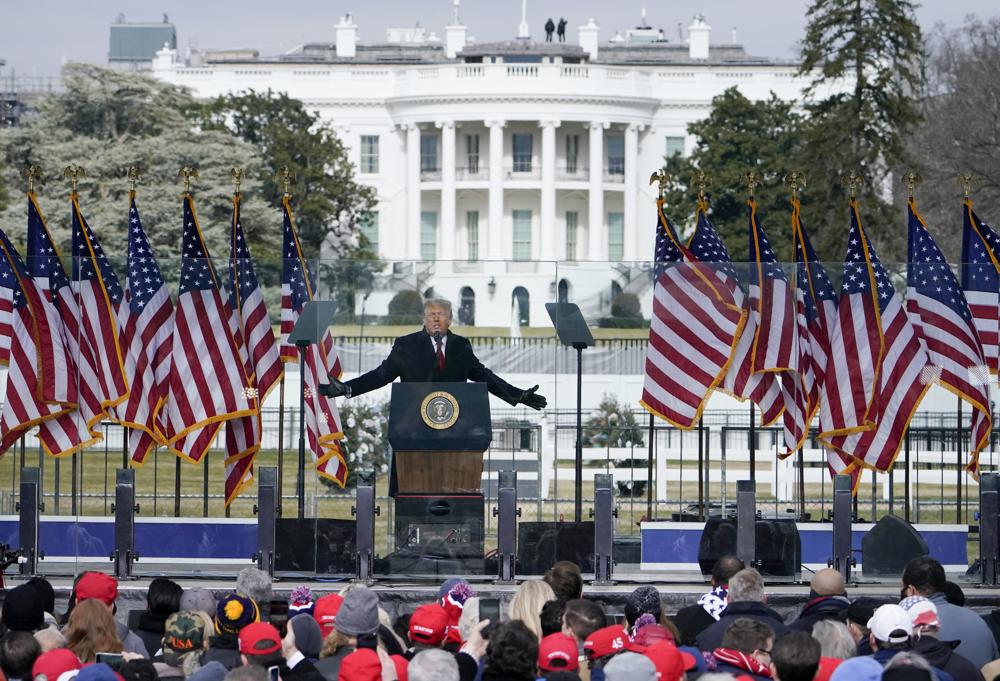
Former President Donald Trump can be sued by injured Capitol Police officers and Democratic lawmakers over the January 6, 2021, insurrection at the U.S. Capitol, the Justice Department said Thursday in a federal court case testing Trump’s legal vulnerability for his speech before the riot. The Justice Department told a Washington federal appeals court in a legal filing that it should allow the lawsuits to move forward, rejecting Trump’s argument that he is immune from the claims. The department said it takes no position on the lawsuits’ claims that the former president’s words incited the attack on the Capitol. Nevertheless, Justice lawyers told the court that a president would not be protected by “absolute immunity” if his words were found to have been an “incitement of imminent private violence.” “As the Nation’s leader and head of state, the President has ‘an extraordinary power to speak to his fellow citizens and on their behalf,’” they wrote. “But that traditional function is one of public communication and persuasion, not incitement of imminent private violence.” The brief was filed by lawyers of the Justice Department’s Civil Division and has no bearing on a separate criminal investigation by a department special counsel into whether Trump can be criminally charged over efforts to undo President Joe Biden’s victory in the 2020 presidential election ahead of the Capitol riot. In fact, the lawyers note that they are not taking a position with respect to potential criminal liability for Trump or anyone else. Trump’s lawyers have argued he was acting within the bounds of his official duties and had no intention to spark violence when he called on thousands of supporters to “march to the Capitol” and “fight like hell” before the riot erupted. “The actions of rioters do not strip President Trump of immunity,” his lawyers wrote in court papers. “In the run-up to January 6 and on the day itself, President Trump was acting well within the scope of ordinary presidential action when he engaged in open discussion and debate about the integrity of the 2020 election.” A Trump spokesperson said Thursday that the president “repeatedly called for peace, patriotism, and respect for our men and women of law enforcement” on January 6 and that the courts “should rule in favor of President Trump in short order and dismiss these frivolous lawsuits.” The case is among many legal woes facing Trump as he mounts another bid for the White House in 2024. A prosecutor in Georgia has been investigating whether Trump and his allies broke the law as they tried to overturn his election defeat in that state. Trump is also under federal criminal investigation over top secret documents found at his Florida estate. In the separate investigation into Trump and his allies’ efforts to keep the Republican president in power, special counsel Jack Smith has subpoenaed former Vice President Mike Pence, who has said he will fight the subpoena. Trump is appealing a decision by a federal judge in Washington, who last year rejected efforts by the former president to toss out the conspiracy civil lawsuits filed by the lawmakers and police officers. U.S. District Judge Amit Mehta ruled that Trump’s words during a rally before the violent storming of the U.S. Capitol were likely “words of incitement not protected by the First Amendment.” “Only in the most extraordinary circumstances could a court not recognize that the First Amendment protects a President’s speech,” Mehta wrote in his February 2022 ruling. “But the court believes this is that case.” One of the lawsuits, filed by Rep. Eric Swalwell, D-Calif., alleges that “Trump directly incited the violence at the Capitol that followed and then watched approvingly as the building was overrun.” Two other lawsuits were also filed, one by other House Democrats and another by officers James Blassingame and Sidney Hemby. The House Democrats’ lawsuit cites a federal civil rights law that was enacted to counter the Ku Klux Klan’s intimidation of officials. The cases describe in detail how Trump and others spread baseless claims of election fraud, both before and after the 2020 presidential election was declared, and charge that they helped to rile up the thousands of rioters before they stormed the Capitol. The lawsuits seek damages for the physical and emotional injuries the plaintiffs sustained during the insurrection. Even if the appeals court agrees that Trump can be sued, those who brought the lawsuit still face an uphill battle. They would need to show there was more than fiery rhetoric, but a direct and intentional call for imminent violence, said Laurie Levenson, a Loyola Law School professor, and former federal prosecutor. “We are really far away from knowing that even if the court allows the lawsuit to go forward, whether they would be successful,” she said. “Even if the court says hypothetically you can bring an action against a president, I think they’re likely to draw a line that is very generous to the president’s protected conduct.” In its filing, the Justice Department cautioned that the “court must take care not to adopt rules that would unduly chill legitimate presidential communication” or saddle a president with burdensome and intrusive lawsuits. “In exercising their traditional communicative functions, Presidents routinely address controversial issues that are the subject of passionate feelings,” the department wrote. “Presidents may at times use strong rhetoric. And some who hear that rhetoric may overreact, or even respond with violence.” Republished with the permission of The Associated Press.
2nd Oath Keeper pleads guilty to conspiracy in Jan. 6 riot
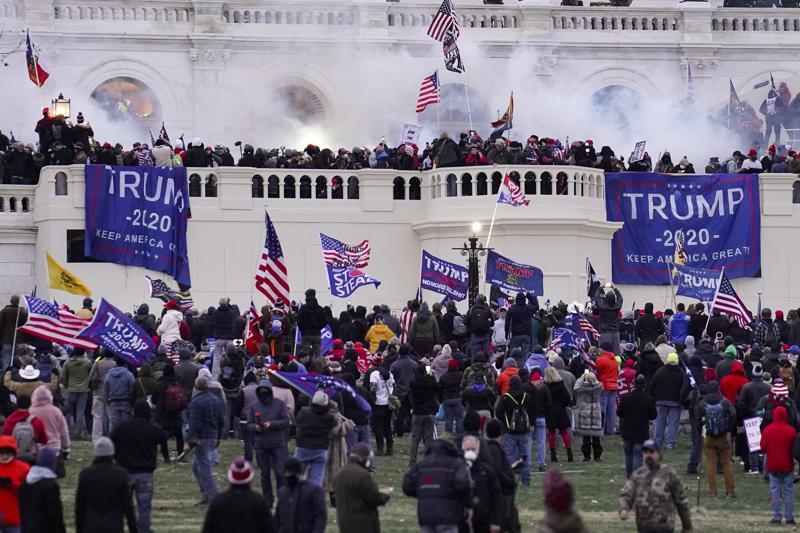
An Alabama man who stormed the U.S. Capitol with other members of the Oath Keepers extremist group pleaded guilty Wednesday to conspiracy and is cooperating with prosecutors in another major boost for the Justice Department in its sweeping Jan. 6 investigation. Mark Grods, 54, is the second member of the far-right Oath Keepers group to admit to participating in a conspiracy to block the certification of President Joe Biden’s victory and agree to cooperate in the Department of Justice’s massive investigation. Grods’ case was kept secret until Wednesday to protect the investigation and his safety before he testified in front of a grand jury, according to court documents. The cooperation agreements are certain to put pressure on the more than a dozen other defendants associated with the far-right Oath Keepers who are still fighting the allegations. It’s the largest conspiracy case that authorities have brought so far in the Jan. 6 attack. Grods, of Mobile, pleaded guilty to charges of conspiracy and obstruction of an official proceeding. U.S. District Judge Amit Mehta said Grods would likely face around four to five years in prison under federal sentencing guidelines. But prosecutors are likely to ask for even less time in exchange for his cooperation against others. Grods and his attorney did not speak to reporters as they left federal court in Washington on Wednesday. The judge told Grods he could not have any contact with other people associated with the Oath Keepers. Last week, prosecutors secured the first guilty plea in the Oath Keepers conspiracy case with defendant Graydon Young, 55, of Englewood, Florida, who was arrested in February. Young has also agreed to cooperate with investigators. Authorities say members of the Oath Keepers came to Washington intent on stopping the peaceful transition of power and were ready to use violence if necessary. Prosecutors have said members of the group prepared in the weeks leading up to Jan. 6 as if they were heading to war and dressed that day in battle gear, like helmets and tactical vests. Oath Keepers leader Stewart Rhodes, who has not been charged, communicated with some of the defendants over a Signal chat called “DC OP: Jan 6 21,” which prosecutors have said shows the group was “activating a plan to use force on Jan. 6.” Defense attorneys have argued that any discussions their clients had before Jan. 6 were in reference to providing security at the rally before the riot or protecting themselves against possible attacks from Antifa activists. They have denied that there was any plot to attack the Capitol or halt the certification of the vote. Grods on Jan. 2 sent a message over Signal that read: “So I guess I am taking full gear less weapons? Just reading through all the posts. Would rather have it and not need it,” according to court documents. Authorities say he brought guns to Washington and gave them to another person to store at a hotel in Virginia. Grods rode in a golf cart to the Capitol and was among those who joined the military-style “stack” formation seen marching toward the building, according to court documents. He went inside with a large stick and left after officers shot pepper balls at a wall near him, prosecutors say. Another defendant told him afterward to “make sure that all signal comms about the op has been deleted and burned,” according to court documents. More than 500 people across the U.S. have been arrested on federal charges so far in the Jan. 6 riot. Grods is the 11th person to plead guilty. A third member of the Oath Keepers group, Jon Ryan Schaffer, has also pleaded guilty and agreed to cooperate with prosecutors, but he wasn’t charged in the conspiracy case. Most of the other plea deals have been for defendants who were charged only with misdemeanors for illegally entering the Capitol. The only defendant who has been sentenced so far is an Indiana woman who pleaded guilty to a misdemeanor charge. She was ordered to serve three years of probation, perform 120 hours of community service and pay $500 in restitution. Republished with the permission of the Associated Press.
No jail time in 1st riot sentence; Oath Keeper pleads guilty
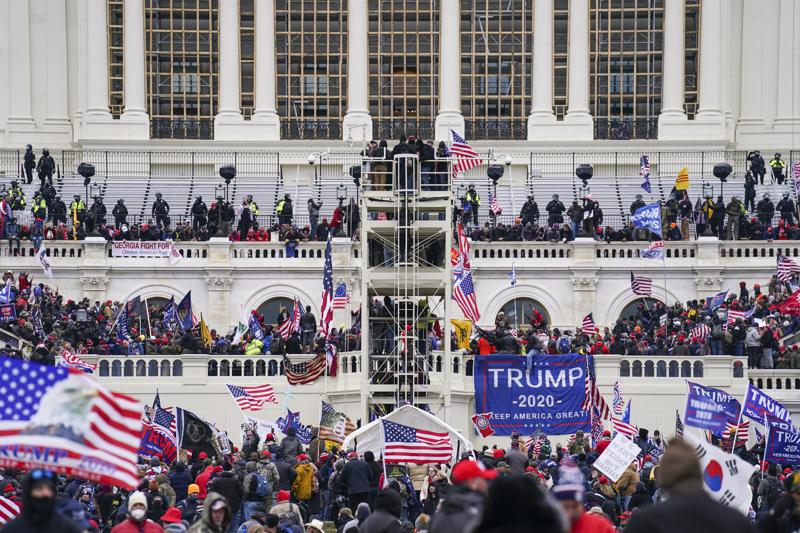
An Indiana woman on Wednesday became the first defendant to be sentenced in the Jan. 6 insurrection at the U.S. Capitol and avoided time behind bars, while a member of the Oath Keepers extremist group pleaded guilty in a conspiracy case and agreed to cooperate with prosecutors in a major step forward for the massive investigation. The two developments signal that the cases against those charged in the deadly siege are slowly advancing, even as the U.S. Department of Justice and the courthouse in Washington, D.C., struggle under the weight of roughly 500 federal arrests across the U.S. And it comes as Republicans in Washington attempt to downplay the violence committed by members of the mob supporting former President Donald Trump. Graydon Young, who was accused alongside 15 other members and associates of the Oath Keepers of conspiring to block the congressional certification of Joe Biden’s presidential victory, pleaded guilty to two counts: conspiracy and obstruction of an official proceeding. It was the first guilty plea in the major conspiracy case brought against members of the group. The second charge calls for up to 20 years in prison, but U.S. District Judge Amit Mehta said federal sentencing guidelines call for Young to serve between 5 1/4 years and 6 1/2 years behind bars. Prosecutors may seek even less time in exchange for his cooperation against other defendants. Young, 55, of Englewood, Florida, was arrested in February and charged in the sweeping conspiracy case accusing members of the Oath Keepers of coming to Washington prepared to use violence and intent on stopping the certification of the vote. Authorities said in court documents that Young joined the Florida chapter of the Oath Keepers in December, writing that he was “looking to get involved in helping …” Later that month, Young reached out to a company that does firearms and combat training about a rifle class for four people, according to the indictment. Authorities say, Young, wearing a helmet and tactical vest, was part of the military-style “stack” seen on camera marching through the crowd before entering the Capitol building. Young’s attorneys didn’t immediately respond to emails sent Wednesday seeking comment. Another Oath Keepers member, Jon Ryan Schaffer, has also pleaded guilty in the riot but was not charged in the conspiracy case. Schaffer has agreed to cooperate with investigators and potentially testify against other defendants. Anna Morgan Lloyd, 49, of Indiana, was ordered by a federal judge to serve three years of probation, perform 120 hours of community service and pay $500 in restitution after admitting to unlawfully entering the Capitol. She pleaded guilty to a single misdemeanor charge under a deal with prosecutors. After the riot, Lloyd described Jan. 6 on Facebook as the “best day ever.” On Wednesday, she apologized to the court, her family, and “the American people,” saying she went to Washington that day to peacefully show her support for Trump. “I’m ashamed that it became a savage display of violence that day. And I would have never been there if I had a clue it was going to turn out that way,” Lloyd told the judge. “It was never my intent to be a part of anything that’s so disgraceful to our American people.” In seeking probation for Lloyd, prosecutors noted that she was not involved in any violence and destruction or preplanning and coordination of the Capitol breach. Lloyd was invited by her hairdresser to drive to Washington to hear Trump speak, her attorney wrote in court documents. U.S. District Court Judge Royce Lamberth said he was giving her a “break” but didn’t want others to think that probation — and not a stiffer sentence — would be the norm. “Legally, I could give you the six months, but is that really what we want our judiciary to do?” the judge asked. Lamberth said he struggled with what would be an appropriate sentence for Lloyd because he views the riot as a serious crime. “This wasn’t a peaceful demonstration the way it turned out. It was not an accident,” he said. “It was intended to and brought a halt to the very functioning of our government.” He said he was “especially troubled” by some lawmakers who are seeking to rewrite the history of the Capitol riot. “I don’t know what planet they were on, but there were millions of people in this country that saw what happened on Jan. 6 and that saw what you saw and what you just described: a disgrace to our country,” the judge said. In a letter to the judge asking for leniency, Lloyd wrote that she was a registered Democrat but that she and her husband began supporting Trump in 2016 because “he was standing up for what we believe in.” After her arrest, Lloyd’s lawyer gave her a list of books and movies to help her “see what life is like for others in our country,” Lloyd wrote. Lloyd said she has sought to educate herself by watching movies such as “Schindler’s List” and the History Channel’s “Burning Tulsa” and reading Bryan Stevenson’s “Just Mercy.” “I’ve lived a sheltered life and truly haven’t experienced life the way many have,” Lloyd wrote. “I’ve learned that even though we live in a wonderful country things still need to improve. People of all colors should feel as safe as I do to walk down the street.” Four other people — a Tennessee man, a Maryland man, and a Virginia couple — have pleaded guilty to the same misdemeanor charge in the last two weeks. Earlier Wednesday, another man, Robert Maurice Reeder of Maryland, admitted to entering the Capitol, but his lawyer said he didn’t force his way inside and didn’t damage any property or hurt anyone. Before his arrest, an attorney for Reeder provided federal authorities with a compilation of photos and videos that he took with his cellphone at the Capitol. A video seemed to show Reeder chanting, “Fight for Trump!” and he recorded an assault on a Capitol police officer, according to the FBI. “You
