
Found emails? Hillary Clinton aide didn’t delete old messages

The longtime Hillary Clinton aide at the center of a renewed FBI email investigation testified under oath four months ago she never deleted old emails, while promising in 2013 not to take sensitive files when she left the State Department. FBI Director James Comey notified Congress on Friday, less than two weeks before the election, that the emails had led agents to re-examine whether classified information was mishandled. That had been the focus of the bureau’s earlier criminal inquiry into the former secretary of state’s use of a private email server, which Comey said in July didn’t warrant charges. The newly discovered emails were on a device seized during a sexting investigation of disgraced former New York congressman, Anthony Weiner, the estranged husband of Huma Abedin, one of Clinton’s closest aides. Abedin’s testimony in a recent civil lawsuit about State Department records may help explain why agents found emails that Comey said “appear to be pertinent” and would be reviewed “to determine whether they contain classified information, as well as to assess their importance to our investigation.” Abedin told lawyers in June in a deposition that, like millions of internet users who don’t manage their inboxes, she simply never deleted old emails, either at work with Clinton or at home with Weiner. “I didn’t have a practice of managing my mailbox other than leaving what was in there sitting in there,” Abedin said. “I didn’t go into my emails and delete State.gov emails. They just lived on my computer. That was my practice for all my email accounts. I didn’t have a particular form of organizing them. I had a few folders, but they were not deleted. They all stayed in whatever device I was using at the time or whatever desktop I was on at the time.” Abedin, vice chairwoman of Clinton’s presidential campaign, and Weiner separated this year after Weiner was caught in 2011, 2013 and again this year sending numerous woman sexually explicit text messages and photographs of himself undressed. Federal authorities in New York and North Carolina are investigating online communications between Weiner and a 15-year-old girl. Abedin’s testimony in the civil suit was complicated by a routine State Department document she signed under penalty of perjury in February 2013. She promised she would “turn over all classified or administratively controlled documents and materials” before she left her government job, and promised that she was not retaining copies, “including any diaries, memorandums of conversation or other documents of a personal nature.” The document required her to give back all “unclassified documents and papers relating to the official business of the government acquired by me while in the employ of the department.” Comey’s announcement Friday — just months after deciding that anyone’s use of Clinton’s private email server didn’t rise to criminal charges for mishandling or removal of classified information — upended the presidential campaigns in their final stretch before the Nov. 8 voter. Clinton urged the FBI to “explain this issue in question, whatever it is, without any delay.” Even within the Justice Department, officials advised Comey not to make the announcement. Upon learning of Comey’s plans to send the letter to Congress, Justice Department officials told FBI officials that was not a good idea and cautioned against it, according to a government official familiar with the discussions. The official was not authorized to publicly discuss the private conversations and spoke on condition of anonymity. The official said the Justice Department had warned the FBI that the letter was inconsistent with department policy intended to avoid the appearance of prosecutorial influence in elections. The position is laid out in a 2012 memo from then-Deputy Attorney General James Cole. It said prosecutors may never select the timing of criminal charges or investigative actions in a way that can be seen as affecting an election or giving a benefit or disadvantage to a candidate. The memo says that although the department has a strong interest in prosecuting election-related crimes, such as those involving campaign finance and patronage, employees must remain committed to fairness and political neutrality. “Simply put, politics must play no role in the decisions of federal investigators or prosecutors regarding any investigations or criminal charges,” the memo states. Comey told FBI employees later Friday he wanted to avoid creating “a misleading impression,” but believed he was obligated. “We don’t ordinarily tell Congress about ongoing investigations, but here I feel an obligation to do so given that I testified repeatedly in recent months that our investigation was completed.” Comey wrote in a letter to staff. “I also think it would be misleading to the American people were we not to supplement the record.” Even if any of the emails are judged to be classified, that would not necessarily indicate potential legal peril for anyone involved. The FBI already found scores of emails with classified information on Clinton’s server, but didn’t think the handling of the material rose to the level of a crime. Republished with permission of the Associated Press.
Hillary Clinton pushes back against ‘unprecedented’ new FBI review
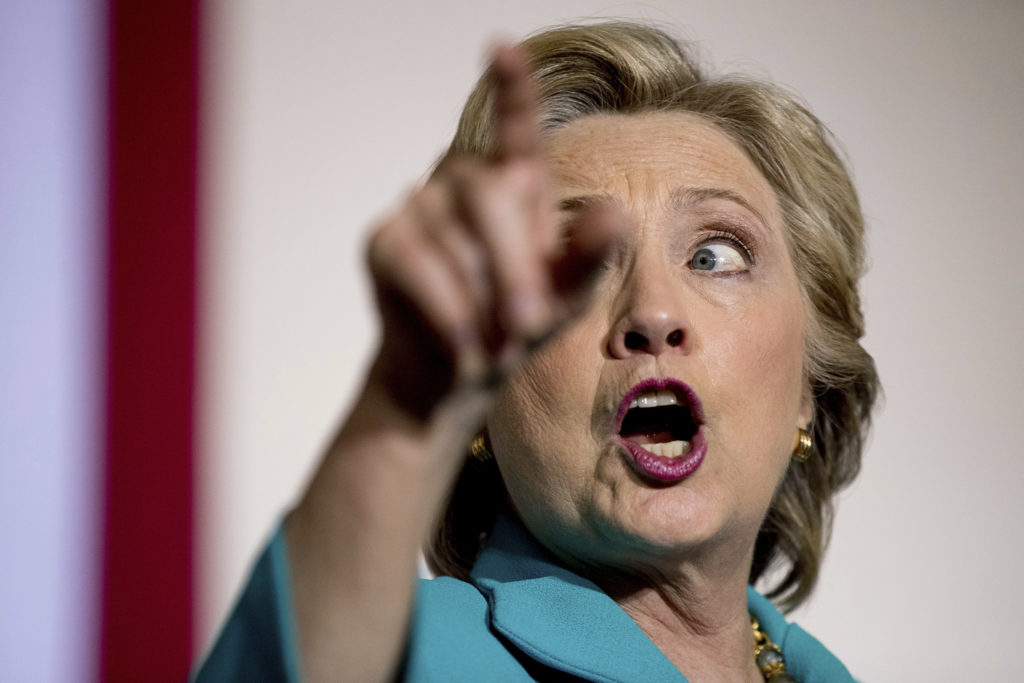
Hillary Clinton lashed out Saturday at the FBI’s handling of a new email review, leading a chorus of Democratic leaders who declared the bureau’s actions just days before the election “unprecedented” and “deeply troubling.” Emboldened Republican rival Donald Trump seized on the reignited email controversy, hoping to raise new doubts about Clinton’s trustworthiness. Rallying supporters in Florida, Clinton pressed FBI Director James Comey to put out the “full and complete facts” about the review into a cache of recently discovered emails. Clinton backers panned Comey’s letter to Congress about the new emails as severely lacking crucial details. “It is pretty strange to put something like that out with such little information right before an election,” Clinton said. She accused Trump of using the issue to confuse and mislead voters in the final leg of the campaign for the Nov. 8 election. The controversy over Clinton’s email practices at the State Department has dogged her for more than a year. The former secretary of state has often been reluctant to weigh in on the matter — and defensive when she’s been pushed to do so. But Clinton’s approach to this latest flare-up is markedly different, underscoring worries that the matter could damage her standing with voters in the election’s final days. Clinton advisers have been rallying Democratic lawmakers and other supporters to her defense, including members of the Congressional Black Caucus. Earlier Saturday, Clinton campaign chairman John Podesta said there was “no evidence of wrongdoing” in the new email review and “no indication this is even about Hillary.” But Comey, who enraged Republicans in the summer when he announced the FBI would not prosecute Clinton for her loose handling of official email, in fact said the new trove appeared to be “pertinent” to the Clinton email investigation. He did not explain how. A government official told The Associated Press on Saturday that the Justice Department had advised the FBI against telling Congress about the new developments in the Clinton investigation because of the potential fallout so close to the election. The official was not authorized to speak publicly about the matter and discussed it on condition of anonymity. Justice officials concluded the letter would be inconsistent with department policy that directs against investigative actions that could be seen as affecting an election or helping a particular candidate, the official said. Landing with a thud, the email issue again threatened to undermine an advantage built by Clinton, the Democratic nominee, over Trump and raised the possibility that the Republican might be able to seize late momentum. Trump told a crowd in Golden, Colorado, on Saturday that the FBI’s review of Clinton email practices raises “everybody’s deepest hope that justice, as last, can be properly delivered.” His crowd cheered Clinton’s email woes, which Trump has taken to calling the biggest political scandal since Watergate. The FBI is looking into whether there was classified information on a device belonging to Anthony Weiner, the disgraced ex-congressman who is separated from longtime Clinton aide Huma Abedin. Comey, in his letter to Congress on Friday, said the FBI had recently come upon new emails while pursuing an unrelated case and was reviewing whether they were classified. A person familiar with the investigation, who lacked authority to discuss the matter publicly and insisted on anonymity, said the device that appears to be at the center of the new review was not a computer Weiner shared with Abedin. As a result, it was not a device searched for work-related emails at the time of the initial investigation. The person said “this is news to (Abedin)” that her emails would be on a computer belonging to her husband. The person added that if the emails included those related to Abedin’s work with Clinton at the State Department, they are expected to be duplicates of what she had already turned over as part of the initial investigation. Trump mused aloud during his rally about whether Clinton was “going to keep Huma,” adding that Abedin has “been a problem.” He hurled insults at Weiner, warning again that the former congressman posed a national security risk because of his access to information through his estranged wife. Abedin, a close Clinton confidant who is a near constant presence in the campaign, was not traveling with Clinton on Saturday. New York Rep. Gregory Meeks suggested the FBI chief might be trying to sway the election and called for him to disclose what he knows. Clinton herself said of Comey: “Put it all out on the table.” Long term, the development all but ensured that, even should Clinton win the White House, she would celebrate a victory under a cloud of investigation. Comey, who was appointed in 2013 to a 10-year term as FBI director, would still be on the job if Clinton wins the White House. Congressional Republicans have already promised years of investigations into Clinton’s private email system. And that’s only one of the email-related episodes facing her in the campaign’s closing days. The tens of thousands of confidential emails from Clinton campaign insiders that were hacked — her campaign blames Russia — and then released by WikiLeaks have provided a steady stream of questions about her policy positions, personnel choices and ties with her husband’s extensive charitable network and post-presidential pursuits. In his letter to congressional leaders Friday, Comey wrote only that new emails have emerged, prompting the agency to “take appropriate investigative steps” to review information that appeared pertinent to its previously closed investigation into Clinton private email system. Clinton’s campaign is hoping the issue will fire up its base of voters who feel the secretary has been unfairly targeted in a litany of investigations, but it could also revive some Clinton fatigue. Given a political gift from the FBI, Trump’s challenge now becomes avoiding any big missteps that might overshadow Clinton’s troubles over the campaign’s final days. If history is a guide, that won’t be easy. Inside Trump’s Colorado rally, his supporters worried whether he could stick to his message
Huma Abedin, a top Hillary Clinton aide, is leaving husband Anthony Weiner amid new sexting scandal
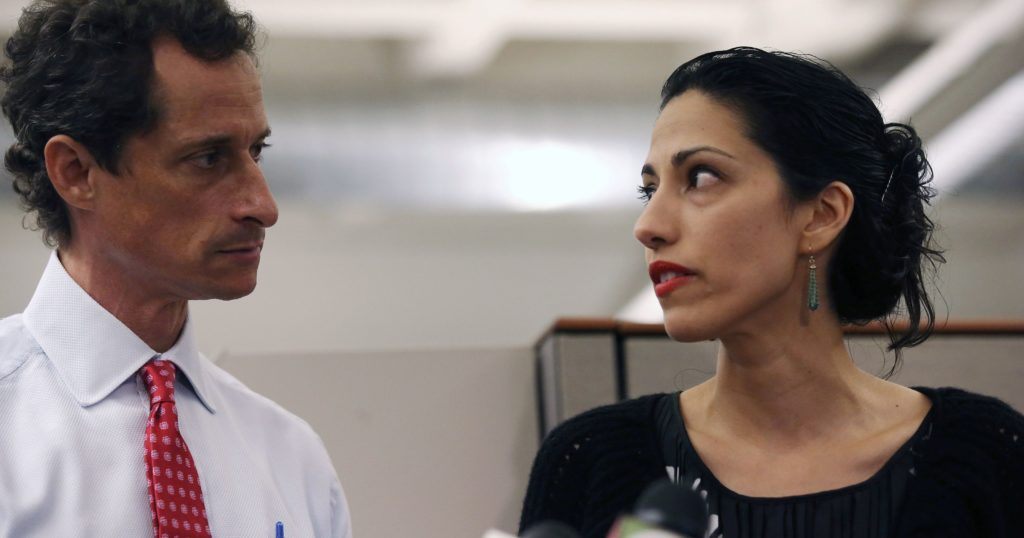
Hillary Clinton aide Huma Abedin is done playing the good wife to Anthony Weiner, announcing Monday she is leaving the serially sexting ex-congressman after he was accused of sending raunchy photos and messages to yet another woman. Abedin, who as vice chair of Clinton’s campaign is destined for big things if the Democrat is elected president, stayed with Weiner after a sexting scandal led him to resign from Congress in 2011 and after a new outbreak of online misbehavior wrecked his bid for New York mayor in 2013. She didn’t leave even when a recent documentary blew up tense moments in their marriage to big-screen proportions. But on Monday, she effectively declared she had had enough. “After long and painful consideration and work on my marriage, I have made the decision to separate from my husband,” she said in a statement issued by the campaign. “Anthony and I remain devoted to doing what is best for our son, who is the light of our life.” The New York Post published photos late Sunday that it said Weiner had sent last year to a woman identified only as a “40-something divorcee” who lives in the West and supports Republican Donald Trump. The photos included two close-ups of Weiner’s bulging underpants. In one of the pictures, Weiner is lying on a bed with his toddler son while texting the woman, according to the Post. The tabloid also ran sexually suggestive messages that it said the two exchanged. Weiner told the Post that he and the woman “have been friends for some time.” “She has asked me not to comment except to say that our conversations were private, often included pictures of her nieces and nephews and my son and were always appropriate,” the 51-year-old Democrat told the newspaper. Weiner didn’t return a call, text or email from The Associated Press. He deleted his Twitter account Monday. The Post didn’t say how it obtained the photographs and messages. Abedin, 40, is a longtime Clinton aide and confidante who is often referred to as the candidate’s second daughter. Trump immediately seized on the aide’s marital split to accuse Clinton of “bad judgment.” He suggested that Weiner might have compromised national security, but offered no evidence to support the allegation. “I only worry for the country in that Hillary Clinton was careless and negligent in allowing Weiner to have such close proximity to highly classified information,” Trump said in a statement. “Who knows what he learned and who he told?” Abedin has been under scrutiny during the probe into Clinton’s use of a private email server while she was secretary of state. Federal prosecutors declined to file charges in the investigation, but FBI Director James Comey said Clinton and her aides had been “extremely careless” in their handling of classified information. Abedin began working for the former first lady as a White House intern and became a trusted aide as Clinton won a seat in the Senate representing New York in 2000, ran for president in 2008 and served as President Barack Obama‘s secretary of state. Former President Bill Clinton officiated when Abedin and Weiner married in 2010. The marriage would provide years of fodder for political commentators, armchair psychologists and spouses all over America who wondered: How could she stay with him? Abedin was pregnant with the couple’s son, Jordan, when a photo of a man’s bulging underpants appeared on Weiner’s Twitter account in 2011. After initially claiming his account was hacked, Weiner acknowledged inappropriate online communication with several women. Two years later, Abedin was all in for her husband’s mayoral bid, raising money, appearing on the campaign trail and participating in interviews in which the couple talked about rebuilding their trust and marriage. Then a new series of sexually explicit pictures and messages emerged, and Weiner was forced to acknowledge he kept sexting after he had resigned from Congress. Still, Abedin said, “I love him, I have forgiven him, I believe in him, and … we are moving forward.” Voters weren’t ready to forgive, however. Weiner lost the Democratic primary. Weiner has since remained in the public eye, commenting on politics on cable news shows. “Weiner,” the documentary offering a cringe-inducing inside view of his mayoral campaign and its unraveling, played in theaters earlier this year and is set to air on Showtime this fall. He recently refused to answer when asked whether he was still sexting, telling The New York Times Magazine in an interview published Aug. 16: “I’m not going to go down the path of talking about any of that.” Some psychology experts, while cautioning they haven’t treated him, suggested his behavior smacks of extreme impulsiveness, compulsion or addiction. “Impulsivity is something that a lot of people really struggle with,” said Jeannette Stern, a New York therapist. While there are various approaches people can try to change such behavior, she noted, “they have to really be willing to stop.” Republished with permission of The Associated Press.
Steven Kurlander: In defense of Debbie Wasserman Schultz

With the Democratic coronation of Hillary (and Bill again, too) Clinton slated to begin Monday, it looks like Congresswoman and Democratic National Committee Chairwoman Debbie Wasserman Schultz won’t be waiving her very curly hair, or the gavel as Chairwoman of the convention in Philadelphia. In fact, she resigned her position as Chairwoman before the convention began. David Axelrod, the former senior advisor to President Obama, stated Sunday “I would ask her to step aside. I would ask her to step aside because she’s a distraction in a week that is Hillary Clinton’s week.” CNN indicated that over the weekend the DNC decided not to allow DWS to speak or preside over the convention (the term “quarantined” was used) while Politico reported that DWS herself pulled herself off the convention dais for fear of being booed by Bernie Sanders supporters. The latest trouble for DWS as DNC Chairwoman began after the (obviously calculated) leak of over 20,000 email by WikiLeaks revealed that DWS and staffers at the DNC were working very hard against Bernie Sanders and his campaign. There was one particular email that set off its own shitstorm where it appeared to indicate that the DNC was going to play Sanders as an atheist to weaken his appeal to southern voters. Imagine that. DWS and the DNC working hard to ensure that self-described socialist Bernie would not get the nomination? Jeez, as Gomer Pyle would opine, SURPRISE, SURPRISE, SURPRISE! In reality, the American political system in terms of how we pick our leaders was always and continues to be just plain biased. There’s no fairness about it. Never was. Never will be. The expectation that political operatives like DWS and parties are arbiters of fairness is just plain silly. Her job, from the beginning of the campaign, was to ensure that Hillary (and Bill too) got nominated. Period. Whether you like her or not, both in her role as DNC Chairwoman or as the chief Democratic antagonist in the House (particularly after Congressman Anthony Weiner took one too many selfies), DWS has been the ultimate loyal soldier to the “mainstream” Clinton-Pelosi wing of the Democratic Party-whether it meant getting into contentious fights with Axelrod and the Obama White House or doing everything she could to ensure that Hillary (and Bill again too) sailed through a nomination process that was rigged from the get go. As chairwoman of a splintered and weak Democratic Party, DWS accomplished what Reince Priebus and mainstream Bushy Republicans couldn’t do – keep what would be in normal times a truly unqualified, populist candidate from obtaining the nomination for president. So while DWS was forced to resign by her own benefactors, DWS got the job done for Hillary (and Bill too). She may have in the long run also prevented the Democratic Party from becoming truly irrelevant to the majority of Americans too. No matter what David Axelrod or any other Democrats say, DWS should hold her curls and head high for a job well do
