
AP Poll: Voters open to candidates who aren’t very religious
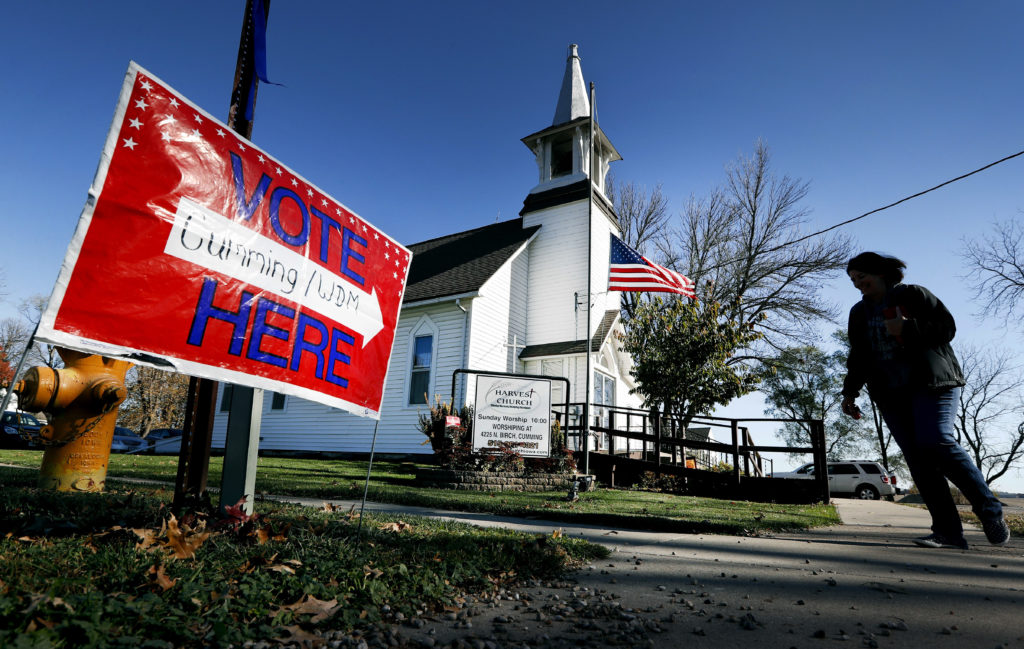
Religion’s role in politics and public policy is in the spotlight heading toward the midterm elections, yet relatively few Americans consider it crucial that a candidate be devoutly religious or share their religious beliefs, according to a poll released Tuesday by The Associated Press-NORC Center for Public Affairs Research. Just 25 percent of Americans say it’s very or extremely important that a candidate has strong religious beliefs, according to the poll. Only 19 percent consider it very or extremely important that a candidate shares their own beliefs, and nearly half say that’s not very important or not important at all. Still, most Americans see a role for religion in shaping public policy. A solid majority of Americans, 57 percent, want the influence of religion on government policy to extend beyond traditional culture war issues and into policies addressing poverty. Americans are more likely to say religion should have at least some influence on poverty than on abortion (45 percent) or LGBT issues (34 percent). There is little public support for the campaign by some conservative religious leaders, backed by President Donald Trump, to allow clergy and religious organizations to endorse political candidates while retaining their tax exempt status. Such a change is opposed by 53 percent of Americans and supported by 13 percent. The rest expressed no opinion. Trump’s stance on political endorsements by clergy is one of many reasons he has retained strong support among white evangelical Christians, despite aspects of his behavior and personal life that don’t neatly align with Christian values. The AP-NORC poll found that 7 in 10 white evangelical Protestants say they approve of Trump, a Republican. The importance of a candidate’s religious faith varied across religious and political groups. Among white evangelical Protestants, 51 percent consider it very or extremely important that a candidate has strong religious beliefs. An additional 25 percent think it’s moderately important. Far fewer Catholics and white mainline Protestants considered this important. Roughly two-thirds of Republicans said it’s at least moderately important that a candidate has strong religious beliefs, compared with 37 percent of Democrats. Jack Kane, an accountant from Key West, Florida, was among the Republican-leaning poll participants who said it wasn’t important to him whether a candidate was deeply religious. “I’d much rather have a guy run the government and not spend all our money, instead of sounding off on what’s going on in the church or on things like abortion,” said Kane, 65, who describes himself as nonreligious. “Who is Catholic, Jewish, Southern Baptist — I could care less, as long as they’re going to carry the torch of freedom.” Kent Jaquette, a Republican-turned-independent and a former United Methodist pastor who lives near San Antonio, said he does not base his choice of candidates on their religious faith. “In politics, you need to look at a person where their morals are, where their values are,” he said. “It may or may not have anything to do with their religion.” Jaquette also questioned the motives of evangelicals who support Trump. “To me, it’s supporting someone who gives no indication he intends to live a Christian life,” said Jaquette, 63. “I believe that Christians should do things that Christ taught — feed the hungry, visit people in jail, help immigrants.” Veronica Irving, a 55-year-old Roman Catholic Republican who lives near Chicago, says it’s extremely important to her that a politician has strong religious beliefs. She’s disappointed that Trump doesn’t demonstrate this more clearly through his behaviors and actions. “It’s not about what faith you come from — it’s just important that you have faith,” she said. At the highest levels of political office, it’s still rare for a politician to profess that he or she is an atheist; surveys indicate that roughly 10 percent of Americans do not believe in a higher power. In recent years, only a small handful of members of Congress have identified themselves as nonbelievers. However, there is some evidence of increasing acceptance of religious diversity — for example, the recent victories by Muslim-American women in Democratic congressional primaries in Michigan and Minnesota. The AP-NORC poll found broad interest in religion having at least some influence on a range of policy issues. In addition to the concern about poverty, 49 percent of Americans want to see religion have some influence on education, 44 percent on health care policy, 43 percent on immigration, 38 percent on gun policy, 36 percent on income inequality, 34 percent on foreign policy and 32 percent on climate change. From each of the largest religious groups, there was strong support for greater religious influence on poverty policy — 71 percent of white evangelical Protestants, 54 percent of white mainline Protestants, 75 percent of nonwhite Protestants and 67 percent of Catholics. The Rev. Jim Wallis, founder of the Christian social justice organization Sojourners, said the poll findings signaled a potentially broader and more vibrant role for organized religion in U.S. politics. “Religious issues are much broader and deeper and different from the issues chosen by the religious right,” he said. “The issues like poverty, immigration, what happens to the homeless — those are becoming the moral and political and voting issues for more and more Christians.” The findings were welcomed by Maureen Malloy Ferguson, a senior policy adviser for The Catholic Association, which depicts its mission as “being a faithful Catholic voice in the public square.” “It’s encouraging to see that so many Americans recognize that religion can be a force for good in society,” she said. However, attorney Emilie Kao, a religious-freedom expert with the conservative Heritage Foundation, questioned whether faith-based organizations might face roadblocks in trying to expand their role in social services. Some jurisdictions, she noted, have sought to exclude religious organizations from various activities, such as adoption and foster care, because of opposition to same-sex marriage and other beliefs. ___ The AP-NORC poll of 1,055 adults was conducted Aug. 16-20 using a sample drawn from NORC’s probability-based AmeriSpeak panel, which is designed to be representative of the
AP Poll: Americans overwhelmingly view Donald Trump negatively
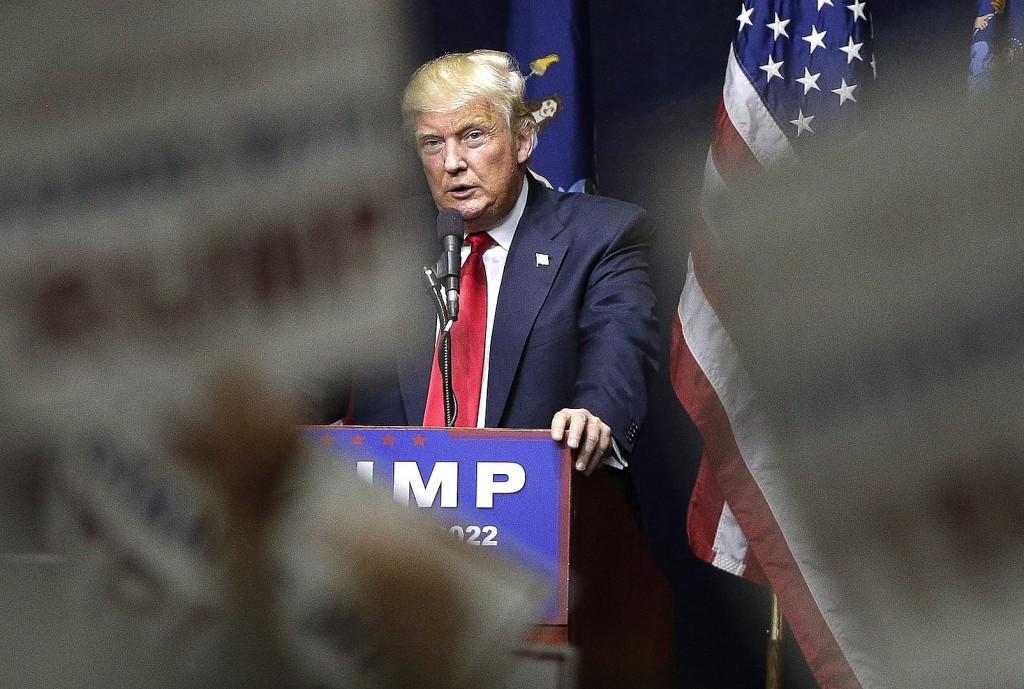
For Americans of nearly every race, gender, political persuasion and location, disdain for Donald Trump runs deep, saddling the Republican front-runner with unprecedented unpopularity as he tries to overcome recent campaign setbacks. Seven in 10 people, including close to half of Republican voters, have an unfavorable view of Trump, according to a new Associated Press-GfK poll. It’s an opinion shared by majorities of men and women; young and old; conservatives, moderates and liberals; and whites, Hispanics and blacks — a devastatingly broad indictment of the billionaire businessman. Even in the South, a region where Trump has won GOP primaries decisively, close to 70 percent view him unfavorably. And among whites without a college education, one of Trump’s most loyal voting blocs, 55 percent have a negative opinion. Trump still leads the Republican field in delegates and has built a loyal following with a steady share of the Republican primary electorate. But the breadth of his unpopularity raises significant questions about how he could stitch together enough support in the general election to win the White House. It also underscores the trouble he may still face in the Republican race, which appears headed to a contested convention where party insiders would have their say about who will represent the GOP in the fall campaign. “He’s at risk of having the nomination denied to him because grass-roots party activists fear he’s so widely disliked that he can’t possibly win,” said Ari Fleischer, a former adviser to President George W. Bush. Beyond their generally negative perception of Trump, large majorities also said they would not describe him as civil, compassionate or likable. On nearly all of these measures, Trump fared worse than his remaining Democratic or Republican rivals. Not that voters have all that much love for those rivals. But their negative perceptions don’t match the depth of the distaste for Trump. Texas Sen. Ted Cruz, who is seeking to catch Trump in the Republican delegate count, is viewed unfavorably by 59 percent, while 55 percent have negative views of Democratic front-runner Hillary Clinton. Another problem for Trump is that his public perception seems to be getting worse. The number of Americans who view him unfavorably has risen more than 10 percentage points since mid-February, a two-month stretch that has included some of his biggest primary victories but also an array of stumbles that suggested difficulties with his campaign organization and a lack of policy depth. A survey conducted by Gallup in January found Trump’s unfavorable rating, then at 60 percent in their polling, was already at a record high level for any major party nominee in their organization’s polling since the 1990’s. Candi Edie, a registered Republican from Arroyo Grande, California, is among those whose views on Trump have grown more negative. “At first, I thought he was great. He was bringing out a lot of issues that weren’t ever said, they were taboo,” Edie said. Now the 64-year-old feels Trump’s early comments masked the fact that he’s “such a bigot.” “I don’t know if he’s lost it or what,” she said. “He’s not acting presidential.”Trump’s unpopularity could provide an opening for Cruz, though he is loathed by many of his Senate colleagues and other party leaders. After a big win Tuesday in Wisconsin, Cruz is angling to overtake Trump at the July GOP convention. Clinton’s campaign believes Trump’s sky-high unfavorable ratings could offset some questions voters have about her own character, and perhaps even give her a chance to peel off some Republicans who can’t stomach a vote for the real estate mogul. Andrew Glaves, a “hard core” Republican from Bothell, Washington, said he might have to side with Clinton if Trump becomes the nominee, even though she’s out of step with his views on gun rights, his top election issue. “I’d be willing to take that as opposed to doing so much harm to the country’s reputation,” said Glaves, 29. More than 60 percent of all registered voters and 31 percent of Republicans said they definitely would not vote for Trump in the general election. One group that is still with him includes those who describe themselves as both Republicans and supporters of the tea party movement. Sixty-eight percent of them have a favorable view. Pennsylvania Republican Robert Paradis plans to vote for Trump in his state’s primary this month. The 76-year-old said that while Trump’s uneven temperament makes him cringe “all the time,” he’s hopeful the front-runner’s bluntness can shake up Washington. “He’s not a politician; he says it the way he feels it,” Paradis said. ___ The AP-GfK Poll of 1,076 adults was conducted online March 31-April 4, using a sample drawn from GfK’s probability-based KnowledgePanel, which is designed to be representative of the U.S. population. The margin of sampling error for all respondents is plus or minus 3.3 percentage points. Respondents were first selected randomly using telephone or mail survey methods and later interviewed online. People selected for KnowledgePanel who didn’t otherwise have access to the Internet were provided access at no cost to them. Republished with permission of the Associated Press.
