
Donald Trump — ‘No Mr. Nice Guy’ — shows softer side to win voters
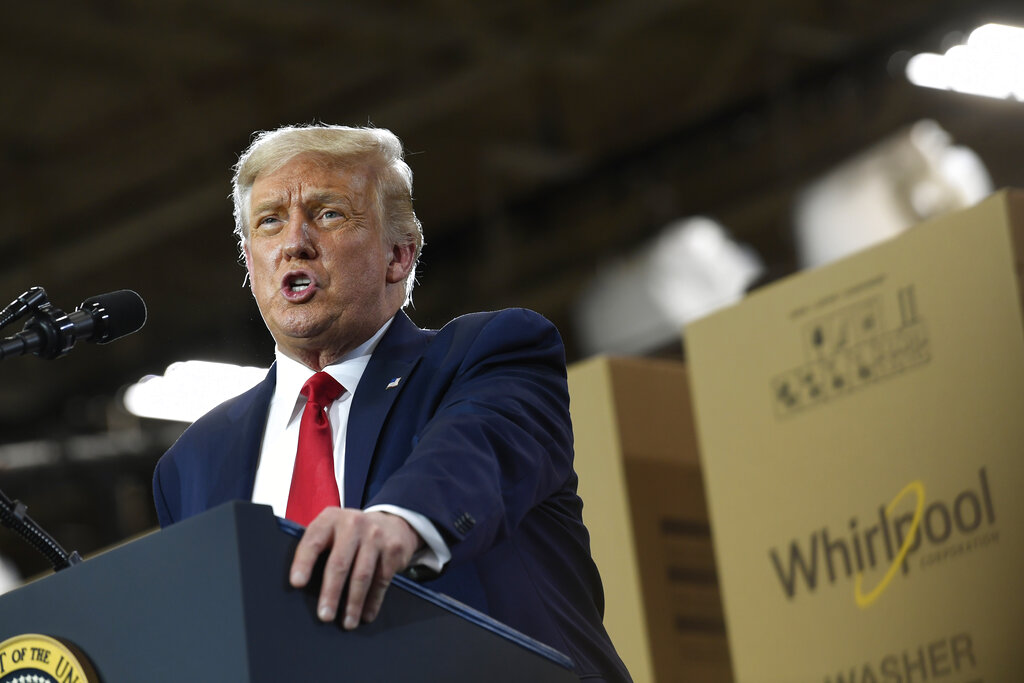
Competing depictions of the president come after the Democrats spent last week showcasing the compassion of Joe Biden.
Donald Trump, a late convert to cause, to join anti-abortion rally
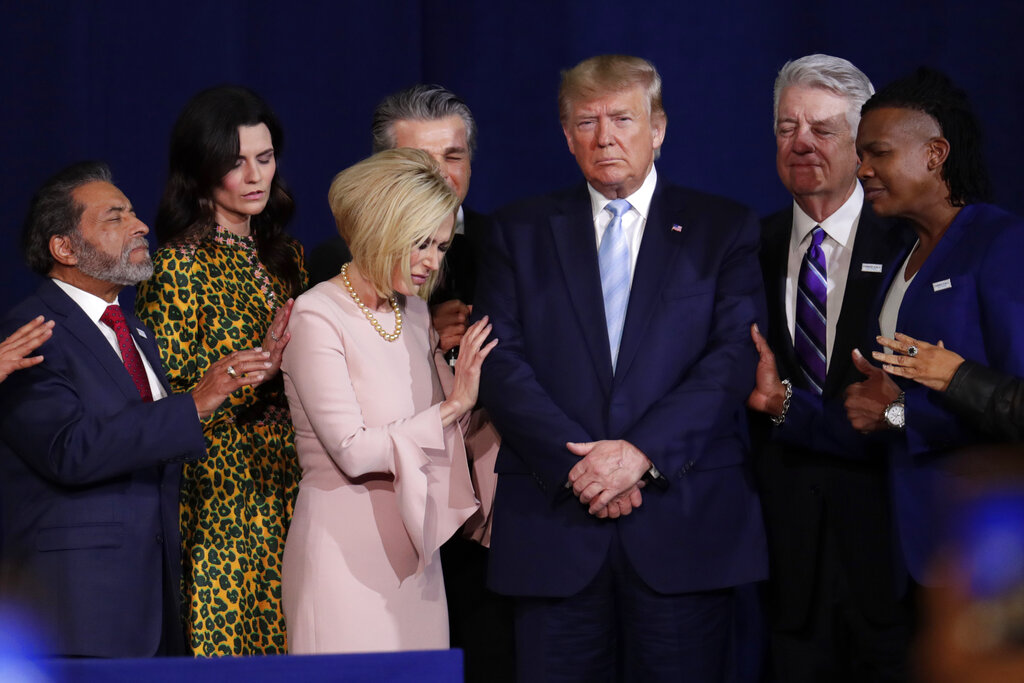
It’s Trump’s latest nod to some of his most loyal backers.
In Donald Trump era, the death of the White House press conference

The presidential news conference, a time-honored tradition going back generations, appears to be no longer. More than a year has passed since President Donald Trump held the only solo news conference of his administration — a rollicking, hastily arranged, 77-minute free-for-all during which he railed against the media, defended his fired national security adviser and insisted nobody who advised his campaign had had contacts with Russia. But there are no signs the White House press shop is interested in a second go-round. Instead, the president engages the press in more informal settings that aides say offer reporters far more access, more often, than past administrations. “President Trump is more accessible than most modern presidents and frequently takes questions from the press,” says White House press secretary Sarah Huckabee Sanders. The president often answers shouted questions at so-called pool sprays, in which a small group of rotating reporters is given access to events such as bill signings and Cabinet lunches. Trump has also taken to answering shouted questions on the White House lawn as he arrives at and departs the White House. The frenzied exchanges — frequently taking place over the roar of Marine One’s rotor — often produce news. But the format also gives the president far more control than he would have during a traditional question-and-answer session. Trump can easily ignore questions he doesn’t like and dodge follow-ups in a way that would be glaring in a traditional news conference. On Friday, for instance, Trump answered several questions in the Oval Office about North Korea and Iran. But when a reporter asked about his threats regarding intervening in the Justice Department, Trump responded with a curt “thank you” that signaled to reporters that he was done with the Q&A session. The president also holds joint news conferences with visiting world leaders, a format reporters call “two and two” because each leader selects two of its country’s reporters to ask questions. While the format looks similar to a solo news conference, the president more often than not calls on friendly reporters from conservative outlets and limits the opportunity for follow-up questions. On Friday, during a joint news conference with German Chancellor Angela Merkel, Trump called on reporters from Fox Business Network and the Christian Broadcasting Network. Fox News correspondent John Roberts has been called on so often that Trump once picked him and then changed his mind. “Actually, we’ll go somebody else this time, John. You’ve been doing enough, John,” he said to laughs. Trump also submits to occasional one-on-one interviews with individual news outlets. Last week, he called in to “Fox & Friends,” his favored format during the campaign. And several times he has held longer, impromptu question-and-answer sessions, including one in the Rose Garden with Senate Majority Leader Mitch McConnell that, for reporters, had the feel of a mosh pit. Margaret Talev, a longtime White House reporter and president of the White House Correspondents Association, said the association welcomes Trump’s “openness to engage on a regular basis, in pool sprays in the Oval Office and less traditional settings such as South Lawn departures.” But, she said, “We have been disappointed at his reluctance to engage in regular full-format news conferences and we will continue to encourage him and his team to return to the practice. Such news conferences help the public to gain a deeper understanding of a president’s thinking on an issue; show transparency and accountability; allow journalists to raise questions the public may be concerned about; and also allow a president to shape his message.” Indeed, during his campaign, Trump often criticized his rival, Democrat Hillary Clinton, for failing to engage more with the press. “Crooked Hillary Clinton has not held a news conference in more than 7 months. Her record is so bad she is unable to answer tough questions!” he tweeted in June 2016. The pattern marks a dramatic departure from historic precedent, according to records kept by The American Presidency Project and dating back to Calvin Coolidge. In their first years alone, President Barack Obama held 11 solo news conferences, George W. Bush held five, and Bill Clinton a dozen. Trump held just one. It’s part of a pattern reflecting Trump’s extraordinarily hostile relationship with a press he loves to hate. “The White House isn’t legally mandated or required to hold press conferences, but it’s a tradition that’s been in place because it serves the public,” said Katie Townsend, the litigation director at Reporters Committee for Freedom of the Press. “And I think the idea that the media is the enemy of the American people and an enemy of the president itself … I think the unwillingness to talk to the members of the media is part of that.” But Ari Fleischer, who served as press secretary for George W. Bush, said there is little benefit for a White House to hold solo new conferences anymore since the president can communicate with the public in other ways. “So long as the president is held accountable as a result of frequent pool sprays, as a result of frequent press conferences with heads of state, one-on-one interviews, the public gets its accountability through other tactics beyond formal long-winded news conferences,” Fleischer said. Bush, he noted, wasn’t a fan of the prime-time news conference, complaining that reporters would “peacock” at those events, making them more about themselves than the president. Trump, however, seems to like the format, which he credited last year for his election win. “Tomorrow, they will say, ‘Donald Trump rants and raves at the press.’ I’m not ranting and raving. I’m just telling you. You know, you’re dishonest people. But I’m not ranting and raving. I love this,” he said during his press conference last year. “I’m having a good time doing it.” Republished with the permission of the Associated Press.
Donald Trump’s unprecedented hands-on messaging carries risks
For the third time in six months, President Donald Trump is on the hunt for a new communications director. But in practice, the job is filled. It’s Trump who’s the White House’s leading expert and the final word on what and how he communicates with the public. Despite decrying most negative media coverage as “fake news” and personally insulting members of the media, he has inserted himself into the White House’s press operations in an unprecedented fashion for a president. Trump has dictated news releases and pushed those who speak for him to bend the facts to bolster his claims. He has ignored the advice of his legal team and thrown out carefully planned legislative strategies with a single 140-character tweet. His direct, hands-on style helped him win the White House and still thrills his supporters. It also, however, poses increasing political and potentially legal risks. The clearest example is his involvement in crafting a statement for son Donald Jr. about a meeting with a Kremlin-connected lawyer. That declaration was quickly proven erroneous and raised questions about whether the president was trying to cover for his son. Trump has struggled to find a communications adviser that meets his approval. His first, Mike Dubke, stayed behind the scenes and never clicked with Trump, leaving after three months. Then Sean Spicer, Trump’s oft-beleaguered press secretary, took on the communications director job as well. He resigned both posts last month when Trump brought in hard-charging New York financier Anthony Scaramucci. Scaramucci lasted only 11 days before being fired in the aftermath of an expletive-filled interview. A fourth candidate for the post, campaign spokesman Jason Miller, was named to the job during the transition but turned it down days later, citing a need to spend time with his family. More recently there have been some informal internal conversations about an increased communications role for White House aide Stephen Miller, according to an administration official who was not authorized to discuss private talks by name and requested anonymity. Those talks are still seen as preliminary. Miller recently clashed with some reporters over immigration policy at a contentious press briefing. This past week, as White House staffers readied a statement accompanying Trump’s signature on legislation approving toughened sanctions on Russia — a bill Trump criticized — word came down that the president wanted to add some off-topic language into the statement. That’s according to two officials familiar with the matter who spoke on condition of anonymity because they were not authorized to publicly talk about internal discussions. “I built a truly great company worth many billions of dollars,” the new section read. “That is a big part of the reason I was elected. As president, I can make far better deals with foreign countries than Congress.” That personal and boastful rhetoric is a far cry from the formal language normally found in presidential statements. It also appeared aimed at angering the same lawmakers he will need if he wants to pass any major legislation. “All presidents are their own best messengers,” said Ari Fleischer, press secretary for President George W. Bush. Fleischer said that Bush, too, would at times get involved with the White House press shop. Fleischer noted there was always a safety net of advisers at work. That does not appear to exist around the current president — particular around his Twitter account. “The lesson for this president is that it’s perfectly fine to be involved and to, at times, go around the mainstream media with Twitter,” Fleischer said. “But he needs to tweet smarter.” Corralling the president’s impulses is a challenge that now falls to new White House chief of staff John Kelly, a four-star Marine general tasked with straightening out an unruly West Wing. But many Trump allies don’t believe he’ll alter his ways. “The reality is President Trump is sitting in the Oval Office,” said Sam Nunberg, a former campaign staffer. “And before that, he was a mogul with a business that spanned continents. He did it his way. He’s not going to change. It got him where he is and it will keep him where he is.” Trump has long considered himself his own best spokesman and cares deeply about his public perception. While a budding real estate magnate in New York in the 1980s and 1990s, he was known to call reporters to plant anonymously sourced scoops about himself. He vaulted to national stardom with “The Apprentice” and micromanaged aspects of his appearances, including his hair and lighting. During the 2016 campaign, Trump was known to obsess over single images in a commercial or the font for an ad. As president, he frequently has raged about his communications staff, blaming them for White House’s stumbles while almost never taking responsibility himself. An avid consumer of cable news, Trump scolds surrogates when he thinks they are not adequately defending him on television. His frequently shifting positions also challenge his staffers, who have grown to be fearful of answering basic questions about the president’s beliefs for fear of later being contradicted, according to more than a half dozen White House officials and outside advisers speaking on the condition of anonymity to discuss private conversations. And the president has pushed staff to defend untruths, including when he ordered Spicer, in Spicer’s first White House briefing, to claim that the size of Trump’s inauguration crowd was larger than his predecessor’s, according to three White House officials and outside advisers familiar with the encounter. More untruths have followed. In March, Trump tweeted without evidence that President Barack Obama had wiretapped Trump Tower. And soon after firing FBI Director James Comey, Trump tweeted a warning that Comey had better hope there were no tapes of their White House conversations. There weren’t. Another statement has received bipartisan condemnation and could face scrutiny from investigators probing possible collusion between Trump’s campaign and Russian officials. As news broke last month that Trump Jr. had met with Russians in June 2016, the president’s eldest son released a statement
Sally Bradshaw’s bolt from GOP a sign of Donald Trump’s impact on party
Less than four years ago, the Republican Party tapped a few respected party officials to help the GOP find its way forward. This week, one of them says she’s leaving the party — driven out by Donald Trump. While not a household name, Sally Bradshaw‘s decision to leave the GOP rocked those who make politics their profession. The longtime aide to former Florida Gov. Jeb Bush was one of the five senior Republican strategists tasked with identifying the party’s shortcomings and recommending ways it could win the White House after its losing 2012 presidential campaign. Now, she says, she’ll vote for Democratic nominee Hillary Clinton if the race in her home state of Florida appears close come Election Day. “Sally is representative of an important segment of our party, and that is college-educated women, where Donald Trump is losing by disastrous margins,” said Ari Fleischer, who worked with Bradshaw on the GOP project and was a senior adviser to President George W. Bush. “Trump has moved in exactly the opposite direction from our recommendations on how to make the party more inclusive.” Fleischer still supports Trump over Clinton. But Bradshaw is among a group of top Republican operatives, messengers, national committee members and donors who continue to decry Trump’s tactics, highlighting almost daily — with three months until Election Day — the rifts created by the billionaire and his takeover of the party. This past weekend, the billionaire industrialist Charles Koch (coke) told hundreds of donors that make up his political network that Trump does not embrace, nor will he fight for, free market principles. That’s one reason Koch‘s network, which has the deepest pockets in conservative politics, is ignoring the presidential contest this year and focusing its fundraising wealth on races for Congress. Donors and elected officials gathering at a Koch event in Colorado said they accepted the Koch brothers’ decision, even if it hurts the GOP’s White House chances. Kentucky Gov. Matt Bevin, among the high-profile Republicans on hand, refused to endorse Trump and referenced now defunct political parties, such as the Whigs, when asked about the health of the modern-day GOP. “The party is not really what matters. It’s the principles,” Bevin told The Associated Press. Another of those in attendance, House Speaker Paul Ryan, didn’t even mention his party’s presidential nominee during his speech to the group. Yet he referenced an election he called “personality contest” devoid of specific goals or principles. Liberals and those on the political left are hardly fully united around Democratic nominee Hillary Clinton, whose convention was interrupted on occasion by supporters of Vermont Sen. Bernie Sanders. But after beating Sanders in the primaries, Clinton took steps to win over Sanders and his supporters — including agreeing to changes to the party’s platform. Trump has shown little such inclination, pushing ahead instead with the approach and policy proposals that proved successful in the GOP primary. Among the key recommendations of the post-2014 report that Bradshaw helped write was for the party to be more inclusive to racial and ethnic minorities, specifically Latino voters. One of Trump’s defining policies is his call to build a wall on the U.S. border with Mexico, and forcibly deport the millions of people — many of whom are Hispanic — living in the country illegally. Bradshaw told The Associated Press her decision to change her voter registration in her home state of Florida was “a personal decision,” with the tipping point being Trump’s criticism of the Muslim mother of a U.S. soldier killed in Iraq in 2004. In an email to CNN, Bradshaw wrote that the GOP was “at a crossroads and have nominated a total narcissist — a misogynist — a bigot.” Her decision to leave the party isn’t “a good sign, given the role she’s played at the national level with the RNC and the high esteem in which she’s held,” said Virginia Republican Chris Jankowski, among the nation’s leading GOP legislative campaign strategists. Another member of the panel that examined Mitt Romney‘s 2012 loss is Henry Barbour, a Republican National Committee member from Mississippi. In a message to the AP, he joined the many Republicans who called on Trump to apologize to the family of the late Capt. Humayun Khan, a suggestion the billionaire has rejected to date. Like Fleischer, he does not plan to follow Bradshaw out of the party, but insisted that Trump must work harder to unify it. “If we are to gain anything by this, Donald Trump must show he wants to unite Americans so he can win in November and the best way to do this would be to apologize,” Barbour said. “There’s no excuse, particularly for his comments about Mrs. Khan.” Republished with permission of the Associated Press.
