
NASA Orion capsule returns to Earth safely
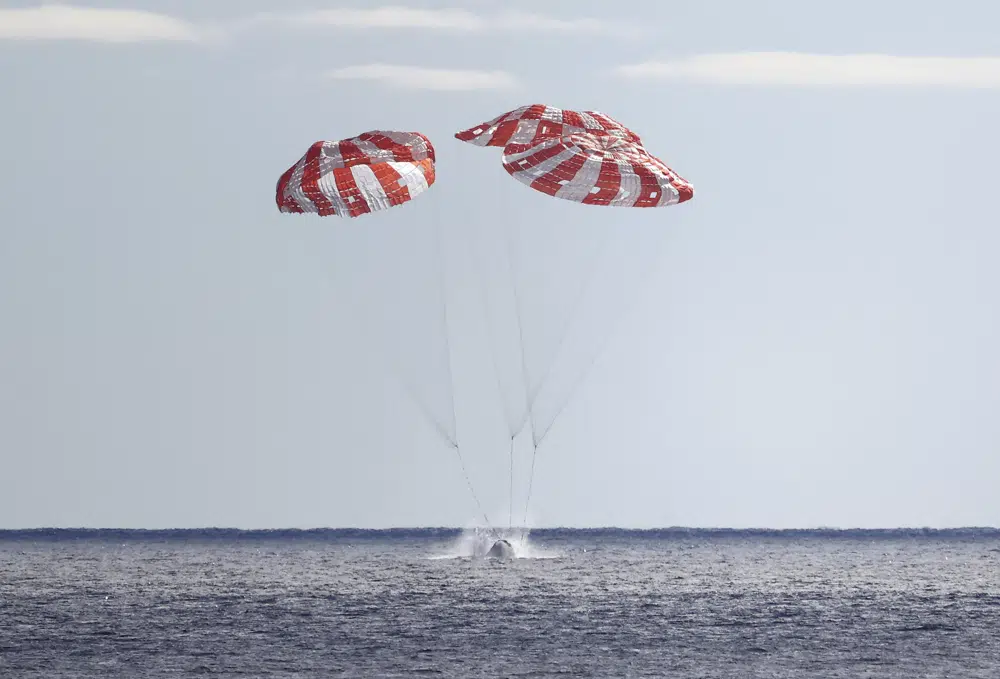
The Orion crew module splashed down in the Pacific Ocean on Sunday and was successfully retrieved by the U.S. Navy’s USS Portland. The Artemis I mission appears to be a complete success. If the onboard instruments confirm that early view, then NASA could be sending astronauts to the Moon for the first time in over fifty years. The Portland will soon begin its trip back to U.S. Naval Base San Diego, where engineers will remove Orion from the ship in preparation for transport back to Kennedy Space Center in Florida for post-flight analysis. Following Orion’s successful splashdown in the Pacific Ocean, flight controllers in mission control at NASA’s Johnson Space Center in Houston spent about two hours performing tests in open water to gather additional data about the spacecraft. Orion was launched into space by the Space Launch System (SLS) – the most powerful rocket ever built. Thousands of Alabamians have worked on making this day a reality – both at NASA’s Marshall Space Flight Center, which was tasked with leading the cutting-edge engineering on the SLS, as well as by NASA’s many contractors in the north Alabama area. On Friday, NASA finalized its contract with Boeing of Huntsville for approximately $3.2 billion to continue manufacturing core and upper stages for future SLS rockets for Artemis missions to the Moon and beyond. Under the SLS Stages Production and Evolution Contract action, Boeing will produce SLS core stages for Artemis III and IV, procure critical and long-lead material for the core stages for Artemis V and VI, provide the exploration upper stages (EUS) for Artemis V and VI, as well as tooling and related support and engineering services. “NASA’s Space Launch System rocket is the only rocket capable of sending large cargos and, soon, astronauts to the Moon,” said John Honeycutt, SLS Program manager. “The SLS core stage is the backbone of NASA’s Moon rocket, producing more than 2 million pounds of thrust at launch, and the addition of the exploration upper stage will enable NASA to support missions to deep space through the 2030s.” The SLS rocket delivers propulsion in stages and is designed to evolve to more advanced configurations to power NASA’s deep space missions. Each SLS rocket configuration uses the same 212-foot-tall core stage to produce more than 2 million pounds of thrust to help propel the mega-rocket off the launch pad. The contract comes as NASA optimizes manufacturing capabilities as Boeing will use Kennedy Space Center in Florida to perform some core stage assembly and outfitting activities beginning with the Artemis III rocket. Teams continue to make progress assembling and manufacturing core stages for Artemis II, III, and IV. The Artemis II stage is scheduled to be completed and delivered to Kennedy in the coming year. The engine section for Artemis III was recently loaded onto NASA’s Pegasus barge for delivery to Kennedy, where it will be outfitted and later integrated with the rest of the rocket. Artemis IV is scheduled to be the mission that lands the first astronauts on the Moon since 1972. That mission will include the first woman on the Moon and the first person of color. NASA hopes to put a permanent human presence on the Moon beginning late in this decade and a man on Mars by the middle of the next decade. To connect with the author of this story, or to comment, email brandonmreporter@gmail.com.
Richard Shelby praises NASA’s successful Artemis launch, notes Alabama ties

U.S. Senator Richard Shelby released a statement regarding the successful launch of NASA’s Space Launch System rocket and the Orion spacecraft for its flight test, Artemis I. This 42-day mission is the first step toward returning American astronauts to the moon. “Congratulations to NASA and all of those who have worked on the Artemis program. Today’s successful liftoff was a historic achievement in our goal of deep space exploration,” said Senator Shelby. “Launching aboard NASA’s Space Launch System – the most powerful rocket in the world, made at Marshall Space Flight Center right here in Alabama – the Orion spacecraft will orbit the moon and return to Earth before next launching with a manned crew. Today, we demonstrated our commitment to returning humans to the Moon and beyond. Today, we made history. I’m proud of the major role that Alabama played in this monumental success.” On Wednesday morning, the Space Launch System (SLS) launched from the Kennedy Space Center in Cape Canaveral, Florida. Onboard was the Orion spacecraft which the SLS launched into space on its way to the Moon. The Artemis I mission is unmanned but is an essential precursor to man’s return to the Moon after almost a fifty-year absence. Sen. Shelby played a key role in advocating for the U.S. Space Command headquarters to be in Huntsville, Alabama. Shelby is retiring at the end of this year after six terms in the Senate. He is the Ranking Republican on the powerful Senate Appropriations committee, which he chaired until Republicans lost control of the Senate in 2021.
Artemis set to launch just after midnight
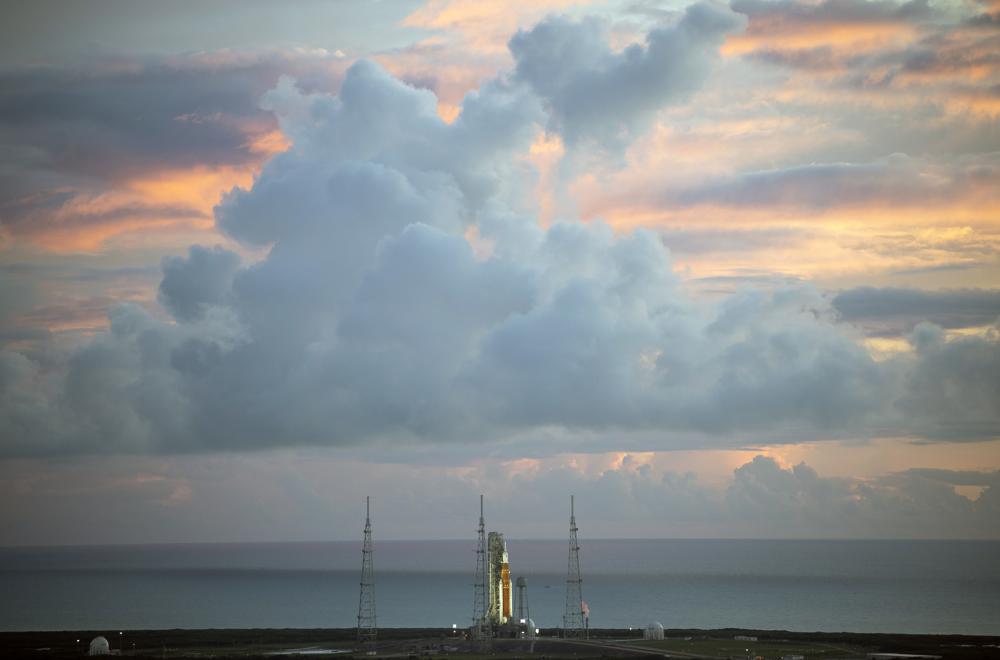
The National Aeronautical and Space Administration (NASA) announced Monday that its Artemis launch teams have been called to stations. The countdown has officially begun towards a launch for Artemis I on Wednesday, November 16th, during a two-hour launch window beginning at 12:04 a.m. CST. The Artemis I mission is unmanned; but is a test of the Artemis spacecraft, which will be carried into space by the Space Launch System (SLS) – the most powerful rocket ever made. The Space Launch System engineering is headquartered at the Marshall Space Flight Center in Huntsville. The SLS, like the Space Shuttle and Apollo missions before it, will be launched from NASA’s Kennedy Space Flight Center in Cape Canaveral, Florida. Artemis will be the vehicle that will take man back to the Moon after a 50-year absence, including the first woman and first African-American to walk on the Moon. NASA plans to eventually establish a permanent manned presence on the Moon and plans for a manned mission to Mars late in the 2030s. The Artemis I mission had been planned for September but had to be scrubbed several times due to problems with a fuel line not working properly on the SLS. Then in late September had to be taken off of the launchpad and sent back to the assembly building due to Hurricane Ian. The ship is now repaired, and Florida is sufficiently recovered from the hurricanes that NASA can operate efficiently. The SLS looks like an Apollo-era Saturn V rocket with two Space Shuttle-era solid rocket boosters attached, and that is not that far off from what it is, but it will allow NASA to carry larger payloads farther than ever before. For decades since Apollo, manned space flight has been limited to low Earth orbit with the Space Shuttle and the International Space Station. Artemis will make manned space flight beyond Earth orbit not only possible but potentially routine. Artemis I will fly to the Moon, orbit, and then return to Earth. If all goes well with the unmanned missions, NASA could potentially launch a manned Artemis mission as early as 2024. The moon base mission is tentatively scheduled for 2028. Thousands of Alabamians, both at NASA and its many contractors, have worked for years to make this mission a reality. You can watch the mission live on NASA TV. To connect with the author of this story, or to comment, email brandonmreporter@gmail.com.
