
Airport shuttle service from Birmingham to Atlanta began Sunday

A Richmond, Va. based transportation company began a shuttle service from Birmingham to the Hartsfield-Jackson Atlanta International Airport this week. The Birmingham-Shuttlesworth International Airport currently operates over 60 flights between itself and Atlanta each week, and although each flight only takes around 30 minutes (once you’re in the air) many travelers prefer to avoid the hassle of adding a connecting flight either to or from the Atlanta airport. Groome Transportation will be offering 14 daily round trips from Birmingham to Atlanta; beginning at 1 a.m. with the last shuttle leaving Birmingham at 8:30 p.m. Services to Birmingham from Hartsfield-Jackson Atlanta International Airport will be offered as well, the first shuttle will be scheduled to leave at 5:30 a.m. with the last trip leaving Atlanta at 1 a.m. according to the Birmingham Patch. Reservations are required in advance and can be purchased online or by phone; the company asks that you schedule the shuttle at least 24 hours before your trip to avoid any potential delays at the time of travel. For now, all shuttles pick passengers up at the Festival Shopping Center on Crestwood Boulevard for one way or round trip service. Adult shuttle trips cost $29 one-way and $58 for a round trip ticket. Young children, three to seven years old, cost $14 each way, while children under three ride for free.
U.S. agency orders corrective action after gas pipeline spill
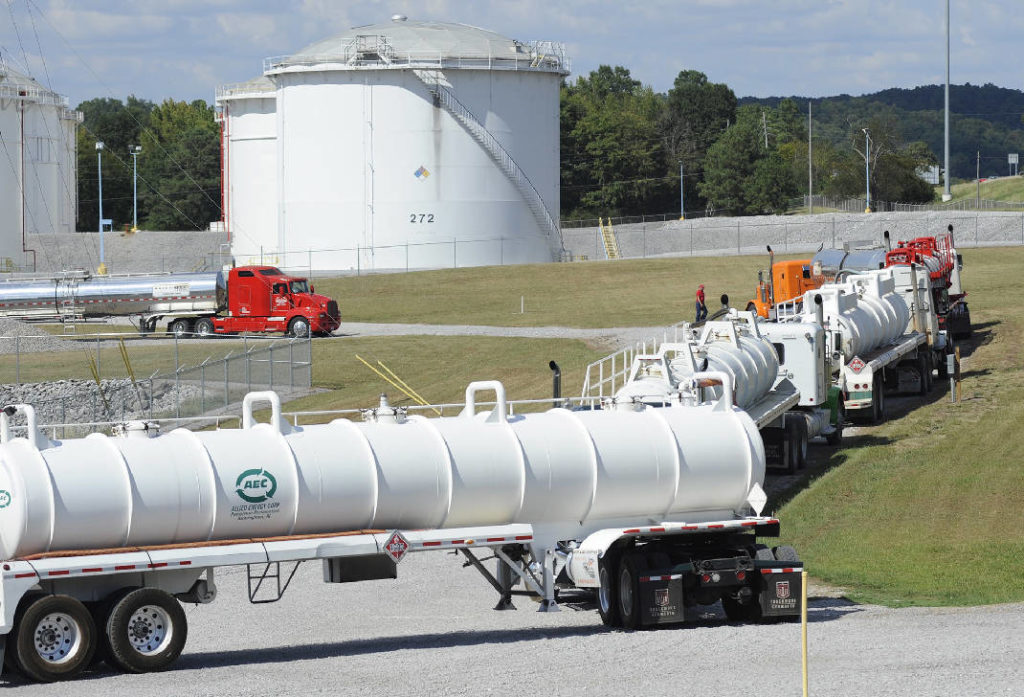
Fuel supplies in at least five states are threatened by a gasoline pipeline spill in Alabama, and the U.S. Department of Transportation has ordered the company responsible to take corrective action before the fuel starts flowing again. Colonial Pipeline Co. must conduct testing and analysis on the failed section of the pipeline, according to the department’s Pipeline and Hazardous Materials Safety Agency, which is investigating the spill in rural Alabama. The company has acknowledged that between 252,000 gallons and 336,000 gallons of gasoline leaked from a pipeline near Helena, Alabama, since the spill was first detected Sept. 9. It’s unclear when the spill actually started. The pipeline section that failed runs from Mississippi to Atlanta. The agency said the spill is “within an unusually sensitive ecological area” and it ordered Colonial to take action “to protect the public, property and the environment from potential hazards.” “The department will remain on site to carry out its investigation, and make sure the operator is taking the necessary steps to prevent any future incidents,” agency administrator Marie Therese Dominguez said in a statement. In a statement Saturday, the Alpharetta, Georgia-based company said that repair work had begun in an effort to return the pipeline to service “as rapidly and safely as possible.” The company said it is shipping as much gasoline as possible on its distillate mainline, or Line 2, in order to mitigate the impact of the pipeline that has been shut down. Colonial earlier said most of the leaked gasoline is contained in a retention pond near the city of Helena and there’s no public safety concern. In response to the shutdown, the governors in Alabama, Georgia and Tennessee announced they would lift restrictions on the number of hours that truck drivers delivering fuel can work, in hopes of preventing fuel shortages. Governors can suspend federal transportation regulations during emergencies. A spokeswoman for Alabama Gov. Robert Bentley said Friday that he’s in communication with pipeline company officials along with state and federal officials assisting at the spill location. Georgia Gov. Nathan Deal said he was confident his order lifting restrictions for drivers would help. “We are confident these measures will help ensure Georgians’ uninterrupted access to motor fuel until Alabama’s pipeline is fixed,” Deal said in a statement. Tennessee Gov. Bill Haslam said his order was a precautionary measure. “We are not currently seeing any widespread unavailability of petroleum in Tennessee,” Haslam said in a statement. “We urge Tennesseans to maintain their normal fuel purchasing and driving patterns to help prevent any potential impacts on our fuel supply while the pipeline undergoes repairs.” The U.S. Environmental Protection Agency waived requirements this week that metro areas with air quality issues in Georgia and Tennessee use a cleaner-burning type of gasoline during the summer months. That requirement of the Clean Air Act expired at midnight Thursday. Republished with permission of the Associated Press.
College-educated whites put hole in Donald Trump coalition

Wanda Melton has voted for every Republican presidential nominee since Ronald Reagan in 1980, but now the Georgia grandmother plans to cross over to support Democrat Hillary Clinton. “I’m not a real fan of Hillary,” Melton says from her office in Atlanta. “But I think it would just be awful to have Donald Trump.” She adds: “I cannot in good conscience let that happen.” Melton is among a particular group of voters, whites with college degrees, who are resistant to Trump. Their skepticism comes as an ominous warning as Trump struggles to rebuild even the losing coalition that Mitt Romney managed four years ago. College-educated whites made up more than one-third of the electorate in 2012. Polls suggest Trump trails Clinton with those voters, especially women. “Donald Trump simply cannot afford to lose ground in any segment of the electorate” that supported Romney, said Florida pollster Fernand Amandi. Romney’s strength with that group, for example, made for a close race in Florida, where President Barack Obama won by less than 75,000 votes out of more than 8.4 million cast. Some Republicans worry Trump’s approach — his unvarnished, sometimes uncouth demeanor and his nationalist and populist arguments — guarantees his defeat, because the same outsider appeal that attracts many working class and even college-educated white men alienates other voters with a college degree. Ann Robinson, 64, is a lifelong Republican in a Trump’s home state of New York, a Democratic stronghold that the real estate tycoon cites as an example of where he can “expand the map.” Robinson sneers at the proposition and says she’ll vote for Clinton. “It’s just not a reasonable movement,” she says of Trump’s populist pitch. “I’m not sure he can actually be their savior. She has so much more experience. Trump has nothing.” Mary Darling, 59, is an Illinois Republican who said she won’t vote for Trump or Clinton. “If they could just soften his edges, people would flock to him, but that’s just not going to happen,” she said. Lew Oliver, chairman of the Orange County Republican Party in Florida, says he’s prepared for an uphill fight in no small part because of Trump’s struggle among more educated voters. “The fundamentals aren’t in our favor, and some of his comments aren’t helping,” Oliver said. Romney drew support from 56 percent of white voters with college degrees, according to 2012 exit polls. Obama notched just 42 percent, but still cruised to a second term. A Washington Post-ABC News poll taken in June found Clinton leading Trump among college-educated whites 50 percent to 42 percent. Polling from the nonpartisan Pew Research Center pointed to particularly stark numbers among white women with at least a bachelor’s degree. At this point in 2008 and 2012, that group of voters was almost evenly divided between Obama and the Republican nominee. This June, Pew found Clinton with a 62-31 advantage. Conversely, Pew found Trump still leads, albeit by a slightly narrower margin than did Romney at this point, among white women with less than a bachelor’s degree. Should Trump fail to even replicate Romney’s coalition, he has little hope of flipping many of the most contested states that Obama won twice, particularly Florida, Colorado and Virginia. Trump’s struggles among college whites have Democrats eyeing North Carolina, which Obama won in 2008 before it reverted back to Republicans, and even GOP-leaning Arizona and Georgia. The education gap for Trump isn’t new. Exit polls in the Republican primaries found him faring better among less educated groups. Trump particularly struggled with better-educated Republicans when Florida Sen. Marco Rubio, R-Fla., was in the presidential race. Republican pollster Greg Strimple of Idaho says the gap is understandable. Voters without a college education, he said, are more likely to be struggling financially, to feel alienated from the political class Trump rails against and to find solace in his promise to stop illegal immigration. College educated voters “may have had relatively stagnant incomes, but they can still look at their 401(k)s and think about the future,” Strimple said. “They’re free to care more about things like tone.” Clinton’s campaign sees the persuadable portion of the electorate as being made up largely of women, many with college degrees. It has tried to reach them by hammering Trump as “dangerous” and “temperamentally unfit” for the job, while her initial general election advertising blitz focuses on her achievements in public life. Strimple said Trump must counter that with a constant “indictment of the last eight years, an indictment of Hillary Clinton. That can get some of those voters back.” The question for Trump, though, is how many Wanda Meltons are already lost. “He’s just not in control of himself,” she says. “That personality type is not suited either to leadership or protecting the country.” Republished with permission of the Associated Press.
