
Congress passes $1.3 trillion budget, averting another shutdown
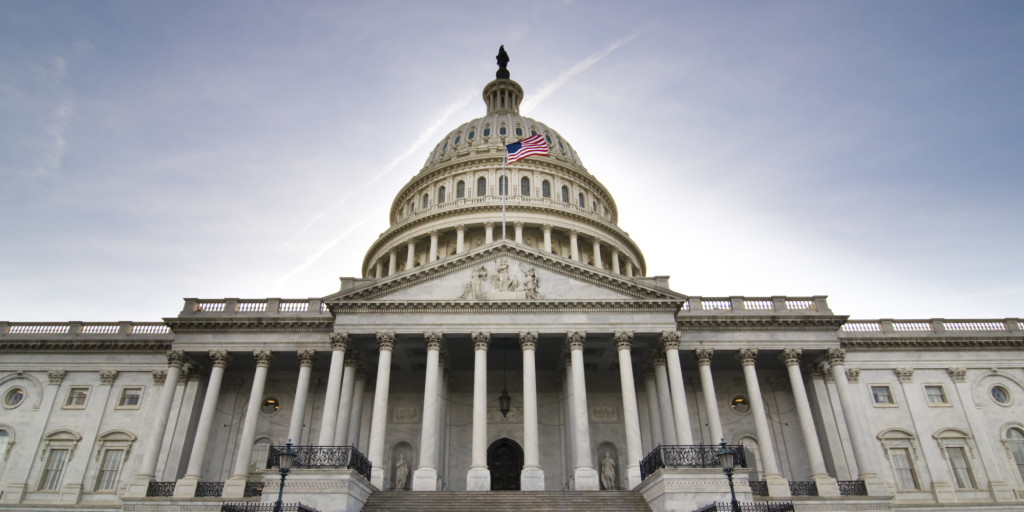
Congress gave final approval Friday to a giant $1.3 trillion spending bill that ends the budget battles for now, but only after late obstacles skirted close to another shutdown as conservatives objected to big outlays on Democratic priorities at a time when Republicans control the House, Senate and White House. Senate passage shortly after midnight averted a third federal shutdown this year, an outcome both parties wanted to avoid. But in crafting a sweeping deal that busts budget caps, they’ve stirred conservative opposition and set the contours for the next funding fight ahead of the midterm elections. The House easily approved the measure Thursday, 256-167, a bipartisan tally that underscored the popularity of the compromise, which funds the government through September. It beefs up military and domestic programs, delivering federal funds to every corner of the country. But action stalled in the Senate, as conservatives ran the clock in protest. Then, an unusual glitch arose when Sen. James Risch, R-Idaho, wanted to remove a provision to rename a forest in his home state after the late Cecil Andrus, a four-term Democratic governor. At one point, Sen. Bob Corker, R-Tenn., stepped forward to declare the entire late-night scene “ridiculous. It’s juvenile.” Once the opponents relented, the Senate began voting, clearing the package by a 65-32 vote a full day before Friday’s midnight deadline to fund the government. “Shame, shame. A pox on both Houses – and parties,” tweeted Sen. Rand Paul, R-Ky., who spent the afternoon tweeting details found in the 2,200-page bill that was released the night before. “No one has read it. Congress is broken.” Paul said later he knew he could only delay, but not stop, the outcome and had made his point. The omnibus spending bill was supposed to be an antidote to the stopgap measures Congress has been forced to pass — five in this fiscal year alone — to keep government temporarily running amid partisan fiscal disputes. Leaders delivered on President Donald Trump’s top priorities of boosting Pentagon coffers and starting work his promised border wall, while compromising with Democrats on funds for road building, child care development, fighting the opioid crisis and more. But the result has been unimaginable to many Republicans after campaigning on spending restraints and balanced budgets. Along with the recent GOP tax cuts law, the bill that stood a foot tall at some lawmakers’ desks ushers in the return of $1 trillion deficits. Trump only reluctantly backed the bill he would have to sign, according to Republican lawmakers and aides, who acknowledged the deal involved necessary trade-offs for the Democratic votes that were needed for passage despite their majority lock on Congress. “Obviously he doesn’t like this process — it’s dangerous to put it up to the 11th hour like this,” said Sen. David Perdue, R-Ga., who opposes the bill and speaks regularly to Trump. “The president, and our leadership, and the leadership in the House got together and said, Look, we don’t like what the Democrats are doing, we got to fund the government.” White House legislative director Marc Short framed it as a compromise. “I can’t sit here and tell you and your viewers that we love everything in the bill,” he said on Fox. “But we think that we got many of our priorities funded.” Trying to smooth over differences, Republican leaders focused on military increases that were once core to the party’s brand as guardians of national security. “Vote yes for our military. Vote yes for the safety and the security of this country,” said House Speaker Paul Ryan, R-Wis., ahead of voting. But even that remained a hard sell. In all, 90 House Republicans, including many from the conservative House Freedom Caucus, voted against the bill, as did two dozen Republicans in the Senate. It was a sign of the entrenched GOP divisions that have made leadership’s job controlling the majority difficult. They will likely repeat on the next budget battle in fall. Democrats faced their own divisions, particularly after failing to resolve the stalemate over shielding young Dreamer immigrants from deportation as Trump’s decision to end the Deferred Action for Childhood Arrivals program has left it for the courts to decide. Instead, Trump won $1.6 billion to begin building and replacing segments of the wall along the border with Mexico. The Congressional Hispanic Caucus opposed the bill. Also missing from the package was a renewal of federal insurance subsidies to curb premium costs on the Affordable Care Act exchanges. Trump ended some of those payments as part of his effort to scuttle President Barack Obama’s health care law, but Republicans have joined Democrats in trying to revive them. Bipartisan efforts to restore the subsidies, and provide additional help for insurance carriers, foundered over disagreements on how tight abortion restrictions should be on using the money for private insurance plans. Senate Republicans made a last-ditch effort to tuck the insurance provisions into the bill, but Democrats refused to yield on abortion restrictions. Still, Democrats were beyond pleased with the outcome. Minority Leader Nancy Pelosi, D-Calif., chronicled the party’s many gains, and noted they could have just have easily withheld votes Republicans needed to avert another shutdown. “We chose to use our leverage to help this bill pass,” Pelosi said. Senate Minority Leader Chuck Schumer, D-N.Y., said as the minority party in Congress, “We feel good.” He added, “We produced a darn good bill.” Republished with the permission of the Associated Press.
US sets new record for censoring, withholding government files
The federal government censored, withheld or said it couldn’t find records sought by citizens, journalists and others more often last year than at any point in the past decade, according to an Associated Press analysis of new data. The calculations cover eight months under President Donald Trump, the first hints about how his administration complies with the Freedom of Information Act. The surge of people who sought records but ended up empty-handed was driven by the government saying more than ever it could not find a single page of requested files and asserting in other cases that it would be illegal under U.S. laws to release the information. People who asked for records under the Freedom of Information Act received censored files or nothing in 78 percent of 823,222 requests, a record over the past decade. When it provided no records, the government said it could find no information related to the request in a little over half those cases. It turned over everything requested in roughly one of every five FOIA requests, according to the AP analysis. Records requests can take months — even years — to get fulfilled. Even then, the government censored documents in nearly two-thirds of cases when it turned over anything. The federal government also spent $40.6 million last year in legal fees defending its decisions to withhold federal files, also a record. That included the time when a U.S. judge ruled against the AP and other news organizations asking for details about who and how much the FBI paid to unlock the iPhone used by a gunman in a mass shooting in San Bernardino, California. When the government loses in court, it sometimes must pay the winner’s attorney’s fees. For example, the New York Times was awarded $51,910 from the CIA in May in a fight over records about chemical weapons in Iraq. It was impossible, based on the government’s own accounting, to determine whether researchers, journalists and others asked for records that did not actually exist or whether federal employees did not search hard enough before giving up. The government said it found nothing 180,924 times, an 18 percent increase over the previous year. “Federal agencies are failing to take advantage of modern technology to store, locate and produce records in response to FOIA requests, and the public is losing out as a result,” said Adam A. Marshall, the Knight Foundation litigation attorney at the Washington-based Reporters Committee for Freedom of the Press. He said citizens and others should try to precisely describe how they want filings cabinets, hard drives or email accounts searched, but “you shouldn’t have to be an expert in records management just to submit a FOIA.” In other cases, the times the government said it would be illegal under other U.S. laws to release requested information nearly doubled to 63,749. Those laws include broad prohibitions against revealing details about U.S. intelligence activities or foreign governments, trade secrets, individual banking or tax records and more. Many of those requests probably involved files related to the U.S. investigation into how Russia interfered in the 2016 presidential election or the related grand jury investigations or about Trump’s personal or business tax returns, said Kel McClanahan, a Washington lawyer who frequently sues the U.S. government for records. “How many people do you think asked for Trump’s tax returns?” he asked. A disturbing trend continued: In more than one-in-three cases, the government reversed itself when challenged and acknowledged that it had improperly tried to withhold pages. But people filed such appeals only 14,713 times, or about 4.3 percent of cases in which the government said it found records but held back some or all of the material. The Trump administration, in a new report last week, noted that it received a record number of information requests last year. It said many agencies reduced their backlogs of overdue requests. The administration also said it was directing federal agencies to improve the number of requests they process and do some more quickly. Performance under the records law by the Trump administration has been a source of curiosity, since Trump has eschewed some of the common conventions of transparency. For example, the president has declined to release his personal tax returns or logs of official visitors to the White House, and ethics waivers granted to many of Trump’s political appointees do not include details about their former or current corporate clients. But Trump is personally more accessible to reporters asking questions than President Barack Obama, and he released as many details about his medical records as previous presidents. The Freedom of Information Act figures, released Friday, cover the actions of 116 departments and agencies during the fiscal 2017, which ended Sept. 30. The highest number of requests went to the departments of Homeland Security, Justice, Defense, Health and Human Services, and Agriculture, along with the National Archives and Records Administration and Veterans Administration. The administration released its figures ahead of Sunshine Week, when news organizations promote open government and freedom of information. Under the records law, citizens and foreigners can compel the U.S. government to turn over copies of federal records for no or little cost. Anyone who seeks information through the law is generally supposed to get it unless disclosure would hurt national security, violate personal privacy, or expose business secrets or confidential decision-making in certain areas. Republished with the permission of the Associated Press.
Donald Trump, Barack Obama, Joe Biden record robocalls for Alabama Senate race
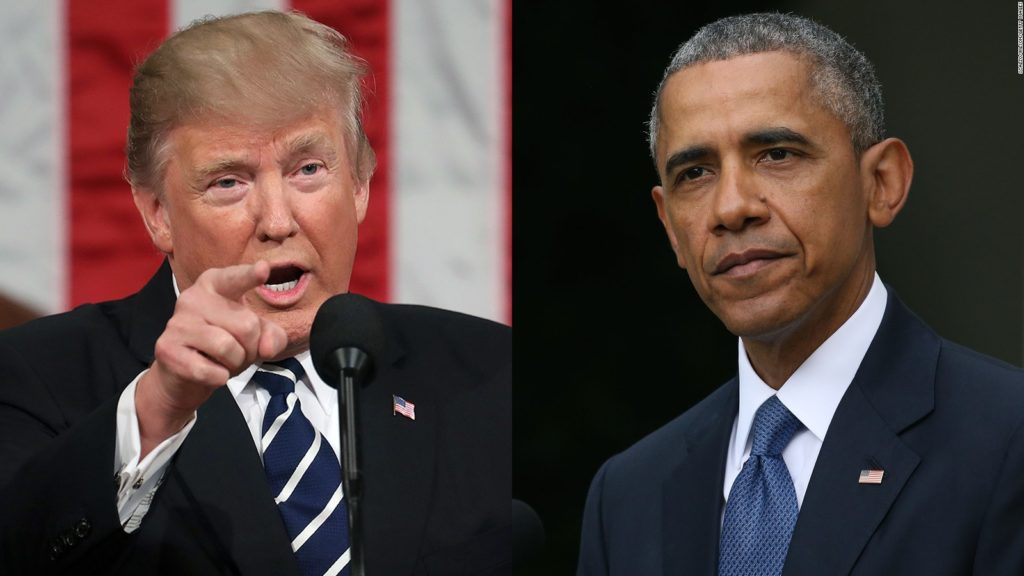
Alabama’s two Senate hopefuls are getting some last-minute help from big names in their respective parties. President Donald Trump recorded a robocall for Republican Roy Moore. Meanwhile former President Barack Obama and former Vice President Joe Biden recorded appeals for Democrat Doug Jones. “If Alabama elects liberal Democrat Doug Jones, all of our progress will be stopped cold,” Trump said in the 90-second audio recording released Sunday by the Moore campaign. “We need Roy voting for us,” Trump said in the recording. “I am stopping illegal immigration and crime. We’re building a stronger military and protecting the Second Amendment and our pro-life values. But if Alabama elects liberal Democrat Doug Jones, all of our progress will be stopped cold. We already know Democrat Doug Jones is a puppet of Nancy Pelosi and Chuck Schumer, and he will vote with the Washington liberals every single time.” Neither Obama’s nor Biden’s mentions call mentions Moore by name. “This one’s serious,” Obama said in his robocall. “You can’t sit it out.” He continued, “Doug Jones is a fighter for equality, for progress. Doug will be our champion for justice. So get out and vote, Alabama.” Moore and Jones face off Tuesday Dec. 12 in the general election.
House GOP chairmen announce probe of Barack Obama’s Justice Dept
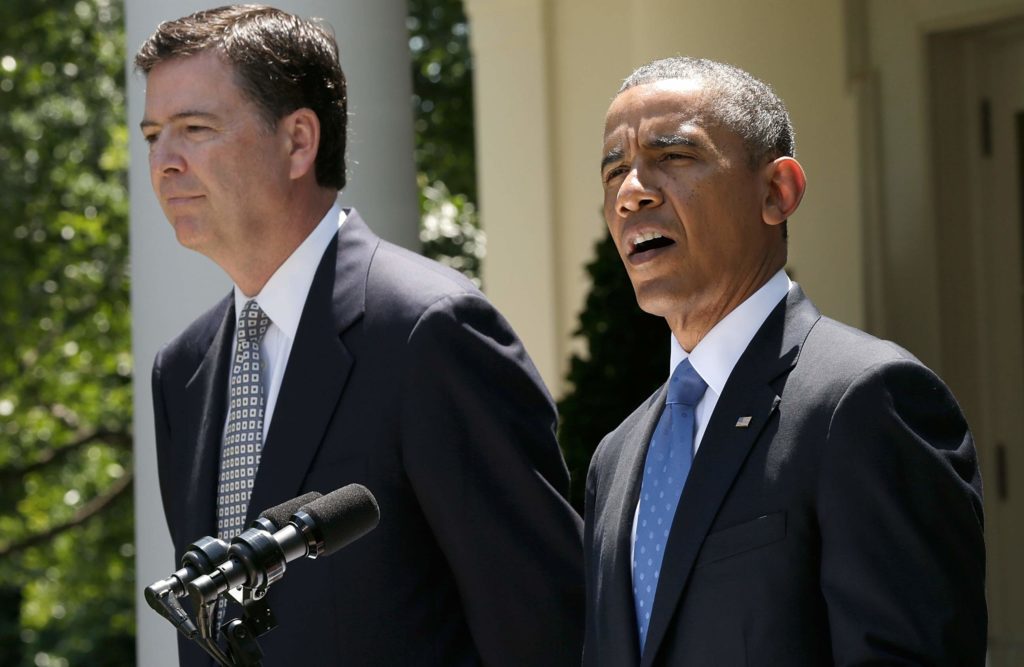
The Republican chairmen of two House committees announced Tuesday they’re opening an investigation into actions the Obama administration Justice Department took during last year’s presidential election. The chairmen said in a statement Tuesday they have several questions, including why then-FBI Director James Comey decided to publicly announce the investigation into Hillary Clinton‘s handling of classified information but not to publicly announce the investigation into Donald Trump‘s campaign associates. Trump fired Comey in May. At first, the White House cited a harsh memo about Comey’s performance from Deputy Attorney General Rod Rosenstein as the justification – though Trump later said he would have fired Comey regardless of what the Justice Department recommended. Rep. Bob Goodlatte of Virginia, chairman of the Judiciary Committee, and Rep. Trey Gowdy of South Carolina, chairman of the Oversight Committee, announced the probe. They described it as necessary to “better understand the reasoning behind how certain conclusions were drawn.” Other questions the Republican lawmakers said they want addressed revolve around the decision not to file criminal charges against Clinton. The lack of charges remains a lingering grievance for Trump, who for months has held it up as an example of a “rigged” criminal justice system that shielded his Democratic opponent from punishment for her use of a private server for government business. Comey said in July of last year that Clinton’s handling of classified information was “extremely careless” but the FBI would not recommend charges against her. The two chairmen said they want to know more about the FBI’s timeline for charging decisions. “Congress has a constitutional duty to preserve the integrity of our justice system by ensuring transparency and accountability of actions taken,” Goodlatte and Gowdy said in a press release. Democratic Rep. Gerry Connolly of Virginia dismissed the move. “This is nothing more than a charade and distraction from the ongoing crisis in the White House. What about Russia? What about rampant conflicts of interest? This gives hypocrisy a bad name,” he said. Republished with permission from the Associated Press.
Breaking tradition, former presidents sparring with Donald Trump

Former presidents are shedding a traditional reluctance to criticize their successors, unleashing pointed attacks on the Trump White House and the commander in chief – but without mentioning him by name. Remarks on the same day by former Presidents George W. Bush and Barack Obama raise the prospect that more dissenters will follow in defiance of President Donald Trump and his policies. “What they are doing is laying down a marker for acceptable public discourse,” said Kathleen Hall Jamieson, a professor of political communication and rhetorical theory at the University of Pennsylvania. “They’re saying, ‘We don’t stand for that kind of language and behavior. These are our values, these are our principles.’” Bush and Obama themselves were preceded by other prominent figures. In recent weeks, Republican Sens. Bob Corker of Tennessee and Arizonans John McCain and Jeff Flake have taken swipes at a president who has pushed the limits of polite political discourse and has seemed to relish public fights over sensitive subjects, including nuclear war, race relations, immigrants and, this week, the war dead. Bush this week delivered a speech that was remarkable for its takedowns of key features of the political movement that put Trump in power. “Bullying and prejudice in our public life sets a national tone, provides permission for cruelty and bigotry, and compromises the moral education of children,” he said in New York. Never a fan of Trump’s, Bush drew his biggest applause with this line: “The only way to pass along civic values is to first live up to them.” Three hundred miles to the south, Obama, a Democrat, used a similar approach to denounce Trump’s brand of politics. “Why are we deliberately trying to misunderstand each other and be cruel to each other and put each other down? That’s not who we are,” he said during a political appearance in Richmond, Virginia. At the White House on Friday, presidential spokeswoman Sarah Huckabee Sanders said the administration believes the former presidents’ remarks “were not directed towards the president.” Trump said Friday he does not believe that feuding with Republican senators could get in the way of his agenda for tax cuts and a new health care law. “I think, actually sometimes it helps,” Trump said in an interview on Fox Business Network. “Sometimes it gets people to do what they’re supposed to be doing.” However coincidental, Bush and Obama’s comments capped periods of reticence for both men during Trump’s tumultuous first months in office. Neither mentioned Trump’s name, but the pair left no doubt who they were talking about. Trump has pursued a ban on Muslim immigration, feuded with disabled Americans, hurricane victims and Gold Star parents and bestowed belittling nicknames on critics – including former Florida Gov. Jeb Bush, Bush’s brother, during the 2016 GOP primary. To be sure, there remains a long slate of Cabinet members and lawmakers who try not to cross Trump in public – from Secretary of State Rex Tillerson, to most of the Senate Republican caucus. In the age of social media and under a president with a delicate Twitter trigger, the retaliation can be brutal. “In 1982, I could have said anything and my constituents may or may not have known about it,” said Dan Glickman, a former member of the House from Kansas. “But now, the comments and the reaction beams around the world instantaneously.” Most of Trump’s loudest critics within his own party aren’t running for public office again and don’t need his support. McCain and Trump have been on prickly territory since Trump said in 2015 that McCain is “not a war hero.” It was only exacerbated when McCain’s Senate votes helped kill Republican efforts to repeal and replace Obama’s signature health care law. McCain has denounced Trump and his supporters multiple times, including this week when he accused them of trading international leadership for “some half-baked, spurious nationalism cooked up by people who would rather find scapegoats than solve problems.” Trump warned McCain in a radio interview: “I fight back.” The Arizona senator, tortured for more than five years in Vietnam and now fighting brain cancer, replied: “I have faced tougher adversaries.” Corker has long questioned Trump’s competence as president and said the people around the president are what’s saving the country from Trump-fueled “chaos.” Last week, after announcing his retirement from the Senate, Corker described the White House as an “adult day care center.” Trump on Twitter nicknamed him “Liddle’ Bob Corker.” Flake, the only one of the three seeking re-election, has a GOP primary opponent backed by some Trump supporters, including former adviser Steve Bannon. The senator has been confronting Trump since 2016, when he stood up in a private caucus meeting and introduced himself to Trump as the senator from Arizona “who didn’t get captured.” Then there’s Tillerson, who was quoted as calling the president “a moron” in private after a July meeting. After the comment was reported, Tillerson tried to patch things up in an extraordinary press conference in which he described Trump as “smart.” A meeting with Trump and interviews followed, with Tillerson insisting his fraught relationship with the president is actually strong. But though a Tillerson aide denied Tillerson had called Trump a moron, the secretary of state himself never has. Republished with permission from the Associated Press.
Barack Obama returns to campaign trail for Dems in governor’s races
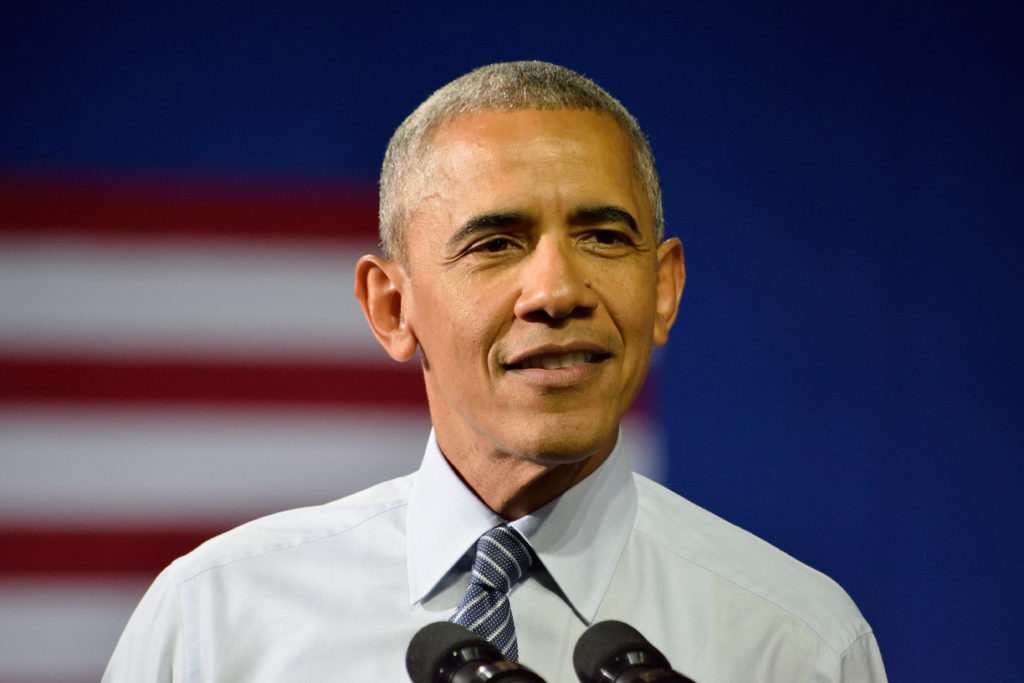
Former President Barack Obama is returning to the campaign trail to stump for Democratic gubernatorial candidates in New Jersey and Virginia as they gear up for next month’s elections. Thursday’s events mark the first time the former president is stepping back into the political spotlight since leaving the White House. Unlike more low-key appearances earlier this year, Obama’s foray into two states won’t be a one-and-done. He is planning more public appearances as the year closes, and preparation for the 2018 midterm elections begins. “Obama seems to be determined to be an engaged and active former president who’s playing a role in different issues and is involved in politics,” Rutgers University professor David Greenberg said. Obama is hoping to sway voters in New Jersey and Virginia, the only two gubernatorial races this year. Both Virginia Gov. Terry McAuliffe, a Democrat, and New Jersey Gov. Chris Christie, a Republican, are term-limited. Those Nov. 7 races will be considered a bellwether of Democrats’ strength in the face of President Donald Trump‘s victory last year. Obama will first drop in on campaign workers in Newark, New Jersey, for a private “canvass kickoff” for Democratic candidate Phil Murphy, who is running against Republican Lt. Gov. Kim Guadagno. The former president will then head to Richmond, Virginia, to rally support for Democrat Ralph Northam in his campaign against Republican Ed Gillespie. At the end of the month, Obama will go to Chicago to head up his first Obama Foundation leadership summit on Oct. 31 and Nov. 1, bringing in speakers like England’s Prince Harry, former Italian Prime Minister Matteo Renzi and artists like Gloria Estefan, Chance the Rapper and indie rock band The National. Obama’s popularity is still undeniable. In an August NBC News/Wall Street Journal poll, 51 percent of Americans said they have a favorable opinion of Obama, while 35 percent had a negative opinion. In the same poll, 36 percent said they had a positive opinion of Trump and 52 percent had a negative opinion. In Richmond, thousands of people lined up on Tuesday to get tickets to Obama’s rally. Retired Richmond social worker Nancy Jackson, 67, said she missed Obama “tremendously” and wished he could serve a third, fourth and fifth term. She said black voters like herself have been despondent since Trump took office. “I think Obama will bring some light to the end of the tunnel,” she said. Obama never completely disappeared from public life, in part because of Trump’s constant criticism and efforts to undo much of Obama’s legacy after eight years in office. He has publicly defended his policies that Trump and the GOP-led Congress have set out to dismantle: the Affordable Care Act – or Obamacare – and the Deferred Action for Childhood Arrivals program, which allowed immigrants brought into the country illegally as children to be temporarily shielded from deportation. Obama was forced to return “pretty quickly,” presidential historian Julian Zelizer of Princeton University said. “The current president has changed all the conventional assumptions about what to do,” Zelizer said. “There is a sense of urgency that makes this moment different than others and former President Obama has continued to be directly in Trump’s line of fire – both his policies and his legacy.” Republished with permission from the Associated Press.
Donald Trump cries foul on judges, but he’s ahead of Barack Obama
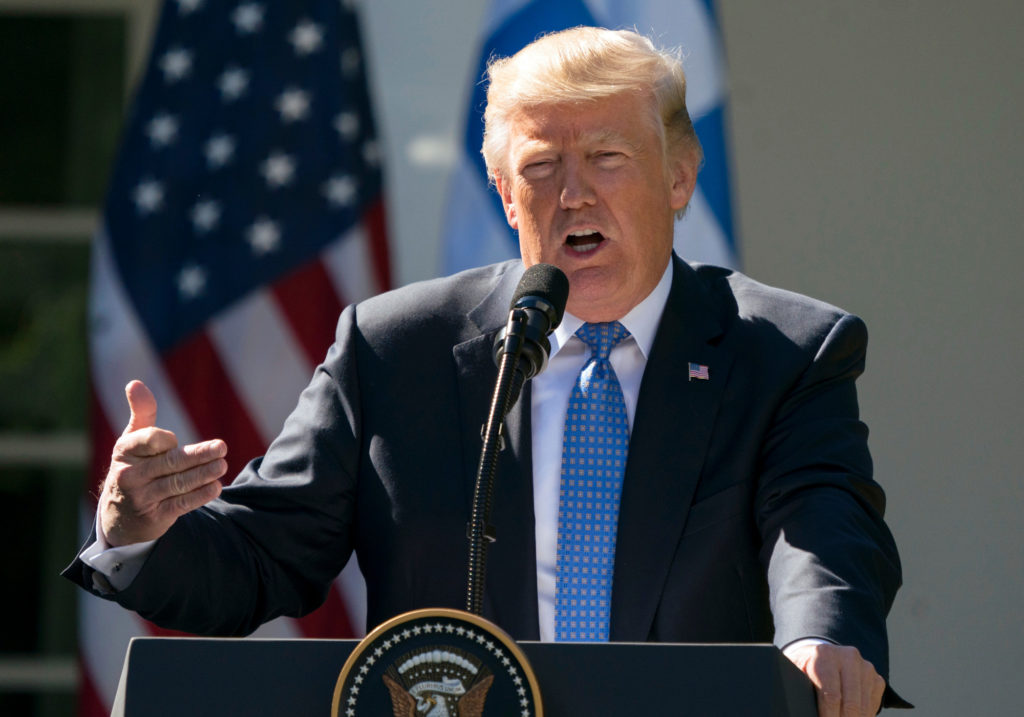
President Donald Trump says Democrats are holding up his judicial nominees, but almost nine months into his presidency, he has had more judges confirmed than President Barack Obama did in the same time period, and his numbers aren’t far off those of other recent presidents. Trump counts the confirmation of Supreme Court Justice Neil Gorsuch as one of his signature achievements. But on Monday he charged that Senate Democrats are holding up confirmation of his other judicial nominees “beyond comprehension.” A top Senate Democrat said claims Democrats are obstructing judicial nominees are false. Speaking in the White House Rose Garden on Monday afternoon, Trump said “something that people aren’t talking about is how many judges we’ve had approved, whether it be the court of appeals, circuit judges, whether it be district judges.” “The Democrats are holding them up beyond anything. Beyond comprehension, they’re holding them up,” Trump said. Earlier in the day, at a Cabinet meeting, Trump said his judicial nominees are “some of the most qualified people ever, and they’re waiting forever on line.” Since taking office in January, Trump has nominated 61 people to federal judgeships, according to information available on the Administrative Office of the U.S. Courts’ website. Approximately 100 more seats are open and awaiting a nominee. Seven of Trump’s judicial nominees, including Gorsuch, have been confirmed by the Senate. According to statistics available online from the Federal Judicial Center, the judicial branch’s research and education agency, Obama had three judicial nominees confirmed at the same point of his presidency, just shy of nine months in, including Supreme Court Justice Sonia Sotomayor. President George H.W. Bush had four confirmed. President George W. Bush had eight. President Bill Clinton, who had a number of nominees confirmed in October of his first year, had nine, including Justice Ruth Bader Ginsburg. And President Ronald Reagan had 13, including Justice Sandra Day O’Connor. Sen. Dianne Feinstein, the top-ranked Democrat on the Judiciary Committee, said in a statement Monday that Obama’s first four appeals court nominees waited an average of 213 days from nomination to confirmation while Trump’s first four appeals court nominees waited an average of 84 days. “Republicans appear to believe they can compensate for their stalled legislative agenda by attacking Democrats with false claims about judicial nominations,” the statement said. White House spokeswoman Kelly Love repeated in a statement Wednesday that Democrats continue to obstruct the confirmation process for judges and also for other presidential nominees. “The President has delivered on his promise to nominate highly qualified judges, starting with Justice Gorsuch. Now, it is time to confirm the outstanding nominees because it’s what the American people deserve,” the statement read. Russell Wheeler, a visiting fellow at the Brookings Institution who studies judicial nominations, said Trump has made many more judicial nominations than Obama in the same window. But Wheeler said it’s too soon to talk about the rate at which Trump’s nominees are confirmed. At the same point in their first terms, Obama had nominated 22 people to federal trial and appeals courts and George W. Bush 59, about the same as Trump, Wheeler said. “I don’t put too much stock in his comments that Democrats are obstructing,” Wheeler said of Trump. Sheldon Goldman, a professor of political science at the University of Massachusetts Amherst who studies judicial selection and confirmation, said he thinks “Trump is doing very well,” in terms of getting his nominees confirmed. He said it “strains credulity” to say Democrats are responsible for any obstruction. Republicans, he said, “hold almost all the cards.” That’s in part because in 2013, then-majority Democrats changed Senate rules so judicial nominations for trial and appeals courts are filibuster-proof, meaning it takes only 51 votes, a simple majority in the 100-member Senate, for confirmation. Republicans currently hold 52 seats. The only thing left for Democrats, Goldman said, is a longstanding Senate tradition that home-state senators must sign off on a judge before a Senate vote. By tradition, senators return a so-called blue slip to sign off on a home-state judicial nominee. Without the blue slip, nominees are not given a vote in the Judiciary Committee. As a result, Democrats only have sway over judicial nominees in states where they hold at least one Senate seat. The Senate’s top Republican, Majority Leader Mitch McConnell of Kentucky, has said the Senate should no longer abide by the tradition. But how to apply the blue slip tradition is up to Judiciary Committee Chairman Charles Grassley, R-Iowa. “Senator Grassley has said that he expects senators and the president to continue engaging in consultation when selecting judicial nominees,” Grassley spokesman Taylor Foy said in a statement. Republished with permission from the Associated Press.
Barack Obama had a ‘pen and phone’ strategy; Donald Trump has an eraser

President Barack Obama had a “pen and phone” strategy. President Donald Trump has an eraser. Since his first days in office, Trump has set out on a wholesale reversal of a long list of accomplishments that Obama achieved through executive action – a less enduring means than the hard-and-fast language of legislation. The latest Obama-era policy to fall is the program shielding from deportation hundreds of thousands of young people brought into the country illegally as children. The Trump administration on Tuesday said the government would stop issuing new work permits while lawmakers debate whether to pass another solution. In explaining his decision, Trump accused Obama of making “an end-run around Congress” to protect the so-called “dreamers.” In effect, this time it’s Trump making an end-run around Obama. Obama, coming out of semi-retirement, retorted that Trump’s action was a “cruel” and “self-defeating” decision tinged with politics. It was yet another demonstration of the easy-come, easy-go nature of presidential achievements attained through unilateral action: What one president does by executive fiat, the next can just as quickly overturn. And it’s not just a Trump-Obama dynamic. Trump’s executive orders will be subject to revision by his successor. And Obama didn’t hesitate to reverse the actions of his predecessor, George W. Bush. For all of that, though, Trump has been “unusually aggressive in his use of unilateral powers,” says Kenneth Mayer, a University of Wisconsin-Madison political scientist and expert on presidential powers and executive orders. While it’s hard to systematically rank presidents on their use of executive actions, Mayer says “there are examples of Trump going beyond what other presidents have done in terms of the frequency and nature of unilateral action.” Trump, lacking any major legislative accomplishments despite the advantage of a Republican-controlled Congress, has issued dozens of executive orders and actions during the past seven months that have had a sweeping effect across the scope of government. They range from huge shifts in international policy to minor tinkering with obscure federal regulations. He’s pulling the United States out of the landmark Paris climate agreement through which nearly 200 countries had committed to combat global warming by reducing polluting emissions. He’s scrapped an Obama administration policy that let national parks ban the sale of bottled water to fight littering. His Education Department has lifted Obama-era guidance to schools to allow transgender students to use the bathroom of their choice. He’s ordered up two deregulatory actions for every new regulation issued. He tweeted out word that transgender individuals would no longer be allowed to serve openly in the military, as provided by the Obama administration, forcing the Pentagon to scramble to draft new rules to that effect. Trump’s actions on environmental matters extend well beyond climate change: He’s moved to rip up Obama’s Clean Power Plan, regulations that sought to reduce emissions from coal-fired power plants. His executive order on regulatory reform has been cited by EPA Administrator Scott Pruitt as a reason to delay or roll back a raft of Obama-era environmental regulations, from cleaning up water pollution from coal mines to blunting limits on emissions of toxic mercury from power plant smokestacks. There’s likely plenty more to come: Trump’s Labor Department wants to undo an Obama administration rule extending mandatory overtime pay to 4.2 million more workers. And the administration is reviewing a potential rule that would let employers opt out of providing no-cost birth control to women for religious and moral reasons. Some changes have been harder to impose than Trump expected: His initial attempt at an executive order temporarily banning travel to the U.S. from several Muslim-majority countries and suspending the U.S. refugee program hit roadblocks in the courts. On his second attempt, the Supreme Court allowed only a sharply scaled back version of the order to go forward pending arguments scheduled for October. Despite his Jan. 25 executive order to jumpstart construction on a U.S.-Mexico border wall, the structure is still far from reality. Obama has largely bitten his tongue as Trump rolled back policy after policy from his presidency. But the former president spoke out clearly Tuesday about the “dreamers” program, saying in a statement that his order had been based on “the well-established legal principle of prosecutorial discretion, deployed by Democratic and Republican presidents alike.” He said he acted unilaterally only after Congress failed to send him legislation to protect the “dreamers.” Obama stepped up his use of executive actions in 2014 as he became frustrated with how difficult it was to push legislation through Congress. He famously declared: “We’re not just going to be waiting for legislation in order to make sure that we’re providing Americans the kind of help they need. I’ve got a pen, and I’ve got a phone.” But the more enduring nature of legislation vs. flimsier executive actions is clear in the difficulty that Republicans have had in repealing Obama’s health care plan: It barely squeaked into law in 2010 but Republicans have been unable to vote it out after pledging for years to repeal it. Presidents know their executive orders can be revoked with the stroke of a pen by their successors. They also know they can put the next president in a bind by creating a program that will be politically difficult to rescind. Trump agonized over his “dreamers” decision and caught criticism for trying to navigate a middle ground by proposing to gradually phase out the program while inviting Congress to come up with a permanent fix. White House press secretary Sarah Huckabee Sanders was left to insist: “It’s not cold-hearted for the president to uphold the law.” Republished with permission from the Associated Press.
Donald Trump to skip Kennedy Center Honors awards program
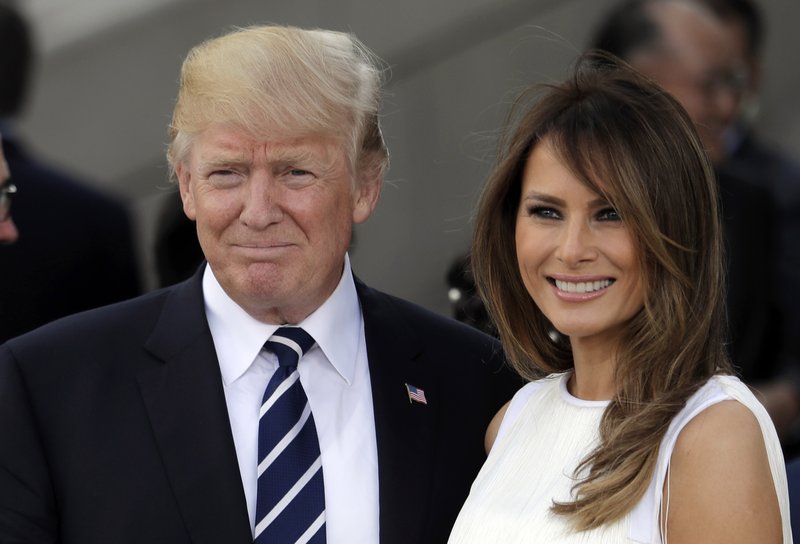
In a break with tradition, President Donald Trump and the first lady have decided not to participate in events for this year’s Kennedy Center Honors arts awards so honorees can celebrate “without any political distraction,” the White House announced Saturday. The Kennedy Center said it respected Trump’s decision and the show will go on. Past presidents and first ladies traditionally host a White House reception in the hours before the Kennedy Center gala, which they would then watch from seats high above the stage. This year’s honors are to be awarded Dec. 3. The Trumps reached their decision Friday, said a White House official who insisted on anonymity to discuss internal deliberations. It was made the same day that the entire membership of the President’s Committee on the Arts and the Humanities resigned to protest Trump’s comments about last weekend’s demonstrations by white supremacists in Charlottesville, Virginia. The president has blamed “many sides” for the violence that left an anti-racism activist dead. Trump has had a long and contentious relationship with the arts world and some Kennedy Center honorees, who are being recognized for lifetime achievement in their fields, already had said they would not attend the White House reception. One honoree, television writer and producer Norman Lear, had also questioned whether Trump would want to attend the gala, “given his indifference or worse regarding the arts and humanities.” Trump has recommended defunding the National Endowment for the Arts and the National Endowment for the Humanities. Dancer Carmen de Lavallade said on her website this week she was honored to be recognized, but would not go to Trump’s White House. “In light of the socially divisive and morally caustic narrative that our existing leadership is choosing to engage in, and in keeping with the principles that I and so many others have fought for, I will be declining the invitation to attend the reception at the White House,” she said. Singer Gloria Estefan earlier had said that she would set her personal politics aside to accept the honor, now in its 40th year. She said the image of a Cuban immigrant, like herself, being honored is important when Latino immigrants in particular have “taken a beating in the recent past.” Estefan once hosted a Democratic fundraiser attended by President Barack Obama. She said she and her husband, Emilio, are not affiliated with a political party. The other honorees are hip-hop artist LL Cool J, who had yet to say whether he would attend the White House reception, and singer Lionel Richie, who described himself as a maybe. Representatives for both celebrities did not immediately respond to requests for comment Saturday. Kennedy Center Chairman David M. Rubenstein and President Deborah F. Rutter said they respect Trump’s decision. “In choosing not to participate in this year’s Honors activities, the administration has graciously signaled its respect for the Kennedy Center and ensures the Honors gala remains a deservingly special moment for the honorees. We are grateful for this gesture” they said in a joint statement. The honorees, announced earlier this month, will be celebrated at a Kennedy Center gala in December, featuring performances and tributes from top entertainers that will be nationally televised. A traditional State Department reception and awards dinner Dec. 2 will be held as planned. Rubenstein and Rutter said all five honorees were expected at both events. The White House said Trump and first lady Melania Trump “extend their sincerest congratulations and well wishes to all of this year’s award recipients for their many accomplishments.” Republished with permission of The Associated Press.
Beyond bluster, U.S., N. Korea in regular contact
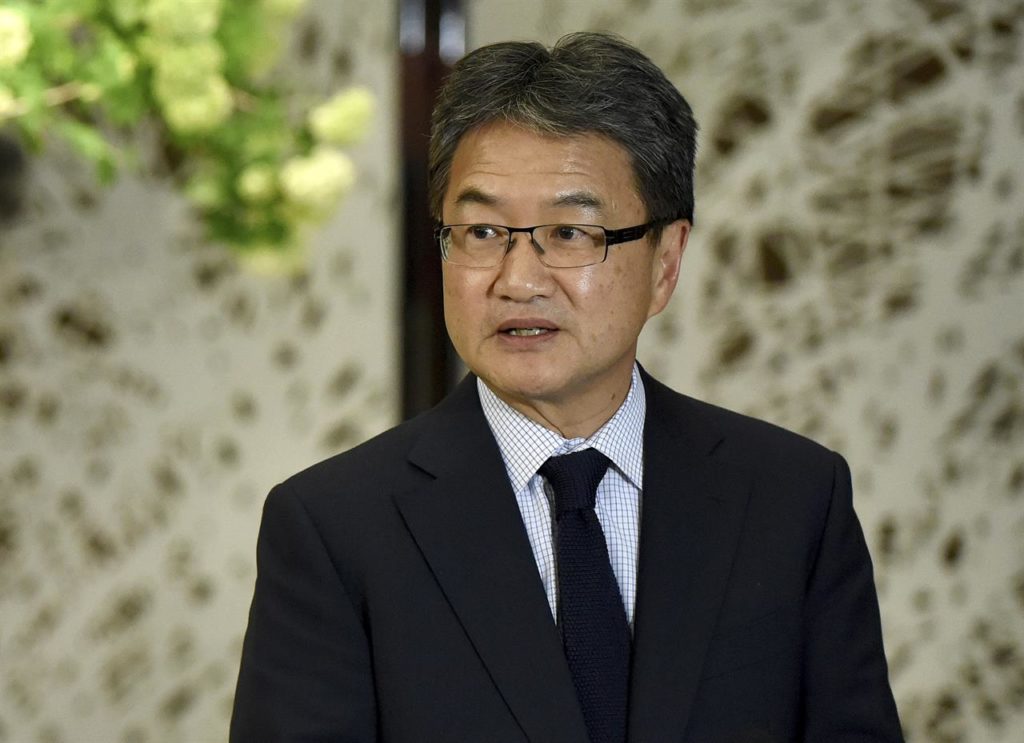
Beyond the bluster, the Trump administration has been quietly engaged in back channel diplomacy with North Korea for several months, addressing Americans imprisoned in the communist country and deteriorating relations between the longtime foes, The Associated Press has learned. It had been known the two sides had discussions to secure the June release of an American university student. But it wasn’t known until now that the contacts have continued, or that they have broached matters other than U.S. detainees. People familiar with the contacts say the interactions have done nothing thus far to quell tensions over North Korea’s nuclear weapons and missile advances, which are now fueling fears of military confrontation. But they say the behind-the-scenes discussions could still be a foundation for more serious negotiation, including on North Korea’s nuclear weapons, should President Donald Trump and North Korean leader Kim Jong Un put aside the bellicose rhetoric of recent days and endorse a dialogue. Trump refused to discuss the diplomatic contacts. “We don’t want to talk about progress, we don’t want to talk about back channels,” Trump told reporters Friday. The diplomatic contacts are occurring regularly between Joseph Yun, the U.S. envoy for North Korea policy, and Pak Song Il, a senior North Korean diplomat at the country’s U.N. mission, according to U.S. officials and others briefed on the process. They weren’t authorized to discuss the confidential exchanges and spoke on condition of anonymity. Officials call it the “New York channel.” Yun is the only U.S. diplomat in contact with any North Korean counterpart. The communications largely serve as a way to exchange messages, allowing Washington and Pyongyang to relay information. Drowned out by the furor over Trump’s warning to North Korea of “fire and fury like the world has never seen,” Secretary of State Rex Tillerson has expressed a willingness to entertain negotiations. His condition: Pyongyang stopping tests of missiles that can now potentially reach the U.S. mainland. Tillerson has even hinted at an ongoing back channel. “We have other means of communication open to them, to certainly hear from them if they have a desire to want to talk,” he said at an Asian security meeting in the Philippines this week. The interactions could point to a level of pragmatism in the Trump administration’s approach to the North Korean threat, despite the president’s dire warnings. On Friday, he tweeted: “Military solutions are now fully in place, locked and loaded, should North Korea act unwisely.” But on Thursday, he said, “we’ll always consider negotiations,” even if they haven’t worked in the last quarter-century. The contacts suggest Pyongyang, too, may be open to a negotiation even as it talks of launching missiles near the U.S. territory of Guam. The North regularly threatens nuclear strikes on the United States and its allies. The State Department and the White House declined to comment on Yun’s diplomacy. A diplomat at North Korea’s U.N. mission only confirmed use of diplomatic channel up to the release of U.S. college student Otto Warmbier two months ago. Trump, in some ways, has been more flexible in his approach to North Korea than President Barack Obama. While variations of the New York channel have been used on-and-off for years by past administrations, there were no discussions over the last seven months of Obama’s presidency after Pyongyang broke them off in anger over U.S. sanctions imposed on its leader, Kim. Obama made little effort to reopen lines of communication. The contacts quickly restarted after Trump’s inauguration, other people familiar with the discussions say. “Contrary to the public vitriol of the moment, the North Koreans were willing to reopen the New York channel following the election of President Trump and his administration signaled an openness to engage and ‘talk about talks,’” said Keith Luse, executive director of the National Committee on North Korea, a U.S.-based group that promotes U.S.-North Korean engagement. “However, the massive trust deficit in Pyongyang and in Washington toward each other has impeded the confidence-building process necessary to have constructive dialogue,” he said. The early U.S. focus was on securing the release of several Americans held in North Korea. They included Warmbier, who was imprisoned for stealing a propaganda poster and only allowed to return to the U.S. in June — in an unconscious state. He died days later. Yun traveled on the widely publicized mission to Pyongyang to bring Warmbier home. Despite outrage in the U.S. with Warmbier’s treatment and sharp condemnation by Trump, the U.S.-North Korean interactions in New York continued. Yun and his counterpart have discussed the other Americans still being held. They include Kim Hak Song, a university employee detained in May accused of unspecified “hostile” acts; Tony Kim, a teacher at the same school, accused of trying to overthrow the government; and Kim Dong Chul, sentenced last year to a decade in prison with hard labor for supposed espionage. But the American and North Korean diplomats also have discussed the overall U.S.-North Korean relationship. The two countries have no diplomatic ties and are still enemies, having only reached an armistice — not a peace treaty — to end the 1950-1953 Korean War. Twenty-eight thousand U.S. troops are still stationed in South Korea. In its own convoluted way, North Korea has indicated openness to talks in recent weeks, even as it has accelerated the tempo of weapons tests. On July 4, after the North test-launched an intercontinental ballistic missile that could potentially strike the continental U.S., leader Kim added a new caveat to his refusal to negotiate over its nukes or missiles. Instead of a blanket rejection, he ruled out such concessions “unless the U.S. hostile policy and nuclear threat to the DPRK are definitely terminated.” That message has been repeated by other North Korean officials, without greater specification. Nor have they offered an indication as to whether Pyongyang would accept denuclearization as the goal of talks. Still, advocates for diplomacy, including some voices in the U.S. government, view the addendum as a potential opening. “North Korea is assessing its options,”
Donald Trump’s unprecedented hands-on messaging carries risks
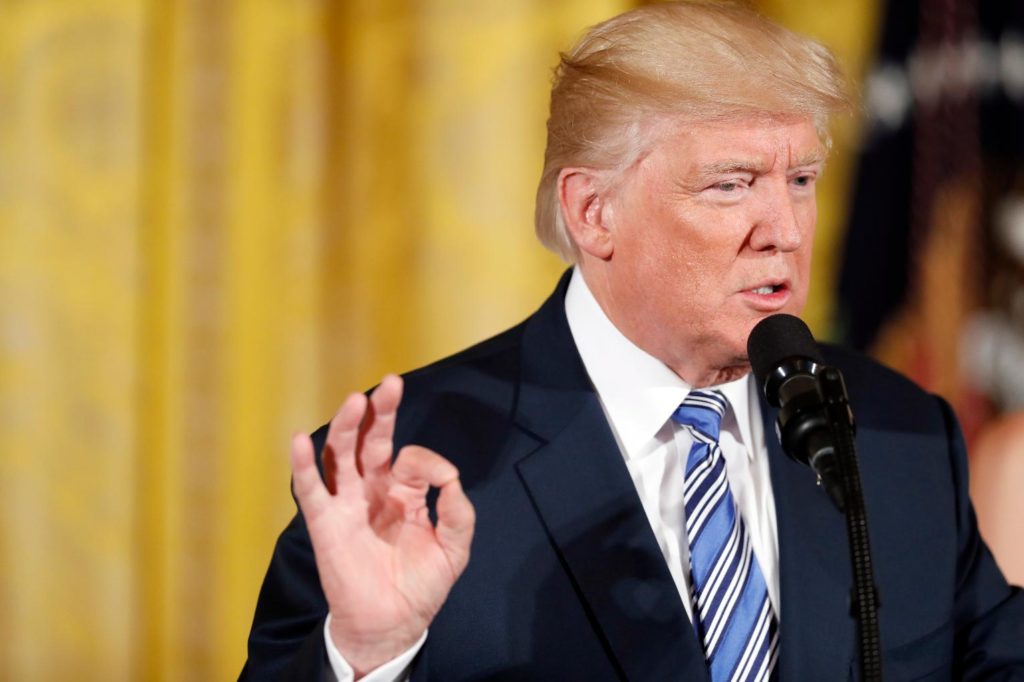
For the third time in six months, President Donald Trump is on the hunt for a new communications director. But in practice, the job is filled. It’s Trump who’s the White House’s leading expert and the final word on what and how he communicates with the public. Despite decrying most negative media coverage as “fake news” and personally insulting members of the media, he has inserted himself into the White House’s press operations in an unprecedented fashion for a president. Trump has dictated news releases and pushed those who speak for him to bend the facts to bolster his claims. He has ignored the advice of his legal team and thrown out carefully planned legislative strategies with a single 140-character tweet. His direct, hands-on style helped him win the White House and still thrills his supporters. It also, however, poses increasing political and potentially legal risks. The clearest example is his involvement in crafting a statement for son Donald Jr. about a meeting with a Kremlin-connected lawyer. That declaration was quickly proven erroneous and raised questions about whether the president was trying to cover for his son. Trump has struggled to find a communications adviser that meets his approval. His first, Mike Dubke, stayed behind the scenes and never clicked with Trump, leaving after three months. Then Sean Spicer, Trump’s oft-beleaguered press secretary, took on the communications director job as well. He resigned both posts last month when Trump brought in hard-charging New York financier Anthony Scaramucci. Scaramucci lasted only 11 days before being fired in the aftermath of an expletive-filled interview. A fourth candidate for the post, campaign spokesman Jason Miller, was named to the job during the transition but turned it down days later, citing a need to spend time with his family. More recently there have been some informal internal conversations about an increased communications role for White House aide Stephen Miller, according to an administration official who was not authorized to discuss private talks by name and requested anonymity. Those talks are still seen as preliminary. Miller recently clashed with some reporters over immigration policy at a contentious press briefing. This past week, as White House staffers readied a statement accompanying Trump’s signature on legislation approving toughened sanctions on Russia — a bill Trump criticized — word came down that the president wanted to add some off-topic language into the statement. That’s according to two officials familiar with the matter who spoke on condition of anonymity because they were not authorized to publicly talk about internal discussions. “I built a truly great company worth many billions of dollars,” the new section read. “That is a big part of the reason I was elected. As president, I can make far better deals with foreign countries than Congress.” That personal and boastful rhetoric is a far cry from the formal language normally found in presidential statements. It also appeared aimed at angering the same lawmakers he will need if he wants to pass any major legislation. “All presidents are their own best messengers,” said Ari Fleischer, press secretary for President George W. Bush. Fleischer said that Bush, too, would at times get involved with the White House press shop. Fleischer noted there was always a safety net of advisers at work. That does not appear to exist around the current president — particular around his Twitter account. “The lesson for this president is that it’s perfectly fine to be involved and to, at times, go around the mainstream media with Twitter,” Fleischer said. “But he needs to tweet smarter.” Corralling the president’s impulses is a challenge that now falls to new White House chief of staff John Kelly, a four-star Marine general tasked with straightening out an unruly West Wing. But many Trump allies don’t believe he’ll alter his ways. “The reality is President Trump is sitting in the Oval Office,” said Sam Nunberg, a former campaign staffer. “And before that, he was a mogul with a business that spanned continents. He did it his way. He’s not going to change. It got him where he is and it will keep him where he is.” Trump has long considered himself his own best spokesman and cares deeply about his public perception. While a budding real estate magnate in New York in the 1980s and 1990s, he was known to call reporters to plant anonymously sourced scoops about himself. He vaulted to national stardom with “The Apprentice” and micromanaged aspects of his appearances, including his hair and lighting. During the 2016 campaign, Trump was known to obsess over single images in a commercial or the font for an ad. As president, he frequently has raged about his communications staff, blaming them for White House’s stumbles while almost never taking responsibility himself. An avid consumer of cable news, Trump scolds surrogates when he thinks they are not adequately defending him on television. His frequently shifting positions also challenge his staffers, who have grown to be fearful of answering basic questions about the president’s beliefs for fear of later being contradicted, according to more than a half dozen White House officials and outside advisers speaking on the condition of anonymity to discuss private conversations. And the president has pushed staff to defend untruths, including when he ordered Spicer, in Spicer’s first White House briefing, to claim that the size of Trump’s inauguration crowd was larger than his predecessor’s, according to three White House officials and outside advisers familiar with the encounter. More untruths have followed. In March, Trump tweeted without evidence that President Barack Obama had wiretapped Trump Tower. And soon after firing FBI Director James Comey, Trump tweeted a warning that Comey had better hope there were no tapes of their White House conversations. There weren’t. Another statement has received bipartisan condemnation and could face scrutiny from investigators probing possible collusion between Trump’s campaign and Russian officials. As news broke last month that Trump Jr. had met with Russians in June 2016, the president’s eldest son released a statement
Donald Trump hedges as military presents new Afghanistan strategy
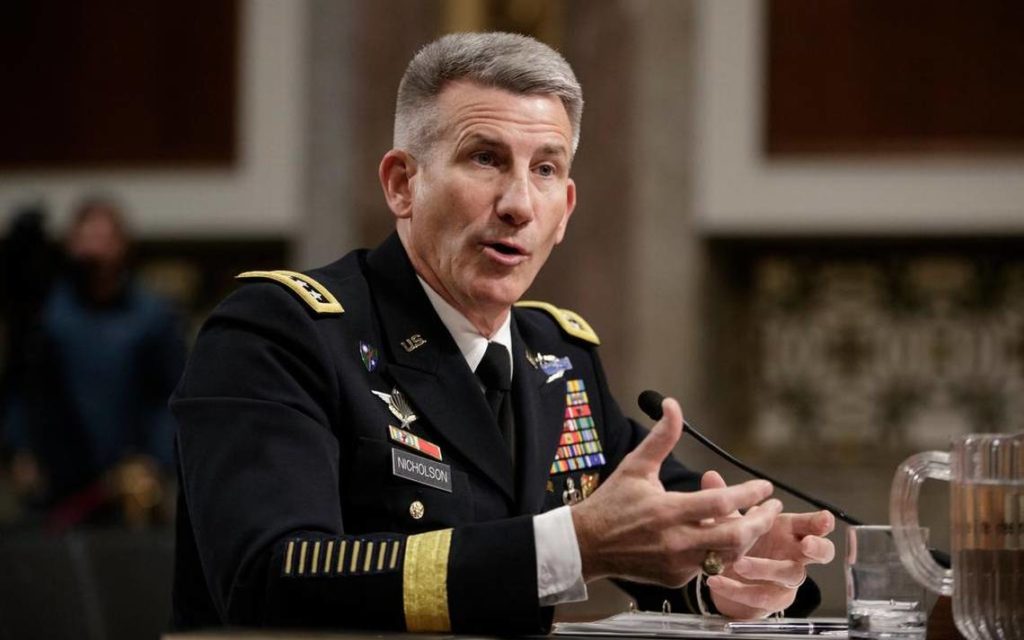
Frustrated by his options, President Donald Trump is withholding approval of a long-delayed Afghanistan war strategy and even mulling a radical shakeup in his national security team as he searches for a “game changer” after 16 years of indecisive conflict. In a recent Situation Room meeting that turned explosive, Trump raised the idea of firing Army Gen. John Nicholson, the top U.S. commander in Afghanistan, according to two officials with knowledge of the discussion. And he suggested installing his national security adviser, Gen. H.R. McMaster, to oversee the mission, said the officials, who weren’t authorized to talk publicly and requested anonymity. The drastic suggestions point to the desperation shared by many in Washington as military and other leaders look for a blueprint for “winning” the Afghan conflict. Trump has been frustrated by what he views as a stalemate. He wants a plan that will allow American forces to pull out once and for all. At a White House lunch with military brass last week, Trump publicly aired his misgivings, saying, “I want to find out why we’ve been there for 17 years.” The Pentagon wants to send almost 4,000 more American forces to expand training of Afghan military forces and beef up U.S. counterterrorism operations against al-Qaida, a growing Islamic State affiliate and other extremist groups. But the troop deployment, which would augment an already existing U.S. force of at least 8,400 troops, has been held up amid broader strategy questions, including how to engage regional powers in an effort to stabilize the fractured nation. These powers include U.S. friends and foes, from Pakistan and India to China, Russia and Iran. Pentagon plans aren’t calling for a radical departure from the limited approach endorsed by former President Barack Obama, and several officials have credited Trump with rightly asking tough questions, such as how the prescribed approach might lead to success. Trump hasn’t welcomed the military’s recommendations with “high-five enthusiasm,” a senior White House official said. Several meetings involving Trump’s National Security Council have been tense as the president demanded answers from top advisers about why American forces needed to be in Afghanistan. Another U.S. official with knowledge of the conversation reported Trump being less interested in hearing about how to restore Afghanistan to long-term stability, and more concerned about dealing a swift and definitive blow to militant groups in the country. The White House has even offered its own, outside-the-box thinking. Officials said Trump’s chief strategist, Steve Bannon, and his son-in-law and adviser, Jared Kushner, have been pushing a plan to have contractors fight the war in Afghanistan instead of U.S. troops. Blackwater Worldwide founder Erik Prince, the brother of Education Secretary Betsy DeVos, was approached by Trump’s top advisers to develop proposals to gradually swap out U.S. troops and put military contractors in their place, a military official said. The military has frowned on such proposals. It believes boosting troop levels will accelerate progress in training Afghan troops and its air force, and help counterterrorism teams pursue targets even more aggressively. They point to improvements among Afghan forces and in anti-corruption efforts. Military leaders — including McMaster, Defense Secretary Jim Mattis and Gen. Joseph Dunford, the Joint Chiefs of Staff chairman, are all said to be on the same page, as is Secretary of State Rex Tillerson. Military officials also have defended Nicholson, saying any punishment of him would be unfair because he hasn’t been given the forces he says he needs. His possible firing was first reported by NBC News. The White House, which declined multiple requests to comment, may shift itself on Afghanistan now that retired Marine Gen. John Kelly is Trump’s new chief of staff. Kelly hasn’t spoken about Afghanistan, however, since his appointment this week. Lawmakers are growing weary. In June, Mattis faced tough questions from Senate Armed Services Committee Chairman John McCain, who told him, “It makes it hard for us to support you when we don’t have a strategy.” Mattis conceded, “We are not winning in Afghanistan right now” and vowed to “correct this as soon as possible.” Doing so requires the president on board. While Trump has been keen to give military officials carte blanche on troop levels and other military affairs, his approach to Afghanistan has grown increasingly assertive. In some ways, his scrutiny of military plans has evoked that of Obama, whom Trump derided as a candidate for not heeding his generals’ advice. Republican lawmakers Thursday urged Trump to listen to his national security advisers on Afghanistan. “Every soldier over there is an insurance policy against our homeland being attacked,” Sen. Lindsey Graham, a leading hawk, told reporters. “My biggest fear is that if you don’t listen to the generals and you try to make this up as you go like Obama and Biden did, you’re going to wind up losing Afghanistan like you did Iraq and the consequences to America are worse.” U.S. indecision is causing Afghanistan’s neighbors to hedge their bets, Sen. Bob Corker, the Senate Foreign Relations Committee chairman, said. As long as they believe Washington is “six months away from stepping out, six months away from giving up,” they will continue to do so, Corker said. Republished with permission of The Associated Press.
