
From ‘likable enough’ to lovefest, Barack Obama to hail Hillary Clinton
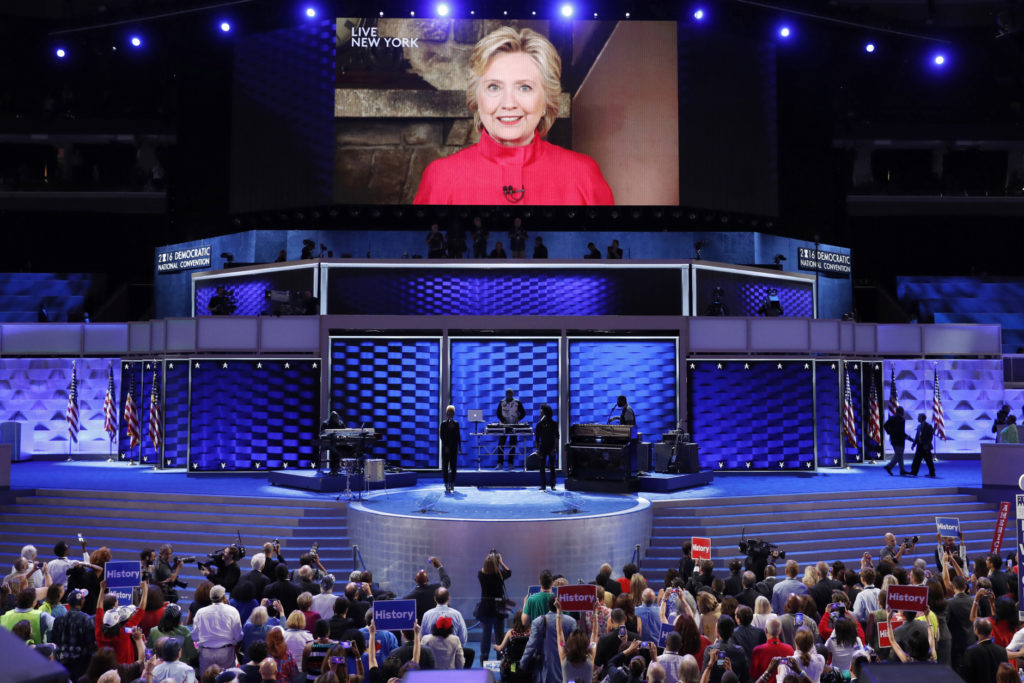
It was long ago and far away when Barack Obama snippily remarked, “You’re likable enough, Hillary.” It’s a lovefest now. Hillary Clinton formally captured the Democratic nomination and declared the glass ceiling keeping women from the presidency cracked and nearly shattered. Her husband, ex-President Bill Clinton closed the historic night with an expansive and passionate testimonial, offering a deeply personal — though sanitized — account of their relationship. It was a policy-driven ode to the “best darn change-maker I have ever met.” Tonight, the current president is joining her party — for it is her party now — in making the case to the nation for electing the former first lady, senator and secretary of state as the first woman to occupy the Oval Office. The Democrats’ standard-bearer at long last, Hillary Clinton was affirmed as the party’s nominee Tuesday night at a convention that appeared to be finding its stride after a disruptive opening at the hands of distraught Bernie Sanders supporters. The ritualistic roll call of the states that sealed her nomination proceeded without trouble inside the hall and Sanders himself stepped up in the name of unity to ask that her nomination be approved by acclamation. The unhappiest among his followers filed out, occupied a media tent and staged a sit-in, some with tape on their mouths to signify their silencing by the party. “This was a four-day Hillary party, and we weren’t welcome,” said Liz Maratea, 31, of New Jersey. “We were treated like lepers.” Clinton’s landmark achievement saturated the roll call with emotion and symbols of women’s long struggle to break through political barriers. Holding a sign saying “Centenarian for Hillary,” 102-year-old Jerry Emmett of Prescott, Arizona, cast her state delegation’s vote. She was born before women won the right to vote in 1920, and remembered her mother casting a ballot for the first time. Bear Atwood, 56, a Terry, Mississippi, civil rights attorney and at-large delegate, was moved to tears when Clinton became the nominee. “I’ve been working in women’s rights for my whole adult life,” she said. “This is the culmination of a career and a personal life.” Said Clinton, in a surprise appearance on video at night’s end: “We just put the biggest crack in that glass ceiling yet.” The crowd roared. Eight years after the bitter primary battle that Obama won, the president and his ex-rival are engaged in a baton-passing partnership: Clinton presenting herself as the protector of his legacy; Obama seeing the election in November as an affirmation of his course as president, if she wins. As polished an orator as he is, he’s got a tough act to follow, after a memorable speech from his wife, Michelle. Her passionate pitch for Clinton on opening night won praise even from Donald Trump, who turned the other cheek for once and ignored her digs. “Excellent,” he said of her delivery. “I thought she did a very good job.” Although the convention made clear progress in sublimating its divisions, Clinton remains a divisive and largely unpopular figure for the country, as is Trump. Polling has consistently found a lack of trust in Clinton, exacerbated by remaining questions about her emails as secretary of state and no doubt by the years of intrigue surrounding the ex-president and herself. The convention’s second night was devoted to reintroducing Clinton to voters, as speakers highlighted issues she has championed for years, like health care and advocacy for children and families. The portrait was missing some strokes. “Hunger Games” actress Elizabeth Banks and other speakers praised Clinton for focusing her early law career on children’s causes; left unsaid was that she also joined the Rose law firm in Arkansas, which worked for Tyson Foods, Wal-Mart and several brokerage houses and had a part in the Whitewater real-estate scandal that dogged the Clintons for years. Bill Clinton traced the couple’s love story chapter and verse, starting from their meeting in a library and proceeding through his head-strong courtship and on through the years. Unsavory episodes, like his numerous dalliances with women in Arkansas and the nearly career-ending liaison with White House intern Monica Lewinsky, were omitted. “Hillary will make us stronger together,” he said, pushing back on the Republicans’ “cartoon” version of his wife. In a subtle dig at Trump, he said the U.S., with his wife as president, would be welcoming to Muslims who love America. And, touching on the shootings of black men by police and by the killings of police officers, he envisioned a future “where nobody’s afraid to walk outside.” Sanders, the liberal scold of the Democratic Party and a fierce competitor of Clinton in primary contests that she had been expected to breeze through early on, came to the convention as a would-be peacemaker. But he had his hands full trying to get his supporters to swing behind Clinton or even tolerate the idea of her presidential candidacy. The morning after his rousing endorsement of Clinton at the convention, Sanders himself was booed as he arrived for a breakfast with California delegates Tuesday. “It is easy to boo,” Sanders said in admonishing his supporters. “But it is harder to look your kids in the face, who would be living under a Donald Trump presidency.” Republished withn permission of the Associated Press.
Citing cyber ‘revolution,’ Barack Obama issues attack response plan
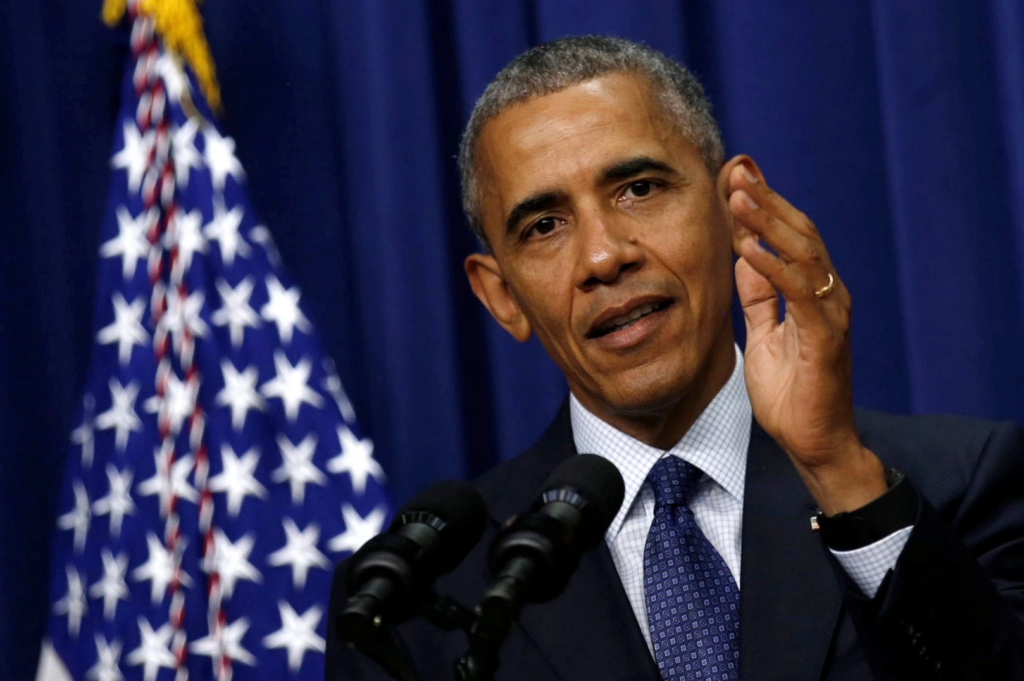
The White House warned Tuesday of a “revolution” of computer-generated threats to the U.S. stoked by growing cyber aggression by traditional U.S. foes like Russia and North Korea, and issued a color-coded response plan for the federal government to use after major cyberattacks. Lisa Monaco, President Barack Obama‘s homeland security and counterterrorism adviser, said while Russia and China grow “more assertive and sophisticated” online, Iran has attacked U.S. banks and North Korea is showing a willingness to attack companies and countries alike. She also warned that non-governmental actors, like the Islamic State group and “hacktivists,” are finding it easy to advance their goals through the internet. “To put it bluntly, we are in the midst of a revolution of the cyber threat – one that is growing more persistent, more diverse, more frequent and more dangerous every day,” Monaco said at a cybersecurity conference in New York. “Unless we act together – government, industry, and citizens – we risk a world where malicious cyber activity could threaten our security and prosperity. That is not a future we should accept.” Aiming to streamline Washington’s response to major attacks, Obama released a presidential policy directive that establishes six levels of severity for attacks, a color-coded system that evokes the terror alert system formally used by the Homeland Security Department. A high-level federal response following the directive’s guidelines will be triggered anytime there’s an attack at or above a level three – orange – indicating an attack likely to affect public health or safety, economic or national security or other U.S. interests. A level 5 – black – is an emergency that poses an “imminent threat” to critical infrastructure, government stability or U.S. lives. The directive lays out which federal law enforcement and intelligence agencies take the lead coordinating the various parts of the response to the attack. Though long in the works, the directive comes amid heightened concern and attention to cybersecurity following the hack of Democratic National Committee emails, which Hillary Clinton‘s campaign has blamed on Russia. The U.S. government hasn’t formally accused Russia of involvement and Moscow has called the accusations “paranoid.” Republished with permission of the Associated Press.
Viewers DNC Guide: Tuesday’s roll call says it all
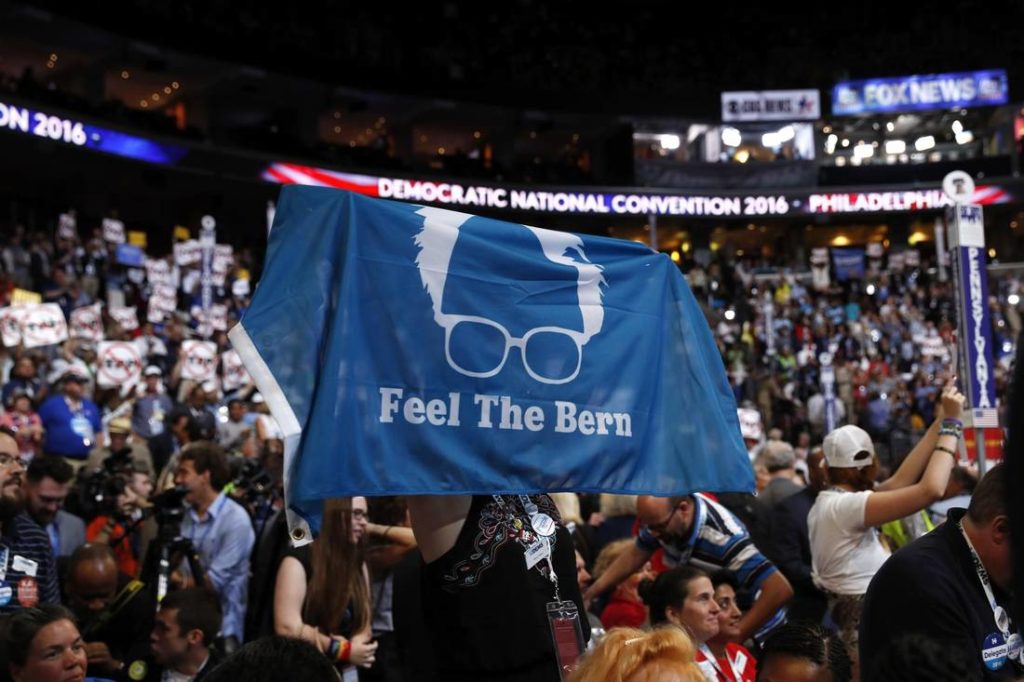
For all of the hoopla attached to a political convention, it all comes down to this: that moment when the presumptive nominee becomes the nominee outright. On Tuesday night, Hillary Clinton is to become the first woman presidential nominee of a major party. The result is foreordained, but the roll call of the states will nonetheless be an emotional coda for Bernie Sanders supporters whose passion and energy took the Vermont senator from fringe candidate to serious contender. Some things to watch for at the Democratic convention on Tuesday: ROLL CALL All of the energy and angst of the hard-fought primary battle between Clinton and Sanders will culminate in the roll call of the states. Each state delegation will get a chance to announce how its delegates are voting. Sanders delegates have pushed to have their votes fully tallied. Sanders has left open the possibility that Clinton could receive the nomination by acclamation — or unanimous nomination — at the end of the roll call. That may not satisfy his delegates. Some are ready to boo or even walk out if there is a unanimous nomination. In 2008, Clinton halted the roll call midway through to call for then-Sen. Barack Obama‘s approval by acclamation, or unanimous vote. FIRST DUDE The spouse of a presidential nominee always gets some love at a party convention. And Bill Clinton‘s speech Tuesday night will pique extra interest since he hopes to be the first first man. Bill Clinton also carries the extra title of ex-president and is a beloved figure to party faithful. But the former president carries with him the baggage of numerous scandals and investigations from his years in the White House. And Clinton, famously protective of his wife, can get in trouble when he gets carried away in defending her. Watch how he’s introduced: Hillary Clinton has joked that she’s still working on what to call her husband if she’s elected, offering “first dude” and “first mate” as possibilities. MOTHERS OF THE MOVEMENT Hoopla and celebration will give way to a somber moment when the convention showcases “mothers of the movement” — women whose children have died in gun violence. The speakers will include the mothers of Eric Garner and Michael Brown, both killed by police. The moment will not be without controversy: Philadelphia’s police union complained that Clinton was showcasing killings by police without giving equal time to the families of fallen officers. Clinton’s campaign responded that two members of law enforcement also are on the convention schedule. MANNERS, MANNERS Will they heed their leader? Sanders’ supporters are bringing a lot of emotion to the convention hall with them, and their leader is having trouble containing it. Sanders has sent out text messages and emails asking his supporters “as a personal courtesy” to him to “not engage in any kind of protest on the floor.” The Vermont senator said in an email that the movement’s credibility “will be damaged by booing, turning of backs, walking out or other similar displays.” Republished with permission of the Associated Press.
Hillary Clinton’s turn: Guide to the Democratic National Convention
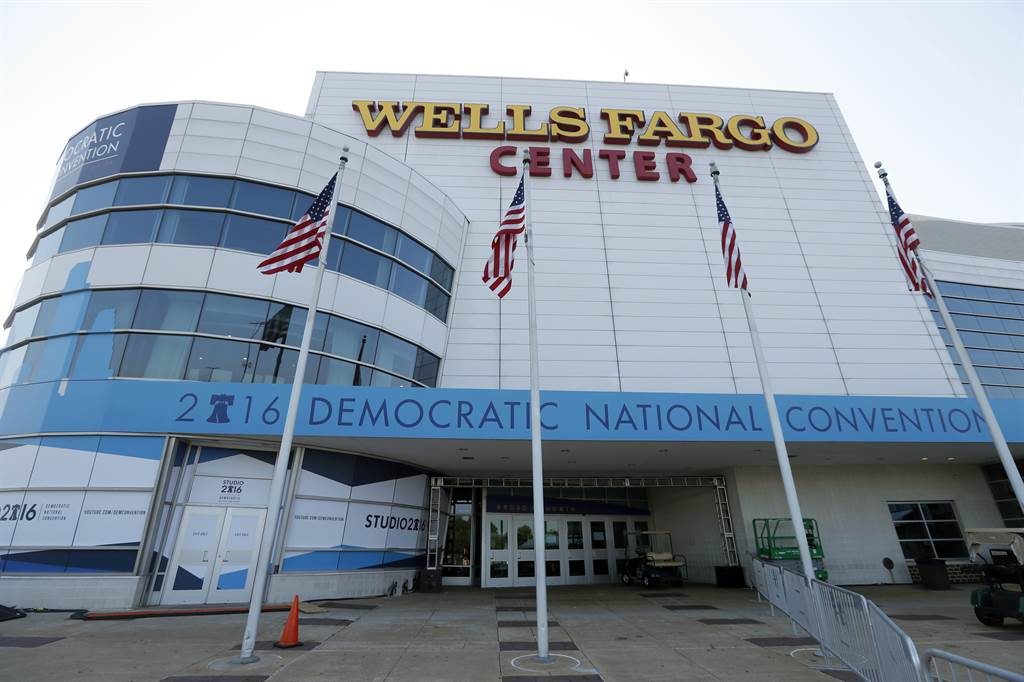
It’s Hillary Clinton‘s turn. The Democratic National Convention opening Monday in Philadelphia is Clinton’s chance to hit reset after a vigorous primary against Bernie Sanders and the unlikely movement that formed behind the Vermont senator. Sanders, a self-described democratic socialist, has endorsed Clinton, but many of his supporters have not. Some of them were dismayed by her choice of Sen. Tim Kaine, D-Va., as her running mate. Last week’s Republican National Convention in Cleveland exposed deep, lingering reservations about Donald Trump from within his own party. The Democratic gathering is expected to be a more smoothly choreographed display of unity among Clinton, Sanders and Democratic lawmakers and voters. What to know about the week: THE POINT Both parties use their national conventions to formally nominate candidates for president and vice president. Party leaders showcase their nominees, and the prime-time speeches by the candidates and prominent politicians win some of the largest television audiences of the campaign. That makes the convention a critical opportunity for a party to introduce its candidates to the country. Democrats also will adopt its platform, which lays out policy principles but has no binding effect. THE LOCATION The Wells Fargo Center, home to the NHL’s Philadelphia Flyers and the NBA’s Philadelphia 76ers, is the convention site. The arena has been transformed with stages, platforms, cameras and lights. Democrats are hoping that city’s historical role in the founding of American democracy will serve as a powerful backdrop for the themes they’ll highlight. WHO’S GOING More than 5,000 delegates are among the 50,000 people set to be in Philadelphia. They include alternates, lawmakers, special guests, journalists and protesters. Among the delegates, about 15 percent are superdelegates, mainly members of Congress and members of the Democratic National Committee. At the GOP convention, a striking number of prominent Republican lawmakers and party leaders were nowhere to be seen, including the party’s previous two presidents and its two most recent presidential nominees. In contrast, bold-name Democrats have been eagerly vying for a chance to speak in Philadelphia. Most Democratic senators and House members are expected to attend. THE SCHEDULE First lady Michelle Obama is set to speak Monday. That’s also when Sanders will give his speech — a closely watched moment for signs of whether his loyal supporters will line up behind Clinton, as he’s asked them to do. Former President Bill Clinton, the candidate’s husband, is the speech to watch Tuesday. A day later, President Barack Obama and Vice President Joe Biden come to Philadelphia. On Thursday, the final night, Chelsea Clinton will introduce her mother for her speech accepting the Democratic nomination. Kaine, who made his debut as Clinton’s running mate at a joint appearance Saturday, will give a speech introducing himself to the country. Officials haven’t yet said when, but the running mate typically speaks Wednesday. Other scheduled speakers are Massachusetts Sen. Elizabeth Warren, New Jersey Sen. Cory Booker, New York Mayor Bill de Blasio and House Minority Leader Nancy Pelosi. THE ENTERTAINMENT Shoop Dogg, Lady Gaga, Lenny Kravitz and Cyndi Lauper will appear in Philadelphia during the convention. Fergie will perform at The Creative Coalition’s gala. THE ROLL CALL States will get a chance to announce how their delegates are voting in the formal roll call Tuesday. It’s a high point for Sanders delegates; they’re pushing to have their votes fully tallied. In 2008, Clinton halted the roll call midway through to call for then-Sen. Barack Obama’s approval by acclamation, or unanimous vote. Sanders says he favors a state-by-state roll call, but he hasn’t indicated exactly what he will do. There’s a total of 4,763 delegates. It takes 2,382 to win the Democratic nomination. Clinton arrives in Philadelphia with 2,814 delegates to Sanders’ 1,893, according to an Associated Press count. That includes the superdelegates, who can vote for any candidate they choose. This year, those superdelegates overwhelmingly backed Clinton. The remaining 4,051 are pledged delegates, won by the candidates based on the results of state primaries and caucuses. THE PROTESTS If there are any fireworks in Philadelphia, expect them to come from Sanders supporters. They have said they plan to show up in full force. Philadelphia officials estimate between 35,000 and 50,000 people will demonstrate across the city each day. Activists have put the estimate higher, at roughly 100,000. Among the groups planning to demonstrate are gun control advocates, the group Occupy DNC Convention and Trump supporters from Pennsylvania. Republished with permission of the Associated Press.
Hillary Clinton says veep pick Tim Kaine is everything GOP ticket isn’t
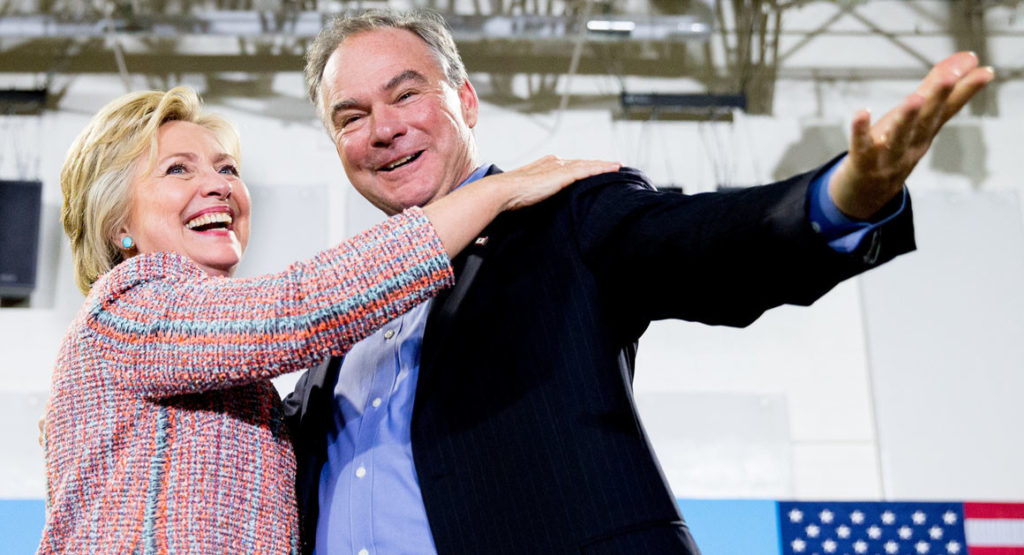
Hillary Clinton debuted running mate Sen. Tim Kaine on Saturday as a can-do progressive committed to social justice and equality – “everything Donald Trump and Mike Pence are not” – at a boisterous rally ahead of next week’s Democratic National Convention. “He is qualified to step into this job and lead from Day One. And he is a progressive who likes to get things done,” Clinton declared at Florida International University. Kaine, a bilingual former Virginia governor, detailed his life in public service. “I like to fight for right,” he said. And, as Clinton smiled broadly at her choice for vice president, Kaine greeted the largely Hispanic audience in Spanish. “We’re going to be ‘compañeros de alma,’ in this great ‘lucha’ ahead,” he said, or “soul mates in this great fight ahead.” Trump, in a text to his own supporters, said President Barack Obama, Clinton and Kaine were “the ultimate insiders” and implored voters to not “let Obama have a 3rd term.” At the splashy rally, Democrats sought to offer a contrast with Trump and Pence, whose first appearance together in a New York City hotel ballroom included a lengthy speech by the GOP businessman and much more limited remarks from Pence, the Indiana governor. The two only briefly posed for photos at their campaign kickoff. Clinton chose to introduce Kaine as her running mate in the battleground state of Florida, waving to the large crowd of cheering supporters as they bounded on stage with their hands raised in the traditional sign of unity. Clinton sought to present the partnership as one built in optimism, panning the Republican convention, which ended two days earlier, as a display of “fear,” ”anger and resentment.” She noted that Kaine had taken a year off from Harvard Law School to do missionary work in Honduras and had worked as a civil rights attorney specializing in equal housing. Clinton said Kaine as governor worked with Republicans and helped his home state navigate the Great Recession without sacrificing funding for education. She also pointed to his work on gun control after the deadly Virginia Tech shooting in 2007, praising his efforts to curb gun violence before a nation still reeling from a series of shootings and violence against police. “Behind that smile, Tim also has a backbone of steel. Just ask the NRA,” Clinton said. Choking up, Kaine described the Virginia Tech shooting as the “worst day … of my life.” Kaine, 58, was long viewed as a likely choice because of his resume in government and his time as chairman of the Democratic National Committee. He also had a particularly powerful backer in Obama, whom Kaine endorsed in 2007. Obama considered him for vice president a year later. Kaine showed a willingness to mix it up with the Republican ticket, assailing Trump as someone who had left “a trail of broken promises and wrecked lives wherever he goes.” He also vouched for Clinton’s trustworthiness, a major liability with voters, telling the crowd, “She has always delivered.” He pointed out that his father-in-law was a Republican governor of Virginia who had integrated the public schools. He called marrying his wife, Anne Holton, “the best decision of my life.” The couple planned to be back in Richmond on Sunday for 9 a.m. Catholic Mass. Holton, who wiped away tears during the speech, is the state’s education secretary and a former state judge. The couple has three adult children, including a son, Nat, a Marine who is going on a deployment on Monday, aides said. Kaine is likely to be a valuable asset for the Democratic ticket in appealing to Hispanic Americans turned off by Trump’s harsh rhetoric about immigrants. Trump was not making public appearances on Saturday but took to Twitter to seek to undercut Clinton’s new addition, pointing to the Trans-Pacific Partnership trade deal and Wall Street as areas where supporters of one-time Clinton rival Bernie Sanders might split with Kaine. Trump tweeted that Kaine “has been praising the Trans-Pacific Partnership and has been pushing hard to get it approved. Job killer!” In a tweet earlier in the day, Trump wrote that Kaine was “owned by the banks. Bernie supporters are outraged, was their last choice. Bernie fought for nothing!” Kaine is viewed skeptically by some liberals, who dislike his 2015 vote to provide the president with “fast-track authority” on trade deals and recent stances on Wall Street regulations, including rules governing regional banks. Clinton opposed the TPP during the primary against Sanders, citing concerns about job protections and national security. A Clinton campaign aide said Kaine made clear “in the course of discussions” that he shares Clinton’s opposition to the TPP in its current form. But progressive groups said they want more assurances that the White House, which has pushed the trade deal, won’t try to ram it through after the November election. “The selection increases the burden on Hillary Clinton to pressure the White House to take TPP off the table in a lame-duck Congress,” said Adam Green, co-founder of the Progressive Change Campaign Committee. But Larry Cohen, a former president of the Communications Workers of America union and a top Sanders adviser, said Kaine’s record needed to be considered in its totality. “Most Harvard Law graduates don’t go into civil rights work in the South,” said Cohen, who first met Kaine when he served as Richmond’s mayor. “His life has been those kinds of choices. He’s never run after big money. He’s always run after ‘How can I make a difference?’” Republished with permission of the Associated Press.
Hillary Clinton looks to steal Donald Trump thunder with VP pick

Hillary Clinton moved closer to introducing her running mate, snatching attention from newly crowned Republican nominee Donald Trump just hours after he closed out his convention with a fiery and foreboding turn at the podium. Crews were still sweeping confetti from the GOP convention hall floor, as the Clinton campaign signaled an announcement was coming soon. In a tweet Friday morning, her campaign urged supporters to text the campaign to get the first word. Virginia Sen. Tim Kaine had emerged as the leading contender, according to Democrats familiar with Clinton’s search. The news could quickly steal Trump’s thunder. In a 75-minute speech Thursday night, Trump made forceful promises to be the champion of disaffected Americans, capping his convention on a high note for the party, not a moment too soon after shows of disharmony and assorted flubs before the four-day closer. Speaking to “the forgotten men and women of our country,” the people who “work hard but no longer have a voice,” he declared: “I am your voice.” With that, he summed up both the paradox and the power of his campaign — a billionaire who made common cause with struggling Americans alienated from the system, or at least a portion of them. The speech was strikingly dark for a celebratory event and almost entirely lacking in policy details. Trump pledged as president to restore a sense of public safety, strictly curb immigration and save the nation from Clinton’s record of “death, destruction, terrorism and weakness.” “I have joined the political arena so that the powerful can no longer beat up on people that cannot defend themselves,” Trump said. He shouted throughout as he read off a teleprompter, showing few flashes of humor or even smiles. Democrats offered a different assessment, with Clinton campaign chairman John Podesta arguing that Trump “offered no real solutions to help working families get ahead or to keep our country safe, just more prejudice and paranoia. America is better than this. America is better than Donald Trump.” Clinton opens a two-day campaign swing Friday in Florida and is expected to introduce her running mate either at a Friday afternoon rally at the state fairgrounds in Tampa or on Saturday at Florida International University in Miami. Kaine, 58, appeared to be the favorite for her choice, according to two Democrats, who both cautioned that Clinton has not made a decision and could change direction. In Cleveland, Trump’s acceptance of the Republican nomination capped his improbable takeover of the GOP, a party that plunges into the general election united in opposition to Clinton but still torn over Trump. Underscoring his unorthodox candidacy, Trump reasserted the hard-line immigration policies that fired up conservatives in the primary but broke with many in his party by expressing support for gays and lesbians. Ever the showman, he fed off the energy of the crowd, stepping back to soak in applause and joining the delegates as they chanted, “U-S-A.” It was an altogether smoother — and more scripted — chapter in a footloose convention shocked a night earlier by Ted Cruz’s prime-time speech, a pointed non-endorsement of the nominee by the Texas senator who finished second in the race and came to Cleveland harboring grievances — and future presidential ambitions. During their convention, Republicans were relentless and often raw in demonizing Clinton. As fired-up supporters at Trump’s acceptance speech broke out in their oft-used refrain of “Lock her up,” the nominee waved them off, and instead declared, “Let’s defeat her in November.” Yet he also accused her of “terrible, terrible crimes.” “This is the legacy of Hillary Clinton: death, destruction, terrorism and weakness,” he said. “But Hillary Clinton’s legacy does not have to be America’s legacy.” In a direct appeal to Americans shaken by a summer of violence at home and around the world, Trump promised that if he takes office in January, “safety will be restored.” He also said young people in predominantly black cities “have as much of a right to live out their dreams as any other child in America.” And he vowed to protect gays and lesbians from violence and oppression, a pledge that was greeted with applause from the crowd. “As a Republican, it is so nice to hear you cheering for what I just said,” he responded. The Democratic convention in Philadelphia, which starts Monday, is expected to be a more orderly affair. Clinton is, if anything, disciplined. Kaine has been active in the Senate on foreign relations and military affairs and built a reputation for working with both parties as Virginia’s governor and mayor of Richmond. “I’m glad the waiting game is nearly over,” Kaine said Thursday. Agriculture Secretary Tom Vilsack, a longtime friend of Hillary and Bill Clinton, is still in the mix, according to one of the two Democrats. Both Democrats are familiar with the selection process and spoke on the condition of anonymity because they were not authorized to discuss it publicly. Kaine’s selection would not be without complication. Liberals have expressed wariness of Kaine for his support of putting the Trans-Pacific Partnership trade agreement on a “fast track” to approval, which both Clinton and primary rival Bernie Sanders oppose. They also note that Kaine recently signed onto a letter asking for less burdensome regulation of regional banks. Republished with permission of the Associated Press.
Running mate Mike Pence: Conservative but not angry about it
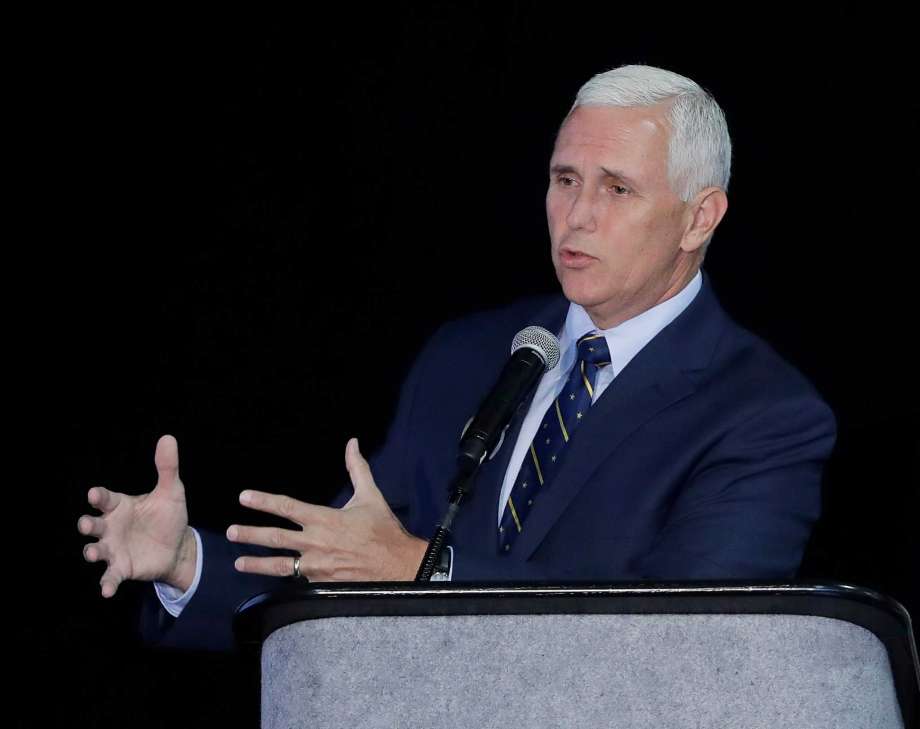
As a conservative talk-radio host in the 1990s, Mike Pence described himself as “Rush Limbaugh on decaf.” Two decades later, Pence is the unflappable conservative governor of Indiana who’s being plucked by Republican presidential contender Donald Trump as his running mate. Where Trump is impulsive, Pence is cool-headed. Where Trump makes conservatives suspicious, Pence has credibility. And where Trump struggles to draw evangelical Christians, Pence is well-regarded by them. A favorite quote highlights how Pence might smooth some of the sharp corners of the Trump campaign and its supporters. “I’m a conservative,” Pence says. “But I’m not angry about it.” The former congressman also is a proven fundraiser with close ties to billionaire industrialists David and Charles Koch and their network of wealthy donors, many of whom have been dismissive of Trump. “One thing you can say about Mike Pence is he’s got a very calm, steady demeanor that in some ways is a little Reaganesque,” said Christine Mathews, a Republican pollster for former Indiana Gov. Mitch Daniels. “He’s a counterbalance to Trump in that way.” Trump announced on Twitter Friday morning that he’s selected Pence as his running mate, capping a wild 24 hours of speculation interrupted by the truck attack in Nice, France, that left scores dead. Not so long ago, their relationship was a little awkward. Trump met privately with Pence before Indiana’s primaries, seeking his endorsement. Instead, Pence, under pressure from national conservatives, tepidly endorsed Trump’s rival, Texas Sen. Ted Cruz, while still lavishing praise on Trump. Trump won that primary. Before the night was over, Cruz had quit the race. For Pence, a former six-term congressman, Trump’s selection offers a return to national politics after his embrace as governor of conservative social issues sidelined his own presidential ambitions. Pence describes himself as “a Christian, a conservative and a Republican, in that order.” In 2015 he provoked a national backlash after signing a law that critics said would have allowed businesses to deny service to gay people for religious reasons. Even some Indiana Republicans have questioned his decisions, suggesting Pence has at times seemed more interested in appealing to national conservatives than doing what’s best for the state. Pence’s support of the state’s religious objections law led to a revolt from the business community, which joined gay rights advocates in successfully pushing for changes to the law. Raised in Columbus, Indiana, in an Irish-Catholic family, Pence revered the Kennedys growing up and has said he voted for Jimmy Carter in 1980. He later identified as an evangelical Christian and was inspired to join the Republican Party by former President Ronald Reagan, whose “happy warrior” rhetorical style Pence has since tried to emulate. After attending Hanover College, Pence graduated from Indiana University Law School in 1986. He met his wife, Karen, around the same time and twice unsuccessfully ran for Congress before taking a job at Indiana Policy Review, a conservative think-tank. In a 1991 essay titled “Confessions of a Negative Campaigner,” Pence swore off harsh political tactics he used in “one of the most divisive and negative campaigns in Indiana’s modern congressional history” while calling for “basic human decency.” “That means your First Amendment rights end at the tip of your opponent’s nose — even in the matter of political rhetoric,” Pence wrote, though he backtracked in the face of a difficult re-election campaign in Indiana. In Congress, Pence sponsored a few bills that became law as amendments in other legislation. But he built a national following among conservatives for his willingness to buck his own party after opposing President George W. Bush‘s Medicare expansion and the No Child Left Behind education overhaul. During the early years of President Barack Obama‘s administration, Pence helped lead the opposition to the Democrat’s agenda. “He has a particularly strong talent, a gift if you will, for being able to stick to principle while making his political opponents or those who disagree with him feel like they are being heard and respected,” said Ryan Streeter, a former Pence aide and George W. Bush staffer who is now a public affairs professor at the University of Texas. Pence’s congressional experience is one trait that Trump, who has never held public office, wanted in a running mate. Marc Short, a former Pence aide and top Koch brothers operative, elaborated: “He’s worked with (House Speaker) Paul Ryan. He’s worked with the team in House leadership. He’s somebody who has deep relationships in the evangelical movement, and he’s somebody who has foreign affairs experience.” Pence’s one term as governor has drawn mixed reaction, and he has managed to alienate moderate Republicans over social issues. Groups threatened boycotts over last year’s religious objections law and late-night television hosts mocked the policy, leading lawmakers to approve changes. This year Pence clashed with the local Catholic archdiocese by opposing the settlement of Syrian refugees in Indianapolis. Pence was also slammed for the planned 2015 launch of “JustIN,” a state-operated news service that was ditched after critics panned it as “Pravda on the Plains.” But he has also presided over Indiana’s improving economy and plummeting unemployment rate, which Republicans credit to the state’s low taxes, limited regulation and pro-business climate. Republished with permission of the Associated Press.
Mike Pence with Donald Trump on blocking some immigration

The Latest on the 2016 presidential campaign (all times local): 10:40 p.m. Indiana Gov. Mike Pence says he supports Donald Trump‘s call to “temporarily suspend immigration from countries where terrorists’ influence and impact represents a threat to the United States.” Pence spoke Friday on Fox News Channel’s “Hannity,” giving his first TV interview since Trump invited him to join the Republican ticket for the White House. Last year, Pence came out against Trump’s proposed temporary ban on foreign Muslims entering the United States, calling such a ban “offensive and unconstitutional.” Trump’s spokeswoman recently said he no longer supports his proposed religious test. Pence says he “stepped up without hesitation” when Trump asked him to be his running mate. He says Trump “understands the anxiety and the aspiration of the American people” like no leader since President Ronald Reagan. __ 9:10 p.m. Hillary Clinton is expressing support for the government of Turkish President Recep Tayyip Erdogan after an attempted military coup rocked Turkey’s capital. The Democratic presidential candidate is urging “calm and respect for laws, institutions, and basic human rights and freedoms — and support for the democratically elected civilian government.” She says, “All parties should work to avoid further violence and bloodshed, and the safety of American citizens and diplomatic missions must be ensured.” Turkish officials say the government appears to have repelled the attempted coup following a night of explosions, air battles and gunfire across Ankara. __ 8:10 p.m. A leader of conservatives making a last-ditch attempt to block Donald Trump’s nomination says she’s dropping her effort to force the Republican National Convention to vote on her plan to let delegates back any presidential candidate they want. The convention rules committee has already rejected Colorado delegate Kendal Unruh‘s proposal to “unbind” delegates from the candidates they were committed to by state primaries and caucuses. Unruh had been saying that despite that defeat, she’d get enough support to force a full convention vote next week on her plan to let delegates vote their conscience. But she said Friday that the Trump campaign and party officials have peeled away that support. She says she and her supporters believe delegates already have the right to vote their conscience and will oppose Trump’s nomination. ___ 5:35 p.m. Donald Trump says the taxes he pays are a private matter. But for candidates auditioning to be his running mate, similar reluctance wasn’t an option. Vice presidential search finalist Newt Gingrich said Thursday that Trump’s campaign required him to submit more than a decade worth of tax returns as part of the vetting process. Vetting potential vice presidents’ tax returns is a standard practice for candidates in both parties — but Trump has so far refused to make his own returns public on the grounds that he is being audited by the Internal Revenue Service. But tax scholars and former IRS officials have noted there is no rule against releasing tax filings during audits and say Richard Nixon released his returns while under audit in 1973. __ 5:15 p.m. Housing and Urban Development Secretary Julian Castro has met with Hillary Clinton at her Washington home as the presumptive Democratic presidential nominee considers her choice for vice president. That’s according to a person familiar with the Friday gathering, who spoke on condition of anonymity to discuss the private meeting. Two other senior Democrats also appeared to meet with Clinton on Friday. Massachusetts Sen. Elizabeth Warren and Colorado Gov. John Hickenlooper were seen in separate cars that departed Clinton’s home Friday afternoon. Clinton is also vetting Virginia Sen. Tim Kaine for the vice presidency and campaigned with him in his home state Thursday. Castro is considered a rising star in the party and is a former mayor of San Antonio. ___ 4:40 p.m. Colorado Gov. John Hickenlooper has visited Hillary Clinton’s Washington home as the presumptive Democratic presidential nominee ponders her choice for vice president. Hickenlooper was in a car that departed Clinton’s Washington home Friday afternoon. The Democratic governor declined to comment on his visit. The apparent meeting came after Massachusetts Sen. Elizabeth Warren visited Clinton’s house earlier Friday. Other candidates Clinton is known to be vetting are Virginia Sen. Tim Kaine and Housing and Urban Development Secretary Julian Castro. A person who spoke on condition of anonymity to discuss internal matters said earlier that Clinton was holding meetings Friday about her running mate selection. ___ 4 p.m. Delegates to the Republican National Convention are embracing Donald Trump‘s choice for vice president — even those who have yet to warm up to Trump. Some delegates hope the choice of Indiana Gov. Mike Pence will help unite Republicans and fire up the party base to support Trump. Not everyone is on board. But at the very least, Trump has all but assured that next week’s convention vote for vice president will go smoothly. Pence has a strong reputation among fellow Republicans as a social conservative. The former congressman has plenty of Washington experience and a calm, thoughtful demeanor that stands in stark contrast to the bombastic Trump. New Hampshire delegate Tom Rath called Pence a solid pick who should reassure a lot of people in the party. __ 3:40 p.m. An application by Bernie Sanders‘ campaign for a permit to rally during the Democratic National Convention has been denied. A spokeswoman for Philadelphia Mayor Jim Kenney says it was rejected because of the requested location in a park across from the convention site. She says the campaign sought to use a certain field that can only be used for recreational purposes. The application said the July 24 rally would be in support of Sanders’ campaign and estimated the crowd size at 15,000 to 40,000 people. Kenney’s spokeswoman, Lauren Hitt, says it’s not too late for the campaign to apply for a different location, if it is still interested. Sanders said Friday he won’t be holding any large rallies during the July 25-28 convention, but will focus on attending smaller events and talking to delegates. __ 3:30 p.m.
Bradley Bryne blocks Obama from using offshore drilling revenue to implement climate program

The U.S. House of Representatives on Tuesday adopted an amendment to block the Obama administration’s proposal to transfer money away from Alabama and other Gulf states to help fund the president’s “Coastal Climate Resilience” program that would help communities “prepare for and adapt to climate change.” The amendment, introduced by Alabama 1st District U.S. Rep. Bradley Bryne, prohibits any efforts to redirect funds allocated under the Gulf of Mexico Security Act (GOMESA) of 2006. GOMESA allows four Gulf states — Alabama, Louisiana, Mississippi and Texas — to receive 37.5 percent of federal oil revenue from drilling off their coasts, capped at $500 million a year, beginning in 2017. In February, President Barack Obama proposed transferring GOMESA money away from the Gulf States to pay for the Coastal Climate Resilience program by redirecting the funds toward climate projects, including $400 million to help Native American tribes in Alaska deal with climate change. Calling the GOMESA payments “unnecessary and costly” the Obama administration has complained they go to only a “handful of States under current law.” Meanwhile, GOMESA states argue they have long received a lower percentage of revenue than interior states for federal drilling within their borders, explaining the money will help offset damage to the environment and infrastructure caused by oil drilling. Prior to the amendment’s passage, Byrne spoke on the House floor in support of it. “These Gulf States not only provide a significant share of the infrastructure and workforce for the industry in the Gulf, but they also have inherent environmental and economic risks,” said Byrne. “Unfortunately, in his budget proposal this year, President Obama recommended that the money be taken away from the Gulf States and instead be spread around the country to implement his radical climate agenda.” Byrne continued, “Not only does this proposal directly contradict the current federal statute, it vastly undermines the purpose of the law — to keep revenues from these lease sales in the states that supply the workforce and have the inherent risk of a potential environmental disaster.” The amendment passed by unanimous voice vote. Watch Byrne’s floor speech on the amendment below:
Email Insights: Donald Trump says Hillary Clinton has failed America’s vets
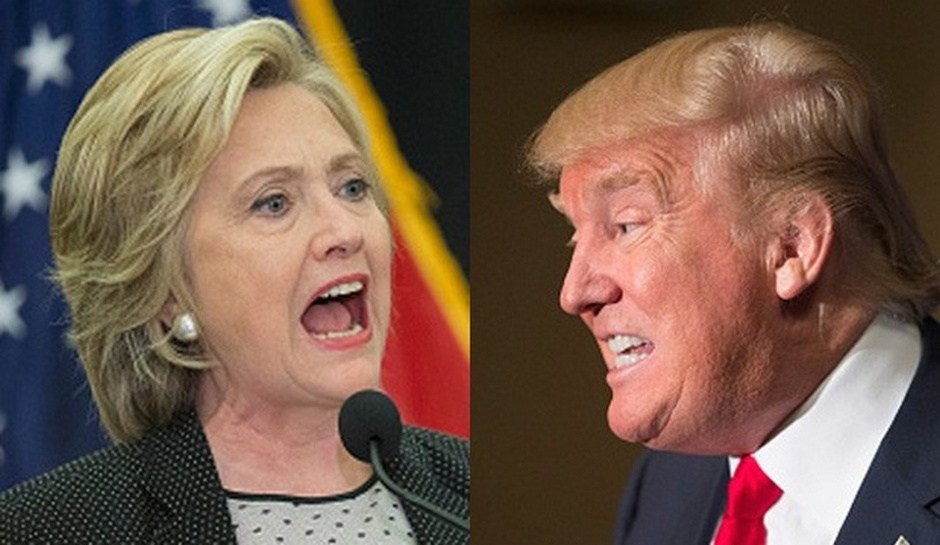
With no holds barred and in one of his lengthiest campaign emails to date, presumptive Republican presidential nominee Donald Trump goes for the jugular on his opponent Hillary Clinton’s history with veterans, saying under her “failed leadership, too many of our nation’s finest died waiting to receive medical help from injuries suffered protecting our country.” Lumping Clinton and the Barack Obama administration together, Trump cites several examples of how he believes veterans have been mistreated and ignored the past eight years. Pointing out Clinton’s “refusal to acknowledge the ‘widespread’ and ‘systemic failures’ that exist in our VA is only intensifying the problems.” Read Trump’s entire email below: The Clinton/Obama era has been disastrous for our nation’s veterans. Under their failed leadership, too many of our nation’s finest died waiting to receive medical help from injuries suffered protecting our country. Clinton’s refusal to acknowledge the “widespread” and “systemic failures” that exist in our VA is only intensifying the problems. As Americans we need to demand more from our public officials to serve our heroes as they served us. The Clinton/Obama way of enriching bureaucrats who fail our veterans is wrong. THE VETERANS AFFAIRS SENATE REPORT SHOWS “SYSTEMATIC FAILURES” AT VETERANS AFFAIRS MEDICAL CENTERS In May, A Senate Investigation Revealed Widespread “Systemic Failures” By The Veteran Affairs Inspector General’s Review of the Veteran Affairs Medical Center In Tomah, Wis…” “A Senate investigation of poor health care at a Veterans Affairs Medical Center in Tomah, Wis., found systemic failures in a VA inspector general’s review of the facility that raise questions about the internal watchdog’s ability to ensure adequate health care for veterans nationwide … One of the biggest failures identified by Senate investigators was the inspector general’s decision not to release its investigation report, which concluded two providers at the facility had been prescribing alarming levels of narcotics.” (Donovan Slack, “Senate Investigation finds ‘Systemic’ Failures at VA Watchdog,” USA TODAY , 05/31/16) The Probe Found The VA’s Inspector General “Discounted Key Evidence and Witness Testimony, Needlessly Narrowed Its Inquiry and Has No Standard For Determining Wrongdoing.” “The probe by the Senate Homeland Security and Governmental Affairs Committee found the inspector general’s office, which is charged with independently investigating VA complaints, discounted key evidence and witness testimony, needlessly narrowed its inquiry and has no standard for determining wrongdoing.” (Donovan Slack, “Senate Investigation finds ‘Systemic’ Failures at VA Watchdog,” USA TODAY , 05/31/16) “One of The Biggest Failures” Was That The VA IG Failed to Release an Investigative Report That Would Have Forced VA Officials to Publicly Address the Excessive Prescription of Narcotics at The Facility. One of the biggest failures identified by Senate investigators was the inspector general’s decision not to release its investigation report, which concluded two providers at the facility had been prescribing alarming levels of narcotics. The facility’s chief of staff at the time was David Houlihan, a physician veterans had nick-named ‘candy man’ because he doled out so many pills. Releasing the report would have forced VA officials to publicly address the issue and ensured follow up by the inspector general to make sure the VA took action. Instead, the inspector general’s office briefed local VA officials and closed the case.” (Donovan Slack, “Senate Investigation finds ‘Systemic’ Failures At VA Watchdog,” USA TODAY , 05/31/16) The Chief of Staff at A VA Facility Was Nick-Named “Candy Man” For Prescribing So Many Pills. “The facility’s chief of staff at the time was David Houlihan, a physician veterans had nick-named ‘candy man’ because he doled out so many pills. Releasing the report would have forced VA officials to publicly address the issue and ensured follow up by the inspector general to make sure the VA took action. Instead, the inspector general’s office briefed local VA officials and closed the case.” (Donovan Slack, “Senate Investigation finds ‘Systemic’ Failures at VA Watchdog,” USA TODAY , 05/31/16) The Investigation Raised Concerns That The VA’s Watchdog Is Able to Ensure “Adequate Health Care For Veterans Nationwide.” “A Senate investigation of poor health care at a Veterans Affairs Medical Center in Tomah, Wis., found systemic failures in a VA inspector general’s review of the facility that raise questions about the internal watchdog’s ability to ensure adequate health care for veterans nationwide.” (Donovan Slack, “Senate Investigation finds ‘Systemic’ Failures at VA Watchdog,” USA TODAY , 05/31/16) According to The Report, In Three Months “The VA Investigated And Substantiated A Majority Of The Allegations That The VA OIG Could Not Substantiate After Several Years.” “‘In just three months, the VA investigated and substantiated a majority of the allegations that the VA OIG could not substantiate after several years,’ the committee report notes.” (Donovan Slack, “Senate Investigation finds ‘Systemic’ Failures at VA Watchdog,” USA TODAY , 05/31/16) AN INTERNAL VA INVESTIGATION ALSO FOUND WIDESPREAD PROBLEMS An Internal Department of Veterans Affairs Investigation Found That Schedulers Routinely Misreported When Patients Actually Wanted to See a doctor or Receive Care, Making It Impossible to Track Delays. “An internal Department of Veterans Affairs investigation found that schedulers in Texas routinely misreported when patients actually wanted to see a doctor or get some other type of care, making it impossible to track delays in the care they received.” (Will Weissert, “Internal VA Report Finds Misleading Wait Time Data in Texas,” The Associated Press , 3/10/16) The Report Tracked Problems in Clinics and Medical Facilities in Central and South Texas. “The report released Tuesday by the VA’s Office of Inspector General tracks problems in clinics and medical facilities in central and South Texas.” (Will Weissert, “Internal VA Report Finds Misleading Wait Time Data in Texas,” The Associated Press , 3/10/16) According to The Report, Schedulers Listed the First Available Date That a Patient Could Be Seen as The Date That a Patient Had Wanted to Be Seen. “According to the report, schedulers often listed the first available date that a patient could be seen as the date that a patient had wanted to be seen. This meant there was no way to track how much longer those seeking care waited to get it.” (Will Weissert, “Internal VA Report Finds Misleading Wait Time Data in Texas,” The Associated Press , 3/10/16) VA Employees Reported That They Sometimes Engaged in Misleading Scheduling at The Behest of
Poll: Hillary Clinton struggles to make inroads with young Americans

Hillary Clinton is struggling to make inroads among young Americans who overwhelmingly supported Bernie Sanders during the Democratic presidential primary, a worrisome sign as she tries to reassemble the coalition that twice propelled Barack Obama into the White House. Opinions of Clinton among young Americans vary by race and ethnicity, according to a new GenForward poll of adults ages 18 to 30. The majority of the nation’s younger blacks and Asian-Americans have a favorable impression of Clinton, but the presumptive Democratic nominee struggles with whites and Hispanics. Just 26 percent of young whites and 49 percent of Hispanics have a positive opinion of the former secretary of state. Both groups overwhelmingly say she is not trustworthy. “I just don’t see her being honest and straightforward,” said Alexander Tomas, an 18-year-old Hispanic from Fort Worth, Texas. A recent high school graduate, Tomas supported Sanders in the state’s Democratic primary, but says he’s now undecided about his choice in November’s general election. GenForward is a survey by the Black Youth Project at the University of Chicago with the Associated Press-NORC Center for Public Affairs Research. The first-of-its-kind poll pays special attention to the voices of young adults of color, highlighting how race and ethnicity shape the opinions of the country’s most diverse generation. The survey polled all young adults, not necessarily registered or likely voters, but the findings suggest Clinton may struggle to turn out people 18 to 30 to support her candidacy. While Clinton emerged victorious in her unexpectedly tough primary with Sanders, the contest revealed a stunning weakness with such young voters. The GenForward poll found that among those who preferred Sanders in the primaries, only half are prepared to say they’ll back Clinton in her general election face-off with presumptive Republican nominee Donald Trump. About a quarter say they won’t support Clinton, and nearly a quarter say they’re not sure. Clinton has made moves in recent days to attract some of Sanders’ loyal young supporters, including unveiling a college affordability plan that would make in-state tuition-free for families making $125,000 or less per year. Sanders proposed free tuition at public higher education institutions for all, a plan supported by three-quarters of young adults, according to the survey. Sanders will formally endorse Clinton on Tuesday during a rally in New Hampshire, a step her campaign sees as an important signal to the Vermont senator’s backers. Clinton spokeswoman Xochitl Hinojosa said the candidate “believes we must do everything we can to make sure that millennial voters have their voice heard in our campaign.” She noted that the campaign recently hired three former Sanders aides to lead an effort to boost outreach to young people. Young people were an important part of the diverse coalition Obama put together during his two successful White House runs. Exit polls found that Obama carried 66 percent of voters 18-30 years old in the 2008 election and 60 percent during his re-election campaign. While Obama carried the majority of younger white voters in 2008, his support dipped to 44 percent in 2012. The president had the overwhelming backing of black and Hispanic voters under 30 in both campaigns, mirroring his overall support from both groups. But the GenForward poll shows weaknesses in Clinton’s support among young Hispanics, who prefer Sanders to Clinton by nearly a 3-to-1 margin. More than 4 in 10 had an unfavorable opinion of Clinton, and they were also more likely to say Clinton is untrustworthy and slightly more likely to say she’s unqualified to be president than young African Americans. Clinton’s support is strongest among young blacks, half of whom consider her honest and trustworthy and two-thirds of whom say they have a favorable opinion of Clinton. Among young Asians, 55 percent view Clinton at least somewhat favorably. While Clinton campaign officials acknowledge their candidate’s disconnect with young people, they see the prospect of a Trump presidency as perhaps the best way to motivate those voters in November. Indeed, the GenForward poll found that Trump’s standing with young people is staggeringly negative. Just 19 percent of young voters have a favorable opinion of the businessman, including 6 percent of African-Americans, 10 percent of Hispanics and 12 percent of Asian-Americans. While Trump performs strongest with young whites, only 27 percent view him favorably. “I’m very afraid of the potential for his presidency,” said Emily Erickson, a 30-year-old from Minneapolis who is planning to vote for Clinton. Erickson, who is interested in social justice and women’s issues, said Trump is “not thoughtful or willing to be intelligent.” But Clinton’s campaign may not simply be able to count on young voters seeing her as the lesser of two evils in a race against Trump. Seven in 10 young voters — including majorities of blacks, whites, Asians and Hispanics — say they are unsatisfied with the race between Clinton and Trump and want the option of a third party candidate. John Davilmar, a 20-year-old from West Palm Beach, Florida, is among those seeking an alternative. Davilmar backed Sanders and is increasingly considering casting his general election vote for Gary Johnson, the former New Mexico governor and Libertarian Party presidential nominee. He says he’s still open to voting for Clinton, but can’t shake the idea that she’s part of the professional political class he distrusts. “So far she’s like a lot of politicians,” Davilmar said. “But at least she’s better than what we would get from Trump.” Republished with permission of the Associated Press.
A lot of holes in GOP presidential ground game in key states
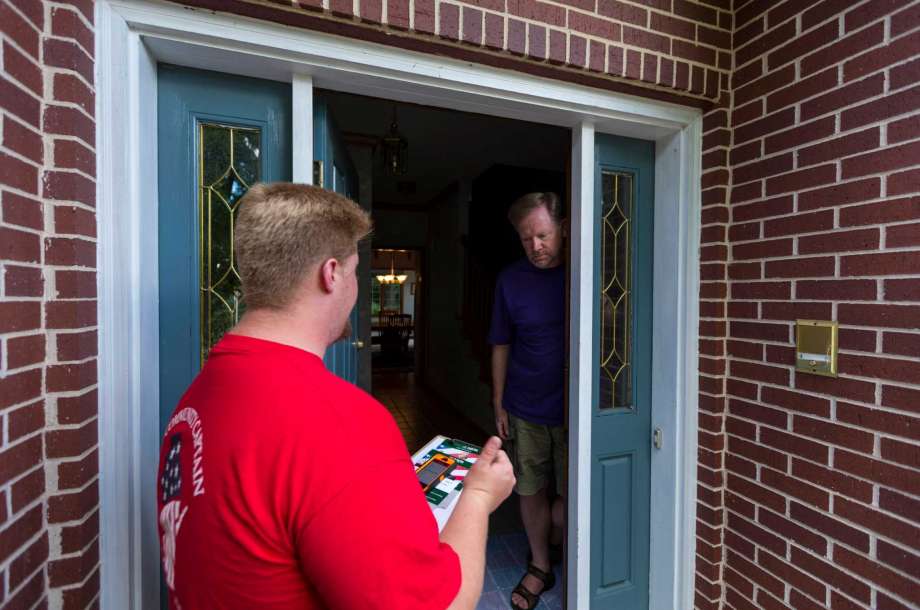
Presidential battleground states were supposed to be swarming with Republican Party workers by now. “We’ve moved on to thousands and thousands of employees,” party chairman Reince Priebus declared in March, contrasting that with the GOP’s late-blooming staffing four years earlier. “We are covering districts across this country in ways that we’ve never had before.” That hasn’t exactly happened, a state-by-state review conducted by The Associated Press has found. With early voting beginning in less than three months in some states, the review reveals that the national GOP has delivered only a fraction of the ground forces detailed in discussions with state leaders earlier in the year. And that is leaving anxious local officials waiting for reinforcements to keep pace with Democrat Hillary Clinton in the states that matter most in 2016. To be sure, the national party actually has notched record levels of fundraising over the past few years and put together a much more robust ground game than it had in 2012. But officials acknowledge the real competition isn’t their past results or the chronically cash-strapped Democratic Party. It’s Clinton and what GOP party chairman Reince Priebus calls “that machine” of Clinton fundraising. Some examples of Republican shortfalls: Ohio Republicans thought they were going to see 220 paid staffers by May; in reality, there are about 50. Plans for Pennsylvania called for 190 paid staffers; there are about 60. Iowa’s planned ground force of 66 by May actually numbers between 25 and 30. In Colorado, recent staff departures have left about two dozen employees, far short of the 80 that were to have been in place. AP learned of the specific May staffing aims from Republicans who were briefed earlier this year; the RNC did not dispute them. Current totals came from interviews with local GOP leaders over the past two weeks. The gulf between what state leaders thought they could count on and what they’ve actually got comes as RNC’s ground game is asked to do more than ever before. Presumptive nominee Donald Trump is relying on the party to do most of the nuts-and-bolts work of finding and persuading voters in the nation’s most competitive battlegrounds. “This is a race we should win,” Ohio GOP chairman Matt Borges said, citing a voter registration boom. “Now, we have to put the people in the field.” In New Hampshire, a swing state that also features one of the nation’s most competitive Senate contests, the Republican National Committee’s original plan called for more than 30 paid staff on the ground by May. Yet what’s happening there highlights that even when the RNC is close to meeting its staffing goals, there can be problems. In this case, 20 positions have been converted to part-time, and local officials have been struggling to fill them. “It’s a tall order to ask the RNC to be the complete field operation for the presidential nominee,” said Steve Duprey, a national party committeeman from New Hampshire. “We’re following through on the plan, but it was slower being implemented than we first would have hoped.” Borges and Duprey, like Republican leaders across the nation, acknowledged that the national party has dramatically reduced its staffing plans in recent months. “You discuss idealistic, you discuss realistic,” said the RNC’s political director Chris Carr. “Some people hear what they want to hear.” The Democrats have been more focused. The GOP’s foes, says party chairman Priebus, “have built their program around a candidate.” By that measure, Clinton and her Democratic allies appear to be quite far ahead, with roughly double the staff of the Republicans in Ohio, for example. For anyone – party or candidate – ground operations are expensive. The RNC’s 242-person payroll cost $1.1 million in May, federally-filed financial documents show. Additionally, the party transfers hundreds of thousands of dollars each month to state parties, which in turn hire more people. Between direct RNC employees and state employees hired with the help of transfers, the party counts more than 750 staff members, including 487 spread across the country and concentrated in battleground states. By contrast, at this point in 2012, there were just 170 paid Republican operatives across the country. Party officials say they are confident they will raise enough money to maintain – and very likely boost – the current level of employees until Election Day. Trump, who did not actively raise money during the primary season, touted surprisingly strong fundraising numbers in late May and June, including $25 million that will be shared with the party. But it was the primary triumph of Trump in May – and the fact that he did not bring with him a hefty portfolio of donors – that derailed the party’s fundraising and hiring goals, party officials said. The timing was important because a nominee typically serves as a major fundraiser for the national party, and having one in March or April would have given the Republicans a boost. A sign on an office door in Sarasota, Florida, illustrates how critical the RNC will be to Trump’s bid for the White House. It’s Trump’s state headquarters. “THANKS FOR STOPPING BY OUR OFFICE!” the blue paper reads. “Our office is TEMPORARILY CLOSED to the public, while our office works to prep for the National Convention in Cleveland.” A phone call to the number on the sign ended with an automated message stating, “Memory is full.” The Republican Party has 75 employees on the ground in Florida – a few dozen shy of Clinton – but they aren’t seamlessly integrated with the Trump campaign. “I do see cooperation between the national party and the Trump campaign,” said Michael Barnett, chairman of the Palm Beach County GOP. “But that hasn’t materialized at the local level yet. That doesn’t mean it won’t happen. It’s a little bit of a late start, but I’m not nervous. Not yet.” Like Florida, Ohio and New Hampshire, Wisconsin is a presidential battleground that features a highly competitive Senate race. That means national party staffers have the dual task
