
Poll: Support for school choice growing among Republicans
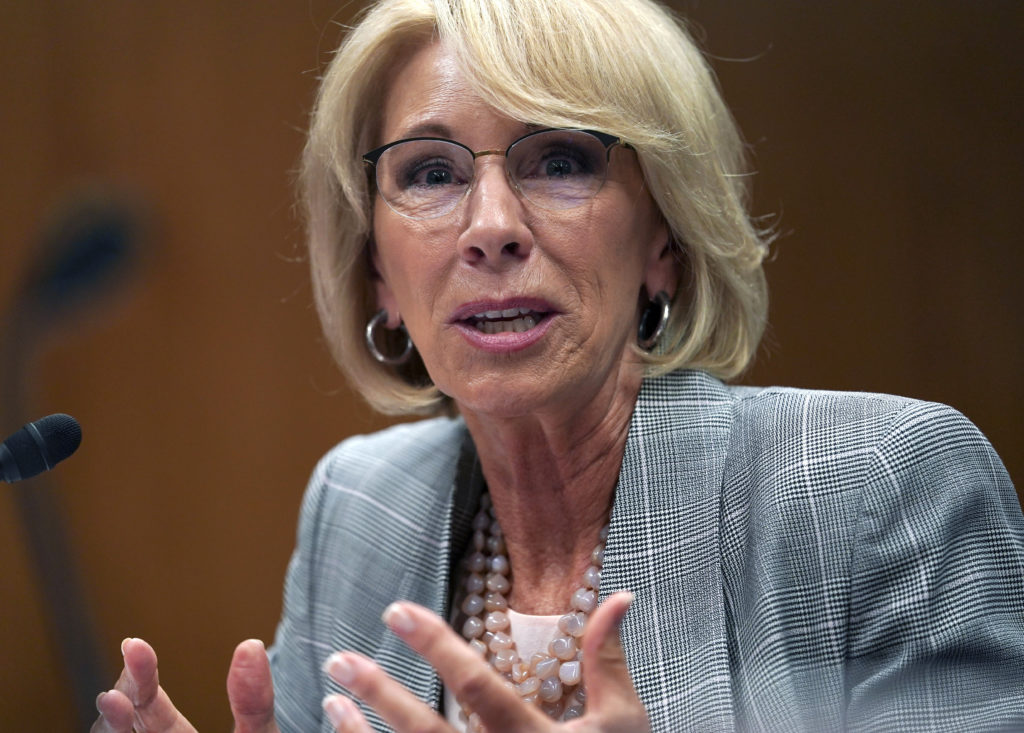
Support for charter schools and private school voucher programs has gone up over the past year, with Republicans accounting for much of the increase, according to a survey published Tuesday. The findings by Education Next, a journal published by Harvard’s Kennedy School and Stanford University, come as Education Secretary Betsy DeVos promotes alternatives to traditional public schools. Forty-four percent of respondents in the poll conducted in May said they support the expansion of charter schools, compared to 39 percent in 2017. The gain of 5 percentage points, however, did not fully offset the drop in support from 51 percent in 2016. When broken down according to party affiliation, 57 percent of Republicans and 36 percent of Democrats voiced support for charter schools, compared to 47 percent of Republicans and 34 percent of Democrats in 2017. “Support is up among Republicans for various strategies to expand school choice, and the Trump administration’s embrace of those policies is a likely explanation,” said Martin West, associate professor of education at Harvard University and a co-author of the report. Nina Rees, president of the National Alliance for Public Charter Schools said the findings “demonstrate through the educational choices they make for their children – families want high-quality charter school options for their kids. “Above all else, parents care that their child has access to an excellent school, and as education advocates it is our job to ensure that wish becomes a reality,” Rees added. Robin Lake, director of the Center on Reinventing Public Education, noted that support for charters has risen mostly among Republicans. “I hate to see an issue turn into a partisan question,” Lake said. “I don’t think that an education policy that’s designed to get better outcomes for kids should ever be a partisan issue.” Support for publicly funded vouchers given to low-income families to help them pay tuition at private school rose from 37 percent to 42 percent over the past year. The Education Department welcomed the results of the poll. “The data consistently show that parents want more education options for their kids and when they are empowered with options, they like it and their kids benefit,” said press secretary Elizabeth Hill. “Education freedom is the future.” Meanwhile, Americans seem to be more satisfied with their local police and the post office than with their neighborhood school. While 51 percent of respondents said they would give their local schools a grade of A or B, 68 percent gave the local post office a similar grade and 69 percent the local police. “It makes sense that only 50 percent of Americans are giving their public school a good grade of an A or a B that they would express support for alternatives to those public schools,” said Patrick McGuinn, a professor of political science and education at Drew University. In the Black Lives Matter era, African-American respondents gave their local police much lower marks than other respondents, but their views of their local schools were even worse. Thirty-nine percent gave their local schools an A or a B, while the local police force received such marks from 43 percent of African-American respondents. The study also found that many Americans favor raising teacher salaries and increasing school funding in the aftermath of teachers walking out of schools in six states earlier this spring to protest pay and other issues. Informed about average teacher earnings in their state, nearly half said they support raising teacher pay. That number was 67 percent when respondents were not told explicitly how much their local teachers were making. Nationally, the average teacher’s salary was $58,950 in 2017, according to the National Center for Education Statistics. “The sense of economic insecurity for teachers is very strong and there is growing support for higher pay, not just from teachers but from the broader community,” said Evan Stone, CEO of Educators For Excellence, a teachers’ advocacy organization. West said that while many believe teachers should be making more, there is disagreement over whether they should be compensated based on how much their students learn or using some other metric. “To the extent that the debate moves from how much are teachers are paid to how they are paid, there is potential for continued conflict,” West said. The Education Next survey was based on interviews with 4,601 adults across the country. The margin of error was 1.4 percentage points. Republished with permission from the Associated Press.
Betsy DeVos calls Kay Ivey, tells her US Dept. of Education approved Alabama ESSA plan

Governor Kay Ivey on Monday announced that Alabama’s Every Student Succeeds Act (ESSA) state plan was approved by the U.S. Department of Education (ED). Ivey received a phone call Monday morning from Education Secretary Betsy DeVos informing her of the decision. The Alabama ESSA state plan was submitted to the ED in October by the Alabama State Board of Education. The framework for the ESSA plan is provided by the ED; however, the indicators found in ESSA are specific to Alabama and many come directly from Alabama Ascending, the strategic plan for the future of education in Alabama. “I had a great conversation with Secretary DeVos about education in Alabama and was glad to receive her call regarding our state ESSA plan. A great deal of thanks must be given to interim State Superintendent Dr. Ed Richardson and Dr. Joe Morton who both worked deliberately and with diligence to help us craft a plan that would meet the requirements of the U.S. Department of Education but also do what is best for Alabama students,” Ivey said. “This plan will help guide Alabama to a better education start for all students and give them the foundation they need to be successful in their future careers.” Focus of the plan The state ESSA plan focuses on: the needs of students and teachers around the state including adding National Board Certified math and science teachers in hard to staff areas; and improving the Alabama Reading Initiative and increasing the overall number of highly qualified teachers. In the FY19 budget, Ivey requested a substantial increase to help hire National Board Certified Teachers in math and science into hard to staff areas, $4 million to improve the Alabama Reading Initiative, and $725,000 in scholarships for students training to teach math and science. Each of those requests were enacted for the upcoming fiscal year. ESSA timeline The state began work on its state ESSA plan in January 2016 and the draft plan was first released for public comment in July 2017. The finalized plan was submitted to the ED in October 2017. In December 2017, the ED sent a letter asking for more details on how Alabama planned to implement certain provisions of ESSA. The updated plan with input from many stakeholder organizations was submitted on February 13, 2018.
Martha Roby: Local insight must lead in our classrooms

As a mother of two young children, I know how important it is that we get it right when it comes to education. I believe decisions about education are best made locally, so throughout my time in Congress, I have worked to implement policies that give local teachers and parents more control over making needed improvements to education for our children. Secretary of Education Betsy DeVos recently testified before the Labor, Health and Human Services, Education Appropriations Subcommittee, on which I am proud to serve. During the hearing, I had the opportunity to ask Secretary DeVos whether, under her leadership, the Department of Education acknowledges that the Every Student Succeeds Act (ESSA) expressly forbids the coercion of states to adopt certain federal education standards, including Common Core. Secretary DeVos assured me that she does acknowledge this and that the Department will continue to follow the letter and spirit of the law. I have championed these anti-coercion measures for several years, and I’m glad to now have a partner leading the Department of Education who will work with us to ensure that Washington won’t force policy agendas into Alabama classrooms. I appreciate Secretary DeVos for taking the time to review the Department’s priorities with our subcommittee, and I was particularly pleased to hear her response to my question. You know as well as I do that when the federal government manipulates education policy and standards, it ties the hands of school administrators, teachers, and parents in a way that is detrimental to the education of our children. We saw this firsthand in our country when No Child Left Behind (NCLB) was the law of the land and federal officials had too much control over our classrooms. During the subcommittee hearing, I was also glad to have the opportunity to talk with Secretary DeVos about the importance of Career Technical Education (CTE) programs and ways we can continue to strengthen and improve them. In Alabama, we are fortunate to have a strong network of these programs. As of last year, Alabama’s Community College System had more than 79,000 students enrolled in CTE programs, and 70 Alabama high schools offer CTE courses with nearly 184,960 students enrolled. As our state’s economy continues to grow and add jobs, it is imperative that our students have access to programs that will prepare them to be competitive in our workforce. It goes without saying that CTE is hugely significant to our state, and I’m pleased Secretary DeVos reaffirmed the Trump Administration’s commitment to supporting these programs all over the country. I am proud to work with the Administration to strengthen CTE, and I will continue to fight to improve our education laws with policies that are more conservative and state-centered. I am confident that local teachers and parents know how to educate the children in their communities better than bureaucrats in Washington, and I will do everything I can in Congress to empower them to be the driving force in our schools. ••• Martha Roby represents Alabama’s Second Congressional District. She lives in Montgomery, Alabama with her husband Riley and their two children.
Cabinet chaos: Trump’s team battles scandal, irrelevance
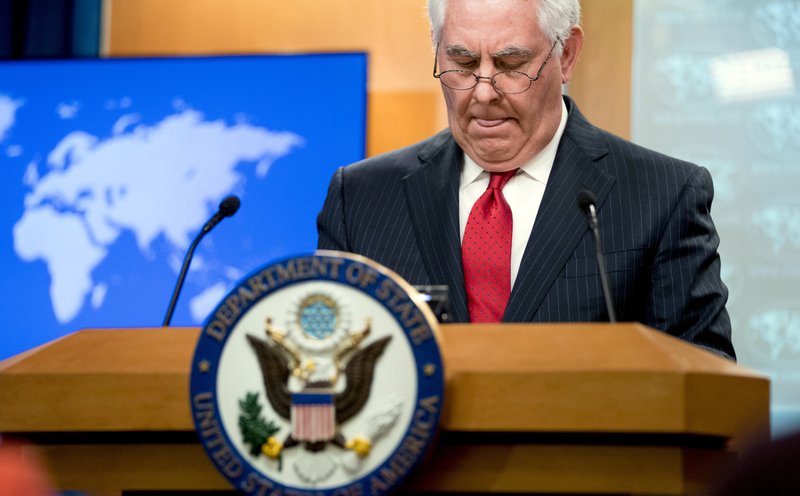
One Cabinet member was grilled by Congress about alleged misuse of taxpayer funds for private flights. Another faced an extraordinary revolt within his own department amid a swirling ethics scandal. A third has come under scrutiny for her failure to answer basic questions about her job in a nationally televised interview. And none of them was the one Trump fired. President Donald Trump’s Cabinet in recent weeks has been enveloped in a cloud of controversy, undermining the administration’s ability to advance its agenda and drawing the ire of a president increasingly willing to cast aside allies and go it alone. Trump’s ouster of Secretary of State Rex Tillerson on Tuesday may have just been the first salvo in a shakeup of a Cabinet that, with few exceptions, has been a team of rivals for bad headlines and largely sidelined by the White House. “Donald Trump is a lone-wolf president who doesn’t want to co-govern with anybody and doesn’t want anyone else getting the credit,” said presidential historian Douglas Brinkley of Rice University. “For his Cabinet, he brought in a bizarre strand of outsiders and right-wing ideologues. Many are famed conservative or wealthy business people, but that doesn’t mean you understand good governance.” The string of embarrassing headlines for Trump’s advisers, as well as the president’s growing distance from them, stands in sharp contrast to how he portrayed the group last year. “There are those that are saying it’s one of the finest group of people ever assembled as a Cabinet,” Trump said then. On Tuesday, the president hinted after firing Tillerson that more changes may be forthcoming, saying an ideal Cabinet is in the making. “I’ve gotten to know a lot of people very well over the last year,” Trump told reporters at the White House, “and I’m really at a point where we’re getting very close to having the Cabinet and other things that I want.” Even as Trump routinely convened Cabinet meetings in front of the cameras for “Dear Leader”-type tributes over the past year, his relationship with many of its members began to splinter. Last summer he began publicly bashing Attorney General Jeff Sessions, a former close adviser who was the first senator to back his campaign. Furious that the attorney general recused himself from the Russia probe that has loomed over the White House, Trump has privately mused about firing Sessions and taken to delivering unprecedented Twitter broadsides against him. Trump has used the words “beleaguered” and “disgraceful” to describe Sessions, who only recently stood up to the president and defended his recusal decision. Tillerson also frequently clashed with Trump, who never forgave the outgoing secretary of state for reportedly calling him “a moron” last summer after grumbling that the president had no grasp of foreign affairs. The pair never developed a particularly warm relationship. Last November, during a full day of meetings in Beijing, Trump and his senior staff were served plates of wilted Caesar salad as they gathered in a private room in the Great Hall of the People. None of the Americans moved to eat the unappetizing dish, but Trump prodded Tillerson to give it a try, according to a senior administration official. “Rex,” the president said, “eat the salad.” Tillerson declined, despite Trump’s urging. After repeatedly undermining and contradicting Tillerson, Trump at last fired his secretary of state in a tweet. Trump in recent days has told confidants that he feels emboldened. He’s proud of his unilateral decisions to impose sweeping tariffs on metal imports and to meet with North Korean dictator Kim Jong Un, and far less willing to put up with disloyalty around him, according to a person who has spoken to the president in recent days but was not authorized to discuss private conversations publicly. Trump’s esteem for the Cabinet has faded in recent months, according to two White House officials and two outside advisers. He also told confidants that he was in the midst of making changes to improve personnel and, according to one person who spoke with him, “get rid of the dead weight” — which could put a number of embattled Cabinet secretaries on notice. The officials all spoke on condition of anonymity to discuss internal matters. Interior Secretary Ryan Zinke underwent questioning Tuesday by Senate Democrats, who accused him of spending tens of thousands of dollars on office renovations and private flights while proposing deep cuts to conservation programs. Zinke pushed back, saying he “never took a private jet anywhere” — because all three flights he had taken on private planes as secretary were on aircraft with propellers, not jet engines. Veterans Affairs Secretary David Shulkin’s days on the job may be limited after a bruising internal report found ethics violations in connection with his trip to Europe with his wife last summer, according to senior administration officials. He also has faced a potential mutiny from his own staff: A political adviser installed by Trump at the Department of Veterans Affairs has openly mused to other VA staff about ousting the former Obama administration official. Trump has floated the notion of moving Energy Secretary Rick Perry to the VA to right the ship, believing Shulkin has become a distraction, according to two people familiar with White House discussions. They were not authorized to discuss internal deliberations and spoke on condition of anonymity. Others under the microscope: —White House aides deemed Education Secretary Betsy DeVos’ recent appearance on “60 Minutes” a disaster as she struggled to defend the administration’s school safety plan and could not answer basic questions about the nation’s education system. —Housing and Urban Development Secretary Ben Carson came under fire last month after reports his agency was spending $31,000 for a new dining set, a purchase HUD officials said was made without Carson’s knowledge. —Environmental Protection Agency Administrator Scott Pruitt has faced questions about $25,000 spent on a soundproof “privacy booth” inside his office to prevent eavesdropping on his phone calls and another $9,000 on biometric locks. —The first Cabinet member to
Betsy DeVos touts school choice, STEM as education priorities
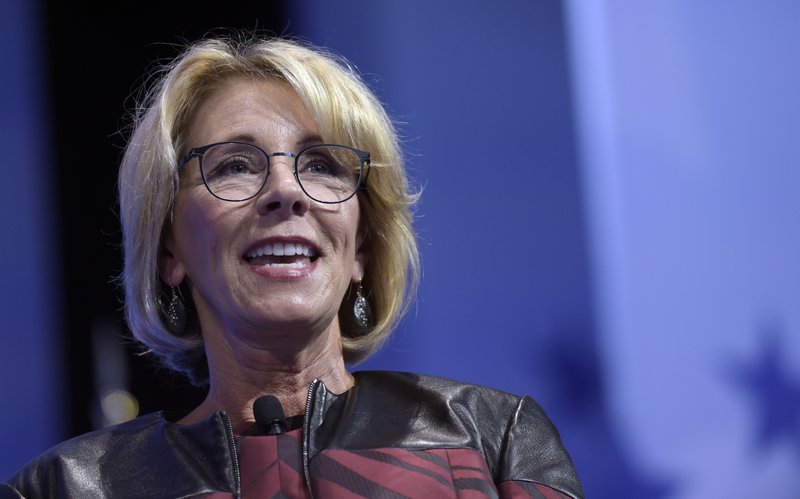
Education Secretary Betsy DeVos has put forth a new set of priorities for states, schools and universities competing for federal grant money. The priorities include school choice, science and technology, special education and school safety. The Education Department awards approximately $4 billion per year in new and continuation competitive grants across some 80 programs, the agency said Thursday. Education secretaries have historically used these competitions to push their priorities. “It’s a little nudge,” said Chad Aldeman, an associate partner at Bellwether Education Partners. “This allows the department to nudge the education field toward these priorities.” There are a total of 11 priorities on DeVos’ list. After receiving public comments on these proposals, the agency will settle on one or several of them. Promoting school choice has been a key focus of the Trump administration. School choice refers to providing parents and their children with options besides their district public school, such as charter schools, vouchers or education savings accounts to attend private schools. DeVos and her supporters say these options better serve students’ individual needs and can benefit children whose local schools are underperforming. Critics say charter and private schools don’t necessarily outperform neighborhood schools and they lack accountability mechanisms. Sen. Patty Murray of Washington, the top Democrat on the Senate committee devoted to education, criticized DeVos’ priorities as a way to privatize education and said the department should be focusing on supporting local, public education. “Since her confirmation hearing, I have voiced concern that Secretary DeVos would abuse her position to prioritize privatization, and that’s exactly what we’re seeing,” Murray said. “Instead of listening to the millions of students, parents and teachers who stood up against her extreme ideological agenda, her proposal will allow her to prioritize applicants that would siphon taxpayer funds away from the public schools that serve the vast majority of students.” Republished with permission from the Associated Press.
Bradley Byrne to host Secretary of Education Betsy DeVos in Mobile
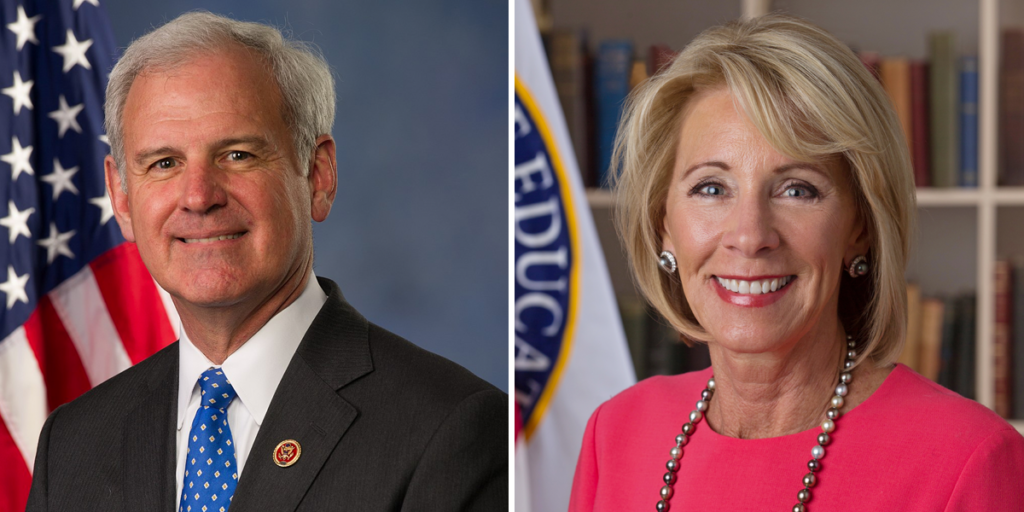
U.S. Secretary of Education Betsy DeVos is making a visit to Mobile, Ala. to visit educational institutions in the area, according to the office of Alabama 1st District U.S. Rep. Bradley Byrne. Byrne announced DeVos will spent a large part of Thursday, August 31, learning more about the range of education opportunities in Southwest Alabama. During her time in Mobile, DeVos will visit ACCEL Day and Evening Academy, Alabama’s first tuition-free public charter school; the AIDT Maritime Training Center, which helps train workers for Austal USA and other shipbuilding jobs; and Council Traditional School, a kindergarten through 5th grade school in the Mobile County School System. DeVos’ Mobile itinerary is as follows: ACCEL Day and Evening Academy: 9:30 a.m. CT Tour of AIDT Maritime Training Center: 11:00 a.m. CT Council Traditional School: 1:15 p.m. CT
Donald Trump returns to Arizona – and a chaotic political landscape
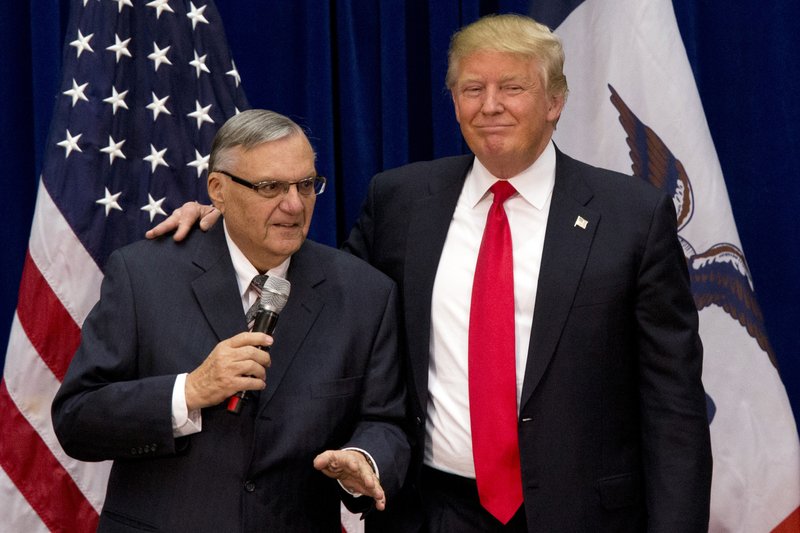
Donald Trump was just a few weeks into his candidacy in 2015 when he came to Phoenix for a speech that ended up being a bigger moment in his campaign than most people realized at the time. Trump savaged his critics and the media, vowed to fine Mexico $100,000 for each immigrant entering the country illegally, talked tough on trade, promised to return America to its winning ways and borrowed a line from Richard Nixon in declaring, “The silent majority is back.” The packed crowd ate it up — the raucous enthusiasm an early sign of the overwhelming support among Trump’s base that would help carry him to the presidency. As Trump returns to Arizona Tuesday in need of another big moment, he will find a place where his agenda and unconventional leadership style have consumed the political landscape and elevated the state’s status in the national fight for control of power in Washington in 2018. It was Arizona senator John McCain who cast the vote that derailed Trump’s effort to repeal the health care law. The other Arizona senator, Jeff Flake, has become the poster child for Republicans who buck the president’s agenda and feel his wrath on Twitter. The president is almost certain to back a GOP challenger to Flake in 2018, complicating Republican efforts to maintain control of the Senate. Trump has also revived the immigration debate and infuriated Latinos here with his talk of pardoning former Sheriff Joe Arpaio over his recent conviction for breaking the law with his signature immigration patrols. The controversy over Civil War monuments has even spilled into Arizona, where the governor has faced repeated calls to take down a handful of Confederate memorials in the state. And an overlooked item in Trump’s agenda, school choice, has made education a hot campaign issue in Arizona. With the strong support of Education Secretary Besty DeVos, Arizona passed the nation’s most ambitious expansion of vouchers this year, and public-school advocates recently submitted more than 100,000 signatures in a petition drive to get the law wiped out on the 2018 ballot. If that isn’t enough fuel for a political bonfire, Trump’s visit to Arizona will be his first political event since the race-driven violence in Virginia and his divisive comments in the aftermath of the protests. That created a dilemma for Republicans like Gov. Doug Ducey on whether to take the stage at the Trump rally while running for re-election. Doing so would subject him to attacks from moderates and the left by appearing with the president so soon after Charlottesville and possibly at the same time as the president pardons Arpaio and throws his endorsement behind Flake’s challenger. But avoiding the stage could hurt him with the base. Ducey’s plan is to greet the president on the airport tarmac and skip the rally, saying he wants to oversee the law enforcement response to protests. The governor supported Trump and appeared on stage at one of his rallies last year in Arizona. Trump would be hard-pressed to find a state where his Republican base is as faithful and vocal as in Arizona, which is a big reason why he came to the state seven times during his campaign and refers to the “special place” it holds for him. The fierce, non-conformist political spirit evident at Trump rallies here traces its roots to the frontier days and allows hard-fisted politicians like him and Arpaio to thrive. “The Republican primary base in Arizona is highly partisan, semi-libertarian in the sense that it’s against the swamp,” said longtime Republican political strategist Chuck Coughlin. “We’re the 48th state to join. We’re still acting like a juvenile. We still act like we’re the last one invited to the party which is sort of what Donald Trump is.” The biggest consequence of Trump’s unorthodox governing style may be seen in Flake’s re-election effort. Flake has been outspoken in his criticism of Trump, taking him to task in pointed jabs in a recent book. Trump has been sending out Tweets signaling his support for far-right former state Sen. Kelli Ward, who is running against Flake in the primary. Other Republicans with less baggage than Ward could also enter the race and complicate things further, making it harder for Republicans to keep the seat in the general election. Rep. Kyrsten Sinema is considered the top threat on the Democratic side. “If the president himself is supporting a challenger to Jeff, it’s a serious problem,” said Coughlin, who has been polling voters about the intraparty turmoil that has unsettled the race. Voters like Julie Brown are indicative of the GOP struggle in the Trump administration between the base and establishment. She attended a Trump rally last year and remains steadfast in her support of the president, even after Charlottesville. “He’s not totally polished and everyone tears apart his words, but you’ll never have to guess what he’s thinking and I like that much better than a politician who just gets up there and buoyantly lies and is bought by lobbyists,” Brown said. “He’s just straightforward, and like I said, it rocks the boat but we need it.” Republished with permission of The Associated Press.
Betsy DeVos undeterred by critics even as agenda remains stalled
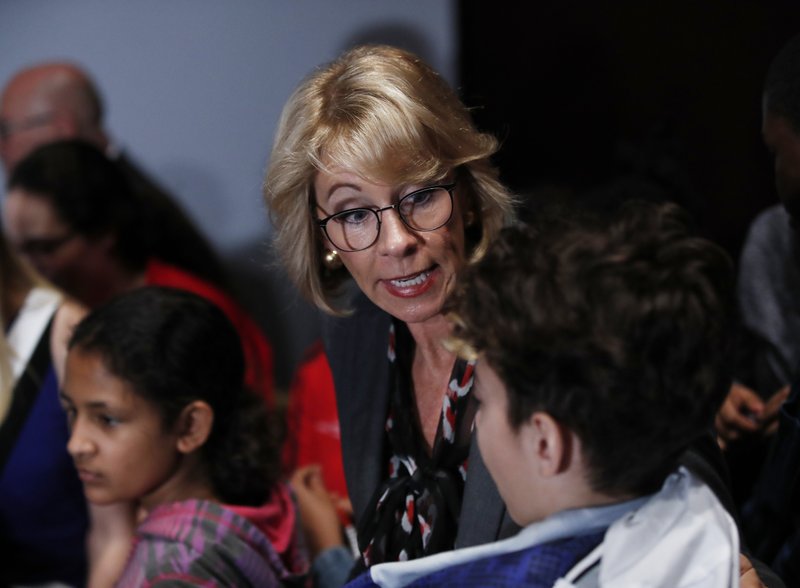
Among the paintings and photographs that decorate Education Secretary Betsy DeVos‘ sunlit, spacious office is the framed roll call from her Senate confirmation. It’s a stark reminder of the bruising process that spurred angry protests, some ridicule and required the vice president’s tie-breaking “yes” vote. Six months on the job, DeVos is no less divisive. Critics see her as hostile to public education and indifferent to civil rights, citing her impassioned push for school choice and her signing off on the repeal of some protections for LGBT students. Conservatives wish she had been less polarizing and more effective in promoting her agenda, noting that the department’s budget requests are stalled in Congress and no tangible school choice plan has emerged. DeVos is undeterred. “We have seen decades of top-down mandated approaches that protect a system at the expense of individual students,” DeVos told The Associated Press. “I am for individual students. I want each of them to have an opportunity to go to a school that works for them.” In her first comprehensive sit-down interview with a national media outlet since taking office, DeVos touched on some of the most pressing issues in K-12 and higher education. She said Washington has a role to “set a tone” and encourage states to adopt choice programs without enacting “a big new federal program that’s going to require a lot of administration.” At the same time, she confirmed that a federal tax-credit voucher program was under consideration as part of a tax overhaul. “It’s certainly part of our discussion,” DeVos said. DeVos, 59, appeared confident, but reserved during the 30-minute interview last week in her office, where photographs of her children and grandchildren and drawings and letters from young students are prominent. Large windows overlook the Capitol. Across the street, visitors lined up outside the National Air and Space Museum, which DeVos toured this year with Ivanka Trump to promote science and engineering among girls. DeVos defended her decision to rewrite Obama-era rules intended to protect students against being deceived by vocational nondegree programs, saying that “the last administration really stepped much more heavily into areas that it should not.” Liberals accuse DeVos of looking out for the interests of for-profit schools, and they point to Trump University, the president’s for-profit school that was sued for fraud. Supporters say the Obama regulations unfairly targeted for-profits and failed to track students’ long-term careers. The decision by the departments of Education and Justice to roll back rules allowing transgender students to use school restrooms of their choice enraged civil rights advocates, who said already vulnerable children could face even more harassment and bullying. Conservatives saw DeVos fulfilling a promise to return control over education issues to states, cities, school districts and parents. “We really believe that states are the best laboratories of democracy on many fronts,” DeVos said. On the issue of school choice, DeVos was resolute. Another major flashpoint: charter schools, which are publicly funded but usually independently operated, and voucher programs that help families cover tuition at private schools. They’re often criticized for a lack of transparency, and studies about their effectiveness have produced mixed results. DeVos disagrees. “I think the first line of accountability is frankly with the parents,” she said. “When parents are choosing school they are proactively making that choice.” For DeVos, who spent more than two decades promoting charter schools in her home state of Michigan, the closure of some low-performing charters was evidence of accountability. “At the same time, there have been zero traditional public schools closed in Michigan for performance and I think that’s a problem,” she said. DeVos got off to a rocky start in the Trump Cabinet. She was satirized for some of her gaffes during the confirmation hearing, such as saying that guns are needed in schools to protect students from grizzly bears. Teacher unions accused her of seeking to privatize public education. Parents and teachers jammed Congress phone lines to oppose her nomination. It took Vice President Mike Pence‘s historic vote – the first by a vice president to break a 50-50 tie on a Cabinet nomination – to secure her position after two Republican senators defected. DeVos is still sometimes met with protesters at public events, and her security detail has been bolstered at an additional cost of $7.8 million. But DeVos isn’t retreating. She actively advocates for school choice, once comparing education to ride-sharing services such as Uber and Lyft, and saying that parents, like riders, need options. Of the 17 K-12 schools that she has visited so far, only seven were traditional public schools. DeVos didn’t attend public school herself or send her children to a public school. Randi Weingarten, president of the American Federation of Teachers, said in a recent speech that DeVos was a “public school denier” and quipped that DeVos can start talking about school choice even in reply to a simple greeting. Conservatives say she may have oversold. “She has made things harder for herself by acting as the secretary for school choice instead of the secretary of education,” said Mike Petrilli, president of the conservative Thomas B. Fordham Institute. “She has missed the opportunity to make it clear that she wants to see all schools succeed.” Moderates are upset. “I have feared that in trying to rush in with a simplified notion of choice – that she will love charters to death,” said Robin Lake, director of the Center on Reinventing Public Education, a pro-charter group. “At this point, six months in, I don’t see any evidence that we are farther along on helping with achievement, equity, with moving the country forward.” Asked to name some of the strengths of public schools that she has observed in her job, DeVos said only that she is “a very strong supporter of public schools.” “But we also need to encourage schools, public schools that are doing a great job to not rest on their laurels but to continue to improve because unless you’re constantly oriented around
Mary Scott Hunter to Betsy DeVos: Keep your promises to the states
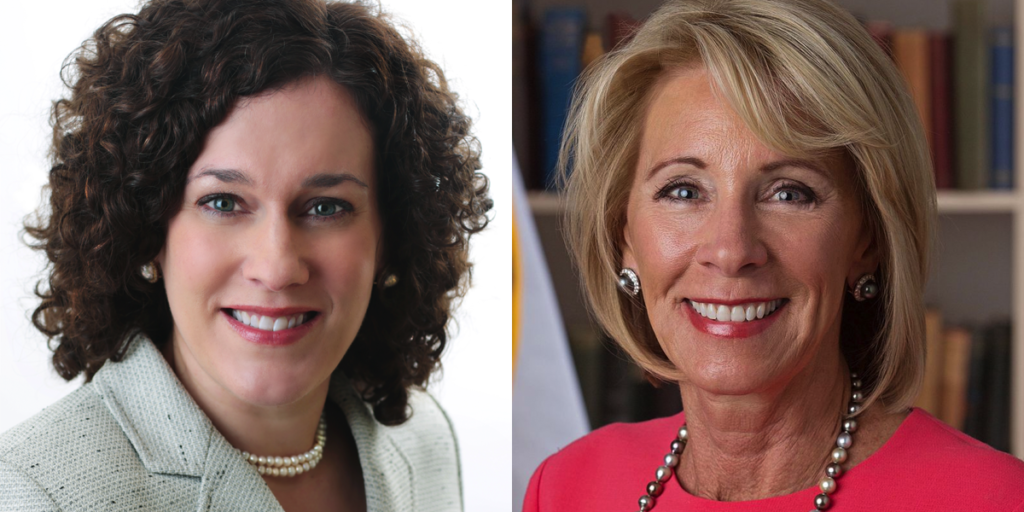
Despite being one of President Donald Trump‘s most controversial nominees, U.S. Department of Education Secretary Betsy DeVos had the “qualified” support of Alabama State Board of Education member Mary Scott Hunter from the jump. Now Hunter is putting her support of DeVos to the test. On Friday, she sent a letter to DeVos asking for standardized testing flexibility as the state seeks to drop the ACT Aspire test for its students in favor of alternative tests. Earlier this year, the DeVos called for states and local school districts to have greater say in education standards and issues, citing the Every Student Succeeds Act (ESSA) as the way to allow more local control. However, when Sentenace followed the ESSA approval process and submitted the state’s education plans to the federal government, the U.S. Department of Education rejected it. But Hunter is not taking “no” for an answer. Earlier this month, Alabama Superintendent of Education Michael Sentance requested flexibility from using ACT Aspire testing while we develop an Alabama test that is right for us. Over the last several years we have worked hard to implement rigorous standards that will best prepare our children and youths for living and working in the 21st century. We have shaped these standards with Alabama’s values in mind while keeping our eyes on what today’s students will need to thrive in the decades to come. At this point our best option is to receive a waiver for next year’s standardized test,” the letter continued. “This would allow us time to develop a test that aligns to our Alabama standards, is rigorous, and properly informs instruction. Alternately, we could use existing formative assessments to determine student growth. If your Department does not grant the waiver there is a strong likelihood we will administer three different summative tests in three years, Aspire this past year, a different test next year, and yet another test the year after next. Obviously this is very undesirable for both our students and teachers. Standardized testing is extraordinarily difficult. Getting it right has implications for Alabama for decades to come. We need time to do that. At the time of publishing, the U.S. Department of Education has yet to grant a waiver to Alabama. Read Hunter’s full letter below:
Betsy DeVos pushes for ‘most ambitious expansion’ of school choice, but offers few details
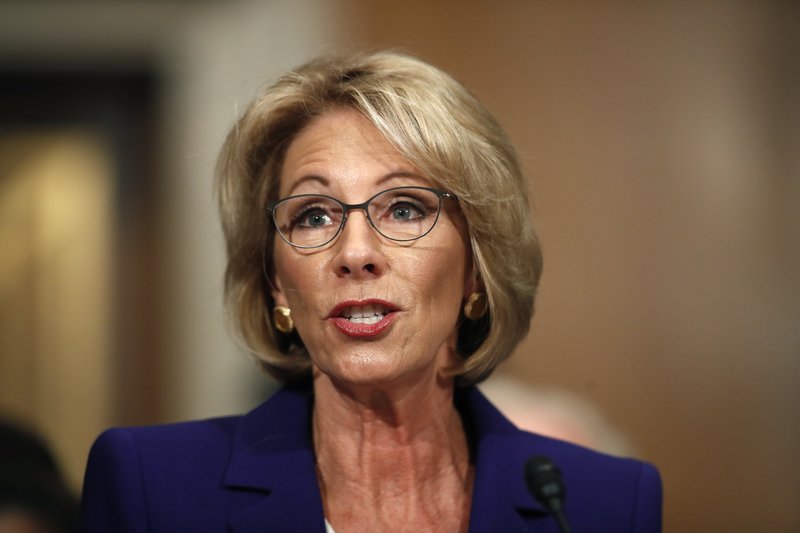
The Trump administration is proposing “the most ambitious expansion” of school choice in American history, Education Secretary Betsy DeVos announced Monday while giving few details on how the program would work. “We must offer the widest number of quality options to every family and every child,” DeVos said in a speech in Indianapolis. “We stand on the verge of the most significant opportunity we have ever had to drag American education out of the Stone Age and into the future.” DeVos gave few specifics other than to say that the state of Indiana could serve as a model. Indiana has one of America’s largest and fastest-growing school voucher programs to give low-income families scholarships to help pay private school tuition. DeVos insisted that decisions on school choice must be left for states, not the federal government, to make. But she also warned states against boycotting reform. “If a state doesn’t want to participate, that would be a terrible mistake on their part. They will be hurting the children and families who can least afford it,” DeVos said at an event hosted by the American Federation for Children, the school choice advocacy group she used to lead. “If politicians in a state block education choice, it means those politicians do not support equal opportunity for all kids.” Earlier this month, President Donald Trump asked Congress to work with him on expanding charter and private school voucher programs nationwide, but he gave no specifics. School choice advocates are divided over whether to push charter schools and vouchers on the federal or state level. Voucher and charter school programs are facing fierce criticism from teachers unions and many Democrats, who believe they drain resources from already underfunded public schools while failing to produce clear academic gains. “Once again, Secretary DeVos is putting her extreme privatization agenda ahead of our students,” said Washington Sen. Patty Murray, the top Democrat on the Senate Health, Education, Labor and Pensions Committee. “DeVos claims she wants to provide more choices for students and families, but in reality, voucher programs siphon taxpayer funds from public schools to unaccountable private and religious schools that often leave children worse off.” Republished with permission of The Associated Press.
Senate confirms Alex Acosta as Donald Trump’s secretary of labor
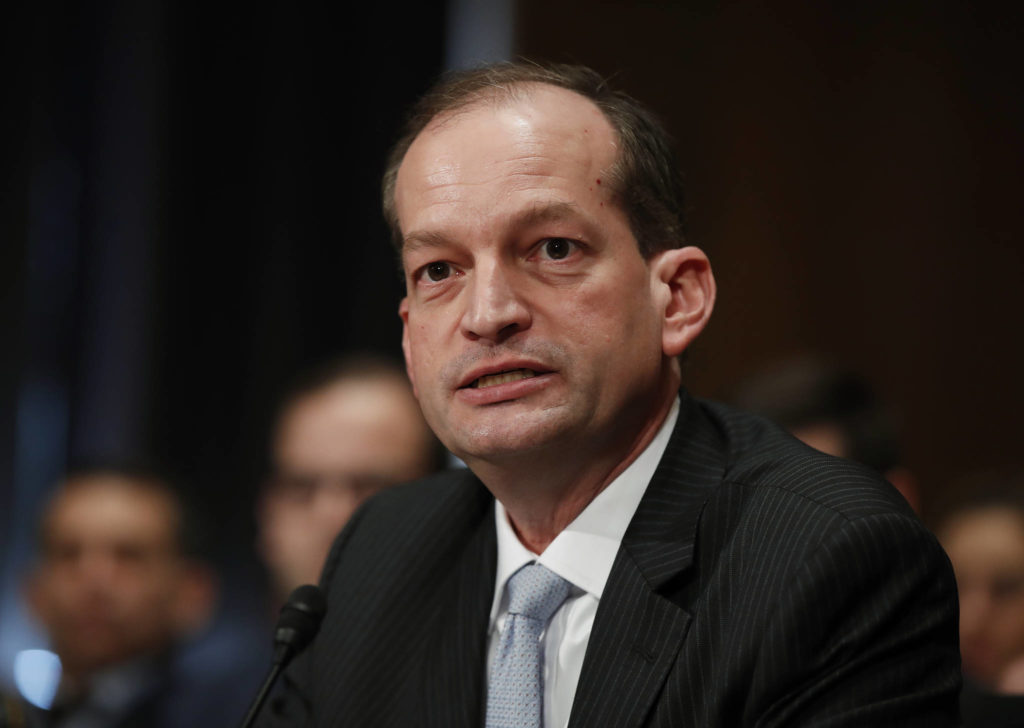
The Senate on Thursday confirmed Alex Acosta as Labor secretary, filling out President Donald Trump‘s Cabinet as he approaches his 100th day in office. The 60-38 vote confirms Acosta to the post. Once sworn as the nation’s 27th Labor secretary, the son of Cuban immigrants will lead a sprawling agency that enforces more than 180 federal laws covering about 10 million employers and 125 million workers. Sen. Tim Scott, R-S.C., spoke for many Republicans with a statement issued just after the vote saying he hopes Acosta’s focus will be “promoting labor policies that are free of unnecessarily burdensome federal regulations.” Scott said he wants Acosta to permanently revoke rules governing financial advisers and adding Americans eligible for overtime pay. Democrats said any Labor secretary should advocate for the American workers to whom Trump promised so much during his upstart presidential campaign. They said Acosta has given no such commitment. “Acosta failed this basic test,” tweeted Sen. Elizabeth Warren, D-Mass. Acosta has been a federal prosecutor, a civil rights chief at the Justice Department and a member of the National Labor Relations Board. He will arrive at the top post with relatively little clear record on some of the top issues facing the administration over key pocketbook issues, such as whether to expand the pool of American workers eligible for overtime pay. Acosta wasn’t Trump’s first choice for the job. Former fast food CEO Andrew Puzder withdrew his name from consideration last month, on the eve of his confirmation vote, after becoming a political headache for the new administration. Puzder acknowledged having hired a housekeeper not authorized to work in the U.S. and paying the related taxes years later — after Trump nominated him — and came under fire from Democrats for other issues related to his company and his private life. Acosta’s ascension would come at a key moment for Trump, just two days before he reaches the symbolic, 100-day marker. The White House has sought to cross the threshold with its own list of Trump’s accomplishments. Trump can say the Acosta vote was bipartisan, because eight Democrats and one independent voted yes. Joining the Republicans in his favor were Democratic Sens. Catherine Cortez Masto of Nevada, Heidi Heitkamp of North Dakota, Joe Manchin of West Virginia, Claire McCaskill of Missouri, Bob Menendez of New Jersey, Bill Nelson of Florida, Jon Tester of Montana and Mark Warner of Virginia. Independent Sen. Angus King of Maine also voted for Acosta. Labor secretary is the last Cabinet post for Trump to fill. Trump’s choice for U.S. trade representative, a job considered Cabinet-level, is awaiting a Senate vote. From the beginning, Acosta’s was a quiet march to confirmation that stood out because it didn’t attract the deep partisan battles faced by some of Trump’s other nominees, including Education Secretary Betsy DeVos and Secretary of State Rex Tillerson. Justice Neil Gorsuch‘s nomination provoked such a fight that majority Senate Republicans used the “nuclear option” to remove the 60-vote filibuster barrier for Supreme Court picks. Thursday’s vote marks the fourth time Acosta has been confirmed for the Senate. Democrats and most labor groups were mostly muted in their response to Acosta’s nomination. At his confirmation hearing, Democratic Sens. Patty Murray of Washington and Warren hammered Acosta for answers on a selection of issues important to labor and whether Acosta would cave to political pressure from Trump. Acosta refused to answer the policy questions until he’s confirmed, and he vowed to be an independent and fair voice for workers. Both senators said they had great concerns, and both voted no. Our standard can’t be ‘not Puzder,’” Murray said Wednesday on the Senate floor. But tellingly, even as Acosta’s nomination wound through the Senate, Democrats and their allies also tried to move on to other, labor-related issues — namely, a minimum wage hike to $15 an hour, which Trump opposes. Meanwhile, the Labor Department’s online landing page bears a glimpse of Acosta’s policy priorities: “Buy American, Hire American.” That’s the title of Trump’s executive order this week directing the secretaries of labor and other agencies to issue guidance within 60 days on policies that would “ensure that, to the extent permitted by law” federal aid “maximize the use of materials produced in the United States, including manufactured products; components of manufactured products; and materials such as steel, iron, aluminum, and cement.” Republished with permission of The Associated Press.
Betsy DeVos faults predecessor for wasting money on school reform
Education Secretary Betsy DeVos says her predecessor wasted billions of dollars trying to fix traditional public schools. DeVos says former Education Secretary Arne Duncan‘s signature $7 billion project targeting failing schools did not produce significant results. Therefore, she says, it is vital to give American parents the options of charter, private and other schools. She asked, “At what point do we accept the fact that throwing money at the problem isn’t the solution?” DeVos spoke Wednesday at the Brookings Institution. Asked whether school choice options also can fail, DeVos said, “I am not sure that we can deteriorate a whole lot.” During the Obama administration, high school graduation rates reached record levels but scores on standardized tests showed mixed results. Republished with permission of The Associated Press.
