
Mike Pence’s critical role: Donald Trump’s emissary to evangelicals
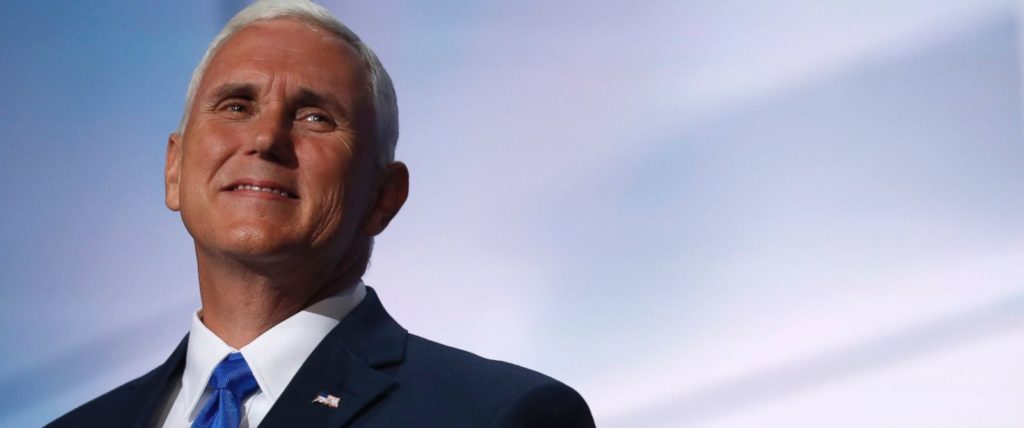
Mike Pence musters all of his Midwestern earnestness as he describes Donald Trump as “a man of faith.” He says the Republican nominee is “a man I’ve prayed with and gotten to know on a personal level.” The description, in an interview with The Associated Press, stands in sharp relief to Trump’s public profile over much of his career: a twice-divorced former playboy who has boasted of his sexual exploits, flaunted his wealth, used crass insults and made sweeping generalizations about whole races. Getting tens of millions of white evangelicals to accept Pence’s portrait of Trump is critical to Republican hopes for capturing the White House. It’s not a question of whether Trump will win more of the white evangelical vote than rival Hillary Clinton. He will. But Trump needs to win that vote by overwhelming margins and with a high turnout. Slight changes in loyalty could decide the outcomes in critical states including North Carolina, Florida, Ohio, Pennsylvania and Virginia. So Pence, the vice presidential nominee, is on a mission across America’s Bible Belt to persuade evangelicals to put their faith in Trump. Raised Catholic but now a protestant evangelical, Pence is the ideal emissary. While Trump has wavered on abortion and same-sex marriage, Pence’s conservative credentials are impeccable. And while Trump has been shaky on religion, Pence’s evangelical beliefs and political persona are deeply intertwined. His signature line: “I’m a Christian, a conservative and a Republican – in that order.” Pence’s language and mannerism are familiar to Christians who call themselves “born again.” The Indiana governor quotes Biblical passages freely and was at ease telling Colorado pastors last week of his college conversion, recalling that he was “overwhelmed with gratitude” that “Jesus had died for all the sins of the world, (and) somewhere in there he died for me.” Republicans hope that gives him credibility as Pence insists Trump is a “good man who will make a great president.” “Evangelicals have to be convinced that you’re at least a good person, even if you aren’t all-in on the lifestyle,” says Tim O’Donnell, a 64-year-old independent in Colorado Springs, Colorado, who came to hear Pence at a recent round-table with church leaders. O’Donnell said he remains unsure about whether can vote for Trump. Most evangelicals, he explained, “aren’t going to vote for Hillary,” but some “just aren’t comfortable voting for Trump either.” White evangelicals cast about a quarter of 2012 ballots. Nearly 8 in 10 of them voted for Republican Mitt Romney over President Barack Obama. A recent AP-Gfk poll showed Trump garnering about 7 in 10 white evangelicals, with the rest split between Clinton and Libertarian Gary Johnson. Trump has attempted some outreach to black evangelicals, an overwhelmingly Democratic group, as well. Trump aides point to their candidate’s strong showing among white evangelicals on his way to the Republican nomination. Trump has backing from many evangelical leaders, including Jerry Falwell Jr., president of Liberty University, the nation’s most high-profile evangelical college. But the Republican nominee has been criticized by others. Some Southern Baptist Convention leaders dislike his opposition to admitting Syrian refugees to the United States. And Pence’s schedule, heavy in recent weeks with visits to churches and social conservative groups, suggests the Trump campaign knows it has work to do. Trump and Pence emphasize the policy promises Republicans typically offer white evangelicals: Supreme Court justices and other federal judges who oppose same-sex marriage and abortion rights, an expansion of “school choice,” and unyielding support for Israel in the Middle East. Trump has added a new incentive, pledging to strike down a federal prohibition on churches engaging in explicit political activity. Trump is a Presbyterian who says he “loves my church” and tells of being influenced by the famous pastor and author Norman Vincent Peale. But he raised eyebrows last year at an Iowa forum year when he said he’d never explicitly sought God’s forgiveness. He’ll only occasionally read scriptural passage from notes – and in January, drew mockery for reading from “Two Corinthians,” rather than “Second Corinthians.” Pence says the distinctions are merely stylistic. “I think it’s fairly obvious to people that we express ourselves differently,” Pence told AP. “Our experiences are different. But I think we come from the same place.” Pence said he believes “people hear (Trump’s) sincerity” and “his commitment to the causes they cherish,” and that will be enough. The Rev. Mark Harris of Charlotte, North Carolina’s First Baptist Church says Pence’s consistency should give evangelicals confidence. Harris, who previously supported Mike Huckabee and then Texas Sen. Ted Cruz before backing Trump, adds another factor: preventing a Clinton victory. “We wish we had somebody that checked all the boxes, who fits the profile,” Harris said. He said evangelicals would like to see someone who can get something done, “even if he “isn’t the greatest spiritual leader.” Still, that hasn’t convinced Michael Farris, a leading national advocate of the home-schooling movement and a Trump critic. Farris welcomed Pence recently to the Home School Legal Defense Association’s national convention in North Carolina. Pence told AP he privately made his case to Farris. But afterward, Farris reaffirmed on his Facebook page that he won’t endorse Trump. Following the presidential debate Monday, Farris ratcheted up his argument. Trump, he posted, “should step aside and let Mike Pence take on Hillary.” Republished with permission of The Associated Press.
Influence of churches, once dominant, now waning in South

Prayers said and the closing hymn sung, tea-drinking churchgoers fill Marble City Grill for Sunday lunch. But hard on their heels comes the afternoon crowd: craft beer-drinking, NFL-watching football fans. Such a scene would have been impossible just months ago because Sunday alcohol sales were long illegal in Sylacauga, hometown of both the actor who played TV’s Gomer Pyle and the white marble used to construct the U.S. Supreme Court building. While the central Alabama city of 12,700 has only one hospital, four public schools and 21 red lights, the chamber of commerce directory lists 78 churches. Yet few were surprised when residents voted overwhelmingly in September to legalize Sunday alcohol sales. Churches lacked either the heart or influence to stop it. That shift is part of a broad pattern across the South: Churches are losing their grip on a region where they could long set community standards with a pulpit-pounding sermon or, more subtly, a sideward glance toward someone walking into a liquor store. In metro Atlanta, youth sports teams regularly practice and play games on Sunday mornings and Wednesday nights — times that were strictly off-limits a generation ago because they conflicted with church worship services. In Mississippi, dozens of businesses display anti-discrimination stickers distributed by a gay rights group rather than worry about a church-based backlash. “It doesn’t matter who wants to buy a house,” said real estate agent Diana Britt, who drives around Jackson, Mississippi, in a work vehicle decorated with one of the stickers. “If they want to buy a house, I’ll sell them a house.” Church-based crusaders against gambling also are on a losing streak as all but two Southern states, Alabama and Mississippi, have lotteries. And, perhaps most tellingly, a recent survey by the Pew Research Center showed 19 percent of Southerners don’t identify with any organized religion. That’s fewer “nones” than in other regions, but the number is up 6 percentage points in the South since 2007. The South is still the Bible Belt, and that same Pew survey found that church affiliation remains stronger in the states of the old Confederacy than anywhere else in the United States. Seventy-six percent of Southerners call themselves Christians, and political advertisements often show candidates in or near church. Religious conservatives remain a powerful force in many Southern statehouses. Still, the same South that often holds itself apart from the rest of the country is becoming more like other U.S. regions when it comes to organized religion, said Jessica Martinez, a senior researcher in religion and public life at Pew. And while race divides many things in the South, the trend is evident among blacks, whites and Hispanic adults, she said. “We’ve seen this sort of broader shift throughout the country as a whole with fewer people identifying as being part of the religious base,” she said. “In the South you see a pattern very similar to what we are seeing in other regions.” Thomas Fuller, a religion professor at Baptist-affiliated Samford University near Birmingham, said there’s no single reason churches are losing the cultural wallop they once packed. Migration into the region and the Internet are but two factors chipping away at a society that seemed much more isolated just a generation ago, he said. “The South is not nearly as homogeneous, is far more diverse culturally now than it’s ever been,” said Fuller. “In a way you’re a little hard-pressed now to talk about Southern culture in a singular fashion. It’s not nearly as one-dimensional anymore or easy to describe.” In Sylacauga, 45 miles southeast of Birmingham, Mayor Doug Murphree said the push for Sunday alcohol sales was linked to attracting new businesses. “We’re not really trying to promote drinking in Sylacauga. But if you look at a big chain restaurant like Ruby Tuesday or O’Charley’s, they’re open on Sunday and a big part of their business is alcohol,” said the mayor. Murphree, who attends a Baptist church, said he met with members of the local ministerial association before the citywide vote to explain the city’s economic situation and the need for Sunday alcohol sales. Pastors listened, and by and large they didn’t preach against it. “They said they were not going to try to block us,” he said. So now, Marble City Grill can sell alcohol after 1 p.m. on Sunday just two blocks up North Broadway Avenue from the white-columned First Baptist Church of Sylacauga. “Things have changed,” said Julie Smith, who owns the restaurant with her husband. “We’ve been open 10 years and at first we had people who wouldn’t come because we sold alcohol. They come now.” Around corner from the restaurant, Dee Walker said he’s attracting a larger crowd every Sunday afternoon at his craft beer and wine shop, The Fermenter’s Market at The Rex, named for the old hotel in which it is located. Walker grew up in neighboring Clay County, the last dry county in Alabama, and recalls the petition drives and fire-and-brimstone sermons anytime someone mentioned legalizing alcohol sales. Southern churches no longer have that kind of influence in many places, Walker said. “You’ve got some diminishing populations when it comes to the religious opposition,” said Walker, standing behind a bar with 36 taps for craft beer. Walker said his customers include church deacons and elders; a Baptist layman quoted Scripture while drinking a hoppy brown ale on a recent weekday afternoon. Joe Godfrey, a Southern Baptist minister and head of a group that calls itself “Alabama’s Moral Compass,” recalls a time when churches were the center of Southern society. “I can remember when schools looking to schedule an event would call the local churches to see if they had anything … that might conflict with the school’s tentative plans. If so, the school would find a different date to hold their event. That is no longer true,” said Godfrey, executive director of Alabama Citizens Action Program. “Today, churches try to find a time to schedule their events when ball teams, schools and civic clubs
