
Unexpected deal would boost Biden Administration pledge on climate change

An unexpected deal reached by Senate Democrats would be the most ambitious action ever taken by the United States to address global warming and could help President Joe Biden come close to meeting his pledge to cut greenhouse gas emissions in half by 2030, experts said Thursday, as they sifted through a massive bill that revives action on climate change weeks after the legislation appeared dead. The deal would spend nearly $370 billion over ten years to boost electric vehicles, jump-start renewable energy such as solar and wind power, and develop alternative energy sources like hydrogen. The deal stunned lawmakers and activists who had given up hope that legislation could be enacted after West Virginia Sen. Joe Manchin said he could not support the measure because of inflation concerns. While analysts were still studying the 725-page bill, the deal announced late Wednesday includes a long-term extension of clean energy tax credits that “could plausibly put the U.S. on track to reduce emissions by 40% in 2030,″ said Ben King, associate director of the Rhodium Group, an independent research firm. Additional action by the Biden administration and Democratic-controlled states could “help close the rest of the gap to the target of a 50-52% cut in emissions by 2030,″ King said. But approval of the bill is far from certain in a 50-50 Senate, where support from every Democrat will be needed to overcome unanimous Republican opposition. Sen. Kyrsten Sinema, D-Ariz., who forced changes in earlier versions of the plan, declined to reveal her stance Thursday. In the narrowly divided House, Democrats can lose no more than four votes and prevail on a possible party-line vote. Still, Biden called the bill “historic” and urged quick passage. “We will improve our energy security and tackle the climate crisis — by providing tax credits and investments for energy projects,″ he said in a statement, adding that the bill “will create thousands of new jobs and help lower energy costs in the future.″ Environmental groups and Democrats also hailed the legislation. “This is an 11th-hour reprieve for climate action and clean energy jobs, and America’s biggest legislative moment for climate and energy policy,″ said Heather Zichal, CEO of America’s Clean Power, a clean energy group. “Passing this bill sends a message to the world that America is leading on climate and sends a message at home that we will create more great jobs for Americans in this industry,″ added Zichal, a former energy adviser to President Barack Obama. Tiernan Sittenfeld, senior vice president of the League of Conservation Voters, summed up her reaction in a single word: “Wow!” Sen. Tina Smith, D-Minn., tweeted that she was “stunned, but in a good way.″ Manchin, who chairs the Senate energy panel, insisted that he had not changed his mind after he told Senate Majority Leader Chuck Schumer two weeks ago that he could not support the bill because of inflation concerns. “There should be no surprises. I’ve never walked away from anything in my life,″ he told reporters on a Zoom call from West Virginia, where he is recovering from COVID-19. Manchin called the bill an opportunity “to really give us an energy policy with security that we need for our nation” while also driving down inflation and high gasoline prices. The bill, which Manchin dubbed the “Inflation Reduction Act of 2022,” includes $300 billion for deficit reduction, as well as measures to lower prescription drug prices and extend subsidies to help Americans who buy health insurance on their own. Besides investments in renewable energy like wind and solar power, the bill includes incentives for consumers to buy energy-efficient appliances such as heat pumps and water heaters, electric vehicles, and rooftop solar panels. The bill creates a $4,000 tax credit for purchases of used electric vehicles and up to $7,500 for new EVs. The tax credit includes income limits for buyers and caps on sticker prices of new EVs — $80,000 for pickups, SUVs, and vans and $55,000 for smaller vehicles. A $25,000 limit would be set on used vehicles. Even with the restrictions, the credits should help stimulate already rising electric vehicle sales, said Jessica Caldwell, senior analyst for Edmunds.com. Electric vehicles accounted for about 5% of new vehicle sales in the U.S. in the first half of the year and are projected to reach up to 37% by 2030. The bill also invests over $60 billion in environmental justice priorities, including block grants to address disproportionate environmental and public health harms related to pollution and climate change in poor and disadvantaged communities. Beverly Wright, executive director of the Deep South Center for Environmental Justice, called the bill a step forward but said she was concerned about tax credits for “polluting industries” such as coal, oil, and gas. “We need bolder action to achieve environmental and climate justice for ourselves and future generations,″ she said. The bill would set a fee on excess methane emissions by oil and gas producers while offering up to $850 million in grants to industry to monitor and reduce methane. The bill’s mixture of tax incentives, grants, and other investments in clean energy, transportation, energy storage, home electrification, agriculture, and manufacturing “makes this a real climate bill,″ said Sen. Brian Schatz, D-Hawaii. “The planet is on fire. This is enormous progress. Let’s get it done.” But not all environmental groups were celebrating. The deal includes promises by Schumer and other Democratic leaders to pursue permitting reforms that Manchin called “essential to unlocking domestic energy and transmission projects,″ including a controversial natural gas pipeline planned in his home state and Virginia. More than 90% of the proposed Mountain Valley Pipeline has been completed, but the project has been delayed by court battles and other issues. The pipeline should be “at the top of the heap” for federal approval, Manchin said and is a good example of why permitting reform is needed to speed energy project approvals. Manchin, a longtime supporter of coal and other fossil fuels, said environmental reviews of such major projects should be concluded within two years instead of lasting up
Joe Biden’s ‘Jobs Cabinet’ to sell infrastructure
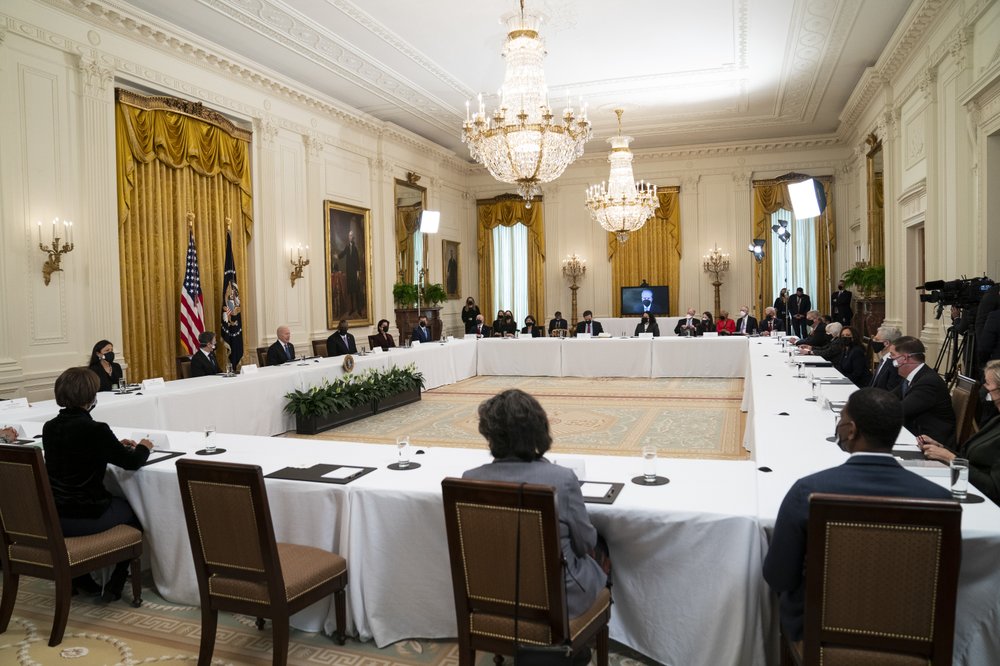
President Joe Biden set about convincing America it needs his $2.3 trillion infrastructure plan on Thursday, deputizing a five-member “jobs Cabinet” to help in the effort. But the enormity of his task was clear as Senate Minority Leader Mitch McConnell’s vowed to oppose the plan “every step of the way.” Speaking in Kentucky, McConnell said he personally likes Biden, and they’ve been friends a long time. But the president will get no cooperation from the GOP, which objects to the corporate tax increases in the plan and says they would hurt America’s ability to compete in a global economy. “We have some big philosophical differences, and that’s going to make it more and more difficult for us to reach bipartisan agreements,” the Republican leader said. White House chief of staff Ron Klain said the key to any outreach is that the proposal’s ideas are already popular. Americans want smooth roads, safe bridges, reliable public transit, electric vehicles, drinkable water, new schools, and investments in manufacturing, among the plan’s many components, he said. “We kind of think it’s just right,” Klain said in a televised interview with the news organization Politico. “But we’re happy to have a conversation with people, less about the price tag, more about what are the elements that should be in the plan that people think are missing.” Those conversations could be limited to Democrats as McConnell declared: “I’m going to fight them every step of the way.” Biden told his Cabinet at its first meeting that he is enlisting several of them to help with the push: Transportation Secretary Pete Buttigieg, Energy Secretary Jennifer Granholm, Housing and Urban Development Secretary Marcia Fudge, Labor Secretary Marty Walsh, and Commerce Secretary Gina Raimondo. “Working with my team here at the White House, each Cabinet member will represent me in dealings with Congress, engage the public in selling the plan and help organize the details as we refine it and move forward,” Biden said. The task will involve lots of salesmanship for a legacy-making piece of legislation that Biden announced in a Wednesday speech. His administration must sway Congress. It needs to rally voters. It’s also looking to outside economists to back the plan. It’s monitoring Wall Street for any celebrations or jitters. It’s forming alliances with advocates while dealing with critics of the plan’s corporate tax hikes and project details. And Biden’s administration also intends, per the plan, to cajole other nations to stop slashing their own tax rates in what has been a race-to-the-bottom to attract and retain multinational businesses. Biden’s vehicle for financing his infrastructure plans is a key dividing line. Republicans object to raising the corporate tax rate to 28% from 21%, one of the many changes so that business taxes would fund infrastructure. Republicans had cut the corporate rate from 35% in 2017, a hallmark policy achievement of Donald Trump’s presidency. Within Washington and corporate board rooms, the administration is attracting its share of accolades and rebukes on his proposal. In Biden’s own party, liberal Democrats in Congress want him to go bigger. And Democrats representing high-tax states want to remove a 2017 tax code change that limited deductions of state and local taxes for individuals. House Speaker Nancy Pelosi expressed no qualms about the proposal’s scope. “It was in the tradition of America — to think big,” Pelosi said at a press conference Thursday. “And now, in this century, President Biden is undertaking something in the tradition of thinking big, being transformational, and creating jobs for America.” While many leading business groups oppose the higher taxes, some major companies see reason for optimism because of the innovations that would be encouraged by the plan. Automakers Ford, General Motors, and Toyota endorsed the general concepts of Biden’s plan, which calls for the construction of 500,000 electric vehicle charging stations by 2030 in what would be a shift away from gasoline-powered cars. But some environmentalists said the plan’s shift away from fossil fuels that cause climate change was not substantial enough. “Biden has pledged to cut carbon emissions 50% and decarbonize our electricity sector, but this proposal won’t even come close,” said Brett Hartl, government affairs director at the Center for Biological Diversity. The White House was quick to address the climate change concerns. Climate adviser Gina McCarthy said the administration expects the infrastructure package to include Biden’s pledge to set a national standard requiring utilities to produce 100% carbon-free electricity by 2035. The proposed electricity standard “is going to be fairly robust, and it’s going to be inclusive,” McCarthy said. “I think we can get to the results that we’re looking for in a number of different ways. If a clean energy standard can be done, we think it should be done.’’ For every criticism of the plan’s details, there were also plaudits for its broader approach. Harvard University economist Larry Summers, a former treasury secretary, endorsed Biden’s plan after previously criticizing the $1.9 trillion coronavirus relief plan because of its size and debt-based financing. He downplayed any risks from corporate tax hikes since low-interest rates mean the costs of obtaining capital are already low for many companies. “I am excited,” Summers said on Twitter. “The economy’s capacity will go up.” The plan also carries a political dimension as organized labor is mobilizing to get the package passed, an important push given the steady recent Republican gains among working-class voters. Biden’s plan, with its focus on construction and manufacturing jobs, has the potential to reverse some of that slide — and the unions that backed him in 2020 are promising to help deliver votes on infrastructure. “Our members are an army a half-million strong, that will make calls, visit members of Congress and rally for good jobs building our nation’s infrastructure,” said Terry O’Sullivan, general president of Laborers International Union of North America, one of the largest construction trades unions. “We did it with boots on the ground to get President Biden elected.” Republished with the permission of the Associated Press.
