
Mike Bloomberg struggles to respond to politics of #MeToo era
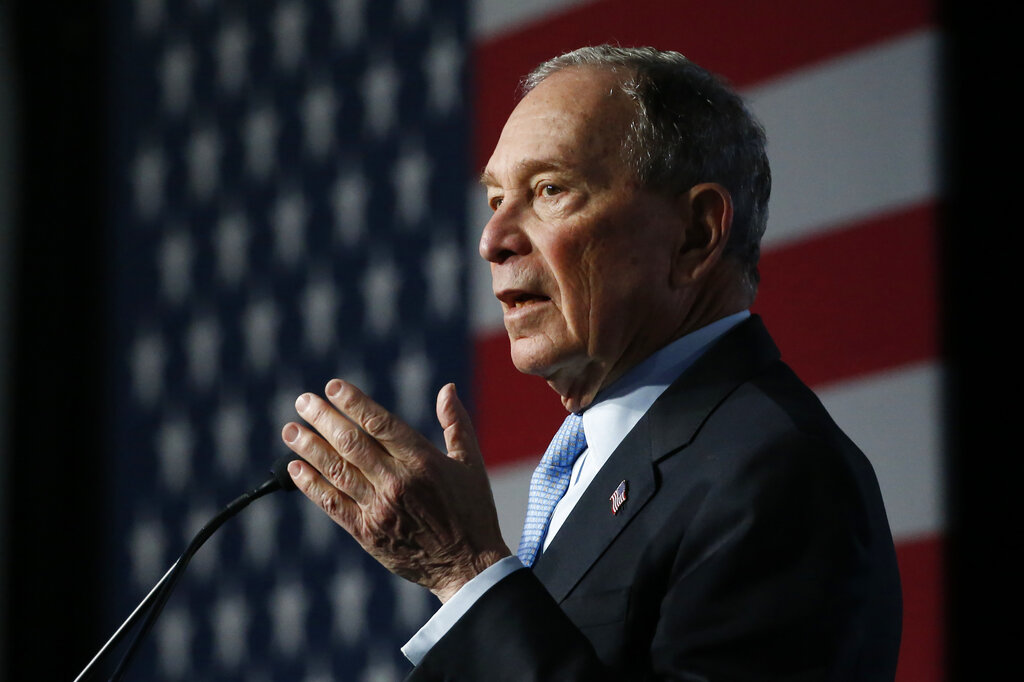
Mike Bloomberg was caught flat-footed during much of Wednesday night’s debate.
Bradley Byrne: Walking the walk in the fight for life
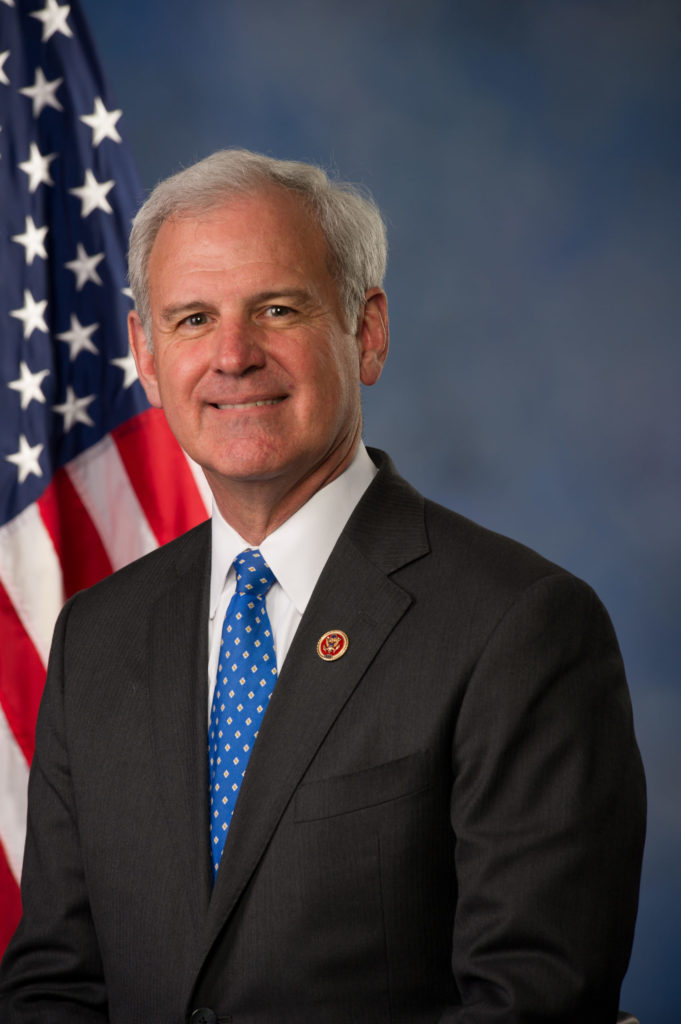
Congressman Byrne discusses last week’s March for Life and the impact of Donald Trump’s unprecedented attendance at the rally.
John Roberts will tap his inner umpire in impeachment trial
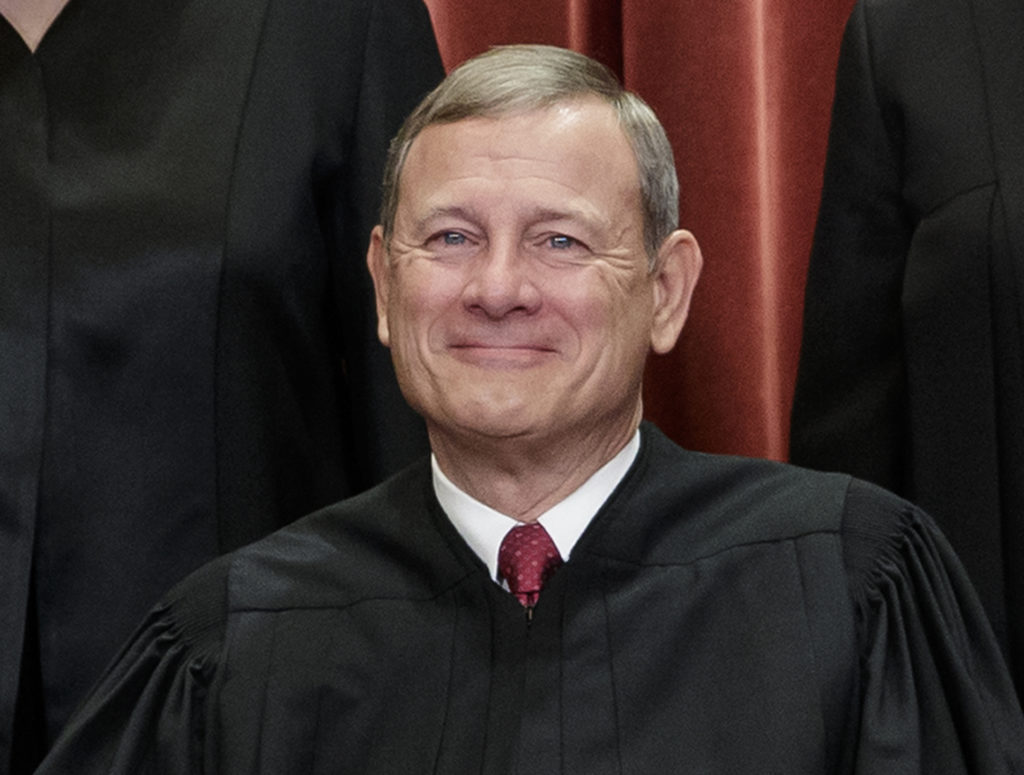
America’s last prolonged look at Chief Justice John Roberts came 14 years ago, when he told senators during his Supreme Court confirmation hearing that judges should be like baseball umpires, impartially calling balls and strikes. “Nobody ever went to a ballgame to see the umpire,” Roberts said. His hair grayer, the 64-year-old Roberts will return to the public eye as he makes the short trip from the Supreme Court to the Senate to preside over President Donald Trump’s impeachment trial. He will be in the national spotlight, but will strive to be like that umpire — doing his best to avoid the partisan mire. “He’s going to look the part, he’s going to play the part and he’s the last person who wants the part,” said Carter Phillips, who has argued 88 Supreme Court cases, 43 of them in front of Roberts. He has a ready model he can follow: Chief Justice William Rehnquist, who never became the center of attention when he presided over President Bill Clinton’s Senate trial. As Roberts moves from the camera-free, relative anonymity of the Supreme Court to the glare of television lights in the Senate, he will have the chance to demonstrate by example what he has preached relentlessly in recent years: Judges are not politicians. He has stuck to his mantra even as he and his fellow, Republican appointees hold a firm 5-4 conservative majority on the Supreme Court. Roberts has a solidly conservative voting record on the court, with a couple of notable exceptions that include sustaining President Barack Obama’s health care law. Trump has been among Roberts’ critics, blasting the chief justice for his health care votes. While Roberts ignored those remarks, at least publicly, he clashed with the president last year when Trump lashed out at an “Obama judge” who ruled against the president’s migrant asylum policy. It’s not as though there isn’t plenty of controversy brewing in his regular place of work. Before the end of June, the justices are expected to decide cases involving guns, abortion, subpoenas for Trump financial records, workplace protections for LGBT people and the fate of an Obama-era program that shields young immigrants from deportation. It’s possible the court will be asked to hear yet another case on the health care law before the term ends. The high court has moved to the right with the addition of two Trump appointees, Justices Neil Gorsuch and Brett Kavanaugh, a development that has made Roberts the justice closest to its ideological center and most able to decide how far the court will move to the right, or left, in any case that otherwise divides liberals and conservatives. In the Senate, though, the chief justice’s powers are limited because any ruling he makes can be overridden by a majority vote. He is not likely to put himself in the position of inviting reversal, said Paul M.Collins Jr., a political scientist and director of legal studies at the University of Massachusetts, Amherst. “Any controversial rulings in support of either party will threaten the viewpoint that the court should be above politics. Democrats would perceive any ruling for Republicans as partisan and if he ruled against the president, Republicans would allege he is holding a grudge,” Collins said. The Senate’s impeachment rules allow Roberts to put questions to a Senate vote, without first ruling himself. Rehnquist looked back on his role in the Clinton trial with a smile. “I did nothing in particular and I did it very well,” Rehnquist recalled two years after the trial, borrowing a line from a Gilbert and Sullivan operetta. Like Rehnquist, Roberts has virtually no experience running a trial, as opposed to the appellate proceedings at the Supreme Court. “I would be shocked if he suddenly becomes a very rigid jurist with respect to technical evidentiary rules,” Phillips said. The mechanics of the trial are not yet clear. Rehnquist had his top aide at the court, James Duff, and at least one law clerk on hand. He regularly consulted with the Senate parliamentarian before announcing rulings. Roberts runs a more flexible Supreme Court than Rehnquist, who would cut off lawyers mid-sentence when the red light came on to show their time was up. Whenever Roberts appears in public, inside the courtroom or elsewhere, he exudes a calm confidence that comes at least in part from preparation. As a leading Supreme Court advocate earlier in his career, Roberts would practice for high court arguments with his main points on five index cards. He rehearsed so that he could make those points in any order and be ready to answer 1,000 questions, even if he might only face 80 to 100 queries during a typical 30-minute argument, he told author Bryan Garner in an interview early in his tenure as chief justice. He also has a quick wit that he has used to settle confusing situations. When the lights dimmed and then went out during arguments in 2016, Roberts quipped, “I knew we should have paid that bill.” Soon after he became chief justice, a light bulb exploded in the courtroom, startling the crowd, justices and court police included. Roberts helped restore calm by calling the incident “a trick they play on new chief justices all the time.” By Mark Sherman Associated Press. Republished with the Permission of the Associated Press.
Donald Trump wants drama, but GOP wants it over
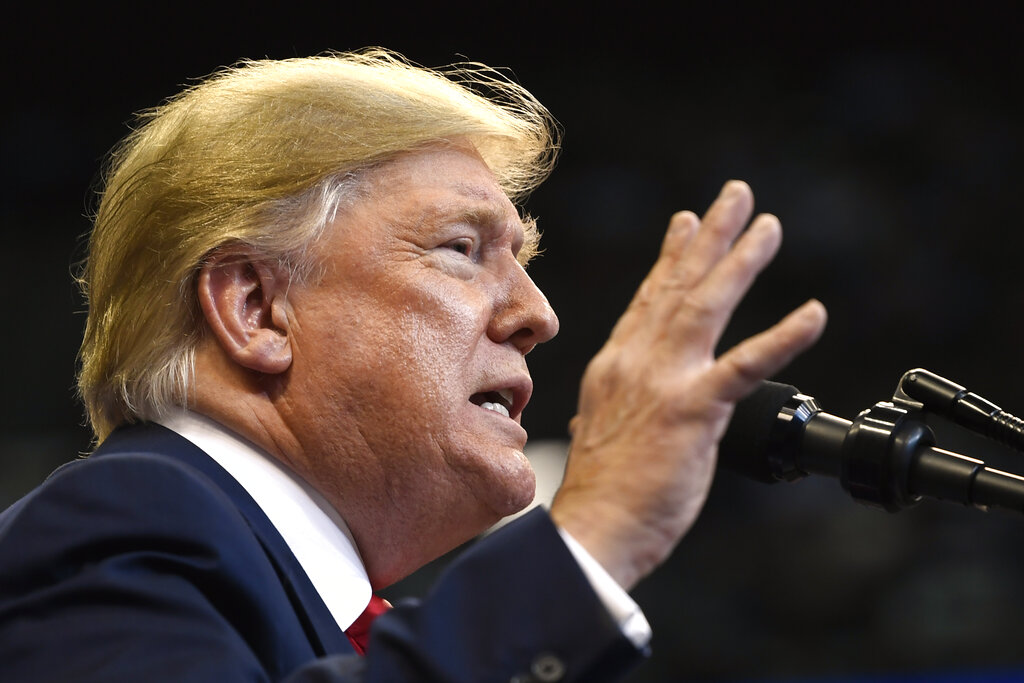
Donald Trump wants more than acquittal. He wants vindication. With impeachment by the House appearing certain, the president has made clear that he views the next step, a trial in the GOP-controlled Senate, as his focus. The president sees the senators not just as a jury deciding his fate, but as partners in a campaign to discredit and punish his Democratic opponents. His Senate allies aren’t so sure that’s a good idea. In recent weeks, Trump has devised a wish list of witnesses for the Senate trial, relishing the opportunity for his lawyers to finally cross-examine his accusers and argue the case that his actions toward Ukraine, including the July 25 call when he asked for a favor, were “perfect.” Trump and his allies have been building up the likely Senate trial, an effort to delegitimize the Democratic-controlled House’s impeachment process by contrast. In the Senate, the Trump team has argued, the president would get the opportunity to challenge witnesses and call some of his own, such as House Intelligence Committee Chairman Adam Schiff, the still-anonymous intelligence community whistleblower, or even Joe Biden and Hunter Biden. He sees that as a chance to embarrass Democrats, including the former vice president and 2020 Democratic rival, and use the friendlier ground to portray himself as the victim of a partisan crusade. “It is pretty clear the president wants a trial,” says Hogan Gidley, the principal deputy White House press secretary. “The president is eager to get his story out.” But it is increasingly clear that Senate Republicans, led by Majority Leader Mitch McConnell, have other ideas. McConnell, who is fiercely protective of his 53-47 Senate majority, has signaled that he wants none of the spectacle Trump desires. Instead he wants a swift trial, potentially with no new witnesses called. “Here’s what I would anticipate: The House managers would come over, make their arguments, the president’s lawyers would then respond. And at that point the Senate has two choices,” McConnell told reporters this week. “It could go down the path of calling witnesses and basically having another trial. Or it could decide — and again 51 members could make that decision — that they’ve heard enough.” In other words, the president, who is almost certain to be found not guilty by the Republican-controlled Senate, can win the hard way or the easy way. Senate Trump allies and advisers inside the White House have in recent days urged the president to temper his expectations and choose the path of least resistance. But Trump, according to three people familiar with the conversations, has responded by repeating his desire for a politically charged trial that drags the Bidens and others into the impeachment spotlight. Still, some aides believe Trump will ultimately relent to McConnell’s advice. Trump’s solicitation of Ukraine for investigations into the Bidens — while withholding military aide from the ally nation facing Russian aggression — forms the core of one article of impeachment against the president. His efforts to block the House investigation forms the second. On Capitol Hill, the emerging GOP consensus is that doing Trump’s defense his way would jeopardize a predictable outcome, test GOP’s fragile loyalties to him and open a Pandora’s Box of unanticipated consequences. “People are beginning to realize that could be a pretty messy and unproductive process,” Sen. Ron Johnson, R-Wis., said Wednesday. “If you start opening up to witnesses, you start opening up to all witnesses. And so I think the president’s got to really decide, to what extent does he want to start going down that road versus just making a strong case.” Democrats would be expected to retaliate by trying to call the president’s senior-most advisers, including acting chief of staff Mick Mulvaney and Secretary of State Mike Pompeo, and his personal attorney, Rudy Giuliani. Under Senate rules, McConnell’s ability to control the proceedings are limited. The Chief Justice of the United States, John Roberts, presides over the trial and any senator may be able to put a motion on witnesses up for a vote. That means defections by just a few GOP senators could thwart McConnell’s plans. With the Republicans slim majority, it’s not at all clear they want to start down the path of a full-blown trial. Should they try to call the whistle-blower or the Bidens to testify, they may not find enough votes of support from their ranks. At the same time, they would have to consider whether to accept or fend off witness requests from Democrats. McConnell also worries that a prolonged impeachment trial would not benefit the handful of GOP senators setting out in the new year on potentially tough reelection bids. Swing state Sens. Susan Collins in Maine, Cory Gardner in Colorado, Joni Ernst in Iowa and Martha McSally in Arizona are among those whose actions will be closely watched. They would much rather be talking about the economy or the pending U.S.-Mexico-Canada trade agreement than engaging in a prolonged, unpredictable impeachment trial. But Republicans also acknowledge they are unlikely to find the 51 votes needed to dismiss the charges against the president outright. Some vulnerable lawmakers and Trump skeptics, such as Sen. Mitt Romney of Utah who has said he is troubled by Trump’s actions, will insist on some semblance of trial. Comparisons are being made to the confirmation of Brett Kavanaugh to the Supreme Court, in which the Senate had to deal at length with allegations of sexual misconduct, though his confirmation by the Republicans was becoming increasingly apparent. “I think the American people are pretty tired of this,” says Sen. Pat Roberts, Republican-Kansas. “I think if we can honor the White House’s concern, OK. But let’s do it in a reasonable time limit. We don’t need six weeks like we did with Clinton.” Around the White House, a divide has emerged between aides and allies embracing the president’s call to use the Senate trial to get back at Democrats and those, particularly in the White House counsel’s office, advising him to heed the warnings of the GOP lawmakers.
Supreme Court takes up gun case, though disputed law has changed
The Supreme Court is turning to gun rights for the first time in nearly a decade, even though those who brought the case, New York City gun owners, already have won changes to the regulation they challenged. The justices’ persistence in hearing arguments Monday despite the city’s action has made gun control advocates fearful that the court’s conservative majority could use the case to call into question gun restrictions across the country. Gun rights groups are hoping the high court is on the verge of extending its landmark rulings from 2008 and 2010 that enshrined the right to have a gun for self-defense at home. For years, the National Rifle Association and its allies had tried to get the court to say more about gun rights, even as mass shootings may have caused the justices to shy away from taking on new disputes over gun limits. Justice Clarence Thomas has been among members of the court who have complained that lower courts are treating the Second Amendment’s right to “keep and bear arms” as a second-class right. The lawsuit in New York began as a challenge to the city’s prohibition on carrying a licensed, locked and unloaded handgun outside the city limits, either to a shooting range or a second home. Lower courts upheld the regulation, but the Supreme Court’s decision in January to step into the case signaled a revived interest in gun rights from a court with two new justices, Neil Gorsuch and Brett Kavanaugh, both appointees of President Donald Trump. Officials at both the city and state level scrambled to find a way to remove the case from the justices’ grasp. Not only did the city change its regulation to allow licensed gun owners to transport their weapons to locations outside New York’s five boroughs, but the state enacted a law barring cities from imposing the challenged restrictions. “There is no case or controversy because New York City has repealed the ordinance and the New York state Legislature has acted to make sure it remains repealed,” said Jonathan Lowy, chief counsel and vice president of the gun control group Brady’s legal action project. But those moves failed to get the court to dismiss the case, although the justices are likely to ask at arguments about whether there’s anything left for them to decide. Paul Clement, who represents three New York residents and New York’s National Rifle Association affiliate challenging the transportation ban, said in an email that among the reasons the case remains alive legally is that the court frowns on tactical moves of the sort employed by the city and state that are meant to frustrate the justices’ review of an issue. In addition, he wrote, that “the City still views firearm ownership as a privilege and not a fundamental right and is still in the business of limiting transport and denying licenses for a host of discretionary reasons.” In the event the court reaches the substance of the law, the city does contend that what it calls its “former rule” did not violate the Constitution. But that would seem to be a tough sell given the court’s makeup, with Gorsuch and, in particular, Kavanaugh on the court. Kavanaugh voted in dissent when his federal appeals court upheld the District of Columbia’s ban on semi-automatic rifles. “Gun bans and gun regulations that are not longstanding or sufficiently rooted in text, history, and tradition are not consistent with the Second Amendment individual right,” Kavanaugh wrote in 2011. Gun control advocates worry that the court could adopt Kavanaugh’s legal rationale, potentially putting at risk regulations about who can carry guns in public, limits on large-capacity ammunition magazines and perhaps even restrictions on gun ownership by convicted criminals, including people convicted of domestic violence. “This approach to the Second Amendment would treat gun rights as an absolute right, frozen in history, and not subject to any restrictions as public safety demands,” said Hannah Shearer, litigation director at the Giffords Law Center to Prevent Gun Violence. Reflecting the possible high stakes, more than three dozen supporting legal briefs have been filed. The Trump administration, 25 mainly Republican states and 120 members of the House of Representatives are on the side of the gun owners. A dozen Democratic-led states and 139 House lawmakers back the city. In addition, Sen. Sheldon Whitehouse, Democrat-Rhode Island, a vocal court critic, filed a brief joined by four Senate Democratic colleagues that asked the justices to dismiss the case and resist being drawn into what he called a political project. Whitehouse also included a warning to the justices. “The Supreme Court is not well. And the people know it. Perhaps the Court can heal itself before the public demands it be ‘restructured in order to reduce the influence of politics,’” he wrote, quoting a public opinion poll showing support for such changes. All 53 Republican senators responded with a letter urging the court not to be cowed by the Democrats’ threats. A decision is expected by late June. By Mark Sherman Associated Press. Republished with the Permission of the Associated Press.
Donald Trump wants Supreme Court to block subpoena for his taxes
Donald Trump is asking the Supreme Court to block a subpoena for his tax returns, in a test of the president’s ability to defy investigations. The filing Thursday sets the stage for a high court showdown over the tax returns Trump has refused to release, unlike every other modern president. The justices also could weigh in more broadly on Trump’s claim that sitting presidents can’t be prosecuted or investigated for crimes. The subpoena from the Manhattan district attorney is seeking Trump’s tax returns back to 2011 from his accounting firm as part of a criminal investigation. Trump’s lawyers say a criminal probe of the president at the state or local level is unconstitutional and unprecedented in American history. “Allowing the sitting president to be targeted for criminal investigation — and to be subpoenaed on that basis— would, like an indictment itself, distract him from the numerous and important duties of his office, intrude on and impair Executive Branch operations, and stigmatize the presidency,” said the brief signed by Jay Sekulow. Lower courts have so far rejected Trump’s claims of immunity. Trump wants the court to decide the case by late June, under a deal to keep the district attorney from enforcing the subpoena in the meantime. The justices may not decide whether to hear the case for at least another month. A second, similar case is headed to the court over a House committee subpoena demanding Trump’s financial records from the same accounting firm. The president has lost both cases at each step of the judicial system so far. The Mazars USA firm has said it will comply with the subpoenas, if courts agree. A ruling against Trump would not require public release of the information. Manhattan District Attorney Cyrus R. Vance Jr. is seeking the records back to 2011 in a broader probe that includes payments made to buy the silence of two women, porn star Stormy Daniels and model Karen McDougal, who claim they had affairs with the president before the 2016 presidential election. Trump has denied the claims. Vance spokesman Danny Frost declined to comment Thursday, saying the district attorney would be making its own Supreme Court filing next week. Trump is asking for the Supreme Court’s intervention as the impeachment drama plays out elsewhere in Washington. Public impeachment hearings that began Wednesday are examining claims that Trump tried to get Ukraine’s leader to investigate political rival Joe Biden. If the House votes to impeach the president, Chief Justice John Roberts would preside at a Senate trial that is likely to begin in January. The justices usually fill their term’s calendar by late January. The New York tax case is moving unusually swiftly through the federal courts. A three-judge panel of the 2nd U.S. Circuit Court of Appeals in New York ruled last week that the tax returns can be turned over to New York prosecutors. The appellate judges emphasized the narrowness of their ruling, deciding only that a state prosecutor can demand Trump’s personal financial records from a third party while the president is in office. Their opinion upholding a trial judge’s earlier ruling noted that they did not consider whether the president is immune from indictment and prosecution while in office or whether the president himself may be ordered to produce documents in a state criminal proceeding. The subpoena does “not implicate, in any way, the performance of his official duties,” 2nd Circuit Chief Judge Robert A. Katzmann wrote. During arguments in a New York courtroom, Trump’s lawyer told the 2nd Circuit that Trump is immune from state criminal law, even if he shoots someone, because he’s president. The exchange stemmed from Trump’s campaign trail comment in 2016 that he “could stand in the middle of Fifth Avenue and shoot somebody, and I wouldn’t lose any voters, OK?” Trump’s lawyers have said the probe by Vance, a Democrat, is politically motivated. The Justice Department, which intervened on Trump’s behalf in New York, has taken a narrower approach, saying Vance must prove “particularized need” for the records before they are released to a grand jury. In the Washington case, the House Committee on Oversight and Reform subpoenaed records from Mazars in April. They include documents from 2011 to 2018 that the House wants for investigation into the president’s reporting of his finances and potential conflicts of interest. The list of documents makes no mention of Trump’s tax returns. The full U.S. Court of Appeals for the District of Columbia Circuit voted Wednesday not to reconsider an earlier panel opinion ordering Mazars to comply with the subpoena. Trump’s two appointees to the Washington court said the full court should have reheard the case. Judge Greg Katsas called the subpoena a “threat to presidential autonomy and independence.” There are two Trump appointees on the nine-member Supreme Court, Justices Neil Gorsuch and Brett Kavanaugh. By MARK SHERMAN Associated Press Republished with the permission of the Associated Press.
Bradley Byrne: The consequences of impeachment
In the summer of 1973, as a student intern in Washington far from my home in Mobile, I got a firsthand view as the Senate held its Watergate hearings. For a young person, it was an amazing introduction to politics, and I was fascinated by what I saw. I followed the subsequent impeachment proceedings in 1974 carefully. Unfortunately, as the facts came out, it was clear President Nixon couldn’t continue in office. During the Clinton impeachment drama, I was a busy father, attorney, and part time state school board member. I could not pay as close attention, but I still watched everything unfold with great interest. Clinton was, and is, a perjurer and abused his office by having sexual relations with a young intern – literally in his office in the White House. Even so, I worried that the Republicans were overreaching with impeachment, and the voters told us we were. After the House impeached Clinton and he was acquitted by the Senate, Republicans lost seats in the House, and Newt Gingrich was forced to resign as Speaker. Fast forward to November 2016 and Donald Trump’s election as President. Since Day 1 of his Presidency, factions in our nation have called Donald Trump an illegitimate president. Many Democrats in elected office have publicly called for his impeachment for over two and a half years. They’ve tried almost every trick in the book to manufacture something worthy of the “high crimes and misdemeanors” our Constitution requires for impeachment. Look no further than Adam Schiff’s recent statement before the House Intelligence Committee. Schiff used his position as chairman of the committee to describe to a captive American audience a completely fabricated phone conversation between President Trump and the President of Ukraine. This is the same Adam Schiff who spent months on cable news networks promising some vague bombshell in the Mueller Report. By now, all his credibility is in shambles. I was proud to cosponsor a resolution to condemn and censure Schiff for his blatant attempt to mislead the public through lies and deception. The American people deserve better. The Ukrainian deal is just the latest impeachment flavor of the week after earlier attempts fell flat. As with all the manufactured scandals from Russia to Justice Brett Kavanaugh, Schiff and his allies in the national news media do not give the full truth in order to keep scandal in the headlines. With regards to the President’s phone call to President Zelensky of Ukraine, the Department of Justice reviewed all the evidence in August, found no evidence of a federal crime, and closed their case. What do Democrats in the House think they will find that our nation’s criminal division could not? The national news media won’t tell you that because it weakens the impeachment narrative. They are complicit with efforts to impeach at all cost. We must stand up during tough times like these. This process we are following now is unprecedented, bad for the country, and, ultimately for the Democrats, bad politics. The substantive basis for the present line of the impeachment “inquiry” is ludicrous. Today, I have a much closer seat for impeachment than I did as a student in 1973. I have followed it as closely as anyone. Next year, voters will have the opportunity to repudiate the Democrats for their baseless impeachment efforts. Speaker Pelosi, Schiff, the Squad and other Democrats would be wise to pay attention to history. If not, and Democrats continue their impeachment crusade, Speaker Pelosi might be looking for another job as President Trump is sworn in for his second term.
Supreme Court begins election year term full of big cases
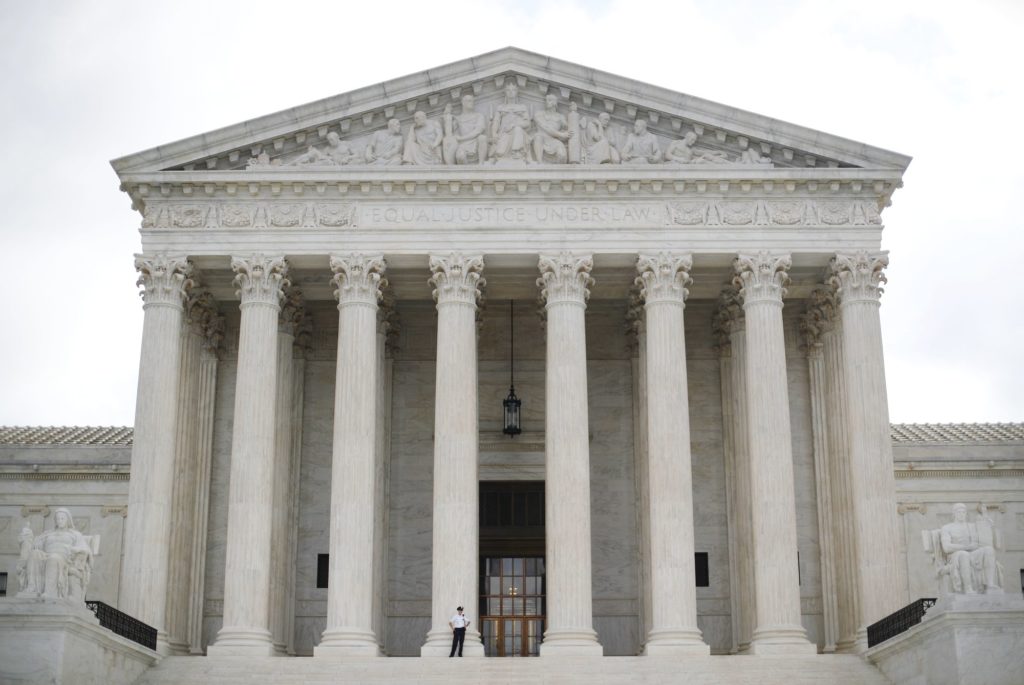
The justices are returning to the Supreme Court bench for the start of an election year term that includes high-profile cases about abortions, protections for young immigrants and LGBT rights. The court meets Monday morning for its first public session since late June. First up is a death penalty case from Kansas about whether states can abolish an insanity defense for criminal defendants. The justices also will hear arguments Monday in a challenge to a murder conviction by a non-unanimous jury in Louisiana. The term could reveal how far to the right and how fast the court’s conservative majority will move, even as Chief Justice John Roberts has made clear he wants to keep the court clear of Washington partisan politics. The court is beginning its second term with both of President Donald Trump’s Supreme Court appointees, Justices Neil Gorsuch and Brett Kavanaugh, on board. The justices could be asked to intervene in disputes between congressional Democrats and the White House that might also involve the possible impeachment of the Republican president. Roberts would preside over a Senate trial of Trump if the House were to impeach him.Its biggest decisions are likely to be handed down in late June, four months before the election. The court also could be front and center in the presidential election campaign itself, especially with health concerns surrounding 86-year-old Justice Ruth Bader Ginsburg.For now, though, the court has plenty of significant cases to deal with, including whether federal civil rights law that bars workplace discrimination on the basis of sex covers LGBT people. The justices will hear arguments Tuesday in two cases on that topic, their first foray into LGBT rights since the retirement of Justice Anthony Kennedy, who wrote all the court’s major gay-rights rulings. Next month, the fate of the Deferred Action for Childhood Arrivals program is in front of the justices. Lower courts have blocked Trump from ending the Obama-era program, which has shielded roughly 700,000 people from deportation and provided them with permits to work.During the winter, the justices will take up a challenge to a Louisiana law that would force abortion providers to have admitting privileges at local hospitals. It’s another test of whether the change in the court’s composition will result in a different outcome. With Kennedy in the majority, the court in 2016 struck down a virtually identical Texas law. By Mark Sherman Associated Press Republished with the permission of the Associated Press.
John Roberts’ Supreme Court defies easy political labels
Just hours after Chief Justice John Roberts handed Republicans a huge victory that protects even the most extreme partisan electoral districts from federal court challenge, critics blasted him as worthy of being impeached, a politician who should run for office and a traitor. But the attacks came from President Donald Trump’s allies and their anger was directed not at the Supreme Court’s partisan gerrymandering ruling, but at the day’s other big decision to keep a citizenship question off the 2020 census, at least for now. Trump tweeted from Japan that the census citizenship decision was “ridiculous.” What good is a high court conservative majority fortified by two Trump appointees, the critics seemed to be saying, if Roberts is not prepared to use it? That’s not how Roberts would characterize the court he now leads in name and as the justice closest to the center of a group otherwise divided between conservatives and liberals. He has talked repeatedly about the need to counter perceptions that the justices are just politicians in black robes, beholden to the president who appointed them. The flurry of action came at the end of a Supreme Court term in which the court welcomed a new justice, Brett Kavanaugh, who narrowly survived the most tumultuous confirmation hearings in nearly 30 years. The justices now begin a three-month summer recess. The court seem determined to maintain as low a profile as possible once Kavanaugh joined the bench in early October, finding a variety of ways to keep hot-button topics like abortion, guns, immigration and gay rights, that might divide conservatives from liberals, off the term’s calendar. “This tactic may have been an effort to keep things relatively quiet” following the Kavanaugh nomination, said Josh Blackman, a law professor at the South Texas College of Law in Houston. But one result of putting off some major decisions in Kavanaugh’s first term is a docket crammed with guns, immigration, gay rights and probably abortion in a session that begins in the fall and will come to a head in June 2020, amid the presidential election campaign. So far there is only a partial answer to the big question of how far and fast the court will move to the right now that the more conservative Roberts had taken the place of Justice Anthony Kennedy, who retired last year, as the swing justice. In the case of partisan gerrymandering, Roberts closed the federal courthouse door to lawsuits, a decision that mainly benefits Republicans whose districting plans had been challenged in several states. On the death penalty, the five conservatives appear much less willing to entertain calls for last-minute reprieves from execution. And in two cases the court divided along ideological lines in overturning precedents that had been on the books for more than 30 years. But Roberts was unwilling to join the conservatives to allow the citizenship question to proceed, although it is not yet clear whether the administration will continue pressing the legal case for the question. The reaction to the census ruling was swift. Former Trump aide Sebastian Gorka called Roberts “a traitor to Constitution.” American Conservative Union president Matt Schlapp called for Roberts’ impeachment. Fox News host Laura Ingraham tweeted that “Roberts should quit and run for office.” The chief justice also declined to be the fifth conservative vote to overturn two past high court decisions about the power of federal agencies, and joined the liberals in ruling for an Alabama death row inmate who suffers from dementia. In emergency appeals, Roberts was the fifth vote to keep Trump from requiring asylum seekers to enter the country at established checkpoints and the fifth vote to prevent Louisiana abortion clinic regulations from taking effect. Twenty-one decisions, or nearly a third of all the cases the court heard since October, were by 5-4 or 5-3 votes. But of those, only seven united the conservatives against dissenting liberals. In 10 others, the cohesive bloc of liberals attracted the vote of a conservative justice. The lack of high-profile cases undoubtedly contributed to the relatively small number of ideologically divided outcomes, said David Cole, legal director for the American Civil Liberties Union, which was on the winning side of the citizenship case and the losing side of the gerrymandering one.Cole said the 5-4 decisions that cross ideological lines “send a message that this is a court that is not just determined by partisan ideology, but is applying law.” Roberts sought to reinforce that perception of the court in comments in November, speaking out after Trump called a judge who ruled against his asylum policy an “Obama judge.” Roberts responded: “We do not have Obama judges or Trump judges, Bush judges or Clinton judges.” Commenting on the day before Thanksgiving, he said an “independent judiciary is something we should all be thankful for.” It could be several years before the impact of a more conservative court, assuming no changes in membership, becomes clear. But one fear among the liberal justices, and liberals more generally, is a push to restrict if not overturn abortion rights the Supreme Court first declared in the Roe v. Wade decision in 1973. At least one conservative justice has the decision in his sights. Justice Clarence Thomas at one point this term labeled it as “notoriously incorrect.” The first term of any new justice often has fewer big cases than normal, but the court’s desire to stay away from controversy was heightened by Kavanaugh’s difficult confirmation following allegations he sexually assaulted a woman when they were both in high school. He denied doing anything improper. When he arrived at the court, his colleagues seemed to welcome him warmly. Justice Elena Kagan, his neighbor on the bench, joked with the new justice and made a point of shaking his hand at the end of his first day of arguments. Kavanaugh’s parents were often in the courtroom, especially when their only child announced an opinion. The new justice “stuck pretty close to the chief in a lot of cases,” said Supreme
Joe Biden launches 2020 bid warning ‘soul’ of America at stake
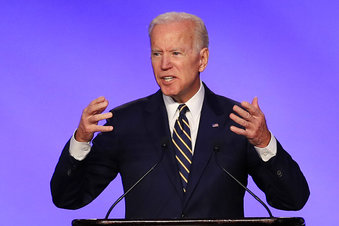
In a video posted on Twitter , Biden focused on the 2017 deadly clash between white supremacists and counter protesters in Charlottesville, Virginia. Biden noted Donald Trump‘s comments that there were some “very fine people” on both sides of the violent encounter, which left one woman dead. “We are in the battle for the soul of this nation,” Biden said. “If we give Donald Trump eight years in the White House, he will forever and fundamentally alter the character of this nation — who we are. And I cannot stand by and watch that happen.” The 76-year-old Biden becomes an instant front-runner alongside Vermont Sen. Bernie Sanders, who is leading many polls and has proved to be a successful fundraiser . Biden has legislative and international experience that is unmatched in the Democratic field , and he is among the best-known faces in U.S. politics. He quickly racked up endorsements on Thursday morning, becoming the first Democrat running for president with the backing of more than one U.S. senator. Still, Biden must compete in a field that now spans at least 20 Democrats and has been celebrated for its racial and gender diversity. As an older white man with occasionally centrist views, Biden has to prove he’s not out of step with his party. He’s yet to outline his positions on the issues defining the 2020 Democratic primary, most notably “Medicare for All,” the universal health care plan authored by Sanders that has been adopted by virtually the entire Democratic field. His critics in both major political parties were also quick to pounce. “The old guard of the Democratic Party failed to stop Trump, and they can’t be counted on to lead the fight against his divide-and-conquer politics today,” the liberal group Justice Democrats tweeted. “The party needs new leadership with a bold vision capable of energizing voters in the Democratic base who stayed home in 2016.” Biden, a native of Scranton, Pennsylvania, is betting that his working class appeal and ties to Barack Obama‘s presidency will help him win over such skeptics. Obama has declined to endorse Biden, however, and several former Obama aides are now working for other candidates. “I asked President Obama not to endorse,” Biden told reporters as he arrived in Delaware Thursday. “Whoever wins this nomination should win it on their own merits.” While he hasn’t endorsed anyone in the crowded field, Obama took the unusual step of weighing in on Thursday’s announcement. “President Obama has long said that selecting Joe Biden as his running mate in 2008 was one of the best decisions he ever made,” Obama spokeswoman Katie Hill said. “He relied on the vice president’s knowledge, insight, and judgment throughout both campaigns and the entire presidency. The two forged a special bond over the last 10 years and remain close today.” Trump welcomed Biden to the campaign in a tweet calling him “Sleepy Joe.” “I only hope you have the intelligence, long in doubt, to wage a successful primary campaign,” Trump said. “It will be nasty – you will be dealing with people who truly have some very sick & demented ideas. But if you make it, I will see you at the Starting Gate.” Privately, Trump allies have warned that Biden might be the biggest re-election threat given the former vice president’s potential appeal among the white working class in the Midwest, the region that gave Trump a path to the presidency. Biden is paying special attention to his native Pennsylvania, a state that swung to Trump in 2016 after voting for Democratic presidential candidates for decades. While Biden represented Delaware in the Senate for 36 years, he was often referred to as Pennsylvania’s third senator. The former vice president will be in the state three times within the opening weeks of his campaign. He’ll be in Philadelphia on Thursday evening headlining a fundraiser at the home of David L. Cohen, executive senior vice president of Comcast. Biden is aiming to raise $500,000 at the event. He will hold his first public event as a 2020 presidential candidate in Pittsburgh on Monday. Then it’s off to Iowa, home of the leadoff nominating caucuses on Tuesday and Wednesday, followed by two days in South Carolina. He’ll visit the other two early-voting states, Nevada and New Hampshire, in early May, before holding a major rally in Philadelphia. Biden’s first media appearance is set for Friday morning on ABC’s “The View,” a move that may help him make an appeal to women whose support will be crucial to winning the primary. He also hired Symone Sanders to serve as a senior strategist, tapping a prominent African American who previously worked for Biden’s chief competitor, Bernie Sanders, in the 2016 presidential contest. As he neared his campaign launch, Biden’s challenges have come into greater focus. He struggled last month to respond to claims that he touched 2014 Nevada lieutenant governor nominee Lucy Flores‘ shoulders and kissed the back of her head before a fall campaign event. A handful of other women have made similar claims, though none has alleged sexual misconduct. Biden, a former U.S. senator from Delaware, pledged in an online video to be “much more mindful” of respecting personal space but joked two days later that he “had permission” to hug a male union leader before addressing the group’s national conference. Biden also has been repeatedly forced to explain his 1991 decision, as Senate Judiciary Committee chairman, to allow Anita Hill to face difficult questions from an all-male panel about allegations of sexual harassment against Supreme Court nominee Clarence Thomas, who later was confirmed to the high court. He has since apologized for his role in the hearing. But in the #MeToo era, particularly after the contentious confirmation of Supreme Court Justice Brett Kavanaugh, the episode remains a significant political liability. Likewise, Biden once played a key role in anti-crime legislation that had a disproportionately negative impact on African Americans. And while several 2020 Democratic contenders have embraced the possibility of reparations
Poll: Just 1 in 4 thinks Brett Kavanaugh told entire truth
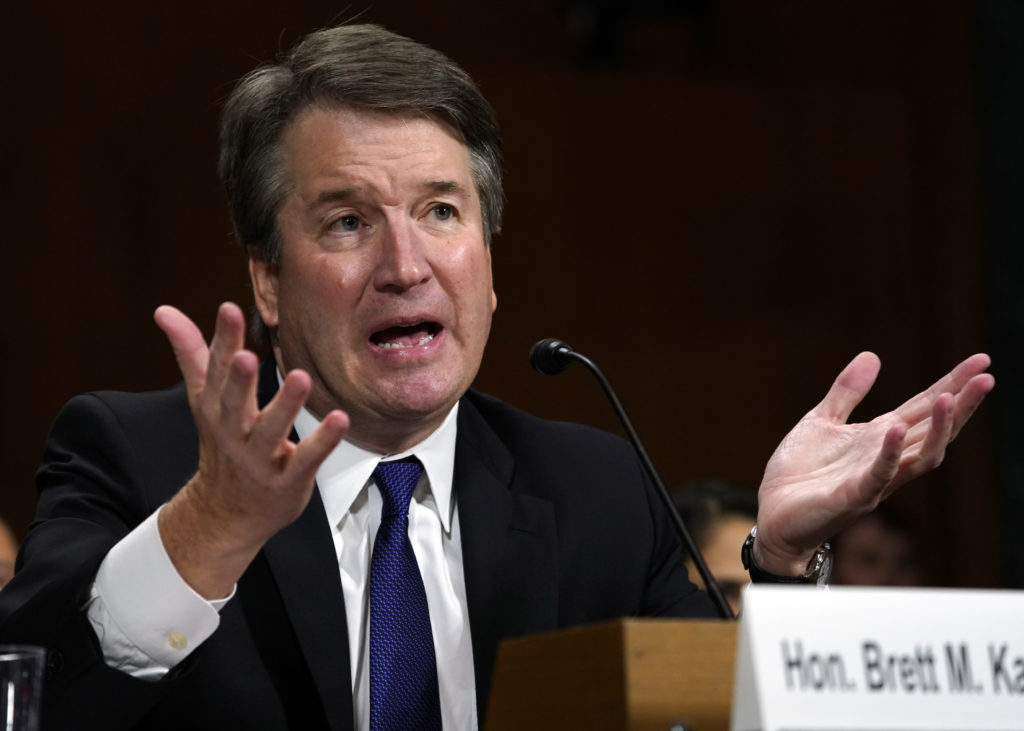
Just 1 in 4 people thinks Brett Kavanaugh was completely honest when as a Supreme Court nominee he gave sworn testimony to the Senate Judiciary Committee last month, with Republicans and Democrats holding starkly distinct opinions of his credibility, according to a poll released Friday. The Associated Press-NORC Center for Public Affairs Research survey also found that the public holds tepid views of how major players handled the extraordinary battle, which culminated Oct. 6 in an exhausted Senate’s near party line confirmation of Kavanaugh. President Donald Trump, Senate Republicans and Democrats and the FBI each earned approval from 32 percent or less of the poll’s respondents. Overall, 39 percent said they believe Kavanaugh was mostly honest but was hiding something when he testified last month before the Senate Judiciary Committee, the drama’s most unforgettable day. Another 31 percent said he was largely lying, and 25 percent said he was totally truthful. A combative Kavanaugh denied California college professor Christine Blasey Ford‘s testimony to the committee that he sexually assaulted her at a 1980s high school gathering when they were teenagers, and he rebutted classmates’ descriptions of him as a heavy drinker. The question was among several that underscored how stances over the searing confirmation battle are deeply colored by people’s political allegiances and less so by gender. Republicans hope that partisan tensions heightened by the fight will drive conservative voters to the polls in the Nov. 6 elections, when GOP control of the House and the Senate is at stake. Six in 10 Republicans, including 57 percent of men and 64 percent of women, said they think Kavanaugh was entirely truthful when he appeared before the Judiciary panel. They included Ricky Richards, who took the survey and agreed to explain his views in a subsequent interview. Richards said he believed Kavanaugh, citing repeated FBI background checks that unearthed no wrongdoing, testimony from supportive witnesses and the body language of Kavanaugh and his wife at the crucial Judiciary session. “He was angry, but he handled himself better than I would have,” said Richards, a 59-year-old engineering consultant from Clifton, Texas. He said Ford’s testimony seemed “purely scripted,” and he faulted her for not recalling some details of what she says happened to her, which experts have said is common for trauma victims. Fewer than 1 in 10 Democrats, men and women, said they think Kavanaugh was fully candid during his appearance. Just over half said he was mostly lying while the rest said he was largely truthful but was hiding something. “It’s just the way he presented himself, the way he answered questions. He was so defensive,” said Barbara Heath, a 60-year-old Democrat and former factory worker from Springfield, Ohio. “To me, he was covering up a lot of things.” Overall, 43 percent disapprove of Kavanaugh’s confirmation while 35 percent approve. More independents disapprove than support his confirmation, 35 percent to 17 percent, while the remaining respondents do not have a strong opinion either way. Forty percent of all men approve of Kavanaugh’s elevation to the high court, while only 30 percent of women do. Yet party identification washes much of that difference away: Around three-quarters of Republican men and women favor Kavanaugh’s confirmation, a view shared by only about 1 in 10 Democrats of both genders. Americans are about evenly divided over whether the Judiciary panel treated Kavanaugh fairly. In contrast, 42 percent thought the committee was unfair to Ford while 30 percent said it was fair to her. Nearly two-thirds of college-educated women said Ford was treated unfairly, a potentially damaging finding for House Republicans defending competitive suburban districts in next month’s elections. The poll also found that: The role played by Trump, who nominated Kavanaugh in July and criticized Ford and another accuser, was strongly or somewhat approved by 32 percent, about the same rating given to Senate Republicans. Senate Democrats won such approval from just 24 percent. Only 3 in 10 said the FBI did a good job. Trump hurriedly ordered the agency to perform a brief investigation of the sexual-harassment allegations against Kavanaugh and said it found no corroboration in a probe Democrats criticized as insufficient. Around 1 in 3 said that since Kavanaugh’s confirmation they have a lot of confidence in the Supreme Court. The rest have only some or hardly any confidence in the nation’s highest court. Eight in 10 Democrats, compared to 6 in 10 Republicans, said a Supreme Court nominee’s personal history and character are extremely or very important. The AP-NORC poll was conducted Oct. 11-14 by The Associated Press-NORC Center for Public Affairs Research, with funding from The Associated Press and NORC at the University of Chicago. It involved interviews conducted in English and Spanish with 1,152 adults nationwide. Interviews were conducted online or by phone among members of NORC’s probability-based AmeriSpeak panel, which is designed to be representative of the U.S. population. The margin of error is plus or minus 4 percentage points. Republished with permission from the Associated Press.
Sprint to Nov. 6: The race to frame the Brett Kavanaugh story
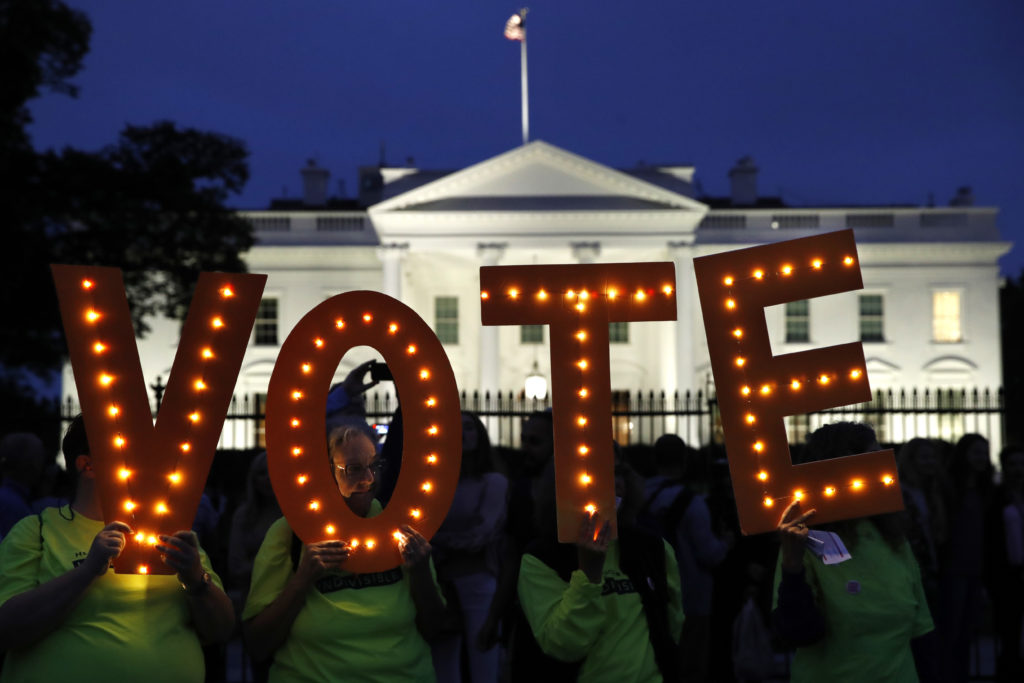
Brett Kavanaugh‘s confirmation to the Supreme Court fired the starting pistol for the final sprint to Election Day in the United States, with control of the House and Senate at stake. The nation’s reckoning with power and who to believe about sexual misconduct has generated a new anger factor among the electorate and made the Nov. 6 balloting a referendum on more than President Donald Trump. What to watch over the final four weeks: ___ KAVANAUGH, TO THE COURT Trump swore in Kavanaugh Saturday as the nation’s 114th member of the Supreme Court after a savage battle that splintered the Senate and riveted the country. Kavanaugh took his oath of office to his lifetime seat just hours after the climactic 50-48 roll call. It was the narrowest Senate vote to confirm a justice since 1881. It was a fitting result for a 100-member chamber that represents a nation deeply split over an array of issues, from health care to who should be considered an American. A yawning divide has opened in the last year over whether allegations of sexual misconduct should be enough to topple accused men from the pinnacle of their professions. Enter Kavanaugh, the appellate court judge accused by Christine Blasey Ford in emotional sworn testimony of sexually assaulting her in the 1980s, while the two were in high school. Accusations from other women followed, none corroborated. Kavanaugh denies that he ever sexually assaulted anyone. In a frequently-shouted sworn statement of his own, he decried the Senate for putting his nomination in jeopardy. Hosting a ceremonial swearing-in for Kavanaugh Monday evening in the White House East Room, Trump declared Kavanaugh had been the victim of a “campaign of political and personal destruction based on lies and deception” and added, “You, sir, under historic scrutiny, were proven innocent.” ___ THE KAVANAUGH EFFECT The Kavanaugh confirmation has blown open the midterm elections from being a national referendum on Trump’s stewardship to a raw emotional discussion over the lack of women in power and how to handle sexual misconduct allegations. With Kavanaugh’s ascension to the high court, Republicans, long dispirited by Trump’s string of scandals and the prospect of losing their congressional majorities, are whooping it up. “It’s turned our base on fire,” Senate Majority Leader Mitch McConnell said. He added Monday that the fight over Kavanaugh, particularly that his nomination was stymied by unproven allegations, injected the GOP with an “adrenaline shot that we had not been able to figure out how to achieve in any other way.” What’s unclear is whether GOP unity is enough to preserve the GOP power in Congress. The same question faces the #MeToo movement against sexual misconduct after the White House successfully argued that the Kavanaugh allegations should not be conflated with the rest of the movement. Even before the confirmation, Kavanaugh’s opponents had a comeback line, printed on the back of jackets they wore to the Capitol: “November is coming.” ___ NORTH DAKOTA Almost immediately after the Senate vote, Democrats felt the chill from faraway North Dakota. That’s the state Trump won by 36 percentage points against Democrat Hillary Clinton in 2016. And even before the Kavanaugh controversy, the Senate race there was among a handful of close contests that could decide whether Republicans keep control of the Senate, where they have a 51-49 majority. Then on Saturday, Democratic Sen. Heidi Heitkamp defied her state’s support for Trump and voted against Kavanaugh’s confirmation. Heitkamp said she was concerned about Kavanaugh’s temperament after his emotional performance before the Senate Judiciary Committee. “Without hesitation,” Heitkamp told reporters, she believed Ford. Polls have put her Republican opponent, Rep. Kevin Cramer, comfortably ahead. He told The New York Times that #MeToo was a “movement toward victimization” that had caused a backlash. “The world got to see close up how ugly it can be when you go too far,” he’s quoted as saying. ___ FRAMING THE STORY Now it’s a four-week race to tell the story. Trump has a busy campaign schedule to spread the word that the allegations against Kavanaugh were a “hoax that was set up by the Democrats” at what he’s called a dangerous time for men who can be falsely accused. “I think you’re going to see a lot of things happen on Nov. 6 that would not have happened before,” Trump said Monday as he departed for an event in Florida. This week alone, he’s expected to hold rallies in Iowa, Pennsylvania, Ohio and Kentucky. McConnell has cast Kavanaugh’s opponents, many of whom protested in the halls of the Senate and yelled at lawmakers, as “the mob.” Democrats are pointing to the Republicans’ handling of the Kavanaugh confirmation as one more reason to oppose the president who nominated him and mocked Ford. “Folks who feel very strongly one way or the other about the issues in front of us should get out and vote,” said Sen. Chris Coons, D-Del., on NBC’s “Meet the Press.” ___ GOVERNORS Look for Kavanaugh’s confirmation to remain a major issue, even though governors don’t have a direct say in the matter. Republican candidates in heavily Democratic states previously called for further investigation of sexual assault claims against Kavanaugh and their Democratic opponents said that wasn’t enough. Democrats are expected to take over some of the governors’ offices now held by the GOP, which controls a near-record 33 offices. Thirty-six states are electing governors this year, with competitive races in states where the Republican incumbents are stepping aside as they hit term limits, including in the swing states of Florida, Nevada and Ohio. The Democratic candidates in Florida, Georgia and Maryland are seeking to be the first black governors there. Republicans, meanwhile, are pushing to pick up seats in increasingly Democratic Colorado and Oregon while keeping them in most of New England as well as the South and much of the West. ___ 2020 CANDIDATES Yep, they’re already running — especially two members of the Senate Judiciary Committee who had visible roles during the Kavanaugh hearings. Sen. Cory
