
Donald Trump stands by ‘culture’ criticism of European immigration
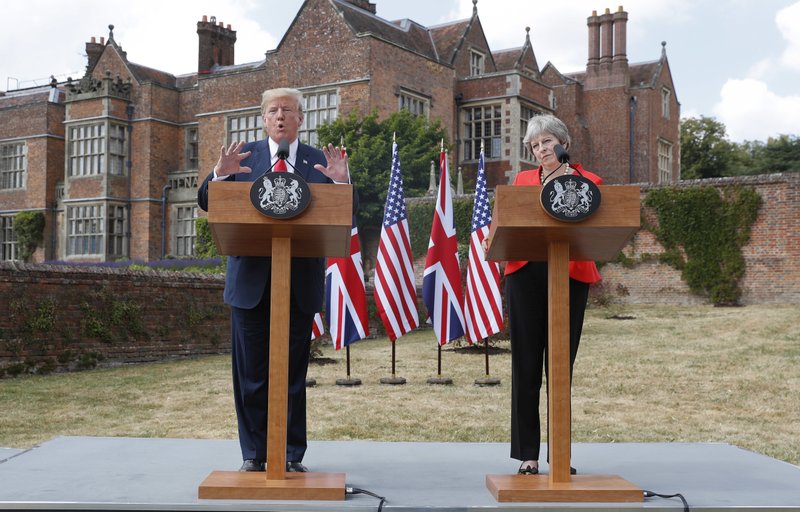
President Donald Trump pressed ahead Friday with his complaints that European immigration policies are changing the “fabric of Europe” and destroying European culture. During a news conference with British Prime Minster Theresa May, Trump backtracked on the criticism of May that he made in an explosive interview released as he began his visit to the country. But he reiterated his belief that Europe’s decision to accept migrants from Middle Eastern and African countries is “a very negative thing for Europe.” Standing next to May at Chequers, the prime minister’s official country estate, Trump acknowledged that his remarks were “politically not necessarily correct.” But he said European countries need to “watch themselves.” “You are changing culture, you are changing a lot of things,” he said, adding, “You see the same terror attacks that I do.” Trump was reiterating a position he articulated in an interview released Thursday by The Sun, in which he also criticized May’s handling of Brexit negotiations and said “I think allowing millions and millions of people to come into Europe is very, very sad.” May quickly rebutted Trump during their joint appearance, saying the U.K. has a “proud history of welcoming people who are fleeing persecution to our country.” “Over the years, overall immigration has been good for the U.K.,” she added. “It’s brought people with different backgrounds, different outlooks here to the U.K. and we’ve seen them contributing to our society and our economy.” Critics have faulted the president for using language that echoes white supremacist laments about the loss of white power. Rep. Adriano Espaillat, D-N.Y., born in the Dominican Republic, said Trump was “trying to throw gasoline on fire and begin a culture war, and it’s unfortunate that he’s divisive in the United States and he’s divisive in Europe as well.” “We all tout our nation as being a nation of immigrants,” Espaillat said. “For him to characterize that as something negative that we should avoid is sort of going against the most important and fundamental tenets of our country.” Rep. Ted Lieu, D-Calif., born in Taipei, Taiwan, said American culture is constantly changing through immigration. “That’s what makes our country amazing and great,” Lieu said. “It is a continual renewal of our American ideals set forth in our Constitution and Declaration of Independence with every new successive generation.” Trump said he believes that the U.K.’s Brexit vote in 2016 was in part a response to lax European immigration laws, and he has frequently tried to use Europe as a cautionary tale for the U.S., where he is seeking to implement more hawkish migration policies. Trump has used tough rhetoric on immigration to motivate his political base at home, at times using racial or ethnic undertones. During the 2016 presidential campaign, he drew global condemnation for a call to ban Muslim immigration to the U.S. Since entering the White House, he has enacted travel restrictions for citizens from some Muslim-majority countries, curtailed refugee admissions to the U.S. and called for “extreme vetting” of those entering the U.S. He drew fire from Democrats earlier this year for describing MS-13 gang members, many of them immigrants to the U.S., as “animals.” Republished with the permission of the Associated Press.
Will Davis: AMEXIT — It’s time to ditch the U.N.
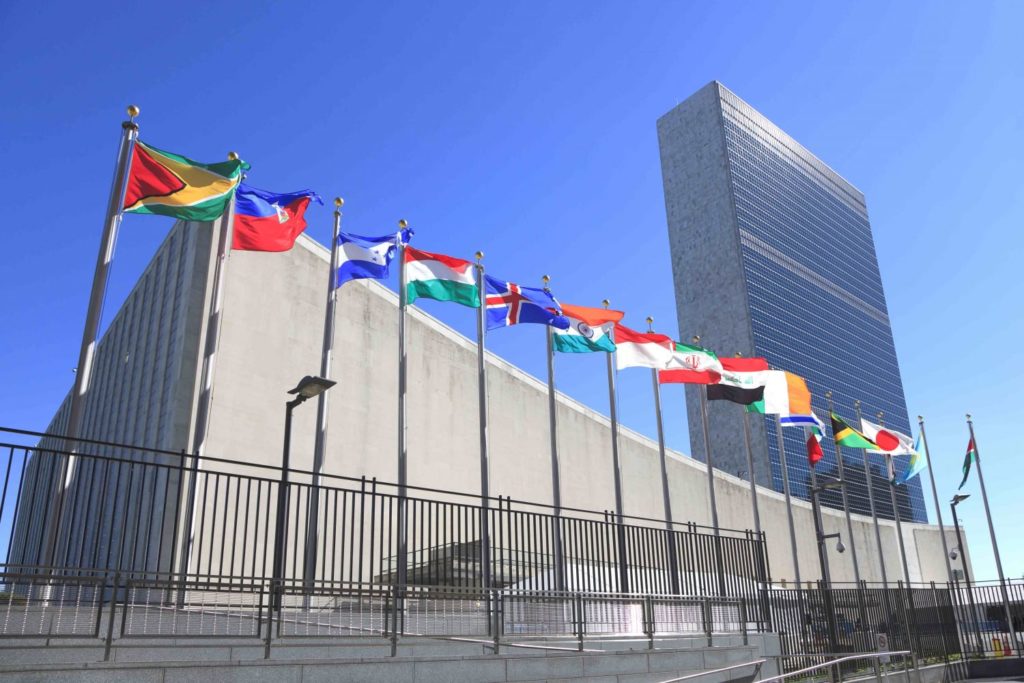
“A forum for anti-semitism & anti-americanism.” Florida Senator Marco Rubio, a former presidential candidate, and one of the country’s leading voices on foreign policy had these harsh words for the United Nations in a Tweet back in February. Rubio also questioned the continued funding for an organization that treats America and her allies with such hostility. This followed a general assembly vote 128-9 to condemn the U.S. decision to recognize Jerusalem as the capital of Israel. Now it’s time for Rubio and his GOP colleagues to put their money where there mouth is and cease funds to this wretched organization. Make no mistake, I am not an advocate of isolationism, and alliances with countries that we can count on are of the upmost important. But, it is now clear that the United Nations has outlived it’s purpose. Today, the institution that was created to prevent war has done more to inspire it. The institution that was created to promote freedom and democracy now promotes tyranny and authoritarianism. Nearly half of the security council’s recent condemnations have focused on Israel, while ripping the U.S’s relationship with them. Since Israel was officially recognized as a state in 1948, the security council has issued 225 resolutions against the democratic state, while by comparison, ignoring the theocratic, terror-supporting states that surround them. This is the exact opposite of what the U.N. was created to do. It is time for the U.S. to ditch this failed institution and form coalitions with countries that we can count on. Countries that share our values. The communist, socialist, and radical islamic states that dominate the discourse at the U.N. can find a forum elsewhere, but there is no reason that forum should be on our soil. Last year, the people of Great Britain stood up for their sovereignty and against unaccountable Bureaucracy, leaving the corrupt European Union. This year, it’s time for the United States to do the same. It’s time for our own Brexit. Our Amexit. ••• William Davis is a sophomore at the University of Alabama. There he is involved in various conservative groups and organizations.
Year’s top news filled with division — and no middle ground
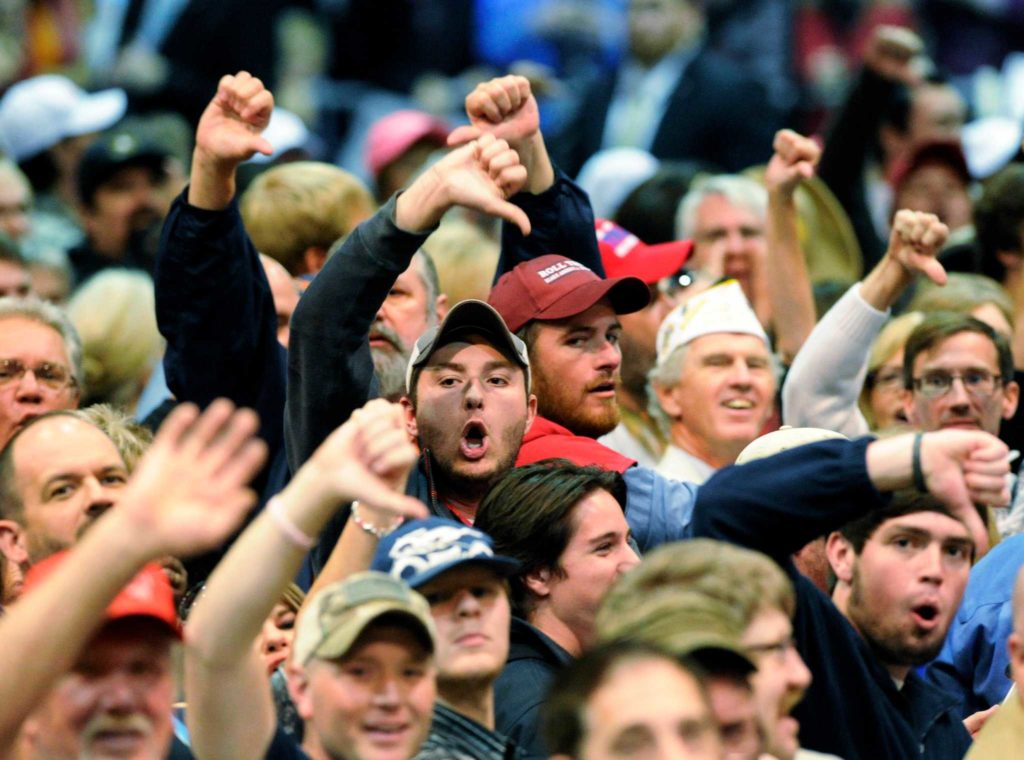
Fed up with Europe’s union across borders? Reject it. Disgusted with the U.S. political establishment? Can it. The news in 2016 was filled with battles over culture and territory that exposed divisions far deeper than many realized. But people confronting those divides repeatedly rejected the prospect of middle-ground solutions and the institutions put in place to deliver them. While the headlines told many different stories, the thread connecting much of the news was a decisive torching of moderation, no matter how uncertain the consequences. “You’re not laughing now, are you?” Nigel Farage, a leader of the Brexit campaign, told the European Parliament after voters in Great Britain spurned membership in the continental union. “What the little people did … was they rejected the multinationals, they rejected the merchant banks, they rejected big politics and they said, ‘Actually, we want our country back.’” Farage was speaking only about the United Kingdom. But his observation that many people well beyond Britain shared that disdain for working within the system was borne out repeatedly in the year’s biggest headlines. In a U.S. presidential campaign fueled by anger and insults, in Syria’s brutal war and Venezuela’s massive protests, in fights over gay rights and migration, opposing sides rejected not just compromise but also the politics of trying to forge it. That was clear from the year’s first days, when armed activists took over a national wildlife refuge in Oregon’s high desert, opposing the federal government’s control of public lands. “It needs to be very clear that these buildings will never, ever return to the federal government,” LaVoy Finicum, an Arizona rancher among the activists, told reporters. Weeks later, federal agents stopped vehicles outside the refuge, arresting eight of the activists and fatally shooting Finicum when he reached into a jacket that held a loaded gun. Even in the rare cases when compromise prevailed, it was viewed with suspicion. When a deal took effect in January limiting Iran’s nuclear program in exchange for relief on sanctions, it marked the culmination of prolonged negotiation by President Barack Obama‘s administration. But the pact was repeatedly attacked by critics in both countries, including Donald Trump, saying it gave the other side too much. “The wisest plan of crazy Trump is tearing up the nuclear deal,” a leading Iranian hard-liner, Hossein Shariatmadari, told his country’s news agency. In mid-February, U.S. Supreme Court Justice Antonin Scalia died in his sleep, leaving a vacuum on a court where he had long been the leading conservative voice. Barely an hour after Scalia’s death was confirmed, Senate Majority Leader Mitch McConnell staked out an uncompromising position on what lay ahead. “The American people should have a voice in the selection of their next Supreme Court justice,” McConnell said, disregarding the fact that U.S. voters had twice elected Obama. “Therefore, this vacancy should not be filled until we have a new president.” North Carolina lawmakers prompted protests and counterprotests when they rushed through House Bill 2, voiding local gay-rights ordinances and limiting bathroom access for transgender people. Companies, the NBA and others followed through on threats to move jobs, games and performances out of the state, amplifying the division. Tensions over U.S. policing bled into a third year. In July, a sniper killed five Dallas police officers during a protest over shootings of black men by police in Louisiana and Minnesota. A South Carolina jury failed to reach a verdict in the trial of a white officer caught on video fatally shooting a black man fleeing a traffic stop. Division, though, was hardly limited to the U.S. In Venezuela, triple-digit inflation and shortages of food and medicine fueled 6,000 protests throughout the year that brought millions into the streets. But the government of President Nicolas Maduro, blamed by many voters for the chaos, blocked a recall campaign. “If you’re going to shoot me because I’m hungry, shoot me!” a young man shouted at a soldier during one protest in Caracas. In Colombia, voters narrowly rejected a deal between the government and a guerrilla group to end a 52-year civil war. Even when lawmakers approved a renegotiated deal, the peace remained fragile. In Brazil, senators impeached President Dilma Rousseff for manipulating budget figures, though many of the lawmakers were, themselves, tarred by accusations of corruption. South Korean President Park Geun-hye was stripped of power in December amid allegations she let a close friend use the government for financial gain. Meanwhile, Syria’s war entered its sixth year. But despite pressure by the U.S. and its allies, Russia and the government of President Bashar Assad unleashed an assault on Aleppo to wipe out rebels, driving up the toll in a conflict that has already claimed as many as 500,000 lives. “This is a targeted strategy to terrorize civilians and to kill anybody and everybody who is in the way of their military objectives,” U.S. Secretary of State John Kerry said, accusing Syria and Russia of war crimes. “As long as war crimes are at question,” a Russian government spokeswoman said, “the Americans should start with Iraq.” In Yemen, cease-fires broke down, extending a nearly two-year civil war. But with Syria capturing most international attention, a famine resulting from the turmoil was mostly overlooked. As the fighting continued, terrorist strikes spread fear well beyond the Middle East. A bombing at a Brussels airport in March and another attack in June at Istanbul’s airport by gunmen with explosives killed a total of nearly 80 people. More than 70 died when a bomb went off in a park in Pakistan, with a faction of the Pakistani Taliban claiming responsibility. In July, a terrorist drove a truck into a Bastille Day crowd in Nice, France, killing 86 and injuring more than 400 others. The Islamic State group claimed responsibility. In June, security guard Omar Mateen opened fire inside a gay nightclub in Orlando, Florida, in the deadliest mass shooting ever in the U.S. In a call to police during the attack, which killed 49, Mateen — a U.S. citizen born
Rio2016, Election2016, PokemonGo top global Twitter trends

The Rio Olympics, the American presidential election and Pokemon Go were the top global trends on Twitter in 2016. The social media site says Rio2016 was the most tweeted-about topic around the world, followed by Election2016 and PokemonGo. Euro2016, Oscars, Brexit, Trump and BlackLivesMatter also made the top 10. A Spanish gamer known as elrubius originated the year’s most popular tweet: It reads “Limonada” (lemonade) and was retweeted more than 1.3 million times. One Direction’s Harry Styles had the second most-repeated post — quoting a Taylor Swift song — with more than 700,000 retweets. A postelection tweet from Hillary Clinton encouraging little girls to recognize their power and seize opportunities was the third most popular of the year with 634,560 retweets. Republished with permission of The Associated Press.
