
VP candidate Tim Kaine’s faith an influence, sometime struggle

The morning after Tim Kaine was named the Democratic vice presidential nominee, his first stop wasn’t a rally or a swing state meet-and-greet – it was a church in Richmond, Virginia, where he and his wife have worshipped for 30 years. He prayed, sang a solo and briefly avoided talk of politics. Kaine has long balanced religion and politics, in his private life and his public one as Virginia’s governor and senator. At times, his Catholicism has run directly against his governing choices. Kaine is morally opposed to the death penalty but signed off on 11 executions during his four years as governor. After opposing gay marriage in his 2005 gubernatorial run, he later broke with the church to support it. He’s personally against abortion but has consistently voted in favor of abortion rights. “How many of us are in the church and are deeply serious about our faith and agree with 100 percent of church doctrine?” Kaine told the National Catholic Reporter in August. “I would argue very few Catholics are in that position. We’re all working out our salvation with fear and trembling.” The campaign didn’t make Kaine available for an interview with the Associated Press. Kaine squares off Tuesday against Republican Indiana Gov. Mike Pence in the only vice presidential debate of the election. Pence is an evangelical Christian who, like Kaine, is open about the influence of his faith on his political life. Pence has been prone to act politically based on his faith, including fighting against Planned Parenthood funding while in Congress and signing a state law that many people saw as allowing discrimination against gay people. Kaine, for his part, ran ads on Christian radio during his 2005 gubernatorial bid. “I oppose gay marriage, I support restrictions on abortion,” he said in one. Now as a U.S. senator, he co-chairs the chamber’s bipartisan prayer breakfast. Every day while campaigning, he mentions the transformative year he spent as a missionary with the Jesuits in Honduras from 1980 to 1981. “I would argue he probably has been one of those Democrats who has been the most comfortable in his own skin generally, and particularly when it comes to issues of faith,” said Mo Elleithee, a former Democratic strategist and former longtime Kaine staffer. His most public test of faith centered on the death penalty. As a Catholic and longtime civil rights lawyer, Kaine staunchly opposes the death penalty and even defended several death row inmates. But Virginia has performed one of the highest numbers of executions. In 2005, Kaine’s Republican opponent, Jerry Kilgore, ran an ad featuring the father of a murder victim of one of Kaine’s death row clients, saying Kaine couldn’t be trusted to uphold the law. In a direct-to-camera appeal, Kaine pushed back. “My faith teaches life is sacred,” he said, before adding, “as governor, I’ll carry out death sentences handed down by Virginia juries, because that’s the law.” And he did. As governor, Kaine oversaw 11 executions, granting clemency only once. Wayne Turnage, Kaine’s former chief of staff, said the typically upbeat Kaine would retreat to his office to be alone for hours on the days executions occurred. “You could sense a significant change in his demeanor,” Turnage said. “The office was a lot quieter, you could tell he was in a more pensive mood.” Gay marriage, too, posed tension between Kaine’s faith and his political beliefs. In September, Kaine recalled before a dinner of the Human Rights Campaign, an organization that advocates for LGBTQ equality, that he opposed gay marriage because of his Catholicism until about a decade ago. Kaine changed his tune when Virginians, in 2006, were voting on a constitutional amendment to keep marriage between one man and one woman. Kaine opposed it, but it passed. Now, he’s a strong proponent of furthering LGBT rights. “I had a difficult time reconciling that equality, which I knew to be true from the experience of my own life, with the teachings of the faith that I had been raised in my entire life,” he said at the dinner. On abortion, Kaine breaks from Hillary Clinton on the Hyde Amendment, which bans federal money from covering abortions. Kaine supports it, but Clinton would push for repeal if elected. Some critics charge Kaine highlights his faith when it’s most politically helpful. “We’d see a different Tim Kaine depending on what crowd he was with,” Kilgore, Kaine’s former Republican opponent, said. And some Catholic groups are openly skeptical about Kaine’s year in Honduras. There, he learned the teachings of “liberation theology,” which advocates the church’s political involvement to improve the lives of the poor. Critics charge the movement has Marxist and socialist underpinnings. But to his allies and observers, Kaine’s honesty and candidness about his faith is partly what’s kept it an asset, not a liability. “His religious devotion has always been a big part of his public persona,” said John McGlennon, a government and public policy professor at Virginia’s College of William and Mary. “He does have a very good way of connecting with voters so that they can see something of themselves in him.” Republished with permission of The Associated Press.
Mother Angelica, founder of Birmingham’s EWTN, dies on Easter Sunday
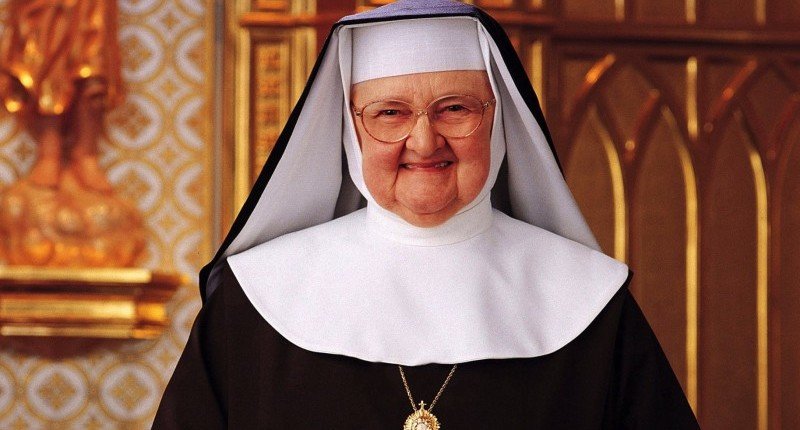
Mother Angelica, the founder of Eternal Word Television Network, Inc. (EWTN), died Easter Sunday; she was 92. An Ohio native, Mother Angelica founded EWTN in Irondale, right outside of Birmingham, Alabama, in 1981. A member of the Poor Clares of Perpetual Adoration, an order also founded in Irondale, Mother Angelica’s vision for a global Catholic network became a reality, with the station now offering 24-hour-a-day programming to more than 264 million homes in 144 countries, according to EWTN’s website. “Mother Angelica succeeded at a task the nation’s bishops themselves couldn’t achieve,” said EWTN board member and Archbishop Charles Chaput of Philadelphia. “She founded and grew a network that appealed to everyday Catholics, understood their needs and fed their spirits. She had a lot of help, obviously, but that was part of her genius.” Beyond building EWTN, many Catholics give credit to Mother Angelica for reviving the church in the United States. “Mother Angelica has been compared to a powerful medieval abbess, said Mark Brumley, president of the California-based Catholic publishing house, Ignatius Press. “But the mass-media instrument she created has extended her influence for the Gospel far beyond that of any medieval abbess, and even beyond that of many of the last century’s most prominent American bishops. Her long-term contribution is hard to assess, of course, but there is no doubt that Mother Angelica has helped root the Church in America more deeply in the Catholic Tradition; and at the same time, she has helped make the Church more innovative in how she communicates that tradition. All Catholics in America should thank God for Mother Angelica.” Shortly after retiring from EWTN in 2000, Mother Angelica suffered a stroke which left the charismatic and gregarious orator confined to Hanceville, Alabama’s, Shrine of the Most Blessed Sacrament, mostly without the capacity to speak. But members of her order, and those closest to her at the network say it may have been in those years she did her most impactful work. “While she was unable to speak at length and sound off on the controversies and confusions of the day, what she did through prayer in her suffering was remarkable,” said Raymond Arroyo, host of the network’s The World Over. “It’s certainly not our efforts that have kept EWTN on the air and allowed it to reach people in amazing ways. I attribute it all to the suffering of that one woman in Hanceville.” Many Catholics and non-Catholics alike took to Twitter Sunday evening in remembrance of Mother Angelica, including Congressman Robert Aderholt and State Rep. Jack Williams. RIP Mother Angelica. While she lived in the district I serve, her true home was living in her faith. @EWTN pic.twitter.com/EwM94T9OXu — Rep. Robert Aderholt (@Robert_Aderholt) March 28, 2016 Blessed to have known an incredible woman of faith, Mother Angelica. She no longer hurts – she is in the presence of the one she loved.#EWTN — Jack Williams (@repjack) March 28, 2016 #MotherAngelica made Catholicism something I actually wanted to do, and do it with my whole heart #SantaSubito pic.twitter.com/GOkOdp8hSw — Badger Catholic ن (@badgercatholic) March 28, 2016 RIP Mother Angelica, 92, EWTN founder: https://t.co/hFWts1l0bP #bham pic.twitter.com/VPyLLp9KoQ — Wade Kwon (@WadeOnTweets) March 28, 2016 Services honoring Mother Angelica’s life and mourning her death will be held beginning Monday, March 28th with a memorial Mass from the Shrine of the Most Blessed Sacrament at Our Lady of the Angels Monastery in Irondale, and concluding Friday, April 1st with a Mass of Christian Burial, Procession and Rite of Committal. Full details can be found here.
Ben Carson: Seventh-day Adventism is right for him
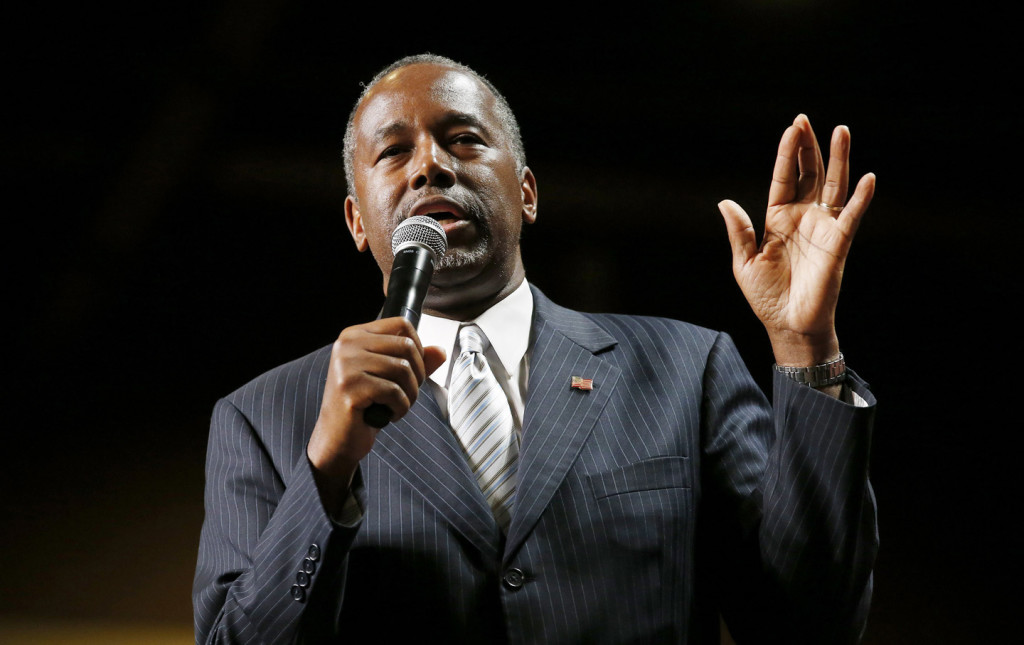
As his surge in heavily evangelical Iowa puts a spotlight on his faith, Republican presidential candidate Ben Carson is opening up about his membership in the Seventh-day Adventist Church. He embraces it as right for him while also framing his beliefs in broad terms that aim to transcend divisions among Christians. In an interview with The Associated Press, days after GOP rival Donald Trump criticized Carson’s church, the retired neurosurgeon said his relationship with God was “the most important aspect. It’s not really denomination specific.” Carson discussed a brief period as a college student when he questioned whether to stay in the church. And in his own criticism, he said it was a “huge mistake” that the top Adventist policymaking body recently voted against ordaining women. “I don’t see any reason why women can’t be ordained,” he said. The remarks from the Republican presidential candidate were his most expansive about his church since he joined the 2016 contest. Voters have come to know him for his faith-infused policy stands, including his opposition to abortion and gay marriage, without hearing much from him about his Adventism. The church, formed in 1863 in Battle Creek, Michigan, has a spiritual focus on healthy living and an extensive network of hospitals and medical clinics. Carson expressed pride in the denomination, while also trying to reach beyond it. “There are a lot of people who have a close relationship with God, and you can generally tell who they are by the way they act, the way they treat other people,” he said Wednesday a few hours before the GOP debate. “The reason that there are like 4,000 denominations is that people have looked at this and said, ‘Let’s interpret it this way. Let’s interpret it this way.’ “Sometimes they get caught up in that and forget about the real purpose of Christian faith,” he said. Trump has appeared to be trying to paint Carson as part of a faith outside the mainstream, not a religious conservative who shares the values of Iowa’s evangelicals. During a rally last Saturday in Florida, Trump noted he was a Presbyterian, calling his own church “middle of the road.” Then he added, “I mean, Seventh-day Adventist, I don’t know about.” A possible impetus for Trump’s new approach was a series of preference polls showing Carson overtaking him in Iowa, the lead-off caucus state where evangelical voters are crucial to success for Republicans. In 2012, Mitt Romney, a Mormon, won just 14 percent of Iowans who described themselves as born again or evangelical Christian, according to Iowa caucus exit polls, amid deep skepticism about his church and his politics. Carson told the AP he had “totally anticipated” that Trump and his supporters would try to stir doubts about his church in the primary contests. “Donald Trump is Donald Trump. It doesn’t surprise me that he’s doing that. I would only be surprised if he didn’t,” Carson said. “There’s a lot of things that are done in politics that are not fair, but when you get into the fray you have to expect those things.” The Seventh-day Adventist Church was born from what is known as the “Great Disappointment,” when Jesus failed to arrive in 1844 as expected by thousands of Christians in a moment of widespread religious fervor known as the Second Great Awakening. Many of these disheartened faithful, called Adventists for their belief in Christ’s imminent return, continued studying the Bible together and set Saturday as their Sabbath day of worship. Ellen White and her husband James were leaders in that movement and founded the Seventh-day Adventist Church. The denomination says it now has 18.7 million members worldwide, with 1.2 million in North America. For the small number of evangelicals who pay close attention to the church, their unease is focused in part on Ellen White, a prolific writer considered a prophet by Adventists, whose views continue to shape the denomination. Some pastors in the Southern Baptist Convention protested this year when Carson was invited to address their annual meeting. While the reasons for the objections were mixed, some cited the religious weight given to White’s opinions, even though Adventists, like other conservative Christians, consider only the Bible authoritative. “We caught wind of the controversy and just gracefully bowed out,” Carson said, shrugging off the episode. Carson is accustomed to misunderstandings about his church. “A lot of people would ascribe any weird thing they heard about anybody — they’d say, ‘That’s the Adventists,’” he said. His mother was an Adventist, and he was baptized into the church twice at his own request, because he felt he was too young the first time to grasp the significance. He has served as an elder, a religious teacher and as a star representative of the denomination around the world. Videos are plentiful online of Carson debating atheists, upholding Adventist teaching that God created the Earth in six days, and giving personal testimonies at churches. A twice-daily Bible reader, Carson said he still belongs to his longtime church in Spencerville, Maryland, and to another in Florida. If he’s on the road campaigning on a Saturday, he and his wife will try to find a local Adventist church or watch services online. In the interview, Carson revealed he went through a brief period of questioning as a Yale University student about whether Adventism was right for him. He said he was upset by segregation in the church. After trying out services at Roman Catholic, Methodist, Baptist and Lutheran churches, he ended up staying. “I concluded it was the right church, just the wrong people. The church was very segregated. You know, if you have the love of God in your heart, it seems like you wouldn’t do that. That has changed fairly significantly since that time,” Carson said. Traces of the anti-Catholic prejudice White expressed in her writings can still be found in Adventism. Carson rejects that bias. “I love Catholics. My best friend is Catholic. I have several honorary degrees from Catholic universities,”
For GOP candidates, better to be with pope than against him
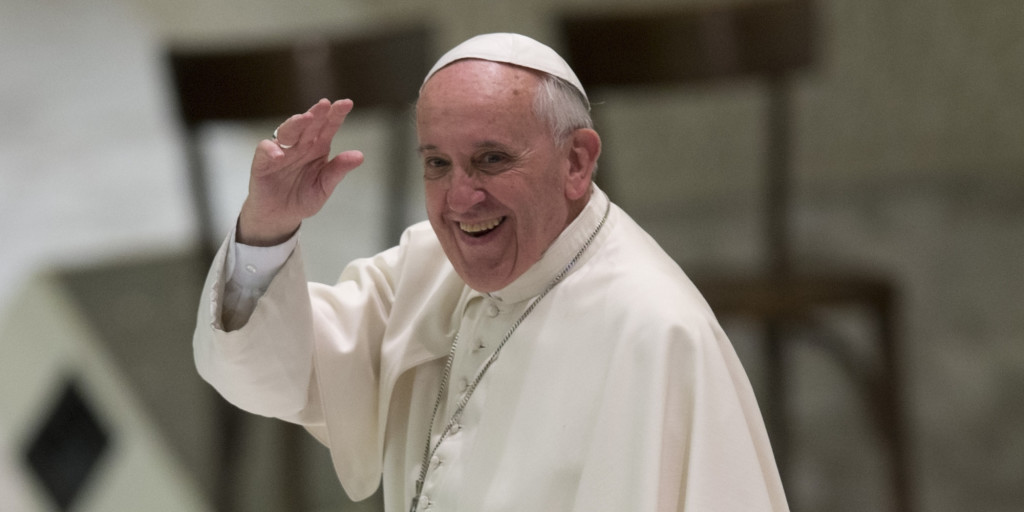
To some Republican presidential candidates, it’s better to be with the popular pope than against him. Marco Rubio, Rand Paul and Ted Cruz have deep policy differences with Pope Francis, but the senators will break off campaign travel to attend his address to Congress later this month, a centerpiece of his eagerly anticipated visit to the United States. Former Florida Gov. Jeb Bush, a devout Catholic, will attend Mass with Francis in Washington. New Jersey Gov. Chris Christie, another Catholic candidate, plans to attend one of the pope’s East Coast events. “Regardless of what the pope says or emphasizes, the simple fact of being associated with his visit is still significant for a candidate,” said David Campbell, a professor at the University of Notre Dame who studies religion and politics. “The images are very powerful.” Francis has become one of the world’s most popular figures since his 2013 election to the papacy, drawing praise for his humility and efforts to refocus the church on the poor and needy. He also has become involved in numerous hot-button political issues, often staking out positions that put him at odds with Republicans. The pope supports the Iran nuclear deal, which many GOP candidates pledge to tear up if they are elected president. As Republicans debate the place of immigrants in the U.S., the pope has urged countries to welcome those seeking refuge and has decried the “inhuman” conditions facing people crossing the U.S.-Mexico border. Francis was also instrumental in secret talks to restore diplomatic relations between the U.S. and Cuba, a rapprochement the GOP views as a premature reward for the island’s repressive government. In a heated primary where any break from party orthodoxy is a political risk, Republican candidates have stepped gingerly around their differences with Francis. When Francis issued an encyclical this year calling for aggressive international action to combat climate change, most Republicans made clear they had no problem with pope taking a position on the matter. But they suggested his stance would have little influence on their own views. “He is a moral authority and as a moral authority is reminding us of our obligation to be good caretakers of the planet,” Rubio, a practicing Catholic, said at the time. “I’m a political leader and my job as a policymaker is to act in the common good.” Bush, who was raised Episcopalian and converted to Catholicism as an adult, said it was best to leave climate change in the realm of politics, not religion. During a campaign stop Thursday in New Hampshire, Bush called the pope an “amazing man” and welcomed his emphasis on mercy and compassion. “I think he’s going to lift people’s spirits up,” Bush said about the pope’s visit to the U.S. “We’re in a time where there’s a lot of vulgarity and a lot of insults and a lot of just coarseness in our discourse. I’m not talking about politics, either. I’m talking about everyday life. “And here’s a man who comes with a gentle soul and I think it might be really healthy for our country to hear someone speak the way he does.” Not all GOP candidates plan to attend events with the pope. Among them are Wisconsin Gov. Scott Walker, whose spokeswoman said he didn’t expect to be in Washington during Francis’ visit, and Rick Santorum, the former Pennsylvania senator and devout Catholic, who was scheduled to be on a campaign trip to Iowa. American politicians have long struggled with how to balance their policy positions with the views of the Vatican. For Democrats, the focus has often been on the gulf between the party’s support for abortion rights and the church’s stern and contrary view. After John Kerry, a Catholic who backs abortion rights, captured the Democratic nomination in 2004, a top Vatican official issued a statement saying priests must deny Communion to politicians who hold that position. Francis has taken a more conciliatory tone on abortion, as well as homosexuality, but hasn’t changed church doctrine. President George W. Bush found himself at odds with the Vatican over the Iraq war. Both Pope John Paul II and his successor Benedict XVI vehemently opposed the war, yet each met Bush during their tenure. Charles Camosy, a theology professor at Fordham University, said that in interactions between politicians and popes, “politics is put aside and there’s respect shown.” Still, the timing of the pope’s visit — in the heart of fall primary campaigning — and his own schedule will make politics difficult to avoid. Francis will hold an Oval Office meeting Sept. 23 with President Barack Obama, who has highlighted areas where his agenda overlaps with the pope’s priorities, including income inequality. The pope will speak the following day on Capitol Hill, where at least some of the focus will be on the reaction to his remarks from the presidential candidates sitting in the audience. The pope’s message in Washington is expected to touch on some of the issues that are sources of disagreement with Republicans, though it’s unlikely he will insert himself directly into presidential politics. Still, as Campbell, the Notre Dame professor, noted, “One thing we’ve learned about Pope Francis is that he’s very unpredictable.” Republished with permission of the Associated Press.
