
Donald Trump vilifies illegal immigrant caravan, says he’ll cut Central American aid
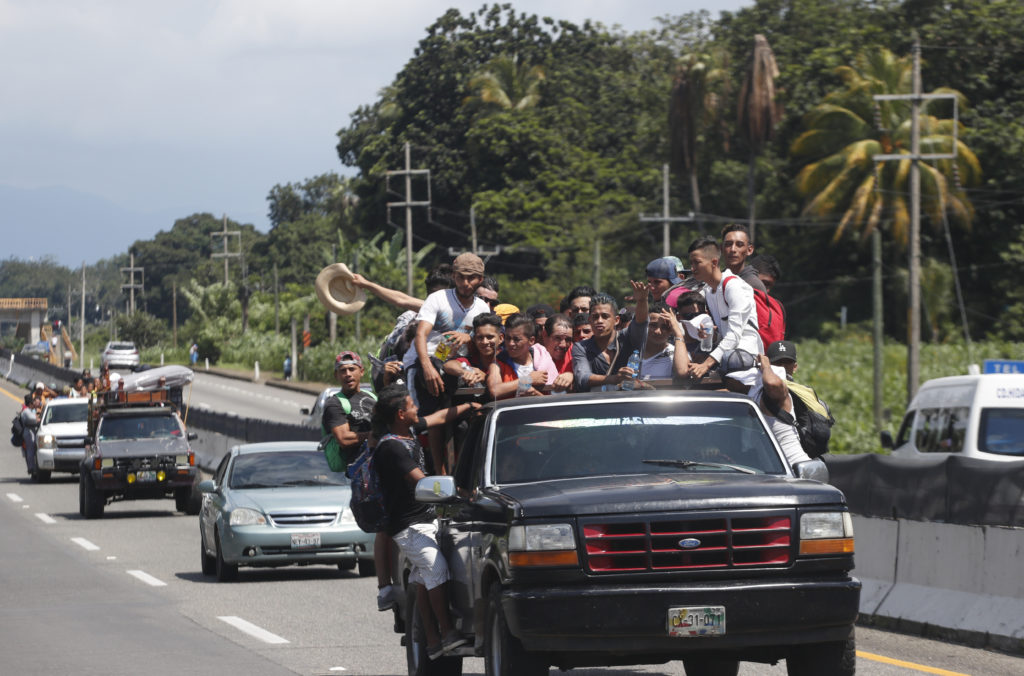
President Donald Trump says the U.S. will begin cutting aid to three Central American countries he accused of failing to stop thousands of migrants heading for the U.S. border. But across his administration there was no indication of any action in response to what he tweeted was a “National Emergy.” For hours on Monday, White House officials were unable to provide an explanation for the president’s threats, which reflected both his apparent frustration with the migrant caravan and his determination to transform it into Republican election gains. Federal agencies said they’d received no guidance on the president’s declaration, issued as he attempts to make illegal immigration a focus of next month’s midterm elections. If Trump should follow through with his threat to end or greatly reduce U.S. aid, that could worsen the poverty and violence that are a root cause of the migration he has been railing against, critics said. Trump tweeted, “Sadly, it looks like Mexico’s Police and Military are unable to stop the Caravan heading to the Southern Border of the United States.” He added without evidence that “criminals and unknown Middle Easterners are mixed in.” “I have alerted Border Patrol and Military that this is a National Emergy,” he wrote. “Must change laws!” Associated Press journalists traveling with the caravan for more than a week have spoken with Hondurans, Guatemalans and Salvadorans but have not met any of the “Middle Easterners” that Trump claimed had “mixed in” with the Central American migrants. It was clear, though, that more migrants were continuing to join the caravan. Trump’s tweets marked the latest escalation of his efforts to thrust immigration politics into the national conversation in the closing weeks of the congressional elections. He and his senior aides have long believed the issue — which was a centerpiece of his winning presidential campaign — is key to revving up his base and motivating GOP voters to turn out in November. “Blame the Democrats,” he wrote. “Remember the midterms.” At a campaign rally in Houston on Monday night, he falsely accused Democrats of “encouraging millions of illegal aliens to break our laws, violate our borders and overwhelm our nation.” Trump for months has sought to use foreign aid as a cudgel more broadly, threatening to withhold humanitarian and other aid from “enemies of America” and using it to pressure foreign governments to bend to his will. On Monday, he said he would be making good on his threat. “Guatemala, Honduras and El Salvador were not able to do the job of stopping people from leaving their country and coming illegally to the U.S. We will now begin cutting off, or substantially reducing, the massive foreign aid routinely given to them,” he wrote. He added later at the White House: “We have been giving so much money to so many different countries for so long that it’s not fair and it’s not good. And then when we ask them to keep their people in their country, they’re unable to do it.” However, it was unclear whether the president’s tweets had any policy implications. A Pentagon spokesman, Army Lt. Col. Jamie Davis, said the Pentagon had received no new orders to provide troops for border security. And a State Department official said the agency had not been given any instructions on eliminating or reducing aid to Central American countries. Last April, Defense Secretary James Mattis authorized up to 4,000 members of the National Guard to help the Department of Homeland Security with southern border security, and approximately 2,100 were sent under the control of border state governors. That number, Davis said, has not changed. The Pentagon also said it was going ahead with plans to include Honduras among the South American nations that will be visited this fall by the USNS Comfort, a hospital ship that Mattis has dispatched to help relieve stress on medical care systems as a result of refugees from Venezuela. The Comfort began treating patients in Ecuador on Monday and is scheduled to make stops in Peru, Colombia and Honduras, according to Pentagon spokesman Col. Rob Manning. “The deployment reflects the United States’ enduring promise of friendship, partnership and solidarity with the Americas,” Manning said. Asked what the administration was doing to operationalize the president’s tweet, White House spokeswoman Sarah Huckabee Sanders told reporters Monday evening that “we’re continuing to look at all options on the table.” “The president wants to make sure we’re doing everything we can to secure and protect our borders and that’s exactly what he’s been talking about,” she said. It is Congress, not the president, that appropriates aid money. The White House would have to notify Congress if it wanted to cut or reallocate aid, which could delay or complicate the process. Rep. Eliot Engel, the top-ranking Democrat on the House Foreign Affairs Committee, said Monday that “my colleagues and I will not stand idly by as this administration ignores congressional intent.” The three countries received about $500 million from the U.S. in fiscal year 2017. That money funds programs that promote economic development and education, as well as supporting democracy and human rights, among other issues. It was not immediately clear how much money Trump now hopes to cut, though the administration already had been pushing to reduce the government’s global aid and foreign operations budget by about 30 percent for fiscal 2019 that began Oct 1. Paul O’Brien, the vice president for policy and advocacy at Oxfam America, said that any attempts to decrease aid to the Central American countries would be “devastating” since the U.S. is a key investor in the region, funding programs on issues ranging from workforce development to reducing violence and improving human rights. In addition, other investors look to the U.S. as a guide. “If you take that money away or you make it unpredictable, you’re actually going to foster the very conditions that are driving people toward migration,” said O’Brien, who accused Trump of “essentially seeking to use migrants as a political chip.” Republished with
Trump administration moves to detain migrant families longer
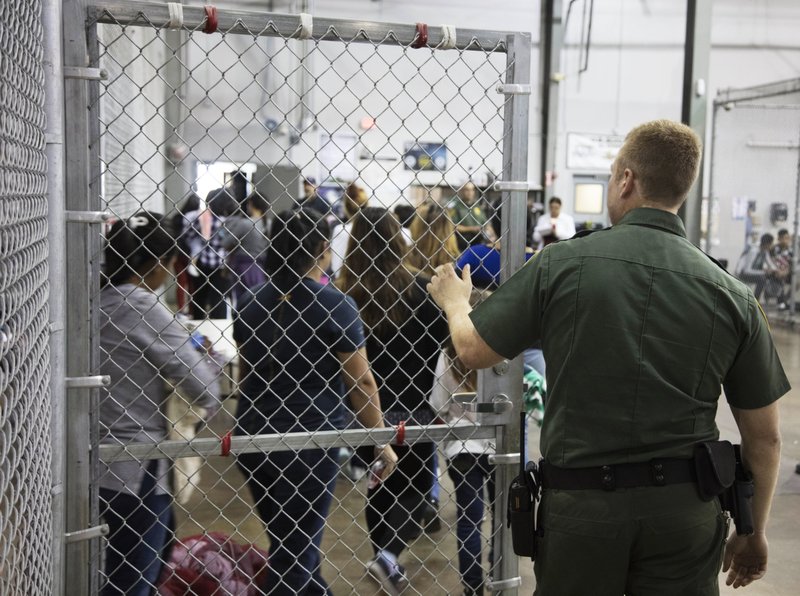
The Trump administration on Thursday moved to abandon a longstanding court settlement that limits how long immigrant children can be kept locked up, proposing new regulations that would allow the government to detain families until their immigration cases are decided. Homeland Security officials said that ending the so-called Flores agreement of 1997 will speed up the handling of asylum requests while also deterring people from illegally crossing the Mexican border. The move angered immigrant rights advocates and is all but certain to trigger a court battle. “It is sickening to see the United States government looking for ways to jail more children for longer,” said Omar Jadwat, director of the ACLU’s Immigrants’ Rights Project. “And it’s yet another example of the Trump administration’s hostility toward immigrants resulting in a policy incompatible with the most basic human values.” Vehicles leave the Port Isabel Detention Center, June 26, 2018, which holds detainees of the U.S. Immigration and Customs Enforcement in Los Fresnos, Texas. [Photo Credit: AP Photo/David J. Phillip, file] The Flores agreement requires the government to keep children in the least restrictive setting possible and to release them generally after 20 days in detention. For decades, because of those restrictions, many parents and children caught trying to slip into the country have been released into the U.S. while their asylum requests wind their way through the courts — a practice President Donald Trump has decried as “catch-and-release.” Such cases can drag on for years, and some immigrants stop showing up to court when it becomes clear their asylum requests are going to be denied. The newly proposed rules would allow the government to hold families in detention until their cases are completed. Homeland Security did not say how long it expects families to be kept locked up. But immigration officials say asylum cases involving detained families move much more quickly, taking months instead of years to resolve, in part because there are none of the delays that result when immigrants set free in the U.S. fail to show up for a hearing. “Today, legal loopholes significantly hinder the department’s ability to appropriately detain and promptly remove family units that have no legal basis to remain in the country,” said Homeland Security Secretary Kirstjen Nielsen. “This rule addresses one of the primary pull factors for illegal immigration and allows the federal government to enforce immigration laws as passed by Congress.” Earlier this summer, a federal judge in California rejected a request by the administration to modify Flores to allow for longer family detention. Administration officials say they have the authority to terminate the agreement, but that is likely to be tested in court. “They’re essentially trying to accomplish through regulation what the court has not permitted,” said Peter Schey, an attorney representing immigrant children under the settlement and president of the Center for Human Rights and Constitutional Law. Schey said he will oppose any effort to end Flores unless the government proposes acceptable regulations for the safe and humane treatment of youngsters. “Refugee children should not be made to suffer inhumane treatment and prolonged and unnecessary detention just to satisfy President Trump’s zero-tolerance approach to refugees seeking safety in the United States from the violence and lawlessness spreading throughout Central America,” Schey said. The Flores agreement became an issue last spring when the Trump administration adopted a policy of prosecuting anyone caught crossing illegally. More than 2,900 children were separated from their parents, prompting international outrage. Trump eventually backed down and stopped the separation of families. A federal judge ordered parents and children reunited; the government has said it has done so in as many cases as it could. But hundreds of parents were deported without their children, while others had criminal records or were not parents as they claimed to be, officials said. Because under Flores children cannot be kept in criminal custody with their parents or held for an extended period in immigration detention, the administration has limited options when dealing with families. The government operates three family detention centers that can hold a total of about 3,000 people, and they are at or near capacity. Homeland Security and the Pentagon have been working to line up as many as 12,000 beds for family members at Fort Bliss in El Paso, Texas. Another request for up to 20,000 beds for youngsters who arrive without parents is also pending. The ACLU’s Jadwat accused the administration of “trying to expand the trauma it is inflicting on these children in order to deter other people from coming to the country.” Rachel Prandini, staff attorney at the Immigrant Legal Resource Center, said the erosion of Flores’ protections would subject children to worsening conditions. “The Trump administration’s decision to exacerbate the suffering of kids, by imposing the cruel policy of family separation earlier this summer and now with this rule change to vastly expand detention of children, is horrifying,” she said. The regulations will be published in the Federal Register and will be subject to a 60-day public comment period starting Friday. Republished with the permission of the Associated Press.
VP Mike Pence tells Central America to do more to stop migrants

U.S. Vice President Mike Pence told the leaders of three Central American nations Thursday that they must do more to stop the flow of migrants who enter the United States illegally. He made the comments to the presidents of Guatemala, Honduras and El Salvador, where economic struggles and violent crime have pushed many people to try to sneak into the U.S. in hopes of finding better lives. “This exodus must end,” Pence said. “It is a threat to the security to the United States, and just as we respect your borders and your sovereignty, we insist that you respect ours.” He said the Trump administration “will always welcome” immigrants who follow the rules in getting permission to enter the U.S. “In the last year alone, we welcomed more than 1.1 million legal immigrants into our country and our communities, including nearly 50,000 legal immigrants from Guatemala, Honduras and El Salvador last year,” he said. But, Pence added, the U.S. is determined to act strongly against those who don’t. “Tell your people that coming to the United States illegally will only result in a hard journey and a harder life,” Pence said. He spoke after discussing immigration issues with Presidents Jimmy Morales of Guatemala, Salvador Sanchez Ceren of El Salvador and Juan Orlando Hernandez of Honduras. Referring to the U.S. policies that led to the separation of more than 2,000 children from their parents, many of them from Central America, Pence noted President Donald Trump has reversed that approach. Sanchez Ceren of El Salvador said one of his ministers had confirmed that the minors in the shelters had their basic needs covered, but he emphasized that “it’s vital for their psychological health and their emotional health to reunite them immediately with their families.” Earlier in the day, Pence was in Ecuador, whose leader he praised for improving relations with the U.S. He also urged President Lenin Moreno to hold a firm line against neighboring Venezuela, which has been crumbling in economic and political crisis. “The Ecuadorean people have shown remarkable compassion,” Pence said, noting that 350,000 Venezuelans have fled to Ecuador, a country of a little more than 16 million people. “We must all take strong action to restore democracy in Venezuela.” Moreno said a solution to the Venezuela’s crisis is ultimately up to its own people, but added that he and Pence agreed to work together in coordination with the Organization of American States to promote citizen rights and fundamental freedoms throughout Latin America. Winning back trade privileges rejected by Ecuador’s former president, Rafael Correa, were a central part of the talks for Moreno. He was elected last year with Correa’s backing but has since broken with his mentor in adopting a more business- and press-friendly stance that has earned him bipartisan praise in Washington as something of a bridge builder in ideologically polarized Latin America. Pence said relations have improved under Moreno’s leadership and noted their shared fight against international drug traffickers. He credited the new president with reversing a decade of failed policy and rooting out corruption. During their private meeting, Pence raised the issue of Julian Assange, the WikiLeaks founder who Ecuador has granted asylum, U.S. officials said. Assange, whose leak of classified U.S. documents infuriated U.S. government officials, has been a sticking point between the two nations. He has been living under asylum inside the Ecuadorean Embassy in London since 2012. Pence and Moreno did not mention Assange in their public comments. Republished with permission from the Associated Press.
