
Thousands of demonstrators across U.S. say ‘Not My President’

Thousands of demonstrators turned out Monday across the U.S. to challenge Donald Trump in a Presidents Day protest dubbed Not My President’s Day. The events on the federal holiday didn’t draw nearly as many people as the million-plus who thronged the streets following the Republican president’s inauguration a month earlier, but the message was similar. Thousands of flag-waving protesters lined up outside Central Park in Manhattan. Many in the crowd chanted “No ban, no wall. The Trump regime has got to fall.” They held aloft signs saying “Uphold the Constitution Now” and “Impeach the Liar.” A rally in downtown Los Angeles also drew thousands. Demonstrators there called attention to Trump’s crackdown on immigration and his party’s response to climate change and the environment. Organizers said they chose to rally on the holiday as a way to honor past presidents by exercising their constitutional right to assemble and peacefully protest. In Chicago, several hundred rallied across the river from the Trump Tower, shouting “Hey, hey, ho, ho, Donald Trump has got to go.” Rebecca Wolfram of Chicago, who’s in her 60s, said concerns about climate change and immigrant rights under Trump prompted her to start attending rallies. “I’m trying to demonstrate as much as possible until I figure out what else to do,” said Wolfram, who held a sign that said “Old white ladies are really displeased.” Several hundred demonstrated in Washington, D.C. Dozens gathered around the fountain in Dupont Circle chanting “Dump Trump” and “Love, not hate: That’s what makes America great.” Dozens marched through midtown Atlanta for a rally named with a Georgia flavor: “ImPEACH NOW! (Not My) President’s Day March.” Hundreds of protesters chanting “This is what democracy looks like” marched through Salt Lake City. The Salt Lake Tribune reports that the crowd marched to push back against Trump and his administration’s stance on such issues as the environment, immigration, free speech and Russia. Some people raised signs that said “Not My President,” while others held up a large American flag. Protester Reg Brookings warned the crowd that Trump is trying to divide the country by making such groups as immigrants the enemy. A small but unruly group of protesters faced off with police in downtown Portland, Oregon. The Oregonian/OregonLive reports the police confronted the crowd in front of the Edith Green-Wendell Wyatt Federal Building. Police took some people into custody. Hundreds of Trump opponents and supporters turned out in Rapid City, South Dakota. A larger anti-Trump faction stood on a street corner as part of a “Not My President” protest, similar to other demonstrations being held across the country. A group supporting the president lined up on a different corner at the same intersection. Republished with permission of The Associated Press.
Trademarked: Donald Trump makes money off the name ‘Central Park’
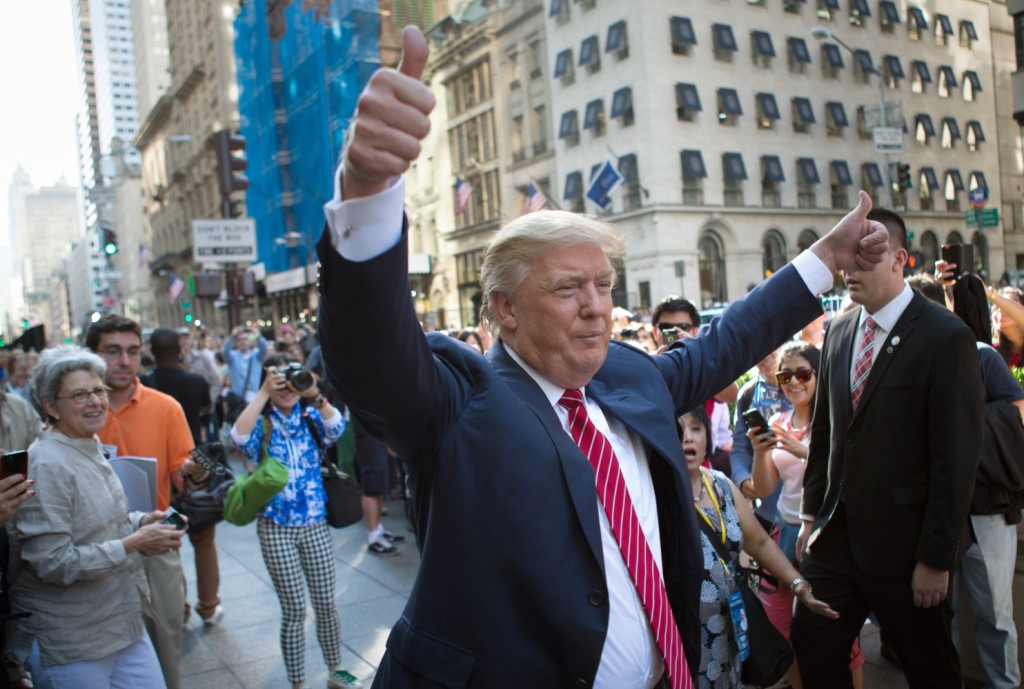
Donald Trump is arguably New York City’s most famous resident, and he’s made some of his money off the name of one of the city’s most famous public landmarks: Central Park. The leading Republican presidential candidate first applied for a trademark to use the words “Central Park” on merchandise more than two decades ago, when the park had a far less glamorous reputation than it does today. Since then, Trump has used the nonexclusive trademark to brand furniture, chandeliers, pillows and even key chains. A Trump spokesman declined to say how much Trump has earned from the trademark, but noted the developer’s deep connections to the park. Trump once owned the Plaza Hotel along Central Park South, operates a skyscraper hotel overlooking the park and famously renovated the park’s once-downtrodden ice rink. “Mr. Trump, over the course of his career, has owned and developed some of the most iconic buildings in the city, many of which … sit only footsteps away from Central Park,” said Alan Garten, executive vice president and general counsel to The Trump Organization. Since it is a public space, no one can put an exclusive trademark on the words “Central Park.” But, as first reported by cable news channel NY1, records show that Trump is the single biggest private, for-profit holder of Central Park trademarks on specific goods. It was undeniably a savvy move. His first application came in 1991, when the city’s violent crime rate was near its height and the park often conjured up fears of urban danger. There were 2,154 murders in the city that year, as opposed to 328 last year, and 1991 was just two years removed from the Central Park jogger case in which a woman was attacked and raped while running through the park. According to the records kept by the U.S. Patent and Trademark Office, Trump first received permission to use Central Park for parking garage services, and later expanded the trademark as the park became synonymous with the high-priced real estate that surrounds it in a safer, more affluent New York. A 2007 trademark allowed him to put the park’s name on dozens of Trump-branded furniture and lighting options. Beds, tables, desks, lamps, flashlights, picture frames and throw pillows all bore the names “Central Park” and “Donald Trump.” A glossy, 44-page furniture catalog boasted photos of the “elegant and rich” furnishings with stylized shots of the park and Trump. Many of Trump’s Central Park products are not currently in production, but they can be found in some discount stores and gift shops. The park isn’t the only New York-area landmark on which Trump has filed a trademark. He owns one for “Westchester,” the county north of the city, that was the namesake of a furniture line, and one for “Fifth Avenue,” to label items within his casino business. Trademark experts say it’s difficult to precisely gauge how much a name is worth. “The question would be, how much more likely is someone to buy something called ‘Central Park’ over the name of some other landmark?” said June Besek, a Columbia Law School professor with an expertise on intellectual property issues. “But if people have a positive association with ‘Central Park’ — or a positive association with simply ‘Trump’ — that would clearly be worth something.” The park is jointly operated by the city and the private Central Park Conservancy. Neither has any ability to revoke a trademark from Trump or any other owner. The nonprofit conservancy sells items such as sweat shirts and snow globes, which, unlike Trump’s products, can carry the official park logo. “Nobody has ownership of the words ‘Central Park.’ It is a public space, with a city-owned logo,” said Monica Klein, a spokeswoman for Mayor Bill de Blasio. “When individuals or companies attempt to infringe on city-owned trademarks, we take appropriate legal actions.” The city owns the rights to more than 200 trademarks and stepped up its efforts to acquire new ones and protect existing ones, including the city’s police and fire departments, after demand for their merchandise grew dramatically after the Sept. 11 attacks. When Trump launched his presidential campaign in June with a speech in which he said Mexican immigrants were “bringing drugs” and were “rapists,” the city reviewed millions of dollars’ worth of contracts it has with him, including for a golf course and skating rinks, but found no legal way to cancel them. De Blasio, a Democrat, has said he wouldn’t do any new business with Trump. Republished with permission of the Associated Press.
